"0341a2901a4ae9aa"{"id":"1000130","slug":"planet-venus-landscape","title":"Planet Venus Landscape","category":"Forest \u0026 Jungle","engine":"4.19+,5.0+","assetVersion":"","engineVersion":"Engine Version: 4.19+,5.0+","tag":"Forest \u0026 Jungle","accent":"blue","visual":"city","summary":"Planet Venus Landscape centers on a master material with procedural alpha blending, 7 landscape layers, lava functions, hot air effects, and cliff generation.","platform":"Unreal Engine","publishedAt":"2026-06-11T10:35:26.548Z","updatedAt":"2026-10-13T07:14:13.399Z","sourceNotes":[],"fileContents":[],"compatibility":["Unreal Engine","Engine Version: 4.19+,5.0+"],"featuredImage":{"alt":"Planet Venus Landscape","src":"/wp-content/uploads/published/2026/06/ba8789bde822-96274faf-5e78-4564-b0bd-c394454a7fd8-e6272aa62e.webp"},"hasDownloadLink":true,"downloads":0,"terms":[{"taxonomy":"category","slug":"forest-and-jungle","name":"Forest \u0026 Jungle"}],"galleryImages":[{"src":"/wp-content/uploads/published/2026/06/2442e23d7611-4e2d3486-0acd-4643-830a-fe7fe517cf0b-8c81b645f8.webp","alt":"Planet Venus Landscape"},{"src":"/wp-content/uploads/published/2026/06/b27ecf755e5a-b915a10d-64c8-4a2e-acca-df7d62306aae-25dc0c5a70.webp","alt":"Planet Venus Landscape"},{"src":"/wp-content/uploads/published/2026/06/f20675f053cd-54bbef64-d0af-4ade-85bf-7788566758d1-05adf4fa3b.webp","alt":"Planet Venus Landscape"},{"src":"/wp-content/uploads/published/2026/06/8e77d652ae17-ca477c4c-7ca3-4871-805d-81cb3aaf4e29-a5143174b2.webp","alt":"Planet Venus Landscape"},{"src":"/wp-content/uploads/published/2026/06/1150fa0b9040-44f51538-2af3-41de-a185-74a29a2407e0-8093724239.webp","alt":"Planet Venus Landscape"}],"accessPanel":{"kind":"resource","title":"Download this resource","eyebrow":"Free Download","message":"Log in or create a free account to start your download.","fileName":"Content.7z","safetyNote":"Resources are manually reviewed before listing to improve quality and reduce obvious risks.","actionLabel":"Download Free","resourceType":"Resource archive"},"contentHtml":"\u003cp\u003ePlanet Venus Landscape is driven by an advanced landscape master material and a set of supporting material systems that shape the environment through procedural behavior instead of hand painting. The package approaches surface construction as a layered material problem, then extends that same logic into lava, cliffs, atmospheric distortion, and random lightening placement. Rather than treating these as disconnected extras, the resource ties them into a single Venus-themed landscape workflow.\u003c/p\u003e \u003cp\u003eThe package then offers a concept focused on implementation as much as appearance. Surface texturing, lava treatment, and cliff handling each have their own dedicated logic, which gives the environment its identity through material response rather than through repeated manual edits. That makes the package especially notable for projects that want a stylized or alien terrain setup with strong control over how the terrain resolves across the landscape.\u003c/p\u003e \u003ch2\u003eAdvanced landscape master material\u003c/h2\u003e\n\u003cp\u003eAt the heart of Planet Venus Landscape is the master material. This is the main system that drives the terrain, and it is advanced for good reason: it does more than assign a static look to the ground. It establishes a procedural framework that controls how the landscape is textured, how layers interact, and how variation is introduced without relying on direct painting across the terrain.\u003c/p\u003e \u003cp\u003eThat matters in practice because a master material becomes the place where broad environmental decisions are made. In this case, the terrain is not locked into a single repeated surface treatment. Instead, it uses a procedural alpha blending method that removes the need for painting. The workflow shifts from manually placing terrain textures by hand to creating or choosing the alpha information that determines how the landscape resolves. The creative emphasis moves toward shaping masks and blending behavior, which opens up a more system-driven way to define the final look.\u003c/p\u003e \u003cp\u003eThe customization angle is one of the clearest strengths here. The material is set up to allow a unique result based on the alpha that is created. That means the visual identity of the terrain is not just inherited from a fixed material arrangement. It can be altered through the alpha-driven logic that controls where and how different surface layers appear. For artists who prefer procedural control over repetitive manual painting, that is the core promise of the resource.\u003c/p\u003e \u003ch2\u003eProcedural alpha blending and the 7-layer terrain setup\u003c/h2\u003e\n\u003cp\u003eThe landscape texturing method is based on procedural alpha blending, and the source details explain how the layer structure supports that process. Six layers are used to create a randomized natural appearance. This is a very specific design choice: the surface is not built from one or two broad material zones, but from multiple interacting layers that help break up repetition and keep the terrain from feeling uniform.\u003c/p\u003e \u003cp\u003eThose six layers are not presented as arbitrary complexity. They serve a visual goal, which is to produce a more natural randomized result across the terrain. In a Venus concept, where the surface likely needs to feel unstable, harsh, and visually varied, a layered structure like this can carry much of the environmental character. The randomization comes from the way the layers blend rather than from painted patches, keeping the landscape generation aligned with the procedural approach established by the master material.\u003c/p\u003e \u003cp\u003eA seventh layer is included for a more technical purpose. It compensates for background texture tiling using pixel depth. This extra layer is important because it shows that the setup is not only about adding visible variety in the foreground. It also addresses a common terrain problem: repeated background patterns that can break the scale or illusion of a larger environment. By using pixel depth as part of the solution, the system treats distance-based visual behavior as part of the material design.\u003c/p\u003e \u003cp\u003eTogether, the seven layers define the main terrain workflow. Six layers contribute to the randomized natural appearance, while the seventh helps control the way background texture repetition is perceived. That division gives the material system both an aesthetic role and a corrective role. One side builds the look; the other helps preserve it across broader views of the landscape.\u003c/p\u003e \u003ch2\u003eLava system material functions and hot air effect\u003c/h2\u003e\n\u003cp\u003ePlanet Venus Landscape does not stop at ground texturing. It also includes two material functions created specifically for the lava system. These functions expand the environment beyond static surface treatment and introduce a separate procedural behavior for one of the most distinctive elements in the scene.\u003c/p\u003e \u003cp\u003eThe lava functions cover procedural distribution, emissive color and intensity, and a gentle lava flow that is separate from the main material. Each of those points matters. Procedural distribution means the lava is not handled as a single flat effect applied in the same way everywhere. Emissive color and intensity provide direct control over how strongly the lava reads within the scene. The gentle flow adds motion-like behavior while remaining distinct from the main terrain material, which helps preserve clarity between the landscape base and the lava layer.\u003c/p\u003e \u003cp\u003eThis separation is especially useful from a setup standpoint. Keeping the lava flow apart from the main material suggests a cleaner division of responsibilities inside the overall material structure. The terrain can focus on layered surface formation, while the lava functions manage their own distribution and appearance logic. That allows the lava to act as a specialized visual system instead of just another color variation on the ground.\u003c/p\u003e \u003cp\u003eA dedicated post process material is also included to create a hot air effect for the lava. This extends the lava treatment beyond the surface itself and into the surrounding atmosphere. The effect supports the idea that the lava should influence nearby visual space rather than sit passively in the environment. In use, it gives the volcanic or superheated parts of the landscape an added sense of intensity without needing to change the main landscape material for that purpose.\u003c/p\u003e \u003ch2\u003eAutomatic cliff generation with slope function blending\u003c/h2\u003e\n\u003cp\u003eThe Venus master material also features a new automatic cliff generation system based on a slope function. This is one of the most directly terrain-aware parts of the package because it responds to the shape of the landscape rather than only to a layer mask. Cliffs are not handled as isolated manually painted regions. They are generated through slope-based logic, which makes terrain angle an active part of how the environment is formed.\u003c/p\u003e \u003cp\u003eThe cliff system includes alpha-based blending specific to cliffs. That is an important distinction because it means the package does not treat all surface transitions the same way. General terrain blending and cliff blending are not collapsed into a single universal behavior. Cliffs receive their own alpha-based treatment, which helps them read as a particular terrain condition with its own visual rules.\u003c/p\u003e \u003cp\u003eFrom a creative usage standpoint, this can help the environment maintain stronger separation between flatter surface regions and steeper formations. In a Venus-themed landscape, those transitions can carry much of the scene’s drama. A slope-driven cliff system makes the terrain react structurally, not just cosmetically, and the cliff-specific blending keeps those regions from feeling like a simple texture swap.\u003c/p\u003e \u003ch2\u003eRandom positioning system for lightening\u003c/h2\u003e\n\u003cp\u003eAnother prepared material in the package uses a random positioning system for lightening. While this is a smaller detail compared with the master material and lava functions, it adds another layer of procedural variation to the scene. The wording points to a placement system rather than a static, fixed effect, which keeps the overall package consistent with its broader procedural mindset.\u003c/p\u003e \u003cp\u003eThis detail fits naturally alongside the rest of the resource. The terrain uses procedural alpha blending, the lava has its own procedural distribution, cliffs are generated from slope behavior, and lightening is also given a random positioning system. The package repeatedly approaches environment building through controlled automation instead of relying on manual placement for every major visual element.\u003c/p\u003e \u003ch2\u003eWhere Planet Venus Landscape fits in production\u003c/h2\u003e\n\u003cp\u003ePlanet Venus Landscape is set up for projects that need a highly stylized planetary terrain with material-driven control over surface variation, cliff formation, and lava treatment. Its strongest identity comes from how these systems interact. The landscape itself is layered procedurally, the background tiling issue is handled through a dedicated seventh layer using pixel depth, lava is given its own functions for distribution and emissive behavior, and the surrounding heat is reinforced with a post process material.\u003c/p\u003e \u003cp\u003eThis creates a workflow that is less about painting terrain by hand and more about shaping the behavior of the material systems. The environment can be pushed toward a unique look through the alpha created for blending, while still retaining specialized logic for cliffs, lava flow, and lightening placement. For a Venus concept, that combination gives the package a clear practical role: it is prepared to handle a harsh alien landscape through layered procedural texturing and focused environmental effects rather than through a basic static terrain material.\u003c/p\u003e\n\n\u003ch2\u003eRelated Resources Worth Checking\u003c/h2\u003e\n\u003cul\u003e\n\u003cli\u003e\u003ca href=\"https://3dcghub.com/dreamscape-stylized-environment-mountains-stylized-nature-open-world-fantasy/\" title=\"Dreamscape: Stylized Environment Mountains - Stylized Nature Open World Fantasy\"\u003eDreamscape: Stylized Environment Mountains - Stylized Nature Open World Fantasy\u003c/a\u003e\u003c/li\u003e\n\u003cli\u003e\u003ca href=\"https://3dcghub.com/brushify-tropical-pack/\" title=\"Brushify - Tropical Pack\"\u003eBrushify - Tropical Pack\u003c/a\u003e\u003c/li\u003e\n\u003cli\u003e\u003ca href=\"https://3dcghub.com/stylized-summer-forest/\" title=\"Stylized Summer Forest\"\u003eStylized Summer Forest\u003c/a\u003e\u003c/li\u003e\n\u003cli\u003e\u003ca href=\"https://3dcghub.com/stylescape-stylized-environment-kit/\" title=\"Stylescape: Stylized Environment Kit\"\u003eStylescape: Stylized Environment Kit\u003c/a\u003e\u003c/li\u003e\n\u003cli\u003e\u003ca href=\"https://3dcghub.com/survival-interactable-procedural-nature-ecosystem/\" title=\"Survival Interactable Procedural Nature Ecosystem\"\u003eSurvival Interactable Procedural Nature Ecosystem\u003c/a\u003e\u003c/li\u003e\n\u003c/ul\u003e","contentTextLength":9727,"navigation":{"current":456,"total":4017,"previous":{"id":"1001647","slug":"mega-sci-fi-city-package","title":"Mega Sci-Fi City Package","category":"Sci-Fi","platform":"Unreal Engine","updatedAt":"2026-10-13T08:23:28.893Z"},"next":{"id":"1001646","slug":"graveyard-and-nature-set","title":"Graveyard and Nature Set","category":"Buildings \u0026 Architecture","platform":"Unreal Engine","updatedAt":"2026-10-13T02:30:35.472Z"}},"relatedResources":[{"id":"1001718","slug":"alien-planet-fantasy-environment-grassland-plants","title":"Alien Planet Fantasy Environment - Grassland Plants","category":"Forest \u0026 Jungle","engine":"4.26+,5.0+","assetVersion":"","engineVersion":"Engine Version: 4.26+,5.0+","tag":"Forest \u0026 Jungle","accent":"blue","visual":"city","summary":"A technical breakdown of the Alien Planet Fantasy Environment asset pack, detailing its interactive foliage physics, World Creator landscape, and audio.","platform":"Unreal Engine","publishedAt":"2026-10-19T15:50:53.489Z","updatedAt":"2026-10-19T15:50:53.489Z","sourceNotes":[],"fileContents":[],"compatibility":["Unreal Engine","Engine Version: 4.26+,5.0+"],"featuredImage":{"alt":"Alien Planet Fantasy Environment - Grassland Plants","src":"/wp-content/uploads/published/2026/10/9a28e0fe65b3-a4a97ffe-1de3-44ae-b9e6-b0202052018b-e9621ed93a.webp"},"hasDownloadLink":true,"downloads":0},{"id":"1001735","slug":"lowpoly-style-woodlands-pack","title":"Lowpoly Style Woodlands Pack","category":"Forest \u0026 Jungle","engine":"4.26+,5.0+","assetVersion":"","engineVersion":"Engine Version: 4.26+,5.0+","tag":"Forest \u0026 Jungle","accent":"blue","visual":"mech","summary":"Construct stylized alpine landscapes and woodland camps using the Lowpoly Style Woodlands Pack, featuring unified material batching and modular nature assets.","platform":"Unreal Engine","publishedAt":"2026-10-20T02:40:02.803Z","updatedAt":"2026-10-20T02:40:02.803Z","sourceNotes":[],"fileContents":[],"compatibility":["Unreal Engine","Engine Version: 4.26+,5.0+"],"featuredImage":{"alt":"Lowpoly Style Woodlands Pack","src":"/wp-content/uploads/published/2026/10/066b0cf4ab99-f8e12b2e-0c2b-4e5d-9ccd-60d3246ca57a-d7f06bb336.webp"},"hasDownloadLink":true,"downloads":0},{"id":"1001668","slug":"stylized-forest-cave","title":"Stylized Forest Cave","category":"Forest \u0026 Jungle","engine":"4.20+,5.0+","assetVersion":"","engineVersion":"Engine Version: 4.20+,5.0+","tag":"Forest \u0026 Jungle","accent":"blue","visual":"mech","summary":"Explore Stylized Forest Cave, featuring simple landscape terrain, cave geometry, fantasy props, and compatibility with the Stylized Terrain Pack of 50 Materials","platform":"Unreal Engine","publishedAt":"2026-10-13T15:10:51.205Z","updatedAt":"2026-10-13T15:10:51.205Z","sourceNotes":[],"fileContents":[],"compatibility":["Unreal Engine","Engine Version: 4.20+,5.0+"],"featuredImage":{"alt":"Stylized Forest Cave","src":"/wp-content/uploads/published/2026/10/5d10bd76e713-41574d66-e077-40a6-85b2-5240bc197b46-a5a75e7023.webp"},"hasDownloadLink":true,"downloads":0}]}
Forest & Jungle
Planet Venus Landscape
Planet Venus Landscape centers on a master material with procedural alpha blending, 7 landscape layers, lava functions, hot air effects, and cliff generation.
Category:Unreal Engine,Forest & JunglePlatform: Unreal EngineEngine Version: 4.19+,5.0+Published: Jun 11, 2026Updated: Oct 13, 2026
Forest & Jungle
Resource overview
Planet Venus Landscape is driven by an advanced landscape master material and a set of supporting material systems that shape the environment through procedural behavior instead of hand painting. The package approaches surface construction as a layered material problem, then extends that same logic into lava, cliffs, atmospheric distortion, and random lightening placement. Rather than treating these as disconnected extras, the resource ties them into a single Venus-themed landscape workflow.
The package then offers a concept focused on implementation as much as appearance. Surface texturing, lava treatment, and cliff handling each have their own dedicated logic, which gives the environment its identity through material response rather than through repeated manual edits. That makes the package especially notable for projects that want a stylized or alien terrain setup with strong control over how the terrain resolves across the landscape.
Advanced landscape master material
At the heart of Planet Venus Landscape is the master material. This is the main system that drives the terrain, and it is advanced for good reason: it does more than assign a static look to the ground. It establishes a procedural framework that controls how the landscape is textured, how layers interact, and how variation is introduced without relying on direct painting across the terrain.
That matters in practice because a master material becomes the place where broad environmental decisions are made. In this case, the terrain is not locked into a single repeated surface treatment. Instead, it uses a procedural alpha blending method that removes the need for painting. The workflow shifts from manually placing terrain textures by hand to creating or choosing the alpha information that determines how the landscape resolves. The creative emphasis moves toward shaping masks and blending behavior, which opens up a more system-driven way to define the final look.
The customization angle is one of the clearest strengths here. The material is set up to allow a unique result based on the alpha that is created. That means the visual identity of the terrain is not just inherited from a fixed material arrangement. It can be altered through the alpha-driven logic that controls where and how different surface layers appear. For artists who prefer procedural control over repetitive manual painting, that is the core promise of the resource.
Procedural alpha blending and the 7-layer terrain setup
The landscape texturing method is based on procedural alpha blending, and the source details explain how the layer structure supports that process. Six layers are used to create a randomized natural appearance. This is a very specific design choice: the surface is not built from one or two broad material zones, but from multiple interacting layers that help break up repetition and keep the terrain from feeling uniform.
Those six layers are not presented as arbitrary complexity. They serve a visual goal, which is to produce a more natural randomized result across the terrain. In a Venus concept, where the surface likely needs to feel unstable, harsh, and visually varied, a layered structure like this can carry much of the environmental character. The randomization comes from the way the layers blend rather than from painted patches, keeping the landscape generation aligned with the procedural approach established by the master material.
A seventh layer is included for a more technical purpose. It compensates for background texture tiling using pixel depth. This extra layer is important because it shows that the setup is not only about adding visible variety in the foreground. It also addresses a common terrain problem: repeated background patterns that can break the scale or illusion of a larger environment. By using pixel depth as part of the solution, the system treats distance-based visual behavior as part of the material design.
Together, the seven layers define the main terrain workflow. Six layers contribute to the randomized natural appearance, while the seventh helps control the way background texture repetition is perceived. That division gives the material system both an aesthetic role and a corrective role. One side builds the look; the other helps preserve it across broader views of the landscape.
Lava system material functions and hot air effect
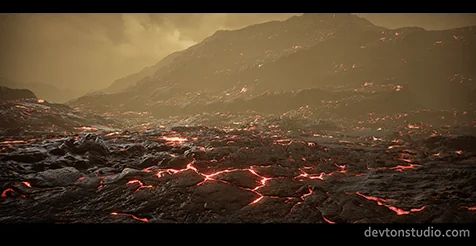
Planet Venus Landscape does not stop at ground texturing. It also includes two material functions created specifically for the lava system. These functions expand the environment beyond static surface treatment and introduce a separate procedural behavior for one of the most distinctive elements in the scene.
The lava functions cover procedural distribution, emissive color and intensity, and a gentle lava flow that is separate from the main material. Each of those points matters. Procedural distribution means the lava is not handled as a single flat effect applied in the same way everywhere. Emissive color and intensity provide direct control over how strongly the lava reads within the scene. The gentle flow adds motion-like behavior while remaining distinct from the main terrain material, which helps preserve clarity between the landscape base and the lava layer.
This separation is especially useful from a setup standpoint. Keeping the lava flow apart from the main material suggests a cleaner division of responsibilities inside the overall material structure. The terrain can focus on layered surface formation, while the lava functions manage their own distribution and appearance logic. That allows the lava to act as a specialized visual system instead of just another color variation on the ground.
A dedicated post process material is also included to create a hot air effect for the lava. This extends the lava treatment beyond the surface itself and into the surrounding atmosphere. The effect supports the idea that the lava should influence nearby visual space rather than sit passively in the environment. In use, it gives the volcanic or superheated parts of the landscape an added sense of intensity without needing to change the main landscape material for that purpose.
Automatic cliff generation with slope function blending
The Venus master material also features a new automatic cliff generation system based on a slope function. This is one of the most directly terrain-aware parts of the package because it responds to the shape of the landscape rather than only to a layer mask. Cliffs are not handled as isolated manually painted regions. They are generated through slope-based logic, which makes terrain angle an active part of how the environment is formed.
The cliff system includes alpha-based blending specific to cliffs. That is an important distinction because it means the package does not treat all surface transitions the same way. General terrain blending and cliff blending are not collapsed into a single universal behavior. Cliffs receive their own alpha-based treatment, which helps them read as a particular terrain condition with its own visual rules.
From a creative usage standpoint, this can help the environment maintain stronger separation between flatter surface regions and steeper formations. In a Venus-themed landscape, those transitions can carry much of the scene’s drama. A slope-driven cliff system makes the terrain react structurally, not just cosmetically, and the cliff-specific blending keeps those regions from feeling like a simple texture swap.
Random positioning system for lightening
Another prepared material in the package uses a random positioning system for lightening. While this is a smaller detail compared with the master material and lava functions, it adds another layer of procedural variation to the scene. The wording points to a placement system rather than a static, fixed effect, which keeps the overall package consistent with its broader procedural mindset.
This detail fits naturally alongside the rest of the resource. The terrain uses procedural alpha blending, the lava has its own procedural distribution, cliffs are generated from slope behavior, and lightening is also given a random positioning system. The package repeatedly approaches environment building through controlled automation instead of relying on manual placement for every major visual element.
Where Planet Venus Landscape fits in production
Planet Venus Landscape is set up for projects that need a highly stylized planetary terrain with material-driven control over surface variation, cliff formation, and lava treatment. Its strongest identity comes from how these systems interact. The landscape itself is layered procedurally, the background tiling issue is handled through a dedicated seventh layer using pixel depth, lava is given its own functions for distribution and emissive behavior, and the surrounding heat is reinforced with a post process material.
This creates a workflow that is less about painting terrain by hand and more about shaping the behavior of the material systems. The environment can be pushed toward a unique look through the alpha created for blending, while still retaining specialized logic for cliffs, lava flow, and lightening placement. For a Venus concept, that combination gives the package a clear practical role: it is prepared to handle a harsh alien landscape through layered procedural texturing and focused environmental effects rather than through a basic static terrain material.
 Forest & Jungle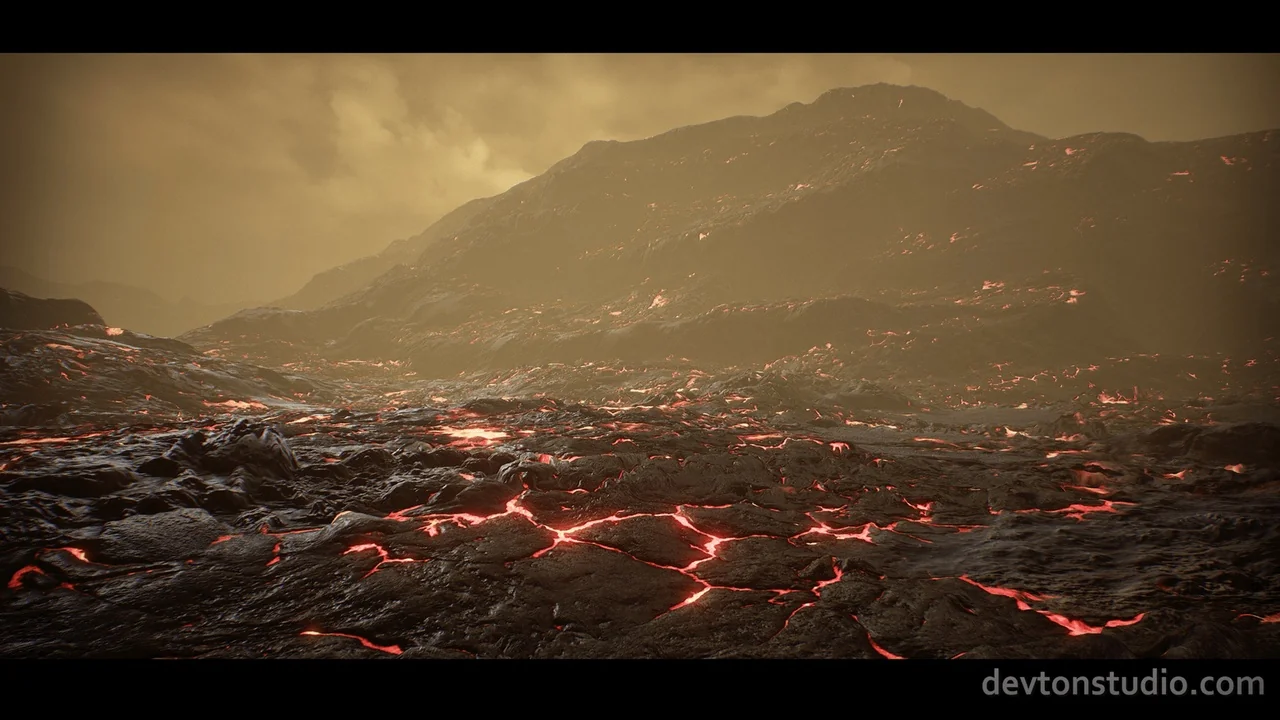
 Forest & Jungle
 Forest & Jungle
 Forest & Jungle