"c14ff6bd758dadb1"{"id":"1001734","slug":"lowpoly-alchemist-s-house","title":"Lowpoly Alchemist's House","category":"Fantasy","engine":"4.25+,5.0+","assetVersion":"","engineVersion":"Engine Version: 4.25+,5.0+","tag":"Fantasy","accent":"blue","visual":"mech","summary":"Build atmospheric medieval fantasy interiors with the Lowpoly Alchemist's House asset collection, featuring over 100 modular handpainted models.","platform":"Unreal Engine","publishedAt":"2026-10-20T02:39:03.250Z","updatedAt":"2026-10-20T02:39:03.250Z","sourceNotes":[],"fileContents":[],"compatibility":["Unreal Engine","Engine Version: 4.25+,5.0+"],"featuredImage":{"alt":"Lowpoly Alchemist's House","src":"/wp-content/uploads/published/2026/10/2dd9e24319ad-0fe5acac-22d5-48cd-8f43-f4c078eaaaef-2537e491de.webp"},"hasDownloadLink":true,"downloads":0,"terms":[{"taxonomy":"category","slug":"fantasy","name":"Fantasy"}],"galleryImages":[{"src":"/wp-content/uploads/published/2026/10/6cc61a82bed4-3da52d01-06ca-478d-bd06-b51eabca8004-5ddd006e4d.webp","alt":"Lowpoly Alchemist's House"},{"src":"/wp-content/uploads/published/2026/10/03426d8bc38c-77e2fd06-74d6-49bc-9787-b34bd802e8e5-e87a983777.webp","alt":"Lowpoly Alchemist's House"},{"src":"/wp-content/uploads/published/2026/10/077c28d29668-27ca9720-6809-4b7d-8ae4-24f88ae85a6d-2e7a21f8b2.webp","alt":"Lowpoly Alchemist's House"},{"src":"/wp-content/uploads/published/2026/10/ae0a500fb1b1-aebb9a11-0efd-4f29-af50-2b0e49a352d0-1e6c3609f6.webp","alt":"Lowpoly Alchemist's House"},{"src":"/wp-content/uploads/published/2026/10/6cf52d50d162-3eb1dda4-4ad6-4157-88ff-5504801dac0a-5ac7de60c5.webp","alt":"Lowpoly Alchemist's House"},{"src":"/wp-content/uploads/published/2026/10/f546dc8c89bb-abc6ecae-d621-402a-bbac-0b6c29b273e1-60183cfc59.webp","alt":"Lowpoly Alchemist's House"}],"accessPanel":{"kind":"resource","title":"Download this resource","eyebrow":"Free Download","message":"Log in or create a free account to start your download.","fileName":"Content.7z","safetyNote":"Resources are manually reviewed before listing to improve quality and reduce obvious risks.","actionLabel":"Download Free","resourceType":"Resource archive"},"contentHtml":"\u003cp\u003eDarkened corners illuminated by flickering light, scattered parchment, and tables laden with strange glassware define the quintessential retreat of a medieval scholar. Creating an indoor space with that specific mood requires assets that balance functional layout construction with dense environmental dressing. Lowpoly Alchemist's House targets this exact setting, supplying more than 100 handpainted assets intended to assemble stylized medieval interior locations steeped in a mysterious ambience.\u003c/p\u003e \u003ch2\u003eConstructing Medieval Interior Locations with Modular Architecture\u003c/h2\u003e\n\u003cp\u003eInterior level design depends heavily on the flexibility of its structural foundation. The package provides a modular structural system comprising walls, floors, ceilings, pillars, and stairs, alongside dedicated window pieces. These elements allow level designers to map out varied floor plans rather than relying on static, pre-assembled rooms.\u003c/p\u003e \u003cp\u003eBy using separate floor and ceiling tiles, builders can delineate different areas of an alchemist's residence, such as a ground-floor study, a narrow hallway, or an elevated loft. Pillars serve both an aesthetic and practical function in these layouts, breaking up open expanses, framing doorways, or supporting structural transitions between rooms. Incorporating stairs enables vertical level progression, making it possible to construct multi-story dwellings, raised platforms for ritual work, or subterranean cellars where sensitive experiments might be hidden away.\u003c/p\u003e \u003cp\u003eWindows punctuate the modular wall setups, establishing natural vantage points within an otherwise enclosed environment. In an indoor medieval setting, window placement influences how interior scenes are framed, providing contrast against the lowpoly architectural shells and anchoring the overall silhouette of the space.\u003c/p\u003e \u003ch2\u003eFurnishing Alchemist Workspaces with Handpainted Laboratory Equipment\u003c/h2\u003e\n\u003cp\u003eOnce the primary layout of walls, floors, and ceilings is established, the focus shifts toward giving the space its distinct trade identity. An alchemist's environment cannot simply look like a generic fantasy home; it requires specialized furnishings and tools that communicate arcane study and empirical experimentation.\u003c/p\u003e \u003cp\u003eThe collection addresses this need by providing a wide range of furniture alongside dedicated laboratory equipment. Workbenches, shelves, and storage units establish the functional workstations necessary for an active laboratory. Designers can arrange heavy tables to serve as primary examination areas, while peripheral shelving units house materials and vessels.\u003c/p\u003e \u003cp\u003eThe laboratory equipment brings character to these workstations. Rather than presenting empty tabletops, scenes can be populated with specialized apparatus that suggests chemical distillation, potion brewing, or mineral analysis. Because each piece is created in a handpainted, stylized aesthetic, the equipment retains clear, readable silhouettes while contributing to the cohesive lowpoly visual identity of the scene. The distinct texturing ensures that glassware, metal stands, and mixing apparatus stand out against wooden and stone furniture surfaces.\u003c/p\u003e \u003ch2\u003eDressing Indoor Scenes with Books, Scrolls, and Everyday Props\u003c/h2\u003e\n\u003cp\u003eA believable interior relies on fine-grained clutter to suggest ongoing human presence. The pack includes an extensive variety of props, featuring books, scrolls, candles, vases, and food. These smaller items allow designers to transform clean, architectural arrangements into dense, lived-in studies.\u003c/p\u003e \u003cp\u003eBooks and scrolls are fundamental to depicting academic pursuits. They can be stacked high on desks, laid flat across reading podiums, or tucked away haphazardly in corners to indicate years of accumulated research. Scrolls unfurled on tables hint at ongoing studies or recipes mid-translation, giving players visual context during exploration.\u003c/p\u003e \u003cp\u003eCandles supply crucial narrative and environmental accents. Scattered across workspaces, positioned on windowsills, or grouped around laboratory vessels, they reinforce the mysterious mood central to the asset pack. Vases and food items introduce domestic reality into the arcane setting, illustrating that the alchemist both works and resides within the same enclosed walls. Balancing scholarly clutter with domestic essentials makes rooms feel grounded, transforming an abstract level layout into a plausible historical fantasy retreat.\u003c/p\u003e \u003ch2\u003eEstablishing a Mysterious Ambience in Stylized Fantasy Levels\u003c/h2\u003e\n\u003cp\u003eAesthetic cohesion is vital when combining structural models with dozens of miscellaneous props. The lowpoly nature of the assets keeps geometry streamlined, while the handpainted textures provide stylized depth, tone, and character across every surface. This combination supports the creation of compact, moody chambers without overwhelming scenes with unnecessary geometric noise.\u003c/p\u003e \u003cp\u003eThe styling works especially well for fantasy games and stylized medieval adventures where clear environmental readability is required. Because the components share a consistent handpainted finish, mixing wall modules, laboratory gear, and small props like candles and food produces a visually unified scene. Designers can build intimate potion shops, secluded scholar towers, underground laboratories, or narrative quest interiors where lighting, architecture, and clutter work in tandem to convey mystery.\u003c/p\u003e \u003ch2\u003ePractical Assembly for Interior Game Environments\u003c/h2\u003e\n\u003cp\u003eDeploying Lowpoly Alchemist's House within a production pipeline centers on layered scene construction. The optimal approach begins by blocking out structural volumes using the modular walls, floors, ceilings, stairs, and pillars to define player pathways and spatial boundaries. Once the architectural framework is solidified, primary furniture pieces can be staged to establish points of interest, such as reading desks, alchemy benches, or storage zones.\u003c/p\u003e \u003cp\u003eThe final phase involves micro-dressing with the prop collection. Distributing books, scrolls, laboratory gear, candles, and food items across surfaces creates narrative depth, showing where experiments were abandoned or where an alchemist spent long hours studying. With more than 100 handpainted assets covering architecture, furniture, and tabletop clutter, the collection provides the necessary components to realize detailed, stylized indoor locations from empty floor plans to fully dressed, atmospheric rooms.\u003c/p\u003e\n\n\u003ch2\u003eExplore Similar Assets\u003c/h2\u003e\n\u003cul\u003e\n\u003cli\u003e\u003ca href=\"https://3dcghub.com/stylized-house-interior-stylized-stylised-kitchen-interior-interior-dinner/\" title=\"Stylized House Interior ( Stylized Stylised Kitchen Interior Interior Dinner )\"\u003eStylized House Interior ( Stylized Stylised Kitchen Interior Interior Dinner )\u003c/a\u003e\u003c/li\u003e\n\u003cli\u003e\u003ca href=\"https://3dcghub.com/house-along-the-river-house-river-village-stylized-stylised-environment-3d/\" title=\"House Along the River ( House River Village Stylized Stylised Environment 3d )\"\u003eHouse Along the River ( House River Village Stylized Stylised Environment 3d )\u003c/a\u003e\u003c/li\u003e\n\u003cli\u003e\u003ca href=\"https://3dcghub.com/utopia-house/\" title=\"UTOPIA HOUSE\"\u003eUTOPIA HOUSE\u003c/a\u003e\u003c/li\u003e\n\u003cli\u003e\u003ca href=\"https://3dcghub.com/stylized-log-cabin/\" title=\"Stylized Log Cabin\"\u003eStylized Log Cabin\u003c/a\u003e\u003c/li\u003e\n\u003cli\u003e\u003ca href=\"https://3dcghub.com/alien-planet-pack/\" title=\"Alien Planet Pack\"\u003eAlien Planet Pack\u003c/a\u003e\u003c/li\u003e\n\u003c/ul\u003e","contentTextLength":6581,"navigation":{"current":49,"total":3719,"previous":{"id":"1001735","slug":"lowpoly-style-woodlands-pack","title":"Lowpoly Style Woodlands Pack","category":"Forest \u0026 Jungle","platform":"Unreal Engine","updatedAt":"2026-10-20T02:40:02.803Z"},"next":{"id":"1001733","slug":"ja-silent-hill-2-fog-vfx","title":"JA - Silent Hill 2 Fog VFX","category":"Weather","platform":"Unreal Engine","updatedAt":"2026-10-20T02:38:23.542Z"}},"relatedResources":[{"id":"8005","slug":"stylized-house-interior-stylized-stylised-kitchen-interior-interior-dinner","title":"Stylized House Interior ( Stylized Stylised Kitchen Interior Interior Dinner )","category":"Fantasy","engine":"4.27,5.0+","assetVersion":"Engine version: 4.27,5.0+","engineVersion":"4.25","tag":"Fantasy","accent":"blue","visual":"city","summary":"Transform your game environments with this comprehensive stylized interior pack featuring 206 unique meshes and modular building compatibility.","platform":"Unreal Engine","publishedAt":"2026-02-22T16:22:48.000Z","updatedAt":"2026-04-19T15:55:37.000Z","sourceNotes":[],"fileContents":[],"compatibility":["Unreal Engine","Engine version: 4.27,5.0+"],"featuredImage":{"alt":"Stylized House Interior ( Stylized Stylised Kitchen Interior Interior Dinner )","src":"https://3dcghub.com/wp-content/uploads/2026/02/f5992525-7a43-4aba-b88d-d2f46dbe750d.webp"},"hasDownloadLink":true,"downloads":1},{"id":"1001520","slug":"house-along-the-river-house-river-village-stylized-stylised-environment-3d","title":"House Along the River ( House River Village Stylized Stylised Environment 3d )","category":"Fantasy","engine":"5.5+","assetVersion":"","engineVersion":"Engine Version: 5.5+","tag":"Fantasy","accent":"blue","visual":"city","summary":"Examine implementation workflows, Lumen lighting setup, and 73 unique meshes in the House Along the River stylized 3D environment pack.","platform":"Unreal Engine","publishedAt":"2026-10-09T13:20:19.696Z","updatedAt":"2026-10-09T13:20:19.696Z","sourceNotes":[],"fileContents":[],"compatibility":["Unreal Engine","Engine Version: 5.5+"],"featuredImage":{"alt":"House Along the River ( House River Village Stylized Stylised Environment 3d )","src":"/wp-content/uploads/published/2026/10/ea27a07cefa7-52b6fdec-f550-4920-b878-5bdbb82979cb-00737b95ec.webp"},"hasDownloadLink":true,"downloads":1},{"id":"1001609","slug":"utopia-house","title":"UTOPIA HOUSE","category":"Fantasy","engine":"5.1+","assetVersion":"","engineVersion":"Engine Version: 5.1+","tag":"Fantasy","accent":"blue","visual":"mech","summary":"Explore the UTOPIA HOUSE interior environment pack featuring 91 placed prop probes, Blueprint-rotatable ceiling lamps, and Unreal Engine 5.0+ Lumen support.","platform":"Unreal Engine","publishedAt":"2026-10-10T16:33:51.767Z","updatedAt":"2026-10-10T16:33:51.767Z","sourceNotes":[],"fileContents":[],"compatibility":["Unreal Engine","Engine Version: 5.1+"],"featuredImage":{"alt":"UTOPIA HOUSE","src":"/wp-content/uploads/published/2026/10/029dd1a719fb-1c084892-b626-4076-a520-dbbc717f8b56-14f2cb318a.webp"},"hasDownloadLink":true,"downloads":0}]}
Fantasy
Lowpoly Alchemist's House
Build atmospheric medieval fantasy interiors with the Lowpoly Alchemist's House asset collection, featuring over 100 modular handpainted models.
Category:Unreal Engine,FantasyPlatform: Unreal EngineEngine Version: 4.25+,5.0+Published: Oct 20, 2026
Fantasy
Resource overview
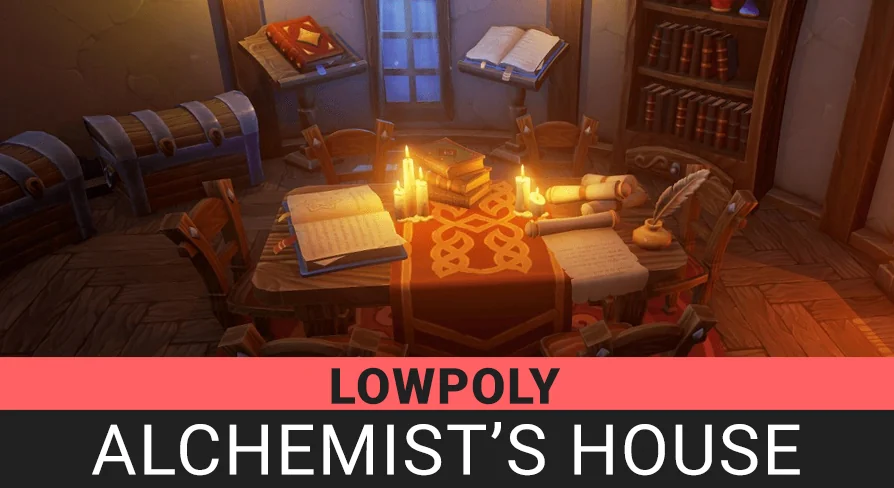
Darkened corners illuminated by flickering light, scattered parchment, and tables laden with strange glassware define the quintessential retreat of a medieval scholar. Creating an indoor space with that specific mood requires assets that balance functional layout construction with dense environmental dressing. Lowpoly Alchemist's House targets this exact setting, supplying more than 100 handpainted assets intended to assemble stylized medieval interior locations steeped in a mysterious ambience.
Constructing Medieval Interior Locations with Modular Architecture
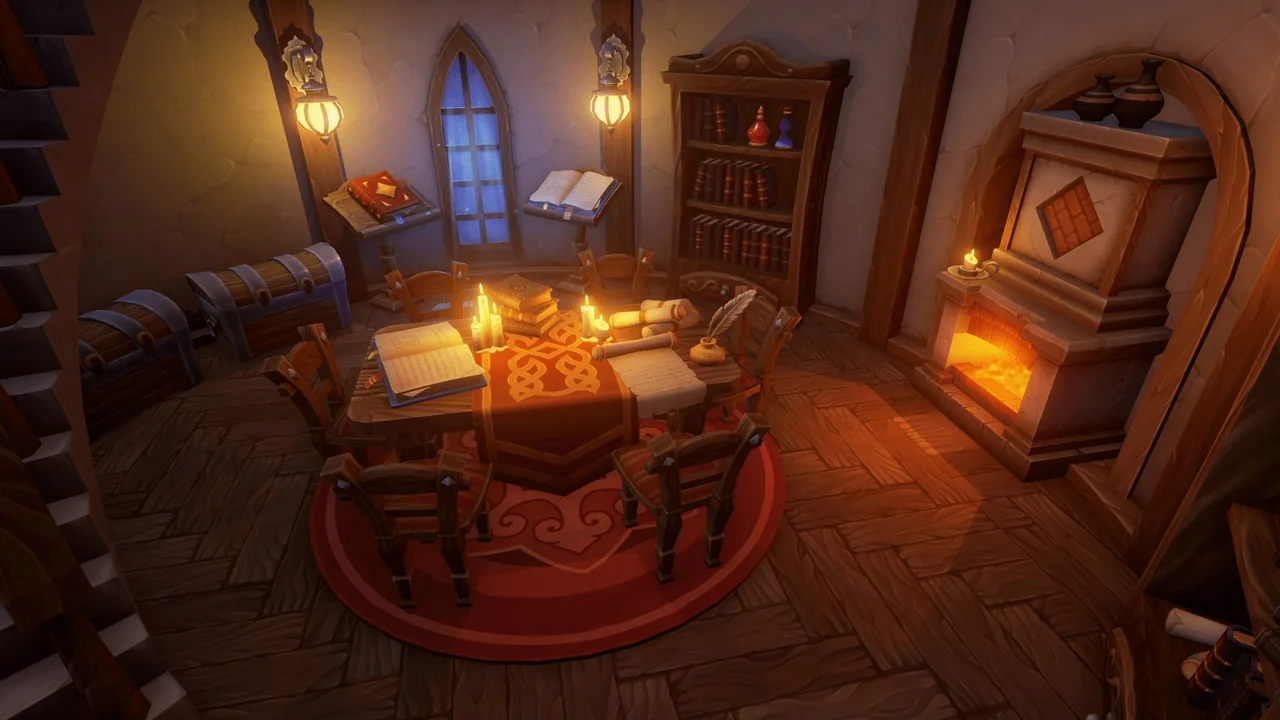
Interior level design depends heavily on the flexibility of its structural foundation. The package provides a modular structural system comprising walls, floors, ceilings, pillars, and stairs, alongside dedicated window pieces. These elements allow level designers to map out varied floor plans rather than relying on static, pre-assembled rooms.
By using separate floor and ceiling tiles, builders can delineate different areas of an alchemist's residence, such as a ground-floor study, a narrow hallway, or an elevated loft. Pillars serve both an aesthetic and practical function in these layouts, breaking up open expanses, framing doorways, or supporting structural transitions between rooms. Incorporating stairs enables vertical level progression, making it possible to construct multi-story dwellings, raised platforms for ritual work, or subterranean cellars where sensitive experiments might be hidden away.
Windows punctuate the modular wall setups, establishing natural vantage points within an otherwise enclosed environment. In an indoor medieval setting, window placement influences how interior scenes are framed, providing contrast against the lowpoly architectural shells and anchoring the overall silhouette of the space.
Furnishing Alchemist Workspaces with Handpainted Laboratory Equipment
Once the primary layout of walls, floors, and ceilings is established, the focus shifts toward giving the space its distinct trade identity. An alchemist's environment cannot simply look like a generic fantasy home; it requires specialized furnishings and tools that communicate arcane study and empirical experimentation.
The collection addresses this need by providing a wide range of furniture alongside dedicated laboratory equipment. Workbenches, shelves, and storage units establish the functional workstations necessary for an active laboratory. Designers can arrange heavy tables to serve as primary examination areas, while peripheral shelving units house materials and vessels.
The laboratory equipment brings character to these workstations. Rather than presenting empty tabletops, scenes can be populated with specialized apparatus that suggests chemical distillation, potion brewing, or mineral analysis. Because each piece is created in a handpainted, stylized aesthetic, the equipment retains clear, readable silhouettes while contributing to the cohesive lowpoly visual identity of the scene. The distinct texturing ensures that glassware, metal stands, and mixing apparatus stand out against wooden and stone furniture surfaces.
Dressing Indoor Scenes with Books, Scrolls, and Everyday Props
A believable interior relies on fine-grained clutter to suggest ongoing human presence. The pack includes an extensive variety of props, featuring books, scrolls, candles, vases, and food. These smaller items allow designers to transform clean, architectural arrangements into dense, lived-in studies.
Books and scrolls are fundamental to depicting academic pursuits. They can be stacked high on desks, laid flat across reading podiums, or tucked away haphazardly in corners to indicate years of accumulated research. Scrolls unfurled on tables hint at ongoing studies or recipes mid-translation, giving players visual context during exploration.
Candles supply crucial narrative and environmental accents. Scattered across workspaces, positioned on windowsills, or grouped around laboratory vessels, they reinforce the mysterious mood central to the asset pack. Vases and food items introduce domestic reality into the arcane setting, illustrating that the alchemist both works and resides within the same enclosed walls. Balancing scholarly clutter with domestic essentials makes rooms feel grounded, transforming an abstract level layout into a plausible historical fantasy retreat.
Establishing a Mysterious Ambience in Stylized Fantasy Levels
Aesthetic cohesion is vital when combining structural models with dozens of miscellaneous props. The lowpoly nature of the assets keeps geometry streamlined, while the handpainted textures provide stylized depth, tone, and character across every surface. This combination supports the creation of compact, moody chambers without overwhelming scenes with unnecessary geometric noise.
The styling works especially well for fantasy games and stylized medieval adventures where clear environmental readability is required. Because the components share a consistent handpainted finish, mixing wall modules, laboratory gear, and small props like candles and food produces a visually unified scene. Designers can build intimate potion shops, secluded scholar towers, underground laboratories, or narrative quest interiors where lighting, architecture, and clutter work in tandem to convey mystery.
Practical Assembly for Interior Game Environments
Deploying Lowpoly Alchemist's House within a production pipeline centers on layered scene construction. The optimal approach begins by blocking out structural volumes using the modular walls, floors, ceilings, stairs, and pillars to define player pathways and spatial boundaries. Once the architectural framework is solidified, primary furniture pieces can be staged to establish points of interest, such as reading desks, alchemy benches, or storage zones.
The final phase involves micro-dressing with the prop collection. Distributing books, scrolls, laboratory gear, candles, and food items across surfaces creates narrative depth, showing where experiments were abandoned or where an alchemist spent long hours studying. With more than 100 handpainted assets covering architecture, furniture, and tabletop clutter, the collection provides the necessary components to realize detailed, stylized indoor locations from empty floor plans to fully dressed, atmospheric rooms.
 Fantasy
 Fantasy
 Fantasy
 Fantasy