"1f00f67f9253451b"{"id":"1000781","slug":"advanced-vehicle-system-replicated-modular-vehicle-physics","title":"Advanced Vehicle System - [Replicated Modular Vehicle Physics]","category":"Engine Tools","engine":"4.26 - 5.7","assetVersion":"Asset Version: 1.2.7 - 1.4.5","engineVersion":"Engine Version: 4.26 - 5.7","tag":"Engine Tools","accent":"blue","visual":"mech","summary":"AVS Vehicle Physics bundles modular replicated driving, suspension, engine audio, tire smoke, skid marks, and trailer support into a single drop-in package.","platform":"Unreal Engine","publishedAt":"2026-07-30T10:29:04.441Z","updatedAt":"2026-07-30T10:29:04.441Z","sourceNotes":[],"fileContents":[],"compatibility":["Unreal Engine","Asset Version: 1.2.7 - 1.4.5","Engine Version: 4.26 - 5.7"],"featuredImage":{"alt":"Advanced Vehicle System - [Replicated Modular Vehicle Physics]","src":"/wp-content/uploads/published/2026/07/4b8b08c58b35-110cea5f-1d83-40f0-a17f-c6525039a95d-05124decc3.webp"},"hasDownloadLink":true,"downloads":1,"terms":[{"taxonomy":"category","slug":"engine-tools-tools-and-plugins","name":"Engine Tools"}],"galleryImages":[{"src":"/wp-content/uploads/published/2026/07/b48504e0c1a7-b63f18e2-0af7-41e8-b346-91c34c01257d-f7751f1aa1.webp","alt":"Advanced Vehicle System - [Replicated Modular Vehicle Physics]"},{"src":"/wp-content/uploads/published/2026/07/20c0a34c4c03-b1f9075a-d383-43a8-9345-15819266b7c5-5f4da64b5c.webp","alt":"Advanced Vehicle System - [Replicated Modular Vehicle Physics]"},{"src":"/wp-content/uploads/published/2026/07/a5c9d6474e00-683ba69f-bcf5-4b7c-b14a-5d4957f69fb5-f32dc3cbc8.webp","alt":"Advanced Vehicle System - [Replicated Modular Vehicle Physics]"},{"src":"/wp-content/uploads/published/2026/07/92e3f568e30c-6866c78c-30e0-404a-ac26-5b428c50d4e3-d1f7965799.webp","alt":"Advanced Vehicle System - [Replicated Modular Vehicle Physics]"},{"src":"/wp-content/uploads/published/2026/07/8a9b72880bdb-609d4d1e-2668-4d26-927d-fae8293e1531-82f71311a6.webp","alt":"Advanced Vehicle System - [Replicated Modular Vehicle Physics]"},{"src":"/wp-content/uploads/published/2026/07/3e585b94a457-762843d6-dcbc-4cc8-ae20-773846ffe3de-2f5c3d9ff3.webp","alt":"Advanced Vehicle System - [Replicated Modular Vehicle Physics]"},{"src":"/wp-content/uploads/published/2026/07/70b892f31bb6-bc82a5fe-91d6-43ca-bb69-14679d5b24af-4b12e5c3c3.webp","alt":"Advanced Vehicle System - [Replicated Modular Vehicle Physics]"},{"src":"/wp-content/uploads/published/2026/07/383b5fdfe271-5027033e-9760-4cf2-8a58-0f08b8b0e68c-1f5257e3f2.webp","alt":"Advanced Vehicle System - [Replicated Modular Vehicle Physics]"},{"src":"/wp-content/uploads/published/2026/07/1efd37fd8bee-a76c4950-7093-41b2-9efb-0a5900bda6da-10e567aecf.webp","alt":"Advanced Vehicle System - [Replicated Modular Vehicle Physics]"},{"src":"/wp-content/uploads/published/2026/07/77f43216ff8e-cfe9899f-ae40-4a48-96f5-e636508b46f2-4f1b440132.webp","alt":"Advanced Vehicle System - [Replicated Modular Vehicle Physics]"}],"accessPanel":{"kind":"resource","title":"Download this resource","eyebrow":"Free Download","message":"Log in or create a free account to start your download.","fileName":"Advanced Vehicle System.7z","safetyNote":"Resources are manually reviewed before listing to improve quality and reduce obvious risks.","actionLabel":"Download Free","resourceType":"Resource archive"},"contentHtml":"\u003cp\u003eTuning a vehicle from scratch usually means hours of configuration before a wheel ever turns in a meaningful way. \u003cem\u003eAVS Vehicle Physics\u003c/em\u003e positions itself squarely against that workflow bottleneck, offering modular setups tuned for fast iteration rather than endless parameter-wrangling. The goal is a system where you drop in your meshes, adjust a handful of settings, and have a drivable vehicle on screen without the overhead of rigging or a custom physics pipeline.\u003c/p\u003e\n\n\u003ch2\u003eDropping Meshes Straight into AVS Vehicle Physics\u003c/h2\u003e\n\u003cp\u003eThe core setup philosophy is simple: bring your own Static Mesh wheels and chassis, plug them in, and drive. The system explicitly avoids rigging prerequisites. \u003cem\u003eAVS\u003c/em\u003e supports any combination of Static Mesh wheels and Static Mesh chassis, and it also supports both Static and Skeletal Mesh vehicles, which means the import path stays flexible regardless of how your art team has prepared the assets.\u003c/p\u003e\n\n\u003cp\u003eBecause wheels are added modularly by component, there is no fixed wheel-count ceiling baked into the framework. Whether the design calls for a motorcycle, a standard four-wheel car, or a multi-axle truck, the component structure scales to match the vehicle. That modularity also opens the door to runtime modification, which is treated as a first-class capability rather than an afterthought.\u003c/p\u003e\n\n\u003ch3\u003eRuntime Modification and Component Detachment\u003c/h3\u003e\n\u003cp\u003eVehicle properties remain modifiable while the game is running. Developers can change wheel mesh, mass, and location at runtime, and the system supports detaching and reattaching components on the fly. This is relevant for damage modeling, modular assembly gameplay, or any design where the vehicle's physical configuration changes during play. Instead of locking the vehicle into its initial spawn state, \u003cem\u003eAVS\u003c/em\u003e treats the component layout as live and editable, which aligns with sandbox and open-world design needs.\u003c/p\u003e\n\n\u003ch2\u003eRaycast and Physics Constraint Wheel Modes\u003c/h2\u003e\n\u003cp\u003e\u003cem\u003eAVS\u003c/em\u003e provides two distinct wheel simulation modes: \u003ccode\u003eRaycast\u003c/code\u003e and \u003ccode\u003ePhysics Constraint\u003c/code\u003e. This dual approach lets developers choose between a lightweight raycast model and a constraint-based physical model depending on the performance and feel they need. Both modes sit on top of a suspension system using what the creator describes as a Sliding Pillar-style model, incorporating spring and damper simulation to govern vertical wheel behavior.\u003c/p\u003e\n\n\u003cp\u003eBraking is modeled with attention to pressure and lock states. Wheel locking is driven by brake pressure and handbrake input, meaning the system does not simply toggle a static lock flag. It responds to how hard the brakes are applied, which feeds directly into skid-based effects like tire smoke and skid marks rendered during heavy braking or sharp turns.\u003c/p\u003e\n\n\u003ch3\u003eEngine, Transmission, and Gear Behavior\u003c/h3\u003e\n\u003cp\u003eThe engine model follows a simple arcade-style approach using torque interpolation per gear rather than a full thermodynamic or mechanical simulation. Transmission supports both automatic and manual modes, without requiring a clutch input from the player. This keeps the driving experience accessible while still giving designers control over gear count and shift behavior. The emphasis is on responsiveness and feel over simulation depth, which matches the stated intent of making vehicles feel good right out of the box.\u003c/p\u003e\n\n\u003ch2\u003eNetwork Replication with Client Authority\u003c/h2\u003e\n\u003cp\u003e\u003cem\u003eAVS\u003c/em\u003e is fully network-replicated and uses a Client Authority Model. For production work, this means the client owning the vehicle has authority over its movement and state, which is a common pattern for FPS and open-world driving games where low-latency local control matters more than server-authoritative prediction. The replication layer is designed specifically with open-world games in mind, and the creator emphasizes that the system is battle-tested through continuous iteration based on community feedback and internal project requirements.\u003c/p\u003e\n\n\u003cp\u003eThis makes \u003cem\u003eAVS\u003c/em\u003e suitable not just for single-player driving sandboxes but for multiplayer open-world systems where players expect responsive control over their vehicles across a network. Trailer support is included as an integrated feature: hitching and unhitching can occur during gameplay, and trailers work out of the box without requiring a separate trailer plugin or custom constraint work.\u003c/p\u003e\n\n\u003ch2\u003eVFX and Audio Bundled into the Driving System\u003c/h2\u003e\n\u003cp\u003eWhere \u003cem\u003eAVS\u003c/em\u003e differs most visibly from competing solutions is in the scope of included effects. Rather than requiring separate purchases or manual implementation, the package bundles tire smoke, vivid skid marks, customizable vehicle lights, exhaust smoke, and immersive engine audio into the core system. These visual and audio details are tied to the simulated physical state of the vehicle, so skid marks appear where wheels lock, smoke emits where friction accumulates, and lights behave according to configurable vehicle state.\u003c/p\u003e\n\n\u003cp\u003eThis integration matters because it collapses the usual assembly step where a developer grabs a physics plugin, then sources a VFX pack for smoke, then finds or builds an audio system for engine sounds, then writes glue logic to connect them. \u003cem\u003eAVS\u003c/em\u003e handles all of these as part of a single straightforward package, getting vehicles road-ready in fewer steps.\u003c/p\u003e\n\n\u003ch2\u003eWhere AVS Fits in an Open-World Production\u003c/h2\u003e\n\u003cp\u003eFor teams building open-world or sandbox driving experiences, the value proposition is fewer integration tasks and faster turnaround on new vehicle prototypes. The system's compatibility note points toward integration with \u003cem\u003eTraffic Control System\u003c/em\u003e, which situates \u003cem\u003eAVS\u003c/em\u003e as a drivable-vehicle layer that can coexist with broader traffic and simulation systems rather than operating in isolation. Its ongoing updates and community-driven feedback loop suggest it is maintained as a living toolset rather than a static asset drop.\u003c/p\u003e\n\n\u003cp\u003eA production that needs replicated multiplayer driving, runtime vehicle modification, bundled driving VFX and audio, and support for arbitrary mesh combinations without rigging will encounter most of those requirements addressed in one place here.\u003c/p\u003e\n\n\u003ch2\u003eContinue Browsing Similar Packs\u003c/h2\u003e\n\u003cul\u003e\n\u003cli\u003e\u003ca href=\"https://3dcghub.com/fgear-vehicle-physics/\" title=\"FGear Vehicle Physics\"\u003eFGear Vehicle Physics\u003c/a\u003e\u003c/li\u003e\n\u003cli\u003e\u003ca href=\"https://3dcghub.com/r-tune-vehicle-physics-2-0-vehicle-system-for-games-animation/\" title=\"R-Tune Vehicle Physics 2.0 - Vehicle System for Games \u0026amp; Animation\"\u003eR-Tune Vehicle Physics 2.0 - Vehicle System for Games \u0026amp; Animation\u003c/a\u003e\u003c/li\u003e\n\u003cli\u003e\u003ca href=\"https://3dcghub.com/dystopia-airship/\" title=\"Dystopia Airship\"\u003eDystopia Airship\u003c/a\u003e\u003c/li\u003e\n\u003cli\u003e\u003ca href=\"https://3dcghub.com/train-template/\" title=\"Train Template\"\u003eTrain Template\u003c/a\u003e\u003c/li\u003e\n\u003cli\u003e\u003ca href=\"https://3dcghub.com/physics-based-helicopter/\" title=\"Physics Based Helicopter\"\u003ePhysics Based Helicopter\u003c/a\u003e\u003c/li\u003e\n\u003c/ul\u003e","contentTextLength":6184,"navigation":{"current":554,"total":3222,"previous":{"id":"13732","slug":"blend-file-importer","title":"Blend File Importer","category":"Engine Tools","platform":"Unreal Engine","updatedAt":"2026-07-30T10:55:24.261Z"},"next":{"id":"22041","slug":"2d-action-rpg-engine-mythril2d","title":"2D Action RPG Engine: Mythril2D","category":"Systems","platform":"Unity","updatedAt":"2026-07-29T16:30:08.036Z"}},"relatedResources":[{"id":"1000000","slug":"fgear-vehicle-physics","title":"FGear Vehicle Physics","category":"Engine Tools","engine":"5.1, 5.3 - 5.6","assetVersion":"1.6.1 - 1.8.3","engineVersion":"5.1, 5.3 - 5.6","tag":"Engine Tools","accent":"blue","visual":"mech","summary":"FGear Vehicle Physics is a custom vehicle physics solution for arcade and semi-arcade racing games, balancing realism, control, demos, docs, and example use.","platform":"Unreal Engine","publishedAt":"2026-05-19T08:25:16.034Z","updatedAt":"2026-05-19T14:42:25.560Z","sourceNotes":[],"fileContents":[],"compatibility":["Unreal Engine","Asset Version: 1.6.1 - 1.8.3","Engine version: 5.1, 5.3 - 5.6"],"featuredImage":{"alt":"FGear Vehicle Physics","src":"/wp-content/uploads/published/2026/05/5158990cfbe4-d351fdd6-e983-4b6d-b3d9-50ebc7959814-61b2dd7e26.webp"},"hasDownloadLink":true,"downloads":1},{"id":"14404","slug":"r-tune-vehicle-physics-2-0-vehicle-system-for-games-animation","title":"R-Tune Vehicle Physics 2.0 - Vehicle System for Games \u0026 Animation","category":"Engine Tools","engine":"5.5 - 5.6","assetVersion":"Engine version: 5.5 - 5.6","engineVersion":"Asset Version:1.3.2 - 2.0","tag":"Engine Tools","accent":"blue","visual":"animation","summary":"Discover R-Tune Vehicle Physics 2.0, a powerful and flexible vehicle system built from scratch in C++ for Unreal Engine 5. This system simplifies vehicle creation using static meshes and offers frame-rate independent physics for professional game development.","platform":"Unreal Engine","publishedAt":"2026-03-11T17:55:23.000Z","updatedAt":"2026-04-19T15:45:47.000Z","sourceNotes":[],"fileContents":[],"compatibility":["Unreal Engine","Engine version: 5.5 - 5.6","Asset Version: 1.3.2 - 2.0"],"featuredImage":{"alt":"R-Tune Vehicle Physics 2.0 - Vehicle System for Games \u0026 Animation","src":"https://3dcghub.com/wp-content/uploads/2026/03/402ca51c-6e8f-4369-b575-12014c2be5a0.webp"},"hasDownloadLink":true,"downloads":0},{"id":"1001267","slug":"insta-deform-component","title":"Insta Deform Component","category":"Engine Tools","engine":"4.26 - 5.6","assetVersion":"Asset Version: 1.2","engineVersion":"Engine Version: 4.26 - 5.6","tag":"Engine Tools","accent":"blue","visual":"mech","summary":"Add instant, fully replicated visual deformation to vehicles and skeletal meshes in Unreal Engine with fast hit-event setup and stress-tested performance.","platform":"Unreal Engine","publishedAt":"2026-09-30T05:49:51.218Z","updatedAt":"2026-09-30T05:49:51.218Z","sourceNotes":[],"fileContents":[],"compatibility":["Unreal Engine","Asset Version: 1.2","Engine Version: 4.26 - 5.6"],"featuredImage":{"alt":"Insta Deform Component","src":"/wp-content/uploads/published/2026/09/c662b5d1a286-0d9734bc-bb9e-47eb-a1d4-b828a06d5463-7ed02f8e45.webp"},"hasDownloadLink":true,"downloads":0}]}
Engine Tools
Advanced Vehicle System - [Replicated Modular Vehicle Physics]
AVS Vehicle Physics bundles modular replicated driving, suspension, engine audio, tire smoke, skid marks, and trailer support into a single drop-in package.
Tuning a vehicle from scratch usually means hours of configuration before a wheel ever turns in a meaningful way. AVS Vehicle Physics positions itself squarely against that workflow bottleneck, offering modular setups tuned for fast iteration rather than endless parameter-wrangling. The goal is a system where you drop in your meshes, adjust a handful of settings, and have a drivable vehicle on screen without the overhead of rigging or a custom physics pipeline.
Dropping Meshes Straight into AVS Vehicle Physics
The core setup philosophy is simple: bring your own Static Mesh wheels and chassis, plug them in, and drive. The system explicitly avoids rigging prerequisites. AVS supports any combination of Static Mesh wheels and Static Mesh chassis, and it also supports both Static and Skeletal Mesh vehicles, which means the import path stays flexible regardless of how your art team has prepared the assets.
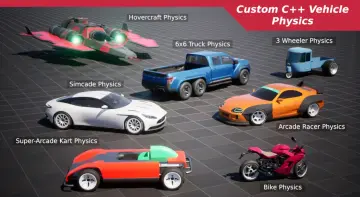
Because wheels are added modularly by component, there is no fixed wheel-count ceiling baked into the framework. Whether the design calls for a motorcycle, a standard four-wheel car, or a multi-axle truck, the component structure scales to match the vehicle. That modularity also opens the door to runtime modification, which is treated as a first-class capability rather than an afterthought.
Runtime Modification and Component Detachment
Vehicle properties remain modifiable while the game is running. Developers can change wheel mesh, mass, and location at runtime, and the system supports detaching and reattaching components on the fly. This is relevant for damage modeling, modular assembly gameplay, or any design where the vehicle's physical configuration changes during play. Instead of locking the vehicle into its initial spawn state, AVS treats the component layout as live and editable, which aligns with sandbox and open-world design needs.
Raycast and Physics Constraint Wheel Modes
AVS provides two distinct wheel simulation modes: Raycast and Physics Constraint. This dual approach lets developers choose between a lightweight raycast model and a constraint-based physical model depending on the performance and feel they need. Both modes sit on top of a suspension system using what the creator describes as a Sliding Pillar-style model, incorporating spring and damper simulation to govern vertical wheel behavior.
Braking is modeled with attention to pressure and lock states. Wheel locking is driven by brake pressure and handbrake input, meaning the system does not simply toggle a static lock flag. It responds to how hard the brakes are applied, which feeds directly into skid-based effects like tire smoke and skid marks rendered during heavy braking or sharp turns.
Engine, Transmission, and Gear Behavior
The engine model follows a simple arcade-style approach using torque interpolation per gear rather than a full thermodynamic or mechanical simulation. Transmission supports both automatic and manual modes, without requiring a clutch input from the player. This keeps the driving experience accessible while still giving designers control over gear count and shift behavior. The emphasis is on responsiveness and feel over simulation depth, which matches the stated intent of making vehicles feel good right out of the box.
Network Replication with Client Authority
AVS is fully network-replicated and uses a Client Authority Model. For production work, this means the client owning the vehicle has authority over its movement and state, which is a common pattern for FPS and open-world driving games where low-latency local control matters more than server-authoritative prediction. The replication layer is designed specifically with open-world games in mind, and the creator emphasizes that the system is battle-tested through continuous iteration based on community feedback and internal project requirements.
This makes AVS suitable not just for single-player driving sandboxes but for multiplayer open-world systems where players expect responsive control over their vehicles across a network. Trailer support is included as an integrated feature: hitching and unhitching can occur during gameplay, and trailers work out of the box without requiring a separate trailer plugin or custom constraint work.
VFX and Audio Bundled into the Driving System
Where AVS differs most visibly from competing solutions is in the scope of included effects. Rather than requiring separate purchases or manual implementation, the package bundles tire smoke, vivid skid marks, customizable vehicle lights, exhaust smoke, and immersive engine audio into the core system. These visual and audio details are tied to the simulated physical state of the vehicle, so skid marks appear where wheels lock, smoke emits where friction accumulates, and lights behave according to configurable vehicle state.
This integration matters because it collapses the usual assembly step where a developer grabs a physics plugin, then sources a VFX pack for smoke, then finds or builds an audio system for engine sounds, then writes glue logic to connect them. AVS handles all of these as part of a single straightforward package, getting vehicles road-ready in fewer steps.
Where AVS Fits in an Open-World Production
For teams building open-world or sandbox driving experiences, the value proposition is fewer integration tasks and faster turnaround on new vehicle prototypes. The system's compatibility note points toward integration with Traffic Control System, which situates AVS as a drivable-vehicle layer that can coexist with broader traffic and simulation systems rather than operating in isolation. Its ongoing updates and community-driven feedback loop suggest it is maintained as a living toolset rather than a static asset drop.
A production that needs replicated multiplayer driving, runtime vehicle modification, bundled driving VFX and audio, and support for arbitrary mesh combinations without rigging will encounter most of those requirements addressed in one place here.
![Advanced Vehicle System - [Replicated Modular Vehicle Physics]](/_img/960/wp-content/uploads/published/2026/07/4b8b08c58b35-110cea5f-1d83-40f0-a17f-c6525039a95d-05124decc3.webp) Engine Tools
Engine Tools![Advanced Vehicle System - [Replicated Modular Vehicle Physics]](/_img/960/wp-content/uploads/published/2026/07/b48504e0c1a7-b63f18e2-0af7-41e8-b346-91c34c01257d-f7751f1aa1.webp)
 Engine Tools
 Engine Tools
 Engine Tools