"b00678cacce53329"{"id":"1002756","slug":"advanced-magic-circle-1","title":"Advanced Magic Circle 1","category":"Spells \u0026 Combat","engine":"4.26+,5.0+","assetVersion":"","engineVersion":"Engine Version: 4.26+,5.0+","tag":"Spells \u0026 Combat","accent":"blue","visual":"mech","summary":"Examine Advanced Magic Circle 1 for Unreal Engine, featuring elemental spell arrays, Cascade LODs, and NiagaraFX support from UE4.26 onward.","platform":"Unreal Engine","indexPolicy":"index","publishedAt":"2026-11-20T06:29:13.038Z","updatedAt":"2026-11-20T06:29:13.038Z","sourceNotes":[],"fileContents":[],"compatibility":["Unreal Engine","Engine Version: 4.26+,5.0+"],"featuredImage":{"alt":"Advanced Magic Circle 1","src":"/wp-content/uploads/published/2026/11/9941583eb709-86672b81-a9e5-4f70-b084-f006f5f45bc0-bb533fa9e6.webp"},"fileSizeBytes":41649517,"hasDownloadLink":true,"downloads":0,"terms":[{"taxonomy":"category","slug":"spells-and-combat","name":"Spells \u0026 Combat"}],"galleryImages":[{"src":"/wp-content/uploads/published/2026/11/a623ebf390a5-d1a1ac60-24f5-468b-89a5-d67c4d2b6a2b-dd073f67e6.webp","alt":"Advanced Magic Circle 1"},{"src":"/wp-content/uploads/published/2026/11/e1daf6eb2167-0a9ef559-fe41-4d1e-969b-b197be80fe34-e8a59f1418.webp","alt":"Advanced Magic Circle 1"},{"src":"/wp-content/uploads/published/2026/11/69461a2e4d37-b15723b8-eb82-4109-8a6d-4849377977c0-b76532968c.webp","alt":"Advanced Magic Circle 1"},{"src":"/wp-content/uploads/published/2026/11/0712cb93d41e-8b082871-8287-4200-9608-592319105037-5a705e0d1f.webp","alt":"Advanced Magic Circle 1"}],"accessPanel":{"kind":"resource","title":"Get this resource","safetyNote":"Resources are manually reviewed before listing to improve quality and reduce obvious risks.","fileName":"Content.7z","resourceType":"Resource archive","versions":[]},"contentHtml":"\u003cp\u003eA glowing glyph array expanding across the floor provides an immediate visual read during combat, signaling a charged spell, a defensive sanctuary, or an environmental hazard. Advanced Magic Circle 1 centers on this foundational game mechanic, providing a wide array of planar visual effects designed to project magical symbols, elemental charges, and technological matrices onto surfaces in real time.\u003c/p\u003e \u003ch2\u003eElemental Diversity Across Magic Circle Arrays\u003c/h2\u003e\n\u003cp\u003eSpellcasting systems often demand distinct visual identities for different schools of combat. Advanced Magic Circle 1 covers a broad stylistic spectrum by supplying presets tailored to diverse themes, ranging from traditional high-fantasy sorcery to technological interfaces.\u003c/p\u003e \u003cp\u003eThe package organizes its visual treatments across multiple core attributes:\u003c/p\u003e\n\u003cul\u003e \u003cli\u003e\u003cstrong\u003eFire:\u003c/strong\u003e Fiery perimeter rings, glowing embers, and high-heat combustion themes suited for pyromancy and explosive area-of-effect spells.\u003c/li\u003e \u003cli\u003e\u003cstrong\u003eIce:\u003c/strong\u003e Frost-tinted runic seals suited to freeze fields, slowing zones, and cryo-based magical effects.\u003c/li\u003e \u003cli\u003e\u003cstrong\u003eThunder:\u003c/strong\u003e High-frequency electrical discharges and flashing lightning arcs that pulse through the circle geometry to indicate shock hazards.\u003c/li\u003e \u003cli\u003e\u003cstrong\u003eWind:\u003c/strong\u003e Swirling vortex patterns and draft currents suggesting air manipulation, updrafts, or evasive protective rings.\u003c/li\u003e \u003cli\u003e\u003cstrong\u003eWater:\u003c/strong\u003e Fluid, aquatic ripples and cresting waves mapped into circular boundary rings for hydro-magic or cleansing areas.\u003c/li\u003e \u003cli\u003e\u003cstrong\u003eDark:\u003c/strong\u003e Shadowy energy fields, deep-tinted runes, and abyssal effects built for necromancy, curses, or sinister incantations.\u003c/li\u003e \u003cli\u003e\u003cstrong\u003eSci-Fi:\u003c/strong\u003e Digital grids, holographic rings, and electronic circuit patterns that transition the package from high fantasy into futuristic and cyberpunk contexts.\u003c/li\u003e \u003cli\u003e\u003cstrong\u003eShine and Pure Spell Visuals:\u003c/strong\u003e Radiant, luminous arrays suited for holy magic, healing pools, or generic arcane charging plates where neutral light is preferred.\u003c/li\u003e\n\u003c/ul\u003e \u003cp\u003eBecause these variations share a unified circular design logic, they provide consistent visual language across an entire game project. Whether an ability relies on burning flames, crackling thunder, or spinning holographic data rings, the structural foundation keeps gameplay telegraphs clear and legible for players navigating fast-paced action.\u003c/p\u003e \u003ch2\u003eAdvanced Architecture Across Cascade and Niagara Systems\u003c/h2\u003e\n\u003cp\u003eVisual effect pipelines in Unreal Engine have evolved significantly, moving from legacy particle frameworks to dynamic simulation workflows. Advanced Magic Circle 1 bridges both sides of this technical spectrum by offering implementations in both the Cascade and Niagara systems.\u003c/p\u003e \u003cp\u003eThe system was expanded to include dedicated NiagaraFX assets starting with Unreal Engine 4.26 and subsequent versions. For developers working within modern rendering workflows, Niagara provides direct control over particle behaviors, simulation stages, and custom parameter adjustments. When transitioning or managing assets between systems, teams working with the NiagaraFX implementation should verify that the Cascade To Niagara plugin is properly enabled in their project environment to ensure full functional compatibility.\u003c/p\u003e \u003cp\u003eAt the same time, the inclusion of dedicated Cascade versions ensures that projects maintaining established legacy pipelines can deploy the magic circles directly without rewriting their particle infrastructure. This dual availability permits studios to phase in upgrades on their own schedule without losing access to specific elemental styles or art setups.\u003c/p\u003e \u003ch2\u003eParticle LOD Management and Distance Optimization\u003c/h2\u003e\n\u003cp\u003eArea-of-effect rings and ground-projected spell runes frequently generate dense visual density, which can burden graphics performance when multiple abilities overlap during combat encounters. Within the Cascade setup, Advanced Magic Circle 1 integrates particle Level of Detail (LOD) systems directly into the emitters.\u003c/p\u003e \u003cp\u003eParticle LODs automatically adjust the density, complexity, and active emitter modules based on the camera distance relative to the spell origin. When an actor triggers a circle immediately beside the active viewport, the effect displays full particle fidelity, sharp runic layers, and detailed peripheral sparks. As the player or camera pulls back—such as in top-down action RPGs, real-time strategy perspectives, or distant multiplayer skirmishes—the LOD system trims down computational overhead by reducing sub-particle counts and non-critical emitter layers.\u003c/p\u003e \u003cp\u003eThis optimization layer protects frame rates during intense battles where multiple characters might cast fire, thunder, or dark magic rings simultaneously. It preserves rendering performance without stripping away the visual clarity needed to recognize which spell is being cast from across the battlefield.\u003c/p\u003e \u003ch2\u003eIntegrating Advanced Magic Circle 1 into Real-Time Gameplay\u003c/h2\u003e\n\u003cp\u003eGround runes and elemental plates serve clear mechanical functions beyond background decoration. In practical game development, these circles tie directly into character state machines, animation notifies, and encounter logic.\u003c/p\u003e \u003cp\u003eDuring skill execution, a character blueprint can spawn a selected circle asset at the player's feet or at a target location during a casting telegraph window. The sharp boundaries of the magic circle define the exact gameplay volume where damage, healing, or status ailments apply. For instance, pairing a wind circle with a knockback mechanic or linking an ice circle to a movement-debuff trigger lets visual design reinforce player expectations instantly.\u003c/p\u003e \u003cp\u003eThe sci-fi variants fit smoothly into non-magical settings. Deploying a sci-fi circle asset beneath a terminal, an automated defense turret, or a teleportation pad transforms the magical symbol into a holographic projection or scanning perimeter. This flexibility allows technical artists and designers to rely on a single, standardized effect set to satisfy distinct art direction needs across varied project genres.\u003c/p\u003e \u003ch2\u003eProduction Utility in Engine Projects\u003c/h2\u003e\n\u003cp\u003eAdvanced Magic Circle 1 supplies a wide palette of elemental and technical visual themes while maintaining balanced technical options across Cascade and Niagara. By incorporating particle LODs to manage distant rendering loads and offering explicit support from Unreal Engine 4.26 onward, it functions as an efficient solution for teams building responsive, readable spellcasting systems.\u003c/p\u003e\n\n\u003ch2\u003eContinue Browsing Similar Packs\u003c/h2\u003e\n\u003cul\u003e\n\u003cli\u003e\u003ca href=\"https://3dcghub.com/magic-circles-and-shields-2/\" rel=\"noopener noreferrer\"\u003eMagic Circles and Shields 2\u003c/a\u003e\u003c/li\u003e\n\u003cli\u003e\u003ca href=\"https://3dcghub.com/cosmic-vfx/\" rel=\"noopener noreferrer\"\u003eCosmic VFX\u003c/a\u003e\u003c/li\u003e\n\u003cli\u003e\u003ca href=\"https://3dcghub.com/sky-open-vfx/\" rel=\"noopener noreferrer\"\u003eSky Open VFX\u003c/a\u003e\u003c/li\u003e\n\u003cli\u003e\u003ca href=\"https://3dcghub.com/ky-magic-fx-04/\" rel=\"noopener noreferrer\"\u003eKY Magic FX 04\u003c/a\u003e\u003c/li\u003e\n\u003cli\u003e\u003ca href=\"https://3dcghub.com/advanced-magic-fx-13/\" rel=\"noopener noreferrer\"\u003eAdvanced Magic FX 13\u003c/a\u003e\u003c/li\u003e\n\u003c/ul\u003e","contentTextLength":6389,"navigation":{"current":124,"total":4797,"previous":{"id":"1002757","slug":"advanced-magic-fx-01","title":"Advanced Magic FX 01","category":"Spells \u0026 Combat","platform":"Unreal Engine","updatedAt":"2026-11-20T06:29:56.236Z"},"next":{"id":"1002755","slug":"20-gun-impact-particles","title":"20+ Gun Impact Particles","category":"Variety","platform":"Unreal Engine","updatedAt":"2026-11-20T06:27:40.384Z"}},"relatedResources":[{"id":"1002863","slug":"magic-circles-and-shields","title":"Magic Circles and Shields","category":"Spells \u0026 Combat","engine":"4.24+,5.0+","assetVersion":"","engineVersion":"Engine Version: 4.24+,5.0+","tag":"Spells \u0026 Combat","accent":"blue","visual":"mech","summary":"Explore 11 unique 3D magic circles and 4 shields featuring custom textures, loop duration controls, mobile distortion adjustments, and a demo scene.","platform":"Unreal Engine","indexPolicy":"index","publishedAt":"2026-11-20T12:45:36.364Z","updatedAt":"2026-11-20T12:45:36.364Z","sourceNotes":[],"fileContents":[],"compatibility":["Unreal Engine","Engine Version: 4.24+,5.0+"],"featuredImage":{"alt":"Magic Circles and Shields","src":"/wp-content/uploads/published/2026/11/b5bbce61447a-4a263956-4f19-4121-a398-515b2e7fb7aa-46dfb724fb.webp"},"fileSizeBytes":67001768,"hasDownloadLink":true,"downloads":0},{"id":"1002814","slug":"modular-magic-circles","title":"Modular Magic Circles","category":"Spells \u0026 Combat","engine":"4.24+,5.0+","assetVersion":"","engineVersion":"Engine Version: 4.24+,5.0+","tag":"Spells \u0026 Combat","accent":"blue","visual":"mech","summary":"Modular Magic Circles provides customizable stylized material effects for fantasy spells, featuring parameterized instances and an interactive showcase room.","platform":"Unreal Engine","indexPolicy":"index","publishedAt":"2026-11-20T07:49:33.103Z","updatedAt":"2026-11-20T07:49:33.103Z","sourceNotes":[],"fileContents":[],"compatibility":["Unreal Engine","Engine Version: 4.24+,5.0+"],"featuredImage":{"alt":"Modular Magic Circles","src":"/wp-content/uploads/published/2026/11/51a88441a75f-3b20c0df-6cd8-4c68-9f2e-3b2527629bf8-113504a1a6.webp"},"fileSizeBytes":90490241,"hasDownloadLink":true,"downloads":0},{"id":"1002796","slug":"ky-magic-chant-fx","title":"KY Magic Chant FX","category":"Spells \u0026 Combat","engine":"4.12+,5.0+","assetVersion":"","engineVersion":"Engine Version: 4.12+,5.0+","tag":"Spells \u0026 Combat","accent":"blue","visual":"mech","summary":"A detailed technical breakdown of KY Magic Chant FX, featuring 33 magic chant circle effects across Niagara and Cascade pipelines.","platform":"Unreal Engine","indexPolicy":"index","publishedAt":"2026-11-20T07:20:53.760Z","updatedAt":"2026-11-20T07:20:53.760Z","sourceNotes":[],"fileContents":[],"compatibility":["Unreal Engine","Engine Version: 4.12+,5.0+"],"featuredImage":{"alt":"KY Magic Chant FX","src":"/wp-content/uploads/published/2026/11/a9c693298b3d-459e9b4f-a1e9-427b-a42e-788f325a9537-a725cd44e2.webp"},"fileSizeBytes":54725656,"hasDownloadLink":true,"downloads":0}]}
Resource screenshots
1 / 4
Join our channel
Follow 3DCGHUB on Telegram for new resource drops, migration updates, and community notices.
A glowing glyph array expanding across the floor provides an immediate visual read during combat, signaling a charged spell, a defensive sanctuary, or an environmental hazard. Advanced Magic Circle 1 centers on this foundational game mechanic, providing a wide array of planar visual effects designed to project magical symbols, elemental charges, and technological matrices onto surfaces in real time.
Elemental Diversity Across Magic Circle Arrays
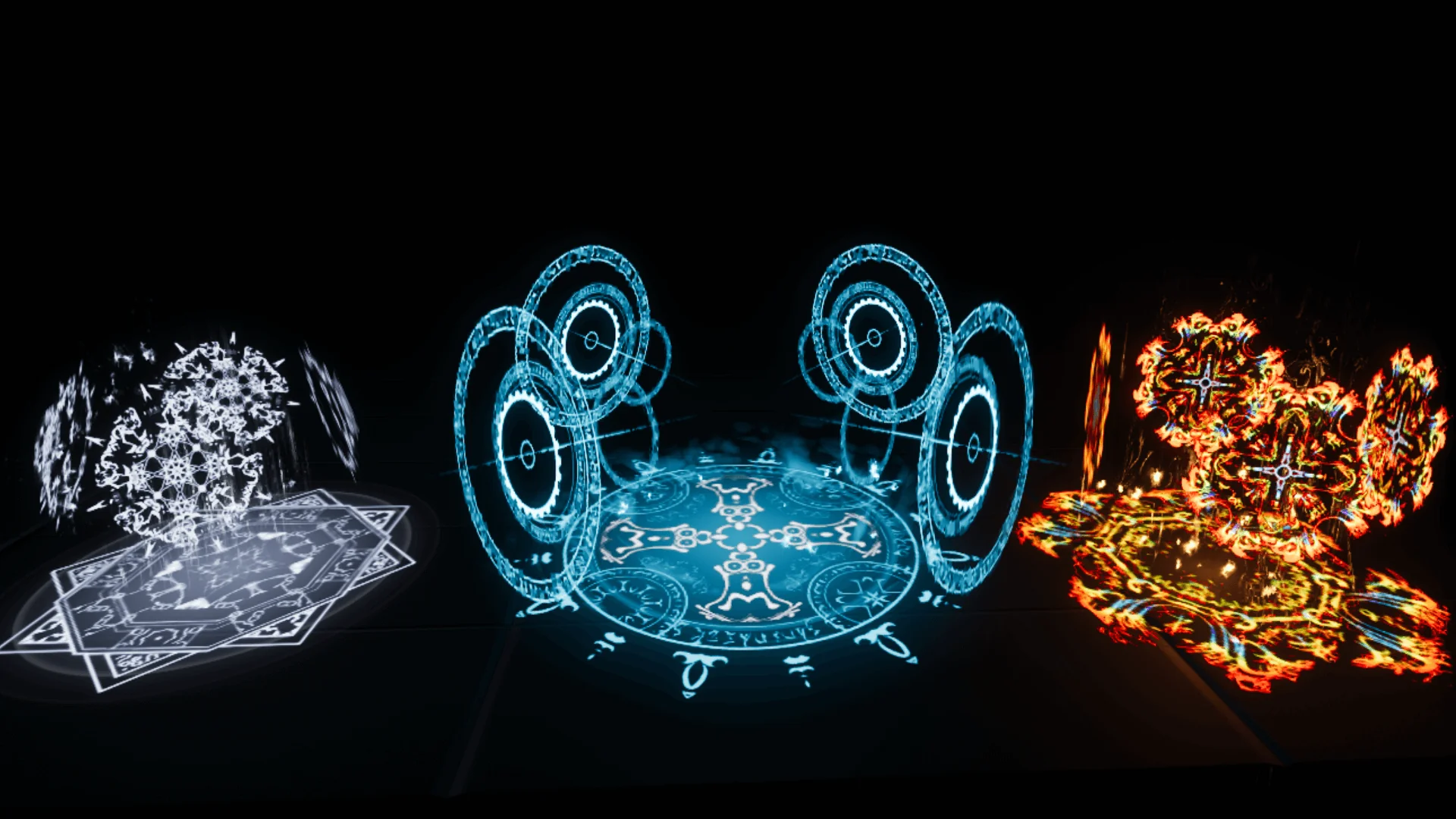
Spellcasting systems often demand distinct visual identities for different schools of combat. Advanced Magic Circle 1 covers a broad stylistic spectrum by supplying presets tailored to diverse themes, ranging from traditional high-fantasy sorcery to technological interfaces.
The package organizes its visual treatments across multiple core attributes:
Fire: Fiery perimeter rings, glowing embers, and high-heat combustion themes suited for pyromancy and explosive area-of-effect spells.
Ice: Frost-tinted runic seals suited to freeze fields, slowing zones, and cryo-based magical effects.
Thunder: High-frequency electrical discharges and flashing lightning arcs that pulse through the circle geometry to indicate shock hazards.
Wind: Swirling vortex patterns and draft currents suggesting air manipulation, updrafts, or evasive protective rings.
Water: Fluid, aquatic ripples and cresting waves mapped into circular boundary rings for hydro-magic or cleansing areas.
Dark: Shadowy energy fields, deep-tinted runes, and abyssal effects built for necromancy, curses, or sinister incantations.
Sci-Fi: Digital grids, holographic rings, and electronic circuit patterns that transition the package from high fantasy into futuristic and cyberpunk contexts.
Shine and Pure Spell Visuals: Radiant, luminous arrays suited for holy magic, healing pools, or generic arcane charging plates where neutral light is preferred.
Because these variations share a unified circular design logic, they provide consistent visual language across an entire game project. Whether an ability relies on burning flames, crackling thunder, or spinning holographic data rings, the structural foundation keeps gameplay telegraphs clear and legible for players navigating fast-paced action.
Advanced Architecture Across Cascade and Niagara Systems
Visual effect pipelines in Unreal Engine have evolved significantly, moving from legacy particle frameworks to dynamic simulation workflows. Advanced Magic Circle 1 bridges both sides of this technical spectrum by offering implementations in both the Cascade and Niagara systems.
The system was expanded to include dedicated NiagaraFX assets starting with Unreal Engine 4.26 and subsequent versions. For developers working within modern rendering workflows, Niagara provides direct control over particle behaviors, simulation stages, and custom parameter adjustments. When transitioning or managing assets between systems, teams working with the NiagaraFX implementation should verify that the Cascade To Niagara plugin is properly enabled in their project environment to ensure full functional compatibility.
At the same time, the inclusion of dedicated Cascade versions ensures that projects maintaining established legacy pipelines can deploy the magic circles directly without rewriting their particle infrastructure. This dual availability permits studios to phase in upgrades on their own schedule without losing access to specific elemental styles or art setups.
Particle LOD Management and Distance Optimization
Area-of-effect rings and ground-projected spell runes frequently generate dense visual density, which can burden graphics performance when multiple abilities overlap during combat encounters. Within the Cascade setup, Advanced Magic Circle 1 integrates particle Level of Detail (LOD) systems directly into the emitters.
Particle LODs automatically adjust the density, complexity, and active emitter modules based on the camera distance relative to the spell origin. When an actor triggers a circle immediately beside the active viewport, the effect displays full particle fidelity, sharp runic layers, and detailed peripheral sparks. As the player or camera pulls back—such as in top-down action RPGs, real-time strategy perspectives, or distant multiplayer skirmishes—the LOD system trims down computational overhead by reducing sub-particle counts and non-critical emitter layers.
This optimization layer protects frame rates during intense battles where multiple characters might cast fire, thunder, or dark magic rings simultaneously. It preserves rendering performance without stripping away the visual clarity needed to recognize which spell is being cast from across the battlefield.
Integrating Advanced Magic Circle 1 into Real-Time Gameplay
Ground runes and elemental plates serve clear mechanical functions beyond background decoration. In practical game development, these circles tie directly into character state machines, animation notifies, and encounter logic.
During skill execution, a character blueprint can spawn a selected circle asset at the player's feet or at a target location during a casting telegraph window. The sharp boundaries of the magic circle define the exact gameplay volume where damage, healing, or status ailments apply. For instance, pairing a wind circle with a knockback mechanic or linking an ice circle to a movement-debuff trigger lets visual design reinforce player expectations instantly.
The sci-fi variants fit smoothly into non-magical settings. Deploying a sci-fi circle asset beneath a terminal, an automated defense turret, or a teleportation pad transforms the magical symbol into a holographic projection or scanning perimeter. This flexibility allows technical artists and designers to rely on a single, standardized effect set to satisfy distinct art direction needs across varied project genres.
Production Utility in Engine Projects
Advanced Magic Circle 1 supplies a wide palette of elemental and technical visual themes while maintaining balanced technical options across Cascade and Niagara. By incorporating particle LODs to manage distant rendering loads and offering explicit support from Unreal Engine 4.26 onward, it functions as an efficient solution for teams building responsive, readable spellcasting systems.
 Spells & Combat
 Spells & Combat
 Spells & Combat