"b00678cacce53329"{"id":"1002814","slug":"modular-magic-circles","title":"Modular Magic Circles","category":"Spells \u0026 Combat","engine":"4.24+,5.0+","assetVersion":"","engineVersion":"Engine Version: 4.24+,5.0+","tag":"Spells \u0026 Combat","accent":"blue","visual":"mech","summary":"Modular Magic Circles provides customizable stylized material effects for fantasy spells, featuring parameterized instances and an interactive showcase room.","platform":"Unreal Engine","indexPolicy":"index","publishedAt":"2026-11-20T07:49:33.103Z","updatedAt":"2026-11-20T07:49:33.103Z","sourceNotes":[],"fileContents":[],"compatibility":["Unreal Engine","Engine Version: 4.24+,5.0+"],"featuredImage":{"alt":"Modular Magic Circles","src":"/wp-content/uploads/published/2026/11/51a88441a75f-3b20c0df-6cd8-4c68-9f2e-3b2527629bf8-113504a1a6.webp"},"fileSizeBytes":90490241,"hasDownloadLink":true,"downloads":0,"terms":[{"taxonomy":"category","slug":"spells-and-combat","name":"Spells \u0026 Combat"}],"galleryImages":[{"src":"/wp-content/uploads/published/2026/11/f66104391977-7b748546-cf77-4eed-8bdd-e5b37f71ca68-9454b2a6cf.webp","alt":"Modular Magic Circles"},{"src":"/wp-content/uploads/published/2026/11/05e71c3569d4-c8425fb1-aa2c-4842-a600-ac62f30f0c1b-84b4866566.webp","alt":"Modular Magic Circles"},{"src":"/wp-content/uploads/published/2026/11/63688edaa42a-b76d1e88-99a4-45ab-b5c0-dd6f20224c21-68b8f22f96.webp","alt":"Modular Magic Circles"},{"src":"/wp-content/uploads/published/2026/11/502b120076b1-3bae8e91-9c77-4304-8b21-644b95c528d0-bad300b901.webp","alt":"Modular Magic Circles"},{"src":"/wp-content/uploads/published/2026/11/9e83c8a89bbe-7797c760-97ce-452c-8efb-535465fa0d92-8aa767d567.webp","alt":"Modular Magic Circles"}],"accessPanel":{"kind":"resource","title":"Get this resource","safetyNote":"Resources are manually reviewed before listing to improve quality and reduce obvious risks.","fileName":"Content.7z","resourceType":"Resource archive","versions":[]},"contentHtml":"\u003ch2\u003eModular Material Effects and Instance Architecture\u003c/h2\u003e\u003cp\u003eConstructing visual magic systems for real-time environments requires balancing aesthetic distinctiveness with technical efficiency. Modular Magic Circles addresses this design requirement by deploying a structure based on multiple instances of modular material effects. Rather than relying on singular, static texture sheets or rigid graphic arrays that only serve a single spell, the package organizes visual effects through an instanced hierarchy. This material framework enables diverse circular visual manifestations to stem from common modular logic, allowing individual circles to exhibit distinct silhouettes, patterns, and dynamic characteristics.\u003c/p\u003e\u003cp\u003eMaterial instancing serves as a foundational workflow method in modern real-time visual development. By generating variations through instances rather than standalone master materials, visual designers can construct bespoke magic circle variants without continually recompiling complex shader graphs. In Modular Magic Circles, adjustments made at the instance level propagate predictably, ensuring stability across different environmental contexts and gameplay scenarios. This modular logic means that a single unified material system can produce casting runes, summoning seals, protective barriers, and area-of-effect visual markers simply by shifting the underlying parameters assigned to each instance.\u003c/p\u003e\u003cp\u003eOn top of that, managing visual assets through modular material effects streamlines overall project maintenance. Instead of populating project directories with dozens of redundant visual assets, artists work with structured instances derived from modular parent setups. This keeps visual assets organized, reduces asset management friction across production teams, and provides a clear path for duplicating, refining, and testing new spell appearances whenever gameplay requirements evolve.\u003c/p\u003e\u003ch2\u003eCustomizing Magic Circles Through Parameter Controls\u003c/h2\u003e\u003cp\u003eThe core utility of Modular Magic Circles lies in its extensive parameterization. Every magic circle provided within the package is customizable through multiple parameters, giving technical artists and designers fine-grained control over how each effect manifests in a scene. Because these material instances expose operational controls directly, creators do not need to accept locked, pre-rendered graphics; they can tune the visuals directly to match the precise aesthetic tone of their specific fantasy project.\u003c/p\u003e\u003cp\u003eParameter adjustment allows for detailed tailoring of individual visual components. Depending on the desired effect, developers can manipulate settings that govern the clarity, presence, and structural density of the circles. In stylized fantasy production, magical abilities vary widely in magnitude and function. A minor defensive cantrip might require delicate, faintly glowing boundary lines, while a catastrophic elemental ritual demands heavy concentric rings, sharp geometric runes, and intense visual prominence. By modifying the parameters exposed within each modular instance, developers can configure an effect to fit anywhere along this visual hierarchy, ranging from subtle ambient environmental indicators to high-impact gameplay focal points.\u003c/p\u003e\u003cp\u003eThis level of direct parameter control minimizes the need to jump between external image authoring programs and the game engine. Rather than generating fresh texture files every time an art director requests a sharper edge, a different line balance, or an alternate visual density, adjustments are handled entirely within the material properties. The modular framework encourages continuous iteration, allowing artists to rapidly test visual alignments, evaluate contrast against terrain surfaces, and fine-tune effect parameters until the circle achieves the exact intended balance.\u003c/p\u003e\u003ch2\u003eExploring Circle Variations Inside the Showcase Room\u003c/h2\u003e\u003cp\u003eTo demonstrate the operational range of its modular material logic, Modular Magic Circles includes a dedicated showcase room. This demonstration environment exhibits several distinct possibilities achievable with the package, providing immediate visual examples of how different parameter combinations translate into finished stylized spell effects.\u003c/p\u003e\u003cp\u003eThe showcase room serves both as an aesthetic gallery and a functional testing environment. Within this controlled space, developers can inspect individual magic circles under neutral conditions, observing how specific patterns hold up at varying distances and camera angles. Seeing several possibilities placed side by side illustrates how diverse the output can become when different parameter sets are applied to the modular material effects. One setup might present a clean, minimalist arcane boundary, while an adjacent setup displays an intricate, layered summoning circle composed of nested geometric rings and intricate runic scripts.\u003c/p\u003e\u003cp\u003eIn addition to serving as a visual reference, the showcase room provides a practical starting point for technical experimentation. Creators looking to build unique spells do not have to begin from a blank slate; they can dissect the pre-built configurations present in the room, identify the specific parameter adjustments responsible for particular visual traits, and use those configurations as templates for their own custom creations. By providing plenty of options to experiment with, the showcase space accelerates the learning process and demonstrates concrete implementations of the underlying material tools.\u003c/p\u003e\u003ch2\u003eStylized Aesthetics and Magical Spell Roles\u003c/h2\u003e\u003cp\u003eStylized visual effects require bold graphical clarity, distinct silhouettes, and clean shapes that communicate gameplay information instantly. Modular Magic Circles targets this stylized visual language, emphasizing crisp lines and well-defined runic geometry that remain legible during rapid action. In real-time fantasy games, magic circles frequently project across varied terrain, adhere to dynamic world geometry, or attach to player character rigs. Under these conditions, visual readability is critical to ensure players can quickly interpret spell boundaries and active areas of effect.\u003c/p\u003e\u003cp\u003eThe package's stylized design makes it suitable for a broad spectrum of fantasy gameplay applications. In tactical combat encounters, visual clarity helps players differentiate between friendly buff areas, hostile area denial zones, and pending ground-targeted attacks. Summoning spells benefit from broad, multi-layered rings that establish a sense of scale, while fast-acting combat abilities rely on compact, sharp circular runes that signal rapid spell resolution without overwhelming the screen with visual noise.\u003c/p\u003e\u003cp\u003eBecause the material logic is entirely modular, creators can emphasize or isolate specific visual features to fit different gameplay conventions. Whether an encounter demands an expansive, stationary runic circle for an environmental puzzle, a series of concentric protective rings surrounding a guardian character, or a sharp cast circle signaling an incoming projectile, the exposed parameters allow the effect to be molded to the functional context of the encounter. This visual flexibility ensures that the material effects remain consistent with stylized fantasy world-building while fulfilling clear communicative roles during play.\u003c/p\u003e\u003ch2\u003eDocumentation Instructions and Modular Asset Ecosystem\u003c/h2\u003e\u003cp\u003eTo help creators implement and customize the material instances efficiently, Modular Magic Circles is accompanied by structured documentation delivered via Google Document instructions. This instructional material provides clear guidance on the package's architecture, walking users through the process of configuring material instances, adjusting parameters, and deploying the effects correctly within their project scenes. By consulting the documentation, developers can understand how the modular parameters interact, ensuring a smooth setup process when incorporating the circles into production pipelines.\u003c/p\u003e\u003cp\u003eThe package forms part of a cohesive collection of technical art and gameplay assets created under a shared modular methodology. Other toolsets developed alongside this package include Force Shields, the Material Function Collection, Prototype Grid Material, and the First-Person Platformer Template, as well as a comprehensive 4-pack Bundle combining multiple graphical toolsets. These complementary releases highlight an engineering philosophy focused on parameterized, reusable materials and practical technical frameworks that reduce production overhead for independent developers and visual artists alike.\u003c/p\u003e\u003cp\u003eThrough the combination of clear instructional documentation, an experimental showcase room exhibiting multiple possibilities, and deeply customizable material instances, Modular Magic Circles provides a versatile visual framework. Technical artists and game designers can leverage its modular material effects to rapidly construct, refine, and deploy stylized magical circles tailored precisely to their gameplay systems and aesthetic goals.\u003c/p\u003e\n\n\u003ch2\u003eRelated Resources Worth Checking\u003c/h2\u003e\n\u003cul\u003e\n\u003cli\u003e\u003ca href=\"https://3dcghub.com/ky-magic-chant-fx/\" rel=\"noopener noreferrer\"\u003eKY Magic Chant FX\u003c/a\u003e\u003c/li\u003e\n\u003cli\u003e\u003ca href=\"https://3dcghub.com/magic-circles-and-shields-2/\" rel=\"noopener noreferrer\"\u003eMagic Circles and Shields 2\u003c/a\u003e\u003c/li\u003e\n\u003cli\u003e\u003ca href=\"https://3dcghub.com/cosmic-vfx/\" rel=\"noopener noreferrer\"\u003eCosmic VFX\u003c/a\u003e\u003c/li\u003e\n\u003cli\u003e\u003ca href=\"https://3dcghub.com/sky-open-vfx/\" rel=\"noopener noreferrer\"\u003eSky Open VFX\u003c/a\u003e\u003c/li\u003e\n\u003cli\u003e\u003ca href=\"https://3dcghub.com/advanced-magic-fx-01/\" rel=\"noopener noreferrer\"\u003eAdvanced Magic FX 01\u003c/a\u003e\u003c/li\u003e\n\u003c/ul\u003e","contentTextLength":9121,"navigation":{"current":66,"total":4797,"previous":{"id":"1002815","slug":"niagara-aura-pack","title":"Niagara Aura Pack","category":"Spells \u0026 Combat","platform":"Unreal Engine","updatedAt":"2026-11-20T07:50:08.010Z"},"next":{"id":"1002813","slug":"modular-impactfx","title":"Modular ImpactFX","category":"Spells \u0026 Combat","platform":"Unreal Engine","updatedAt":"2026-11-20T07:48:57.821Z"}},"relatedResources":[{"id":"1002863","slug":"magic-circles-and-shields","title":"Magic Circles and Shields","category":"Spells \u0026 Combat","engine":"4.24+,5.0+","assetVersion":"","engineVersion":"Engine Version: 4.24+,5.0+","tag":"Spells \u0026 Combat","accent":"blue","visual":"mech","summary":"Explore 11 unique 3D magic circles and 4 shields featuring custom textures, loop duration controls, mobile distortion adjustments, and a demo scene.","platform":"Unreal Engine","indexPolicy":"index","publishedAt":"2026-11-20T12:45:36.364Z","updatedAt":"2026-11-20T12:45:36.364Z","sourceNotes":[],"fileContents":[],"compatibility":["Unreal Engine","Engine Version: 4.24+,5.0+"],"featuredImage":{"alt":"Magic Circles and Shields","src":"/wp-content/uploads/published/2026/11/b5bbce61447a-4a263956-4f19-4121-a398-515b2e7fb7aa-46dfb724fb.webp"},"fileSizeBytes":67001768,"hasDownloadLink":true,"downloads":0},{"id":"1002796","slug":"ky-magic-chant-fx","title":"KY Magic Chant FX","category":"Spells \u0026 Combat","engine":"4.12+,5.0+","assetVersion":"","engineVersion":"Engine Version: 4.12+,5.0+","tag":"Spells \u0026 Combat","accent":"blue","visual":"mech","summary":"A detailed technical breakdown of KY Magic Chant FX, featuring 33 magic chant circle effects across Niagara and Cascade pipelines.","platform":"Unreal Engine","indexPolicy":"index","publishedAt":"2026-11-20T07:20:53.760Z","updatedAt":"2026-11-20T07:20:53.760Z","sourceNotes":[],"fileContents":[],"compatibility":["Unreal Engine","Engine Version: 4.12+,5.0+"],"featuredImage":{"alt":"KY Magic Chant FX","src":"/wp-content/uploads/published/2026/11/a9c693298b3d-459e9b4f-a1e9-427b-a42e-788f325a9537-a725cd44e2.webp"},"fileSizeBytes":54725656,"hasDownloadLink":true,"downloads":0},{"id":"16419","slug":"magic-circles-and-shields-2","title":"Magic Circles and Shields 2","category":"Spells \u0026 Combat","engine":"4.26+,5.0+","assetVersion":"Engine version: 4.26+,5.0+","engineVersion":"4.24","tag":"Spells \u0026 Combat","accent":"blue","visual":"audio","summary":"Magic Circles and Shields 2 is a professional collection of 3D visual effects designed for fantasy games. It includes unique textures and customizable loops for diverse magical applications.","platform":"Unreal Engine","indexPolicy":"noindex","publishedAt":"2026-03-12T17:06:26.000Z","updatedAt":"2026-04-19T15:44:33.000Z","sourceNotes":[],"fileContents":[],"compatibility":["Unreal Engine","Engine version: 4.26+,5.0+"],"featuredImage":{"alt":"Magic Circles and Shields 2","src":"https://3dcghub.com/wp-content/uploads/2026/03/35f8e386-04e0-4c96-973e-de822e9f047a.webp"},"fileSizeBytes":69428012,"hasDownloadLink":true,"downloads":1}]}
Resource screenshots
1 / 5
Join our channel
Follow 3DCGHUB on Telegram for new resource drops, migration updates, and community notices.
Resources are manually reviewed before listing to improve quality and reduce obvious risks.
No account required
Spells & Combat
Modular Magic Circles
Modular Magic Circles provides customizable stylized material effects for fantasy spells, featuring parameterized instances and an interactive showcase room.
Modular Material Effects and Instance Architecture
Constructing visual magic systems for real-time environments requires balancing aesthetic distinctiveness with technical efficiency. Modular Magic Circles addresses this design requirement by deploying a structure based on multiple instances of modular material effects. Rather than relying on singular, static texture sheets or rigid graphic arrays that only serve a single spell, the package organizes visual effects through an instanced hierarchy. This material framework enables diverse circular visual manifestations to stem from common modular logic, allowing individual circles to exhibit distinct silhouettes, patterns, and dynamic characteristics.
Material instancing serves as a foundational workflow method in modern real-time visual development. By generating variations through instances rather than standalone master materials, visual designers can construct bespoke magic circle variants without continually recompiling complex shader graphs. In Modular Magic Circles, adjustments made at the instance level propagate predictably, ensuring stability across different environmental contexts and gameplay scenarios. This modular logic means that a single unified material system can produce casting runes, summoning seals, protective barriers, and area-of-effect visual markers simply by shifting the underlying parameters assigned to each instance.
On top of that, managing visual assets through modular material effects streamlines overall project maintenance. Instead of populating project directories with dozens of redundant visual assets, artists work with structured instances derived from modular parent setups. This keeps visual assets organized, reduces asset management friction across production teams, and provides a clear path for duplicating, refining, and testing new spell appearances whenever gameplay requirements evolve.
Customizing Magic Circles Through Parameter Controls
The core utility of Modular Magic Circles lies in its extensive parameterization. Every magic circle provided within the package is customizable through multiple parameters, giving technical artists and designers fine-grained control over how each effect manifests in a scene. Because these material instances expose operational controls directly, creators do not need to accept locked, pre-rendered graphics; they can tune the visuals directly to match the precise aesthetic tone of their specific fantasy project.
Parameter adjustment allows for detailed tailoring of individual visual components. Depending on the desired effect, developers can manipulate settings that govern the clarity, presence, and structural density of the circles. In stylized fantasy production, magical abilities vary widely in magnitude and function. A minor defensive cantrip might require delicate, faintly glowing boundary lines, while a catastrophic elemental ritual demands heavy concentric rings, sharp geometric runes, and intense visual prominence. By modifying the parameters exposed within each modular instance, developers can configure an effect to fit anywhere along this visual hierarchy, ranging from subtle ambient environmental indicators to high-impact gameplay focal points.
This level of direct parameter control minimizes the need to jump between external image authoring programs and the game engine. Rather than generating fresh texture files every time an art director requests a sharper edge, a different line balance, or an alternate visual density, adjustments are handled entirely within the material properties. The modular framework encourages continuous iteration, allowing artists to rapidly test visual alignments, evaluate contrast against terrain surfaces, and fine-tune effect parameters until the circle achieves the exact intended balance.
Exploring Circle Variations Inside the Showcase Room
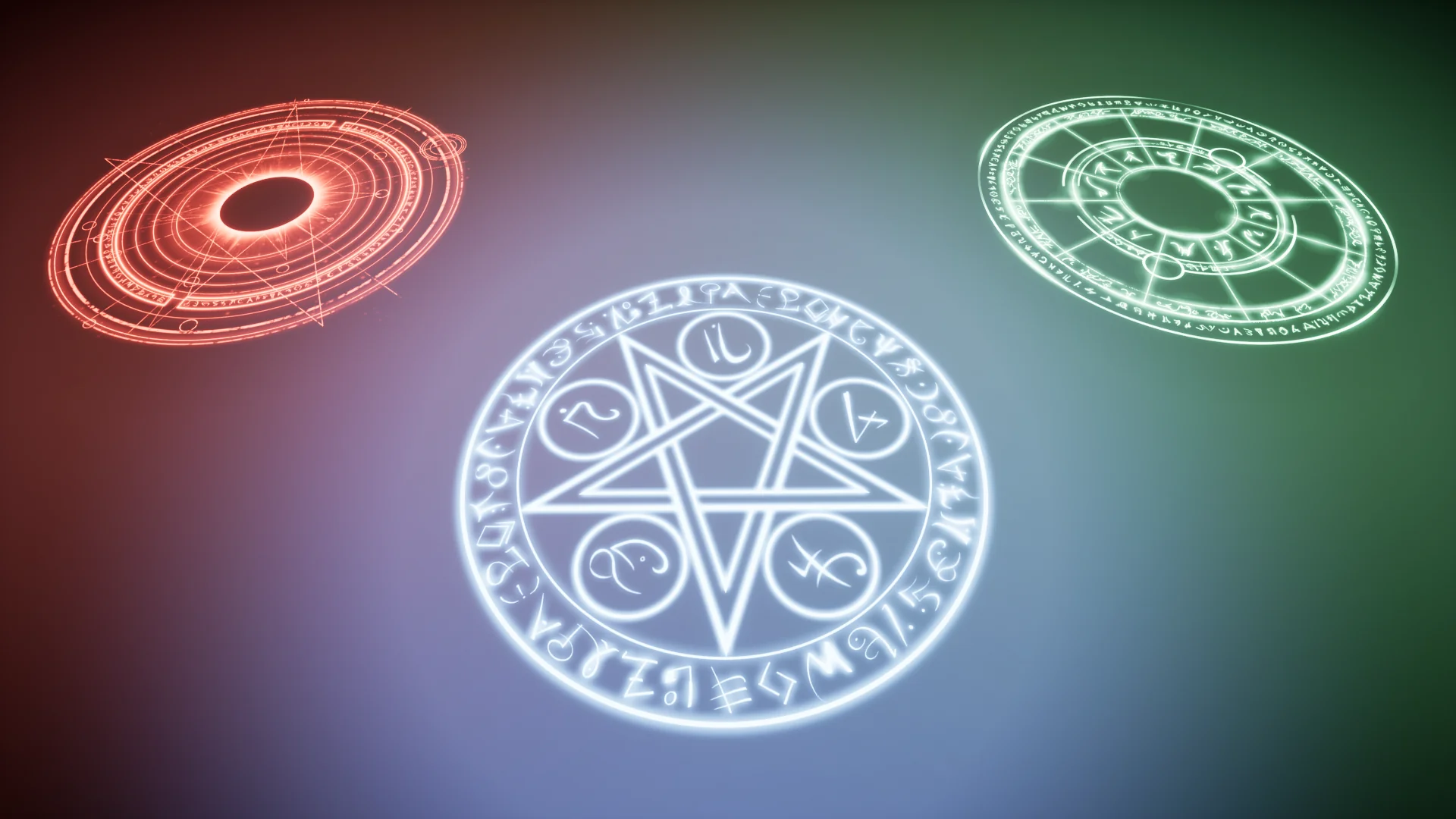
To demonstrate the operational range of its modular material logic, Modular Magic Circles includes a dedicated showcase room. This demonstration environment exhibits several distinct possibilities achievable with the package, providing immediate visual examples of how different parameter combinations translate into finished stylized spell effects.
The showcase room serves both as an aesthetic gallery and a functional testing environment. Within this controlled space, developers can inspect individual magic circles under neutral conditions, observing how specific patterns hold up at varying distances and camera angles. Seeing several possibilities placed side by side illustrates how diverse the output can become when different parameter sets are applied to the modular material effects. One setup might present a clean, minimalist arcane boundary, while an adjacent setup displays an intricate, layered summoning circle composed of nested geometric rings and intricate runic scripts.
In addition to serving as a visual reference, the showcase room provides a practical starting point for technical experimentation. Creators looking to build unique spells do not have to begin from a blank slate; they can dissect the pre-built configurations present in the room, identify the specific parameter adjustments responsible for particular visual traits, and use those configurations as templates for their own custom creations. By providing plenty of options to experiment with, the showcase space accelerates the learning process and demonstrates concrete implementations of the underlying material tools.
Stylized Aesthetics and Magical Spell Roles
Stylized visual effects require bold graphical clarity, distinct silhouettes, and clean shapes that communicate gameplay information instantly. Modular Magic Circles targets this stylized visual language, emphasizing crisp lines and well-defined runic geometry that remain legible during rapid action. In real-time fantasy games, magic circles frequently project across varied terrain, adhere to dynamic world geometry, or attach to player character rigs. Under these conditions, visual readability is critical to ensure players can quickly interpret spell boundaries and active areas of effect.
The package's stylized design makes it suitable for a broad spectrum of fantasy gameplay applications. In tactical combat encounters, visual clarity helps players differentiate between friendly buff areas, hostile area denial zones, and pending ground-targeted attacks. Summoning spells benefit from broad, multi-layered rings that establish a sense of scale, while fast-acting combat abilities rely on compact, sharp circular runes that signal rapid spell resolution without overwhelming the screen with visual noise.
Because the material logic is entirely modular, creators can emphasize or isolate specific visual features to fit different gameplay conventions. Whether an encounter demands an expansive, stationary runic circle for an environmental puzzle, a series of concentric protective rings surrounding a guardian character, or a sharp cast circle signaling an incoming projectile, the exposed parameters allow the effect to be molded to the functional context of the encounter. This visual flexibility ensures that the material effects remain consistent with stylized fantasy world-building while fulfilling clear communicative roles during play.
Documentation Instructions and Modular Asset Ecosystem
To help creators implement and customize the material instances efficiently, Modular Magic Circles is accompanied by structured documentation delivered via Google Document instructions. This instructional material provides clear guidance on the package's architecture, walking users through the process of configuring material instances, adjusting parameters, and deploying the effects correctly within their project scenes. By consulting the documentation, developers can understand how the modular parameters interact, ensuring a smooth setup process when incorporating the circles into production pipelines.
The package forms part of a cohesive collection of technical art and gameplay assets created under a shared modular methodology. Other toolsets developed alongside this package include Force Shields, the Material Function Collection, Prototype Grid Material, and the First-Person Platformer Template, as well as a comprehensive 4-pack Bundle combining multiple graphical toolsets. These complementary releases highlight an engineering philosophy focused on parameterized, reusable materials and practical technical frameworks that reduce production overhead for independent developers and visual artists alike.
Through the combination of clear instructional documentation, an experimental showcase room exhibiting multiple possibilities, and deeply customizable material instances, Modular Magic Circles provides a versatile visual framework. Technical artists and game designers can leverage its modular material effects to rapidly construct, refine, and deploy stylized magical circles tailored precisely to their gameplay systems and aesthetic goals.
 Spells & Combat
 Spells & Combat
 Spells & Combat