"6c6413bef81af556"{"id":"1001185","slug":"advanced-glass-material-pack","title":"Advanced Glass Material Pack","category":"Shaders","engine":"5.0+","assetVersion":"","engineVersion":"Engine Version: 5.0+","tag":"Shaders","accent":"blue","visual":"luts","summary":"Examine the Advanced Glass Material Pack, featuring 5 glass types, over 35 material instances, vertex painting support, and 42 mask and normal textures.","platform":"Unreal Engine","publishedAt":"2026-09-17T06:34:49.942Z","updatedAt":"2026-09-17T06:34:49.942Z","sourceNotes":[],"fileContents":[],"compatibility":["Unreal Engine","Engine Version: 5.0+"],"featuredImage":{"alt":"Advanced Glass Material Pack","src":"/wp-content/uploads/published/2026/09/d991116315e2-090806c4-3f39-426d-8dfc-75300ddf461e-649af1b75b.webp"},"hasDownloadLink":true,"downloads":0,"terms":[{"taxonomy":"category","slug":"shaders","name":"Shaders"}],"galleryImages":[{"src":"/wp-content/uploads/published/2026/09/2da5c2b36a2c-c4d8c9cd-6f6e-4ab0-ac42-6c604d161d5b-e23a3f38b2.webp","alt":"Advanced Glass Material Pack"},{"src":"/wp-content/uploads/published/2026/09/1c35012e41d5-59568756-1d49-4ae0-b23b-e8c084d27bcc-ba03713b8e.webp","alt":"Advanced Glass Material Pack"},{"src":"/wp-content/uploads/published/2026/09/193d1ce73206-f9c5f192-d900-4ff2-9ffa-389aebc62ba7-4952fc1854.webp","alt":"Advanced Glass Material Pack"},{"src":"/wp-content/uploads/published/2026/09/3704fb80fa40-49a1d4fc-9cda-4315-9475-fcb70492e652-06939bbc25.webp","alt":"Advanced Glass Material Pack"},{"src":"/wp-content/uploads/published/2026/09/a3c8bcd97c41-5f3595b6-7893-4311-966e-1bbcf8bf198b-71f946feca.webp","alt":"Advanced Glass Material Pack"}],"accessPanel":{"kind":"resource","title":"Download this resource","eyebrow":"Free Download","message":"Log in or create a free account to start your download.","fileName":"Content.7z","safetyNote":"Resources are manually reviewed before listing to improve quality and reduce obvious risks.","actionLabel":"Download Free","resourceType":"Resource archive"},"contentHtml":"\u003cp\u003eGlass in interactive environments demands far more than simple surface transparency. A window in an abandoned facility reflects age differently than a modern automotive windshield, just as frosted refrigeration panes scatter light differently from rainfall on an exterior display case. The Advanced Glass Material Pack addresses this broad range of physical conditions by grouping translucent surfaces into distinct behavioral states: clean, dirty, frozen, shattered, and wet. Rather than forcing artists to treat glass as an immutable, uniform layer, the collection builds its visual response around surface manipulation, localized distress, and instance-level adjustments.\u003c/p\u003e \u003ch2\u003eFive Core Formats: From Clean Acrylic to Shattered Panes\u003c/h2\u003e\n\u003cp\u003eThe pack is anchored by five fundamental classifications of glass, each handling visibility, distortion, and surface contaminants through dedicated parameters:\u003c/p\u003e\n\u003cul\u003e \u003cli\u003e\u003cstrong\u003eClean Glass:\u003c/strong\u003e Encompasses pristine structural panes, tinted colored variants, patterned decorative panels, and smooth synthetic sheets such as acrylic. Light passes through with minimal scattering, prioritizing crisp specular highlights and controlled transmission tints.\u003c/li\u003e \u003cli\u003e\u003cstrong\u003eDirty Glass:\u003c/strong\u003e Simulates environmental exposure through particulate layers, dusty films, and dried liquid stains. These surface layers break up clear reflections and diffuse transmitted light according to accumulated residue.\u003c/li\u003e \u003cli\u003e\u003cstrong\u003eFrozen Glass:\u003c/strong\u003e Recreates cold-weather condensation and crystallization. Structural surfaces exhibit frost build-up that softens visibility, occludes background elements, and spreads light broad across frozen crystalline formations.\u003c/li\u003e \u003cli\u003e\u003cstrong\u003eShattered Glass:\u003c/strong\u003e Introduces structural fractures, fissure networks, and impact cracks. Internal fracture lines scatter internal reflections and bend light aggressively along sharp mechanical breaks.\u003c/li\u003e \u003cli\u003e\u003cstrong\u003eWet Glass:\u003c/strong\u003e Mimics active liquid presence, water droplets, and moisture films. Refractive bead patterns and damp surfaces alter the underlying specular clarity, creating liquid trails and variable surface tension effects.\u003c/li\u003e\n\u003c/ul\u003e \u003ch2\u003eForty-Two Masks and Normal Maps Driving Translucency\u003c/h2\u003e\n\u003cp\u003eLight transmission and distortion in the collection rely on an asset library of 42 textures composed entirely of masks and normal maps. These texture assets are not static diffuse illustrations; instead, they serve as mathematical drivers for light deflection and surface breakup. Normal maps define the micro-relief of structural ribs, manufacturing waves in acrylic, the sharp displacement of cracked edges, and the rounded contours of standing water beads. When light encounters these surface normals, it redirects refraction rays to produce convincing visual distortions without altering underlying mesh geometry.\u003c/p\u003e\n\u003cp\u003eWorking alongside the normal maps, the texture masks isolate specific material channels. Dirt accumulation, water run-off, frost density, and stain patterns are mapped to distinct grayscale channels. This separation allows ambient environment light to calculate clean transmission on one part of a panel while catching rough, scattering dust particles on another. Because these maps operate across 42 specialized files, the material setups can produce varied surface looks without relying on a single repetitive grime pass across an entire environment.\u003c/p\u003e \u003ch2\u003eCustom Texture Overrides Across Material Instances\u003c/h2\u003e\n\u003cp\u003eManaging glass properties across multiple scene props is streamlined through more than 35 pre-configured material instances. These instances demonstrate varied ready-to-use setups, allowing technical artists and environment dressers to inspect how specific values shape distinct styles of translucent surfaces.\u003c/p\u003e\n\u003cp\u003eBeyond the pre-made examples, the master setup is constructed around an easy and flexible Material Instance workflow. Central to this system is the ability to feed custom textures directly into key material overrides:\u003c/p\u003e\n\u003cul\u003e \u003cli\u003e\u003cstrong\u003eOpacity Overrides:\u003c/strong\u003e Artists can plug in project-specific alpha channels or density masks to dictate precisely where a surface transitions from transparent visibility to complete occlusion.\u003c/li\u003e \u003cli\u003e\u003cstrong\u003eRefraction Overrides:\u003c/strong\u003e Custom maps let users control the intensity of light bending, tailoring index-of-refraction response to represent thin acrylic sheets, standard commercial windowpanes, or thick industrial glass.\u003c/li\u003e \u003cli\u003e\u003cstrong\u003eRoughness Overrides:\u003c/strong\u003e Surface sheen can be tuned from razor-sharp mirror reflections down to entirely matte, frosted scatter by swapping in external roughness maps or dialing instance scalar values.\u003c/li\u003e\n\u003c/ul\u003e\n\u003cp\u003eThis override architecture ensures that proprietary studio textures, bespoke company logos, etched motifs, or tailored impact maps integrate into the shading system without touching the core graph logic.\u003c/p\u003e \u003ch2\u003eBlending Surface Conditions with Vertex Paint Support\u003c/h2\u003e\n\u003cp\u003eStatic window panes often feel artificial because real-world surfaces rarely exhibit a single, uniform state. The Advanced Glass Material Pack addresses this by incorporating native vertex paint support. By using vertex color channels directly within the viewport, level designers can paint dynamic transitions onto meshes without baking unique UV textures for every asset.\u003c/p\u003e\n\u003cp\u003eVertex painting allows a pane of glass to transition seamlessly from a clean, transparent center to dirty, stained edges where a frame collects runoff. Similarly, artists can paint shattered fracture patterns around specific impact points while keeping the perimeter intact, or apply frost buildup along the cold lower edge of an industrial refrigeration door that dissipates toward the top. In exterior setups, vertex painting allows rain-drenched wet glass to pool along horizontal sills while vertical sections remain clear. This mesh-level painting capability turns standard geometric planes into bespoke environmental storytelling props.\u003c/p\u003e \u003ch2\u003eIndustrial, Automotive, and Architectural Adaptability\u003c/h2\u003e\n\u003cp\u003eThe collection spans multiple practical categories, making it applicable to industrial enclosures, automotive design, realistic architecture, and general interior windows. In automotive contexts, clean and wet instances serve windshields, indicator covers, and mirrors, while dirt masks accommodate weathered vehicles operating in off-road or industrial terrain. Architectural visualizations benefit from the clean acrylic, patterned dividers, and colored decorative panels, providing realistic translucent screening for interior partitions and modern facades.\u003c/p\u003e\n\u003cp\u003eBecause the pack focuses on modular parameters rather than locked-in looks, the combination of 42 textures, 35 ready-made instances, and direct vertex paint manipulation provides a robust foundation for any scene requiring authentic translucent glass behavior.\u003c/p\u003e\n\n\u003ch2\u003eContinue Browsing Similar Packs\u003c/h2\u003e\n\u003cul\u003e\n\u003cli\u003e\u003ca href=\"https://3dcghub.com/liquid-materials-vfx-pack/\" title=\"LIQUID MATERIALS : VFX Pack\"\u003eLIQUID MATERIALS : VFX Pack\u003c/a\u003e\u003c/li\u003e\n\u003cli\u003e\u003ca href=\"https://3dcghub.com/volumetric-glass/\" title=\"Volumetric Glass\"\u003eVolumetric Glass\u003c/a\u003e\u003c/li\u003e\n\u003cli\u003e\u003ca href=\"https://3dcghub.com/crystal-vfx-pack/\" title=\"Crystal VFX Pack\"\u003eCrystal VFX Pack\u003c/a\u003e\u003c/li\u003e\n\u003cli\u003e\u003ca href=\"https://3dcghub.com/lens-and-film-post-process/\" title=\"Lens and Film Post Process\"\u003eLens and Film Post Process\u003c/a\u003e\u003c/li\u003e\n\u003cli\u003e\u003ca href=\"https://3dcghub.com/energy-ball-vfx-pack/\" title=\"Energy Ball VFX Pack\"\u003eEnergy Ball VFX Pack\u003c/a\u003e\u003c/li\u003e\n\u003c/ul\u003e","contentTextLength":6738,"navigation":{"current":13,"total":3140,"previous":{"id":"1001186","slug":"colorama","title":"Colorama","category":"Shaders","platform":"Unreal Engine","updatedAt":"2026-09-17T06:37:24.617Z"},"next":{"id":"1001184","slug":"semi-permanent-blood-droplets","title":"Semi-Permanent Blood Droplets","category":"Liquid","platform":"Unreal Engine","updatedAt":"2026-09-17T06:32:56.595Z"}},"relatedResources":[{"id":"1000844","slug":"liquid-materials-vfx-pack","title":"LIQUID MATERIALS : VFX Pack","category":"Shaders","engine":"5.1+","assetVersion":"","engineVersion":"Engine Version: 5.1+","tag":"Shaders","accent":"blue","visual":"luts","summary":"LIQUID MATERIALS: VFX Pack provides 23 meshes, 13 glass materials, and 13 liquid materials with automatic Niagara-based real-time fluid animation for Unreal Eng","platform":"Unreal Engine","publishedAt":"2026-08-04T07:08:15.893Z","updatedAt":"2026-08-04T07:08:15.893Z","sourceNotes":[],"fileContents":[],"compatibility":["Unreal Engine","Engine Version: 5.1+"],"featuredImage":{"alt":"LIQUID MATERIALS : VFX Pack","src":"/wp-content/uploads/published/2026/08/031b6a53ab5b-856b12c0-66b3-4f90-9a63-103fd8b06400-4230560477.webp"},"hasDownloadLink":true,"downloads":2},{"id":"1000156","slug":"volumetric-glass","title":"Volumetric Glass","category":"Shaders","engine":"4.26+,5.0+","assetVersion":"","engineVersion":"Engine Version: 4.26+,5.0+","tag":"Shaders","accent":"blue","visual":"mech","summary":"Volumetric Glass is a master material for underwater volume and shaped glass, optimized for VR, PC/Console, and mobile sci-fi scenes.","platform":"Unreal Engine","publishedAt":"2026-06-18T22:24:38.713Z","updatedAt":"2026-06-18T22:24:38.713Z","sourceNotes":[],"fileContents":[],"compatibility":["Unreal Engine","Engine Version: 4.26+,5.0+"],"featuredImage":{"alt":"Volumetric Glass","src":"/wp-content/uploads/published/2026/06/e17367fbe13f-98b3ac2f-dae2-4afb-af8c-205793d089f6-eb59282112.webp"},"hasDownloadLink":true,"downloads":0},{"id":"15776","slug":"crystal-vfx-pack","title":"Crystal VFX Pack","category":"Shaders","engine":"5.0+","assetVersion":"Engine version: 5.0+","engineVersion":"5.0","tag":"Shaders","accent":"blue","visual":"mech","summary":"Enhance your project with the Crystal VFX Pack, featuring over 26 customizable sets, high-quality Niagara systems, and dynamic materials for realistic gemstones.","platform":"Unreal Engine","publishedAt":"2026-03-12T13:05:30.000Z","updatedAt":"2026-04-19T15:44:41.000Z","sourceNotes":[],"fileContents":[],"compatibility":["Unreal Engine","Engine version: 5.0+"],"featuredImage":{"alt":"Crystal VFX Pack","src":"https://3dcghub.com/wp-content/uploads/2026/03/fe5bd575-1857-4339-8737-4d3534cda831.webp"},"hasDownloadLink":true,"downloads":1}]}
Shaders
Advanced Glass Material Pack
Examine the Advanced Glass Material Pack, featuring 5 glass types, over 35 material instances, vertex painting support, and 42 mask and normal textures.
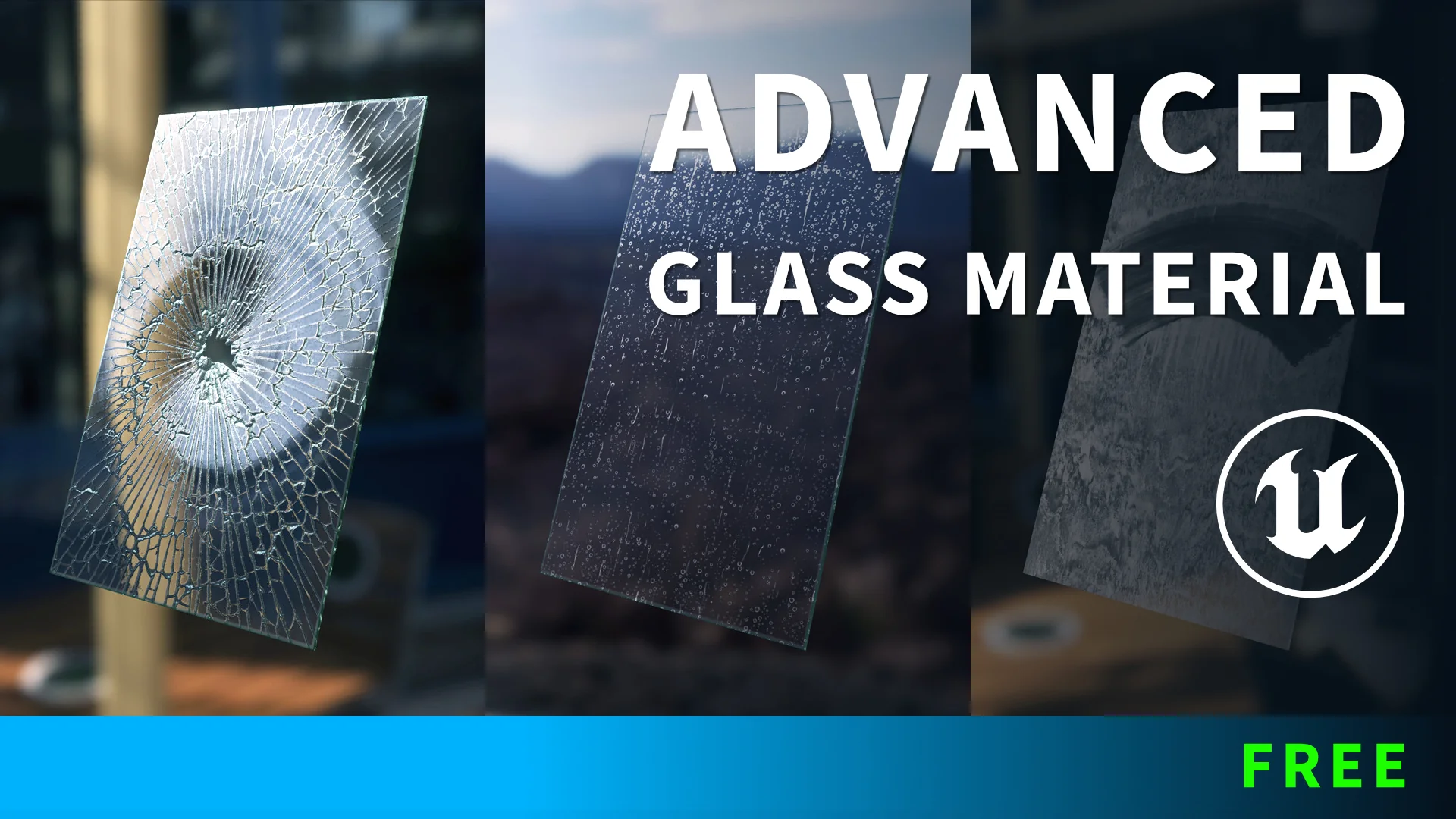
Glass in interactive environments demands far more than simple surface transparency. A window in an abandoned facility reflects age differently than a modern automotive windshield, just as frosted refrigeration panes scatter light differently from rainfall on an exterior display case. The Advanced Glass Material Pack addresses this broad range of physical conditions by grouping translucent surfaces into distinct behavioral states: clean, dirty, frozen, shattered, and wet. Rather than forcing artists to treat glass as an immutable, uniform layer, the collection builds its visual response around surface manipulation, localized distress, and instance-level adjustments.
Five Core Formats: From Clean Acrylic to Shattered Panes
The pack is anchored by five fundamental classifications of glass, each handling visibility, distortion, and surface contaminants through dedicated parameters:
Clean Glass: Encompasses pristine structural panes, tinted colored variants, patterned decorative panels, and smooth synthetic sheets such as acrylic. Light passes through with minimal scattering, prioritizing crisp specular highlights and controlled transmission tints.
Dirty Glass: Simulates environmental exposure through particulate layers, dusty films, and dried liquid stains. These surface layers break up clear reflections and diffuse transmitted light according to accumulated residue.
Frozen Glass: Recreates cold-weather condensation and crystallization. Structural surfaces exhibit frost build-up that softens visibility, occludes background elements, and spreads light broad across frozen crystalline formations.
Shattered Glass: Introduces structural fractures, fissure networks, and impact cracks. Internal fracture lines scatter internal reflections and bend light aggressively along sharp mechanical breaks.
Wet Glass: Mimics active liquid presence, water droplets, and moisture films. Refractive bead patterns and damp surfaces alter the underlying specular clarity, creating liquid trails and variable surface tension effects.
Forty-Two Masks and Normal Maps Driving Translucency
Light transmission and distortion in the collection rely on an asset library of 42 textures composed entirely of masks and normal maps. These texture assets are not static diffuse illustrations; instead, they serve as mathematical drivers for light deflection and surface breakup. Normal maps define the micro-relief of structural ribs, manufacturing waves in acrylic, the sharp displacement of cracked edges, and the rounded contours of standing water beads. When light encounters these surface normals, it redirects refraction rays to produce convincing visual distortions without altering underlying mesh geometry.
Working alongside the normal maps, the texture masks isolate specific material channels. Dirt accumulation, water run-off, frost density, and stain patterns are mapped to distinct grayscale channels. This separation allows ambient environment light to calculate clean transmission on one part of a panel while catching rough, scattering dust particles on another. Because these maps operate across 42 specialized files, the material setups can produce varied surface looks without relying on a single repetitive grime pass across an entire environment.
Custom Texture Overrides Across Material Instances
Managing glass properties across multiple scene props is streamlined through more than 35 pre-configured material instances. These instances demonstrate varied ready-to-use setups, allowing technical artists and environment dressers to inspect how specific values shape distinct styles of translucent surfaces.
Beyond the pre-made examples, the master setup is constructed around an easy and flexible Material Instance workflow. Central to this system is the ability to feed custom textures directly into key material overrides:
Opacity Overrides: Artists can plug in project-specific alpha channels or density masks to dictate precisely where a surface transitions from transparent visibility to complete occlusion.
Refraction Overrides: Custom maps let users control the intensity of light bending, tailoring index-of-refraction response to represent thin acrylic sheets, standard commercial windowpanes, or thick industrial glass.
Roughness Overrides: Surface sheen can be tuned from razor-sharp mirror reflections down to entirely matte, frosted scatter by swapping in external roughness maps or dialing instance scalar values.
This override architecture ensures that proprietary studio textures, bespoke company logos, etched motifs, or tailored impact maps integrate into the shading system without touching the core graph logic.
Blending Surface Conditions with Vertex Paint Support
Static window panes often feel artificial because real-world surfaces rarely exhibit a single, uniform state. The Advanced Glass Material Pack addresses this by incorporating native vertex paint support. By using vertex color channels directly within the viewport, level designers can paint dynamic transitions onto meshes without baking unique UV textures for every asset.
Vertex painting allows a pane of glass to transition seamlessly from a clean, transparent center to dirty, stained edges where a frame collects runoff. Similarly, artists can paint shattered fracture patterns around specific impact points while keeping the perimeter intact, or apply frost buildup along the cold lower edge of an industrial refrigeration door that dissipates toward the top. In exterior setups, vertex painting allows rain-drenched wet glass to pool along horizontal sills while vertical sections remain clear. This mesh-level painting capability turns standard geometric planes into bespoke environmental storytelling props.
Industrial, Automotive, and Architectural Adaptability
The collection spans multiple practical categories, making it applicable to industrial enclosures, automotive design, realistic architecture, and general interior windows. In automotive contexts, clean and wet instances serve windshields, indicator covers, and mirrors, while dirt masks accommodate weathered vehicles operating in off-road or industrial terrain. Architectural visualizations benefit from the clean acrylic, patterned dividers, and colored decorative panels, providing realistic translucent screening for interior partitions and modern facades.
Because the pack focuses on modular parameters rather than locked-in looks, the combination of 42 textures, 35 ready-made instances, and direct vertex paint manipulation provides a robust foundation for any scene requiring authentic translucent glass behavior.
 Shaders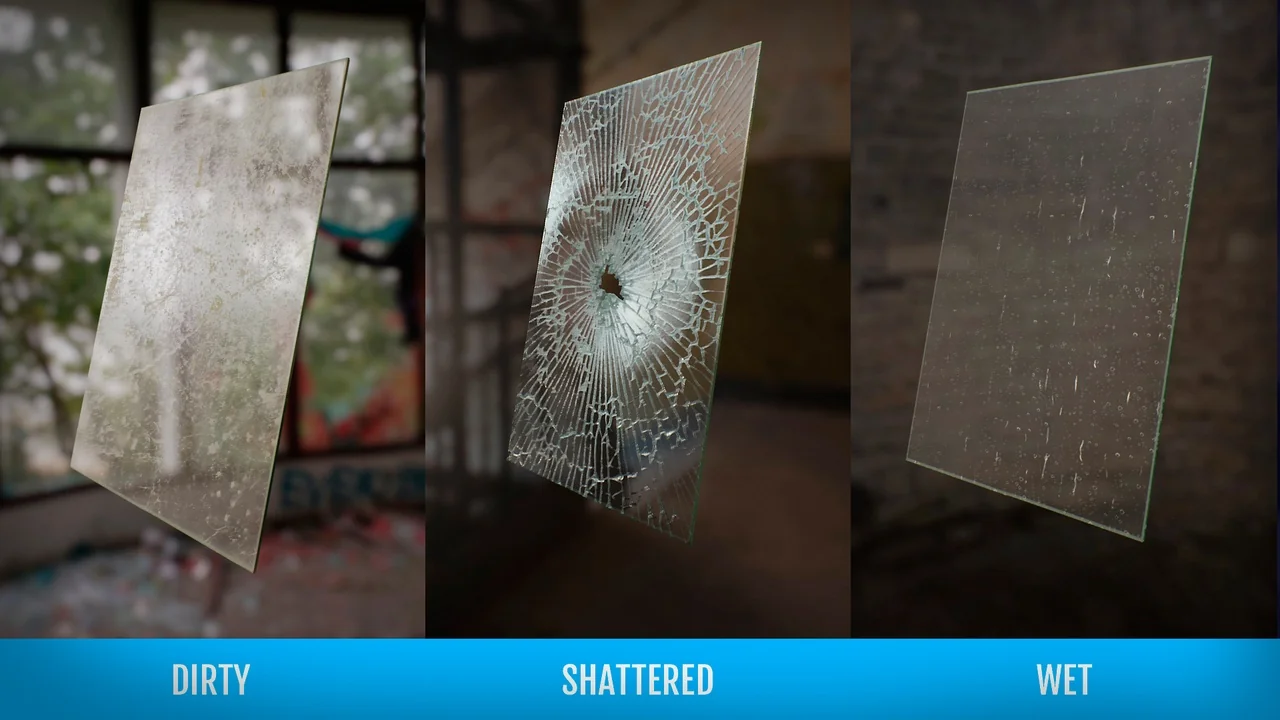
 Shaders
 Shaders
 Shaders