"031373f479d9561a"{"id":"28545","slug":"acf-u-ascent-combat-framework-ultimate-v4-c-complete-action-rpg-creator","title":"(ACF U) Ascent Combat Framework Ultimate V4- C++ Complete Action RPG Creator","category":"Game Mechanics","engine":"5.7","assetVersion":"Engine version: 5.7","engineVersion":"Asset Version:4.2.4","tag":"Game Mechanics","accent":"blue","visual":"luts","summary":"Ascent Combat Framework Ultimate brings combat, progression, UI, questing, dialogue, riding, and world systems into one extendable C++ framework for Unreal. It pairs production-oriented architecture with a ready-to-go sample project and broad Blueprint supp...","platform":"Unreal Engine","publishedAt":"2026-05-17T12:50:27.000Z","updatedAt":"2026-05-17T12:50:28.000Z","sourceNotes":[],"fileContents":[],"compatibility":["Unreal Engine","Engine version: 5.7","Asset Version: 4.2.4"],"featuredImage":{"alt":"(ACF U) Ascent Combat Framework Ultimate V4- C++ Complete Action RPG Creator","src":"https://3dcghub.com/wp-content/uploads/2026/05/db863b590c9f_97457578-1381-47fc-a623-73e693c9ec32.webp"},"hasDownloadLink":true,"downloads":8,"terms":[{"taxonomy":"category","slug":"game-mechanics-tools-and-plugins","name":"Game Mechanics"},{"taxonomy":"post_tag","slug":"game-systems","name":"Game Systems"},{"taxonomy":"post_tag","slug":"plugins","name":"Plugins"},{"taxonomy":"post_tag","slug":"unreal-engine-5","name":"Unreal Engine 5"}],"galleryImages":[{"src":"https://3dcghub.com/wp-content/uploads/2026/05/e2b4fc9911a5_ed60733d-0009-4166-9b4a-7b541c67e8f7.webp","alt":"(ACF U) Ascent Combat Framework Ultimate V4- C++ Complete Action RPG Creator"},{"src":"https://3dcghub.com/wp-content/uploads/2026/05/aa04209589f0_6604a5f7-5eb2-46c2-b610-cae40b01f1fc.webp","alt":"(ACF U) Ascent Combat Framework Ultimate V4- C++ Complete Action RPG Creator"},{"src":"https://3dcghub.com/wp-content/uploads/2026/05/31b07cea0609_eddd588b-9d24-4b01-8bf5-36e033c4f5fd.webp","alt":"(ACF U) Ascent Combat Framework Ultimate V4- C++ Complete Action RPG Creator"},{"src":"https://3dcghub.com/wp-content/uploads/2026/05/ead715b8264e_9a40faeb-f69f-41f1-8ff4-65fa23ff3404.webp","alt":"(ACF U) Ascent Combat Framework Ultimate V4- C++ Complete Action RPG Creator"},{"src":"https://3dcghub.com/wp-content/uploads/2026/05/8a0b308c30a5_c48b64e1-603f-448f-8219-c455b57eebed.webp","alt":"(ACF U) Ascent Combat Framework Ultimate V4- C++ Complete Action RPG Creator"},{"src":"https://3dcghub.com/wp-content/uploads/2026/05/0c46bcb54516_ec8459f0-9b6a-42f7-94ec-bc21c4f10d11.webp","alt":"(ACF U) Ascent Combat Framework Ultimate V4- C++ Complete Action RPG Creator"},{"src":"https://3dcghub.com/wp-content/uploads/2026/05/507a52507563_9ba72018-a48b-4cda-a83f-0ca58a683c50.webp","alt":"(ACF U) Ascent Combat Framework Ultimate V4- C++ Complete Action RPG Creator"},{"src":"https://3dcghub.com/wp-content/uploads/2026/05/3dd99d816327_7310691f-85f8-4f1d-a5d2-67cb1fddbae6.webp","alt":"(ACF U) Ascent Combat Framework Ultimate V4- C++ Complete Action RPG Creator"},{"src":"https://3dcghub.com/wp-content/uploads/2026/05/47478496997b_f3a88509-bc4d-4a96-b8f5-19d126404242.webp","alt":"(ACF U) Ascent Combat Framework Ultimate V4- C++ Complete Action RPG Creator"},{"src":"https://3dcghub.com/wp-content/uploads/2026/05/3db499580954_43f05c9b-6c43-4de6-97df-df32be51f87b.webp","alt":"(ACF U) Ascent Combat Framework Ultimate V4- C++ Complete Action RPG Creator"}],"accessPanel":{"kind":"resource","title":"Access this resource","eyebrow":"Free Download","message":"Log in or create a free account to start your download.","fileName":"5.7,v4.2.4.7z","safetyNote":"All resources are 100% manually reviewed to eliminate all risks.","actionLabel":"Download Free","resourceType":"Resource archive"},"contentHtml":"\u003cp\u003eBuilding an action RPG usually means stitching together combat logic, character movement, UI flows, inventory rules, quest structure, AI behavior, saving, and world navigation long before a project starts to feel playable. Ascent Combat Framework Ultimate approaches that bottleneck as a multi-module C++ plugin for Unreal, aimed at getting a multiplayer-ready action RPG framework in place quickly while still leaving room for extension.\u003c/p\u003e\n\u003cp\u003eIts identity is not that of a narrow combat add-on. ACF U combines the Ascent Combat Framework, Ascent Toolset, and Ascent UI Tools into one package, then layers in systems such as Combo Graph, advanced editor tools, and hundreds of integration Blueprints. This gives a framework that covers the moment-to-moment feel of fighting as well as the surrounding game structure that gives those fights context.\u003c/p\u003e \u003ch2\u003eStarting with a complete Action RPG workflow\u003c/h2\u003e\n\u003cp\u003eACF U leans into a setup flow that tries to remove the usual gap between a technical foundation and something a team can actually build with. It includes a ready-to-go sample project and a fully featured Blueprint sample project that showcases its capabilities, with everything set up to work out of the box.\u003c/p\u003e\n\u003cp\u003eThat matters most for developers who want to start from a working gameplay base instead of building every connective system by hand. The framework is presented as a production-ready C++ tool with the simplicity of a Blueprint template, but without the usual fragility that comes from modifying template-heavy projects. The plugin is meant to be extended rather than hacked into place, using a layered architecture so teams can build on top of it instead of inside it. For a project expected to grow over time, that makes the framework useful not only as a prototype launcher but also as a longer-term gameplay backbone.\u003c/p\u003e \u003ch2\u003eGameplay Ability System, CommonUI, and Contextual Animations at the core\u003c/h2\u003e\n\u003cp\u003eOne of the clearest practical traits of ACF U is how much of its structure is tied to established Unreal systems. It is built on an industry-standard layered architecture and uses Gameplay Ability System, CommonUI, and Contextual Animations.\u003c/p\u003e\n\u003cp\u003eRecent updates push that even further. The combat modules are now fully powered by the Gameplay Ability System, with complete Blueprint support for it. That shifts combat from a self-contained feature into a system that can sit more comfortably alongside attributes, leveling, spells, and status-driven gameplay. The framework also adds a brand-new animation layering system and an improved finishers system using Contextual Animations, which gives combat scenes more control over how layered motion and authored interactions are handled. On the UI side, CommonUI sits beneath more than 100 widgets and automatic gamepad navigation across main menu, pause, settings, vendors, chests, and other interface elements. For teams trying to keep interaction flows consistent across a large RPG, that broad UI coverage can shape far more than menus alone.\u003c/p\u003e \u003ch2\u003eShaping melee, ranged combat, and traversal scenes\u003c/h2\u003e\n\u003cp\u003eACF U covers both close-range action and weapon-driven encounters. Its melee combat supports animation warp and adjustments, while ranged combat and shooting include samples for bows, shotguns, rifles, and pistols.\u003c/p\u003e\n\u003cp\u003eThat spread opens up different kinds of encounter design inside the same framework. A project can lean into grounded melee exchanges with parries, finishers, and targeting lock-ons, or branch into hybrid fights where ranged pressure and spellcasting sit alongside weapon combos. The targeting system is highly customizable and includes the possibility of locking on in a souls-like style, which changes how enemy spacing, camera framing, and duel readability can be staged. Traversal and movement also receive direct attention: the framework includes an advanced character controller with three sample AnimBlueprints covering Blendspaces, Distance Matching, and GASP integration in beta with Motion Matching. Update notes add improved traversal, improved warp mechanics, and new GASP integration, alongside hit stop and parry additions. For developers building action scenes, these details point to a toolkit concerned with feel as much as feature count.\u003c/p\u003e\n\u003cp\u003eMounted play expands that range again. Riding and mounted combat support any kind of creature and vehicles, and newer updates introduce flying mounts as well. That makes the framework relevant not just for dungeon-scale encounters but for outdoor travel, pursuit sequences, or large fantasy spaces where moving across the world is part of the game’s identity.\u003c/p\u003e \u003ch2\u003eInventory, quests, dialogue, and the structure around combat\u003c/h2\u003e\n\u003cp\u003eCombat systems tend to get attention first, but ACF U pushes just as hard into the surrounding game layer. Inventory and equipment are included alongside crafting, and the UI is already prepared with gamepad navigation for every element, including vendors and chests.\u003c/p\u003e\n\u003cp\u003eThe progression side is tied to an attribute system and leveling based on GAS, while spells include many pre-made options as well as the possibility of creating new ones. The framework also adds a new Lyra-inspired inventory system using fragments, broadening how item data can be structured. Outside the player kit, there is a node-based quest editor with dozens of pre-made objectives and a node-based dialogue editor that supports custom cameras, animations, and voices. These are the kinds of tools that let an action RPG move beyond isolated combat tests and into authored progression, reactive conversation, and task-driven world design.\u003c/p\u003e\n\u003cp\u003eWorld readability is supported by a map creator for world maps and minimaps, a full navigation system with map, markers, and compass, and a style manager that makes widget reskinning easier. An automatic save system can save and load the entire world with a single Blueprint node, which is a major structural piece for any project that wants persistent quests, world state, or player progression without building custom save logic first. Taken together, these systems give developers a way to connect combat encounters to traversal, hubs, vendors, objectives, and persistent progress rather than treating each of those as a separate production track.\u003c/p\u003e \u003ch2\u003eAI Powered NPCs, Daily routines, and the Open World Sample Project\u003c/h2\u003e\n\u003cp\u003eRecent version updates show the framework pushing beyond character action into broader world simulation. Version 4.2 adds AI Powered NPCs and a Skill Tree Creator, both marked experimental.\u003c/p\u003e\n\u003cp\u003eVersion 4.1 expands NPC and world-facing features with daily routines for NPCs, world dialogues, and DaySequences with experimental day and night cycle support. It also adds a building system, improved traversal, flying mounts, and the already noted animation layering and contextual finisher improvements. Those additions shift ACF U toward projects that want more than combat arenas. They support towns with schedules, open environments that change over time, and player activities that can include construction as well as exploration.\u003c/p\u003e\n\u003cp\u003eThe AI framework itself already includes AI groups and companions, plus pre-made behaviors for monsters, melee enemies, ranged enemies, and mages. An enhanced AI framework with a ticketing system is also part of the update trail. For production work, that gives teams tools for both encounter logic and broader companion or group behavior. A massive open world sample project is also part of the package’s recent direction, reinforcing that these systems are intended to scale beyond confined demo maps into larger spaces with travel, dialogue, schedules, combat, and navigation all interacting at once.\u003c/p\u003e \u003ch2\u003eWhere ACF U fits in production\u003c/h2\u003e\n\u003cp\u003eACF U is aimed at teams that want a complete Unreal gameplay framework instead of one isolated feature. It supports multiplayer, includes advanced editor tools that blend into the engine, and comes with a large amount of supporting material through documentation, tutorials, and a large developer community.\u003c/p\u003e\n\u003cp\u003eIt also expects some familiarity with Blueprint and Unreal basics, which places it in a useful middle ground: approachable through Blueprint support and sample content, but still driven by an extendable C++ architecture. For developers shaping a third-person fantasy action RPG with melee combat, ranged weapons, quests, dialogue, mounts, saves, navigation, and AI-driven world behavior, it fits best as a full production framework rather than a one-off mechanic pack.\u003c/p\u003e\n\n\u003ch2\u003eContinue Browsing Similar Packs\u003c/h2\u003e\n\u003cul\u003e\n\u003cli\u003e\u003ca href=\"https://3dcghub.com/ultimate-level-art-tool-ulat-tools-plugin-plugins/\" title=\"Ultimate Level Art Tool – ULAT ( Tools / Plugin / Plugins )\"\u003eUltimate Level Art Tool – ULAT ( Tools / Plugin / Plugins )\u003c/a\u003e\u003c/li\u003e\n\u003c/ul\u003e\n\n\u003ch2\u003eAsset Gallery\u003c/h2\u003e","contentTextLength":8517,"navigation":{"current":1362,"total":3223,"previous":{"id":"28553","slug":"american-classic-v8-engine-sound","title":"American Classic V8 Engine Sound","category":"Sound Effects","platform":"Unreal Engine","updatedAt":"2026-05-17T12:50:37.000Z"},"next":{"id":"28528","slug":"bat-extension","title":".bat Extension","category":"Engine Tools","platform":"Unreal Engine","updatedAt":"2026-05-16T08:03:05.000Z"}},"relatedResources":[{"id":"15423","slug":"hyper-mesh-to-icon-creator-v4","title":"Hyper Mesh to Icon Creator v4","category":"Icons","engine":"5.3+","assetVersion":"Engine version: 5.3+","engineVersion":"5.3","tag":"Icons","accent":"blue","visual":"mech","summary":"Transform your 3D models into professional 2D inventory icons with Hyper Mesh to Icon Creator v4. This local, fast tool eliminates the need for external software like Photoshop.","platform":"Unreal Engine","publishedAt":"2026-03-12T08:59:30.000Z","updatedAt":"2026-04-19T15:44:47.000Z","sourceNotes":[],"fileContents":[],"compatibility":["Unreal Engine","Engine version: 5.3+"],"featuredImage":{"alt":"Hyper Mesh to Icon Creator v4","src":"https://3dcghub.com/wp-content/uploads/2026/03/039f2623-933b-49aa-8be1-20241fe7049c.webp"},"hasDownloadLink":true,"downloads":1},{"id":"1000383","slug":"modern-rpg-skill-tree","title":"Modern RPG Skill Tree","category":"Game Mechanics","engine":"5.0+","assetVersion":"","engineVersion":"Engine Version: 5.0+","tag":"Game Mechanics","accent":"blue","visual":"mech","summary":"A Blueprint-based UI framework featuring animated slots, a dynamic connecting system, and 30 ready-made abilities for cyberpunk or survival RPGs.","platform":"Unreal Engine","publishedAt":"2026-07-07T08:11:54.174Z","updatedAt":"2026-07-07T08:11:54.174Z","sourceNotes":[],"fileContents":[],"compatibility":["Unreal Engine","Engine Version: 5.0+"],"featuredImage":{"alt":"Modern RPG Skill Tree","src":"/wp-content/uploads/published/2026/07/33db49ae92a4-307a7e31-ece5-4b7f-96d6-82a3752f1f24-40104f2744.webp"},"hasDownloadLink":true,"downloads":0},{"id":"24560","slug":"unreal-engine-5-c-advanced-action-rpg","title":"Unreal Engine 5 C++: Advanced Action RPG","category":"Unreal Engine","engine":"Video language: English","assetVersion":"Video language: English","engineVersion":"File content: video + supporting files + English subtitles","tag":"Unreal Engine","accent":"blue","visual":"animation","summary":"An intermediate Unreal Engine 5 C++ course focused on advanced RPG combat, Gameplay Ability System work, and the systems that support responsive melee gameplay. It moves from hero setup and combo design into enemy AI, reactions, special abilities, UI, and g...","platform":"Unreal Engine","publishedAt":"2026-04-15T13:14:09.000Z","updatedAt":"2026-04-20T06:12:44.000Z","sourceNotes":[],"fileContents":[],"compatibility":["Unreal Engine","Video language: English","File content: video + supporting files + English subtitles"],"featuredImage":{"alt":"Unreal Engine 5 C++: Advanced Action RPG","src":"https://3dcghub.com/wp-content/uploads/2026/04/30646bfd2e0c_5743852_e253_15.webp"},"hasDownloadLink":true,"downloads":6}]}
Ascent Combat Framework Ultimate brings combat, progression, UI, questing, dialogue, riding, and world systems into one extendable C++ framework for Unreal. It pairs production-oriented architecture with a ready-to-go sample project and broad Blueprint supp...
Building an action RPG usually means stitching together combat logic, character movement, UI flows, inventory rules, quest structure, AI behavior, saving, and world navigation long before a project starts to feel playable. Ascent Combat Framework Ultimate approaches that bottleneck as a multi-module C++ plugin for Unreal, aimed at getting a multiplayer-ready action RPG framework in place quickly while still leaving room for extension.
Its identity is not that of a narrow combat add-on. ACF U combines the Ascent Combat Framework, Ascent Toolset, and Ascent UI Tools into one package, then layers in systems such as Combo Graph, advanced editor tools, and hundreds of integration Blueprints. This gives a framework that covers the moment-to-moment feel of fighting as well as the surrounding game structure that gives those fights context.
Starting with a complete Action RPG workflow
ACF U leans into a setup flow that tries to remove the usual gap between a technical foundation and something a team can actually build with. It includes a ready-to-go sample project and a fully featured Blueprint sample project that showcases its capabilities, with everything set up to work out of the box.
That matters most for developers who want to start from a working gameplay base instead of building every connective system by hand. The framework is presented as a production-ready C++ tool with the simplicity of a Blueprint template, but without the usual fragility that comes from modifying template-heavy projects. The plugin is meant to be extended rather than hacked into place, using a layered architecture so teams can build on top of it instead of inside it. For a project expected to grow over time, that makes the framework useful not only as a prototype launcher but also as a longer-term gameplay backbone.
Gameplay Ability System, CommonUI, and Contextual Animations at the core
One of the clearest practical traits of ACF U is how much of its structure is tied to established Unreal systems. It is built on an industry-standard layered architecture and uses Gameplay Ability System, CommonUI, and Contextual Animations.
Recent updates push that even further. The combat modules are now fully powered by the Gameplay Ability System, with complete Blueprint support for it. That shifts combat from a self-contained feature into a system that can sit more comfortably alongside attributes, leveling, spells, and status-driven gameplay. The framework also adds a brand-new animation layering system and an improved finishers system using Contextual Animations, which gives combat scenes more control over how layered motion and authored interactions are handled. On the UI side, CommonUI sits beneath more than 100 widgets and automatic gamepad navigation across main menu, pause, settings, vendors, chests, and other interface elements. For teams trying to keep interaction flows consistent across a large RPG, that broad UI coverage can shape far more than menus alone.
Shaping melee, ranged combat, and traversal scenes
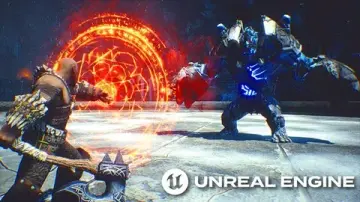
ACF U covers both close-range action and weapon-driven encounters. Its melee combat supports animation warp and adjustments, while ranged combat and shooting include samples for bows, shotguns, rifles, and pistols.
That spread opens up different kinds of encounter design inside the same framework. A project can lean into grounded melee exchanges with parries, finishers, and targeting lock-ons, or branch into hybrid fights where ranged pressure and spellcasting sit alongside weapon combos. The targeting system is highly customizable and includes the possibility of locking on in a souls-like style, which changes how enemy spacing, camera framing, and duel readability can be staged. Traversal and movement also receive direct attention: the framework includes an advanced character controller with three sample AnimBlueprints covering Blendspaces, Distance Matching, and GASP integration in beta with Motion Matching. Update notes add improved traversal, improved warp mechanics, and new GASP integration, alongside hit stop and parry additions. For developers building action scenes, these details point to a toolkit concerned with feel as much as feature count.
Mounted play expands that range again. Riding and mounted combat support any kind of creature and vehicles, and newer updates introduce flying mounts as well. That makes the framework relevant not just for dungeon-scale encounters but for outdoor travel, pursuit sequences, or large fantasy spaces where moving across the world is part of the game’s identity.
Inventory, quests, dialogue, and the structure around combat
Combat systems tend to get attention first, but ACF U pushes just as hard into the surrounding game layer. Inventory and equipment are included alongside crafting, and the UI is already prepared with gamepad navigation for every element, including vendors and chests.
The progression side is tied to an attribute system and leveling based on GAS, while spells include many pre-made options as well as the possibility of creating new ones. The framework also adds a new Lyra-inspired inventory system using fragments, broadening how item data can be structured. Outside the player kit, there is a node-based quest editor with dozens of pre-made objectives and a node-based dialogue editor that supports custom cameras, animations, and voices. These are the kinds of tools that let an action RPG move beyond isolated combat tests and into authored progression, reactive conversation, and task-driven world design.
World readability is supported by a map creator for world maps and minimaps, a full navigation system with map, markers, and compass, and a style manager that makes widget reskinning easier. An automatic save system can save and load the entire world with a single Blueprint node, which is a major structural piece for any project that wants persistent quests, world state, or player progression without building custom save logic first. Taken together, these systems give developers a way to connect combat encounters to traversal, hubs, vendors, objectives, and persistent progress rather than treating each of those as a separate production track.
AI Powered NPCs, Daily routines, and the Open World Sample Project
Recent version updates show the framework pushing beyond character action into broader world simulation. Version 4.2 adds AI Powered NPCs and a Skill Tree Creator, both marked experimental.
Version 4.1 expands NPC and world-facing features with daily routines for NPCs, world dialogues, and DaySequences with experimental day and night cycle support. It also adds a building system, improved traversal, flying mounts, and the already noted animation layering and contextual finisher improvements. Those additions shift ACF U toward projects that want more than combat arenas. They support towns with schedules, open environments that change over time, and player activities that can include construction as well as exploration.
The AI framework itself already includes AI groups and companions, plus pre-made behaviors for monsters, melee enemies, ranged enemies, and mages. An enhanced AI framework with a ticketing system is also part of the update trail. For production work, that gives teams tools for both encounter logic and broader companion or group behavior. A massive open world sample project is also part of the package’s recent direction, reinforcing that these systems are intended to scale beyond confined demo maps into larger spaces with travel, dialogue, schedules, combat, and navigation all interacting at once.
Where ACF U fits in production
ACF U is aimed at teams that want a complete Unreal gameplay framework instead of one isolated feature. It supports multiplayer, includes advanced editor tools that blend into the engine, and comes with a large amount of supporting material through documentation, tutorials, and a large developer community.
It also expects some familiarity with Blueprint and Unreal basics, which places it in a useful middle ground: approachable through Blueprint support and sample content, but still driven by an extendable C++ architecture. For developers shaping a third-person fantasy action RPG with melee combat, ranged weapons, quests, dialogue, mounts, saves, navigation, and AI-driven world behavior, it fits best as a full production framework rather than a one-off mechanic pack.
 Game Mechanics
 Icons
Icons Game Mechanics
 Unreal Engine