"7e6fc58c410f2894"{"id":"1001039","slug":"abandoned-swimming-pool-environment-abandoned-building-pool-apocalyptic-swim-2","title":"Abandoned Swimming Pool Environment ( Abandoned Building Pool Apocalyptic Swim )","category":"Interior","engine":"4.27,5.0+","assetVersion":"","engineVersion":"Engine Version: 4.27,5.0+","tag":"Interior","accent":"blue","visual":"city","summary":"A ruined pool environment with 146 unique meshes, ULAT compatibility, and a moody post-apocalyptic look for game-ready projects and virtual production.","platform":"Unreal Engine","publishedAt":"2026-08-27T10:24:56.371Z","updatedAt":"2026-08-27T10:24:56.371Z","sourceNotes":[],"fileContents":[],"compatibility":["Unreal Engine","Engine Version: 4.27,5.0+"],"featuredImage":{"alt":"Abandoned Swimming Pool Environment ( Abandoned Building Pool Apocalyptic Swim )","src":"/wp-content/uploads/published/2026/08/f814cef1dbcb-eb374130-5318-4fd3-9de8-c59142e7122d-313d5f39e5.webp"},"hasDownloadLink":true,"downloads":1,"terms":[{"taxonomy":"category","slug":"interior","name":"Interior"}],"galleryImages":[{"src":"/wp-content/uploads/published/2026/08/5f58fe26acc8-ca8fd93c-c7a6-4801-8f94-85955a265072-0d7d4c70d9.webp","alt":"Abandoned Swimming Pool Environment ( Abandoned Building Pool Apocalyptic Swim )"},{"src":"/wp-content/uploads/published/2026/08/b56f8fc1eb03-b96e09bc-99be-4fc2-a418-025c7bdfe46f-d812f10959.webp","alt":"Abandoned Swimming Pool Environment ( Abandoned Building Pool Apocalyptic Swim )"},{"src":"/wp-content/uploads/published/2026/08/7a14a9488213-c8bbfd40-36b6-42c3-8e28-aa42f0eeb3c9-b772eea47f.webp","alt":"Abandoned Swimming Pool Environment ( Abandoned Building Pool Apocalyptic Swim )"},{"src":"/wp-content/uploads/published/2026/08/166e081b9727-b9eba5cc-c5d4-48cf-b232-5e578ea68763-63f3abd7d5.webp","alt":"Abandoned Swimming Pool Environment ( Abandoned Building Pool Apocalyptic Swim )"},{"src":"/wp-content/uploads/published/2026/08/2aa12879c67c-05211051-1ef5-4732-88b6-c7f574d78bb4-4882503bd8.webp","alt":"Abandoned Swimming Pool Environment ( Abandoned Building Pool Apocalyptic Swim )"},{"src":"/wp-content/uploads/published/2026/08/44bbba4b4cc5-0a3dab88-ff8b-4d4b-a895-4338d7317e6d-081e244f7a.webp","alt":"Abandoned Swimming Pool Environment ( Abandoned Building Pool Apocalyptic Swim )"},{"src":"/wp-content/uploads/published/2026/08/f2c51929ed41-4c67fb45-26eb-4258-bf4f-db85818dcad3-d90594e812.webp","alt":"Abandoned Swimming Pool Environment ( Abandoned Building Pool Apocalyptic Swim )"},{"src":"/wp-content/uploads/published/2026/08/888eee069c0b-c41fa829-9029-49b2-8d4e-83e72a303e46-64c1714d6c.webp","alt":"Abandoned Swimming Pool Environment ( Abandoned Building Pool Apocalyptic Swim )"},{"src":"/wp-content/uploads/published/2026/08/038c1198b821-fb004976-b89f-4fea-ac31-4ce2f56cccfe-96069680de.webp","alt":"Abandoned Swimming Pool Environment ( Abandoned Building Pool Apocalyptic Swim )"},{"src":"/wp-content/uploads/published/2026/08/140fa4c5580f-377e8619-e0f0-4f5d-9b67-cf040033f56c-f3362cdd97.webp","alt":"Abandoned Swimming Pool Environment ( Abandoned Building Pool Apocalyptic Swim )"}],"accessPanel":{"kind":"resource","title":"Download this resource","eyebrow":"Free Download","message":"Log in or create a free account to start your download.","fileName":"Content.7z","safetyNote":"Resources are manually reviewed before listing to improve quality and reduce obvious risks.","actionLabel":"Download Free","resourceType":"Resource archive"},"contentHtml":"\u003cp\u003eWhen a level calls for a derelict swimming pool, the space has to tell a story on its own: a building that once held lifeguards and laughing children now sits silent, with broken beams and stained tiles. The Abandoned Swimming Pool Environment ( Abandoned Building Pool Apocalyptic Swim ) supplies the pieces that make that setting convincing. It comes with 146 unique meshes that cover everything from structural damage to the water left behind.\u003c/p\u003e \u003ch2\u003eA pool hall worth exploring\u003c/h2\u003e\n\u003cp\u003eThis environment pack is shaped by the idea of a ruined pool facility. The 146 unique meshes include the structural elements you would expect after years of neglect: collapsed ceiling sections, fallen beams, crumbling walls, and worn-out steps. The floor is covered with mossy tiles in some spots and sunken in others. Fallen glass and rusted metal add the small hazards that tell you this place has been vandalized and then forgotten.\u003c/p\u003e\n\u003cp\u003eAll the highlighted assets from the showcase are included. The meshes are described as high quality with a good level of detail, and they are optimized for game-ready projects. That means they are meant to be placed directly into a real-time environment without requiring heavy cleanup. Virtual production levels also benefit from this approach, because the camera can move through the space and the surfaces still hold up.\u003c/p\u003e \u003ch2\u003eULAT inside: the modular layer\u003c/h2\u003e\n\u003cp\u003eRunning underneath the environment is the Ultimate Level Art Tool, or ULAT. This tool is included with the pack, and the environment set is compatible with it. ULAT was originally designed as a modular design development tool for mobile and web-based systems, but its use here is far more direct: it lets you build custom modular buildings quickly and populate a scene in a natural way.\u003c/p\u003e\n\u003cp\u003eFor a destroyed swimming complex, ULAT gives you control over the layout. Instead of placing every broken concrete chunk by hand, you can assemble the pool hall from modular parts and then spread the debris and overgrowth across it. This is especially useful when you need multiple versions of the same ruin for different levels or takes. The tool works with the environment asset, so the pool pieces and the surrounding architecture share the same system.\u003c/p\u003e \u003ch2\u003eReading the tags as a design brief\u003c/h2\u003e\n\u003cp\u003eThe asset tag list reads less like SEO and more like a mood board. \"Collapsed ceiling\" and \"fallen beams\" point to the structural damage. \"Toxic water,\" \"flooded,\" and \"water damage\" describe the state of the water. \"Algae growth\" and \"mossy tiles\" show how vegetation is reasserting itself. \"Sunlight beams\" and \"shadowy corners\" tell you how the light enters through gaps in the roof. Together, these tags outline a scene that is both visually distinct and easy to adapt.\u003c/p\u003e\n\u003cp\u003eThe same tags also steer the narrative. \"Post-war setting,\" \"dystopian,\" \"survival horror,\" and \"urban decay\" are all listed, along with \"mysterious abandonment\" and \"cinematic scene.\" For a game developer, this is a ready-made backdrop for an entire chapter. For a virtual production artist, it offers a believable place where characters can linger and the environment does the emoting.\u003c/p\u003e \u003ch3\u003eWater and decay as storytelling tools\u003c/h3\u003e\n\u003cp\u003eThe state of the pool water is one of the strongest narrative signals in the asset. Some tags describe a \"dried-up pool\" and \"sunken floor,\" which suggests a space that has been empty for a long time. Others mention \"flooded\" conditions and \"underground water,\" which carries a different set of implications. The pack includes enough variants to support either reading of the scene.\u003c/p\u003e\n\u003cp\u003eThe small details listed in the tags—\"vandalized,\" \"fallen glass,\" \"ruste metal,\" \"worn-out steps\"—add character to the ruin. \"Nature reclaiming\" and \"overgrown\" contrast with the industrial infrastructure, creating the \"nature vs. Industry\" tension that shows up repeatedly in post-apocalyptic art. Even the phrases \"echoing hall\" and \"echoing footsteps\" hint at the acoustics of a large empty concrete space, which is something you can use for audio design as well.\u003c/p\u003e \u003ch2\u003eImplementation notes for your project\u003c/h2\u003e\n\u003cp\u003eThe pack is positioned for two main uses: populating game environments and filling virtual production levels. In both cases, the assets are described as well-optimized and game-ready, so they are designed to be placed and used immediately. The included ULAT compatibility adds a layer of flexibility for teams that need to adjust the building layout around the pool or create additional modular structures.\u003c/p\u003e\n\u003cp\u003eSupport for the product runs through a ticket system, which is useful for technical questions during integration. For a level designer working on a survival-horror game, this environment provides the central ruined space plus the debris needed to block or guide player movement. For a small production team, it serves as a complete location that can be populated with actors or characters without a lengthy modeling pass.\u003c/p\u003e\n\n\u003ch2\u003eExplore Similar Assets\u003c/h2\u003e\n\u003cul\u003e\n\u003cli\u003e\u003ca href=\"https://3dcghub.com/abandoned-swimming-pool-environment-abandoned-building-pool-apocalyptic-swim/\" title=\"Abandoned Swimming Pool Environment ( Abandoned Building Pool Apocalyptic Swim )\"\u003eAbandoned Swimming Pool Environment ( Abandoned Building Pool Apocalyptic Swim )\u003c/a\u003e\u003c/li\u003e\n\u003cli\u003e\u003ca href=\"https://3dcghub.com/roman-swimming-pool-environment-roman-swimming-pool-historical-roman-ancient/\" title=\"Roman Swimming Pool Environment ( Roman Swimming Pool Historical Roman Ancient )\"\u003eRoman Swimming Pool Environment ( Roman Swimming Pool Historical Roman Ancient )\u003c/a\u003e\u003c/li\u003e\n\u003cli\u003e\u003ca href=\"https://3dcghub.com/soviet-post-soviet-abandoned-world/\" title=\"Soviet/Post Soviet Abandoned World.\"\u003eSoviet/Post Soviet Abandoned World.\u003c/a\u003e\u003c/li\u003e\n\u003cli\u003e\u003ca href=\"https://3dcghub.com/abandoned-factory-industrial-railway-zone-update-v-2/\" title=\"ABANDONED FACTORY / Industrial railway zone (Update V.2)\"\u003eABANDONED FACTORY / Industrial railway zone (Update V.2)\u003c/a\u003e\u003c/li\u003e\n\u003cli\u003e\u003ca href=\"https://3dcghub.com/post-soviet-hostel/\" title=\"Post Soviet Hostel\"\u003ePost Soviet Hostel\u003c/a\u003e\u003c/li\u003e\n\u003c/ul\u003e","contentTextLength":5159,"navigation":{"current":692,"total":3618,"previous":{"id":"1001040","slug":"advanced-hover-vehicle-system","title":"Advanced Hover Vehicle System","category":"Game Mechanics","platform":"Unreal Engine","updatedAt":"2026-08-27T10:28:28.025Z"},"next":{"id":"1001038","slug":"abandoned-factory-industrial-railway-zone-update-v-2","title":"ABANDONED FACTORY / Industrial railway zone (Update V.2)","category":"Abandoned","platform":"Unreal Engine","updatedAt":"2026-08-27T10:13:05.620Z"}},"relatedResources":[{"id":"8983","slug":"roman-swimming-pool-environment-roman-swimming-pool-historical-roman-ancient","title":"Roman Swimming Pool Environment ( Roman Swimming Pool Historical Roman Ancient )","category":"Interior","engine":"5.1+","assetVersion":"Engine version: 5.1+","engineVersion":"5.1","tag":"Interior","accent":"blue","visual":"city","summary":"Transform your digital worlds with the Roman Swimming Pool Environment. This pack features 61 unique meshes, Nanite support, and modular tools for realistic historical scenes.","platform":"Unreal Engine","publishedAt":"2026-02-25T17:45:47.000Z","updatedAt":"2026-04-19T15:55:18.000Z","sourceNotes":[],"fileContents":[],"compatibility":["Unreal Engine","Engine version: 5.1+"],"featuredImage":{"alt":"Roman Swimming Pool Environment ( Roman Swimming Pool Historical Roman Ancient )","src":"https://3dcghub.com/wp-content/uploads/2026/02/512e92a0-3945-4783-9fb3-582d15cb628e.webp"},"hasDownloadLink":true,"downloads":1},{"id":"8767","slug":"abandoned-swimming-pool-environment-abandoned-building-pool-apocalyptic-swim","title":"Abandoned Swimming Pool Environment ( Abandoned Building Pool Apocalyptic Swim )","category":"Interior","engine":"5.3+","assetVersion":"Engine version: 5.3+","engineVersion":"4.27","tag":"Interior","accent":"blue","visual":"city","summary":"Create hauntingly beautiful post-apocalyptic scenes with the Abandoned Swimming Pool Environment. This pack features 146 unique meshes and a powerful modular building tool for game developers.","platform":"Unreal Engine","publishedAt":"2026-02-25T17:55:28.000Z","updatedAt":"2026-04-19T15:51:23.000Z","sourceNotes":[],"fileContents":[],"compatibility":["Unreal Engine","Engine version: 5.3+"],"featuredImage":{"alt":"Abandoned Swimming Pool Environment ( Abandoned Building Pool Apocalyptic Swim )","src":"https://3dcghub.com/wp-content/uploads/2026/02/8e808dcc-707e-414f-90df-1daf72426425.webp"},"hasDownloadLink":true,"downloads":1},{"id":"1001562","slug":"the-blue-metro-2029-post-apocalyptic-metros-subway-subways-environment","title":"The Blue Metro 2029 ( Post Apocalyptic Metros Subway Subways Environment )","category":"Interior","engine":"4.26+,5.0+","assetVersion":"","engineVersion":"Engine Version: 4.26+,5.0+","tag":"Interior","accent":"blue","visual":"city","summary":"Explore The Blue Metro 2029 environment pack, featuring 84 unique meshes, a preassembled scene, and Ultimate Level Art Tool integration for Unreal Engine.","platform":"Unreal Engine","publishedAt":"2026-10-10T03:53:06.565Z","updatedAt":"2026-10-10T03:53:06.565Z","sourceNotes":[],"fileContents":[],"compatibility":["Unreal Engine","Engine Version: 4.26+,5.0+"],"featuredImage":{"alt":"The Blue Metro 2029 ( Post Apocalyptic Metros Subway Subways Environment )","src":"/wp-content/uploads/published/2026/10/6b422210387e-df3b1f57-d420-4a67-a416-702f37650df1-7b534a15b5.webp"},"hasDownloadLink":true,"downloads":0}]}
Interior
Abandoned Swimming Pool Environment ( Abandoned Building Pool Apocalyptic Swim )
A ruined pool environment with 146 unique meshes, ULAT compatibility, and a moody post-apocalyptic look for game-ready projects and virtual production.
Category:Unreal Engine,InteriorPlatform: Unreal EngineEngine Version: 4.27,5.0+Published: Aug 27, 2026
Interior
Resource overview
When a level calls for a derelict swimming pool, the space has to tell a story on its own: a building that once held lifeguards and laughing children now sits silent, with broken beams and stained tiles. The Abandoned Swimming Pool Environment ( Abandoned Building Pool Apocalyptic Swim ) supplies the pieces that make that setting convincing. It comes with 146 unique meshes that cover everything from structural damage to the water left behind.
A pool hall worth exploring
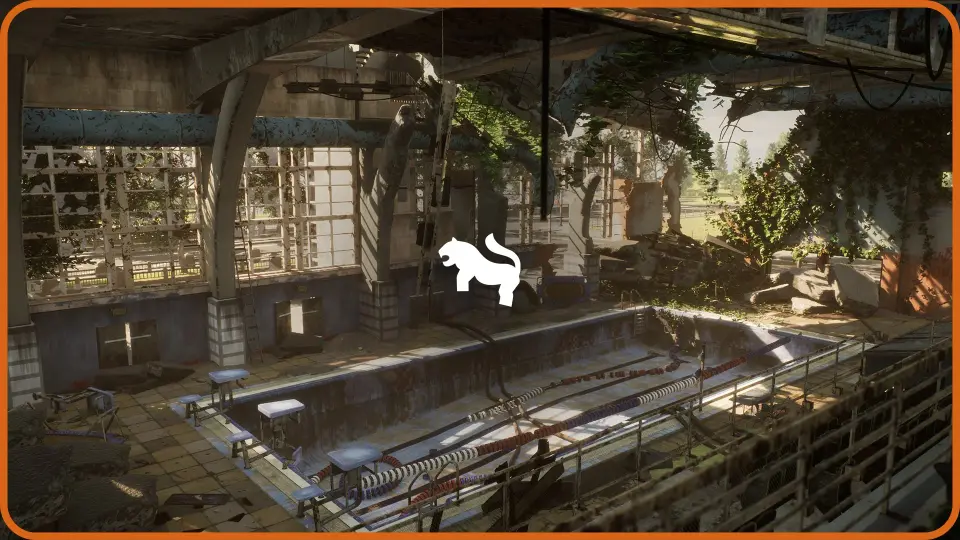
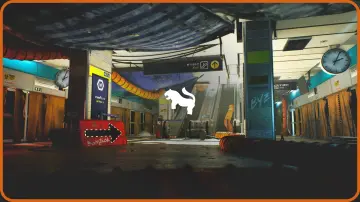
This environment pack is shaped by the idea of a ruined pool facility. The 146 unique meshes include the structural elements you would expect after years of neglect: collapsed ceiling sections, fallen beams, crumbling walls, and worn-out steps. The floor is covered with mossy tiles in some spots and sunken in others. Fallen glass and rusted metal add the small hazards that tell you this place has been vandalized and then forgotten.
All the highlighted assets from the showcase are included. The meshes are described as high quality with a good level of detail, and they are optimized for game-ready projects. That means they are meant to be placed directly into a real-time environment without requiring heavy cleanup. Virtual production levels also benefit from this approach, because the camera can move through the space and the surfaces still hold up.
ULAT inside: the modular layer
Running underneath the environment is the Ultimate Level Art Tool, or ULAT. This tool is included with the pack, and the environment set is compatible with it. ULAT was originally designed as a modular design development tool for mobile and web-based systems, but its use here is far more direct: it lets you build custom modular buildings quickly and populate a scene in a natural way.
For a destroyed swimming complex, ULAT gives you control over the layout. Instead of placing every broken concrete chunk by hand, you can assemble the pool hall from modular parts and then spread the debris and overgrowth across it. This is especially useful when you need multiple versions of the same ruin for different levels or takes. The tool works with the environment asset, so the pool pieces and the surrounding architecture share the same system.
Reading the tags as a design brief
The asset tag list reads less like SEO and more like a mood board. "Collapsed ceiling" and "fallen beams" point to the structural damage. "Toxic water," "flooded," and "water damage" describe the state of the water. "Algae growth" and "mossy tiles" show how vegetation is reasserting itself. "Sunlight beams" and "shadowy corners" tell you how the light enters through gaps in the roof. Together, these tags outline a scene that is both visually distinct and easy to adapt.
The same tags also steer the narrative. "Post-war setting," "dystopian," "survival horror," and "urban decay" are all listed, along with "mysterious abandonment" and "cinematic scene." For a game developer, this is a ready-made backdrop for an entire chapter. For a virtual production artist, it offers a believable place where characters can linger and the environment does the emoting.
Water and decay as storytelling tools
The state of the pool water is one of the strongest narrative signals in the asset. Some tags describe a "dried-up pool" and "sunken floor," which suggests a space that has been empty for a long time. Others mention "flooded" conditions and "underground water," which carries a different set of implications. The pack includes enough variants to support either reading of the scene.
The small details listed in the tags—"vandalized," "fallen glass," "ruste metal," "worn-out steps"—add character to the ruin. "Nature reclaiming" and "overgrown" contrast with the industrial infrastructure, creating the "nature vs. Industry" tension that shows up repeatedly in post-apocalyptic art. Even the phrases "echoing hall" and "echoing footsteps" hint at the acoustics of a large empty concrete space, which is something you can use for audio design as well.
Implementation notes for your project
The pack is positioned for two main uses: populating game environments and filling virtual production levels. In both cases, the assets are described as well-optimized and game-ready, so they are designed to be placed and used immediately. The included ULAT compatibility adds a layer of flexibility for teams that need to adjust the building layout around the pool or create additional modular structures.
Support for the product runs through a ticket system, which is useful for technical questions during integration. For a level designer working on a survival-horror game, this environment provides the central ruined space plus the debris needed to block or guide player movement. For a small production team, it serves as a complete location that can be populated with actors or characters without a lengthy modeling pass.
 Interior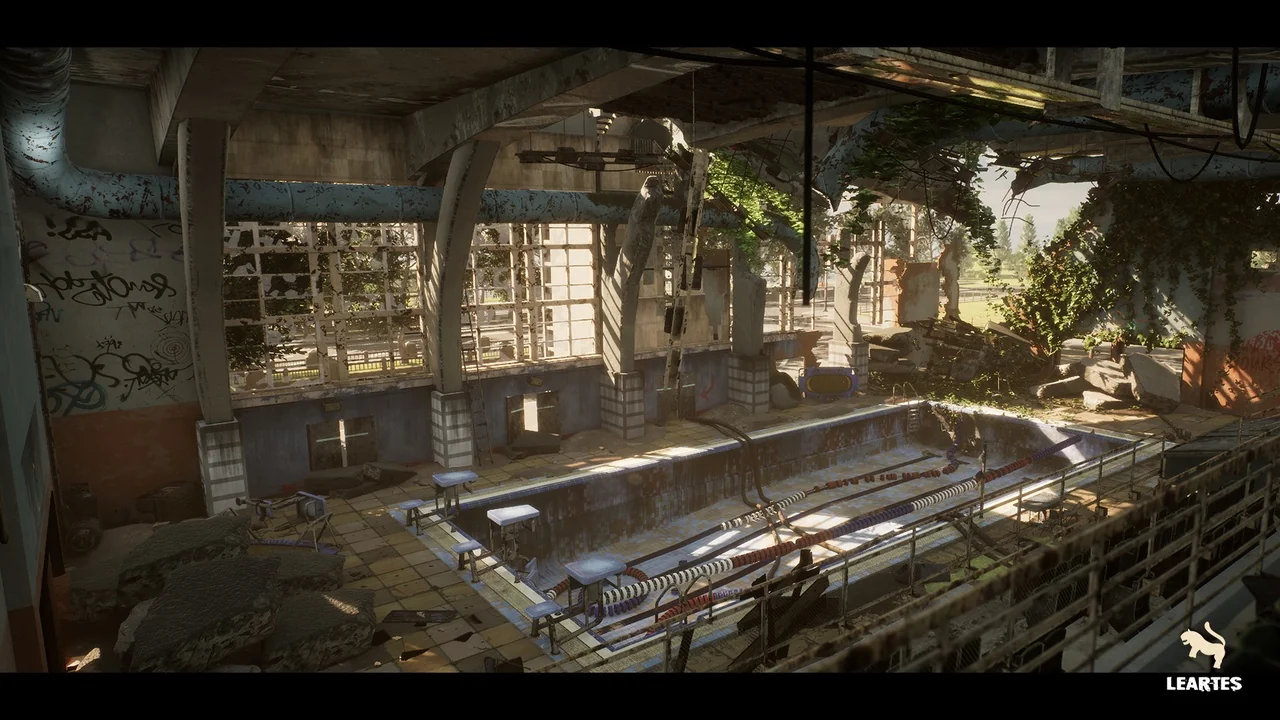
 Interior
 Interior
 Interior