"7aa4acc705f0d80b"{"id":"1001932","slug":"50-vector-particles","title":"50+ Vector Particles","category":"Variety","engine":"4.26+,5.0+","assetVersion":"","engineVersion":"Engine Version: 4.26+,5.0+","tag":"Variety","accent":"blue","visual":"mech","summary":"Explore 50+ Vector Particles, featuring Maya 2015 fluid dynamic fields, local and global setups, energy walls, flame jets, and demo room integration.","platform":"Unreal Engine","publishedAt":"2026-10-24T11:10:47.968Z","updatedAt":"2026-10-24T11:10:47.968Z","sourceNotes":[],"fileContents":[],"compatibility":["Unreal Engine","Engine Version: 4.26+,5.0+"],"featuredImage":{"alt":"50+ Vector Particles","src":"/wp-content/uploads/published/2026/10/7377f5f8f34c-6bab5d5e-1640-407d-83af-8aaff61eb265-f493fdedda.webp"},"hasDownloadLink":true,"downloads":0,"terms":[{"taxonomy":"category","slug":"variety-vfx","name":"Variety"}],"galleryImages":[{"src":"/wp-content/uploads/published/2026/10/5a0de25f6b76-33bdb8c7-a205-4b5b-9390-5a22e35befd3-e1e0485839.webp","alt":"50+ Vector Particles"},{"src":"/wp-content/uploads/published/2026/10/87f8db06572b-00789e17-2a46-443a-a7d1-934607878d1a-e8ceb7488c.webp","alt":"50+ Vector Particles"},{"src":"/wp-content/uploads/published/2026/10/ae9a235fe2ee-183d08cf-d2cb-4f4a-ba3d-0519b5f42cc5-c01c470d18.webp","alt":"50+ Vector Particles"},{"src":"/wp-content/uploads/published/2026/10/8cc65c8bc7bf-fcefad89-7bb5-4ecd-a7c8-655ccc0b897a-87dd7fd395.webp","alt":"50+ Vector Particles"},{"src":"/wp-content/uploads/published/2026/10/1cb1cde10d7b-dc6e8f8b-cf37-4e52-ae11-0eef96f3deec-e11e974ead.webp","alt":"50+ Vector Particles"}],"accessPanel":{"kind":"resource","title":"Download this resource","eyebrow":"Free Download","message":"Log in or create a free account to start your download.","fileName":"Content.7z","safetyNote":"Resources are manually reviewed before listing to improve quality and reduce obvious risks.","actionLabel":"Download Free","resourceType":"Resource archive"},"contentHtml":"\u003ch2\u003eBypassing Simulation in Maya and Houdini\u003c/h2\u003e\u003cp\u003eGenerating dynamic motion vectors for real-time particles typically demands extensive simulation runs inside external digital content creation tools.\u003c/p\u003e\u003cp\u003e50+ Vector Particles eliminates that simulation friction by supplying pre-baked velocity fields extracted directly from Maya 2015 fluid dynamics. Originally calculated for the sci-fi project ABATRON, the collection delivers ready-to-use vector data straight to visual effects pipelines. Instead of establishing fluid emitters, tuning voxel grid resolutions, and exporting bespoke velocity volumes for every single project requirement, artists can immediately pull from over fifty discrete particle setups driven by existing mathematical flow paths. This setup completely bypasses the need to dive into Houdini or Maya simply to generate believable curl, turbulence, and directional drag.\u003c/p\u003e\u003ch2\u003eExploring Local and Global Vector Field Behaviors\u003c/h2\u003e\u003cp\u003eParticle behavior changes drastically depending on whether a vector volume affects an isolated area or influences the wider game environment.\u003c/p\u003e\u003cp\u003eThis collection supplies both local and global field examples to address different spatial needs. A local field confines particle velocity curves to a specific bounded volume, making it well-suited for contained prop interactions, weapon muzzles, or localized gameplay phenomena. Conversely, global field implementations allow forces to interact across broader spatial coordinates, ensuring GPU visual effects respond consistently within ambient world spaces. These distinctions give technical artists direct control over how velocity vectors steer particle trajectories, whether guiding tight circular motions within an engine or sweeping embers across an entire level section.\u003c/p\u003e\u003ch2\u003eEnergy Walls, Flame Jets, and Atmospheric Distortions\u003c/h2\u003e\u003cp\u003eThe collection spans diverse visual states ranging from structured sci-fi hard surfaces to turbulent environmental combustion.\u003c/p\u003e\u003cp\u003eWithin the library, particle configurations are grouped into clear behavioral archetypes. Defensive systems are represented through energy walls, force fields, and protective barriers that maintain distinct spatial boundaries. Rotational and swirling phenomena appear through vortexes, tornadoes, and stylized motions like weird looking fish tracing vector paths. For environmental hazards, the package supplies ground fire, directional flame jets, and fiery walls, complemented by soft, organic steam and gas flows. Space-bending phenomena also appear through wormhole structures alongside purely aesthetic visual effects that prioritize clean, energetic particle motion.\u003c/p\u003e\u003ch2\u003eRe-Purposing Maya 2015 Fluid Dynamics for Custom FX\u003c/h2\u003e\u003cp\u003eAdapting pre-calculated fluid mathematics allows existing velocity grids to take on completely new roles in a scene.\u003c/p\u003e\u003cp\u003eBecause all of the particles can be re-purposed, their function is not locked to their default configuration. A vector field originally calculated to drive organic steam or drifting gas flows can easily drive magical mists, cooling vents, or chemical clouds simply by altering material parameters, particle scale, and color curves. Similarly, the velocity curves governing flame jets and ground fire can be reoriented to create high-velocity thruster exhausts or plasma discharges. Since the underlying fluid grids derive from Maya 2015 simulations, the motion retains complex organic curls, counter-currents, and velocity variations that would take days to keyframe manually.\u003c/p\u003e\u003ch2\u003eDeconstructing Setups Inside the Included Demo Room\u003c/h2\u003e\u003cp\u003eDissecting an active particle system inside an engine environment remains one of the fastest paths toward mastering vector-driven behavior.\u003c/p\u003e\u003cp\u003eThe package incorporates a dedicated demo room where each vector particle configuration is placed in an operational environment. This space serves as an instructional testing ground, demonstrating how distinct velocity fields interact with particle life cycles, emission rates, and spatial transformations. Rather than reading raw velocity matrices, artists can observe how the vector volumes deform, accelerate, and shape particles in real time. The learning process extends through documentation and training videos, accompanied by community support via a Discord chat and development updates through the W3 Studios newsletter.\u003c/p\u003e\u003ch2\u003eProduction Deployment with Explosions Builder\u003c/h2\u003e\u003cp\u003eThe collection relies on GPU particle pipelines, ensuring scenes remain performant even when emitters release thousands of active points simultaneously.\u003c/p\u003e\u003cp\u003eThanks to these GPU foundations, the library pairs effectively with tools like Explosions Builder, where velocity grids can manipulate secondary smoke trails, flying embers, or concussive shockwaves outward from an impact point. Repurposing these systems involves swapping particle textures, retiming velocities, or adjusting field bounds, allowing the fluid dynamics developed for ABATRON to underpin combat abilities, environmental hazards, and ambient effects across varied visual targets.\u003c/p\u003e\n\n\u003ch2\u003eMore From The Same Workflow\u003c/h2\u003e\n\u003cul\u003e\n\u003cli\u003e\u003ca href=\"https://3dcghub.com/butterfly-particles/\" title=\"Butterfly Particles\"\u003eButterfly Particles\u003c/a\u003e\u003c/li\u003e\n\u003cli\u003e\u003ca href=\"https://3dcghub.com/stylized-vfx-pack/\" title=\"Stylized VFX Pack\"\u003eStylized VFX Pack\u003c/a\u003e\u003c/li\u003e\n\u003cli\u003e\u003ca href=\"https://3dcghub.com/simple-cartoon-fx-pack/\" title=\"Simple Cartoon FX Pack\"\u003eSimple Cartoon FX Pack\u003c/a\u003e\u003c/li\u003e\n\u003cli\u003e\u003ca href=\"https://3dcghub.com/fantasy-vfx-collection-5/\" title=\"FANTASY VFX COLLECTION \u0026#039;5\u0026#039;\"\u003eFANTASY VFX COLLECTION \u0026#039;5\u0026#039;\u003c/a\u003e\u003c/li\u003e\n\u003cli\u003e\u003ca href=\"https://3dcghub.com/particle-rings/\" title=\"Particle Rings\"\u003eParticle Rings\u003c/a\u003e\u003c/li\u003e\n\u003c/ul\u003e","contentTextLength":5104,"navigation":{"current":58,"total":3925,"previous":{"id":"1001933","slug":"advanced-battle-royale-template","title":"Advanced Battle Royale Template","category":"Shooter","platform":"Unreal Engine","updatedAt":"2026-10-24T11:11:26.550Z"},"next":{"id":"1001931","slug":"4k-full-fantasy-gui-ui-524-png-186-widget-blueprints","title":"4k Full Fantasy GUI / UI + 524 png + 186 widget blueprints","category":"UI Kits / HUDs","platform":"Unreal Engine","updatedAt":"2026-10-24T11:10:16.342Z"}},"relatedResources":[{"id":"1001866","slug":"butterfly-particles","title":"Butterfly Particles","category":"Variety","engine":"4.25+,5.0+","assetVersion":"","engineVersion":"Engine Version: 4.25+,5.0+","tag":"Variety","accent":"blue","visual":"mech","summary":"Configure stylized Butterfly Particles across 63 Niagara systems, using 20 textures, 20 mask types, two-color materials, and custom spline controls.","platform":"Unreal Engine","publishedAt":"2026-10-22T11:09:50.685Z","updatedAt":"2026-10-22T11:09:50.685Z","sourceNotes":[],"fileContents":[],"compatibility":["Unreal Engine","Engine Version: 4.25+,5.0+"],"featuredImage":{"alt":"Butterfly Particles","src":"/wp-content/uploads/published/2026/10/101ba1fc51e7-91958e27-6ecd-4c95-8bd5-5ee40fd72170-6bdb5236d2.webp"},"hasDownloadLink":true,"downloads":0},{"id":"17449","slug":"stylized-vfx-pack","title":"Stylized VFX Pack","category":"Variety","engine":"4.26+,5.0+","assetVersion":"Engine version: 4.26+,5.0+","engineVersion":"4.22","tag":"Variety","accent":"blue","visual":"city","summary":"Enhance your project with the Stylized VFX Pack, a collection of anime-style particles featuring explosions, electric effects, and dynamic motion trails. This pack is designed for creators seeking a high-energy, stylized aesthetic.","platform":"Unreal Engine","publishedAt":"2026-03-13T14:36:06.000Z","updatedAt":"2026-04-19T15:43:32.000Z","sourceNotes":[],"fileContents":[],"compatibility":["Unreal Engine","Engine version: 4.26+,5.0+"],"featuredImage":{"alt":"Stylized VFX Pack","src":"https://3dcghub.com/wp-content/uploads/2026/03/02553b52-0b92-4de6-af20-a8d85f3e7a10.webp"},"hasDownloadLink":true,"downloads":2},{"id":"1001666","slug":"simple-cartoon-fx-pack","title":"Simple Cartoon FX Pack","category":"Variety","engine":"4.10+,5.0+","assetVersion":"","engineVersion":"Engine Version: 4.10+,5.0+","tag":"Variety","accent":"blue","visual":"mech","summary":"Explore the Simple Cartoon FX Pack, featuring 10 stylized game particles with cartoon shading and editable material instances for casual game workflows.","platform":"Unreal Engine","publishedAt":"2026-10-13T15:07:26.502Z","updatedAt":"2026-10-13T15:07:26.502Z","sourceNotes":[],"fileContents":[],"compatibility":["Unreal Engine","Engine Version: 4.10+,5.0+"],"featuredImage":{"alt":"Simple Cartoon FX Pack","src":"/wp-content/uploads/published/2026/10/43e6ff1aa10a-e7eed192-5502-4a94-a4a9-c2409c0d8613-2453e9c1e9.webp"},"hasDownloadLink":true,"downloads":3}]}
Variety
50+ Vector Particles
Explore 50+ Vector Particles, featuring Maya 2015 fluid dynamic fields, local and global setups, energy walls, flame jets, and demo room integration.
Category:Unreal Engine,VarietyPlatform: Unreal EngineEngine Version: 4.26+,5.0+Published: Oct 24, 2026
Variety
Resource overview
Bypassing Simulation in Maya and Houdini
Generating dynamic motion vectors for real-time particles typically demands extensive simulation runs inside external digital content creation tools.
50+ Vector Particles eliminates that simulation friction by supplying pre-baked velocity fields extracted directly from Maya 2015 fluid dynamics. Originally calculated for the sci-fi project ABATRON, the collection delivers ready-to-use vector data straight to visual effects pipelines. Instead of establishing fluid emitters, tuning voxel grid resolutions, and exporting bespoke velocity volumes for every single project requirement, artists can immediately pull from over fifty discrete particle setups driven by existing mathematical flow paths. This setup completely bypasses the need to dive into Houdini or Maya simply to generate believable curl, turbulence, and directional drag.
Exploring Local and Global Vector Field Behaviors
Particle behavior changes drastically depending on whether a vector volume affects an isolated area or influences the wider game environment.
This collection supplies both local and global field examples to address different spatial needs. A local field confines particle velocity curves to a specific bounded volume, making it well-suited for contained prop interactions, weapon muzzles, or localized gameplay phenomena. Conversely, global field implementations allow forces to interact across broader spatial coordinates, ensuring GPU visual effects respond consistently within ambient world spaces. These distinctions give technical artists direct control over how velocity vectors steer particle trajectories, whether guiding tight circular motions within an engine or sweeping embers across an entire level section.
Energy Walls, Flame Jets, and Atmospheric Distortions
The collection spans diverse visual states ranging from structured sci-fi hard surfaces to turbulent environmental combustion.
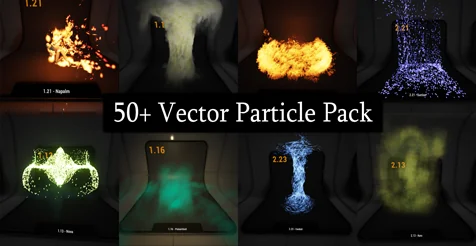
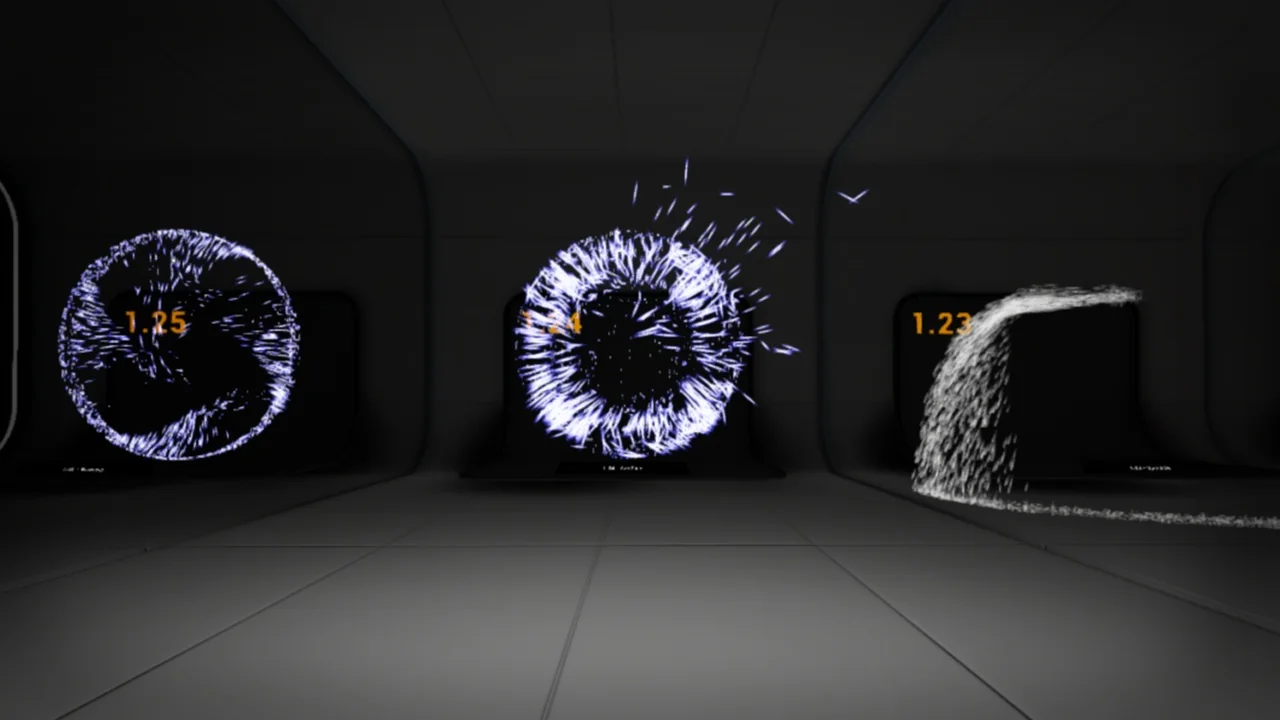
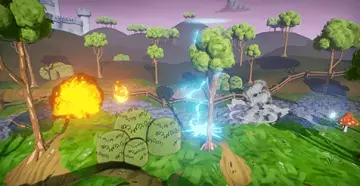
Within the library, particle configurations are grouped into clear behavioral archetypes. Defensive systems are represented through energy walls, force fields, and protective barriers that maintain distinct spatial boundaries. Rotational and swirling phenomena appear through vortexes, tornadoes, and stylized motions like weird looking fish tracing vector paths. For environmental hazards, the package supplies ground fire, directional flame jets, and fiery walls, complemented by soft, organic steam and gas flows. Space-bending phenomena also appear through wormhole structures alongside purely aesthetic visual effects that prioritize clean, energetic particle motion.
Re-Purposing Maya 2015 Fluid Dynamics for Custom FX
Adapting pre-calculated fluid mathematics allows existing velocity grids to take on completely new roles in a scene.
Because all of the particles can be re-purposed, their function is not locked to their default configuration. A vector field originally calculated to drive organic steam or drifting gas flows can easily drive magical mists, cooling vents, or chemical clouds simply by altering material parameters, particle scale, and color curves. Similarly, the velocity curves governing flame jets and ground fire can be reoriented to create high-velocity thruster exhausts or plasma discharges. Since the underlying fluid grids derive from Maya 2015 simulations, the motion retains complex organic curls, counter-currents, and velocity variations that would take days to keyframe manually.
Deconstructing Setups Inside the Included Demo Room
Dissecting an active particle system inside an engine environment remains one of the fastest paths toward mastering vector-driven behavior.
The package incorporates a dedicated demo room where each vector particle configuration is placed in an operational environment. This space serves as an instructional testing ground, demonstrating how distinct velocity fields interact with particle life cycles, emission rates, and spatial transformations. Rather than reading raw velocity matrices, artists can observe how the vector volumes deform, accelerate, and shape particles in real time. The learning process extends through documentation and training videos, accompanied by community support via a Discord chat and development updates through the W3 Studios newsletter.
Production Deployment with Explosions Builder
The collection relies on GPU particle pipelines, ensuring scenes remain performant even when emitters release thousands of active points simultaneously.
Thanks to these GPU foundations, the library pairs effectively with tools like Explosions Builder, where velocity grids can manipulate secondary smoke trails, flying embers, or concussive shockwaves outward from an impact point. Repurposing these systems involves swapping particle textures, retiming velocities, or adjusting field bounds, allowing the fluid dynamics developed for ABATRON to underpin combat abilities, environmental hazards, and ambient effects across varied visual targets.
 Variety
 Variety
 Variety
 Variety