"4481da9c895ef786"{"id":"1001330","slug":"105-zombie-animations-mocap-281-bonus-zombie-audio","title":"105 Zombie Animations Mocap + 281 Bonus Zombie Audio","category":"Gestures","engine":"4.26+,5.0+","assetVersion":"","engineVersion":"Engine Version: 4.26+,5.0+","tag":"Gestures","accent":"blue","visual":"animation","summary":"Explore the 105 Zombie Animations Mocap + 281 Bonus Zombie Audio pack, featuring root motion, in-place clips, body and hand data, and dedicated creature sounds.","platform":"Unreal Engine","publishedAt":"2026-10-03T14:12:15.323Z","updatedAt":"2026-10-03T14:12:15.323Z","sourceNotes":[],"fileContents":[],"compatibility":["Unreal Engine","Engine Version: 4.26+,5.0+"],"featuredImage":{"alt":"105 Zombie Animations Mocap + 281 Bonus Zombie Audio","src":"/wp-content/uploads/published/2026/10/481672306d6e-a2d32d1c-40ed-4367-8494-8ce6a781466a-d094331acc.webp"},"hasDownloadLink":true,"downloads":0,"terms":[{"taxonomy":"category","slug":"gestures","name":"Gestures"}],"galleryImages":[{"src":"/wp-content/uploads/published/2026/10/87101fc5de00-2cd9eee6-c68a-48c4-a973-bcc7ec3c912d-de600fb6f5.webp","alt":"105 Zombie Animations Mocap + 281 Bonus Zombie Audio"},{"src":"/wp-content/uploads/published/2026/10/f6eadde2d081-d5a64af3-8660-4aa4-8401-8fc36571624c-377cdf5b5c.webp","alt":"105 Zombie Animations Mocap + 281 Bonus Zombie Audio"},{"src":"/wp-content/uploads/published/2026/10/66804bfa6df9-9c5dc34b-df7e-4425-acb7-2f675519f97b-fd8be9402c.webp","alt":"105 Zombie Animations Mocap + 281 Bonus Zombie Audio"},{"src":"/wp-content/uploads/published/2026/10/bb6b42f0bb9b-da8ef205-b350-4ddf-b404-5edecc69517c-6ade8e9332.webp","alt":"105 Zombie Animations Mocap + 281 Bonus Zombie Audio"},{"src":"/wp-content/uploads/published/2026/10/98b9fb6c440f-9cc2bfb1-431c-47de-9915-ffba2b843b9e-412a223e14.webp","alt":"105 Zombie Animations Mocap + 281 Bonus Zombie Audio"},{"src":"/wp-content/uploads/published/2026/10/76a543c3c9ac-ee0236ab-7b5a-4e85-a9d4-094524029295-9e2e9b3fe3.webp","alt":"105 Zombie Animations Mocap + 281 Bonus Zombie Audio"},{"src":"/wp-content/uploads/published/2026/10/63cb95c2367d-ed7f5ee5-85f5-4c06-8a74-bd87454ca0a4-b1ce5566e9.webp","alt":"105 Zombie Animations Mocap + 281 Bonus Zombie Audio"},{"src":"/wp-content/uploads/published/2026/10/fa4487586d12-a6feabb4-8190-43a2-8372-ceeaa99246ed-0e11749522.webp","alt":"105 Zombie Animations Mocap + 281 Bonus Zombie Audio"},{"src":"/wp-content/uploads/published/2026/10/6824250d2863-216caef6-d101-4657-81f3-42912071babf-32d36c4692.webp","alt":"105 Zombie Animations Mocap + 281 Bonus Zombie Audio"},{"src":"/wp-content/uploads/published/2026/10/51e2d705d0b1-070ff1b2-d862-4845-a706-c3b9f88c1624-fd25090c6a.webp","alt":"105 Zombie Animations Mocap + 281 Bonus Zombie Audio"}],"accessPanel":{"kind":"resource","title":"Download this resource","eyebrow":"Free Download","message":"Log in or create a free account to start your download.","fileName":"Content.7z","safetyNote":"Resources are manually reviewed before listing to improve quality and reduce obvious risks.","actionLabel":"Download Free","resourceType":"Resource archive"},"contentHtml":"\u003ch2\u003eGrounding Post-Apocalyptic Creature Behavior with 105 Mocap Animations\u003c/h2\u003e\n\u003cp\u003eProducing believable undead enemy behaviors requires a balance between erratic, unnatural motion and grounded physical presence. Hand-keyed monster movement often struggles to convey the weight and irregular kinetic pacing that characterizes infected or reanimated creatures. The 105 Zombie Animations Mocap collection addresses this core animation requirement by delivering motion-captured body and hand performances tuned directly for zombie, horror, and post-apocalyptic projects.\u003c/p\u003e\n\u003cp\u003eRather than offering isolated movements, the collection provides a structured split between stationary engine mechanics and physics-driven trajectory changes. The library features 75 in-place animations and 30 root motion animations, allowing animators and technical artists to split behavioral states between code-driven character controllers and trajectory-driven root movement. Every sequence incorporates detailed hand animations alongside full-body tracking, eliminating the need to manually pose fingers for claws, grabs, and flailing gestures during complex combat encounters.\u003c/p\u003e \u003ch2\u003eIn-Place Movement, Attacks, and Expressive Body States\u003c/h2\u003e\n\u003cp\u003eThe 75 in-place animations form the operational core for responsive artificial intelligence setups where programmatic navigation meshes or character movement components dictate actor velocity.\u003c/p\u003e\n\u003cp\u003eCombat interactions within the in-place collection prioritize frantic encounters, offering 14 attack animations and 2 dedicated bite sequences. When creatures take damage from player weapons, 6 hit reaction clips allow characters to register weapon impacts without breaking state coherence. Locomotion needs are handled by 11 in-place locomotion tracks, complemented by 7 jump sequences and 2 fall animations for traversing varied terrain. For reactive states, the pack features 5 detection sequences, enabling enemies to display alert behaviors before transitioning into pursuit.\u003c/p\u003e\n\u003cp\u003eIdle and transitional states are heavily varied to prevent AI hordes from looking uniform. Nine primary idle sequences are joined by 3 ground idle variations, allowing actors to lurk on floors or rest against level geometry. When engaging the player or ambient props, 4 eating animations support environmental storytelling scenes where infected feed on targets. Positional recoveries are covered by 2 get-down and 2 get-up sequences, while 7 scream animations provide cues to signal incoming threats. The in-place segment is rounded out by a fatal dead state animation.\u003c/p\u003e \u003ch2\u003eRoot Motion Capabilities and Turn Updates\u003c/h2\u003e\n\u003cp\u003eCertain dynamic actions require absolute alignment between mesh position and animation movement, making the 30 root motion sequences crucial for close-quarters grappling and lunges.\u003c/p\u003e\n\u003cp\u003eRoot motion prevents the unnatural sliding often visible when an enemy lunges forward or lunges off a ledge during an attack sequence. Within the root motion selection, 10 attacks and 11 locomotion tracks handle momentum-driven combat runs. Environmental and reactionary actions include 2 jumps, 2 hit reactions, and 2 detection animations. Transitions are similarly supported with 1 get-down clip, 1 get-up clip, and a focused scream sequence that drives the skeleton forward through root-level transformation.\u003c/p\u003e\n\u003cp\u003eSubsequent production refinements expanded this movement library with 14 additional animations. This revision introduced 12 directional turns divided evenly between 6 in-place and 6 root-motion variations, granting characters fluid transitions when changing facing angles during patrol or pursuit loops. Two death sequences—one in-place and one root motion—were introduced alongside an engine-level rotation fix specifically resolving orientation anomalies previously present in the detection animations across both locomotion formats.\u003c/p\u003e \u003ch2\u003eMapping 281 Bonus Zombie Audio Tracks to Behavioral Triggers\u003c/h2\u003e\n\u003cp\u003eAudio is as critical as motion data when building intimidating horror encounters, and synchronizing monster vocalizations to rapid animation states often slows down asset assembly.\u003c/p\u003e\n\u003cp\u003eTo eliminate the delay of searching for external sound effects, the package includes 281 bonus zombie audio files mapped across the exact action categories defined by the animation tracks. Combat audio forms the largest segment, offering 55 attack sounds alongside 47 dedicated hit response cues that can be connected to blend trees or hitboxes. Alert and spotting behaviors are supported by 17 detection sounds, while 21 distinct scream files provide acoustic feedback during aggressive charges and alert transitions.\u003c/p\u003e\n\u003cp\u003ePassive and ambient monster actions are also thoroughly represented in the audio set. Character idles are backed by 40 general idle vocalizations and 18 ground-idle sounds tailored for low, guttural resting sounds. When creatures feed on the environment, 35 eating sound effects deliver visceral audio directly tied to the corresponding consumption animations. Movement-specific audio rounds out the library, delivering 24 locomotion sound files and 24 jump cues to support physical impact and exertion during athletic jumps or lunging leaps.\u003c/p\u003e \u003ch2\u003ePipeline Implementation with Skeletal Meshes and Pure Animation Assets\u003c/h2\u003e\n\u003cp\u003eProduction pipelines vary significantly across studios, which makes raw, unencumbered animation files an essential baseline for custom game architecture.\u003c/p\u003e\n\u003cp\u003eThe package ships strictly as skeletal meshes and animation assets without pre-built Blueprints. By omitting hard-coded gameplay Blueprints, the assets integrate cleanly into proprietary state machines, behavior trees, motion-matching systems, or custom character blueprints without requiring cleanup or dependency decoupling. Developers retain full freedom to configure notify tracks, retarget the motion capture data across alternate creature skeletons, or align the 281 audio cues to exact frame markers in their own event graphs.\u003c/p\u003e\n\u003cp\u003eWhether implemented as roaming infected in an open-world survival game or tightly scripted corridor hazards in a horror shooter, the combination of comprehensive capture-based skeletal motions and dedicated creature audio provides a plug-and-play foundation for terrifying adversary encounters.\u003c/p\u003e\n\n\u003ch2\u003eRelated Resources Worth Checking\u003c/h2\u003e\n\u003cul\u003e\n\u003cli\u003e\u003ca href=\"https://3dcghub.com/actorcore-spunky-moves/\" title=\"ActorCore Spunky Moves\"\u003eActorCore Spunky Moves\u003c/a\u003e\u003c/li\u003e\n\u003cli\u003e\u003ca href=\"https://3dcghub.com/scared-mocap-animation-pack/\" title=\"Scared - MoCap Animation Pack\"\u003eScared - MoCap Animation Pack\u003c/a\u003e\u003c/li\u003e\n\u003cli\u003e\u003ca href=\"https://3dcghub.com/91-interaction-mocap-animations/\" title=\"91 Interaction Mocap Animations\"\u003e91 Interaction Mocap Animations\u003c/a\u003e\u003c/li\u003e\n\u003cli\u003e\u003ca href=\"https://3dcghub.com/couples-anim-pack/\" title=\"Couples Anim Pack\"\u003eCouples Anim Pack\u003c/a\u003e\u003c/li\u003e\n\u003cli\u003e\u003ca href=\"https://3dcghub.com/dialogue-anims/\" title=\"Dialogue Anims\"\u003eDialogue Anims\u003c/a\u003e\u003c/li\u003e\n\u003c/ul\u003e","contentTextLength":6318,"navigation":{"current":3,"total":3269,"previous":{"id":"1001331","slug":"ancient-mountain-temple-nanite","title":"Ancient Mountain Temple (Nanite)","category":"Historical","platform":"Unreal Engine","updatedAt":"2026-10-03T17:12:02.776Z"},"next":{"id":"1000185","slug":"unreal-engine-5-c-advanced-frontend-ui-programming","title":"Unreal Engine 5 C++: Advanced Frontend UI Programming","category":"Unreal Engine","platform":"Unreal Engine","updatedAt":"2026-10-03T14:08:44.356Z"}},"relatedResources":[{"id":"6000","slug":"actorcore-spunky-moves","title":"ActorCore Spunky Moves","category":"Gestures","engine":"4.26+,5.0+","assetVersion":"Engine version: 4.26+,5.0+","engineVersion":"4.25","tag":"Gestures","accent":"blue","visual":"animation","summary":"Enhance your projects with ActorCore Spunky Moves. This high-quality mocap pack features seamless social animations for young 3D characters in Unreal Engine.","platform":"Unreal Engine","publishedAt":"2026-02-18T16:22:18.000Z","updatedAt":"2026-04-19T15:56:34.000Z","sourceNotes":[],"fileContents":[],"compatibility":["Unreal Engine","Engine version: 4.26+,5.0+"],"featuredImage":{"alt":"ActorCore Spunky Moves","src":"https://3dcghub.com/wp-content/uploads/2026/02/b64077ce-9517-45a3-9220-e8b0371f2727.webp"},"hasDownloadLink":true,"downloads":1},{"id":"6059","slug":"scared-mocap-animation-pack","title":"Scared - MoCap Animation Pack","category":"Gestures","engine":"4.27,5.0+","assetVersion":"Engine version: 4.27,5.0+","engineVersion":"4.15","tag":"Gestures","accent":"blue","visual":"animation","summary":"Enhance your horror or survival game with the Scared MoCap Animation Pack. Featuring 60 realistic animations of fear, crying, and hiding for 3D characters.","platform":"Unreal Engine","publishedAt":"2026-02-18T16:40:14.000Z","updatedAt":"2026-04-19T15:56:32.000Z","sourceNotes":[],"fileContents":[],"compatibility":["Unreal Engine","Engine version: 4.27,5.0+"],"featuredImage":{"alt":"Scared - MoCap Animation Pack","src":"https://3dcghub.com/wp-content/uploads/2026/02/22e8ffc2-5241-4aa9-8e14-5b8ae8501c5e.webp"},"hasDownloadLink":true,"downloads":0},{"id":"5993","slug":"91-interaction-mocap-animations","title":"91 Interaction Mocap Animations","category":"Gestures","engine":"5.1+","assetVersion":"Engine version: 5.1+","engineVersion":"4.26","tag":"Gestures","accent":"blue","visual":"animation","summary":"Enhance your Action and RPG games with 91 high-quality MOCAP interaction animations. Includes root motion and in-place motions for UE4 and UE5 skeletons.","platform":"Unreal Engine","publishedAt":"2026-02-18T16:19:43.000Z","updatedAt":"2026-04-19T15:56:34.000Z","sourceNotes":[],"fileContents":[],"compatibility":["Unreal Engine","Engine version: 5.1+"],"featuredImage":{"alt":"91 Interaction Mocap Animations","src":"https://3dcghub.com/wp-content/uploads/2026/02/2696b9ef-4943-4155-8afd-5e38c1bb1d04.webp"},"hasDownloadLink":true,"downloads":1}]}
Explore the 105 Zombie Animations Mocap + 281 Bonus Zombie Audio pack, featuring root motion, in-place clips, body and hand data, and dedicated creature sounds.
Category:Unreal Engine,GesturesPlatform: Unreal EngineEngine Version: 4.26+,5.0+Published: Oct 3, 2026
Gestures
Resource overview
Grounding Post-Apocalyptic Creature Behavior with 105 Mocap Animations
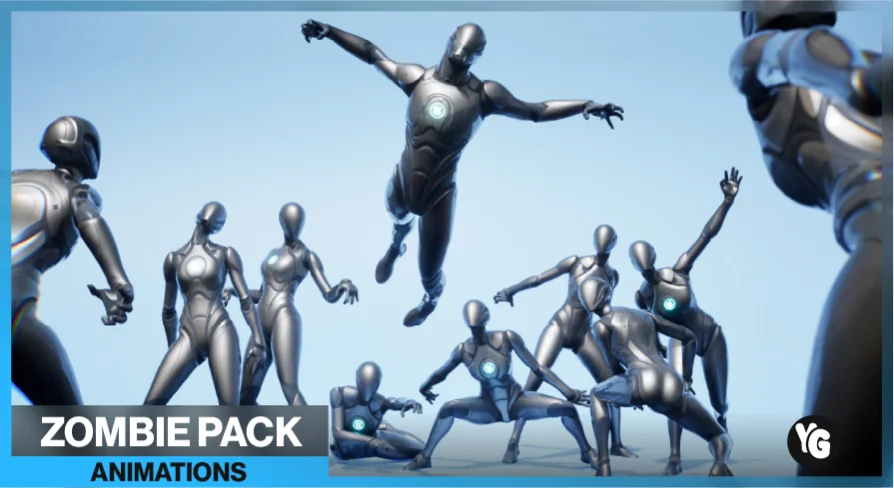
Producing believable undead enemy behaviors requires a balance between erratic, unnatural motion and grounded physical presence. Hand-keyed monster movement often struggles to convey the weight and irregular kinetic pacing that characterizes infected or reanimated creatures. The 105 Zombie Animations Mocap collection addresses this core animation requirement by delivering motion-captured body and hand performances tuned directly for zombie, horror, and post-apocalyptic projects.
Rather than offering isolated movements, the collection provides a structured split between stationary engine mechanics and physics-driven trajectory changes. The library features 75 in-place animations and 30 root motion animations, allowing animators and technical artists to split behavioral states between code-driven character controllers and trajectory-driven root movement. Every sequence incorporates detailed hand animations alongside full-body tracking, eliminating the need to manually pose fingers for claws, grabs, and flailing gestures during complex combat encounters.
In-Place Movement, Attacks, and Expressive Body States
The 75 in-place animations form the operational core for responsive artificial intelligence setups where programmatic navigation meshes or character movement components dictate actor velocity.
Combat interactions within the in-place collection prioritize frantic encounters, offering 14 attack animations and 2 dedicated bite sequences. When creatures take damage from player weapons, 6 hit reaction clips allow characters to register weapon impacts without breaking state coherence. Locomotion needs are handled by 11 in-place locomotion tracks, complemented by 7 jump sequences and 2 fall animations for traversing varied terrain. For reactive states, the pack features 5 detection sequences, enabling enemies to display alert behaviors before transitioning into pursuit.
Idle and transitional states are heavily varied to prevent AI hordes from looking uniform. Nine primary idle sequences are joined by 3 ground idle variations, allowing actors to lurk on floors or rest against level geometry. When engaging the player or ambient props, 4 eating animations support environmental storytelling scenes where infected feed on targets. Positional recoveries are covered by 2 get-down and 2 get-up sequences, while 7 scream animations provide cues to signal incoming threats. The in-place segment is rounded out by a fatal dead state animation.
Root Motion Capabilities and Turn Updates
Certain dynamic actions require absolute alignment between mesh position and animation movement, making the 30 root motion sequences crucial for close-quarters grappling and lunges.
Root motion prevents the unnatural sliding often visible when an enemy lunges forward or lunges off a ledge during an attack sequence. Within the root motion selection, 10 attacks and 11 locomotion tracks handle momentum-driven combat runs. Environmental and reactionary actions include 2 jumps, 2 hit reactions, and 2 detection animations. Transitions are similarly supported with 1 get-down clip, 1 get-up clip, and a focused scream sequence that drives the skeleton forward through root-level transformation.
Subsequent production refinements expanded this movement library with 14 additional animations. This revision introduced 12 directional turns divided evenly between 6 in-place and 6 root-motion variations, granting characters fluid transitions when changing facing angles during patrol or pursuit loops. Two death sequences—one in-place and one root motion—were introduced alongside an engine-level rotation fix specifically resolving orientation anomalies previously present in the detection animations across both locomotion formats.
Mapping 281 Bonus Zombie Audio Tracks to Behavioral Triggers
Audio is as critical as motion data when building intimidating horror encounters, and synchronizing monster vocalizations to rapid animation states often slows down asset assembly.
To eliminate the delay of searching for external sound effects, the package includes 281 bonus zombie audio files mapped across the exact action categories defined by the animation tracks. Combat audio forms the largest segment, offering 55 attack sounds alongside 47 dedicated hit response cues that can be connected to blend trees or hitboxes. Alert and spotting behaviors are supported by 17 detection sounds, while 21 distinct scream files provide acoustic feedback during aggressive charges and alert transitions.
Passive and ambient monster actions are also thoroughly represented in the audio set. Character idles are backed by 40 general idle vocalizations and 18 ground-idle sounds tailored for low, guttural resting sounds. When creatures feed on the environment, 35 eating sound effects deliver visceral audio directly tied to the corresponding consumption animations. Movement-specific audio rounds out the library, delivering 24 locomotion sound files and 24 jump cues to support physical impact and exertion during athletic jumps or lunging leaps.
Pipeline Implementation with Skeletal Meshes and Pure Animation Assets
Production pipelines vary significantly across studios, which makes raw, unencumbered animation files an essential baseline for custom game architecture.
The package ships strictly as skeletal meshes and animation assets without pre-built Blueprints. By omitting hard-coded gameplay Blueprints, the assets integrate cleanly into proprietary state machines, behavior trees, motion-matching systems, or custom character blueprints without requiring cleanup or dependency decoupling. Developers retain full freedom to configure notify tracks, retarget the motion capture data across alternate creature skeletons, or align the 281 audio cues to exact frame markers in their own event graphs.
Whether implemented as roaming infected in an open-world survival game or tightly scripted corridor hazards in a horror shooter, the combination of comprehensive capture-based skeletal motions and dedicated creature audio provides a plug-and-play foundation for terrifying adversary encounters.
 Gestures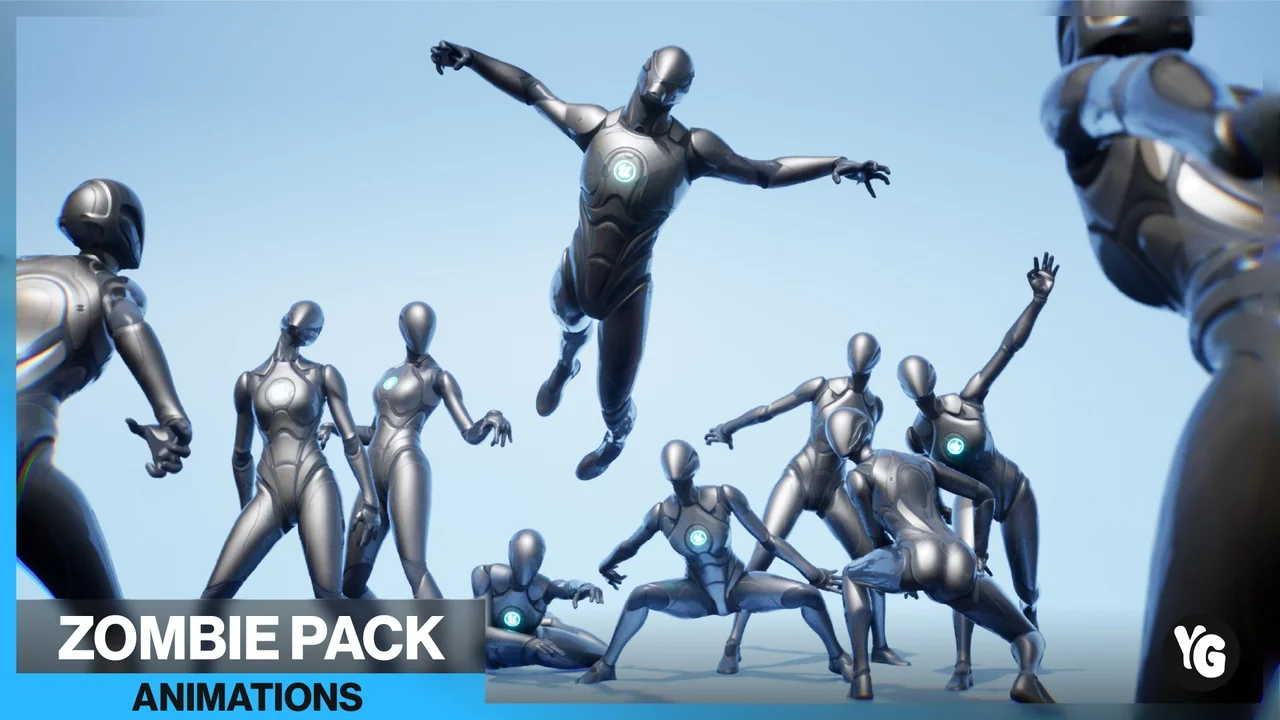
 Gestures
 Gestures
 Gestures