"7ad89cffa44984cf"{"id":"1002568","slug":"wwii-british-infantry","title":"WWII British Infantry","category":"Characters \u0026 Creatures","engine":"4.19+,5.0+","assetVersion":"","engineVersion":"Engine Version: 4.19+,5.0+","tag":"Characters","accent":"blue","visual":"character","summary":"Explore the WWII British Infantry character asset, featuring standard UE mannequin rigging, PBR textures, APEX cloth physics, and customizable materials.","platform":"Unreal Engine","indexPolicy":"index","publishedAt":"2026-11-13T12:16:57.150Z","updatedAt":"2026-11-13T12:16:57.150Z","sourceNotes":[],"fileContents":[],"compatibility":["Unreal Engine","Engine Version: 4.19+,5.0+"],"featuredImage":{"alt":"WWII British Infantry","src":"/wp-content/uploads/published/2026/11/d4d3db87b052-1c717dd5-b58c-4b00-b8e4-e4a6dacce6fb-ffc005f3e6.webp"},"hasDownloadLink":true,"downloads":0,"terms":[{"taxonomy":"category","slug":"characters-and-creatures","name":"Characters \u0026 Creatures"}],"galleryImages":[{"src":"/wp-content/uploads/published/2026/11/f221ea5414bb-751b5bc7-001f-4d11-b2fe-89c6767bf07f-57bce19605.webp","alt":"WWII British Infantry"},{"src":"/wp-content/uploads/published/2026/11/114734f79193-089ec74a-f7ae-41b1-8d93-abf839c567a0-544fe4da37.webp","alt":"WWII British Infantry"},{"src":"/wp-content/uploads/published/2026/11/3dabad769656-d9db07e9-9207-46b0-a477-b696f75d9206-1b3d7d3e58.webp","alt":"WWII British Infantry"},{"src":"/wp-content/uploads/published/2026/11/509101a11327-eb740d2d-f15a-4d7f-8a65-664fcd4a8b70-4ee6277e7d.webp","alt":"WWII British Infantry"},{"src":"/wp-content/uploads/published/2026/11/7ec206a2171c-853dd5b1-f291-4b1e-a10a-5d0ea5611a3c-b81437eeb6.webp","alt":"WWII British Infantry"},{"src":"/wp-content/uploads/published/2026/11/55487661d2b6-74312b03-467d-4a5b-a1a0-49c121833fc5-f570f1b3c1.webp","alt":"WWII British Infantry"},{"src":"/wp-content/uploads/published/2026/11/14655effe030-834751e4-4c6a-458f-b166-a110ba4407c2-aefc99e8a9.webp","alt":"WWII British Infantry"},{"src":"/wp-content/uploads/published/2026/11/f1cadeba3ddd-9e0799c4-80df-46e6-a33e-9bfbe3fe63e9-9a5589ddc3.webp","alt":"WWII British Infantry"}],"accessPanel":{"kind":"resource","title":"Get this resource","eyebrow":"Free resource","message":"Download this resource in your browser.","fileName":"Content.7z","safetyNote":"Resources are manually reviewed before listing to improve quality and reduce obvious risks.","actionLabel":"Get this resource","resourceType":"Resource archive","versions":[]},"contentHtml":"\u003cp\u003eCreating grounded military scenarios requires character assets that balance visual authenticity with flexible technical systems. The WWII British Infantry model addresses this requirement by providing a wartime combatant setup built for modern real-time pipelines. While the base identity is rooted in second World War historical military engagements, the underlying technical framework is structured to step outside strictly authentic depictions whenever a scenario demands it. Production environments often alternate between strictly documented historical recreations and speculative alternative-history narratives. Having an asset that accommodates both approaches simplifies character pipeline design without necessitating entirely new sculpts or mesh modifications.\u003c/p\u003e\u003ch2\u003eDeploying the WWII British Infantry in Historical and Speculative Scenarios\u003c/h2\u003e\u003cp\u003eHistorical wartime projects demand clear silhouettes, accurate gear shapes, and materials that look coherent within battlefield environments. The WWII British Infantry asset fulfills these baseline requirements for twentieth-century European and global theaters. The uniform shapes, loadout layout, and overall posture fit standard infantry roles across frontline combat, defensive entrenchments, and combined-arms engagements.\u003c/p\u003e\u003cp\u003eThe character is not restricted to textbook military depictions. Because the visual pipeline supports rapid texture swaps and localized color tinting, this model can pivot into alternative-history timelines. Developers working on retro-futuristic warfare, counter-factual mid-century conflicts, or dieselpunk settings can alter the asset's context quickly. Changing tactical patterns transforms the standard frontline British soldier into an operative from an alternate branch of service or a rogue faction within an imagined mid-twentieth-century setting. This dual utility lets narrative and worldbuilding teams push past conventional battlefield representations while preserving the underlying military silhouette.\u003c/p\u003e\u003ch2\u003eMaterial Customization and Team Color Systems\u003c/h2\u003e\u003cp\u003eUniform differentiation can be an operational hurdle in multiplayer titles or squad-focused tactical games. The WWII British Infantry asset solves this through an advanced material system that enables quick visual restructuring. New camouflage patterns can be imported and assigned directly, giving artists control over how fabrics interact with diverse theater environments such as woodland, arid brush, or urban ruins.\u003c/p\u003e\u003cp\u003eBeyond camouflage swaps, the material setup includes support for localized color adjustments across specific uniform components. This function is particularly practical when building multiplayer team identification. Rather than exporting separate texture files for allied and opposing sides, technical artists can define distinct color accents directly within the shader. Adjusting specific cloth or gear components yields clear team differentiation without breaking the overarching gritty aesthetic. This parameter-driven workflow reduces texture memory overhead across complex scenes containing multiple soldiers simultaneously.\u003c/p\u003e\u003ch2\u003eStandard Mannequin Rigging and Animation Blueprint Integration\u003c/h2\u003e\u003cp\u003eLocomotion and combat readiness depend heavily on skeleton structure. The WWII British Infantry model is rigged directly to the standard Unreal Engine mannequin hierarchy. This structural choice grants immediate access to the wide spectrum of existing marketplace animation assets without demanding tedious retargeting sessions or bone-mapping translations.\u003c/p\u003e\u003cp\u003eIntegration with standard animation blueprints means developers can connect existing locomotion trees, weapon handling states, and aim offsets directly to the character. Combat actions such as crouching, tactical sprinting, vaulting, and prone crawls function reliably out of the box. Teams prototyping quick action mechanics can take advantage of the free Animation Starter Pack from Epic, wiring foundational movement logic, weapon stances, and hit reactions into the British infantry skeleton immediately. This skeletal conformity drastically accelerates the prototyping stage for both solo creators and larger production teams.\u003c/p\u003e\u003ch2\u003eAPEX Cloth Physics and Dynamic Movement\u003c/h2\u003e\u003cp\u003eStatic clothing can break immersion when characters perform violent or sudden tactical maneuvers. The model features ready-to-go APEX cloth physics, giving specific uniform elements the freedom to react naturally to physical forces. As a soldier sprints across rugged terrain, drops into trenches, or takes cover behind debris, loose fabric sections shift according to kinetic energy and simulated world wind.\u003c/p\u003e\u003cp\u003eAPEX cloth simulation adds tangible weight to the soldier during dynamic combat sequences without requiring complex custom skeletal bones for uniform tails or hanging gear. In real-time situations where characters move between high-speed sprints, sudden directional changes, and dynamic mantle animations, cloth physics preserve a believable sense of mass and momentum. This physical response helps ground the infantry model firmly in the physical realities of the surrounding environment.\u003c/p\u003e\u003ch2\u003ePBR Textures and Geometric Balance Across Multiple Camera Distances\u003c/h2\u003e\u003cp\u003eA key challenge in character design is ensuring that geometry and surface materials hold up across drastically different viewing perspectives. The WWII British Infantry asset is crafted with geometry balanced for mid-distance, long-distance, and tight close-up rendering. This structural balance lets artists deploy the character across diverse camera configurations:\u003c/p\u003e\u003cul\u003e\u003cli\u003eDirect player control in third-person camera perspectives where uniform folds and rear loadouts remain under constant view\u003c/li\u003e\u003cli\u003eNon-player characters (NPCs) and enemy combatants encountered during first-person shooters\u003c/li\u003e\u003cli\u003eRival combatants in wide-angle tactical or third-person strategy camera setups\u003c/li\u003e\u003cli\u003eClose-up cinematic framing during narrative scenes and tactical mission briefings\u003c/li\u003e\u003c/ul\u003e\u003cp\u003eVisual fidelity across these view ranges is maintained through a dedicated physically based rendering (PBR) texture pipeline. Every texture set includes high-detailed Diffuse (Albedo), Roughness, Metalness, and Normal maps. The metallic map delineates buckles, weapons, and rigid hardware from canvas webbings and wool cloths, while the roughness map governs how moisture, sweat, and material age diffuse light across surfaces. Coupled with sharp surface normals, the assets capture fine textile weaves, leather grain, and weathered metal edges without relying on excessive polygon density.\u003c/p\u003e\u003ch2\u003eInfantry Deployment Across Single-Player and Multiplayer Frameworks\u003c/h2\u003e\u003cp\u003eThe technical configuration of the WWII British Infantry asset makes it well-suited for varied production contexts. When building single-player campaigns, level designers can populate frontline fortifications with authentic British combat units that execute standard patrol scripts, fireteam behaviors, and dynamic duck-and-cover routines driven by the underlying animation blueprint. The high-detail PBR maps and APEX cloth ensure that when the player closes in for dialogue, squad commands, or close-quarters melee, the character preserves its visual weight.\u003c/p\u003e\u003cp\u003eFor multiplayer environments, the asset leverages its material customization to field clear friendly and enemy squads. Paired with compatibility systems like Gothic Knight setups, technical directors can establish consistent pipelines across varied historical and combatant projects. Whether tasked with commanding an infantry platoon across the fields of historical Europe or adapting a custom-patterned patrol into an alternate-timeline dieselpunk skirmish, the model provides a reliable, adaptable, and engine-ready foundation.\u003c/p\u003e\n\n\u003ch2\u003eRelated Resources Worth Checking\u003c/h2\u003e\n\u003cul\u003e\n\u003cli\u003e\u003ca href=\"https://3dcghub.com/medieval-infantry/\" rel=\"noopener noreferrer\"\u003eMedieval Infantry\u003c/a\u003e\u003c/li\u003e\n\u003cli\u003e\u003ca href=\"https://3dcghub.com/german-soldier-wwii/\" rel=\"noopener noreferrer\"\u003eGerman Soldier WWII\u003c/a\u003e\u003c/li\u003e\n\u003cli\u003e\u003ca href=\"https://3dcghub.com/light-warrior/\" rel=\"noopener noreferrer\"\u003eLight Warrior\u003c/a\u003e\u003c/li\u003e\n\u003cli\u003e\u003ca href=\"https://3dcghub.com/light-lamellar-armour-pack/\" rel=\"noopener noreferrer\"\u003eLight Lamellar Armour Pack\u003c/a\u003e\u003c/li\u003e\n\u003cli\u003e\u003ca href=\"https://3dcghub.com/noir-mafia-characters/\" rel=\"noopener noreferrer\"\u003eNoir/Mafia Characters\u003c/a\u003e\u003c/li\u003e\n\u003c/ul\u003e","contentTextLength":7779,"navigation":{"current":9,"total":4499,"previous":{"id":"1002569","slug":"celebrations-all-in-one-bundle-vfx-and-material-for-christmas-halloween-holidays","title":"Celebrations All In One Bundle — VFX \u0026 Material for Christmas Halloween Holidays","category":"Variety","platform":"Unreal Engine","updatedAt":"2026-11-13T18:04:37.405Z"},"next":{"id":"1002567","slug":"workout-set","title":"Workout Set","category":"Characters \u0026 Creatures","platform":"Unreal Engine","updatedAt":"2026-11-13T12:14:09.185Z"}},"relatedResources":[{"id":"1002485","slug":"medieval-infantry","title":"Medieval Infantry","category":"Characters \u0026 Creatures","engine":"4.19+,5.0+","assetVersion":"","engineVersion":"Engine Version: 4.19+,5.0+","tag":"Characters","accent":"blue","visual":"character","summary":"Customizable realistic medieval warriors with advanced material controls, UE mannequin compatibility, a dedicated weapon asset, and a deployable ballista.","platform":"Unreal Engine","indexPolicy":"index","publishedAt":"2026-11-12T03:49:48.304Z","updatedAt":"2026-11-12T03:49:48.304Z","sourceNotes":[],"fileContents":[],"compatibility":["Unreal Engine","Engine Version: 4.19+,5.0+"],"featuredImage":{"alt":"Medieval Infantry","src":"/wp-content/uploads/published/2026/11/b6de45965936-86df4195-fcaf-4770-a2e1-5228fc98f0d5-86b001c8c2.webp"},"hasDownloadLink":true,"downloads":0},{"id":"1002040","slug":"german-soldier-wwii","title":"German Soldier WWII","category":"Characters \u0026 Creatures","engine":"4.26+,5.0+","assetVersion":"","engineVersion":"Engine Version: 4.26+,5.0+","tag":"Characters","accent":"blue","visual":"character","summary":"Explore the German Soldier WWII character asset, featuring standard UE mannequin rigging, customizable camouflage materials, and full PBR texture sets.","platform":"Unreal Engine","indexPolicy":"index","publishedAt":"2026-10-26T14:22:08.764Z","updatedAt":"2026-10-26T14:22:08.764Z","sourceNotes":[],"fileContents":[],"compatibility":["Unreal Engine","Engine Version: 4.26+,5.0+"],"featuredImage":{"alt":"German Soldier WWII","src":"/wp-content/uploads/published/2026/10/ef549c4de90c-7506682f-e445-427d-a90f-9300d7328716-5c6da2ebf9.webp"},"hasDownloadLink":true,"downloads":0},{"id":"1001642","slug":"light-warrior","title":"Light Warrior","category":"Characters \u0026 Creatures","engine":"4.19+,5.0+","assetVersion":"","engineVersion":"Engine Version: 4.19+,5.0+","tag":"Characters","accent":"blue","visual":"character","summary":"Explore the Light Warrior character asset for Unreal Engine, featuring APEX cloth dynamics, advanced material customization, UE mannequin rigging, and weapons.","platform":"Unreal Engine","indexPolicy":"index","publishedAt":"2026-10-13T02:26:09.285Z","updatedAt":"2026-10-13T02:26:09.285Z","sourceNotes":[],"fileContents":[],"compatibility":["Unreal Engine","Engine Version: 4.19+,5.0+"],"featuredImage":{"alt":"Light Warrior","src":"/wp-content/uploads/published/2026/10/1961ac8c32cb-1891ca23-2a17-4068-81af-80cf504d4ba6-7b198e2c02.webp"},"hasDownloadLink":true,"downloads":0}]}
Characters
WWII British Infantry
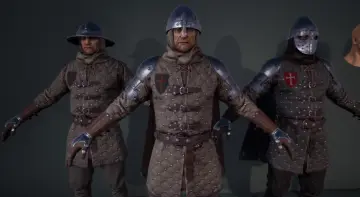
Explore the WWII British Infantry character asset, featuring standard UE mannequin rigging, PBR textures, APEX cloth physics, and customizable materials.
Creating grounded military scenarios requires character assets that balance visual authenticity with flexible technical systems. The WWII British Infantry model addresses this requirement by providing a wartime combatant setup built for modern real-time pipelines. While the base identity is rooted in second World War historical military engagements, the underlying technical framework is structured to step outside strictly authentic depictions whenever a scenario demands it. Production environments often alternate between strictly documented historical recreations and speculative alternative-history narratives. Having an asset that accommodates both approaches simplifies character pipeline design without necessitating entirely new sculpts or mesh modifications.
Deploying the WWII British Infantry in Historical and Speculative Scenarios
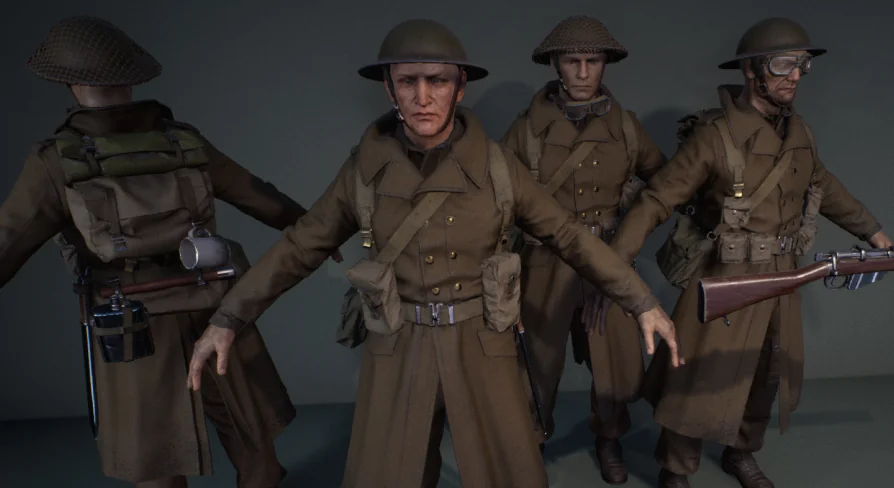
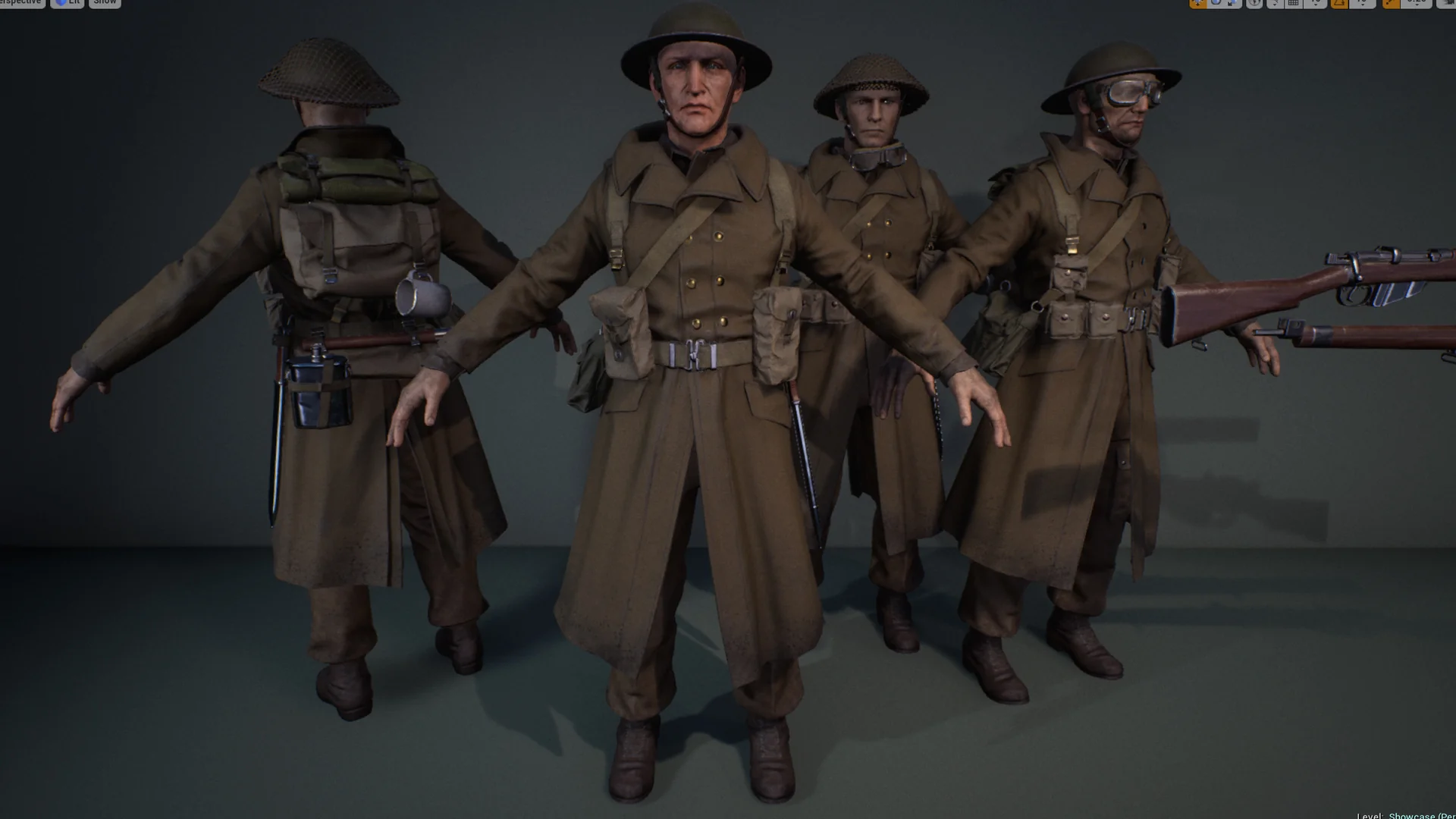
Historical wartime projects demand clear silhouettes, accurate gear shapes, and materials that look coherent within battlefield environments. The WWII British Infantry asset fulfills these baseline requirements for twentieth-century European and global theaters. The uniform shapes, loadout layout, and overall posture fit standard infantry roles across frontline combat, defensive entrenchments, and combined-arms engagements.
The character is not restricted to textbook military depictions. Because the visual pipeline supports rapid texture swaps and localized color tinting, this model can pivot into alternative-history timelines. Developers working on retro-futuristic warfare, counter-factual mid-century conflicts, or dieselpunk settings can alter the asset's context quickly. Changing tactical patterns transforms the standard frontline British soldier into an operative from an alternate branch of service or a rogue faction within an imagined mid-twentieth-century setting. This dual utility lets narrative and worldbuilding teams push past conventional battlefield representations while preserving the underlying military silhouette.
Material Customization and Team Color Systems
Uniform differentiation can be an operational hurdle in multiplayer titles or squad-focused tactical games. The WWII British Infantry asset solves this through an advanced material system that enables quick visual restructuring. New camouflage patterns can be imported and assigned directly, giving artists control over how fabrics interact with diverse theater environments such as woodland, arid brush, or urban ruins.
Beyond camouflage swaps, the material setup includes support for localized color adjustments across specific uniform components. This function is particularly practical when building multiplayer team identification. Rather than exporting separate texture files for allied and opposing sides, technical artists can define distinct color accents directly within the shader. Adjusting specific cloth or gear components yields clear team differentiation without breaking the overarching gritty aesthetic. This parameter-driven workflow reduces texture memory overhead across complex scenes containing multiple soldiers simultaneously.
Standard Mannequin Rigging and Animation Blueprint Integration
Locomotion and combat readiness depend heavily on skeleton structure. The WWII British Infantry model is rigged directly to the standard Unreal Engine mannequin hierarchy. This structural choice grants immediate access to the wide spectrum of existing marketplace animation assets without demanding tedious retargeting sessions or bone-mapping translations.
Integration with standard animation blueprints means developers can connect existing locomotion trees, weapon handling states, and aim offsets directly to the character. Combat actions such as crouching, tactical sprinting, vaulting, and prone crawls function reliably out of the box. Teams prototyping quick action mechanics can take advantage of the free Animation Starter Pack from Epic, wiring foundational movement logic, weapon stances, and hit reactions into the British infantry skeleton immediately. This skeletal conformity drastically accelerates the prototyping stage for both solo creators and larger production teams.
APEX Cloth Physics and Dynamic Movement
Static clothing can break immersion when characters perform violent or sudden tactical maneuvers. The model features ready-to-go APEX cloth physics, giving specific uniform elements the freedom to react naturally to physical forces. As a soldier sprints across rugged terrain, drops into trenches, or takes cover behind debris, loose fabric sections shift according to kinetic energy and simulated world wind.
APEX cloth simulation adds tangible weight to the soldier during dynamic combat sequences without requiring complex custom skeletal bones for uniform tails or hanging gear. In real-time situations where characters move between high-speed sprints, sudden directional changes, and dynamic mantle animations, cloth physics preserve a believable sense of mass and momentum. This physical response helps ground the infantry model firmly in the physical realities of the surrounding environment.
PBR Textures and Geometric Balance Across Multiple Camera Distances
A key challenge in character design is ensuring that geometry and surface materials hold up across drastically different viewing perspectives. The WWII British Infantry asset is crafted with geometry balanced for mid-distance, long-distance, and tight close-up rendering. This structural balance lets artists deploy the character across diverse camera configurations:
Direct player control in third-person camera perspectives where uniform folds and rear loadouts remain under constant view
Non-player characters (NPCs) and enemy combatants encountered during first-person shooters
Rival combatants in wide-angle tactical or third-person strategy camera setups
Close-up cinematic framing during narrative scenes and tactical mission briefings
Visual fidelity across these view ranges is maintained through a dedicated physically based rendering (PBR) texture pipeline. Every texture set includes high-detailed Diffuse (Albedo), Roughness, Metalness, and Normal maps. The metallic map delineates buckles, weapons, and rigid hardware from canvas webbings and wool cloths, while the roughness map governs how moisture, sweat, and material age diffuse light across surfaces. Coupled with sharp surface normals, the assets capture fine textile weaves, leather grain, and weathered metal edges without relying on excessive polygon density.
Infantry Deployment Across Single-Player and Multiplayer Frameworks
The technical configuration of the WWII British Infantry asset makes it well-suited for varied production contexts. When building single-player campaigns, level designers can populate frontline fortifications with authentic British combat units that execute standard patrol scripts, fireteam behaviors, and dynamic duck-and-cover routines driven by the underlying animation blueprint. The high-detail PBR maps and APEX cloth ensure that when the player closes in for dialogue, squad commands, or close-quarters melee, the character preserves its visual weight.
For multiplayer environments, the asset leverages its material customization to field clear friendly and enemy squads. Paired with compatibility systems like Gothic Knight setups, technical directors can establish consistent pipelines across varied historical and combatant projects. Whether tasked with commanding an infantry platoon across the fields of historical Europe or adapting a custom-patterned patrol into an alternate-timeline dieselpunk skirmish, the model provides a reliable, adaptable, and engine-ready foundation.
 Characters
 Characters
 Characters
 Characters