"a7cfa646d0d8ae55"{"id":"1001214","slug":"water-materials","title":"Water Materials","category":"Water","engine":"5.0+","assetVersion":"","engineVersion":"Engine Version: 5.0+","tag":"Water","accent":"blue","visual":"luts","summary":"A breakdown of the Water Materials collection for Unreal Engine, featuring 12 core materials, 8 lighter variations, and vertex paint controls.","platform":"Unreal Engine","publishedAt":"2026-09-19T08:52:56.340Z","updatedAt":"2026-09-19T08:52:56.340Z","sourceNotes":[],"fileContents":[],"compatibility":["Unreal Engine","Engine Version: 5.0+"],"featuredImage":{"alt":"Water Materials","src":"/wp-content/uploads/published/2026/09/1db7cdb9038c-ce6ac2e6-47aa-4af3-bbad-d40516237245-8ecc62b00e.webp"},"hasDownloadLink":true,"downloads":0,"terms":[{"taxonomy":"category","slug":"water","name":"Water"}],"galleryImages":[{"src":"/wp-content/uploads/published/2026/09/e6e3e2c42021-e0b692bb-7ae3-43f2-9b7f-7daad95af6d1-49059ba9b3.webp","alt":"Water Materials"},{"src":"/wp-content/uploads/published/2026/09/70ff7de9084d-9a932ed2-bd8c-402a-afa0-5d741e557dbd-fb3be27426.webp","alt":"Water Materials"},{"src":"/wp-content/uploads/published/2026/09/ae3d200ec987-a5f7e1db-a9f4-4945-bce0-22838b04a501-13592071d0.webp","alt":"Water Materials"},{"src":"/wp-content/uploads/published/2026/09/58dc402c21b3-1b8b0b4a-9c08-4339-871d-fe3773007f79-537e46be86.webp","alt":"Water Materials"}],"accessPanel":{"kind":"resource","title":"Download this resource","eyebrow":"Free Download","message":"Log in or create a free account to start your download.","fileName":"Content.7z","safetyNote":"Resources are manually reviewed before listing to improve quality and reduce obvious risks.","actionLabel":"Download Free","resourceType":"Resource archive"},"contentHtml":"\u003ch2\u003eWater Environments Across Oceans, Rivers, and Pixel Art\u003c/h2\u003e\u003cp\u003eReal-time water surfaces present distinct challenges depending on the scale and style of an environment. A turbulent open ocean demands broad displacement and rolling crests, while a mountain river requires directional flow and surface tension around obstacles. Waterfalls introduce rapid vertical drop and dense mist patterns, completely distinct from the controlled, caustic-lit clarity of an artificial swimming pool. Stylized aesthetics bring their own constraints, such as pixel art scenes that discard photorealistic refraction in favor of stepped, quantized visual stepping.\u003c/p\u003e\u003cp\u003eThe Water Materials collection addresses these disparate scene types within a single package. Rather than confining its scope to a single biome or visual target, it spans realistic liquid simulations through to stylized pixel graphics. Designers working on expansive outdoor maritime scenes can deploy broad ocean shaders, while level artists assembling urban or domestic areas have access to tranquil swimming pool water. Mountain valleys and forest paths can be populated with directed rivers and plummeting waterfalls, keeping water aesthetics unified across radically different levels.\u003c/p\u003e\u003ch2\u003eThe Twelve Water Materials and Optimized Variations\u003c/h2\u003e\u003cp\u003eAt the center of the set is a library of 12 distinct Water Materials, supplemented by 8 cheaper variations. Having 12 unique base materials ensures that environmental surfaces do not look like simple recolors of a single parent shader. A waterfall requires unique mapping for vertical falloff and directional stretching, whereas an ocean surface relies on multidirectional wave oscillation and horizontal dispersion. Separating these behaviors into dedicated materials gives each biome appropriate physical motion and surface response.\u003c/p\u003e\u003cp\u003eThe inclusion of 8 cheaper variations provides direct control over shader complexity. Water rendering is notoriously heavy on graphics hardware, frequently driving up instruction counts through complex calculations for refraction, depth fading, normal blending, and dynamic movement. In performance-constrained situations—such as dense scenes filled with heavy geometry, mobile deployments, or secondary background bodies of water—running fully featured shaders can create unnecessary rendering overhead. The cheaper variations strip down demanding mathematical operations, allowing developers to maintain visual coherence across an entire project without sacrificing frame rates on background streams or non-essential ponds.\u003c/p\u003e\u003ch2\u003eSurface Customization Through Vertex Painting and Material Parameters\u003c/h2\u003e\u003cp\u003eStatic water planes can easily look synthetic if edges, shoreline interactions, and color transitions are uniform across a mesh. This package relies heavily on vertex painting to resolve blending issues directly inside the editor. By painting directly onto mesh vertices, artists can paint local variations into a water body, such as introducing wet riverbanks, generating localized foam lines near rocky outcroppings, or fading shallow areas into deep basins without editing the underlying master shader graph.\u003c/p\u003e\u003cp\u003eAlongside vertex painting, exposed material parameters allow fine-grained control over surface look and behavior. Instead of locking artists into predetermined presets, the parameters provide direct access to tweak critical surface qualities on material instances. Teams can adjust color values, surface tint, depth absorption, wave scales, tiling rates, and movement speed in real time. This workflow eliminates the need to compile new shaders for minor artistic changes, speeding up level dressing and aesthetic look-development across diverse project scenes.\u003c/p\u003e\u003ch2\u003eEngine Version Deployments and FX Compatibility\u003c/h2\u003e\u003cp\u003eThe collection entered the permanent collection of Unreal Engine sponsored content in November 2018, establishing a stable foundation for long-term production use. Compatibility spans multiple iterations of the engine. The original material content is accessible starting from Unreal Engine version 4.13 onward, establishing baseline support for legacy engine branches. An updated set of content was introduced for Unreal Engine version 4.15 and higher, accommodating architectural updates and improvements implemented in later engine releases.\u003c/p\u003e\u003cp\u003eEnvironmental water bodies rarely exist in isolation; they serve as habitats and backdrops for surrounding atmospheric and biological visual effects. This material set is compatible with Insect Birds and Fish FX, allowing environment artists to populate streams, riverbeds, and ocean surfaces with responsive wildlife systems. Because the water shaders handle both realistic and stylized surfaces cleanly, integrating swimming organisms below the surface or airborne insects above streams does not produce visual discordance against the material planes.\u003c/p\u003e\u003ch2\u003eTarget Production Contexts\u003c/h2\u003e\u003cp\u003eThis package is structured primarily for environment artists and technical designers who need quick coverage across varied aquatic biomes without constructing custom shader math from scratch. Solo developers and small teams benefit from the broad range of 12 distinct surface types, which eliminates the need to purchase separate shader sets for rivers, waterfalls, and pools. The dual availability of full-featured materials alongside cheaper variations makes it equally practical for teams targeting strict performance budgets, providing an adaptable framework for everything from retro pixel projects to realistic natural scenes.\u003c/p\u003e\n\n\u003ch2\u003eContinue Browsing Similar Packs\u003c/h2\u003e\n\u003cul\u003e\n\u003cli\u003e\u003ca href=\"https://3dcghub.com/cartoon-water-shader/\" title=\"Cartoon Water Shader\"\u003eCartoon Water Shader\u003c/a\u003e\u003c/li\u003e\n\u003cli\u003e\u003ca href=\"https://3dcghub.com/stylized-water/\" title=\"Stylized Water\"\u003eStylized Water\u003c/a\u003e\u003c/li\u003e\n\u003cli\u003e\u003ca href=\"https://3dcghub.com/realistic-materials-vol-7-water-ice-25-materials/\" title=\"Realistic Materials Vol. 7 - Water \u0026amp; Ice (25+ Materials)\"\u003eRealistic Materials Vol. 7 - Water \u0026amp; Ice (25+ Materials)\u003c/a\u003e\u003c/li\u003e\n\u003cli\u003e\u003ca href=\"https://3dcghub.com/moving-water-material-pack/\" title=\"Moving Water Material Pack\"\u003eMoving Water Material Pack\u003c/a\u003e\u003c/li\u003e\n\u003cli\u003e\u003ca href=\"https://3dcghub.com/waterstamp-water-decals/\" title=\"Waterstamp - Water Decals\"\u003eWaterstamp - Water Decals\u003c/a\u003e\u003c/li\u003e\n\u003c/ul\u003e","contentTextLength":5674,"navigation":{"current":11,"total":3167,"previous":{"id":"1001215","slug":"advanced-crt-tv-vcr-vhs-effects","title":"Advanced CRT TV - VCR - VHS Effects","category":"Variety","platform":"Unreal Engine","updatedAt":"2026-09-19T08:55:15.447Z"},"next":{"id":"1001213","slug":"cartoon-water-shader","title":"Cartoon Water Shader","category":"Water","platform":"Unreal Engine","updatedAt":"2026-09-19T08:51:37.588Z"}},"relatedResources":[{"id":"1001213","slug":"cartoon-water-shader","title":"Cartoon Water Shader","category":"Water","engine":"5.0+","assetVersion":"","engineVersion":"Engine Version: 5.0+","tag":"Water","accent":"blue","visual":"mech","summary":"Explore Cartoon Water Shader, featuring stylized water materials, river and waterfall tools, buoyancy, underwater effects, and tile solver systems.","platform":"Unreal Engine","publishedAt":"2026-09-19T08:51:37.588Z","updatedAt":"2026-09-19T08:51:37.588Z","sourceNotes":[],"fileContents":[],"compatibility":["Unreal Engine","Engine Version: 5.0+"],"featuredImage":{"alt":"Cartoon Water Shader","src":"/wp-content/uploads/published/2026/09/65dfc8ccd016-ae677613-d823-407e-8397-e6f92539e22a-1bb83d5d29.webp"},"hasDownloadLink":true,"downloads":0},{"id":"12700","slug":"stylized-water","title":"Stylized Water","category":"Water","engine":"5.2+","assetVersion":"Engine version: 5.2+","engineVersion":"5.2","tag":"Water","accent":"blue","visual":"luts","summary":"Enhance your Unreal Engine 5 projects with a comprehensive system for creating stylized water bodies. This asset includes displaced waves, reactive ripples, and tools optimized for maximum performance.","platform":"Unreal Engine","publishedAt":"2026-03-09T16:05:49.000Z","updatedAt":"2026-04-19T15:46:37.000Z","sourceNotes":[],"fileContents":[],"compatibility":["Unreal Engine","Engine version: 5.2+"],"featuredImage":{"alt":"Stylized Water","src":"https://3dcghub.com/wp-content/uploads/2026/03/6c767c2b-7a54-4934-a8fc-80e9719f8a50.webp"},"hasDownloadLink":true,"downloads":4},{"id":"24867","slug":"realistic-materials-vol-7-water-ice-25-materials","title":"Realistic Materials Vol. 7 - Water \u0026 Ice (25+ Materials)","category":"Water","engine":"5.1+","assetVersion":"Engine version: 5.1+","engineVersion":"","tag":"Water","accent":"blue","visual":"luts","summary":"Realistic Materials Vol. 7 - Water \u0026 Ice collects 28 materials with 4K texture sets, drag-and-drop setup, and master material controls. It is set up for suburban exterior structures and supports Lumen in Unreal Engine 5.0+.","platform":"Unreal Engine","publishedAt":"2026-04-17T10:55:54.000Z","updatedAt":"2026-04-20T06:12:36.000Z","sourceNotes":[],"fileContents":[],"compatibility":["Unreal Engine","Engine version: 5.1+"],"featuredImage":{"alt":"Realistic Materials Vol. 7 - Water \u0026 Ice (25+ Materials)","src":"https://3dcghub.com/wp-content/uploads/2026/04/9e3c6b9fcb39_b6c41555-a1e9-4371-a22a-f9409f4c3835.webp"},"hasDownloadLink":true,"downloads":1}]}
Water
Water Materials
A breakdown of the Water Materials collection for Unreal Engine, featuring 12 core materials, 8 lighter variations, and vertex paint controls.
Water Environments Across Oceans, Rivers, and Pixel Art
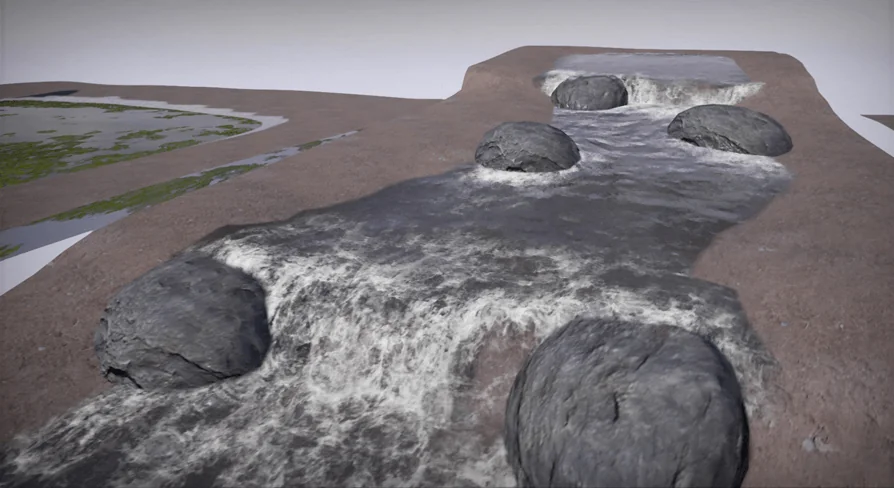
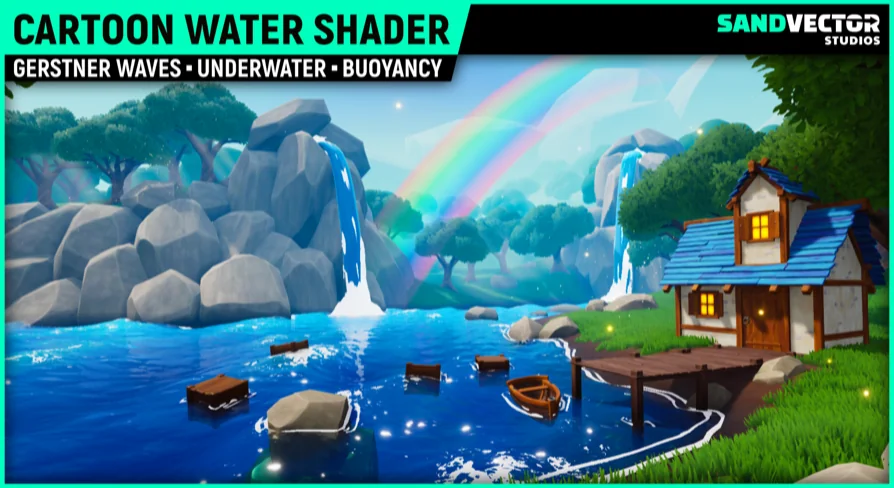
Real-time water surfaces present distinct challenges depending on the scale and style of an environment. A turbulent open ocean demands broad displacement and rolling crests, while a mountain river requires directional flow and surface tension around obstacles. Waterfalls introduce rapid vertical drop and dense mist patterns, completely distinct from the controlled, caustic-lit clarity of an artificial swimming pool. Stylized aesthetics bring their own constraints, such as pixel art scenes that discard photorealistic refraction in favor of stepped, quantized visual stepping.
The Water Materials collection addresses these disparate scene types within a single package. Rather than confining its scope to a single biome or visual target, it spans realistic liquid simulations through to stylized pixel graphics. Designers working on expansive outdoor maritime scenes can deploy broad ocean shaders, while level artists assembling urban or domestic areas have access to tranquil swimming pool water. Mountain valleys and forest paths can be populated with directed rivers and plummeting waterfalls, keeping water aesthetics unified across radically different levels.
The Twelve Water Materials and Optimized Variations
At the center of the set is a library of 12 distinct Water Materials, supplemented by 8 cheaper variations. Having 12 unique base materials ensures that environmental surfaces do not look like simple recolors of a single parent shader. A waterfall requires unique mapping for vertical falloff and directional stretching, whereas an ocean surface relies on multidirectional wave oscillation and horizontal dispersion. Separating these behaviors into dedicated materials gives each biome appropriate physical motion and surface response.
The inclusion of 8 cheaper variations provides direct control over shader complexity. Water rendering is notoriously heavy on graphics hardware, frequently driving up instruction counts through complex calculations for refraction, depth fading, normal blending, and dynamic movement. In performance-constrained situations—such as dense scenes filled with heavy geometry, mobile deployments, or secondary background bodies of water—running fully featured shaders can create unnecessary rendering overhead. The cheaper variations strip down demanding mathematical operations, allowing developers to maintain visual coherence across an entire project without sacrificing frame rates on background streams or non-essential ponds.
Surface Customization Through Vertex Painting and Material Parameters
Static water planes can easily look synthetic if edges, shoreline interactions, and color transitions are uniform across a mesh. This package relies heavily on vertex painting to resolve blending issues directly inside the editor. By painting directly onto mesh vertices, artists can paint local variations into a water body, such as introducing wet riverbanks, generating localized foam lines near rocky outcroppings, or fading shallow areas into deep basins without editing the underlying master shader graph.
Alongside vertex painting, exposed material parameters allow fine-grained control over surface look and behavior. Instead of locking artists into predetermined presets, the parameters provide direct access to tweak critical surface qualities on material instances. Teams can adjust color values, surface tint, depth absorption, wave scales, tiling rates, and movement speed in real time. This workflow eliminates the need to compile new shaders for minor artistic changes, speeding up level dressing and aesthetic look-development across diverse project scenes.
Engine Version Deployments and FX Compatibility
The collection entered the permanent collection of Unreal Engine sponsored content in November 2018, establishing a stable foundation for long-term production use. Compatibility spans multiple iterations of the engine. The original material content is accessible starting from Unreal Engine version 4.13 onward, establishing baseline support for legacy engine branches. An updated set of content was introduced for Unreal Engine version 4.15 and higher, accommodating architectural updates and improvements implemented in later engine releases.
Environmental water bodies rarely exist in isolation; they serve as habitats and backdrops for surrounding atmospheric and biological visual effects. This material set is compatible with Insect Birds and Fish FX, allowing environment artists to populate streams, riverbeds, and ocean surfaces with responsive wildlife systems. Because the water shaders handle both realistic and stylized surfaces cleanly, integrating swimming organisms below the surface or airborne insects above streams does not produce visual discordance against the material planes.
Target Production Contexts
This package is structured primarily for environment artists and technical designers who need quick coverage across varied aquatic biomes without constructing custom shader math from scratch. Solo developers and small teams benefit from the broad range of 12 distinct surface types, which eliminates the need to purchase separate shader sets for rivers, waterfalls, and pools. The dual availability of full-featured materials alongside cheaper variations makes it equally practical for teams targeting strict performance budgets, providing an adaptable framework for everything from retro pixel projects to realistic natural scenes.
 Water
Water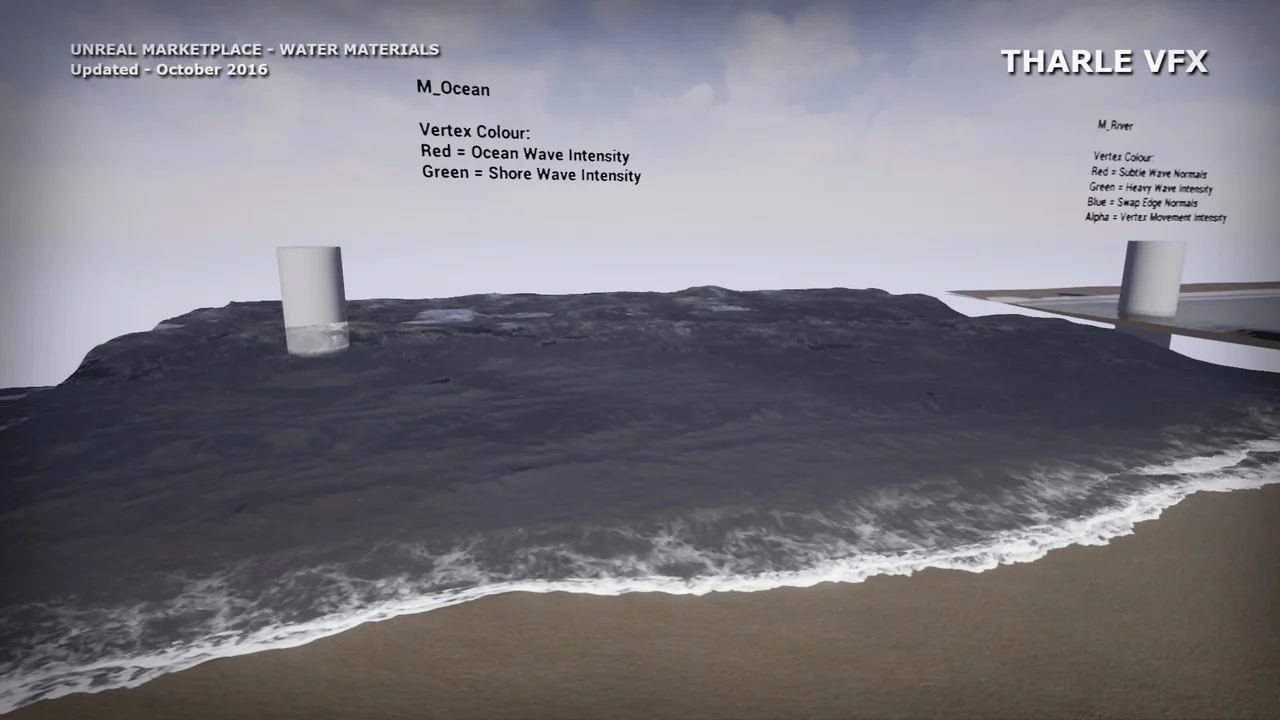
 Water
Water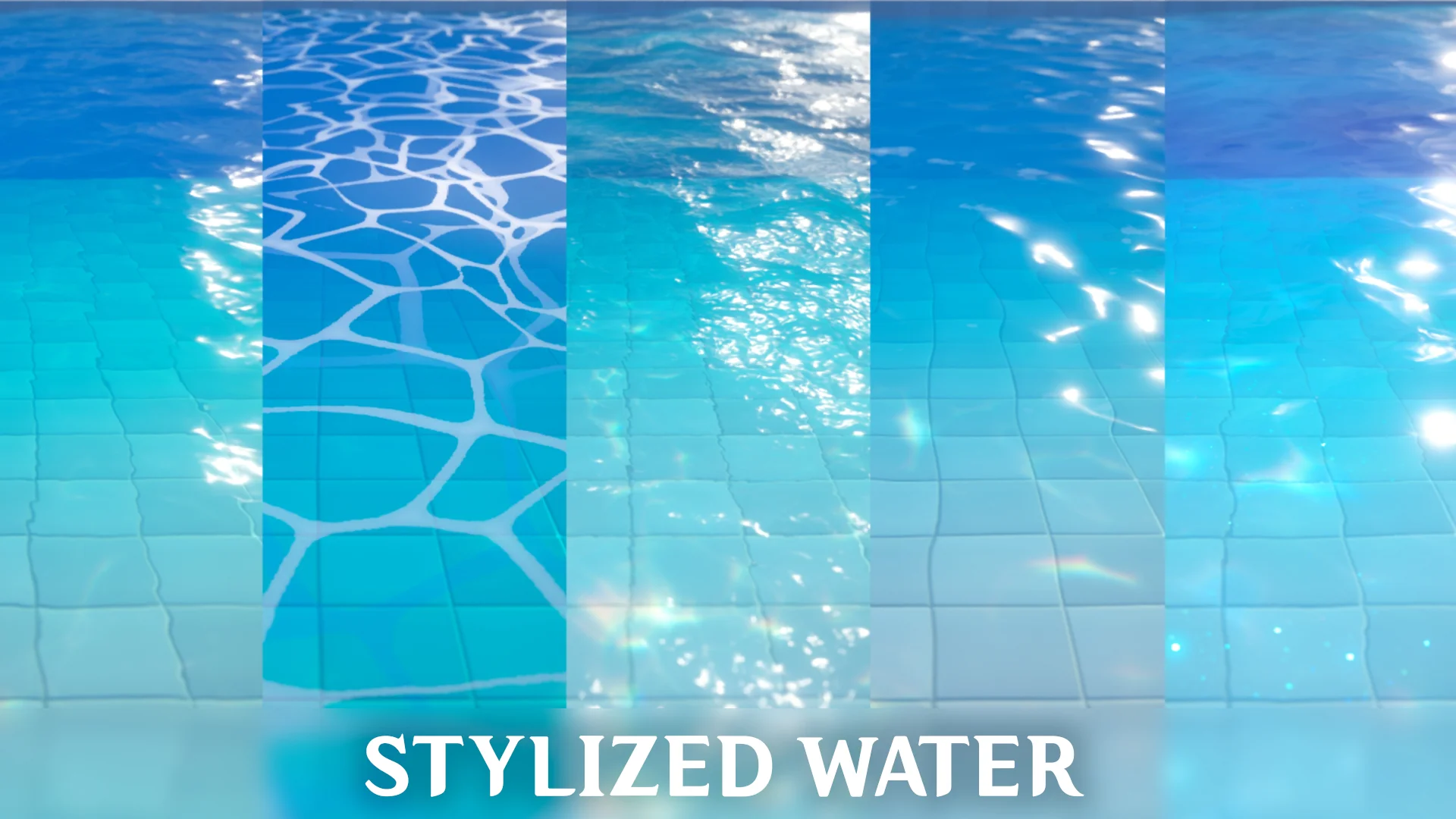 Water
Water Water
Water