"0341a2901a4ae9aa"{"id":"1001161","slug":"warehouse-abandoned-factory-district","title":"Warehouse - Abandoned Factory District","category":"Industrial","engine":"4.27,5.0+","assetVersion":"","engineVersion":"Engine Version: 4.27,5.0+","tag":"Industrial","accent":"blue","visual":"mech","summary":"Warehouse - Abandoned Factory District delivers over 1,000 industrial assets, functional motion blueprints, audio, and photogrammetry detailing.","platform":"Unreal Engine","publishedAt":"2026-09-11T09:39:32.707Z","updatedAt":"2026-09-11T09:39:32.707Z","sourceNotes":[],"fileContents":[],"compatibility":["Unreal Engine","Engine Version: 4.27,5.0+"],"featuredImage":{"alt":"Warehouse - Abandoned Factory District","src":"/wp-content/uploads/published/2026/09/0d31143c8102-96fa8327-2ea3-4f37-ac7e-addb57c90780-9c79c1476e.webp"},"hasDownloadLink":true,"downloads":4,"terms":[{"taxonomy":"category","slug":"industrial-environments","name":"Industrial"}],"galleryImages":[{"src":"/wp-content/uploads/published/2026/09/965b72b5b2ad-d11090e5-5bcc-4581-959f-bb0da03a6b44-8918e5b771.webp","alt":"Warehouse - Abandoned Factory District"},{"src":"/wp-content/uploads/published/2026/09/d44f78604022-d03aa665-bd9c-4245-9e90-f6cd5ba2438a-c73ce17e85.webp","alt":"Warehouse - Abandoned Factory District"},{"src":"/wp-content/uploads/published/2026/09/0ecd47037bb8-21785e56-1e4c-419e-a884-c73026676de0-632708e540.webp","alt":"Warehouse - Abandoned Factory District"},{"src":"/wp-content/uploads/published/2026/09/7513abcd9eaa-492a1955-9249-4775-a0da-02226a3ac86a-0962502d0c.webp","alt":"Warehouse - Abandoned Factory District"},{"src":"/wp-content/uploads/published/2026/09/6eff8c44ffdf-f2db41d3-1fb2-45b4-b0b7-cb3ad543513d-47a0670e01.webp","alt":"Warehouse - Abandoned Factory District"},{"src":"/wp-content/uploads/published/2026/09/9f2e5b61f477-16184df2-dc1a-4021-a70a-370f6cd281b7-ed069f7a50.webp","alt":"Warehouse - Abandoned Factory District"},{"src":"/wp-content/uploads/published/2026/09/925b2681e4cf-bc8b469c-c95e-4673-94a7-4efd77c7d625-1723587f08.webp","alt":"Warehouse - Abandoned Factory District"},{"src":"/wp-content/uploads/published/2026/09/6d3cd36c64af-2dc40191-7546-41dc-84e7-093aa464d9d2-8ef00cb3e0.webp","alt":"Warehouse - Abandoned Factory District"},{"src":"/wp-content/uploads/published/2026/09/7349c9ed0c8d-7d12aef6-33a2-46e9-9d36-508e3f565ec5-2cbdfdc122.webp","alt":"Warehouse - Abandoned Factory District"},{"src":"/wp-content/uploads/published/2026/09/ce99b00dea2c-d326e7bd-40cb-4078-ab53-203e777a1d11-df815be1b7.webp","alt":"Warehouse - Abandoned Factory District"}],"accessPanel":{"kind":"resource","title":"Download this resource","eyebrow":"Free Download","message":"Log in or create a free account to start your download.","fileName":"Content.7z","safetyNote":"Resources are manually reviewed before listing to improve quality and reduce obvious risks.","actionLabel":"Download Free","resourceType":"Resource archive"},"contentHtml":"\u003ch2\u003eWarehouse Prefabs and the Industrial Asset Library\u003c/h2\u003e\n\u003cp\u003eWarehouse - Abandoned Factory District is constructed from more than 1,000 modular assets spanning structural steel, ruined brick walls, pipe networks, and fragmented concrete. The environment brings together diverse architectural elements designed to portray industrial neglect, from corroded corridors to vast open-floor processing zones. A high concentration of detailed props, including scrap metal, construction debris, scattered trash, and decaying mechanical parts, allows level designers to scatter micro-detail across floor spaces without needing to bring in outside prop libraries.\u003c/p\u003e\n\u003cp\u003eThe collection focuses heavily on tactile decay, relying on assets generated through photogrammetry to reproduce authentic surface fractures, flaking paint, and oxidized iron. These high-fidelity materials capture the distinct grime of a forgotten urban sector, giving broken masonry, worn steel framing, and steam fittings a weathered finish. By packaging modular architecture with standalone machinery props, the district can be configured into sprawling manufacturing sectors, dense subterranean factory levels, or post-apocalyptic city ruins.\u003c/p\u003e \u003ch2\u003eInteractive Elevator Blueprints and Moving Machinery\u003c/h2\u003e\n\u003cp\u003eRather than presenting a purely static scene, the environment incorporates functional Blueprints to support player movement and mechanical activity. A working elevator blueprint provides vertical traversal through multi-story warehouse interiors, allowing gameplay designers to build connected, multi-tier encounters without constructing bespoke mechanical logic from scratch. Other motion elements across the factory floor inject life into otherwise derelict corridors, keeping the space dynamic during player exploration.\u003c/p\u003e\n\u003cp\u003eInteraction extends to foundational environment controls, such as functional doors that open and close, along with togglable lighting networks. These systems integrate smoothly with production workflows, giving developers quick access to light switching and access-point management directly inside the scene. Alongside the motion blueprints, embedded audio files and atmospheric VFX—such as drifting steam and ambient factory hums—work together to establish a thick, industrial soundscape and mood throughout the complex.\u003c/p\u003e \u003ch2\u003ePhotogrammetry Detailing Across Standard and Lumen Pipelines\u003c/h2\u003e\n\u003cp\u003eSurface authenticity across the district stems from high-resolution photogrammetry resources. Surfaces show authentic chipping along concrete borders, layered rust eating into iron beams, and tactile soil and debris clinging to building foundations. This level of physical grounding prevents large open areas, such as expansive warehouse bays and loading docks, from looking flat or repetitive under close scrutiny.\u003c/p\u003e\n\u003cp\u003eThe package is configured to operate across both Standard lighting and Unreal Engine's dynamic Lumen lighting pipelines. In Lumen, bouncing light highlights the pitted surfaces of broken structural columns and filters through ruptured ceiling sections to illuminate dust and steam particles suspended in the air. For productions requiring direct control or fixed rendering overhead, the standard lighting pipeline maintains clear visibility, specular response on wet steel, and sharp shadow transitions across complex pipe frameworks.\u003c/p\u003e \u003ch2\u003eScalability Testing and Large-Scale District Performance\u003c/h2\u003e\n\u003cp\u003eManaging over a thousand individual assets across a vast industrial territory requires tight optimization for real-time framerates. The included demonstration scene is pre-configured to maintain solid playback speeds while rendering complex industrial architecture, extensive prop placement, and active visual effects simultaneously. During real-time performance evaluation, the diverse environment achieved 100 FPS running at Full HD (1080p) under High scalability settings.\u003c/p\u003e\n\u003cp\u003eThis benchmark was documented on a testing system equipped with an AMD Ryzen 9 processor, an Nvidia RTX 4080 graphics card, 64GB of RAM, and fast SSD storage. The scene manages draw calls and asset density effectively, ensuring that the large-scale downtown map can serve as an expansive, reliable foundation. Teams can directly expand the district, adding custom city blocks, adjacent suburban roads, or connected transit corridors without immediate performance degradation.\u003c/p\u003e \u003ch2\u003eDelivered Prefabs and the District Roadmap\u003c/h2\u003e\n\u003cp\u003eBeyond the primary release, the environment features ongoing expansion through version updates. The delivered v1.1 update expanded the core package with at least 10 unique structural objects, including specialized industrial roofs, alongside more than 10 complete building prefabs. These prefabs speed up environment blockouts by letting artists drop assembled factory facilities directly into the map before dressing them with smaller props and machinery.\u003c/p\u003e\n\u003cp\u003eThe planned development roadmap details subsequent milestones aimed at widening the toolkit:\u003c/p\u003e\n\u003cul\u003e\n\u003cli\u003eV1.2: A dedicated new lighting scenario to offer alternative atmospheric conditions for the factory grounds.\u003c/li\u003e\n\u003cli\u003eV1.3: Additional machine animations designed to increase realism and operational movement across the facility floor.\u003c/li\u003e\n\u003c/ul\u003e\n\u003cp\u003eWith its vast selection of ruined walls, functional blueprints, modular steel modules, and planned updates, Warehouse - Abandoned Factory District serves as a comprehensive production platform for apocalyptic backdrops, forgotten urban complexes, and dense manufacturing environments.\u003c/p\u003e\n\n\u003ch2\u003eExplore Similar Assets\u003c/h2\u003e\n\u003cul\u003e\n\u003cli\u003e\u003ca href=\"https://3dcghub.com/factory-district/\" title=\"Factory District\"\u003eFactory District\u003c/a\u003e\u003c/li\u003e\n\u003cli\u003e\u003ca href=\"https://3dcghub.com/abandoned-factory-factory-warehouse-industrial-factory-industrial-warehouse/\" title=\"Abandoned Factory (Factory, Warehouse, Industrial Factory, Industrial Warehouse)\"\u003eAbandoned Factory (Factory, Warehouse, Industrial Factory, Industrial Warehouse)\u003c/a\u003e\u003c/li\u003e\n\u003cli\u003e\u003ca href=\"https://3dcghub.com/factory/\" title=\"Factory\"\u003eFactory\u003c/a\u003e\u003c/li\u003e\n\u003cli\u003e\u003ca href=\"https://3dcghub.com/modular-warehouse/\" title=\"Modular Warehouse\"\u003eModular Warehouse\u003c/a\u003e\u003c/li\u003e\n\u003cli\u003e\u003ca href=\"https://3dcghub.com/devton-abandoned-prison/\" title=\"DevTon Abandoned Prison\"\u003eDevTon Abandoned Prison\u003c/a\u003e\u003c/li\u003e\n\u003c/ul\u003e","contentTextLength":5584,"navigation":{"current":981,"total":4017,"previous":{"id":"1001162","slug":"abandoned-carnival-circus","title":"Abandoned Carnival Circus","category":"Tools, Objects \u0026 Decor","platform":"Unreal Engine","updatedAt":"2026-09-11T12:46:08.073Z"},"next":{"id":"1001160","slug":"operating-system-simulator-plugin","title":"Operating System Simulator Plugin","category":"Game Mechanics","platform":"Unreal Engine","updatedAt":"2026-09-11T02:34:11.844Z"}},"relatedResources":[{"id":"8587","slug":"factory-district","title":"Factory District","category":"Industrial","engine":"4.26+,5.0+","assetVersion":"Engine version: 4.26+,5.0+","engineVersion":"4.13","tag":"Industrial","accent":"blue","visual":"city","summary":"Build a detailed industrial zone with the Factory District environment pack. This collection features over 250 assets, including pre-made buildings and modular rail systems.","platform":"Unreal Engine","publishedAt":"2026-02-23T17:58:42.000Z","updatedAt":"2026-04-19T15:55:24.000Z","sourceNotes":[],"fileContents":[],"compatibility":["Unreal Engine","Engine version: 4.26+,5.0+"],"featuredImage":{"alt":"Factory District","src":"https://3dcghub.com/wp-content/uploads/2026/02/f45ddb6b-bd53-451d-a5cb-078e6b6c5714.webp"},"hasDownloadLink":true,"downloads":1},{"id":"8533","slug":"abandoned-factory-factory-warehouse-industrial-factory-industrial-warehouse","title":"Abandoned Factory (Factory, Warehouse, Industrial Factory, Industrial Warehouse)","category":"Industrial","engine":"5.1+","assetVersion":"Engine version: 5.1+","engineVersion":"5.1","tag":"Industrial","accent":"blue","visual":"city","summary":"Discover a hauntingly detailed industrial environment for Unreal Engine 5. This modular pack features Lumen and Nanite support to create eerie, high-performance factory interiors.","platform":"Unreal Engine","publishedAt":"2026-02-23T17:42:18.000Z","updatedAt":"2026-04-19T15:55:25.000Z","sourceNotes":[],"fileContents":[],"compatibility":["Unreal Engine","Engine version: 5.1+"],"featuredImage":{"alt":"Abandoned Factory (Factory, Warehouse, Industrial Factory, Industrial Warehouse)","src":"https://3dcghub.com/wp-content/uploads/2026/02/1a226462-18db-4ce2-abd9-6a4036207706.webp"},"hasDownloadLink":true,"downloads":1},{"id":"8578","slug":"factory","title":"Factory","category":"Industrial","engine":"5.0+","assetVersion":"Engine version: 5.0+","engineVersion":"4.19","tag":"Industrial","accent":"blue","visual":"city","summary":"Create immersive industrial levels with this comprehensive Factory asset pack. It features detailed hangars, vehicles, and warehouse props optimized for current-gen game performance.","platform":"Unreal Engine","publishedAt":"2026-02-23T17:56:47.000Z","updatedAt":"2026-04-19T15:55:24.000Z","sourceNotes":[],"fileContents":[],"compatibility":["Unreal Engine","Engine version: 5.0+"],"featuredImage":{"alt":"Factory","src":"https://3dcghub.com/wp-content/uploads/2026/02/734c461d-2f71-4e20-9013-8f92821b5f73.webp"},"hasDownloadLink":true,"downloads":0}]}
Industrial
Warehouse - Abandoned Factory District
Warehouse - Abandoned Factory District delivers over 1,000 industrial assets, functional motion blueprints, audio, and photogrammetry detailing.
Warehouse Prefabs and the Industrial Asset Library
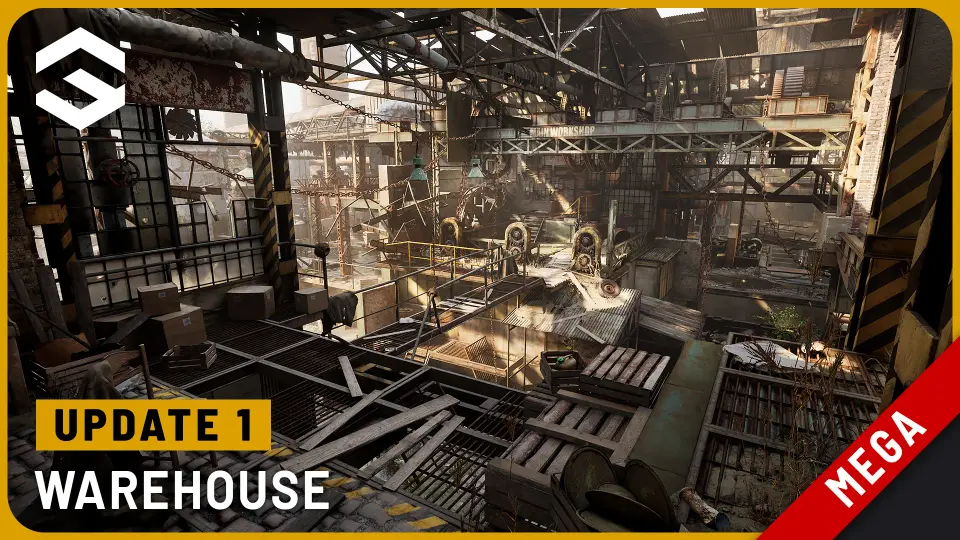
Warehouse - Abandoned Factory District is constructed from more than 1,000 modular assets spanning structural steel, ruined brick walls, pipe networks, and fragmented concrete. The environment brings together diverse architectural elements designed to portray industrial neglect, from corroded corridors to vast open-floor processing zones. A high concentration of detailed props, including scrap metal, construction debris, scattered trash, and decaying mechanical parts, allows level designers to scatter micro-detail across floor spaces without needing to bring in outside prop libraries.
The collection focuses heavily on tactile decay, relying on assets generated through photogrammetry to reproduce authentic surface fractures, flaking paint, and oxidized iron. These high-fidelity materials capture the distinct grime of a forgotten urban sector, giving broken masonry, worn steel framing, and steam fittings a weathered finish. By packaging modular architecture with standalone machinery props, the district can be configured into sprawling manufacturing sectors, dense subterranean factory levels, or post-apocalyptic city ruins.
Interactive Elevator Blueprints and Moving Machinery
Rather than presenting a purely static scene, the environment incorporates functional Blueprints to support player movement and mechanical activity. A working elevator blueprint provides vertical traversal through multi-story warehouse interiors, allowing gameplay designers to build connected, multi-tier encounters without constructing bespoke mechanical logic from scratch. Other motion elements across the factory floor inject life into otherwise derelict corridors, keeping the space dynamic during player exploration.
Interaction extends to foundational environment controls, such as functional doors that open and close, along with togglable lighting networks. These systems integrate smoothly with production workflows, giving developers quick access to light switching and access-point management directly inside the scene. Alongside the motion blueprints, embedded audio files and atmospheric VFX—such as drifting steam and ambient factory hums—work together to establish a thick, industrial soundscape and mood throughout the complex.
Photogrammetry Detailing Across Standard and Lumen Pipelines
Surface authenticity across the district stems from high-resolution photogrammetry resources. Surfaces show authentic chipping along concrete borders, layered rust eating into iron beams, and tactile soil and debris clinging to building foundations. This level of physical grounding prevents large open areas, such as expansive warehouse bays and loading docks, from looking flat or repetitive under close scrutiny.
The package is configured to operate across both Standard lighting and Unreal Engine's dynamic Lumen lighting pipelines. In Lumen, bouncing light highlights the pitted surfaces of broken structural columns and filters through ruptured ceiling sections to illuminate dust and steam particles suspended in the air. For productions requiring direct control or fixed rendering overhead, the standard lighting pipeline maintains clear visibility, specular response on wet steel, and sharp shadow transitions across complex pipe frameworks.
Scalability Testing and Large-Scale District Performance
Managing over a thousand individual assets across a vast industrial territory requires tight optimization for real-time framerates. The included demonstration scene is pre-configured to maintain solid playback speeds while rendering complex industrial architecture, extensive prop placement, and active visual effects simultaneously. During real-time performance evaluation, the diverse environment achieved 100 FPS running at Full HD (1080p) under High scalability settings.
This benchmark was documented on a testing system equipped with an AMD Ryzen 9 processor, an Nvidia RTX 4080 graphics card, 64GB of RAM, and fast SSD storage. The scene manages draw calls and asset density effectively, ensuring that the large-scale downtown map can serve as an expansive, reliable foundation. Teams can directly expand the district, adding custom city blocks, adjacent suburban roads, or connected transit corridors without immediate performance degradation.
Delivered Prefabs and the District Roadmap
Beyond the primary release, the environment features ongoing expansion through version updates. The delivered v1.1 update expanded the core package with at least 10 unique structural objects, including specialized industrial roofs, alongside more than 10 complete building prefabs. These prefabs speed up environment blockouts by letting artists drop assembled factory facilities directly into the map before dressing them with smaller props and machinery.
The planned development roadmap details subsequent milestones aimed at widening the toolkit:
V1.2: A dedicated new lighting scenario to offer alternative atmospheric conditions for the factory grounds.
V1.3: Additional machine animations designed to increase realism and operational movement across the facility floor.
With its vast selection of ruined walls, functional blueprints, modular steel modules, and planned updates, Warehouse - Abandoned Factory District serves as a comprehensive production platform for apocalyptic backdrops, forgotten urban complexes, and dense manufacturing environments.
 Industrial
 Industrial
 Industrial
 Industrial