"a338a1d501976271"{"id":"1001380","slug":"victorian-street","title":"Victorian Street","category":"Victorian","engine":"4.18+,5.0+","assetVersion":"","engineVersion":"Engine Version: 4.18+,5.0+","tag":"Victorian","accent":"blue","visual":"mech","summary":"Build authentic 19th-century London environments with Victorian Street, featuring modular red-brick architecture, cobblestone roads, and Unreal Engine support.","platform":"Unreal Engine","publishedAt":"2026-10-04T12:12:17.227Z","updatedAt":"2026-10-04T12:12:17.227Z","sourceNotes":[],"fileContents":[],"compatibility":["Unreal Engine","Engine Version: 4.18+,5.0+"],"featuredImage":{"alt":"Victorian Street","src":"/wp-content/uploads/published/2026/10/8e300d0926b8-fc2ebb85-6c7f-4079-97c1-b261d98c6ce7-d4f1172dbc.webp"},"hasDownloadLink":true,"downloads":0,"terms":[{"taxonomy":"category","slug":"victorian","name":"Victorian"}],"galleryImages":[{"src":"/wp-content/uploads/published/2026/10/87efb548c90c-b4e0ede7-3e12-416e-b835-81c547570d0e-4fba6b268c.webp","alt":"Victorian Street"},{"src":"/wp-content/uploads/published/2026/10/9f8a6f7f6df6-a9e52b03-6627-4049-ae31-682e92e1058d-88209b6175.webp","alt":"Victorian Street"},{"src":"/wp-content/uploads/published/2026/10/7d15755488a6-72ee39a7-0244-4a33-85bb-f6f24f61adc4-f9531a220a.webp","alt":"Victorian Street"},{"src":"/wp-content/uploads/published/2026/10/a697e090e87a-eafbf3e3-2c49-4f48-a507-4323eeb27b1d-6fcf86b09d.webp","alt":"Victorian Street"},{"src":"/wp-content/uploads/published/2026/10/45c17db8efa6-b19e781d-1d1f-4fd9-88ce-d5303dff19c7-467a3900c8.webp","alt":"Victorian Street"},{"src":"/wp-content/uploads/published/2026/10/5d764f5d5801-24c3cc44-09ad-408d-880c-9d6fcd16ddff-bc68b8aef0.webp","alt":"Victorian Street"},{"src":"/wp-content/uploads/published/2026/10/339698473556-fd99c732-9915-435d-ae5c-ffb6dac16832-aaeaaa253a.webp","alt":"Victorian Street"},{"src":"/wp-content/uploads/published/2026/10/eae2f242d599-aec97b20-6545-4469-aa0e-787d52557166-8f049532ad.webp","alt":"Victorian Street"},{"src":"/wp-content/uploads/published/2026/10/c242e6716e98-32db8857-20bc-428c-b1fc-6db05da2f632-cf13481186.webp","alt":"Victorian Street"},{"src":"/wp-content/uploads/published/2026/10/1ea7f6b65fae-f10bd670-8f8e-4983-8728-b600c54faa0a-55a44823d0.webp","alt":"Victorian Street"}],"accessPanel":{"kind":"resource","title":"Download this resource","eyebrow":"Free Download","message":"Log in or create a free account to start your download.","fileName":"Content.7z","safetyNote":"Resources are manually reviewed before listing to improve quality and reduce obvious risks.","actionLabel":"Download Free","resourceType":"Resource archive"},"contentHtml":"\u003ch2\u003eReconstructing 19th-Century London in Digital Environments\u003c/h2\u003e\n\u003cp\u003eCapturing the visual identity of 19th-century London demands a distinct architectural vocabulary. Historic city corridors rely on a balance of tall, closely spaced buildings, layered ground textures, and period-specific street infrastructure. Victorian Street functions as a focused environment pack designed to build these historical urban settings for games, real-time cinematics, virtual reality projects, and architectural or historical visualizations. Instead of presenting a static, unchangeable backdrop, the pack emphasizes a modular assembly philosophy that allows artists and level designers to customize layouts to match the exact scale and camera framing their projects require.\u003c/p\u003e \u003cp\u003eThe collection balances grand architectural facades with fine street-level storytelling elements. From wide avenues lined with commercial store fronts to narrow backstreets, the kit provides the building blocks needed to convey the dense, atmospheric character of the Victorian era. Real-time rendering considerations are embedded directly into the asset construction, making the pack suitable for performance-heavy interactive game scenes as well as high-fidelity cinematic fly-throughs.\u003c/p\u003e \u003ch2\u003eModular Architecture: Red-Brick and Stone Facades\u003c/h2\u003e\n\u003cp\u003eThe core structural foundation of Victorian Street lies in its modular building system. Historic London architecture is recognized for its combination of masonry styles, and the pack reflects this through authentic Victorian-era buildings assembled from detailed red-brick and carved stone facades. The modularity of these structural components gives creators the freedom to alter building heights, adjust street widths, and build varied street blocks without obvious repetitive patterns.\u003c/p\u003e \u003cp\u003eIndividual facade pieces can be snapped, stacked, and rearranged to form continuous terraced housing, standalone civic structures, or bustling commercial rows. The red-brick textures capture the aged, industrial grit characteristic of the period, while stone facade accents provide architectural relief around window bays, cornices, and rooflines. Because the building geometry is segmented into reusable pieces, scenes can scale from compact cinematic vignettes to expansive playable levels while maintaining a consistent visual standard.\u003c/p\u003e \u003ch2\u003eGroundwork with Cobblestone Roads and Vintage Shopfronts\u003c/h2\u003e\n\u003cp\u003eGround-level visual interest is critical for grounding the player or camera within a historical street scene. Victorian Street addresses this through detailed cobblestone roads and dedicated pedestrian sidewalks that outline the path of travel. The cobblestone paving conveys the uneven, worn texture of period roadways, working alongside curb sections and sidewalk flagstones to create distinct boundaries between vehicle routes and pedestrian walkways.\u003c/p\u003e \u003cp\u003eFlanking the cobblestones are vintage shopfronts that populate the ground floors of the modular buildings. These storefronts bring commercial activity to the environment, establishing street-level destinations that enhance realism. Whether configured as corner shops, specialty trades, or high-street merchants, the shopfront modules integrate directly beneath the upper-floor residential or commercial facades, ensuring seamless vertical transitions throughout the urban architecture.\u003c/p\u003e \u003ch2\u003ePeriod Props: Signage, Lamps, Awnings, and Flags\u003c/h2\u003e\n\u003cp\u003eDetailed props transform architectural shells into lived-in historical settings. Victorian Street includes an assortment of period-accurate dressing items selected to enrich street corners and shop exteriors:\u003c/p\u003e\n\u003cul\u003e \u003cli\u003e\u003cstrong\u003eVintage Signage:\u003c/strong\u003e Commercial signs provide narrative context to the storefronts and establish the commercial density of the district.\u003c/li\u003e \u003cli\u003e\u003cstrong\u003eStreet Lamps:\u003c/strong\u003e Authentic period lamps line sidewalks and entry points, serving as both historical markers and logical light sources for atmospheric night or twilight scenes.\u003c/li\u003e \u003cli\u003e\u003cstrong\u003eFabric Awnings:\u003c/strong\u003e Extending out from the shopfronts, awnings break up the flat vertical lines of the facades and add layered silhouette variation along the walkway.\u003c/li\u003e \u003cli\u003e\u003cstrong\u003eUnion Jack Flags:\u003c/strong\u003e Hanging flags introduce national iconography and visual movement, anchoring the environment firmly in historic Britain.\u003c/li\u003e\n\u003c/ul\u003e\n\u003cp\u003eThese props can be placed along curbs, mounted onto facade walls, or hung over entryways, giving level artists the granular control needed to scatter visual details and direct player attention across complex scenes.\u003c/p\u003e \u003ch2\u003eUnreal Engine Pipeline: Nanite, Lumen, and Blueprints\u003c/h2\u003e\n\u003cp\u003eVictorian Street is engineered specifically for modern Unreal Engine pipelines, making full use of core rendering advancements such as Nanite and Lumen. Support for Nanite allows the environment's intricate stonework, brick details, and cobblestone surfaces to maintain dense geometric fidelity on screen without forcing artists into aggressive manual LOD compromises. High-poly structural elements retain crisp silhouettes and relief, whether viewed from a distant aerial perspective or examined up close in a first-person walk-through.\u003c/p\u003e \u003cp\u003eFull compatibility with Lumen handles indirect illumination, real-time light bounces, and shadow depth across narrow alleyways and enclosed street corridors. Sunlight bouncing off red-brick walls naturally casts warm tones into recessed doorways and shaded sidewalks, while artificial light from the street lamps scatters realistically across the wet or dry cobblestones. The package also leverages Blueprint systems for modularity and demonstration setups, helping artists inspect pre-assembled structures, test layout variations, and integrate the modular pieces efficiently into their own level hierarchy.\u003c/p\u003e \u003ch2\u003eProject Suitability and Practical Workflow Fit\u003c/h2\u003e\n\u003cp\u003eBecause the pack combines high-fidelity geometric assets with modular construction and real-time optimization, it bridges the gap between different production types. Game developers working on narrative adventure titles, historical action games, or survival horror experiences can use the modular assets to build traversable, performant city levels. The detailed street props and realistic masonry textures provide the necessary fidelity for close-up player inspection during exploration or investigative gameplay.\u003c/p\u003e \u003cp\u003eVirtual reality creators and cinematic artists benefit similarly from the pack's visual density. In cinematic fly-throughs, the combination of Nanite geometry and Lumen lighting ensures stable visual performance during rapid camera sweeps across detailed rooflines and cobblestone surfaces. For historical visualizers, the period-accurate styling of the shopfronts, lamps, and facades offers an authentic foundation for recreating 19th-century urban life without having to model individual historical architectural features from scratch.\u003c/p\u003e\n\n\u003ch2\u003eMore From The Same Workflow\u003c/h2\u003e\n\u003cul\u003e\n\u003cli\u003e\u003ca href=\"https://3dcghub.com/cathedral-of-the-dead-victorian-cathedral-cathedral-church/\" title=\"Cathedral Of The Dead (Victorian Cathedral, Cathedral, Church)\"\u003eCathedral Of The Dead (Victorian Cathedral, Cathedral, Church)\u003c/a\u003e\u003c/li\u003e\n\u003cli\u003e\u003ca href=\"https://3dcghub.com/auge-mountaintop-observatory/\" title=\"Auge Mountaintop Observatory\"\u003eAuge Mountaintop Observatory\u003c/a\u003e\u003c/li\u003e\n\u003cli\u003e\u003ca href=\"https://3dcghub.com/opera-hall/\" title=\"Opera Hall\"\u003eOpera Hall\u003c/a\u003e\u003c/li\u003e\n\u003cli\u003e\u003ca href=\"https://3dcghub.com/the-lords-mansion/\" title=\"The Lords\u0026#039; Mansion\"\u003eThe Lords\u0026#039; Mansion\u003c/a\u003e\u003c/li\u003e\n\u003cli\u003e\u003ca href=\"https://3dcghub.com/the-abandoned-library/\" title=\"The Abandoned Library\"\u003eThe Abandoned Library\u003c/a\u003e\u003c/li\u003e\n\u003c/ul\u003e","contentTextLength":6874,"navigation":{"current":21,"total":3338,"previous":{"id":"1001381","slug":"favelas","title":"Favelas","category":"Cities","platform":"Unreal Engine","updatedAt":"2026-10-04T12:52:34.671Z"},"next":{"id":"1001379","slug":"sports-stadium","title":"Sports Stadium","category":"Cities","platform":"Unreal Engine","updatedAt":"2026-10-04T12:10:57.137Z"}},"relatedResources":[{"id":"1001337","slug":"cathedral-of-the-dead-victorian-cathedral-cathedral-church","title":"Cathedral Of The Dead (Victorian Cathedral, Cathedral, Church)","category":"Victorian","engine":"4.26+,5.0+","assetVersion":"","engineVersion":"Engine Version: 4.26+,5.0+","tag":"Victorian","accent":"blue","visual":"mech","summary":"Victorian cathedral environment pack featuring 42+ modular pieces, 20+ iconic meshes, vertex painting shaders, and tiling materials for dark fantasy scenes.","platform":"Unreal Engine","publishedAt":"2026-10-04T10:02:26.219Z","updatedAt":"2026-10-04T10:02:26.219Z","sourceNotes":[],"fileContents":[],"compatibility":["Unreal Engine","Engine Version: 4.26+,5.0+"],"featuredImage":{"alt":"Cathedral Of The Dead (Victorian Cathedral, Cathedral, Church)","src":"/wp-content/uploads/published/2026/10/34c3fd1d7fd8-4f37ff23-d25a-402c-9ca1-d8264a3a04b6-30ee99214a.webp"},"hasDownloadLink":true,"downloads":0},{"id":"1001163","slug":"auge-mountaintop-observatory","title":"Auge Mountaintop Observatory","category":"Victorian","engine":"5.2+","assetVersion":"","engineVersion":"Engine Version: 5.2+","tag":"Victorian","accent":"blue","visual":"mech","summary":"Technical breakdown of the Auge Mountaintop Observatory environment for Unreal Engine, covering Nanite foliage, master materials, and Lumen support.","platform":"Unreal Engine","publishedAt":"2026-09-11T14:10:48.446Z","updatedAt":"2026-09-11T14:10:48.446Z","sourceNotes":[],"fileContents":[],"compatibility":["Unreal Engine","Engine Version: 5.2+"],"featuredImage":{"alt":"Auge Mountaintop Observatory","src":"/wp-content/uploads/published/2026/09/0c65b7aa82d4-ca18a121-ba99-4635-ab99-6a85c43a0203-928d2f0860.webp"},"hasDownloadLink":true,"downloads":3},{"id":"1001146","slug":"opera-hall","title":"Opera Hall","category":"Victorian","engine":"5.4+","assetVersion":"","engineVersion":"Engine Version: 5.4+","tag":"Victorian","accent":"blue","visual":"mech","summary":"Explore the modular Opera Hall environment for Unreal Engine 5.0+, featuring Nanite geometry, Lumen dynamic lighting, and classical architecture.","platform":"Unreal Engine","publishedAt":"2026-09-10T11:39:06.098Z","updatedAt":"2026-09-10T11:39:06.098Z","sourceNotes":[],"fileContents":[],"compatibility":["Unreal Engine","Engine Version: 5.4+"],"featuredImage":{"alt":"Opera Hall","src":"/wp-content/uploads/published/2026/09/ef792404e8b7-4d1d0b79-a86f-4d30-8496-953ffec27c76-1bbcb3ca4e.webp"},"hasDownloadLink":true,"downloads":0}]}
Victorian
Victorian Street
Build authentic 19th-century London environments with Victorian Street, featuring modular red-brick architecture, cobblestone roads, and Unreal Engine support.
Category:Unreal Engine,VictorianPlatform: Unreal EngineEngine Version: 4.18+,5.0+Published: Oct 4, 2026
Victorian
Resource overview
Reconstructing 19th-Century London in Digital Environments
Capturing the visual identity of 19th-century London demands a distinct architectural vocabulary. Historic city corridors rely on a balance of tall, closely spaced buildings, layered ground textures, and period-specific street infrastructure. Victorian Street functions as a focused environment pack designed to build these historical urban settings for games, real-time cinematics, virtual reality projects, and architectural or historical visualizations. Instead of presenting a static, unchangeable backdrop, the pack emphasizes a modular assembly philosophy that allows artists and level designers to customize layouts to match the exact scale and camera framing their projects require.
The collection balances grand architectural facades with fine street-level storytelling elements. From wide avenues lined with commercial store fronts to narrow backstreets, the kit provides the building blocks needed to convey the dense, atmospheric character of the Victorian era. Real-time rendering considerations are embedded directly into the asset construction, making the pack suitable for performance-heavy interactive game scenes as well as high-fidelity cinematic fly-throughs.
Modular Architecture: Red-Brick and Stone Facades
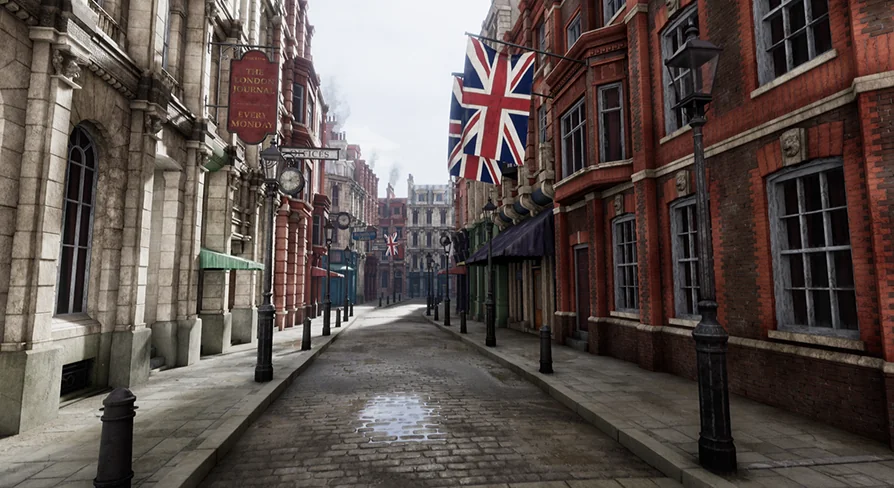
The core structural foundation of Victorian Street lies in its modular building system. Historic London architecture is recognized for its combination of masonry styles, and the pack reflects this through authentic Victorian-era buildings assembled from detailed red-brick and carved stone facades. The modularity of these structural components gives creators the freedom to alter building heights, adjust street widths, and build varied street blocks without obvious repetitive patterns.
Individual facade pieces can be snapped, stacked, and rearranged to form continuous terraced housing, standalone civic structures, or bustling commercial rows. The red-brick textures capture the aged, industrial grit characteristic of the period, while stone facade accents provide architectural relief around window bays, cornices, and rooflines. Because the building geometry is segmented into reusable pieces, scenes can scale from compact cinematic vignettes to expansive playable levels while maintaining a consistent visual standard.
Groundwork with Cobblestone Roads and Vintage Shopfronts
Ground-level visual interest is critical for grounding the player or camera within a historical street scene. Victorian Street addresses this through detailed cobblestone roads and dedicated pedestrian sidewalks that outline the path of travel. The cobblestone paving conveys the uneven, worn texture of period roadways, working alongside curb sections and sidewalk flagstones to create distinct boundaries between vehicle routes and pedestrian walkways.
Flanking the cobblestones are vintage shopfronts that populate the ground floors of the modular buildings. These storefronts bring commercial activity to the environment, establishing street-level destinations that enhance realism. Whether configured as corner shops, specialty trades, or high-street merchants, the shopfront modules integrate directly beneath the upper-floor residential or commercial facades, ensuring seamless vertical transitions throughout the urban architecture.
Period Props: Signage, Lamps, Awnings, and Flags
Detailed props transform architectural shells into lived-in historical settings. Victorian Street includes an assortment of period-accurate dressing items selected to enrich street corners and shop exteriors:
Vintage Signage: Commercial signs provide narrative context to the storefronts and establish the commercial density of the district.
Street Lamps: Authentic period lamps line sidewalks and entry points, serving as both historical markers and logical light sources for atmospheric night or twilight scenes.
Fabric Awnings: Extending out from the shopfronts, awnings break up the flat vertical lines of the facades and add layered silhouette variation along the walkway.
Union Jack Flags: Hanging flags introduce national iconography and visual movement, anchoring the environment firmly in historic Britain.
These props can be placed along curbs, mounted onto facade walls, or hung over entryways, giving level artists the granular control needed to scatter visual details and direct player attention across complex scenes.
Unreal Engine Pipeline: Nanite, Lumen, and Blueprints
Victorian Street is engineered specifically for modern Unreal Engine pipelines, making full use of core rendering advancements such as Nanite and Lumen. Support for Nanite allows the environment's intricate stonework, brick details, and cobblestone surfaces to maintain dense geometric fidelity on screen without forcing artists into aggressive manual LOD compromises. High-poly structural elements retain crisp silhouettes and relief, whether viewed from a distant aerial perspective or examined up close in a first-person walk-through.
Full compatibility with Lumen handles indirect illumination, real-time light bounces, and shadow depth across narrow alleyways and enclosed street corridors. Sunlight bouncing off red-brick walls naturally casts warm tones into recessed doorways and shaded sidewalks, while artificial light from the street lamps scatters realistically across the wet or dry cobblestones. The package also leverages Blueprint systems for modularity and demonstration setups, helping artists inspect pre-assembled structures, test layout variations, and integrate the modular pieces efficiently into their own level hierarchy.
Project Suitability and Practical Workflow Fit
Because the pack combines high-fidelity geometric assets with modular construction and real-time optimization, it bridges the gap between different production types. Game developers working on narrative adventure titles, historical action games, or survival horror experiences can use the modular assets to build traversable, performant city levels. The detailed street props and realistic masonry textures provide the necessary fidelity for close-up player inspection during exploration or investigative gameplay.
Virtual reality creators and cinematic artists benefit similarly from the pack's visual density. In cinematic fly-throughs, the combination of Nanite geometry and Lumen lighting ensures stable visual performance during rapid camera sweeps across detailed rooflines and cobblestone surfaces. For historical visualizers, the period-accurate styling of the shopfronts, lamps, and facades offers an authentic foundation for recreating 19th-century urban life without having to model individual historical architectural features from scratch.
 Victorian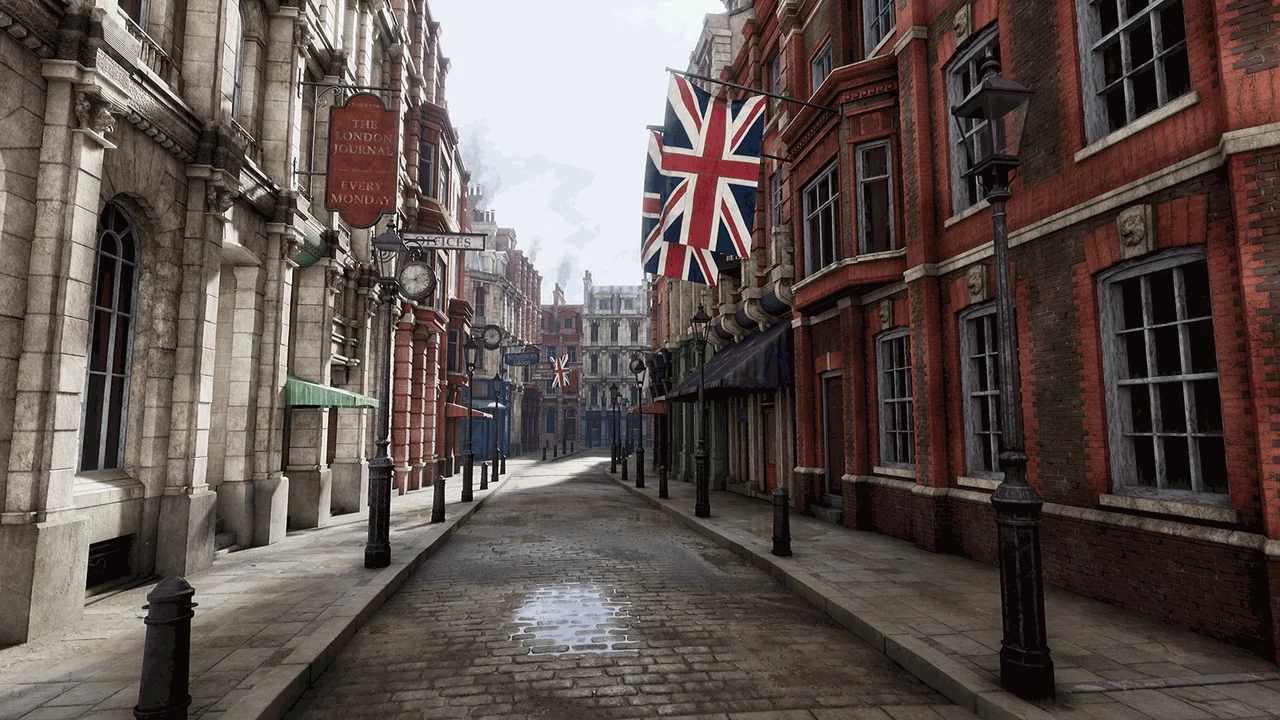
 Victorian
 Victorian
 Victorian