"0341a2901a4ae9aa"{"id":"1001163","slug":"auge-mountaintop-observatory","title":"Auge Mountaintop Observatory","category":"Victorian","engine":"5.2+","assetVersion":"","engineVersion":"Engine Version: 5.2+","tag":"Victorian","accent":"blue","visual":"mech","summary":"Technical breakdown of the Auge Mountaintop Observatory environment for Unreal Engine, covering Nanite foliage, master materials, and Lumen support.","platform":"Unreal Engine","publishedAt":"2026-09-11T14:10:48.446Z","updatedAt":"2026-09-11T14:10:48.446Z","sourceNotes":[],"fileContents":[],"compatibility":["Unreal Engine","Engine Version: 5.2+"],"featuredImage":{"alt":"Auge Mountaintop Observatory","src":"/wp-content/uploads/published/2026/09/0c65b7aa82d4-ca18a121-ba99-4635-ab99-6a85c43a0203-928d2f0860.webp"},"hasDownloadLink":true,"downloads":3,"terms":[{"taxonomy":"category","slug":"victorian","name":"Victorian"}],"galleryImages":[{"src":"/wp-content/uploads/published/2026/09/70ef4c5aab4a-60a6a8e0-6f2e-4c4d-9b04-6c6de4f9ed48-ff57d5362a.webp","alt":"Auge Mountaintop Observatory"},{"src":"/wp-content/uploads/published/2026/09/581ecd87b1d4-0ccb6ac3-b851-4702-a04b-33ca7dd3bbcf-a204aad22c.webp","alt":"Auge Mountaintop Observatory"},{"src":"/wp-content/uploads/published/2026/09/fd945c6569bd-ddeb87fa-7933-4dd5-9afc-6343d989b41a-aef1fed5ad.webp","alt":"Auge Mountaintop Observatory"},{"src":"/wp-content/uploads/published/2026/09/32d00828a3e1-9820dfd2-e3c0-4e08-b052-63c6ed929907-0f1e5a24db.webp","alt":"Auge Mountaintop Observatory"},{"src":"/wp-content/uploads/published/2026/09/3308498fcc4f-12e2aabe-0847-4239-bf2b-c9c0a8b8031c-5170ec5320.webp","alt":"Auge Mountaintop Observatory"},{"src":"/wp-content/uploads/published/2026/09/cc3fb3483211-a3fc0b5d-eaae-4281-be67-15f3940c2c04-eff4c10646.webp","alt":"Auge Mountaintop Observatory"},{"src":"/wp-content/uploads/published/2026/09/bdc1065783a1-f81c9756-bad3-405c-93b4-a18d4de1a39d-196f8209ef.webp","alt":"Auge Mountaintop Observatory"},{"src":"/wp-content/uploads/published/2026/09/c2879876e550-218dd5a8-ffac-4f31-bc02-b0b9ecb9aec4-e438c3d1b5.webp","alt":"Auge Mountaintop Observatory"},{"src":"/wp-content/uploads/published/2026/09/8484d2f99acf-7e9e898f-0de5-4282-bac0-720abbe54dde-27ef0b9d30.webp","alt":"Auge Mountaintop Observatory"},{"src":"/wp-content/uploads/published/2026/09/8dec45c00b74-aac81748-de53-4ba9-963b-d68448fdda65-d266f8e2cd.webp","alt":"Auge Mountaintop Observatory"}],"accessPanel":{"kind":"resource","title":"Download this resource","eyebrow":"Free Download","message":"Log in or create a free account to start your download.","fileName":"Content.7z","safetyNote":"Resources are manually reviewed before listing to improve quality and reduce obvious risks.","actionLabel":"Download Free","resourceType":"Resource archive"},"contentHtml":"\u003ch2\u003eSetting Up the Auge Mountaintop Observatory Environment\u003c/h2\u003e\u003cp\u003eDeploying the Auge Mountaintop Observatory begins with loading the complete project structure directly in Unreal Engine. All maps, meshes, and material graphs arrive fully configured, bypassing the manual re-linking steps often required when assembling large-scale environmental scenes. Level designers can immediately open the included maps to inspect the spatial relationship between the core observatory structures, the rugged terrain, and the surrounding natural elements.\u003c/p\u003e\u003cp\u003eBecause the project comes with pre-constructed demonstration layouts, artists can work outward from the existing composition or deconstruct the placement into modular components. The entire kit is calibrated for high-fidelity interactive performance, ensuring that asset scale, collision boundaries, and material draw instances function cleanly within a real-time production budget.\u003c/p\u003e\u003ch2\u003eMaster Material Setup and Surface Customization\u003c/h2\u003e\u003cp\u003eSurfacing across the environment relies on a centralized master material pipeline engineered to govern the majority of props and architectural pieces. Rather than generating isolated material instances with rigid properties, the master material exposes fine-tuned control over fundamental surface characteristics, including albedo coloration, roughness levels, and normal map intensity. This architecture allows developers to balance surface wear, weather accumulation, and local contrast directly inside the engine viewport without modifying source texture maps.\u003c/p\u003e\u003cp\u003eA critical technical element of the surface pipeline is the texture channel packing configuration. Ambient occlusion, roughness, and metalness are combined into a single packed texture file (Roughness | Metalness | Ambient Occlusion). This packing strategy preserves texture sampler slots, cuts down aggregate memory overhead, and maximizes runtime rendering efficiency. Texture assets throughout the pack are delivered at 4K resolution, supplying high visual fidelity for close-up hero shots and cinematic camera passes.\u003c/p\u003e\u003cp\u003eColor adjustability is built directly into painted surface components. Through exposed scalar and vector parameters in the master material instances, artists can recolor structural elements, mechanical trims, or interior painted surfaces. This flexibility makes it possible to shift the visual palette from an austere, clinical scientific outpost to a distressed, weather-worn facility without generating duplicate asset files.\u003c/p\u003e\u003ch2\u003eNanite Meshes and Included Nature Assets\u003c/h2\u003e\u003cp\u003eThe package contains 367 distinct meshes, encompassing both the man-made observatory architecture and an extensive suite of environmental props. In addition to structural building blocks, the collection incorporates several specialized asset groups designed to anchor the complex into an alpine wilderness:\u003c/p\u003e\u003cul\u003e\u003cli\u003eFoliage VOL.7: Ash Trees, supplied in both Nanite and traditional low-poly mesh variants.\u003c/li\u003e\u003cli\u003eFoliage VOL.8: Dead Trees, configured with both Nanite and low-poly options for dense silhouette framing.\u003c/li\u003e\u003cli\u003eFoliage VOL.23: Ivy, delivered in low-poly formats for clinging organic growth along stone and brick facades.\u003c/li\u003e\u003cli\u003eRocks VOL.1: Heavy rock formations prepared with dedicated material variations for snow accumulation, surface wetness, and moss coverage, built with Nanite support.\u003c/li\u003e\u003cli\u003eWATER \u0026amp; ICE VOL.1: Icicles with both Nanite and low-poly mesh definitions to reflect freezing high-altitude conditions.\u003c/li\u003e\u003c/ul\u003e\u003cp\u003eThe inclusion of both Nanite-ready and low-poly variations gives teams distinct geometric pathways depending on project constraints. For modern geometric workflows, Nanite eliminates manual LOD generation and streaming issues on complex vegetation and craggy terrain. For pipelines relying on conventional polygon budgets, the low-poly variants maintain silhouette clarity while keeping vertex counts predictable.\u003c/p\u003e\u003ch2\u003eLumen Lighting Integration and Post-Process Configuration\u003c/h2\u003e\u003cp\u003eAtmospheric rendering in the environment is tuned for Unreal Engine 5.0 and newer, featuring native support for Lumen dynamic global illumination and reflections. Diffuse light bounce off snowy rock faces, dark interior corners inside the observatory dome, and subtle surface highlights on frozen icicles resolve dynamically without the need for precomputed lightmaps.\u003c/p\u003e\u003cp\u003eThe scene includes a dedicated post-process setup integrated with a custom Look Up Table (LUT). This grade establishes the atmospheric baseline, managing highlights, midtone contrast, and shadow depth to deliver an authentic cinematic tone. The balance between exposure management and color balance complements the natural lighting conditions expected of an exposed mountaintop station, while remaining accessible for level artists who wish to swap LUTs or retune the post-process volume for night scenarios, heavy blizzards, or overcast days.\u003c/p\u003e\u003ch2\u003eAsset Geometry and Multi-Genre Application\u003c/h2\u003e\u003cp\u003eEvery asset within the 367-mesh library is modeled with complete detail across all sides. Geometry is not hollowed out or left untextured on rear-facing surfaces, allowing props, machinery, and stone components to be freely rotated, overturned, or repositioned in 360-degree views without breaking visual continuity. This structural completeness is essential for environmental storytelling, whether populating a playable traversal path or framing low-angle camera sequences.\u003c/p\u003e\u003cp\u003eAll signs, logos, and industrial markings across the observatory are custom-designed studio originals. The pack contains no real-world trademarks or protected branding, eliminating clearance friction for commercial game releases, cinematics, or virtual production stages.\u003c/p\u003e\u003cp\u003eWhile shaped by the central concept of an isolated mountaintop facility, the assets adapt naturally across multiple aesthetic themes. The heavy masonry, aged timber, and utilitarian metalwork fit Gothic castles, dark fantasy strongholds, post-apocalyptic shelters, abandoned Victorian science outposts, or psychological horror settings. The combination of snowy geological formations, dead ash trees, and detailed interior props provides a versatile baseline for building isolated, atmospheric worlds.\u003c/p\u003e\n\n\u003ch2\u003eRelated Resources Worth Checking\u003c/h2\u003e\n\u003cul\u003e\n\u003cli\u003e\u003ca href=\"https://3dcghub.com/the-abandoned-library/\" title=\"The Abandoned Library\"\u003eThe Abandoned Library\u003c/a\u003e\u003c/li\u003e\n\u003cli\u003e\u003ca href=\"https://3dcghub.com/sicka-mansion/\" title=\"SICKA MANSION\"\u003eSICKA MANSION\u003c/a\u003e\u003c/li\u003e\n\u003cli\u003e\u003ca href=\"https://3dcghub.com/opera-hall/\" title=\"Opera Hall\"\u003eOpera Hall\u003c/a\u003e\u003c/li\u003e\n\u003cli\u003e\u003ca href=\"https://3dcghub.com/the-lords-mansion/\" title=\"The Lords\u0026#039; Mansion\"\u003eThe Lords\u0026#039; Mansion\u003c/a\u003e\u003c/li\u003e\n\u003cli\u003e\u003ca href=\"https://3dcghub.com/victorian-market-in-abandoned-factory-building-victorian-market-abandoned/\" title=\"Victorian Market in Abandoned Factory Building ( Victorian Market Abandoned )\"\u003eVictorian Market in Abandoned Factory Building ( Victorian Market Abandoned )\u003c/a\u003e\u003c/li\u003e\n\u003c/ul\u003e","contentTextLength":6279,"navigation":{"current":979,"total":4017,"previous":{"id":"1001164","slug":"castle-grimguard-night-day","title":"Castle Grimguard (Night/Day)","category":"Fantasy","platform":"Unreal Engine","updatedAt":"2026-09-16T02:48:23.211Z"},"next":{"id":"1001162","slug":"abandoned-carnival-circus","title":"Abandoned Carnival Circus","category":"Tools, Objects \u0026 Decor","platform":"Unreal Engine","updatedAt":"2026-09-11T12:46:08.073Z"}},"relatedResources":[{"id":"1000388","slug":"the-abandoned-library","title":"The Abandoned Library","category":"Victorian","engine":"5.1+","assetVersion":"","engineVersion":"Engine Version: 5.1+","tag":"Victorian","accent":"blue","visual":"mech","summary":"Build eerie, neglected environments with 80+ PBR library props, featuring custom dirt materials, runtime stacking Blueprints, and real-time clock mechanics.","platform":"Unreal Engine","publishedAt":"2026-07-07T14:29:08.766Z","updatedAt":"2026-07-07T14:29:08.766Z","sourceNotes":[],"fileContents":[],"compatibility":["Unreal Engine","Engine Version: 5.1+"],"featuredImage":{"alt":"The Abandoned Library","src":"/wp-content/uploads/published/2026/07/de984685fb55-197e4358-4440-421e-b5d7-d644942f922e-005844a0ad.webp"},"hasDownloadLink":true,"downloads":1},{"id":"1000678","slug":"sicka-mansion","title":"SICKA MANSION","category":"Victorian","engine":"5.2+","assetVersion":"","engineVersion":"Engine Version: 5.2+","tag":"Victorian","accent":"blue","visual":"mech","summary":"SICKA MANSION delivers a full Victorian horror environment with nearly 200 props, character system, object inspection, hybrid lighting, and Niagara particles fo","platform":"Unreal Engine","publishedAt":"2026-07-22T14:53:18.949Z","updatedAt":"2026-07-22T14:53:18.949Z","sourceNotes":[],"fileContents":[],"compatibility":["Unreal Engine","Engine Version: 5.2+"],"featuredImage":{"alt":"SICKA MANSION","src":"/wp-content/uploads/published/2026/07/fa310693b10c-f45a39a2-9014-4980-bf08-dffeba55ee22-3178646f95.webp"},"hasDownloadLink":true,"downloads":0},{"id":"1001337","slug":"cathedral-of-the-dead-victorian-cathedral-cathedral-church","title":"Cathedral Of The Dead (Victorian Cathedral, Cathedral, Church)","category":"Victorian","engine":"4.26+,5.0+","assetVersion":"","engineVersion":"Engine Version: 4.26+,5.0+","tag":"Victorian","accent":"blue","visual":"mech","summary":"Victorian cathedral environment pack featuring 42+ modular pieces, 20+ iconic meshes, vertex painting shaders, and tiling materials for dark fantasy scenes.","platform":"Unreal Engine","publishedAt":"2026-10-04T10:02:26.219Z","updatedAt":"2026-10-04T10:02:26.219Z","sourceNotes":[],"fileContents":[],"compatibility":["Unreal Engine","Engine Version: 4.26+,5.0+"],"featuredImage":{"alt":"Cathedral Of The Dead (Victorian Cathedral, Cathedral, Church)","src":"/wp-content/uploads/published/2026/10/34c3fd1d7fd8-4f37ff23-d25a-402c-9ca1-d8264a3a04b6-30ee99214a.webp"},"hasDownloadLink":true,"downloads":1}]}
Victorian
Auge Mountaintop Observatory
Technical breakdown of the Auge Mountaintop Observatory environment for Unreal Engine, covering Nanite foliage, master materials, and Lumen support.
Setting Up the Auge Mountaintop Observatory Environment
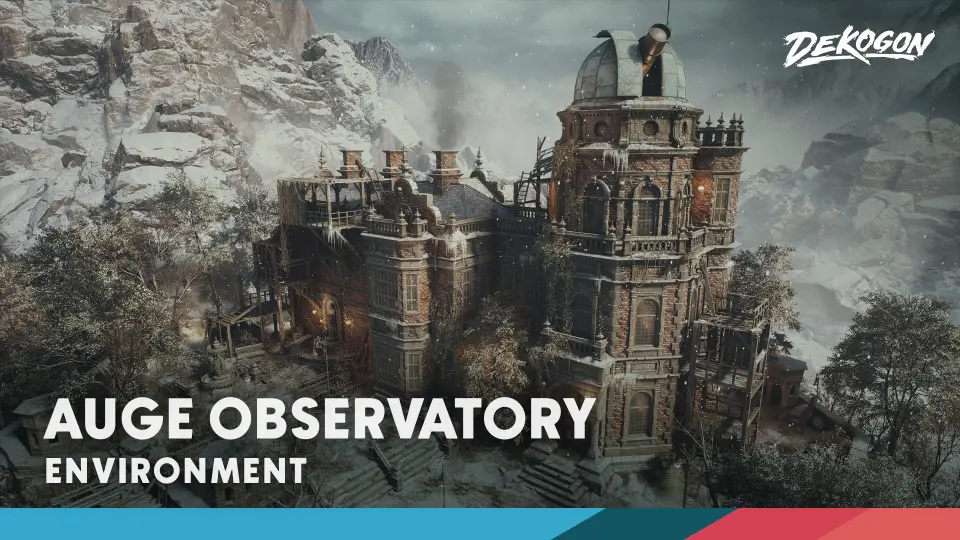
Deploying the Auge Mountaintop Observatory begins with loading the complete project structure directly in Unreal Engine. All maps, meshes, and material graphs arrive fully configured, bypassing the manual re-linking steps often required when assembling large-scale environmental scenes. Level designers can immediately open the included maps to inspect the spatial relationship between the core observatory structures, the rugged terrain, and the surrounding natural elements.
Because the project comes with pre-constructed demonstration layouts, artists can work outward from the existing composition or deconstruct the placement into modular components. The entire kit is calibrated for high-fidelity interactive performance, ensuring that asset scale, collision boundaries, and material draw instances function cleanly within a real-time production budget.
Master Material Setup and Surface Customization
Surfacing across the environment relies on a centralized master material pipeline engineered to govern the majority of props and architectural pieces. Rather than generating isolated material instances with rigid properties, the master material exposes fine-tuned control over fundamental surface characteristics, including albedo coloration, roughness levels, and normal map intensity. This architecture allows developers to balance surface wear, weather accumulation, and local contrast directly inside the engine viewport without modifying source texture maps.
A critical technical element of the surface pipeline is the texture channel packing configuration. Ambient occlusion, roughness, and metalness are combined into a single packed texture file (Roughness | Metalness | Ambient Occlusion). This packing strategy preserves texture sampler slots, cuts down aggregate memory overhead, and maximizes runtime rendering efficiency. Texture assets throughout the pack are delivered at 4K resolution, supplying high visual fidelity for close-up hero shots and cinematic camera passes.
Color adjustability is built directly into painted surface components. Through exposed scalar and vector parameters in the master material instances, artists can recolor structural elements, mechanical trims, or interior painted surfaces. This flexibility makes it possible to shift the visual palette from an austere, clinical scientific outpost to a distressed, weather-worn facility without generating duplicate asset files.
Nanite Meshes and Included Nature Assets
The package contains 367 distinct meshes, encompassing both the man-made observatory architecture and an extensive suite of environmental props. In addition to structural building blocks, the collection incorporates several specialized asset groups designed to anchor the complex into an alpine wilderness:
Foliage VOL.7: Ash Trees, supplied in both Nanite and traditional low-poly mesh variants.
Foliage VOL.8: Dead Trees, configured with both Nanite and low-poly options for dense silhouette framing.
Foliage VOL.23: Ivy, delivered in low-poly formats for clinging organic growth along stone and brick facades.
Rocks VOL.1: Heavy rock formations prepared with dedicated material variations for snow accumulation, surface wetness, and moss coverage, built with Nanite support.
WATER & ICE VOL.1: Icicles with both Nanite and low-poly mesh definitions to reflect freezing high-altitude conditions.
The inclusion of both Nanite-ready and low-poly variations gives teams distinct geometric pathways depending on project constraints. For modern geometric workflows, Nanite eliminates manual LOD generation and streaming issues on complex vegetation and craggy terrain. For pipelines relying on conventional polygon budgets, the low-poly variants maintain silhouette clarity while keeping vertex counts predictable.
Lumen Lighting Integration and Post-Process Configuration
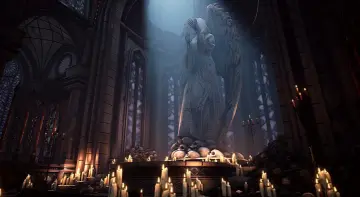
Atmospheric rendering in the environment is tuned for Unreal Engine 5.0 and newer, featuring native support for Lumen dynamic global illumination and reflections. Diffuse light bounce off snowy rock faces, dark interior corners inside the observatory dome, and subtle surface highlights on frozen icicles resolve dynamically without the need for precomputed lightmaps.
The scene includes a dedicated post-process setup integrated with a custom Look Up Table (LUT). This grade establishes the atmospheric baseline, managing highlights, midtone contrast, and shadow depth to deliver an authentic cinematic tone. The balance between exposure management and color balance complements the natural lighting conditions expected of an exposed mountaintop station, while remaining accessible for level artists who wish to swap LUTs or retune the post-process volume for night scenarios, heavy blizzards, or overcast days.
Asset Geometry and Multi-Genre Application
Every asset within the 367-mesh library is modeled with complete detail across all sides. Geometry is not hollowed out or left untextured on rear-facing surfaces, allowing props, machinery, and stone components to be freely rotated, overturned, or repositioned in 360-degree views without breaking visual continuity. This structural completeness is essential for environmental storytelling, whether populating a playable traversal path or framing low-angle camera sequences.
All signs, logos, and industrial markings across the observatory are custom-designed studio originals. The pack contains no real-world trademarks or protected branding, eliminating clearance friction for commercial game releases, cinematics, or virtual production stages.
While shaped by the central concept of an isolated mountaintop facility, the assets adapt naturally across multiple aesthetic themes. The heavy masonry, aged timber, and utilitarian metalwork fit Gothic castles, dark fantasy strongholds, post-apocalyptic shelters, abandoned Victorian science outposts, or psychological horror settings. The combination of snowy geological formations, dead ash trees, and detailed interior props provides a versatile baseline for building isolated, atmospheric worlds.
 Victorian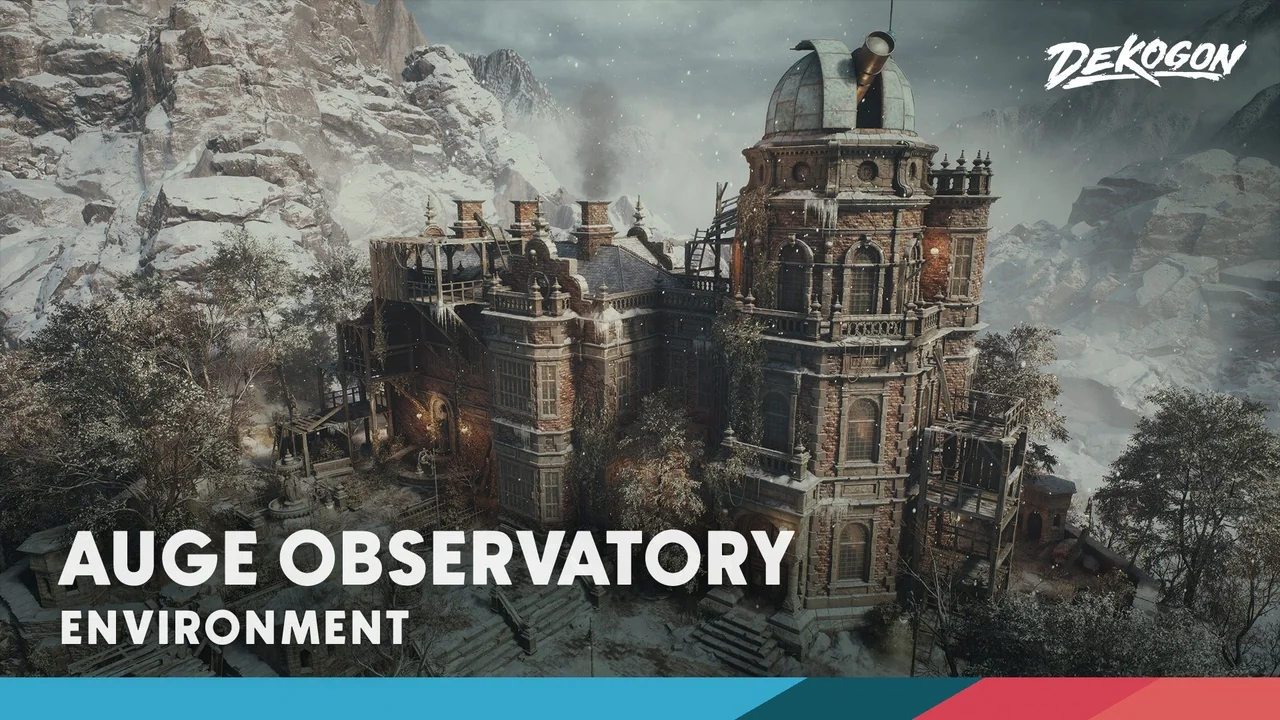
 Victorian
 Victorian
 Victorian