"efaa631e936fd3ee"{"id":"1002242","slug":"truck-trailer-attach-detach-system","title":"Truck Trailer Attach Detach System","category":"Vehicles \u0026 Transportation","engine":"5.4+","assetVersion":"","engineVersion":"Engine Version: 5.4+","tag":"Vehicles","accent":"blue","visual":"mech","summary":"Explore the Truck Trailer Attach Detach System featuring a truck cab, container and tanker trailers, working mirrors, full lighting, and sound integration.","platform":"Unreal Engine","publishedAt":"2026-10-29T15:58:22.057Z","updatedAt":"2026-10-29T15:58:22.057Z","sourceNotes":[],"fileContents":[],"compatibility":["Unreal Engine","Engine Version: 5.4+"],"featuredImage":{"alt":"Truck Trailer Attach Detach System","src":"/wp-content/uploads/published/2026/10/a084ad077072-59de3110-a96b-4b66-9c12-cc14487ac73a-33d37a585d.webp"},"hasDownloadLink":true,"downloads":0,"terms":[{"taxonomy":"category","slug":"vehicles-and-transportation","name":"Vehicles \u0026 Transportation"}],"galleryImages":[{"src":"/wp-content/uploads/published/2026/10/513a7e26e743-f6ef864f-94c4-4d20-94fb-c16300197c93-54473fb353.webp","alt":"Truck Trailer Attach Detach System"},{"src":"/wp-content/uploads/published/2026/10/5bbecc409781-310a137b-a0d0-4f65-9334-055431ecfdbd-4b5c6f9cee.webp","alt":"Truck Trailer Attach Detach System"},{"src":"/wp-content/uploads/published/2026/10/b95afabd76f5-eca0bac6-b531-4c40-bbfd-1565fbf719b6-efb3272868.webp","alt":"Truck Trailer Attach Detach System"},{"src":"/wp-content/uploads/published/2026/10/74e153847d86-eb120f9b-061d-453c-a7e2-784c5df1b885-741e53475d.webp","alt":"Truck Trailer Attach Detach System"},{"src":"/wp-content/uploads/published/2026/10/00425341d845-6e8773c5-5067-453f-88a7-a473b85009c4-e1b36b4ea2.webp","alt":"Truck Trailer Attach Detach System"},{"src":"/wp-content/uploads/published/2026/10/d52cbaee38b7-a3fdb941-d260-46e1-a6da-b189504db7bc-295d2244bd.webp","alt":"Truck Trailer Attach Detach System"},{"src":"/wp-content/uploads/published/2026/10/5c6a1f5e62ff-6291e9d0-bd1c-4415-a52b-ed9a988941e4-004aac17fe.webp","alt":"Truck Trailer Attach Detach System"},{"src":"/wp-content/uploads/published/2026/10/05118fd2b34f-bf416bee-345f-4305-8ce4-53612324477e-a763f4d13a.webp","alt":"Truck Trailer Attach Detach System"},{"src":"/wp-content/uploads/published/2026/10/746664208c48-9b536295-f738-474f-a2cd-d46060afc647-0ab1ad51c4.webp","alt":"Truck Trailer Attach Detach System"}],"accessPanel":{"kind":"resource","title":"Download this resource","eyebrow":"Free Download","message":"Log in or create a free account to start your download.","fileName":"Truck Trailer Attach Detach System.7z","safetyNote":"Resources are manually reviewed before listing to improve quality and reduce obvious risks.","actionLabel":"Download Free","resourceType":"Resource archive"},"contentHtml":"\u003ch2\u003eDeploying the Truck Cab and Trailer Coupling Logic\u003c/h2\u003e\u003cp\u003eIntegrating heavy transport vehicles into an interactive environment requires a stable foundation for articulated physics and mechanical connections. The setup begins with the drivable truck cab Blueprint, which serves as the core actor handling player input, chassis movement, and hitch logic. Coupled to this unit are two distinct trailer types: a container trailer made for standard freight transport and a tanker trailer configured for liquid cargo profiles. The primary implementation step involves establishing the attach and detach interaction between the cab's fifth-wheel coupling point and the trailer kingpin.\u003c/p\u003e\u003cp\u003eWhen maneuvering the truck cab into position, the attach mechanism detects alignment between the rear chassis of the cab and the hitch assembly of the chosen trailer. Executing the attachment sequence links the trailer physics directly to the truck cab, transferring momentum, braking force, and steering pivot responses seamlessly. Detaching reverses this process, allowing the truck cab to disconnect cleanly, leaving either the container trailer or tanker trailer stationary while the cab drives away independently. This modularity allows level designers and gameplay programmers to script transport missions, distribution hubs, or dynamic cargo switching without re-authoring separate unified vehicle meshes.\u003c/p\u003e\u003ch2\u003eDriving Controls, Braking Dynamics, and the Sound Engine\u003c/h2\u003e\u003cp\u003eHandling large commercial vehicles requires a dedicated driving system that accurately conveys the weight and stopping distance of articulated loads. The driving system governs forward acceleration, steering sensitivity, and braking behavior across the truck cab whether running solo or pulling heavy tonnage. Applying the brakes triggers deceleration curves tuned for heavy transport, preventing instantaneous stops and demanding calculated braking distances from the driver, particularly when hauling the container trailer or the loaded tanker trailer.\u003c/p\u003e\u003cp\u003eAudio feedback is tied directly into the physical operation of the rig. An integrated sound engine, implemented for version 4.22 and newer releases, responds to motor load, throttle input, idling states, and braking maneuvers. As the truck accelerates, the sound engine transitions through throttle bands, matching the audible strain of the engine against the vehicle mass. Releasing the accelerator and applying the brakes brings the audio system into deceleration and idle states, reinforcing physical speed reduction with matching mechanical sound output throughout transit.\u003c/p\u003e\u003ch2\u003eConfiguring the Multi-Stage Truck Light System and Signals\u003c/h2\u003e\u003cp\u003eNavigating roads under low-visibility or nighttime conditions relies on an extensive, multi-state light system wired across the truck cab and trailer bodies. Rather than utilizing basic binary illumination, the vehicle incorporates separate operational lighting groups to cover distinct road scenarios and safety requirements:\u003c/p\u003e\u003cul\u003e\u003cli\u003e\u003cstrong\u003eHeadlights with High and Low Beams:\u003c/strong\u003e Standard low beams cast controlled illumination for city streets and populated routes, while switching to high beams extends visual range down unlit highways.\u003c/li\u003e\u003cli\u003e\u003cstrong\u003eTruck Floodlights:\u003c/strong\u003e High-intensity auxiliary floodlights mounted to the cab cast wide-angle illumination across work zones, coupling areas, and loading docks.\u003c/li\u003e\u003cli\u003e\u003cstrong\u003eBrake and Reverse Lights:\u003c/strong\u003e Rear-facing illumination signals deceleration when the footbrake engages and provides white reverse illumination when shifting into backward movement.\u003c/li\u003e\u003cli\u003e\u003cstrong\u003eLeft and Right Blinkers:\u003c/strong\u003e Directional turn signals indicate lane changes and junction turns, operating independently on both sides of the chassis.\u003c/li\u003e\u003cli\u003e\u003cstrong\u003eHazard Lights:\u003c/strong\u003e Simultaneous flashing of all signal markers ensures safety compliance during roadside stops, emergency maneuvers, or while conducting hitching and unhitching operations.\u003c/li\u003e\u003c/ul\u003e\u003cp\u003eBecause the lighting logic connects across the attach interface, signal commands executed from the cab propagate through to the electrical fixtures on both the container trailer and tanker trailer, ensuring trailers mirror the brake lights, reverse lights, and hazard states initiated by the driver.\u003c/p\u003e\u003ch2\u003eWorking Mirrors and Multi-Angle Camera Perspectives\u003c/h2\u003e\u003cp\u003eManeuvering a multi-axle truck cab with an extended trailer requires constant situational awareness, particularly when reversing into tight loading bays or checking clearances during sharp turns. The package incorporates working mirrors positioned on the cab doors, reflecting the surrounding environment in real time. Drivers can monitor the trailer flanks directly from the driver seat, verifying that the rear wheels clear curbs, structural columns, and other obstacles along the driving path.\u003c/p\u003e\u003cp\u003eTo assist with spatial awareness outside the cab interior, the vehicle script provides three selectable cameras. Drivers can switch between an interior dashboard view, a close-following chase camera suited for solo cab navigation, and an extended external view configured to frame both the truck cab and the full length of the container trailer or tanker trailer. These alternate viewpoints allow precise visual verification when lining up the truck hitch with a parked trailer, monitoring rear-axle articulation, or executing high-precision reversing maneuvers into docking platforms.\u003c/p\u003e\u003ch2\u003eBlueprint Script Architecture and Bundle Compatibility\u003c/h2\u003e\u003cp\u003eAt the structural level, the asset is driven by cleanly organized Blueprints and scripts that expose key operational variables for direct adjustment. Designers can tune throttle response, tweak brake friction values, adjust camera placement offsets, and modify light intensity properties without altering underlying vehicle code. The system maintains verified compatibility with the Car-Truck-Motorcycles-Cycling-Bundle, allowing developers to embed this heavy transport framework directly into diverse vehicular traffic networks alongside two-wheelers, light passenger cars, and commercial fleets.\u003c/p\u003e\u003cp\u003eBy unifying the mechanical attach and detach routine, realistic lighting circuits, three distinct camera views, functioning reflective mirrors, and dedicated 4.22+ engine sound assets, the Truck Trailer Attach Detach System delivers a complete, production-ready utility for projects requiring authentic freight logistics and heavy-duty vehicle driving mechanics.\u003c/p\u003e\n\n\u003ch2\u003eRelated Resources Worth Checking\u003c/h2\u003e\n\u003cul\u003e\n\u003cli\u003e\u003ca href=\"https://3dcghub.com/truck-and-trailers/\" title=\"Truck and Trailers\"\u003eTruck and Trailers\u003c/a\u003e\u003c/li\u003e\n\u003cli\u003e\u003ca href=\"https://3dcghub.com/vehicles-vol-5-trucks-tractors-buses-low-poly/\" title=\"Vehicles VOL.5 - Trucks, Tractors, Buses (Low Poly)\"\u003eVehicles VOL.5 - Trucks, Tractors, Buses (Low Poly)\u003c/a\u003e\u003c/li\u003e\n\u003cli\u003e\u003ca href=\"https://3dcghub.com/heavy-tractor/\" title=\"Heavy Tractor\"\u003eHeavy Tractor\u003c/a\u003e\u003c/li\u003e\n\u003cli\u003e\u003ca href=\"https://3dcghub.com/physics-based-destructible-vehicle-trailer/\" title=\"Physics-Based Destructible Vehicle Trailer\"\u003ePhysics-Based Destructible Vehicle Trailer\u003c/a\u003e\u003c/li\u003e\n\u003cli\u003e\u003ca href=\"https://3dcghub.com/military-truck-rigged-bp-controllable-military-truck-army-drivable-car-3d/\" title=\"Military Truck - Rigged/BP Controllable ( Military Truck Army Drivable Car 3D )\"\u003eMilitary Truck - Rigged/BP Controllable ( Military Truck Army Drivable Car 3D )\u003c/a\u003e\u003c/li\u003e\n\u003c/ul\u003e","contentTextLength":6514,"navigation":{"current":43,"total":4209,"previous":{"id":"1002243","slug":"tv-set","title":"TV Set","category":"Consumer","platform":"Unreal Engine","updatedAt":"2026-10-29T15:59:22.438Z"},"next":{"id":"1002241","slug":"tree-felling-system","title":"Tree Felling System","category":"Procedural Systems","platform":"Unreal Engine","updatedAt":"2026-10-29T15:57:04.621Z"}},"relatedResources":[{"id":"5316","slug":"truck-and-trailers","title":"Truck and Trailers","category":"Vehicles \u0026 Transportation","engine":"4.27,5.0+","assetVersion":"Engine version: 4.27,5.0+","engineVersion":"4.22","tag":"Vehicles","accent":"blue","visual":"mech","summary":"Enhance your simulation games with high-quality drivable trucks and customizable trailers. This asset package features realistic interiors and advanced blueprin","platform":"Unreal Engine","publishedAt":"2026-02-15T14:11:01.000Z","updatedAt":"2026-04-19T15:56:58.000Z","sourceNotes":[],"fileContents":[],"compatibility":["Unreal Engine","Engine version: 4.27,5.0+"],"featuredImage":{"alt":"Truck and Trailers","src":"https://3dcghub.com/wp-content/uploads/2026/02/edd96ff4-0cc0-4db6-bfa2-bdef6f72b463.webp"},"hasDownloadLink":true,"downloads":0},{"id":"1000495","slug":"vehicles-vol-5-trucks-tractors-buses-low-poly","title":"Vehicles VOL.5 - Trucks, Tractors, Buses (Low Poly)","category":"Vehicles \u0026 Transportation","engine":"5.1+","assetVersion":"","engineVersion":"Engine Version: 5.1+","tag":"Vehicles","accent":"blue","visual":"mech","summary":"A prop-only vehicle pack of trucks, tractors, and buses with 4k textures, master material controls, and Lumen support for Unreal Engine 5.1+.","platform":"Unreal Engine","publishedAt":"2026-07-13T03:43:56.572Z","updatedAt":"2026-07-13T03:43:56.572Z","sourceNotes":[],"fileContents":[],"compatibility":["Unreal Engine","Engine Version: 5.1+"],"featuredImage":{"alt":"Vehicles VOL.5 - Trucks, Tractors, Buses (Low Poly)","src":"/wp-content/uploads/published/2026/07/58cb2f5ebbef-d7b63d3f-8209-40ea-8f7f-03c754bd1f60-b0de32e215.webp"},"hasDownloadLink":true,"downloads":1},{"id":"1001732","slug":"heavy-tractor","title":"Heavy Tractor","category":"Service \u0026 Commercial Vehicles","engine":"5.1+","assetVersion":"","engineVersion":"Engine Version: 5.1+","tag":"Service","accent":"blue","visual":"mech","summary":"A drivable Heavy Tractor featuring dedicated suspension physics, an HQ interior with an animated steering wheel, and Truck and Trailers compatibility.","platform":"Unreal Engine","publishedAt":"2026-10-20T02:37:51.976Z","updatedAt":"2026-10-20T02:37:51.976Z","sourceNotes":[],"fileContents":[],"compatibility":["Unreal Engine","Engine Version: 5.1+"],"featuredImage":{"alt":"Heavy Tractor","src":"/wp-content/uploads/published/2026/10/e887cfdefbe9-dc235b7c-d0ff-49cf-952f-0c234b4f58d1-4076199525.webp"},"hasDownloadLink":true,"downloads":0}]}
Vehicles
Truck Trailer Attach Detach System
Explore the Truck Trailer Attach Detach System featuring a truck cab, container and tanker trailers, working mirrors, full lighting, and sound integration.
Deploying the Truck Cab and Trailer Coupling Logic
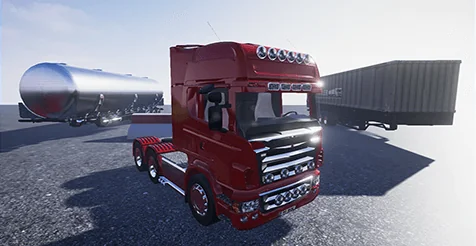
Integrating heavy transport vehicles into an interactive environment requires a stable foundation for articulated physics and mechanical connections. The setup begins with the drivable truck cab Blueprint, which serves as the core actor handling player input, chassis movement, and hitch logic. Coupled to this unit are two distinct trailer types: a container trailer made for standard freight transport and a tanker trailer configured for liquid cargo profiles. The primary implementation step involves establishing the attach and detach interaction between the cab's fifth-wheel coupling point and the trailer kingpin.
When maneuvering the truck cab into position, the attach mechanism detects alignment between the rear chassis of the cab and the hitch assembly of the chosen trailer. Executing the attachment sequence links the trailer physics directly to the truck cab, transferring momentum, braking force, and steering pivot responses seamlessly. Detaching reverses this process, allowing the truck cab to disconnect cleanly, leaving either the container trailer or tanker trailer stationary while the cab drives away independently. This modularity allows level designers and gameplay programmers to script transport missions, distribution hubs, or dynamic cargo switching without re-authoring separate unified vehicle meshes.
Driving Controls, Braking Dynamics, and the Sound Engine
Handling large commercial vehicles requires a dedicated driving system that accurately conveys the weight and stopping distance of articulated loads. The driving system governs forward acceleration, steering sensitivity, and braking behavior across the truck cab whether running solo or pulling heavy tonnage. Applying the brakes triggers deceleration curves tuned for heavy transport, preventing instantaneous stops and demanding calculated braking distances from the driver, particularly when hauling the container trailer or the loaded tanker trailer.
Audio feedback is tied directly into the physical operation of the rig. An integrated sound engine, implemented for version 4.22 and newer releases, responds to motor load, throttle input, idling states, and braking maneuvers. As the truck accelerates, the sound engine transitions through throttle bands, matching the audible strain of the engine against the vehicle mass. Releasing the accelerator and applying the brakes brings the audio system into deceleration and idle states, reinforcing physical speed reduction with matching mechanical sound output throughout transit.
Configuring the Multi-Stage Truck Light System and Signals
Navigating roads under low-visibility or nighttime conditions relies on an extensive, multi-state light system wired across the truck cab and trailer bodies. Rather than utilizing basic binary illumination, the vehicle incorporates separate operational lighting groups to cover distinct road scenarios and safety requirements:
Headlights with High and Low Beams: Standard low beams cast controlled illumination for city streets and populated routes, while switching to high beams extends visual range down unlit highways.
Truck Floodlights: High-intensity auxiliary floodlights mounted to the cab cast wide-angle illumination across work zones, coupling areas, and loading docks.
Brake and Reverse Lights: Rear-facing illumination signals deceleration when the footbrake engages and provides white reverse illumination when shifting into backward movement.
Left and Right Blinkers: Directional turn signals indicate lane changes and junction turns, operating independently on both sides of the chassis.
Hazard Lights: Simultaneous flashing of all signal markers ensures safety compliance during roadside stops, emergency maneuvers, or while conducting hitching and unhitching operations.
Because the lighting logic connects across the attach interface, signal commands executed from the cab propagate through to the electrical fixtures on both the container trailer and tanker trailer, ensuring trailers mirror the brake lights, reverse lights, and hazard states initiated by the driver.
Working Mirrors and Multi-Angle Camera Perspectives
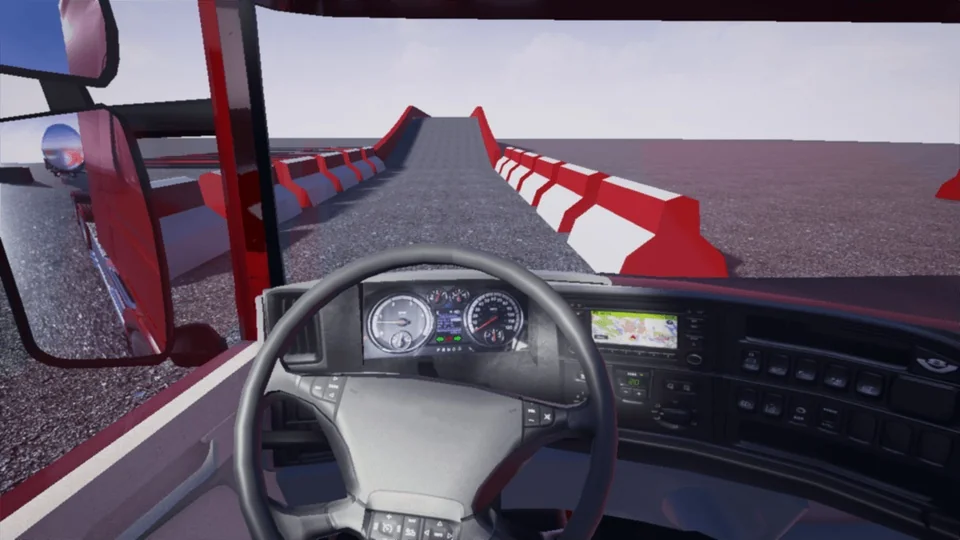
Maneuvering a multi-axle truck cab with an extended trailer requires constant situational awareness, particularly when reversing into tight loading bays or checking clearances during sharp turns. The package incorporates working mirrors positioned on the cab doors, reflecting the surrounding environment in real time. Drivers can monitor the trailer flanks directly from the driver seat, verifying that the rear wheels clear curbs, structural columns, and other obstacles along the driving path.
To assist with spatial awareness outside the cab interior, the vehicle script provides three selectable cameras. Drivers can switch between an interior dashboard view, a close-following chase camera suited for solo cab navigation, and an extended external view configured to frame both the truck cab and the full length of the container trailer or tanker trailer. These alternate viewpoints allow precise visual verification when lining up the truck hitch with a parked trailer, monitoring rear-axle articulation, or executing high-precision reversing maneuvers into docking platforms.
Blueprint Script Architecture and Bundle Compatibility
At the structural level, the asset is driven by cleanly organized Blueprints and scripts that expose key operational variables for direct adjustment. Designers can tune throttle response, tweak brake friction values, adjust camera placement offsets, and modify light intensity properties without altering underlying vehicle code. The system maintains verified compatibility with the Car-Truck-Motorcycles-Cycling-Bundle, allowing developers to embed this heavy transport framework directly into diverse vehicular traffic networks alongside two-wheelers, light passenger cars, and commercial fleets.
By unifying the mechanical attach and detach routine, realistic lighting circuits, three distinct camera views, functioning reflective mirrors, and dedicated 4.22+ engine sound assets, the Truck Trailer Attach Detach System delivers a complete, production-ready utility for projects requiring authentic freight logistics and heavy-duty vehicle driving mechanics.
 Vehicles
 Vehicles
 Vehicles
 Service