"95ccd6d7c96110f6"{"id":"1002464","slug":"the-robot-maars","title":"The robot MAARS","category":"Mechanical \u0026 Robots","engine":"4.22+,5.0+","assetVersion":"","engineVersion":"Engine Version: 4.22+,5.0+","tag":"Mechanical","accent":"blue","visual":"mech","summary":"Integrate the drivable MAARS crawler robot with an M240B machine gun, full multiplayer replication, and custom Blueprints into Unreal Engine projects.","platform":"Unreal Engine","indexPolicy":"index","publishedAt":"2026-11-11T08:51:19.595Z","updatedAt":"2026-11-11T08:51:19.595Z","sourceNotes":[],"fileContents":[],"compatibility":["Unreal Engine","Engine Version: 4.22+,5.0+"],"featuredImage":{"alt":"The robot MAARS","src":"/wp-content/uploads/published/2026/11/e07e453241ab-57e7bff9-a1d9-49b5-935f-fe8238f5de8d-20d17a0235.webp"},"hasDownloadLink":true,"downloads":0,"terms":[{"taxonomy":"category","slug":"mechanical-and-robots","name":"Mechanical \u0026 Robots"}],"galleryImages":[{"src":"/wp-content/uploads/published/2026/11/9a826e8c17a2-57619eb8-088e-4cad-aa7f-9a23f394d5a6-8cbf93a9d7.webp","alt":"The robot MAARS"},{"src":"/wp-content/uploads/published/2026/11/ce8c94a7b11e-714adccf-4f98-4620-9ef4-4f8078a4909b-f622ab093d.webp","alt":"The robot MAARS"},{"src":"/wp-content/uploads/published/2026/11/cb86d0212b68-06a56990-49e2-4ee3-ad4b-9d2003ab54f4-a63374cb3a.webp","alt":"The robot MAARS"},{"src":"/wp-content/uploads/published/2026/11/c068ef56a068-e385e3ff-3dd0-4760-801d-e430dfcd96e0-1f3996110d.webp","alt":"The robot MAARS"},{"src":"/wp-content/uploads/published/2026/11/7f09cb89d287-8a6c59ff-8d7c-4bc8-9d64-c1c49fbb291f-11cb4a8dbf.webp","alt":"The robot MAARS"}],"accessPanel":{"kind":"resource","title":"Get this resource","eyebrow":"Free resource","message":"Download this resource in your browser.","fileName":"The robot MAARS.7z","safetyNote":"Resources are manually reviewed before listing to improve quality and reduce obvious risks.","actionLabel":"Get this resource","resourceType":"Resource archive","versions":[]},"contentHtml":"\u003cp\u003eUnmanned ground vehicles occupy a distinct role in modern military and SWAT operations, serving as remote reconnaissance platforms, heavy fire support, and perimeter defense units. Placing a functional unmanned combat system into an interactive project requires coordinated vehicle movement, responsive targeting, dynamic visual effects, and network-friendly logic. The MAARS robot delivers an operational tracked combat crawler outfitted with an M240B light machine gun, providing developers with a foundation for tactical shooters, military simulations, and cooperative combat prototypes.\u003c/p\u003e \u003ch2\u003eDeploying the MAARS Platform in Tactical and Military Simulations\u003c/h2\u003e\n\u003cp\u003eCombat encounters set within forward operating bases, urban combat corridors, or SWAT breach zones demand believable tactical machinery. The MAARS unit brings an armed crawler platform into these environments without requiring developers to assemble chassis physics, weapon sockets, and remote control hierarchies from scratch. As a drivable vehicle, the package supplies the mechanics needed to pilot the unit across varied ground conditions, capturing the deliberate pacing and ground-hugging presence of a dedicated military ground drone.\u003c/p\u003e \u003cp\u003eBecause the unit serves as both a vehicle and an autonomous-styled weapon platform, it slots cleanly into diverse mission templates. In a military reconnaissance scenario, it acts as an advance scout sent through hostile terrain to flush out entrenched targets. In domestic law enforcement or tactical SWAT sequences, it functions as a mobile barricade and suppressive fire platform capable of engaging hostiles before infantry units breach a structure. The combination of tracked crawler locomotion and an integrated firearm gives the asset immediate utility across sandboxes focusing on combined arms, defensive siege mechanics, or remote-piloted support vehicles.\u003c/p\u003e \u003ch2\u003eWeaponry, Muzzle Flash, and Ballistic Effects on the MAARS Chassis\u003c/h2\u003e\n\u003cp\u003eOffensive capabilities on the MAARS platform center on the M240B light machine gun, mounted directly to the chassis to provide sustained suppression and direct fire. Rather than offering a purely static mesh for the weapon, the system integrates the active firing sequence into its gameplay loop. Firing triggers built-in visual elements, including muzzle flash emitters and physical bullet clip effects that accompany continuous fire.\u003c/p\u003e \u003cp\u003eThese weapon visual effects complete the sensory profile of a rapid-firing light machine gun. The muzzle flash provides real-time visual feedback for target tracking and night engagements, while the bullet clip effects ground the ballistic cycle in tangible mechanical motion. This makes the shooting sequence read clearly both from the perspective of the player piloting the unit and from opposing actors taking cover downrange.\u003c/p\u003e \u003cp\u003eDevelopers are not locked into the default loadout. The system permits weapon swapping straight through Blueprints, allowing teams to detach the M240B and attach alternative firearms or custom payload systems. Whether a design calls for lighter automatic weapons, heavier specialized ordnances, or unconventional combat tools, the underlying weapon mounting and firing logic remains adaptable to project-specific requirements.\u003c/p\u003e \u003ch2\u003eDrive Systems, Crawler Locomotion, and Animation Blueprints\u003c/h2\u003e\n\u003cp\u003eTracked vehicles carry unique kinetic expectations compared to wheeled cars or walking mechs. The MAARS package treats locomotion through a dedicated vehicle and crawler workflow, coordinating input with an Animation Blueprint to control the movement dynamics of the tank-style chassis. This setup ensures that turns, forward motion, and stationary pivots reflect the mechanical constraints of dual-track steering.\u003c/p\u003e \u003cp\u003eThe drivable nature of the platform accommodates varied player interaction models. In first-person or third-person military titles, players can take direct control of the drone via terminal interfaces or remote-control devices. In vehicle-centric tactical games, the unit acts as an independently piloted entity operating alongside conventional tanks, troop transports, and infantry squads. The inclusion of an Animation Blueprint keeps mechanical drive states synchronized with player commands, avoiding visual sliding and unnatural rotation during sharp maneuvers.\u003c/p\u003e \u003ch2\u003eNetwork Replication Architecture Inside the BP_MAARS Blueprint\u003c/h2\u003e\n\u003cp\u003eMultiplayer synchronization often presents a substantial hurdle when adding vehicles and automated turrets into networked projects. The MAARS package resolves this hurdle by providing fully replicated functionality out of the box. Every core feature—from directional driving and chassis rotation to weapon firing and visual effect spawning—is structured to communicate seamlessly between client and server.\u003c/p\u003e \u003cp\u003eAll core operational logic is centralized within the BP_MAARS Blueprint. Within this script, replicated events ensure that weapon discharges, trajectory alignment, and crawler positions propagate accurately across all connected clients in a session. Remote players observe the correct turret facing angles, muzzle flashes, and spent clip ejections without synchronization drift or local-only misalignments. For teams developing competitive team shooters, squad-based military simulations, or cooperative perimeter defense modes, having a pre-replicated combat crawler eliminates the extensive labor typically involved in authoring custom client-side prediction and server validation loops for drivable weapon mounts.\u003c/p\u003e \u003ch2\u003eConfiguring the Robot for Custom Armaments and Input Systems\u003c/h2\u003e\n\u003cp\u003eIntegrating the unit into an active Unreal Engine level follows a clean, standardized setup pipeline. The actor can be dragged directly from the content browser into any environment. To establish direct control over movement and weapon discharge, developers map the input events defined in BP_MAARS into the project's input settings. Reviewing BP_MAARS reveals the exact bindings required for throttle, steering, weapon aiming, and weapon firing, allowing developers to link their preferred keyboard, mouse, or console button configurations cleanly.\u003c/p\u003e \u003cp\u003eControl flexibility extends beyond traditional keyboard and mouse setups. The package supports Gamepad Virtual Cursor functionality, granting developers an established method to interface with aiming or menu-driven drone controls using modern console gamepads. This broad input support simplifies implementation on multi-platform projects where cursor movement must seamlessly translate across both analog thumbsticks and standard desktop inputs.\u003c/p\u003e \u003cp\u003eBeyond control bindings, visual customization is directly supported via Blueprints. Teams can change the exterior color palette of the MAARS unit to match specific faction uniforms, camouflage profiles, or law enforcement paint schemes. Applying desert tans, woodland greens, tactical SWAT blacks, or fictional security liveries requires no external texture modification tools, allowing rapid iteration on team identification directly in the engine.\u003c/p\u003e \u003cp\u003eTeams building modern warfare projects, tactical shooters, or remote vehicle combat games will find the platform ready to slot into production environments, providing a balanced baseline of functional locomotion, dynamic combat effects, and network-ready scripting.\u003c/p\u003e\n\n\u003ch2\u003eExplore Similar Assets\u003c/h2\u003e\n\u003cul\u003e\n\u003cli\u003e\u003ca href=\"https://3dcghub.com/funny-robot/\" rel=\"noopener noreferrer\"\u003eFunny Robot\u003c/a\u003e\u003c/li\u003e\n\u003cli\u003e\u003ca href=\"https://3dcghub.com/etasphera22/\" rel=\"noopener noreferrer\"\u003eEtasphera22\u003c/a\u003e\u003c/li\u003e\n\u003cli\u003e\u003ca href=\"https://3dcghub.com/etasphera05/\" rel=\"noopener noreferrer\"\u003eEtasphera05\u003c/a\u003e\u003c/li\u003e\n\u003cli\u003e\u003ca href=\"https://3dcghub.com/g2-cyborg-characters/\" rel=\"noopener noreferrer\"\u003eG2: Cyborg Characters\u003c/a\u003e\u003c/li\u003e\n\u003cli\u003e\u003ca href=\"https://3dcghub.com/etasphera58/\" rel=\"noopener noreferrer\"\u003eEtasphera58\u003c/a\u003e\u003c/li\u003e\n\u003c/ul\u003e","contentTextLength":7321,"navigation":{"current":1,"total":4387,"next":{"id":"1002463","slug":"service-drone","title":"Service Drone","category":"Characters \u0026 Creatures","platform":"Unreal Engine","updatedAt":"2026-11-11T08:50:34.556Z"}},"relatedResources":[{"id":"1002457","slug":"funny-robot","title":"Funny Robot","category":"Mechanical \u0026 Robots","engine":"4.26+,5.0+","assetVersion":"","engineVersion":"Engine Version: 4.26+,5.0+","tag":"Mechanical","accent":"blue","visual":"mech","summary":"A detailed look at Funny Robot, featuring Epic Skeleton rigging, free animation pack testing, PBR instanced materials, and nine color options.","platform":"Unreal Engine","indexPolicy":"index","publishedAt":"2026-11-11T08:45:08.782Z","updatedAt":"2026-11-11T08:45:08.782Z","sourceNotes":[],"fileContents":[],"compatibility":["Unreal Engine","Engine Version: 4.26+,5.0+"],"featuredImage":{"alt":"Funny Robot","src":"/wp-content/uploads/published/2026/11/0191d544d27c-2df6e3b4-2f83-48bf-86dd-e7229347fba3-927c352f1a.webp"},"hasDownloadLink":true,"downloads":0},{"id":"1002456","slug":"etasphera22","title":"Etasphera22","category":"Mechanical \u0026 Robots","engine":"4.18+,5.0+","assetVersion":"","engineVersion":"Engine Version: 4.18+,5.0+","tag":"Mechanical","accent":"blue","visual":"mech","summary":"Technical implementation guide for the Etasphera22 modular robot character, covering PBR textures, two-sided shader setup, and Epic Skeleton integration.","platform":"Unreal Engine","indexPolicy":"index","publishedAt":"2026-11-11T08:44:25.710Z","updatedAt":"2026-11-11T08:44:25.710Z","sourceNotes":[],"fileContents":[],"compatibility":["Unreal Engine","Engine Version: 4.18+,5.0+"],"featuredImage":{"alt":"Etasphera22","src":"/wp-content/uploads/published/2026/11/74aeb8cf9fcd-b0858cde-36e1-4f05-a94f-617501e9c316-8f1406f91b.webp"},"hasDownloadLink":true,"downloads":0},{"id":"1002455","slug":"etasphera05","title":"Etasphera05","category":"Mechanical \u0026 Robots","engine":"4.18+,5.0+","assetVersion":"","engineVersion":"Engine Version: 4.18+,5.0+","tag":"Mechanical","accent":"blue","visual":"mech","summary":"Explore the Etasphera05 low-poly modular android character, featuring Epic Skeleton rigging, 4K PBR texture sets, and Super Bot Pack Vol.3 compatibility.","platform":"Unreal Engine","indexPolicy":"index","publishedAt":"2026-11-11T08:43:41.117Z","updatedAt":"2026-11-11T08:43:41.117Z","sourceNotes":[],"fileContents":[],"compatibility":["Unreal Engine","Engine Version: 4.18+,5.0+"],"featuredImage":{"alt":"Etasphera05","src":"/wp-content/uploads/published/2026/11/e5539bd11014-8071095d-4be2-498c-8a1f-bb628d708e30-6a0ce5621f.webp"},"hasDownloadLink":true,"downloads":0}]}
Mechanical
The robot MAARS
Integrate the drivable MAARS crawler robot with an M240B machine gun, full multiplayer replication, and custom Blueprints into Unreal Engine projects.
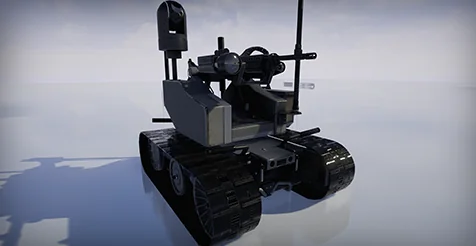
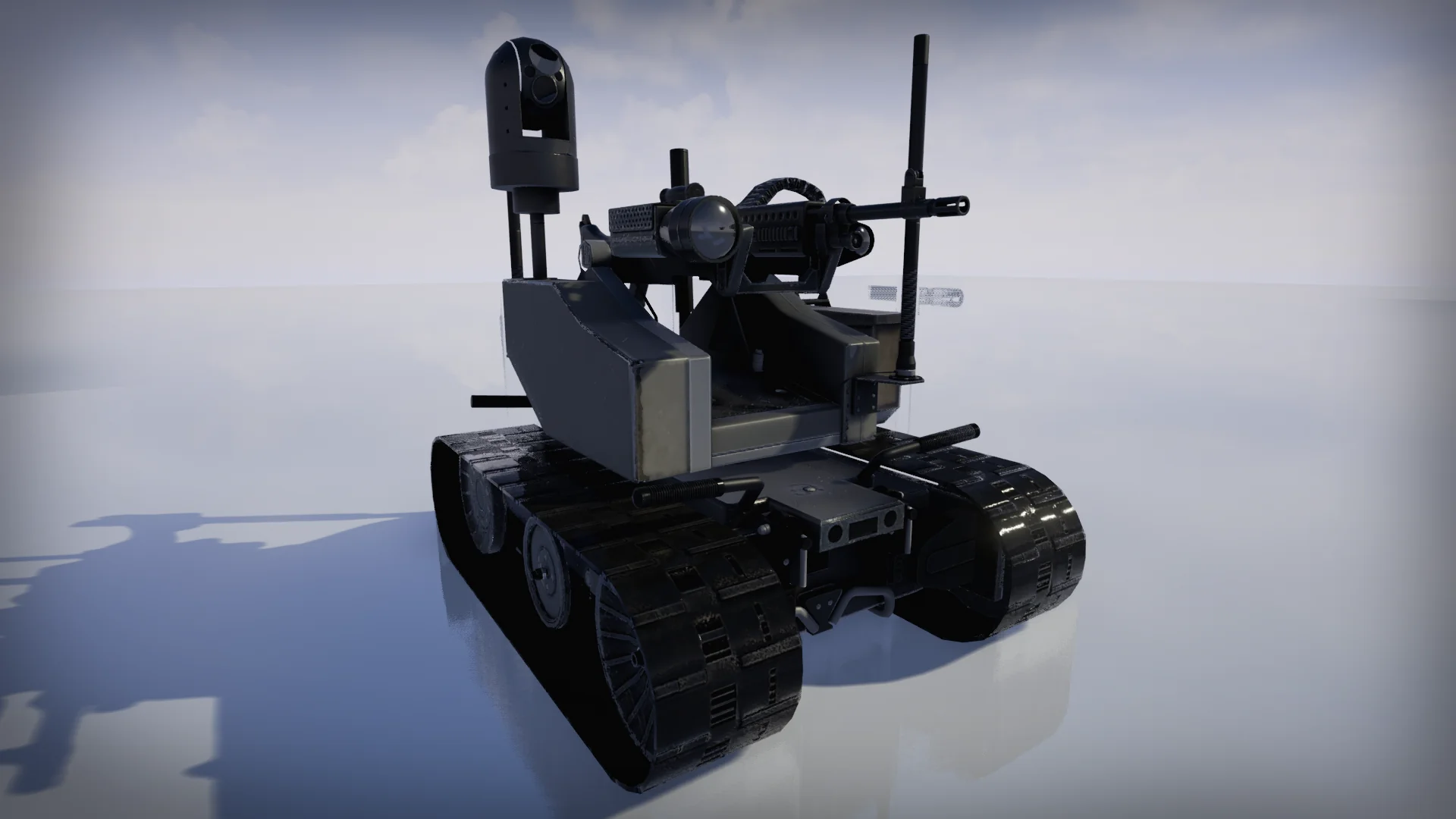
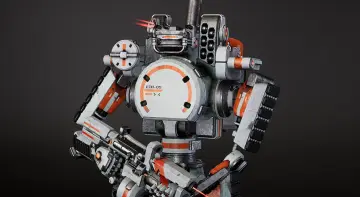
Unmanned ground vehicles occupy a distinct role in modern military and SWAT operations, serving as remote reconnaissance platforms, heavy fire support, and perimeter defense units. Placing a functional unmanned combat system into an interactive project requires coordinated vehicle movement, responsive targeting, dynamic visual effects, and network-friendly logic. The MAARS robot delivers an operational tracked combat crawler outfitted with an M240B light machine gun, providing developers with a foundation for tactical shooters, military simulations, and cooperative combat prototypes.
Deploying the MAARS Platform in Tactical and Military Simulations
Combat encounters set within forward operating bases, urban combat corridors, or SWAT breach zones demand believable tactical machinery. The MAARS unit brings an armed crawler platform into these environments without requiring developers to assemble chassis physics, weapon sockets, and remote control hierarchies from scratch. As a drivable vehicle, the package supplies the mechanics needed to pilot the unit across varied ground conditions, capturing the deliberate pacing and ground-hugging presence of a dedicated military ground drone.
Because the unit serves as both a vehicle and an autonomous-styled weapon platform, it slots cleanly into diverse mission templates. In a military reconnaissance scenario, it acts as an advance scout sent through hostile terrain to flush out entrenched targets. In domestic law enforcement or tactical SWAT sequences, it functions as a mobile barricade and suppressive fire platform capable of engaging hostiles before infantry units breach a structure. The combination of tracked crawler locomotion and an integrated firearm gives the asset immediate utility across sandboxes focusing on combined arms, defensive siege mechanics, or remote-piloted support vehicles.
Weaponry, Muzzle Flash, and Ballistic Effects on the MAARS Chassis
Offensive capabilities on the MAARS platform center on the M240B light machine gun, mounted directly to the chassis to provide sustained suppression and direct fire. Rather than offering a purely static mesh for the weapon, the system integrates the active firing sequence into its gameplay loop. Firing triggers built-in visual elements, including muzzle flash emitters and physical bullet clip effects that accompany continuous fire.
These weapon visual effects complete the sensory profile of a rapid-firing light machine gun. The muzzle flash provides real-time visual feedback for target tracking and night engagements, while the bullet clip effects ground the ballistic cycle in tangible mechanical motion. This makes the shooting sequence read clearly both from the perspective of the player piloting the unit and from opposing actors taking cover downrange.
Developers are not locked into the default loadout. The system permits weapon swapping straight through Blueprints, allowing teams to detach the M240B and attach alternative firearms or custom payload systems. Whether a design calls for lighter automatic weapons, heavier specialized ordnances, or unconventional combat tools, the underlying weapon mounting and firing logic remains adaptable to project-specific requirements.
Drive Systems, Crawler Locomotion, and Animation Blueprints
Tracked vehicles carry unique kinetic expectations compared to wheeled cars or walking mechs. The MAARS package treats locomotion through a dedicated vehicle and crawler workflow, coordinating input with an Animation Blueprint to control the movement dynamics of the tank-style chassis. This setup ensures that turns, forward motion, and stationary pivots reflect the mechanical constraints of dual-track steering.
The drivable nature of the platform accommodates varied player interaction models. In first-person or third-person military titles, players can take direct control of the drone via terminal interfaces or remote-control devices. In vehicle-centric tactical games, the unit acts as an independently piloted entity operating alongside conventional tanks, troop transports, and infantry squads. The inclusion of an Animation Blueprint keeps mechanical drive states synchronized with player commands, avoiding visual sliding and unnatural rotation during sharp maneuvers.
Network Replication Architecture Inside the BP_MAARS Blueprint
Multiplayer synchronization often presents a substantial hurdle when adding vehicles and automated turrets into networked projects. The MAARS package resolves this hurdle by providing fully replicated functionality out of the box. Every core feature—from directional driving and chassis rotation to weapon firing and visual effect spawning—is structured to communicate seamlessly between client and server.
All core operational logic is centralized within the BP_MAARS Blueprint. Within this script, replicated events ensure that weapon discharges, trajectory alignment, and crawler positions propagate accurately across all connected clients in a session. Remote players observe the correct turret facing angles, muzzle flashes, and spent clip ejections without synchronization drift or local-only misalignments. For teams developing competitive team shooters, squad-based military simulations, or cooperative perimeter defense modes, having a pre-replicated combat crawler eliminates the extensive labor typically involved in authoring custom client-side prediction and server validation loops for drivable weapon mounts.
Configuring the Robot for Custom Armaments and Input Systems
Integrating the unit into an active Unreal Engine level follows a clean, standardized setup pipeline. The actor can be dragged directly from the content browser into any environment. To establish direct control over movement and weapon discharge, developers map the input events defined in BP_MAARS into the project's input settings. Reviewing BP_MAARS reveals the exact bindings required for throttle, steering, weapon aiming, and weapon firing, allowing developers to link their preferred keyboard, mouse, or console button configurations cleanly.
Control flexibility extends beyond traditional keyboard and mouse setups. The package supports Gamepad Virtual Cursor functionality, granting developers an established method to interface with aiming or menu-driven drone controls using modern console gamepads. This broad input support simplifies implementation on multi-platform projects where cursor movement must seamlessly translate across both analog thumbsticks and standard desktop inputs.
Beyond control bindings, visual customization is directly supported via Blueprints. Teams can change the exterior color palette of the MAARS unit to match specific faction uniforms, camouflage profiles, or law enforcement paint schemes. Applying desert tans, woodland greens, tactical SWAT blacks, or fictional security liveries requires no external texture modification tools, allowing rapid iteration on team identification directly in the engine.
Teams building modern warfare projects, tactical shooters, or remote vehicle combat games will find the platform ready to slot into production environments, providing a balanced baseline of functional locomotion, dynamic combat effects, and network-ready scripting.
 Mechanical
 Mechanical
 Mechanical
 Mechanical