"95ccd6d7c96110f6"{"id":"1002456","slug":"etasphera22","title":"Etasphera22","category":"Mechanical \u0026 Robots","engine":"4.18+,5.0+","assetVersion":"","engineVersion":"Engine Version: 4.18+,5.0+","tag":"Mechanical","accent":"blue","visual":"mech","summary":"Technical implementation guide for the Etasphera22 modular robot character, covering PBR textures, two-sided shader setup, and Epic Skeleton integration.","platform":"Unreal Engine","indexPolicy":"index","publishedAt":"2026-11-11T08:44:25.710Z","updatedAt":"2026-11-11T08:44:25.710Z","sourceNotes":[],"fileContents":[],"compatibility":["Unreal Engine","Engine Version: 4.18+,5.0+"],"featuredImage":{"alt":"Etasphera22","src":"/wp-content/uploads/published/2026/11/74aeb8cf9fcd-b0858cde-36e1-4f05-a94f-617501e9c316-8f1406f91b.webp"},"hasDownloadLink":true,"downloads":0,"terms":[{"taxonomy":"category","slug":"mechanical-and-robots","name":"Mechanical \u0026 Robots"}],"galleryImages":[{"src":"/wp-content/uploads/published/2026/11/9e437e92910c-711273cf-a51a-4e01-bdff-8abbe132fc7d-7759200649.webp","alt":"Etasphera22"},{"src":"/wp-content/uploads/published/2026/11/143bd02454c9-0be35d0c-f704-4193-90d8-e4690fd11844-143a928709.webp","alt":"Etasphera22"},{"src":"/wp-content/uploads/published/2026/11/d53932935c59-a38c9ea4-0fd6-4563-8030-007436977342-575f13f91a.webp","alt":"Etasphera22"},{"src":"/wp-content/uploads/published/2026/11/bb1cd229c48d-ca16b7da-e4e7-4b05-a46f-b6e5245cbe0f-3967bba1d1.webp","alt":"Etasphera22"},{"src":"/wp-content/uploads/published/2026/11/352d25723d6d-558ee4c5-1850-4e04-992a-68481a110c4b-a4b00a0fd8.webp","alt":"Etasphera22"},{"src":"/wp-content/uploads/published/2026/11/ba43cc641cdf-d79470f7-19f7-4abe-85b3-8e73ec3dc79a-57bf5b7715.webp","alt":"Etasphera22"},{"src":"/wp-content/uploads/published/2026/11/2a2dd3c61802-e0a66645-a376-4d65-a45d-886ce3d58a54-843612ee14.webp","alt":"Etasphera22"},{"src":"/wp-content/uploads/published/2026/11/707e2bb6cde3-560f919b-317b-4b14-86cc-e1ab5e1cbf0d-1bee52eaab.webp","alt":"Etasphera22"}],"accessPanel":{"kind":"resource","title":"Get this resource","eyebrow":"Free resource","message":"Download this resource in your browser.","fileName":"Content.7z","safetyNote":"Resources are manually reviewed before listing to improve quality and reduce obvious risks.","actionLabel":"Get this resource","resourceType":"Resource archive","versions":[]},"contentHtml":"\u003ch2\u003eDeploying Etasphera22 in First-Person, Strategy, and RPG Workflows\u003c/h2\u003e\n\u003cp\u003eIntegrating a mechanical combat unit into a real-time production requires a balance between visual definition and rendering performance. Etasphera22 functions as a low-poly character model engineered specifically to bridge distinct gameplay genres, adapting cleanly to first-person shooters, real-time or turn-based strategy titles, and role-playing games. The mechanical nature of the asset makes it equally viable as a player avatar, an armored companion, or an automated enemy combatant within futuristic and industrial settings.\u003c/p\u003e\n\u003cp\u003eIn a first-person shooter context, character presentation demands immediate visual clarity during high-speed movement and weapon handling. The physical breakdown of Etasphera22 provides clear mechanical jointing and armor layering that reads well under standard field-of-view settings. When positioned directly in front of the player camera or viewed during cooperative encounters, the surface detailing maintains readability without collapsing into noisy geometry. The included weapon geometry operates in lockstep with the primary character mesh, allowing combat systems to handle draw, fire, and holstering states through unified actor structures.\u003c/p\u003e\n\u003cp\u003eStrategy games present the opposite technical challenge, requiring dozens or hundreds of autonomous units simultaneously on screen. Because the model maintains a low-poly budget, top-down and isometric camera angles can display multiple instances of the robot without overwhelming the vertex pipeline. The silhouette remains distinct from steep camera pitches, ensuring that players managing tactical squads can immediately distinguish the unit on the battlefield. Role-playing mechanics benefit similarly: the distinct armor plates, mechanical limbs, and weapon components give designers clear visual anchors to tie into inventory screens, stat progression, or specialized combat roles.\u003c/p\u003e \u003ch2\u003eTexture Partitioning Across Etasphera22 Mechanical Modules\u003c/h2\u003e\n\u003cp\u003eSurface detail across the character is separated across four dedicated layout regions, each targeting a native resolution of 4096x4096 pixels. These texture partitions divide the asset into practical functional sets:\u003c/p\u003e\n\u003cul\u003e \u003cli\u003e\u003cstrong\u003eBody:\u003c/strong\u003e Handles the core chassis, torso assembly, and central structural mechanics at 4096x4096 resolution.\u003c/li\u003e \u003cli\u003e\u003cstrong\u003eArm_Leg:\u003c/strong\u003e Encompasses the articulated mechanical limbs, joints, and locomotion hydraulics at 4096x4096 resolution.\u003c/li\u003e \u003cli\u003e\u003cstrong\u003eArmor:\u003c/strong\u003e Isolates the exterior protective plating, mounted panels, and defensive shells at 4096x4096 resolution.\u003c/li\u003e \u003cli\u003e\u003cstrong\u003eWeapon:\u003c/strong\u003e Covers the accompanying firearm and offensive hardware independently at 4096x4096 resolution.\u003c/li\u003e\n\u003c/ul\u003e\n\u003cp\u003eThis four-way segmentation serves a vital practical role in project optimization. Because each sector maintains its own independent texture map, memory budgets can be managed dynamically according to platform targets. For productions operating under strict VRAM caps or targeting broad hardware configurations, these maps can be downsampled directly to 1024x1024 pixels. The UV layouts and surface baking preserve surface readability through this reduction, ensuring that the silhouette, panel seams, and material definitions remain crisp without substantial visual degradation.\u003c/p\u003e\n\u003cp\u003eThe texture architecture uses physically based rendering workflows, allowing the metallic plating, joint mechanics, and protective armor coatings to respond accurately to scene lighting. Environmental reflections, specular highlights, and ambient shadows react consistently whether the character moves through brightly lit outdoor environments or dark interior corridors. Separating the weapon onto its own 4096x4096 map also allows technical artists to swap or adjust armament materials without altering the primary character shaders.\u003c/p\u003e \u003ch2\u003eManaging Two-Sided Polygon Rendering and PBR Surface Behavior\u003c/h2\u003e\n\u003cp\u003eA crucial technical requirement for configuring Etasphera22 in-engine is the implementation of a shader configured with two-sided polygon display. Mechanical models with modular armor plating, thin protective cowlings, and exposed internal chassis sections frequently feature geometry where both faces of a surface remain visible during dynamic movement. Standard single-sided material pipelines cull back-facing polygons to conserve render overhead, which can cause thin metal skirts, armor flanges, and hollow structural panels to disappear when observed from specific angles.\u003c/p\u003e\n\u003cp\u003eEnabling two-sided rendering in the material graph resolves this issue directly. It prevents backface culling across the open edges of the armor and mechanical housing, maintaining solid physical presence without requiring artists to extrude unnecessary internal geometry that would bloat the poly count. When combining two-sided rendering with standard PBR material inputs, surface normals must be handled correctly across both sides of the mesh to prevent inverted light responses. Ensuring the shading network properly handles two-sided lighting guarantees that light wraps realistically around the thin armor edges and cast shadows land naturally on the underlying machinery.\u003c/p\u003e\n\u003cp\u003eThis shader approach proves especially useful during close-up animations, such as weapon reloads or melee strikes, where limbs flex and expose internal joints. The double-sided presentation preserves mechanical depth across complex poses, ensuring the robotic character looks solid and completely assembled under dynamic direct lighting and spotlight cones.\u003c/p\u003e \u003ch2\u003eEpic Skeleton Rigging, Blueprints, and Super Bot Pack Vol.3 Integration\u003c/h2\u003e\n\u003cp\u003eUnderneath the surface mesh, Etasphera22 is fully rigged using the Epic Skeleton hierarchy. Adhering to this standard skeletal structure eliminates the friction typically associated with custom mechanical rigs. The asset integrates directly with established animation systems, allowing technical directors to retarget locomotion libraries, combat movesets, and idling sequences without constructing proprietary bone chains from scratch. The inclusion of an Animation Blueprint setup means motion states can be driven immediately by runtime character velocity, acceleration vectors, and combat triggers.\u003c/p\u003e\n\u003cp\u003eBlueprint and script integration further accelerate gameplay implementation. The asset is structured for modular deployment, enabling game logic to address distinct components of the character during runtime. Scripted events can toggle visibility on specific armor plates, attach alternative weapons to the designated skeletal sockets, or trigger localized damage effects across the limb and body hierarchy. Because the model maintains compatibility with Super Bot Pack Vol.3, it slots naturally into broader mechanical unit rosters, matching the organizational and technical framework of other robots within that collective ecosystem.\u003c/p\u003e\n\u003cp\u003eWhether handling movement logic through built-in character controllers or tying weapon fire scripts to the articulated firearm, the union of an Epic Skeleton foundation and dedicated Blueprint scaffolding keeps technical setup straightforward. Developers can focus on refining gameplay feedback, tuning movement speeds, and tailoring state machines knowing the mechanical mesh, textures, and skeleton already conform to standard production standards.\u003c/p\u003e\n\n\u003ch2\u003eRelated Resources Worth Checking\u003c/h2\u003e\n\u003cul\u003e\n\u003cli\u003e\u003ca href=\"https://3dcghub.com/etasphera05/\" rel=\"noopener noreferrer\"\u003eEtasphera05\u003c/a\u003e\u003c/li\u003e\n\u003cli\u003e\u003ca href=\"https://3dcghub.com/g2-cyborg-characters/\" rel=\"noopener noreferrer\"\u003eG2: Cyborg Characters\u003c/a\u003e\u003c/li\u003e\n\u003cli\u003e\u003ca href=\"https://3dcghub.com/etasphera58/\" rel=\"noopener noreferrer\"\u003eEtasphera58\u003c/a\u003e\u003c/li\u003e\n\u003cli\u003e\u003ca href=\"https://3dcghub.com/etasphera45/\" rel=\"noopener noreferrer\"\u003eEtasphera45\u003c/a\u003e\u003c/li\u003e\n\u003cli\u003e\u003ca href=\"https://3dcghub.com/sci-fi-cyber-robot-01/\" rel=\"noopener noreferrer\"\u003eSci-FI Cyber Robot 01\u003c/a\u003e\u003c/li\u003e\n\u003c/ul\u003e","contentTextLength":7316,"navigation":{"current":9,"total":4387,"previous":{"id":"1002457","slug":"funny-robot","title":"Funny Robot","category":"Mechanical \u0026 Robots","platform":"Unreal Engine","updatedAt":"2026-11-11T08:45:08.782Z"},"next":{"id":"1002455","slug":"etasphera05","title":"Etasphera05","category":"Mechanical \u0026 Robots","platform":"Unreal Engine","updatedAt":"2026-11-11T08:43:41.117Z"}},"relatedResources":[{"id":"1002455","slug":"etasphera05","title":"Etasphera05","category":"Mechanical \u0026 Robots","engine":"4.18+,5.0+","assetVersion":"","engineVersion":"Engine Version: 4.18+,5.0+","tag":"Mechanical","accent":"blue","visual":"mech","summary":"Explore the Etasphera05 low-poly modular android character, featuring Epic Skeleton rigging, 4K PBR texture sets, and Super Bot Pack Vol.3 compatibility.","platform":"Unreal Engine","indexPolicy":"index","publishedAt":"2026-11-11T08:43:41.117Z","updatedAt":"2026-11-11T08:43:41.117Z","sourceNotes":[],"fileContents":[],"compatibility":["Unreal Engine","Engine Version: 4.18+,5.0+"],"featuredImage":{"alt":"Etasphera05","src":"/wp-content/uploads/published/2026/11/e5539bd11014-8071095d-4be2-498c-8a1f-bb628d708e30-6a0ce5621f.webp"},"hasDownloadLink":true,"downloads":0},{"id":"1002414","slug":"g2-cyborg-characters","title":"G2: Cyborg Characters","category":"Mechanical \u0026 Robots","engine":"4.26+,5.0+","assetVersion":"","engineVersion":"Engine Version: 4.26+,5.0+","tag":"Mechanical","accent":"blue","visual":"character","summary":"Explore G2: Cyborg Characters, featuring UE4 Mannequin compatibility with 02 extra bones, 83 facial blendshapes, modular gear, and master materials.","platform":"Unreal Engine","indexPolicy":"index","publishedAt":"2026-11-10T12:14:19.479Z","updatedAt":"2026-11-10T12:14:19.479Z","sourceNotes":[],"fileContents":[],"compatibility":["Unreal Engine","Engine Version: 4.26+,5.0+"],"featuredImage":{"alt":"G2: Cyborg Characters","src":"/wp-content/uploads/published/2026/11/82b8c3f18c83-a04d3ee7-6751-42b7-9c76-c7f85a0819a5-849f086bef.webp"},"hasDownloadLink":true,"downloads":0},{"id":"1002013","slug":"etasphera58","title":"Etasphera58","category":"Mechanical \u0026 Robots","engine":"4.26+,5.0+","assetVersion":"","engineVersion":"Engine Version: 4.26+,5.0+","tag":"Mechanical","accent":"blue","visual":"mech","summary":"Explore the low poly Etasphera58 mechanical character, featuring 4096x4096 texture sets, ID masks, Epic Skeleton rigging, and multi-genre game support.","platform":"Unreal Engine","indexPolicy":"index","publishedAt":"2026-10-26T12:51:36.872Z","updatedAt":"2026-10-26T12:51:36.872Z","sourceNotes":[],"fileContents":[],"compatibility":["Unreal Engine","Engine Version: 4.26+,5.0+"],"featuredImage":{"alt":"Etasphera58","src":"/wp-content/uploads/published/2026/10/b7b5030ead38-150f6462-eff5-44bc-846d-aa2dc3bbb9ad-c230a90d6c.webp"},"hasDownloadLink":true,"downloads":0}]}
Mechanical
Etasphera22
Technical implementation guide for the Etasphera22 modular robot character, covering PBR textures, two-sided shader setup, and Epic Skeleton integration.
Deploying Etasphera22 in First-Person, Strategy, and RPG Workflows
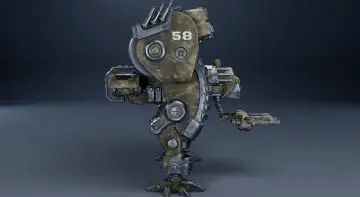
Integrating a mechanical combat unit into a real-time production requires a balance between visual definition and rendering performance. Etasphera22 functions as a low-poly character model engineered specifically to bridge distinct gameplay genres, adapting cleanly to first-person shooters, real-time or turn-based strategy titles, and role-playing games. The mechanical nature of the asset makes it equally viable as a player avatar, an armored companion, or an automated enemy combatant within futuristic and industrial settings.
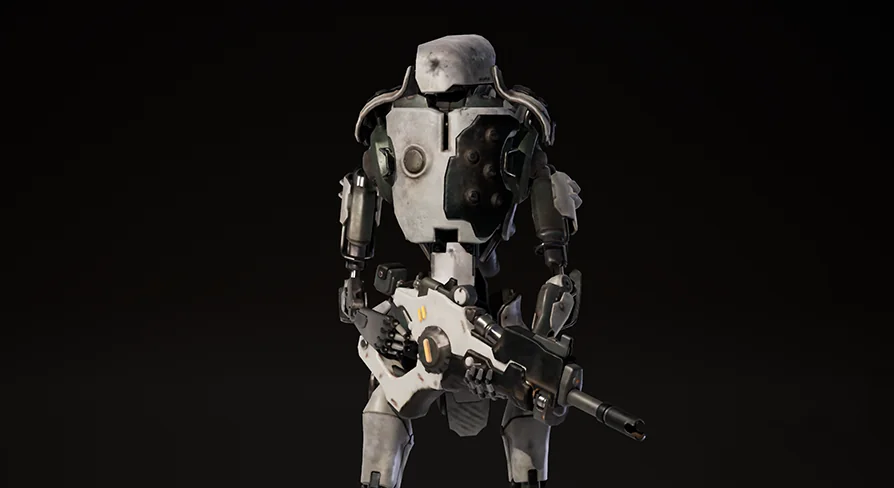
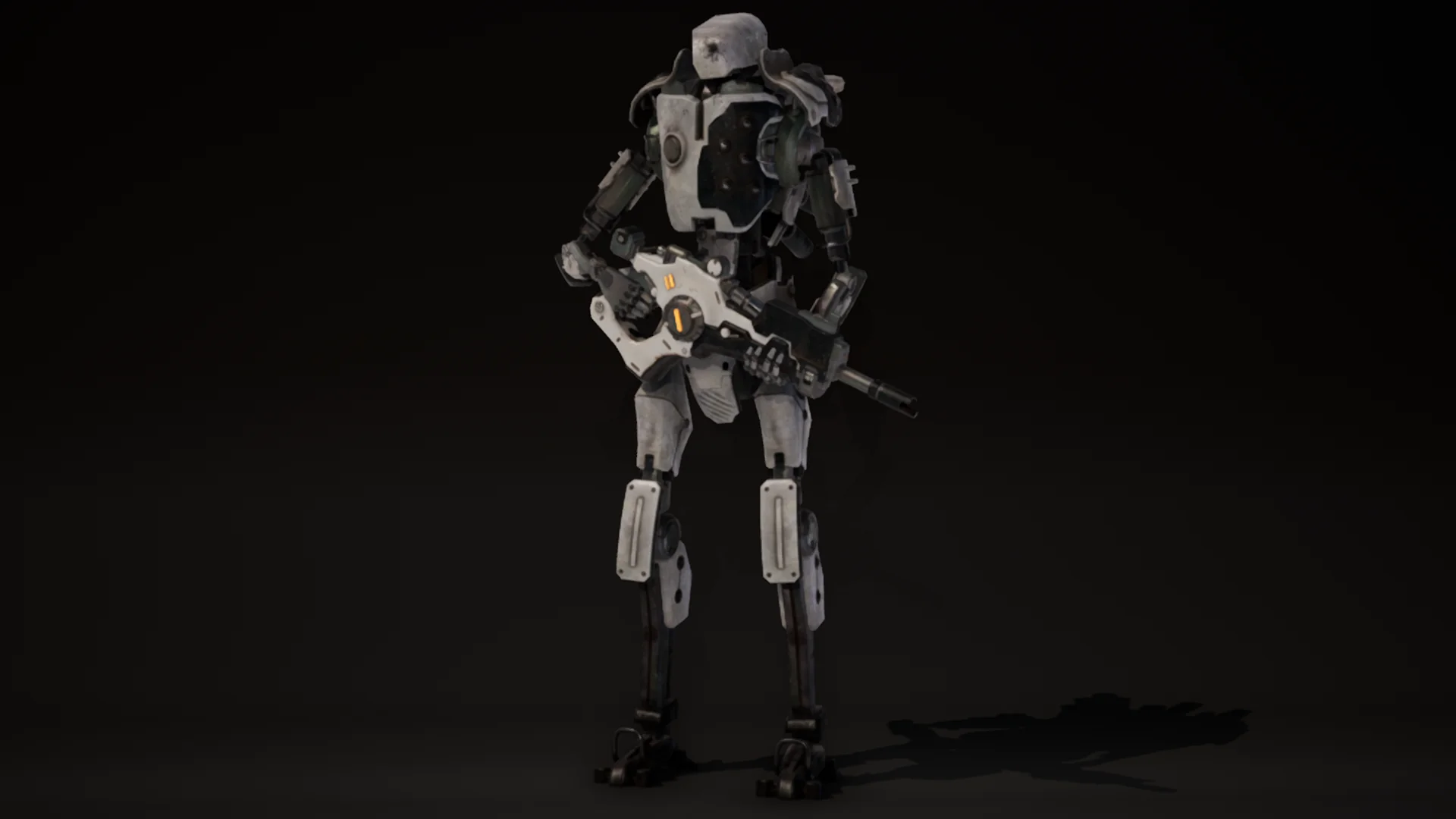
In a first-person shooter context, character presentation demands immediate visual clarity during high-speed movement and weapon handling. The physical breakdown of Etasphera22 provides clear mechanical jointing and armor layering that reads well under standard field-of-view settings. When positioned directly in front of the player camera or viewed during cooperative encounters, the surface detailing maintains readability without collapsing into noisy geometry. The included weapon geometry operates in lockstep with the primary character mesh, allowing combat systems to handle draw, fire, and holstering states through unified actor structures.
Strategy games present the opposite technical challenge, requiring dozens or hundreds of autonomous units simultaneously on screen. Because the model maintains a low-poly budget, top-down and isometric camera angles can display multiple instances of the robot without overwhelming the vertex pipeline. The silhouette remains distinct from steep camera pitches, ensuring that players managing tactical squads can immediately distinguish the unit on the battlefield. Role-playing mechanics benefit similarly: the distinct armor plates, mechanical limbs, and weapon components give designers clear visual anchors to tie into inventory screens, stat progression, or specialized combat roles.
Texture Partitioning Across Etasphera22 Mechanical Modules
Surface detail across the character is separated across four dedicated layout regions, each targeting a native resolution of 4096x4096 pixels. These texture partitions divide the asset into practical functional sets:
Body: Handles the core chassis, torso assembly, and central structural mechanics at 4096x4096 resolution.
Arm_Leg: Encompasses the articulated mechanical limbs, joints, and locomotion hydraulics at 4096x4096 resolution.
Armor: Isolates the exterior protective plating, mounted panels, and defensive shells at 4096x4096 resolution.
Weapon: Covers the accompanying firearm and offensive hardware independently at 4096x4096 resolution.
This four-way segmentation serves a vital practical role in project optimization. Because each sector maintains its own independent texture map, memory budgets can be managed dynamically according to platform targets. For productions operating under strict VRAM caps or targeting broad hardware configurations, these maps can be downsampled directly to 1024x1024 pixels. The UV layouts and surface baking preserve surface readability through this reduction, ensuring that the silhouette, panel seams, and material definitions remain crisp without substantial visual degradation.
The texture architecture uses physically based rendering workflows, allowing the metallic plating, joint mechanics, and protective armor coatings to respond accurately to scene lighting. Environmental reflections, specular highlights, and ambient shadows react consistently whether the character moves through brightly lit outdoor environments or dark interior corridors. Separating the weapon onto its own 4096x4096 map also allows technical artists to swap or adjust armament materials without altering the primary character shaders.
Managing Two-Sided Polygon Rendering and PBR Surface Behavior
A crucial technical requirement for configuring Etasphera22 in-engine is the implementation of a shader configured with two-sided polygon display. Mechanical models with modular armor plating, thin protective cowlings, and exposed internal chassis sections frequently feature geometry where both faces of a surface remain visible during dynamic movement. Standard single-sided material pipelines cull back-facing polygons to conserve render overhead, which can cause thin metal skirts, armor flanges, and hollow structural panels to disappear when observed from specific angles.
Enabling two-sided rendering in the material graph resolves this issue directly. It prevents backface culling across the open edges of the armor and mechanical housing, maintaining solid physical presence without requiring artists to extrude unnecessary internal geometry that would bloat the poly count. When combining two-sided rendering with standard PBR material inputs, surface normals must be handled correctly across both sides of the mesh to prevent inverted light responses. Ensuring the shading network properly handles two-sided lighting guarantees that light wraps realistically around the thin armor edges and cast shadows land naturally on the underlying machinery.
This shader approach proves especially useful during close-up animations, such as weapon reloads or melee strikes, where limbs flex and expose internal joints. The double-sided presentation preserves mechanical depth across complex poses, ensuring the robotic character looks solid and completely assembled under dynamic direct lighting and spotlight cones.
Epic Skeleton Rigging, Blueprints, and Super Bot Pack Vol.3 Integration
Underneath the surface mesh, Etasphera22 is fully rigged using the Epic Skeleton hierarchy. Adhering to this standard skeletal structure eliminates the friction typically associated with custom mechanical rigs. The asset integrates directly with established animation systems, allowing technical directors to retarget locomotion libraries, combat movesets, and idling sequences without constructing proprietary bone chains from scratch. The inclusion of an Animation Blueprint setup means motion states can be driven immediately by runtime character velocity, acceleration vectors, and combat triggers.
Blueprint and script integration further accelerate gameplay implementation. The asset is structured for modular deployment, enabling game logic to address distinct components of the character during runtime. Scripted events can toggle visibility on specific armor plates, attach alternative weapons to the designated skeletal sockets, or trigger localized damage effects across the limb and body hierarchy. Because the model maintains compatibility with Super Bot Pack Vol.3, it slots naturally into broader mechanical unit rosters, matching the organizational and technical framework of other robots within that collective ecosystem.
Whether handling movement logic through built-in character controllers or tying weapon fire scripts to the articulated firearm, the union of an Epic Skeleton foundation and dedicated Blueprint scaffolding keeps technical setup straightforward. Developers can focus on refining gameplay feedback, tuning movement speeds, and tailoring state machines knowing the mechanical mesh, textures, and skeleton already conform to standard production standards.
 Mechanical
 Mechanical
 Mechanical
 Mechanical