"95ccd6d7c96110f6"{"id":"1002457","slug":"funny-robot","title":"Funny Robot","category":"Mechanical \u0026 Robots","engine":"4.26+,5.0+","assetVersion":"","engineVersion":"Engine Version: 4.26+,5.0+","tag":"Mechanical","accent":"blue","visual":"mech","summary":"A detailed look at Funny Robot, featuring Epic Skeleton rigging, free animation pack testing, PBR instanced materials, and nine color options.","platform":"Unreal Engine","indexPolicy":"index","publishedAt":"2026-11-11T08:45:08.782Z","updatedAt":"2026-11-11T08:45:08.782Z","sourceNotes":[],"fileContents":[],"compatibility":["Unreal Engine","Engine Version: 4.26+,5.0+"],"featuredImage":{"alt":"Funny Robot","src":"/wp-content/uploads/published/2026/11/0191d544d27c-2df6e3b4-2f83-48bf-86dd-e7229347fba3-927c352f1a.webp"},"hasDownloadLink":true,"downloads":0,"terms":[{"taxonomy":"category","slug":"mechanical-and-robots","name":"Mechanical \u0026 Robots"}],"galleryImages":[{"src":"/wp-content/uploads/published/2026/11/48f79a3339ea-304d5aab-2777-41fa-a8bd-85d6083c7824-dfb42c036c.webp","alt":"Funny Robot"},{"src":"/wp-content/uploads/published/2026/11/8f6002adb7e0-5ae51bfb-ea22-48f8-91ea-9112cb0f0576-9c22d17f98.webp","alt":"Funny Robot"},{"src":"/wp-content/uploads/published/2026/11/635714539c8a-17437f51-f4cd-43a1-ae4a-3d3622b3bbe9-13303cee60.webp","alt":"Funny Robot"},{"src":"/wp-content/uploads/published/2026/11/67598c0d52b8-32aec381-7df2-4982-8dfb-dfd0b841c396-e4c06ce5a0.webp","alt":"Funny Robot"},{"src":"/wp-content/uploads/published/2026/11/6f174cff5346-97db3b6e-037d-4d3e-8021-d0e20805f9f7-5f6a1252c8.webp","alt":"Funny Robot"},{"src":"/wp-content/uploads/published/2026/11/00b0e3b57db6-351188dc-0638-49fe-8024-c0ea50512206-423f907589.webp","alt":"Funny Robot"}],"accessPanel":{"kind":"resource","title":"Get this resource","eyebrow":"Free resource","message":"Download this resource in your browser.","fileName":"Content.7z","safetyNote":"Resources are manually reviewed before listing to improve quality and reduce obvious risks.","actionLabel":"Get this resource","resourceType":"Resource archive","versions":[]},"contentHtml":"\u003cp\u003eFunny Robot delivers an expressive, stylized character asset shaped by an accessible, fantasy-inspired mechanical theme. Anchored by standard skeletal compatibility and a physically based rendering pipeline, the asset is structured to integrate cleanly into real-time interactive projects that require lighthearted, non-humanoid or whimsical robotic entities. By focusing on established rigging conventions and modular surface customization, the model solves common animation and visual variety needs right from the outset.\u003c/p\u003e \u003ch2\u003eRigging the Funny Robot to the Epic Skeleton Standard\u003c/h2\u003e\n\u003cp\u003eA primary technical foundation of the model is its native rigging to the Epic Skeleton. In real-time character art pipelines, adhering strictly to this standard bone hierarchy eliminates the friction often encountered when importing third-party characters. The joint orientation, naming conventions, and hierarchy correspond directly to established industry standards, allowing technical artists and animators to leverage preexisting motion datasets without rebuilding retargeting profiles from scratch.\u003c/p\u003e\n\u003cp\u003eDeformation consistency across mechanical limbs can present unique hurdles, especially when rigid surfaces bend around soft-weighted joints. Funny Robot addresses this by maintaining structural proportions that align with standard humanoid proportions while retaining exaggerated, humorous contours. The skeletal mapping preserves clean pivot behavior around the elbows, knees, torso, and neck, preventing visual tearing or awkward stretching during extreme kinematic poses.\u003c/p\u003e\n\u003cp\u003ePractical verification is already built into the character setup. The mesh has been tested directly against the free animation pack, confirming that base locomotion sets, idle stances, turns, and transitions run smoothly without manual bone adjustments. This out-of-the-box validation ensures that developers seeking plug-and-play behavior can assign existing movement blueprints and animation trees to the character immediately upon import.\u003c/p\u003e \u003ch2\u003eMaterial Instancing and the Nine Funny Robot Colorways\u003c/h2\u003e\n\u003cp\u003eSurface properties on the character rely on modern physically based rendering (PBR) workflows. The surface responses reflect accurate light behavior across diffuse coloration, roughness values, and metallic properties, giving the mechanical plates, joints, and detailing a grounded physical presence while honoring the exaggerated, stylized shape language of the model.\u003c/p\u003e\n\u003cp\u003eTo support visual diversity without bloating memory usage, the character leverages an instanced material architecture. Rather than relying on nine separate standalone material setups that each demand individual texture calls and shader compilation overhead, the package uses material instances driven by shared parent logic. This structural setup enables fast runtime performance and uniform shader modifications across every variation.\u003c/p\u003e\n\u003cp\u003eThe package supplies nine distinct color variations. In practical production scenarios, having nine curated color palettes permits immediate deployment across diverse gameplay roles:\u003c/p\u003e\n\u003cul\u003e\n\u003cli\u003e\u003cstrong\u003eTeam and Faction Identification:\u003c/strong\u003e Differentiating squads, opposing armies, or cooperative player markers across competitive gameplay arenas.\u003c/li\u003e\n\u003cli\u003e\u003cstrong\u003eTier and Level Progression:\u003c/strong\u003e Signaling unit ranks, upgrades, or difficulty scaling through recognizable color shifts across repetitive enemy types.\u003c/li\u003e\n\u003cli\u003e\u003cstrong\u003eEnvironmental Adaptation:\u003c/strong\u003e Blending unit appearance to match biome themes, ranging from arid deserts to subterranean or industrial settings.\u003c/li\u003e\n\u003cli\u003e\u003cstrong\u003eRole Specialization:\u003c/strong\u003e Visualizing support, builder, combat, or scout functions within the same baseline unit hierarchy.\u003c/li\u003e\n\u003c/ul\u003e\n\u003cp\u003eBecause the colorways exist as instanced materials, technical teams can tweak individual tint masks, scalar parameters, or roughness shifts across the entire fleet without manually painting unique texture sheets for every variant.\u003c/p\u003e \u003ch2\u003eThe Cute Fantasy Robot Aesthetic in Real-Time Production\u003c/h2\u003e\n\u003cp\u003eArtistic direction often dictates how well a character communicates its purpose to the player. Funny Robot combines cute, comedic, and fantasy attributes to avoid the utilitarian, grimy realism common in conventional robotic designs. The exaggerated proportions, friendly silhouette, and expressive styling make it suitable for all-ages gameplay, family-oriented titles, and narrative games that lean into whimsical worldbuilding.\u003c/p\u003e\n\u003cp\u003eIn fantasy settings where traditional technology is swapped for magical automatons, clockwork helpers, or enchanted constructs, the asset fills a distinct thematic niche. The character avoids sharp, aggressive angles in favor of approachable contours that signal neutral or friendly intent, making it equally effective as a player companion, an interactive vendor, or a lighthearted puzzle protagonist.\u003c/p\u003e\n\u003cp\u003eThe comedic slant also lends itself to expressive secondary motion. When paired with squash-and-stretch animation sets or comedic physical reactions, the model's playful frame emphasizes impacts, trips, jumps, and celebratory dances far more effectively than hyper-realistic, photorealistic machinery ever could.\u003c/p\u003e \u003ch2\u003eIntegrating with Toon RTS Environment Systems\u003c/h2\u003e\n\u003cp\u003eBeyond isolated character usage, the model is built with cross-asset compatibility in mind, specifically aligning with the visual and thematic rules of the Toon RTS Environment - Humans ecosystem. In top-down real-time strategy (RTS) titles, units are typically viewed from distant, angled perspectives where readability is critical.\u003c/p\u003e\n\u003cp\u003eWorking alongside human units in a toon RTS setting creates an immediate dynamic. The robot can operate as an automated resource gatherer, an assistant drone for human commanders, an escort objective, or an oddball mechanical faction competing for territory. Its readable forms and distinct material variations prevent unit clustering from turning into a visually confusing mass on screen, ensuring players can instantly identify individual units amidst busy tactical encounters.\u003c/p\u003e\n\u003cp\u003eThe shared stylized treatment ensures that lighting responses, surface sheen, and silhouette edges do not clash with the surrounding architectural or environmental assets of the Toon RTS line. Asset cohesion prevents immersion breaks, sparing art directors the time-consuming process of adjusting texture brightness, edge softening, or shader parameters to harmonize disparate third-party marketplace assets.\u003c/p\u003e \u003ch2\u003eDeployment Readiness Across Standard Pipelines\u003c/h2\u003e\n\u003cp\u003eThe setup of Funny Robot prioritizes immediate functional integration over cumbersome manual configuration. Because it combines Epic Skeleton conformity, pre-validated animation playback through standard free libraries, a clean instanced PBR material layout, and direct alignment with complementary toon environments, it sits ready for dynamic game logic implementation. Whether deployed as a fleet of colored worker bots, a comical player character, or a whimsical RTS unit, the asset provides a dependable foundation built entirely on standard production conventions.\u003c/p\u003e\n\n\u003ch2\u003eMore From The Same Workflow\u003c/h2\u003e\n\u003cul\u003e\n\u003cli\u003e\u003ca href=\"https://3dcghub.com/etasphera22/\" rel=\"noopener noreferrer\"\u003eEtasphera22\u003c/a\u003e\u003c/li\u003e\n\u003cli\u003e\u003ca href=\"https://3dcghub.com/etasphera05/\" rel=\"noopener noreferrer\"\u003eEtasphera05\u003c/a\u003e\u003c/li\u003e\n\u003cli\u003e\u003ca href=\"https://3dcghub.com/g2-cyborg-characters/\" rel=\"noopener noreferrer\"\u003eG2: Cyborg Characters\u003c/a\u003e\u003c/li\u003e\n\u003cli\u003e\u003ca href=\"https://3dcghub.com/etasphera58/\" rel=\"noopener noreferrer\"\u003eEtasphera58\u003c/a\u003e\u003c/li\u003e\n\u003cli\u003e\u003ca href=\"https://3dcghub.com/etasphera45/\" rel=\"noopener noreferrer\"\u003eEtasphera45\u003c/a\u003e\u003c/li\u003e\n\u003c/ul\u003e","contentTextLength":7008,"navigation":{"current":8,"total":4387,"previous":{"id":"1002458","slug":"mech-biped","title":"MECH BIPED","category":"Characters \u0026 Creatures","platform":"Unreal Engine","updatedAt":"2026-11-11T08:45:43.128Z"},"next":{"id":"1002456","slug":"etasphera22","title":"Etasphera22","category":"Mechanical \u0026 Robots","platform":"Unreal Engine","updatedAt":"2026-11-11T08:44:25.710Z"}},"relatedResources":[{"id":"1002456","slug":"etasphera22","title":"Etasphera22","category":"Mechanical \u0026 Robots","engine":"4.18+,5.0+","assetVersion":"","engineVersion":"Engine Version: 4.18+,5.0+","tag":"Mechanical","accent":"blue","visual":"mech","summary":"Technical implementation guide for the Etasphera22 modular robot character, covering PBR textures, two-sided shader setup, and Epic Skeleton integration.","platform":"Unreal Engine","indexPolicy":"index","publishedAt":"2026-11-11T08:44:25.710Z","updatedAt":"2026-11-11T08:44:25.710Z","sourceNotes":[],"fileContents":[],"compatibility":["Unreal Engine","Engine Version: 4.18+,5.0+"],"featuredImage":{"alt":"Etasphera22","src":"/wp-content/uploads/published/2026/11/74aeb8cf9fcd-b0858cde-36e1-4f05-a94f-617501e9c316-8f1406f91b.webp"},"hasDownloadLink":true,"downloads":0},{"id":"1002455","slug":"etasphera05","title":"Etasphera05","category":"Mechanical \u0026 Robots","engine":"4.18+,5.0+","assetVersion":"","engineVersion":"Engine Version: 4.18+,5.0+","tag":"Mechanical","accent":"blue","visual":"mech","summary":"Explore the Etasphera05 low-poly modular android character, featuring Epic Skeleton rigging, 4K PBR texture sets, and Super Bot Pack Vol.3 compatibility.","platform":"Unreal Engine","indexPolicy":"index","publishedAt":"2026-11-11T08:43:41.117Z","updatedAt":"2026-11-11T08:43:41.117Z","sourceNotes":[],"fileContents":[],"compatibility":["Unreal Engine","Engine Version: 4.18+,5.0+"],"featuredImage":{"alt":"Etasphera05","src":"/wp-content/uploads/published/2026/11/e5539bd11014-8071095d-4be2-498c-8a1f-bb628d708e30-6a0ce5621f.webp"},"hasDownloadLink":true,"downloads":0},{"id":"1002414","slug":"g2-cyborg-characters","title":"G2: Cyborg Characters","category":"Mechanical \u0026 Robots","engine":"4.26+,5.0+","assetVersion":"","engineVersion":"Engine Version: 4.26+,5.0+","tag":"Mechanical","accent":"blue","visual":"character","summary":"Explore G2: Cyborg Characters, featuring UE4 Mannequin compatibility with 02 extra bones, 83 facial blendshapes, modular gear, and master materials.","platform":"Unreal Engine","indexPolicy":"index","publishedAt":"2026-11-10T12:14:19.479Z","updatedAt":"2026-11-10T12:14:19.479Z","sourceNotes":[],"fileContents":[],"compatibility":["Unreal Engine","Engine Version: 4.26+,5.0+"],"featuredImage":{"alt":"G2: Cyborg Characters","src":"/wp-content/uploads/published/2026/11/82b8c3f18c83-a04d3ee7-6751-42b7-9c76-c7f85a0819a5-849f086bef.webp"},"hasDownloadLink":true,"downloads":0}]}
Mechanical
Funny Robot
A detailed look at Funny Robot, featuring Epic Skeleton rigging, free animation pack testing, PBR instanced materials, and nine color options.
Funny Robot delivers an expressive, stylized character asset shaped by an accessible, fantasy-inspired mechanical theme. Anchored by standard skeletal compatibility and a physically based rendering pipeline, the asset is structured to integrate cleanly into real-time interactive projects that require lighthearted, non-humanoid or whimsical robotic entities. By focusing on established rigging conventions and modular surface customization, the model solves common animation and visual variety needs right from the outset.
Rigging the Funny Robot to the Epic Skeleton Standard
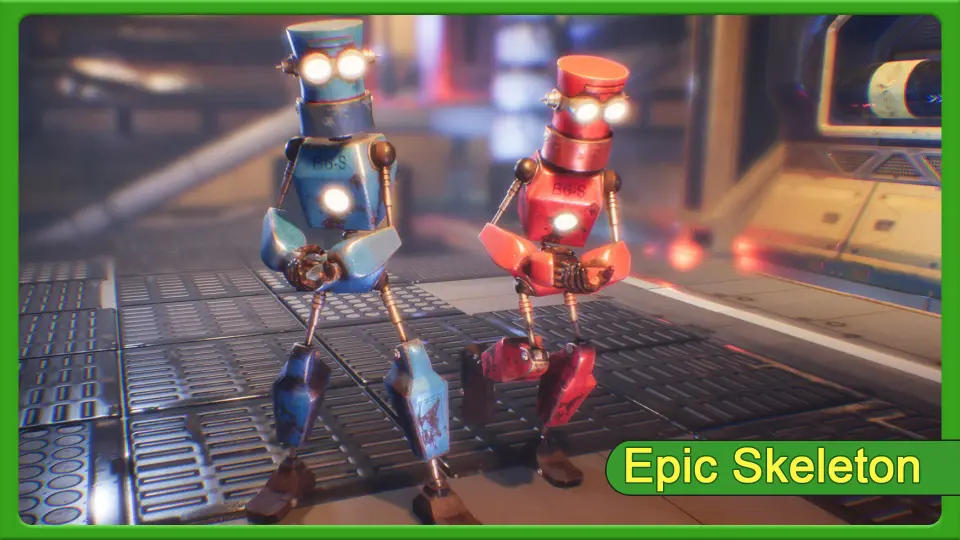
A primary technical foundation of the model is its native rigging to the Epic Skeleton. In real-time character art pipelines, adhering strictly to this standard bone hierarchy eliminates the friction often encountered when importing third-party characters. The joint orientation, naming conventions, and hierarchy correspond directly to established industry standards, allowing technical artists and animators to leverage preexisting motion datasets without rebuilding retargeting profiles from scratch.
Deformation consistency across mechanical limbs can present unique hurdles, especially when rigid surfaces bend around soft-weighted joints. Funny Robot addresses this by maintaining structural proportions that align with standard humanoid proportions while retaining exaggerated, humorous contours. The skeletal mapping preserves clean pivot behavior around the elbows, knees, torso, and neck, preventing visual tearing or awkward stretching during extreme kinematic poses.
Practical verification is already built into the character setup. The mesh has been tested directly against the free animation pack, confirming that base locomotion sets, idle stances, turns, and transitions run smoothly without manual bone adjustments. This out-of-the-box validation ensures that developers seeking plug-and-play behavior can assign existing movement blueprints and animation trees to the character immediately upon import.
Material Instancing and the Nine Funny Robot Colorways
Surface properties on the character rely on modern physically based rendering (PBR) workflows. The surface responses reflect accurate light behavior across diffuse coloration, roughness values, and metallic properties, giving the mechanical plates, joints, and detailing a grounded physical presence while honoring the exaggerated, stylized shape language of the model.
To support visual diversity without bloating memory usage, the character leverages an instanced material architecture. Rather than relying on nine separate standalone material setups that each demand individual texture calls and shader compilation overhead, the package uses material instances driven by shared parent logic. This structural setup enables fast runtime performance and uniform shader modifications across every variation.
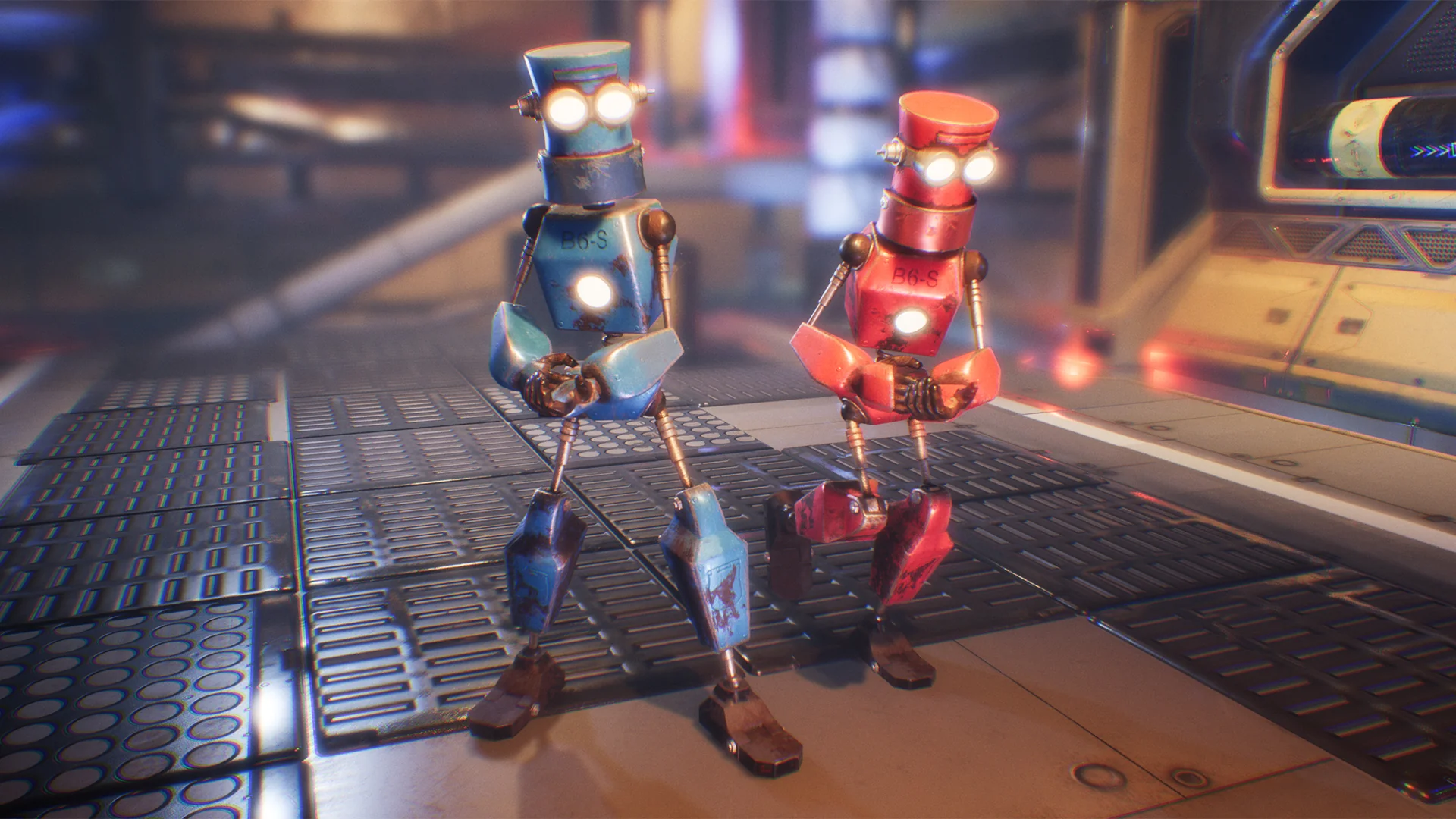
The package supplies nine distinct color variations. In practical production scenarios, having nine curated color palettes permits immediate deployment across diverse gameplay roles:
Team and Faction Identification: Differentiating squads, opposing armies, or cooperative player markers across competitive gameplay arenas.
Tier and Level Progression: Signaling unit ranks, upgrades, or difficulty scaling through recognizable color shifts across repetitive enemy types.
Environmental Adaptation: Blending unit appearance to match biome themes, ranging from arid deserts to subterranean or industrial settings.
Role Specialization: Visualizing support, builder, combat, or scout functions within the same baseline unit hierarchy.
Because the colorways exist as instanced materials, technical teams can tweak individual tint masks, scalar parameters, or roughness shifts across the entire fleet without manually painting unique texture sheets for every variant.
The Cute Fantasy Robot Aesthetic in Real-Time Production
Artistic direction often dictates how well a character communicates its purpose to the player. Funny Robot combines cute, comedic, and fantasy attributes to avoid the utilitarian, grimy realism common in conventional robotic designs. The exaggerated proportions, friendly silhouette, and expressive styling make it suitable for all-ages gameplay, family-oriented titles, and narrative games that lean into whimsical worldbuilding.
In fantasy settings where traditional technology is swapped for magical automatons, clockwork helpers, or enchanted constructs, the asset fills a distinct thematic niche. The character avoids sharp, aggressive angles in favor of approachable contours that signal neutral or friendly intent, making it equally effective as a player companion, an interactive vendor, or a lighthearted puzzle protagonist.
The comedic slant also lends itself to expressive secondary motion. When paired with squash-and-stretch animation sets or comedic physical reactions, the model's playful frame emphasizes impacts, trips, jumps, and celebratory dances far more effectively than hyper-realistic, photorealistic machinery ever could.
Integrating with Toon RTS Environment Systems
Beyond isolated character usage, the model is built with cross-asset compatibility in mind, specifically aligning with the visual and thematic rules of the Toon RTS Environment - Humans ecosystem. In top-down real-time strategy (RTS) titles, units are typically viewed from distant, angled perspectives where readability is critical.
Working alongside human units in a toon RTS setting creates an immediate dynamic. The robot can operate as an automated resource gatherer, an assistant drone for human commanders, an escort objective, or an oddball mechanical faction competing for territory. Its readable forms and distinct material variations prevent unit clustering from turning into a visually confusing mass on screen, ensuring players can instantly identify individual units amidst busy tactical encounters.
The shared stylized treatment ensures that lighting responses, surface sheen, and silhouette edges do not clash with the surrounding architectural or environmental assets of the Toon RTS line. Asset cohesion prevents immersion breaks, sparing art directors the time-consuming process of adjusting texture brightness, edge softening, or shader parameters to harmonize disparate third-party marketplace assets.
Deployment Readiness Across Standard Pipelines
The setup of Funny Robot prioritizes immediate functional integration over cumbersome manual configuration. Because it combines Epic Skeleton conformity, pre-validated animation playback through standard free libraries, a clean instanced PBR material layout, and direct alignment with complementary toon environments, it sits ready for dynamic game logic implementation. Whether deployed as a fleet of colored worker bots, a comical player character, or a whimsical RTS unit, the asset provides a dependable foundation built entirely on standard production conventions.
 Mechanical
 Mechanical
 Mechanical
 Mechanical