"c68a05d5e51405b3"{"id":"1000693","slug":"temperature-and-radiation-system-replicated-with-day-and-night","title":"Temperature and Radiation System (Replicated - With day and night)","category":"Procedural Systems","engine":"4.26+,5.0+","assetVersion":"","engineVersion":"Engine Version: 4.26+,5.0+","tag":"Procedural Systems","accent":"blue","visual":"mech","summary":"Replicated Unreal Engine temperature and radiation system with volume-based control, local and world variation, sunlight and world time integration for multipla","platform":"Unreal Engine","publishedAt":"2026-07-23T11:04:08.438Z","updatedAt":"2026-07-23T11:04:08.438Z","sourceNotes":[],"fileContents":[],"compatibility":["Unreal Engine","Engine Version: 4.26+,5.0+"],"featuredImage":{"alt":"Temperature and Radiation System (Replicated - With day and night)","src":"/wp-content/uploads/published/2026/07/d26ee346e4d2-00-1920x1080-0ae41c199871e9124e9c37445f9542d1-8f90a8e4a8.webp"},"hasDownloadLink":true,"downloads":0,"terms":[{"taxonomy":"category","slug":"procedural-systems","name":"Procedural Systems"}],"galleryImages":[{"src":"/wp-content/uploads/published/2026/07/f1608e3001e2-09g-1920x1080-b368124753b08a1e9a9b2c38f5b97279-f9c7afa6cc.webp","alt":"Temperature and Radiation System (Replicated - With day and night)"},{"src":"/wp-content/uploads/published/2026/07/bc2125f5f93b-01-1920x1080-c929a3554adc2e2ea27a0e6c5a87039c-93be3b95c1.webp","alt":"Temperature and Radiation System (Replicated - With day and night)"},{"src":"/wp-content/uploads/published/2026/07/a8f7d8781e0b-09h-1920x1080-3e50c5212bceae87cd630100ba38e2f1-fa904ce0af.webp","alt":"Temperature and Radiation System (Replicated - With day and night)"},{"src":"/wp-content/uploads/published/2026/07/9f9f191f5194-02-1920x1080-0823c69d38cd0e43dffc614dcdf797de-6d49a6997f.webp","alt":"Temperature and Radiation System (Replicated - With day and night)"},{"src":"/wp-content/uploads/published/2026/07/4fb9d0407d4f-09f-1920x1080-5eda807a8dae348a17940e10464e03d9-1a31552c80.webp","alt":"Temperature and Radiation System (Replicated - With day and night)"},{"src":"/wp-content/uploads/published/2026/07/687f48a5adb8-03b-1920x1080-77ced3d25fec9ce4cdfaaab57652fb27-250b23b79d.webp","alt":"Temperature and Radiation System (Replicated - With day and night)"},{"src":"/wp-content/uploads/published/2026/07/a8c4ac0dbe32-09d-1920x1080-9b8bb22ffb6a8657454a176c2e6ba121-178a2b1573.webp","alt":"Temperature and Radiation System (Replicated - With day and night)"},{"src":"/wp-content/uploads/published/2026/07/decdbae7796a-04-1920x1080-a26bb3a5fef18cb2d8eb62fcffd0ae15-d245c4ecbd.webp","alt":"Temperature and Radiation System (Replicated - With day and night)"},{"src":"/wp-content/uploads/published/2026/07/8c5adb08e744-05-1920x1080-782ebc57ebcbda0aca43f3a5f1912826-ba8c9c88db.webp","alt":"Temperature and Radiation System (Replicated - With day and night)"},{"src":"/wp-content/uploads/published/2026/07/009be8a5b46d-06-1920x1080-876c9072b91559b2b8baefc3caa2e7b9-305e78b33c.webp","alt":"Temperature and Radiation System (Replicated - With day and night)"}],"accessPanel":{"kind":"resource","title":"Download this resource","eyebrow":"Free Download","message":"Log in or create a free account to start your download.","fileName":"Content.7z","safetyNote":"Resources are manually reviewed before listing to improve quality and reduce obvious risks.","actionLabel":"Download Free","resourceType":"Resource archive"},"contentHtml":"\u003ch2\u003eSetting Up a Volume-Driven Temperature and Radiation System\u003c/h2\u003e\n\u003cp\u003eWiring environmental hazards into a game project often means writing custom logic from scratch or stitching together disparate variables that do not communicate cleanly over a network. \u003cstrong\u003eTemperature and Radiation System (Replicated - With day and night)\u003c/strong\u003e exists to collapse that setup work into a single integrated framework. The asset provides a structured approach to adding two distinct environmental mechanics—temperature exposure and radiation accumulation—to an Unreal Engine project without forcing a developer to build the underlying tracking architecture.\u003c/p\u003e\n\n\n\u003cp\u003eThe setup path is volume-centric. Instead of relying solely on global parameters that affect every actor uniformly, the system uses volumes as the primary control mechanism. A designer places a volume in the level, configures its properties, and the volume dictates how temperature and radiation behave inside its bounds. This volume-driven approach means that environmental conditions can be localized to specific regions of a map, creating layered gameplay spaces where one room might be dangerously hot while an adjacent corridor remains safe.\u003c/p\u003e\n\n\u003cp\u003eBecause the system is replicated, the setup naturally extends to multiplayer scenarios. The environmental values tracked by the system are synchronized across the network, meaning that temperature and radiation states do not need manual network plumbing to function correctly in a hosted session. Any actor subject to these environmental forces experiences the same conditions regardless of whether they are the server or a connected client.\u003c/p\u003e\n\n\u003ch2\u003eVariation Sources: Local, World, Sunlight, and World Time\u003c/h2\u003e\n\u003cp\u003eThe system does not treat temperature and radiation as static numbers. Several input sources drive variation, giving a developer control over how these values shift across space and time.\u003c/p\u003e\n\u003cul\u003e\n\u003cli\u003e\u003cstrong\u003eLocal variation:\u003c/strong\u003e Tied to the volume system, this allows specific areas within a larger world to carry their own temperature or radiation profiles. A sealed bunker might block outside radiation entirely, while an open crater radiates intensely.\u003c/li\u003e\n\u003cli\u003e\u003cstrong\u003eWorld variation:\u003c/strong\u003e Controls the broader environmental baseline. The world itself carries a global context that volumes can override or interact with, so a project based on a harsh desert planet can set a global temperature high and then carve out cooled zones where players recover.\u003c/li\u003e\n\u003cli\u003e\u003cstrong\u003eSunlight integration:\u003c/strong\u003e Temperature dynamics respond to the presence and behavior of sunlight. This means daytime can naturally carry higher thermal load than shade, and a level designer can use light occlusion or exposure to sun as a gameplay factor.\u003c/li\u003e\n\u003cli\u003e\u003cstrong\u003eWorld time integration:\u003c/strong\u003e Conditions shift based on the time of day within the world. A day-night cycle directly feeds into the temperature system, so nights can drop temperatures and alter the environmental pressure players experience.\u003c/li\u003e\n\u003c/ul\u003e\n\n\u003cp\u003eThese variation sources can overlap. A volume might define a local temperature floor while the world sets a broader baseline, sunlight pushes the temperature up during the day, and world time modulates the sunlight contribution as the sun sets. This layered control gives a developer fine-grained authority over how present and aggressive each environmental hazard is at any given moment.\u003c/p\u003e\n\n\n\u003ch2\u003eReplication and Multiplayer Integration\u003c/h2\u003e\n\u003cp\u003eThe replication aspect affects how the system behaves in a production environment with multiple players. When an environmental mechanic is replicated, the server maintains authority over the tracked values—here, the current temperature and radiation states—and broadcasts those states to connected clients. The client machines then apply those values to their local actors.\u003c/p\u003e\n\n\u003cp\u003eFor a temperature and radiation system, this matters because environmental damage or hazard states are often tied to player survival. If a client and server disagree on how much radiation a player has absorbed, the gameplay outcome becomes unreliable. Health loss might trigger on one machine but not another. The replicated architecture addresses this by keeping the canonical state on the server and ensuring clients receive consistent updates.\u003c/p\u003e\n\n\u003cp\u003eThe day-night component also interacts with replication. Since world time drives some of the temperature variation, and world time is a shared state in multiplayer, the server-synchronized clock ensures that all players experience the same thermal shifts as the day progresses. A player on a fast connection and a player on a slow connection both see the same sunset-driven temperature drop at the same world time, because the replicated time state governs the local calculations.\u003c/p\u003e\n\n\u003ch2\u003eBuilding Environmental Gameplay Around Temperature and Radiation\u003c/h2\u003e\n\u003cp\u003eWhere this asset fits in a real production workflow depends on the type of game being built. Survival shooters benefit directly: radiation volumes can define contaminated zones that require protective gear, and temperature volumes can create heat hazards near lava or fire sources. The day-night interaction adds a scheduling layer, where players must manage their exposure based on the time—venturing into a sun-baked wasteland at noon carries thermal risk that an evening raid avoids.\u003c/p\u003e\n\n\u003cp\u003eThe volume-based control also supports more subtle gameplay design. A level designer can stack volumes or nest them to create gradient effects rather than binary boundaries. Instead of a player instantly taking radiation damage when crossing a line, overlapping volumes with decreasing intensity can simulate a realistic fallout decay pattern. The same logic applies to temperature: a volume focused on a heat source can taper off, so a player moving away from a fire feels a gradual reduction in thermal pressure rather than a hard cutoff.\u003c/p\u003e\n\n\u003cp\u003eThe combination of local and world control means the system adapts to both interior and exterior level design. Interior spaces can use local volumes to define hazardous rooms while the world baseline handles the outside environment. Exterior spaces rely more heavily on the world, sunlight, and world time interactions, letting the day-night cycle create survival pressure without placing a volume in every open area.\u003c/p\u003e\n\n\u003ch3\u003eSunlight and World Time as Active Gameplay Drivers\u003c/h3\u003e\n\u003cp\u003eSunlight and world time are not just visual flavor in this system. They actively drive the temperature values that affect gameplay. The presence of sunlight increases the temperature a player experiences, and the current world time determines whether and how strongly that sunlight factor applies. This creates a pressure curve tied to the day-night cycle.\u003c/p\u003e\n\n\u003cp\u003eA project can lean into this by designing content around the clock. A midday assault on a solar-exposed position becomes harder because the temperature itself is a hostile factor. Night operations become easier from a thermal standpoint, but the system does not force that to be universally safe—it leaves room for local volumes and world settings to define separate night conditions. The world time variable means a designer can set a custom curve: maybe temperature drops sharply at dusk, or maybe it lingers at high levels for a few hours after sunset. The control exists within the system to shape that behavior.\u003c/p\u003e\n\n\u003ch2\u003eIntegration Points for a Replicated Day-Night Survival Project\u003c/h2\u003e\n\u003cp\u003eA project consuming this asset needs to account for a few connection points. First, the world time must be a replicated and synchronized value for the day-night temperature and radiation variation to behave consistently in multiplayer. The system ties its variation to world time, so any existing day-night cycle in the project needs to feed into that variable or use the system's own clock.\u003c/p\u003e\n\n\u003cp\u003eSecond, the volume-based workflow implies that level design needs to account for volume placement as part of the environmental design pass rather than as a post-hoc addition. Volumes are the primary control mechanism, so a level built without considering where temperature and radiation volumes go will not use the system to its full capacity. The most effective approach is to identify hazard zones during the level blockout phase and place the controlling volumes as those zones take shape.\u003c/p\u003e\n\n\u003cp\u003eThird, the system's reliance on sunlight for temperature variation means the lighting setup in a level interacts with the gameplay mechanic. A level that uses strong directional light as a dominant sun source will produce different temperature behavior than a level with heavy overcast volumetric cloud cover. The system does not arbitrarily invent temperature values—it derives part of its behavior from the sun's presence, so the lighting conditions a designer chooses directly impact the environmental hazard profile.\u003c/p\u003e\n\n\u003ch3\u003eProduction-Readiness for Multiplayer Environmental Mechanics\u003c/h3\u003e\n\u003cp\u003eThe replicated nature of the system makes it viable for multiplayer projects without requiring a developer to solve the networking architecture independently. A single-player environmental system can track state locally, but bringing the same mechanic into a multiplayer context introduces complexity around state authority, client prediction, and synchronization. By being replicated, the asset handles that layer, letting a team focus on tuning the variation—local, world, sunlight, and world time—rather than debugging why one player sees radiation levels that do not match the server.\u003c/p\u003e\n\n\u003cp\u003eThe day-night integration further strengthens the production case. Time-driven mechanics are common in survival and environmental hazard games, but wiring them cleanly into a replicated temperature and radiation tracker takes effort. The system already accounts for that linkage, so a project with a day-night cycle gets the time-based variation without needing to build a custom bridge between the clock and the hazard tracker.\u003c/p\u003e\n\n\n\u003ch2\u003eTuning Environmental Intensity Across Spaces\u003c/h2\u003e\n\u003cp\u003eThe practical takeaway for a team considering this asset is that it provides a ready-to-tune framework rather than a fixed behavior model. The temperature and radiation values are not hardcoded to a single curve. They respond to four distinct input sources—local volume properties, world baseline settings, sunlight state, and current world time—and a developer can adjust each independently.\u003c/p\u003e\n\n\u003cp\u003eThis means a hostile zone can be made deadlier by tightening the volume bounds, raising the world radiation baseline, increasing the sunlight temperature contribution, or accelerating the day-night cycle to compress the time players have to react. Conversely, a safer zone can be carved out by placing a local volume that overrides the world baseline. The system's architecture supports both extremes and the gradient between them, so the production workflow becomes a matter of identifying where each environmental hazard should exist in the level and then tuning the relevant input source until the gameplay pressure matches the design intent.\u003c/p\u003e\n\n\u003cp\u003eBecause the system extends to both temperature and radiation, a project can use the same framework for two distinct hazard types. The variation sources apply to both, so a single volume can define a zone that is simultaneously hot and radioactive, or a designer can separate them, using one volume for thermal hazards and another for contamination zones. The control granularity is consistent across both mechanics, which simplifies the setup when a level needs multiple hazard types operating in the same space.\u003c/p\u003e\n\n\u003ch2\u003eRelated Resources Worth Checking\u003c/h2\u003e\n\u003cul\u003e\n\u003cli\u003e\u003ca href=\"https://3dcghub.com/ultra-dynamic-sky/\" title=\"Ultra Dynamic Sky\"\u003eUltra Dynamic Sky\u003c/a\u003e\u003c/li\u003e\n\u003cli\u003e\u003ca href=\"https://3dcghub.com/road-creator-pro/\" title=\"Road Creator Pro\"\u003eRoad Creator Pro\u003c/a\u003e\u003c/li\u003e\n\u003cli\u003e\u003ca href=\"https://3dcghub.com/stylized-dynamic-sky-weather-system/\" title=\"Stylized Dynamic Sky \u0026amp; Weather System\"\u003eStylized Dynamic Sky \u0026amp; Weather System\u003c/a\u003e\u003c/li\u003e\n\u003cli\u003e\u003ca href=\"https://3dcghub.com/high-school-science-lab-classroom-90s-themed-day-night-lighting/\" title=\"High school Science Lab Classroom - 90\u0026#039;s themed (Day/Night Lighting)\"\u003eHigh school Science Lab Classroom - 90\u0026#039;s themed (Day/Night Lighting)\u003c/a\u003e\u003c/li\u003e\n\u003cli\u003e\u003ca href=\"https://3dcghub.com/high-school-basketball-gym-day-night-afternoon-midnight-lighting/\" title=\"High School Basketball Gym - (Day/Night/Afternoon/Midnight Lighting)\"\u003eHigh School Basketball Gym - (Day/Night/Afternoon/Midnight Lighting)\u003c/a\u003e\u003c/li\u003e\n\u003c/ul\u003e","contentTextLength":11531,"navigation":{"current":1311,"total":3860,"previous":{"id":"1000694","slug":"unreal-5-niagara-advanced-niagara","title":"Unreal 5 Niagara - Advanced Niagara","category":"Unreal Engine","platform":"Unreal Engine","updatedAt":"2026-07-23T12:15:10.822Z"},"next":{"id":"1000692","slug":"tactical-shooter-kit-v1","title":"Tactical Shooter Kit V1","category":"Shooter","platform":"Unreal Engine","updatedAt":"2026-07-23T10:15:02.012Z"}},"relatedResources":[{"id":"1000770","slug":"easysky-multiplayer-ready-dynamic-day-night-cycle","title":"EasySky Multiplayer Ready Dynamic Day / Night Cycle","category":"Procedural Systems","engine":"4.26+,5.0+","assetVersion":"","engineVersion":"Engine Version: 4.26+,5.0+","tag":"Procedural Systems","accent":"blue","visual":"mech","summary":"Blueprint-driven Unreal Engine skybox with dynamic day/night cycle, multiplayer-ready, drag-and-drop setup, and profiled performance optimized for PC, console,","platform":"Unreal Engine","publishedAt":"2026-07-28T17:44:38.260Z","updatedAt":"2026-07-28T17:44:38.260Z","sourceNotes":[],"fileContents":[],"compatibility":["Unreal Engine","Engine Version: 4.26+,5.0+"],"featuredImage":{"alt":"EasySky Multiplayer Ready Dynamic Day / Night Cycle","src":"/wp-content/uploads/published/2026/07/f5f310659cea-2d9fdec0-ac02-44d7-83d4-ed86e198a14c-018be534e4.webp"},"hasDownloadLink":true,"downloads":0},{"id":"11609","slug":"ultra-dynamic-sky","title":"Ultra Dynamic Sky","category":"Procedural Systems","engine":"Aseet Version:8.6b - 9.6","assetVersion":"Engine version: 5.1+","engineVersion":"Aseet Version:8.6b - 9.6","tag":"Procedural Systems","accent":"blue","visual":"character","summary":"Ultra Dynamic Sky offers a comprehensive and natural sky system designed for flexibility and speed. It features a full weather system, customizable volumetric clouds, and real-world celestial simulation.","platform":"Unreal Engine","publishedAt":"2026-03-05T18:00:27.000Z","updatedAt":"2026-07-08T21:45:49.541Z","sourceNotes":[],"fileContents":[],"compatibility":["Unreal Engine","Engine version: 5.1+","Aseet Version:8.6b - 9.6"],"featuredImage":{"alt":"Ultra Dynamic Sky","src":"https://3dcghub.com/wp-content/uploads/2026/03/cbacfeb0-4619-459c-8c69-eaffc8dda72c.webp"},"hasDownloadLink":true,"downloads":13},{"id":"25129","slug":"road-creator-pro","title":"Road Creator Pro","category":"Procedural Systems","engine":"5.6+","assetVersion":"Engine version: 5.6+","engineVersion":"","tag":"Procedural Systems","accent":"blue","visual":"city","summary":"Road Creator Pro brings roads, intersections, bridges, tunnels, and roadside details into Unreal Engine through a spline-based workflow. It also adds terrain deformation, snapping, traffic signals, signage, and day-night visibility tools for practical scene...","platform":"Unreal Engine","publishedAt":"2026-04-19T06:27:25.000Z","updatedAt":"2026-04-20T06:12:32.000Z","sourceNotes":[],"fileContents":[],"compatibility":["Unreal Engine","Engine version: 5.6+"],"featuredImage":{"alt":"Road Creator Pro","src":"https://3dcghub.com/wp-content/uploads/2026/04/c012b5395914_ed21df1f-da93-448a-b233-0700745ec894.webp"},"hasDownloadLink":true,"downloads":5}]}
Procedural Systems
Temperature and Radiation System (Replicated - With day and night)
Replicated Unreal Engine temperature and radiation system with volume-based control, local and world variation, sunlight and world time integration for multipla
Setting Up a Volume-Driven Temperature and Radiation System
Wiring environmental hazards into a game project often means writing custom logic from scratch or stitching together disparate variables that do not communicate cleanly over a network. Temperature and Radiation System (Replicated - With day and night) exists to collapse that setup work into a single integrated framework. The asset provides a structured approach to adding two distinct environmental mechanics—temperature exposure and radiation accumulation—to an Unreal Engine project without forcing a developer to build the underlying tracking architecture.
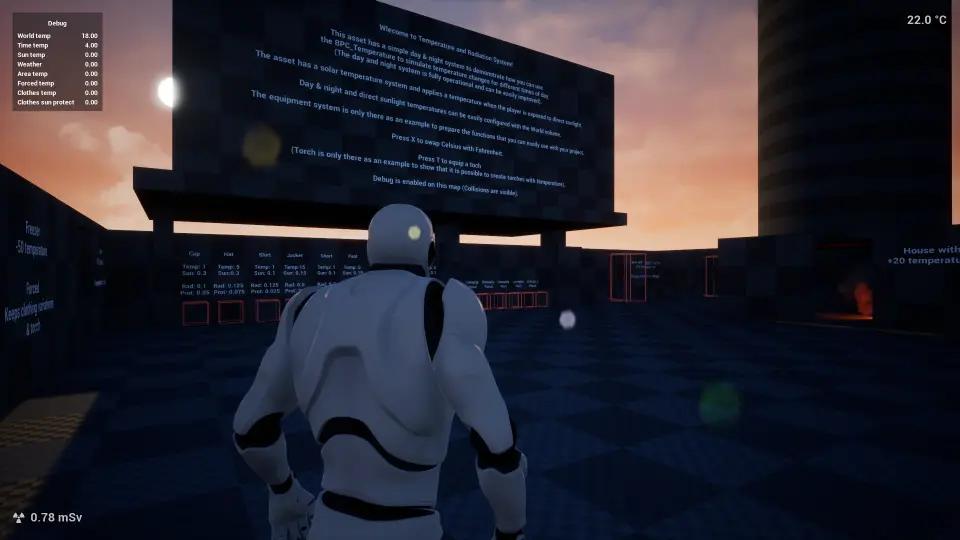
The setup path is volume-centric. Instead of relying solely on global parameters that affect every actor uniformly, the system uses volumes as the primary control mechanism. A designer places a volume in the level, configures its properties, and the volume dictates how temperature and radiation behave inside its bounds. This volume-driven approach means that environmental conditions can be localized to specific regions of a map, creating layered gameplay spaces where one room might be dangerously hot while an adjacent corridor remains safe.
Because the system is replicated, the setup naturally extends to multiplayer scenarios. The environmental values tracked by the system are synchronized across the network, meaning that temperature and radiation states do not need manual network plumbing to function correctly in a hosted session. Any actor subject to these environmental forces experiences the same conditions regardless of whether they are the server or a connected client.
Variation Sources: Local, World, Sunlight, and World Time
The system does not treat temperature and radiation as static numbers. Several input sources drive variation, giving a developer control over how these values shift across space and time.
Local variation: Tied to the volume system, this allows specific areas within a larger world to carry their own temperature or radiation profiles. A sealed bunker might block outside radiation entirely, while an open crater radiates intensely.
World variation: Controls the broader environmental baseline. The world itself carries a global context that volumes can override or interact with, so a project based on a harsh desert planet can set a global temperature high and then carve out cooled zones where players recover.
Sunlight integration: Temperature dynamics respond to the presence and behavior of sunlight. This means daytime can naturally carry higher thermal load than shade, and a level designer can use light occlusion or exposure to sun as a gameplay factor.
World time integration: Conditions shift based on the time of day within the world. A day-night cycle directly feeds into the temperature system, so nights can drop temperatures and alter the environmental pressure players experience.
These variation sources can overlap. A volume might define a local temperature floor while the world sets a broader baseline, sunlight pushes the temperature up during the day, and world time modulates the sunlight contribution as the sun sets. This layered control gives a developer fine-grained authority over how present and aggressive each environmental hazard is at any given moment.
Replication and Multiplayer Integration
The replication aspect affects how the system behaves in a production environment with multiple players. When an environmental mechanic is replicated, the server maintains authority over the tracked values—here, the current temperature and radiation states—and broadcasts those states to connected clients. The client machines then apply those values to their local actors.
For a temperature and radiation system, this matters because environmental damage or hazard states are often tied to player survival. If a client and server disagree on how much radiation a player has absorbed, the gameplay outcome becomes unreliable. Health loss might trigger on one machine but not another. The replicated architecture addresses this by keeping the canonical state on the server and ensuring clients receive consistent updates.
The day-night component also interacts with replication. Since world time drives some of the temperature variation, and world time is a shared state in multiplayer, the server-synchronized clock ensures that all players experience the same thermal shifts as the day progresses. A player on a fast connection and a player on a slow connection both see the same sunset-driven temperature drop at the same world time, because the replicated time state governs the local calculations.
Building Environmental Gameplay Around Temperature and Radiation
Where this asset fits in a real production workflow depends on the type of game being built. Survival shooters benefit directly: radiation volumes can define contaminated zones that require protective gear, and temperature volumes can create heat hazards near lava or fire sources. The day-night interaction adds a scheduling layer, where players must manage their exposure based on the time—venturing into a sun-baked wasteland at noon carries thermal risk that an evening raid avoids.
The volume-based control also supports more subtle gameplay design. A level designer can stack volumes or nest them to create gradient effects rather than binary boundaries. Instead of a player instantly taking radiation damage when crossing a line, overlapping volumes with decreasing intensity can simulate a realistic fallout decay pattern. The same logic applies to temperature: a volume focused on a heat source can taper off, so a player moving away from a fire feels a gradual reduction in thermal pressure rather than a hard cutoff.
The combination of local and world control means the system adapts to both interior and exterior level design. Interior spaces can use local volumes to define hazardous rooms while the world baseline handles the outside environment. Exterior spaces rely more heavily on the world, sunlight, and world time interactions, letting the day-night cycle create survival pressure without placing a volume in every open area.
Sunlight and World Time as Active Gameplay Drivers
Sunlight and world time are not just visual flavor in this system. They actively drive the temperature values that affect gameplay. The presence of sunlight increases the temperature a player experiences, and the current world time determines whether and how strongly that sunlight factor applies. This creates a pressure curve tied to the day-night cycle.
A project can lean into this by designing content around the clock. A midday assault on a solar-exposed position becomes harder because the temperature itself is a hostile factor. Night operations become easier from a thermal standpoint, but the system does not force that to be universally safe—it leaves room for local volumes and world settings to define separate night conditions. The world time variable means a designer can set a custom curve: maybe temperature drops sharply at dusk, or maybe it lingers at high levels for a few hours after sunset. The control exists within the system to shape that behavior.
Integration Points for a Replicated Day-Night Survival Project
A project consuming this asset needs to account for a few connection points. First, the world time must be a replicated and synchronized value for the day-night temperature and radiation variation to behave consistently in multiplayer. The system ties its variation to world time, so any existing day-night cycle in the project needs to feed into that variable or use the system's own clock.
Second, the volume-based workflow implies that level design needs to account for volume placement as part of the environmental design pass rather than as a post-hoc addition. Volumes are the primary control mechanism, so a level built without considering where temperature and radiation volumes go will not use the system to its full capacity. The most effective approach is to identify hazard zones during the level blockout phase and place the controlling volumes as those zones take shape.
Third, the system's reliance on sunlight for temperature variation means the lighting setup in a level interacts with the gameplay mechanic. A level that uses strong directional light as a dominant sun source will produce different temperature behavior than a level with heavy overcast volumetric cloud cover. The system does not arbitrarily invent temperature values—it derives part of its behavior from the sun's presence, so the lighting conditions a designer chooses directly impact the environmental hazard profile.
Production-Readiness for Multiplayer Environmental Mechanics
The replicated nature of the system makes it viable for multiplayer projects without requiring a developer to solve the networking architecture independently. A single-player environmental system can track state locally, but bringing the same mechanic into a multiplayer context introduces complexity around state authority, client prediction, and synchronization. By being replicated, the asset handles that layer, letting a team focus on tuning the variation—local, world, sunlight, and world time—rather than debugging why one player sees radiation levels that do not match the server.
The day-night integration further strengthens the production case. Time-driven mechanics are common in survival and environmental hazard games, but wiring them cleanly into a replicated temperature and radiation tracker takes effort. The system already accounts for that linkage, so a project with a day-night cycle gets the time-based variation without needing to build a custom bridge between the clock and the hazard tracker.
Tuning Environmental Intensity Across Spaces
The practical takeaway for a team considering this asset is that it provides a ready-to-tune framework rather than a fixed behavior model. The temperature and radiation values are not hardcoded to a single curve. They respond to four distinct input sources—local volume properties, world baseline settings, sunlight state, and current world time—and a developer can adjust each independently.
This means a hostile zone can be made deadlier by tightening the volume bounds, raising the world radiation baseline, increasing the sunlight temperature contribution, or accelerating the day-night cycle to compress the time players have to react. Conversely, a safer zone can be carved out by placing a local volume that overrides the world baseline. The system's architecture supports both extremes and the gradient between them, so the production workflow becomes a matter of identifying where each environmental hazard should exist in the level and then tuning the relevant input source until the gameplay pressure matches the design intent.
Because the system extends to both temperature and radiation, a project can use the same framework for two distinct hazard types. The variation sources apply to both, so a single volume can define a zone that is simultaneously hot and radioactive, or a designer can separate them, using one volume for thermal hazards and another for contamination zones. The control granularity is consistent across both mechanics, which simplifies the setup when a level needs multiple hazard types operating in the same space.
 Procedural Systems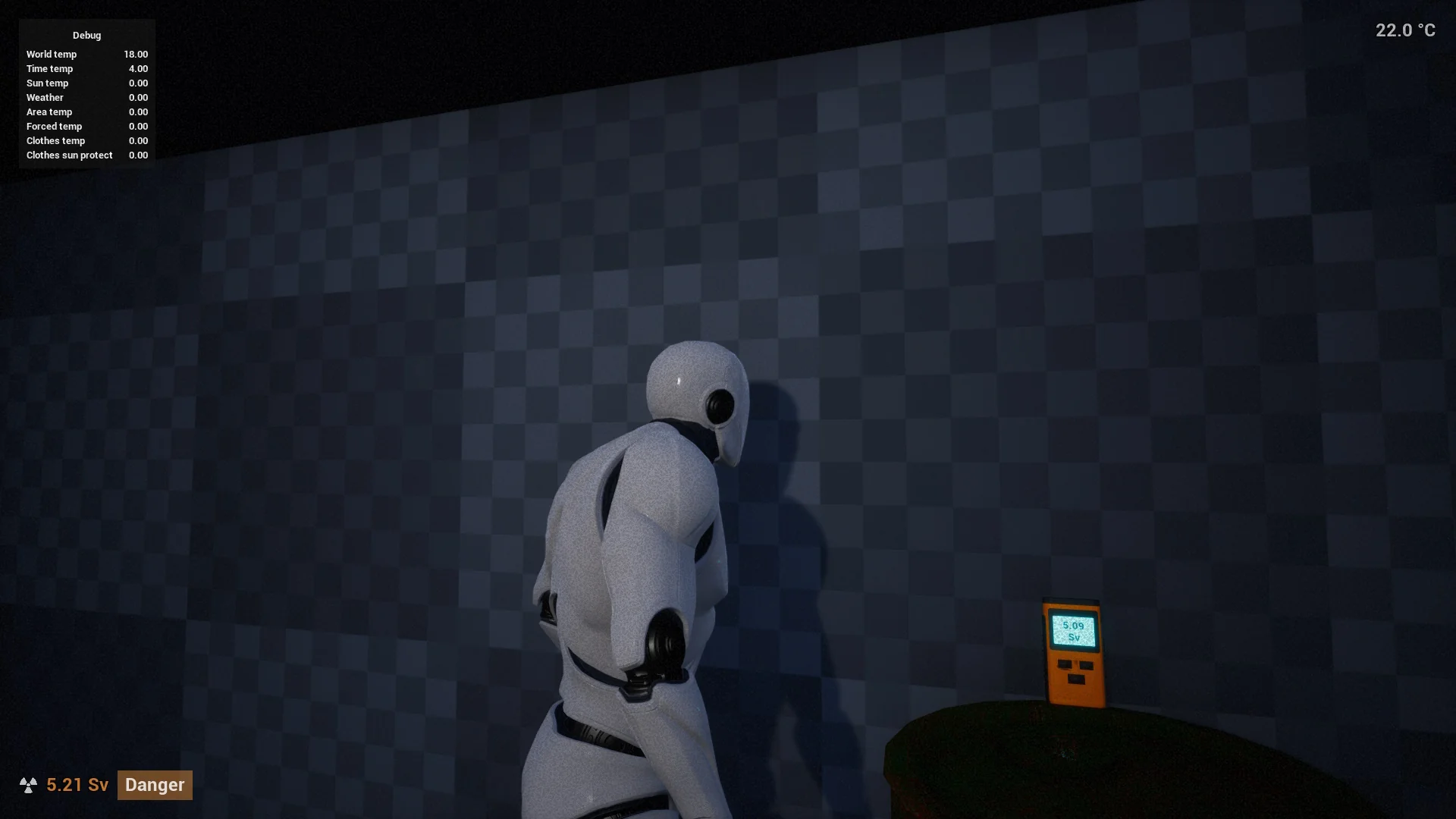
 Procedural Systems
 Procedural Systems
 Procedural Systems