"efaa631e936fd3ee"{"id":"1002226","slug":"suspension-bridge","title":"Suspension Bridge","category":"Procedural Systems","engine":"4.22+,5.0+","assetVersion":"","engineVersion":"Engine Version: 4.22+,5.0+","tag":"Procedural Systems","accent":"blue","visual":"mech","summary":"Build adaptable suspension bridges with configurable blueprint settings, automatic height compensation, straightening logic, and UV Light compatibility.","platform":"Unreal Engine","publishedAt":"2026-10-29T15:25:23.582Z","updatedAt":"2026-10-29T15:25:23.582Z","sourceNotes":[],"fileContents":[],"compatibility":["Unreal Engine","Engine Version: 4.22+,5.0+"],"featuredImage":{"alt":"Suspension Bridge","src":"/wp-content/uploads/published/2026/10/94f656729825-80d13e9c-5093-4893-985e-09b23d18b9cf-9a2e9e760c.webp"},"hasDownloadLink":true,"downloads":0,"terms":[{"taxonomy":"category","slug":"procedural-systems","name":"Procedural Systems"}],"galleryImages":[{"src":"/wp-content/uploads/published/2026/10/1f14c947a6df-ea6e954d-8510-41c2-9c58-fb44784fa0b9-f40e03d45a.webp","alt":"Suspension Bridge"},{"src":"/wp-content/uploads/published/2026/10/cbbd880bcbe3-51fda0b1-3ead-4599-8d4a-2c778050eee6-08e305cd44.webp","alt":"Suspension Bridge"},{"src":"/wp-content/uploads/published/2026/10/b56a33b316f0-bf74c6b1-e47f-4190-ad66-93a66203d366-4b117f361a.webp","alt":"Suspension Bridge"},{"src":"/wp-content/uploads/published/2026/10/51c5c4e1a80a-17899d3a-5016-4595-81b0-dd355fef71f4-d4a0debc62.webp","alt":"Suspension Bridge"},{"src":"/wp-content/uploads/published/2026/10/460e780d778a-63da976f-561d-43bf-860b-db1b8c397916-2d29da08d4.webp","alt":"Suspension Bridge"},{"src":"/wp-content/uploads/published/2026/10/7596c106f9fe-3433c780-2182-467a-9a8a-1d101d15722f-00b5839239.webp","alt":"Suspension Bridge"},{"src":"/wp-content/uploads/published/2026/10/bef0689e6f1c-81bfe0ef-f0e2-4ff6-8297-43b81e9901a2-da9d28411e.webp","alt":"Suspension Bridge"}],"accessPanel":{"kind":"resource","title":"Download this resource","eyebrow":"Free Download","message":"Log in or create a free account to start your download.","fileName":"Content.7z","safetyNote":"Resources are manually reviewed before listing to improve quality and reduce obvious risks.","actionLabel":"Download Free","resourceType":"Resource archive"},"contentHtml":"\u003ch2\u003eBridging Uneven Elevations in Level Design\u003c/h2\u003e\n\u003cp\u003eSpanning divides between disparate terrain points is a recurring task in environmental art and level construction. Whether a map requires a passage across a rocky gorge, a wooden crossing over a jungle ravine, or an access point connecting separated structures, horizontal traversal assets must adapt to the landscape rather than forcing the landscape to adapt to them. Building bridges manually out of static modular pieces often introduces visual distortions, broken angles, or awkward steps when connection points sit at disparate elevations. Suspension Bridge addresses this production bottleneck directly through an adaptable Blueprint system created specifically to span gaps across variable heights.\u003c/p\u003e\n\u003cp\u003eIn conventional greyboxing and level blockout workflows, designers regularly encounter terrain boundaries where the departure ledge and the arrival ledge do not rest on a shared horizontal plane. Trying to force a rigid bridge mesh across such an incline typically leads to twisted walkway geometry or visible clipping into surrounding cliff faces. The blueprint foundation behind Suspension Bridge streamlines this process by calculating the trajectory between endpoints, allowing level creators to establish natural pathways across cliffs, river valleys, and canyon gaps without having to model bespoke crossing geometry for every single vertical variation.\u003c/p\u003e \u003ch2\u003eHeight Difference Compensation and Blueprint Straightening\u003c/h2\u003e\n\u003cp\u003eThe defining technical feature of this system is its automated capacity to process vertical disparity between endpoints. When placed across terrain with an uneven grade, the blueprint takes height difference into consideration and straightens the bridge automatically. This algorithmic compensation ensures that the span remains coherent, functional, and visually plausible from the initial anchor to the destination anchor.\u003c/p\u003e\n\u003cp\u003eWhen level geometry forces a bridge to climb or descend, traditional static assets tend to pitch awkwardly, causing ropes, cables, and decking to rotate off their primary axes. By factoring elevation variance directly into the transformation math, the blueprint realigns and straightens the walkway plane. This keeps the suspension deck properly oriented along the intended traversal vector while preventing erratic warping across the middle of the span. The straightening functionality maintains a smooth gradient along the deck, resolving the mechanical tension expected of a real-world suspension structure while preserving clear sightlines and predictable footpaths for players navigating the environment.\u003c/p\u003e \u003ch2\u003eConfigurable Settings for Suspension Bridge Spans\u003c/h2\u003e\n\u003cp\u003eEnvironmental design demands flexibility, as no two map locations require the exact same walkway length, clearance, or visual density. Suspension Bridge incorporates a variety of configurable settings that let designers tailor the structure to the explicit needs of the immediate scene. Rather than locking creators into a single rigid dimension, the blueprint provides adjustable parameters to suit wide chasms, short passes, and specialized level layouts alike.\u003c/p\u003e\n\u003cp\u003eConfigurable parameters allow level artists to adjust how the suspension bridge populates and spans an area. By modifying these settings, creators can fine-tune the bridge structure to fit specific gameplay beats, such as wide scenic vistas where a long span creates environmental scale, or tight, hazardous gaps designed to constrain player movement. These options reduce the overhead of managing multiple disparate bridge assets in an asset library, allowing a unified tool to generate crossings that seamlessly match the scale, footprint, and technical constraints of each distinct level section.\u003c/p\u003e \u003ch2\u003eTraversal Reliability Under Third-Person Character Testing\u003c/h2\u003e\n\u003cp\u003eVisual fidelity must always be matched by practical gameplay function, especially when dealing with physics, collisions, and character movement over suspended surfaces. Suspension Bridge has been verified through dedicated third-person shooter testing (TPS test), confirming that the surface geometry supports active player traversal without encountering movement hitching or collision anomalies.\u003c/p\u003e\n\u003cp\u003eIn third-person action games, bridges present distinct navigational challenges. Dynamic character controllers, camera collision spheres, and foot-placement systems often struggle with inclined, swinging, or narrow walkways. Steep inclines, segmented collision seams, or poorly aligned bounds can cause third-person cameras to clip aggressively or force player characters into falling states. The TPS traversal evaluation ensures that characters can run, jog, and maneuver across the bridge decking smoothly. Because the blueprint manages the deck alignment and straightens the span relative to elevation changes, the collision path remains continuous and dependable under real-time character input.\u003c/p\u003e \u003ch2\u003eLighting Behavior and UV Light Compatibility\u003c/h2\u003e\n\u003cp\u003eLighting complex geometric structures like suspension bridges requires precise surface data. The presence of thin support elements, repeating planks, stretched tension cables, and wide decking surfaces can easily introduce shadow artifacts or uneven illumination if UV channels and lighting systems are misaligned. Suspension Bridge features compatibility with UV Light, ensuring that lighting passes, surface reflections, and ambient illumination interact cleanly with the entire structure.\u003c/p\u003e\n\u003cp\u003eClean UV light behavior is essential when placing bridges across open-air daylight scenes or dark, moody atmospheric interiors. Sunlight streaming across a mountain gorge requires consistent shadow casting beneath the bridge deck, while local light sources like torches, lampposts, or spotlights must cast accurate highlights on the suspension framework. Thanks to proper UV light support, the bridge avoids light leakage, distorted shadow maps, and unappealing baking seams across its structural components, maintaining visual continuity regardless of the environment’s lighting scenario.\u003c/p\u003e \u003ch2\u003eWorkflow Placement and Environment Integration\u003c/h2\u003e\n\u003cp\u003eFrom an environment art and level blocking perspective, Suspension Bridge fits into production pipelines where rapid iteration and terrain adaptability are top priorities. Instead of spending production hours manually aligning individual plank segments or creating unique bridge meshes in external digital content creation software for every change in cliff height, environment artists can place and configure the blueprint directly inside the editor viewport.\u003c/p\u003e\n\u003cp\u003eThe asset serves as both an aesthetic fixture and a reliable navigational pathway. By pairing configurable settings with height-aware straightening logic, verified TPS player traversal, and dependable UV Light handling, Suspension Bridge functions as a complete solution for connecting varied terrain across outdoor levels, mountain passes, adventure zones, and complex game worlds.\u003c/p\u003e\n\n\u003ch2\u003eContinue Browsing Similar Packs\u003c/h2\u003e\n\u003cul\u003e\n\u003cli\u003e\u003ca href=\"https://3dcghub.com/smart-spline-generator/\" title=\"Smart Spline Generator\"\u003eSmart Spline Generator\u003c/a\u003e\u003c/li\u003e\n\u003cli\u003e\u003ca href=\"https://3dcghub.com/procedural-road-and-highway-tool-with-simple-vehicle-traffic/\" title=\"Procedural Road And Highway Tool With Simple Vehicle Traffic\"\u003eProcedural Road And Highway Tool With Simple Vehicle Traffic\u003c/a\u003e\u003c/li\u003e\n\u003cli\u003e\u003ca href=\"https://3dcghub.com/crossroad-generator/\" title=\"Crossroad Generator\"\u003eCrossroad Generator\u003c/a\u003e\u003c/li\u003e\n\u003cli\u003e\u003ca href=\"https://3dcghub.com/road-creator-pro/\" title=\"Road Creator Pro\"\u003eRoad Creator Pro\u003c/a\u003e\u003c/li\u003e\n\u003cli\u003e\u003ca href=\"https://3dcghub.com/archvis-vr/\" title=\"ArchVis VR\"\u003eArchVis VR\u003c/a\u003e\u003c/li\u003e\n\u003c/ul\u003e","contentTextLength":7054,"navigation":{"current":59,"total":4209,"previous":{"id":"1002227","slug":"sword-animset-pro","title":"Sword Animset Pro","category":"Combat","platform":"Unreal Engine","updatedAt":"2026-10-29T15:26:02.245Z"},"next":{"id":"1002225","slug":"survival-horror-inventory-props-pack","title":"Survival Horror Inventory Props Pack","category":"Tools, Objects \u0026 Decor","platform":"Unreal Engine","updatedAt":"2026-10-29T15:24:31.835Z"}},"relatedResources":[{"id":"1001029","slug":"smart-spline-generator","title":"Smart Spline Generator","category":"Procedural Systems","engine":"4.26+,5.0+","assetVersion":"","engineVersion":"Engine Version: 4.26+,5.0+","tag":"Procedural Systems","accent":"blue","visual":"mech","summary":"Generate ivy, vines, ropes, and fences that align to any surface in UE. 100% Blueprint spline tool with bridge mechanics, mesh optimization, and Merge Actor sup","platform":"Unreal Engine","publishedAt":"2026-08-23T12:07:57.773Z","updatedAt":"2026-08-23T12:07:57.773Z","sourceNotes":[],"fileContents":[],"compatibility":["Unreal Engine","Engine Version: 4.26+,5.0+"],"featuredImage":{"alt":"Smart Spline Generator","src":"/wp-content/uploads/published/2026/08/f90a16a3c76e-b9721aca-557f-4b86-ba96-1d0847842373-d8e9d64b13.webp"},"hasDownloadLink":true,"downloads":3},{"id":"1000546","slug":"procedural-road-and-highway-tool-with-simple-vehicle-traffic","title":"Procedural Road And Highway Tool With Simple Vehicle Traffic","category":"Procedural Systems","engine":"4.26+,5.0+","assetVersion":"","engineVersion":"Engine Version: 4.26+,5.0+","tag":"Procedural Systems","accent":"blue","visual":"mech","summary":"Unreal Engine Blueprint tool for procedural roads, highways, bridges, and train tracks with spline-based generation, landscape deformation, and traffic spawner.","platform":"Unreal Engine","publishedAt":"2026-07-15T04:13:04.435Z","updatedAt":"2026-07-15T04:13:04.435Z","sourceNotes":[],"fileContents":[],"compatibility":["Unreal Engine","Engine Version: 4.26+,5.0+"],"featuredImage":{"alt":"Procedural Road And Highway Tool With Simple Vehicle Traffic","src":"/wp-content/uploads/published/2026/07/6e7951f23e2f-2fe34f13-8299-4e88-821d-c7764035437a-ded20f5dd1.webp"},"hasDownloadLink":true,"downloads":1},{"id":"28604","slug":"crossroad-generator","title":"Crossroad Generator","category":"Procedural Systems","engine":"5.2+","assetVersion":"Engine version: 5.2+","engineVersion":"","tag":"Procedural Systems","accent":"blue","visual":"animation","summary":"Crossroad Generator turns road layout work into a fast in-editor workflow inside Unreal Engine 5. It focuses on procedural street infrastructure, from crossroads and bridges to sidewalks, guardrails, signs, and power lines, while also supporting landscape d...","platform":"Unreal Engine","publishedAt":"2026-05-17T14:06:52.000Z","updatedAt":"2026-05-17T14:06:53.000Z","sourceNotes":[],"fileContents":[],"compatibility":["Unreal Engine","Engine version: 5.2+"],"featuredImage":{"alt":"Crossroad Generator","src":"https://3dcghub.com/wp-content/uploads/2026/05/1d8705b678ec_331a5188-8aeb-45e7-98d2-a7863a4aab3f.webp"},"hasDownloadLink":true,"downloads":4}]}
Procedural Systems
Suspension Bridge
Build adaptable suspension bridges with configurable blueprint settings, automatic height compensation, straightening logic, and UV Light compatibility.
Spanning divides between disparate terrain points is a recurring task in environmental art and level construction. Whether a map requires a passage across a rocky gorge, a wooden crossing over a jungle ravine, or an access point connecting separated structures, horizontal traversal assets must adapt to the landscape rather than forcing the landscape to adapt to them. Building bridges manually out of static modular pieces often introduces visual distortions, broken angles, or awkward steps when connection points sit at disparate elevations. Suspension Bridge addresses this production bottleneck directly through an adaptable Blueprint system created specifically to span gaps across variable heights.
In conventional greyboxing and level blockout workflows, designers regularly encounter terrain boundaries where the departure ledge and the arrival ledge do not rest on a shared horizontal plane. Trying to force a rigid bridge mesh across such an incline typically leads to twisted walkway geometry or visible clipping into surrounding cliff faces. The blueprint foundation behind Suspension Bridge streamlines this process by calculating the trajectory between endpoints, allowing level creators to establish natural pathways across cliffs, river valleys, and canyon gaps without having to model bespoke crossing geometry for every single vertical variation.
Height Difference Compensation and Blueprint Straightening
The defining technical feature of this system is its automated capacity to process vertical disparity between endpoints. When placed across terrain with an uneven grade, the blueprint takes height difference into consideration and straightens the bridge automatically. This algorithmic compensation ensures that the span remains coherent, functional, and visually plausible from the initial anchor to the destination anchor.
When level geometry forces a bridge to climb or descend, traditional static assets tend to pitch awkwardly, causing ropes, cables, and decking to rotate off their primary axes. By factoring elevation variance directly into the transformation math, the blueprint realigns and straightens the walkway plane. This keeps the suspension deck properly oriented along the intended traversal vector while preventing erratic warping across the middle of the span. The straightening functionality maintains a smooth gradient along the deck, resolving the mechanical tension expected of a real-world suspension structure while preserving clear sightlines and predictable footpaths for players navigating the environment.
Configurable Settings for Suspension Bridge Spans
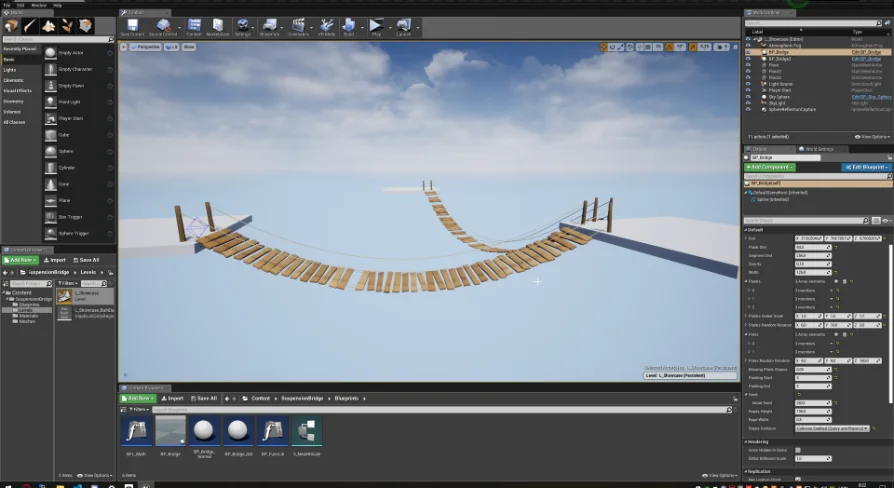
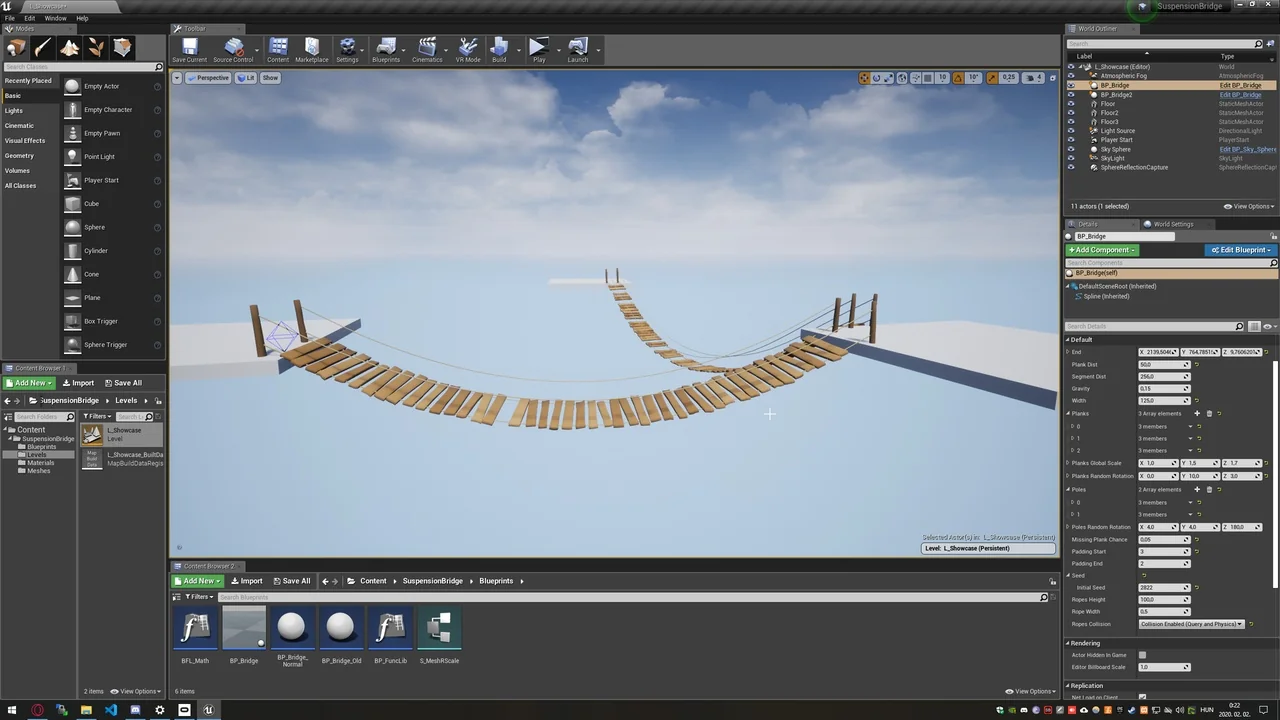
Environmental design demands flexibility, as no two map locations require the exact same walkway length, clearance, or visual density. Suspension Bridge incorporates a variety of configurable settings that let designers tailor the structure to the explicit needs of the immediate scene. Rather than locking creators into a single rigid dimension, the blueprint provides adjustable parameters to suit wide chasms, short passes, and specialized level layouts alike.
Configurable parameters allow level artists to adjust how the suspension bridge populates and spans an area. By modifying these settings, creators can fine-tune the bridge structure to fit specific gameplay beats, such as wide scenic vistas where a long span creates environmental scale, or tight, hazardous gaps designed to constrain player movement. These options reduce the overhead of managing multiple disparate bridge assets in an asset library, allowing a unified tool to generate crossings that seamlessly match the scale, footprint, and technical constraints of each distinct level section.
Traversal Reliability Under Third-Person Character Testing
Visual fidelity must always be matched by practical gameplay function, especially when dealing with physics, collisions, and character movement over suspended surfaces. Suspension Bridge has been verified through dedicated third-person shooter testing (TPS test), confirming that the surface geometry supports active player traversal without encountering movement hitching or collision anomalies.
In third-person action games, bridges present distinct navigational challenges. Dynamic character controllers, camera collision spheres, and foot-placement systems often struggle with inclined, swinging, or narrow walkways. Steep inclines, segmented collision seams, or poorly aligned bounds can cause third-person cameras to clip aggressively or force player characters into falling states. The TPS traversal evaluation ensures that characters can run, jog, and maneuver across the bridge decking smoothly. Because the blueprint manages the deck alignment and straightens the span relative to elevation changes, the collision path remains continuous and dependable under real-time character input.
Lighting Behavior and UV Light Compatibility
Lighting complex geometric structures like suspension bridges requires precise surface data. The presence of thin support elements, repeating planks, stretched tension cables, and wide decking surfaces can easily introduce shadow artifacts or uneven illumination if UV channels and lighting systems are misaligned. Suspension Bridge features compatibility with UV Light, ensuring that lighting passes, surface reflections, and ambient illumination interact cleanly with the entire structure.
Clean UV light behavior is essential when placing bridges across open-air daylight scenes or dark, moody atmospheric interiors. Sunlight streaming across a mountain gorge requires consistent shadow casting beneath the bridge deck, while local light sources like torches, lampposts, or spotlights must cast accurate highlights on the suspension framework. Thanks to proper UV light support, the bridge avoids light leakage, distorted shadow maps, and unappealing baking seams across its structural components, maintaining visual continuity regardless of the environment’s lighting scenario.
Workflow Placement and Environment Integration
From an environment art and level blocking perspective, Suspension Bridge fits into production pipelines where rapid iteration and terrain adaptability are top priorities. Instead of spending production hours manually aligning individual plank segments or creating unique bridge meshes in external digital content creation software for every change in cliff height, environment artists can place and configure the blueprint directly inside the editor viewport.
The asset serves as both an aesthetic fixture and a reliable navigational pathway. By pairing configurable settings with height-aware straightening logic, verified TPS player traversal, and dependable UV Light handling, Suspension Bridge functions as a complete solution for connecting varied terrain across outdoor levels, mountain passes, adventure zones, and complex game worlds.
 Procedural Systems
 Procedural Systems
 Procedural Systems
 Procedural Systems