"cadbdd4ea746864c"{"id":"1002961","slug":"stylized-modular-skeletons-villagers","title":"Stylized Modular Skeletons (Villagers)","category":"Characters \u0026 Creatures","engine":"4.19+,5.0+","assetVersion":"","engineVersion":"Engine Version: 4.19+,5.0+","tag":"Characters","accent":"blue","visual":"character","summary":"Explore the Stylized Modular Skeletons (Villagers) pack, featuring rigged modular clothing, farming weapons, and customizable master materials.","platform":"Unreal Engine","indexPolicy":"index","publishedAt":"2026-11-22T12:51:31.315Z","updatedAt":"2026-11-22T12:51:31.315Z","sourceNotes":[],"fileContents":[],"compatibility":["Unreal Engine","Engine Version: 4.19+,5.0+"],"featuredImage":{"alt":"Stylized Modular Skeletons (Villagers)","src":"/wp-content/uploads/published/2026/11/2e396362be42-d0a33a1b-908b-42a0-beaf-9c14b00041c6-81c870c7a3.webp"},"hasDownloadLink":true,"downloads":0,"terms":[{"taxonomy":"category","slug":"characters-and-creatures","name":"Characters \u0026 Creatures"}],"galleryImages":[{"src":"/wp-content/uploads/published/2026/11/16a306c62e46-42c2f0ee-9ef9-4f69-8b0d-af553f3c1c1a-cf73a9cec0.webp","alt":"Stylized Modular Skeletons (Villagers)"},{"src":"/wp-content/uploads/published/2026/11/bc336b2582a5-c6ce368b-0de0-438e-914b-3711be9bb27d-9b19258303.webp","alt":"Stylized Modular Skeletons (Villagers)"},{"src":"/wp-content/uploads/published/2026/11/21f516fc8348-4027ec47-4117-4772-9793-9ae66926a306-bfc4e597bf.webp","alt":"Stylized Modular Skeletons (Villagers)"},{"src":"/wp-content/uploads/published/2026/11/f19e7ac26dd6-e52967d9-06dd-42a8-b049-135611c3ba7b-5cc0f7f772.webp","alt":"Stylized Modular Skeletons (Villagers)"},{"src":"/wp-content/uploads/published/2026/11/7f562c3721f1-977feb2e-15e5-4338-a46e-0940059b9141-6d8092aa33.webp","alt":"Stylized Modular Skeletons (Villagers)"},{"src":"/wp-content/uploads/published/2026/11/0a982469d94b-419c556a-f2e7-430c-9819-ef18fe84567e-15bfc8c58f.webp","alt":"Stylized Modular Skeletons (Villagers)"},{"src":"/wp-content/uploads/published/2026/11/fbb012b2d0ce-088b275c-d5ab-4e7f-8691-f2e6b5435106-0819dd4e03.webp","alt":"Stylized Modular Skeletons (Villagers)"}],"accessPanel":{"kind":"resource","title":"Get this resource","safetyNote":"Resources are manually reviewed before listing to improve quality and reduce obvious risks.","fileName":"Content.7z","resourceType":"Resource archive","versions":[]},"contentHtml":"\u003ch2\u003ePopulating Cursed Settlements with Stylized Villagers\u003c/h2\u003e\u003cp\u003eRansacked hamlets, plague-stricken farmlands, and forgotten catacombs often demand a distinct class of undead that differs from standard armored infantry. Rather than marching ranks of identical bone warriors wearing polished steel, rural fantasy environments feel considerably more grounded when the restless dead still bear the garments and implements of their past lives. Stylized Modular Skeletons (Villagers) addresses this narrative need directly, offering stylized, lowpoly skeletal figures wrapped in the tattered everyday wear of medieval peasants, field hands, and laborers.\u003c/p\u003e\u003cp\u003eThe package establishes a strong bridge between horror and stylized dark fantasy. Whether an encounter takes place in a moonlit wheat field, a ransacked tavern cellar, or an abandoned lumber mill, these skeletal figures provide immediate visual context. The contrast between brittle bone anatomy and rustic working garments allows developers to quickly populate hordes or custom encounters where every shambling enemy retains recognizable remnants of a former trade.\u003c/p\u003e\u003ch2\u003eDressing Undead Laborers with Modular Clothing Parts\u003c/h2\u003e\u003cp\u003eVisual diversity across large enemy groups prevents encounters from feeling repetitive. The kit supplies a 26-piece modular wardrobe tailored specifically to civilian archetypes. This allows developers to mix, match, and assemble distinct outfits for each individual skeleton, avoiding the uniform look common in mob-based encounters.\u003c/p\u003e\u003cp\u003eThe included clothing parts cover every major wearable layer:\u003c/p\u003e\u003cul\u003e\u003cli\u003e4 hats featuring different shapes and rustic silhouettes\u003c/li\u003e\u003cli\u003e4 individual shirts suited for peasant and commoner wear\u003c/li\u003e\u003cli\u003e1 robe for cultist, elder, or ceremonial variations\u003c/li\u003e\u003cli\u003e1 apron ideal for butchers, smiths, or workshop laborers\u003c/li\u003e\u003cli\u003e4 distinct styles of pants\u003c/li\u003e\u003cli\u003e4 belts to break up waistlines and anchor accessories\u003c/li\u003e\u003cli\u003e4 pairs of gloves ranging in coverage and material style\u003c/li\u003e\u003cli\u003e4 pairs of boots reflecting rugged rural footwear\u003c/li\u003e\u003c/ul\u003e\u003cp\u003eBecause the clothing pieces are fully rigged alongside the skeletal base, garments deform naturally with the skeleton during locomotion, attacks, and idle cycles. This shared rigging eliminates the need to manually attach or conform static clothing meshes to underlying bones, streamlining the pipeline when establishing diverse enemy variants inside an animation blueprint.\u003c/p\u003e\u003ch2\u003eArming Villagers Skeletons with Improvised Rural Tools\u003c/h2\u003e\u003cp\u003eA peasant uprising from beyond the grave relies on the implements found in barns, workshops, and homesteads rather than armories. The package equips these characters with an extensive collection of improvised weaponry and rural tools, split between modular components and standalone props.\u003c/p\u003e\u003cp\u003eThe collection provides 3 modular weapon sets:\u003c/p\u003e\u003cul\u003e\u003cli\u003eModular forks\u003c/li\u003e\u003cli\u003eModular hammers\u003c/li\u003e\u003cli\u003eModular pickaxes\u003c/li\u003e\u003c/ul\u003e\u003cp\u003eThese modular sets allow creators to swap parts, handles, and heads to assemble varied tool configurations across multiple units. Complementing the modular tools is an arsenal of 12 non-modular combat and utility items:\u003c/p\u003e\u003cul\u003e\u003cli\u003e3 distinct axes suitable for woodcutting or combat\u003c/li\u003e\u003cli\u003eA standard knife\u003c/li\u003e\u003cli\u003eA butcher's knife emphasizing a slaughterhouse aesthetic\u003c/li\u003e\u003cli\u003eA curved sickle for field harvesting\u003c/li\u003e\u003cli\u003eA fighter plank acting as a makeshift bludgeon\u003c/li\u003e\u003cli\u003eA fighter spear for ranged melee pokes\u003c/li\u003e\u003cli\u003eA scythe carrying traditional grim reaper connotations\u003c/li\u003e\u003cli\u003eA rugged shovel\u003c/li\u003e\u003cli\u003eA lit torch to cast dynamic light during nighttime raids\u003c/li\u003e\u003cli\u003eA defensive shield crafted from salvaged materials\u003c/li\u003e\u003c/ul\u003e\u003cp\u003eBeyond hand-held weapons, the kit includes additional dressing items that expand narrative possibilities. Two pairs of shackles, three sets of chains, and two flasks allow developers to turn standard skeletons into chained dungeon captives, escaped prisoners, or wandering alchemical experiments.\u003c/p\u003e\u003ch2\u003eMaster Material Controls and Visual Tinting for Skeletons\u003c/h2\u003e\u003cp\u003eThe visual pipeline is structured around four specialized master materials designed to handle surfaces cleanly across all assets: clothing, clothing with opacity, weapons, and the skeleton itself. The dedicated opacity material handles frayed hems, worn edges, and decaying cloth fibers without requiring distinct shaders for every garment.\u003c/p\u003e\u003cp\u003eCustomization extends directly into real-time visual parameters. The material setup enables complete control over color tinting for both the fabrics and the bone surfaces beneath them. Developers can adjust skeleton tones from bleached white and aged sepia to mossy green or charred black. Fabrics can be shifted across muted earth tones, vivid dyed hues, or faded greys to separate enemy tiers or indicate faction alignment.\u003c/p\u003e\u003cp\u003eA built-in dirt effect system provides an extra layer of environmental integration. By blending grime over the clothing and bone geometry, characters can appear freshly unearthed from soggy graves, soiled from field labor, or covered in centuries of dust. Additional advanced parameters are built into the shader structure as well, though these experimental functions remain disabled by default to keep base performance predictable.\u003c/p\u003e\u003ch2\u003eIntegration, Rigging, and Expanding the Undead Horde\u003c/h2\u003e\u003cp\u003eEvery skeletal mesh and clothing item arrives fully rigged and prepared for implementation in game development engines. Their compatibility with animation blueprints ensures that existing stylized combat animations, shambling walk cycles, and death ragdolls can be mapped directly to the character hierarchy without tedious re-skinning tasks.\u003c/p\u003e\u003cp\u003eThe modular framework is also built to accommodate future asset additions. The character foundation is designed to interoperate with upcoming releases containing heavier armor variants, such as leather and plate armor pieces. This planned interchangeability means the rural garments and improvised weapons found here can eventually be blended with heavier military equipment, allowing developers to create hybrid units that show a transition from lowly peasant militia to equipped battlefield thralls.\u003c/p\u003e\u003cp\u003eTeams developing wave-based survival games, dark fantasy role-playing games, stylized dungeon crawlers, or comedic horror titles gain an immediate set of flexible character assets. With 26 clothing elements, 15 offensive weapons, environmental shackles, and deep material tinting, the package delivers all the components needed to fill cursed villages with believable, varied undead.\u003c/p\u003e\n\n\u003ch2\u003eRelated Resources Worth Checking\u003c/h2\u003e\n\u003cul\u003e\n\u003cli\u003e\u003ca href=\"https://3dcghub.com/stylized-modular-skeletons-bandits/\" rel=\"noopener noreferrer\"\u003eStylized Modular Skeletons (Bandits)\u003c/a\u003e\u003c/li\u003e\n\u003cli\u003e\u003ca href=\"https://3dcghub.com/unlit-stylized-military-characters/\" rel=\"noopener noreferrer\"\u003eUnlit Stylized Military Characters\u003c/a\u003e\u003c/li\u003e\n\u003cli\u003e\u003ca href=\"https://3dcghub.com/eggo-the-talking-egg-face-morphs-epic-skeleton-skins-and-ultimate-material/\" rel=\"noopener noreferrer\"\u003eEggo the Talking Egg, face morphs, epic skeleton, skins and ultimate material\u003c/a\u003e\u003c/li\u003e\n\u003cli\u003e\u003ca href=\"https://3dcghub.com/millie-schoolgirl/\" rel=\"noopener noreferrer\"\u003eMillie Schoolgirl\u003c/a\u003e\u003c/li\u003e\n\u003cli\u003e\u003ca href=\"https://3dcghub.com/skeleton-crew-bundle-hand-painted-series/\" rel=\"noopener noreferrer\"\u003eSkeleton Crew Bundle - Hand Painted Series\u003c/a\u003e\u003c/li\u003e\n\u003c/ul\u003e","contentTextLength":6508,"navigation":{"current":7,"total":4889,"previous":{"id":"1002962","slug":"twig-people","title":"Twig People","category":"Characters \u0026 Creatures","platform":"Unreal Engine","updatedAt":"2026-11-22T12:52:18.960Z"},"next":{"id":"1002960","slug":"stylized-modular-skeletons-bandits","title":"Stylized Modular Skeletons (Bandits)","category":"Characters \u0026 Creatures","platform":"Unreal Engine","updatedAt":"2026-11-22T12:49:50.211Z"}},"relatedResources":[{"id":"1002960","slug":"stylized-modular-skeletons-bandits","title":"Stylized Modular Skeletons (Bandits)","category":"Characters \u0026 Creatures","engine":"4.19+,5.0+","assetVersion":"","engineVersion":"Engine Version: 4.19+,5.0+","tag":"Characters","accent":"blue","visual":"character","summary":"Stylized Modular Skeletons (Bandits) offers 29 armor parts, 41 modular weapon pieces, 4 shields, and two master materials for fantasy and horror games.","platform":"Unreal Engine","indexPolicy":"index","publishedAt":"2026-11-22T12:49:50.211Z","updatedAt":"2026-11-22T12:49:50.211Z","sourceNotes":[],"fileContents":[],"compatibility":["Unreal Engine","Engine Version: 4.19+,5.0+"],"featuredImage":{"alt":"Stylized Modular Skeletons (Bandits)","src":"/wp-content/uploads/published/2026/11/be280cc14331-f4896481-5033-46f9-8a33-bd7c197999bc-3b6cb06f67.webp"},"hasDownloadLink":true,"downloads":0},{"id":"1000902","slug":"unlit-stylized-military-characters","title":"Unlit Stylized Military Characters","category":"Characters \u0026 Creatures","engine":"4.26+,5.0+","assetVersion":"","engineVersion":"Engine Version: 4.26+,5.0+","tag":"Characters","accent":"blue","visual":"character","summary":"A bundle of unlit stylized military characters with toon material options, Epic skeleton compatibility, modular and standalone models, and a small texture footp","platform":"Unreal Engine","indexPolicy":"index","publishedAt":"2026-08-06T05:08:45.276Z","updatedAt":"2026-08-06T05:08:45.276Z","sourceNotes":[],"fileContents":[],"compatibility":["Unreal Engine","Engine Version: 4.26+,5.0+"],"featuredImage":{"alt":"Unlit Stylized Military Characters","src":"/wp-content/uploads/published/2026/08/fb48ecc224ed-9b72a340-637d-48b8-b18a-37118a2716f8-92ba26cd04.webp"},"fileSizeBytes":94216176,"hasDownloadLink":true,"downloads":4},{"id":"2259","slug":"eggo-the-talking-egg-face-morphs-epic-skeleton-skins-and-ultimate-material","title":"Eggo the Talking Egg, face morphs, epic skeleton, skins and ultimate material","category":"Characters \u0026 Creatures","engine":"4.26+,5.0+","assetVersion":"Engine version: 4.26+,5.0+","engineVersion":"4.26","tag":"Characters","accent":"blue","visual":"luts","summary":"Discover Eggo, a stylized talking egg character for Unreal Engine. Featuring ARKit morph targets, Epic Skeleton rigging, and highly customizable materials.","platform":"Unreal Engine","indexPolicy":"noindex","publishedAt":"2026-02-07T08:43:13.000Z","updatedAt":"2026-04-19T15:58:04.000Z","sourceNotes":[],"fileContents":[],"compatibility":["Unreal Engine","Engine version: 4.26+,5.0+"],"featuredImage":{"alt":"Eggo the Talking Egg, face morphs, epic skeleton, skins and ultimate material","src":"https://3dcghub.com/wp-content/uploads/2026/02/5506d981-c808-43b3-bbfe-4dca876ada17.webp"},"fileSizeBytes":386693335,"hasDownloadLink":true,"downloads":0}]}[{"id":4225,"sourceId":4225,"taxonomyId":4225,"taxonomy":"category","slug":"asset-library","name":"Asset Library","parentId":null,"count":4743,"hasChildren":true,"href":"/","seoTitle":"Free Game Assets Library | 3DCGHUB","seoDescription":"Browse free Unreal Engine, Unity, Blender assets and game development tutorials on 3DCGHUB with previews, compatibility notes, and secure downloads.","sitemapEnabled":true,"children":[{"id":4227,"sourceId":4227,"taxonomyId":4227,"taxonomy":"category","slug":"blender-add-ons-plugins","name":"Blender Add-ons \u0026 Plugins","parentId":4225,"count":10,"hasChildren":false,"href":"/category/blender-add-ons-plugins/","seoTitle":"Free Blender Add-ons \u0026 Plugins | 3DCGHUB","seoDescription":"Browse free Blender Add-ons \u0026 Plugins tools for Blender on 3DCGHUB: curated downloads with preview images, compatibility notes and secure download access.","sitemapEnabled":true},{"id":514,"sourceId":514,"taxonomyId":514,"taxonomy":"category","slug":"unity-2","name":"Unity","parentId":4225,"count":453,"hasChildren":true,"href":"/category/unity-2/","seoTitle":"Free Unity Assets | 3DCGHUB","seoDescription":"Browse free Unity resources on 3DCGHUB: curated downloads with preview images, compatibility notes and secure download access.","sitemapEnabled":true,"children":[{"id":523,"sourceId":523,"taxonomyId":523,"taxonomy":"category","slug":"2d","name":"2D","parentId":514,"count":1,"hasChildren":true,"href":"/category/2d/","seoTitle":"Free Unity 2D | 3DCGHUB","seoDescription":"Browse free 2D assets for Unity on 3DCGHUB: curated downloads with preview images, compatibility notes and secure download access.","sitemapEnabled":true},{"id":515,"sourceId":515,"taxonomyId":515,"taxonomy":"category","slug":"3d-unity-2","name":"3D","parentId":514,"count":162,"hasChildren":true,"href":"/category/3d-unity-2/","seoTitle":"Free Unity 3D Assets | 3DCGHUB","seoDescription":"Browse free 3D assets for Unity on 3DCGHUB: curated downloads with preview images, compatibility notes and secure download access.","sitemapEnabled":true},{"id":565,"sourceId":565,"taxonomyId":565,"taxonomy":"category","slug":"add-ons","name":"Add-Ons","parentId":514,"count":2,"hasChildren":false,"href":"/category/add-ons/","seoTitle":"Free Unity Add-Ons | 3DCGHUB","seoDescription":"Browse free Add-Ons assets for Unity on 3DCGHUB: curated downloads with preview images, compatibility notes and secure download access.","sitemapEnabled":true},{"id":529,"sourceId":529,"taxonomyId":529,"taxonomy":"category","slug":"audio-unity-2","name":"Audio","parentId":514,"count":1,"hasChildren":true,"href":"/category/audio-unity-2/","seoTitle":"Free Unity Audio | 3DCGHUB","seoDescription":"Browse free Audio for Unity on 3DCGHUB: curated downloads with preview images, compatibility notes and secure download access.","sitemapEnabled":true},{"id":557,"sourceId":557,"taxonomyId":557,"taxonomy":"category","slug":"templates","name":"Templates","parentId":514,"count":36,"hasChildren":true,"href":"/category/templates/","seoTitle":"Free Unity Templates | 3DCGHUB","seoDescription":"Browse free Unity project templates on 3DCGHUB. Starter kits with previews, compatibility notes, and secure download access.","sitemapEnabled":true},{"id":533,"sourceId":533,"taxonomyId":533,"taxonomy":"category","slug":"tools-unity-2","name":"Tools","parentId":514,"count":0,"hasChildren":true,"href":"/category/tools-unity-2/","sitemapEnabled":true},{"id":554,"sourceId":554,"taxonomyId":554,"taxonomy":"category","slug":"vfx-unity-2","name":"VFX","parentId":514,"count":4,"hasChildren":true,"href":"/category/vfx-unity-2/","seoTitle":"Free Unity VFX | 3DCGHUB","seoDescription":"Browse free VFX for Unity on 3DCGHUB: curated downloads with preview images, compatibility notes and secure download access.","sitemapEnabled":true}]},{"id":511,"sourceId":511,"taxonomyId":511,"taxonomy":"category","slug":"unreal-engine-2","name":"Unreal Engine","parentId":4225,"count":4281,"hasChildren":true,"href":"/category/unreal-engine-2/","seoTitle":"Free Unreal Engine Assets | 3DCGHUB","seoDescription":"Browse free Unreal Engine resources on 3DCGHUB: curated downloads with preview images, compatibility notes and secure download access.","sitemapEnabled":true,"children":[{"id":54,"sourceId":54,"taxonomyId":54,"taxonomy":"category","slug":"3d","name":"3D","parentId":511,"count":2427,"hasChildren":true,"href":"/category/3d/","seoTitle":"Free Unreal Engine 3D | 3DCGHUB","seoDescription":"Browse free 3D assets for Unreal Engine on 3DCGHUB: curated downloads with preview images, compatibility notes and secure download access.","sitemapEnabled":true},{"id":441,"sourceId":441,"taxonomyId":441,"taxonomy":"category","slug":"animations","name":"Animations","parentId":511,"count":245,"hasChildren":true,"href":"/category/animations/","seoTitle":"Free Unreal Engine Animations | 3DCGHUB","seoDescription":"Browse free Animations for Unreal Engine on 3DCGHUB: curated downloads with preview images, compatibility notes and secure download access.","sitemapEnabled":true},{"id":446,"sourceId":446,"taxonomyId":446,"taxonomy":"category","slug":"audio","name":"Audio","parentId":511,"count":63,"hasChildren":true,"href":"/category/audio/","seoTitle":"Free Unreal Engine Audio Resources | 3DCGHUB","seoDescription":"Browse free Unreal Engine audio resources including sound effects, voices, dialogue, and ambient sounds. Curated free downloads on 3DCGHUB.","sitemapEnabled":true},{"id":466,"sourceId":466,"taxonomyId":466,"taxonomy":"category","slug":"game-systems","name":"Game Systems","parentId":511,"count":356,"hasChildren":true,"href":"/category/game-systems/","seoTitle":"Free Unreal Engine Game Systems | 3DCGHUB","seoDescription":"Browse free Game Systems tools for Unreal Engine on 3DCGHUB: curated downloads with preview images, compatibility notes and secure download access.","sitemapEnabled":true},{"id":478,"sourceId":478,"taxonomyId":478,"taxonomy":"category","slug":"game-templates","name":"Game Templates","parentId":511,"count":150,"hasChildren":true,"href":"/category/game-templates/","seoTitle":"Free Unreal Engine Game Templates | 3DCGHUB","seoDescription":"Browse free Game Templates for Unreal Engine on 3DCGHUB: curated downloads with preview images, compatibility notes and secure download access.","sitemapEnabled":true},{"id":432,"sourceId":432,"taxonomyId":432,"taxonomy":"category","slug":"hdri","name":"HDRI","parentId":511,"count":6,"hasChildren":true,"href":"/category/hdri/","seoTitle":"Free Unreal Engine HDRI | 3DCGHUB","seoDescription":"Browse free Unreal Engine HDRI skies and lighting maps on 3DCGHUB. Environment lighting with previews and secure downloads.","sitemapEnabled":true},{"id":228,"sourceId":228,"taxonomyId":228,"taxonomy":"category","slug":"material-and-textures","name":"Material \u0026 Textures","parentId":511,"count":172,"hasChildren":true,"href":"/category/material-and-textures/","seoTitle":"Free Unreal Engine Material \u0026 Textures | 3DCGHUB","seoDescription":"Browse free Material \u0026 Textures for Unreal Engine on 3DCGHUB: curated downloads with preview images, compatibility notes and secure download access.","sitemapEnabled":true},{"id":298,"sourceId":298,"taxonomyId":298,"taxonomy":"category","slug":"sprites-and-flipbooks","name":"Sprites \u0026 Flipbooks","parentId":511,"count":17,"hasChildren":true,"href":"/category/sprites-and-flipbooks/","seoTitle":"Free Unreal Engine Sprites \u0026 Flipbooks | 3DCGHUB","seoDescription":"Browse free Sprites \u0026 Flipbooks assets for Unreal Engine on 3DCGHUB: curated downloads with preview images, compatibility notes and secure download access.","sitemapEnabled":true},{"id":489,"sourceId":489,"taxonomyId":489,"taxonomy":"category","slug":"tools-and-plugins","name":"Tools \u0026 Plugins","parentId":511,"count":390,"hasChildren":true,"href":"/category/tools-and-plugins/","seoTitle":"Free Unreal Engine Tools \u0026 Plugins | 3DCGHUB","seoDescription":"Browse free Tools \u0026 Plugins for Unreal Engine on 3DCGHUB: curated downloads with preview images, compatibility notes and secure download access.","sitemapEnabled":true},{"id":459,"sourceId":459,"taxonomyId":459,"taxonomy":"category","slug":"ui","name":"UI","parentId":511,"count":43,"hasChildren":true,"href":"/category/ui/","seoTitle":"Free Unreal Engine UI | 3DCGHUB","seoDescription":"Browse free UI for Unreal Engine on 3DCGHUB: curated downloads with preview images, compatibility notes and secure download access.","sitemapEnabled":true},{"id":450,"sourceId":450,"taxonomyId":450,"taxonomy":"category","slug":"vfx","name":"VFX","parentId":511,"count":412,"hasChildren":true,"href":"/category/vfx/","seoTitle":"Free Unreal Engine VFX | 3DCGHUB","seoDescription":"Browse free VFX for Unreal Engine on 3DCGHUB: curated downloads with preview images, compatibility notes and secure download access.","sitemapEnabled":true}]}]},{"id":4222,"sourceId":4222,"taxonomyId":4222,"taxonomy":"category","slug":"tutorial-library","name":"Tutorial Library","parentId":null,"count":117,"hasChildren":false,"href":"/tutorials/","seoTitle":"Free Game Development Tutorial Library | 3DCGHUB","seoDescription":"Browse free game development tutorials for Unreal Engine, Unity, Blender, and more on 3DCGHUB with practical workflows and secure downloads.","sitemapEnabled":true}]
Resource screenshots
1 / 7
Join our channel
Follow 3DCGHUB on Telegram for new resource drops, migration updates, and community notices.
Populating Cursed Settlements with Stylized Villagers
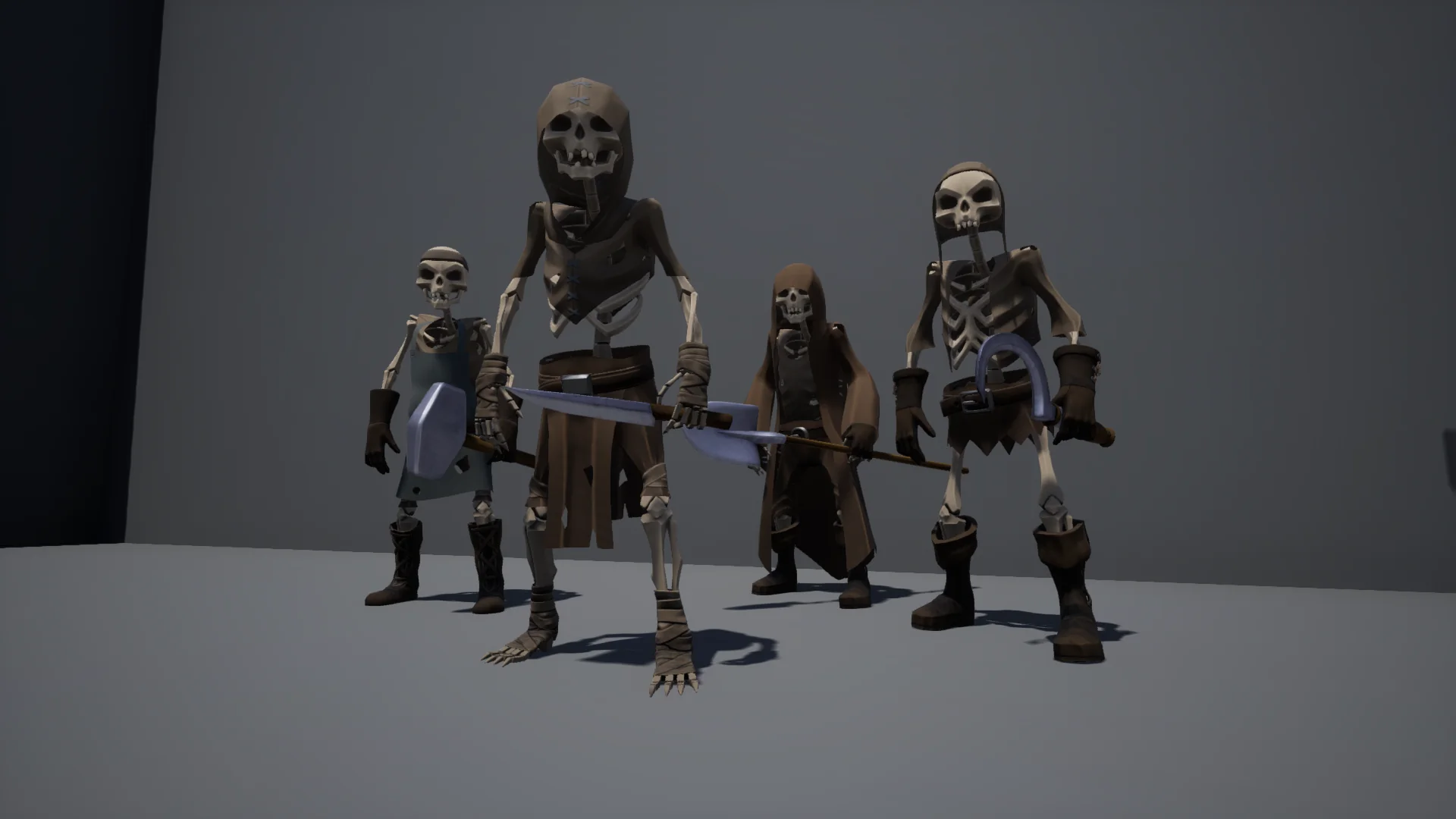
Ransacked hamlets, plague-stricken farmlands, and forgotten catacombs often demand a distinct class of undead that differs from standard armored infantry. Rather than marching ranks of identical bone warriors wearing polished steel, rural fantasy environments feel considerably more grounded when the restless dead still bear the garments and implements of their past lives. Stylized Modular Skeletons (Villagers) addresses this narrative need directly, offering stylized, lowpoly skeletal figures wrapped in the tattered everyday wear of medieval peasants, field hands, and laborers.
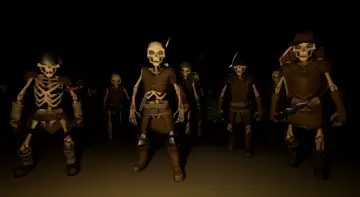
The package establishes a strong bridge between horror and stylized dark fantasy. Whether an encounter takes place in a moonlit wheat field, a ransacked tavern cellar, or an abandoned lumber mill, these skeletal figures provide immediate visual context. The contrast between brittle bone anatomy and rustic working garments allows developers to quickly populate hordes or custom encounters where every shambling enemy retains recognizable remnants of a former trade.
Dressing Undead Laborers with Modular Clothing Parts
Visual diversity across large enemy groups prevents encounters from feeling repetitive. The kit supplies a 26-piece modular wardrobe tailored specifically to civilian archetypes. This allows developers to mix, match, and assemble distinct outfits for each individual skeleton, avoiding the uniform look common in mob-based encounters.
The included clothing parts cover every major wearable layer:
4 hats featuring different shapes and rustic silhouettes
4 individual shirts suited for peasant and commoner wear
1 robe for cultist, elder, or ceremonial variations
1 apron ideal for butchers, smiths, or workshop laborers
4 distinct styles of pants
4 belts to break up waistlines and anchor accessories
4 pairs of gloves ranging in coverage and material style
4 pairs of boots reflecting rugged rural footwear
Because the clothing pieces are fully rigged alongside the skeletal base, garments deform naturally with the skeleton during locomotion, attacks, and idle cycles. This shared rigging eliminates the need to manually attach or conform static clothing meshes to underlying bones, streamlining the pipeline when establishing diverse enemy variants inside an animation blueprint.
Arming Villagers Skeletons with Improvised Rural Tools
A peasant uprising from beyond the grave relies on the implements found in barns, workshops, and homesteads rather than armories. The package equips these characters with an extensive collection of improvised weaponry and rural tools, split between modular components and standalone props.
The collection provides 3 modular weapon sets:
Modular forks
Modular hammers
Modular pickaxes
These modular sets allow creators to swap parts, handles, and heads to assemble varied tool configurations across multiple units. Complementing the modular tools is an arsenal of 12 non-modular combat and utility items:
3 distinct axes suitable for woodcutting or combat
A standard knife
A butcher's knife emphasizing a slaughterhouse aesthetic
A curved sickle for field harvesting
A fighter plank acting as a makeshift bludgeon
A fighter spear for ranged melee pokes
A scythe carrying traditional grim reaper connotations
A rugged shovel
A lit torch to cast dynamic light during nighttime raids
A defensive shield crafted from salvaged materials
Beyond hand-held weapons, the kit includes additional dressing items that expand narrative possibilities. Two pairs of shackles, three sets of chains, and two flasks allow developers to turn standard skeletons into chained dungeon captives, escaped prisoners, or wandering alchemical experiments.
Master Material Controls and Visual Tinting for Skeletons
The visual pipeline is structured around four specialized master materials designed to handle surfaces cleanly across all assets: clothing, clothing with opacity, weapons, and the skeleton itself. The dedicated opacity material handles frayed hems, worn edges, and decaying cloth fibers without requiring distinct shaders for every garment.
Customization extends directly into real-time visual parameters. The material setup enables complete control over color tinting for both the fabrics and the bone surfaces beneath them. Developers can adjust skeleton tones from bleached white and aged sepia to mossy green or charred black. Fabrics can be shifted across muted earth tones, vivid dyed hues, or faded greys to separate enemy tiers or indicate faction alignment.
A built-in dirt effect system provides an extra layer of environmental integration. By blending grime over the clothing and bone geometry, characters can appear freshly unearthed from soggy graves, soiled from field labor, or covered in centuries of dust. Additional advanced parameters are built into the shader structure as well, though these experimental functions remain disabled by default to keep base performance predictable.
Integration, Rigging, and Expanding the Undead Horde
Every skeletal mesh and clothing item arrives fully rigged and prepared for implementation in game development engines. Their compatibility with animation blueprints ensures that existing stylized combat animations, shambling walk cycles, and death ragdolls can be mapped directly to the character hierarchy without tedious re-skinning tasks.
The modular framework is also built to accommodate future asset additions. The character foundation is designed to interoperate with upcoming releases containing heavier armor variants, such as leather and plate armor pieces. This planned interchangeability means the rural garments and improvised weapons found here can eventually be blended with heavier military equipment, allowing developers to create hybrid units that show a transition from lowly peasant militia to equipped battlefield thralls.
Teams developing wave-based survival games, dark fantasy role-playing games, stylized dungeon crawlers, or comedic horror titles gain an immediate set of flexible character assets. With 26 clothing elements, 15 offensive weapons, environmental shackles, and deep material tinting, the package delivers all the components needed to fill cursed villages with believable, varied undead.
 Characters
 Characters
 Characters