"c68a05d5e51405b3"{"id":"1000104","slug":"stylized-male-and-female-characters-with-assets-and-ui","title":"Stylized Male and Female characters, with assets and UI","category":"Characters \u0026 Creatures","engine":"Engine Version: 4.27,5.0+","assetVersion":"Engine Version: 4.27,5.0+","engineVersion":"","tag":"Characters","accent":"blue","visual":"character","summary":"A stylized modular character bundle for Unreal projects with nine body variants, Epic skeleton support, improved third-person animations, and UI demos.","platform":"Unreal Engine","publishedAt":"2026-06-07T16:04:14.141Z","updatedAt":"2026-06-07T16:04:14.141Z","sourceNotes":[],"fileContents":[],"compatibility":["Unreal Engine","Engine Version: 4.27,5.0+"],"featuredImage":{"alt":"Stylized Male and Female characters, with assets and UI","src":"/wp-content/uploads/published/2026/06/669af5bdf8c7-56aa6c7b-9504-4541-9f15-538e3992fe82-234ddb292c.webp"},"hasDownloadLink":true,"downloads":0,"terms":[{"taxonomy":"category","slug":"characters-and-creatures","name":"Characters \u0026 Creatures"}],"galleryImages":[{"src":"/wp-content/uploads/published/2026/06/3a8754dab3a8-7566f3c1-6d51-41d3-a49d-d67780b99b0c-724d41648e.webp","alt":"Stylized Male and Female characters, with assets and UI"},{"src":"/wp-content/uploads/published/2026/06/942c709e5bef-ae4c2999-2023-4941-a469-607ce90b38b4-4466fdff9a.webp","alt":"Stylized Male and Female characters, with assets and UI"},{"src":"/wp-content/uploads/published/2026/06/853aa635ebc4-d5d26288-5537-4bb0-8393-4151e99a613c-e2eced1635.webp","alt":"Stylized Male and Female characters, with assets and UI"},{"src":"/wp-content/uploads/published/2026/06/2f45ef9d1963-400b9ad6-ba46-4876-9d19-2bcdfa9e4b98-ad896a45c6.webp","alt":"Stylized Male and Female characters, with assets and UI"},{"src":"/wp-content/uploads/published/2026/06/f224e0cd7ffb-c69460ab-04a4-4012-ba75-f6fb6808d632-a1c9cb8945.webp","alt":"Stylized Male and Female characters, with assets and UI"},{"src":"/wp-content/uploads/published/2026/06/bb4e82a043b0-1a8fe3d5-95f2-4326-b952-36aa3b42cdb3-669a3719d9.webp","alt":"Stylized Male and Female characters, with assets and UI"},{"src":"/wp-content/uploads/published/2026/06/2fc4408a0a73-61af335b-d4b9-4bbf-8b99-2e73246469c5-56b4a90f05.webp","alt":"Stylized Male and Female characters, with assets and UI"},{"src":"/wp-content/uploads/published/2026/06/661b31010a57-f6f0c36f-189d-4ad4-b35c-381ed47edba9-92f6ebc64c.webp","alt":"Stylized Male and Female characters, with assets and UI"},{"src":"/wp-content/uploads/published/2026/06/16a81991d4e8-6bc7577a-2c84-4b1b-8d06-edb71cd5cb87-40c8342e64.webp","alt":"Stylized Male and Female characters, with assets and UI"},{"src":"/wp-content/uploads/published/2026/06/dbd2538f8731-b8ac1b46-0372-4251-af48-e4d170c3ee93-1a50f68c94.webp","alt":"Stylized Male and Female characters, with assets and UI"}],"accessPanel":{"kind":"resource","title":"Access this resource","eyebrow":"Free Download","message":"Log in or create a free account to start your download.","fileName":"Content.7z","safetyNote":"Resources are manually reviewed before listing to improve quality and reduce obvious risks.","actionLabel":"Download Free","resourceType":"Resource archive"},"contentHtml":"\u003cp\u003eCharacters in this bundle are meant to be assembled, swapped, and previewed in motion rather than treated as static figures. The set pairs stylized male and female characters with modular parts, a working third-person controller duplicate with improved animations, and a functional customization menu example that shows how those parts can be changed in context.\u003c/p\u003e\u003cp\u003eThe core of the package is a modular character workflow. Bodies, ethnic heads, clothing pieces, hair styles, and accessories are all part of the set, and the items are split into clear body regions: head, upper, lower, hands, and feet. That structure makes the pack immediately relevant for projects that need visible character variation, especially when the goal is to let a player or developer swap parts instead of maintaining separate fully assembled characters for every combination.\u003c/p\u003e\u003ch2\u003eCharacter customization in motion\u003c/h2\u003e\u003cp\u003eThe most practical part of this bundle is that it does not stop at loose character pieces. It includes a duplicate of the default thirdperson controller with improved animations, which places the modular characters into a familiar gameplay framework. Instead of only offering assets to assemble, the set also shows how those assembled results behave in an active controller setup.\u003c/p\u003e\u003cp\u003eA functional example of a character customization menu is included as well. That matters for implementation because the modular parts are not isolated examples; they are presented in a usable interface where the swaps can be seen in context. For teams prototyping a customization flow, this gives a direct reference point for how the heads, clothing, and other segmented pieces can be presented and changed inside a running character system.\u003c/p\u003e\u003cp\u003eThe package also includes a simple swapper BP demo. Alongside the customization menu demo, this adds another practical layer to the bundle’s setup angle. One example focuses on the menu side of character changes, while the swapper blueprint demo points toward the moment-to-moment act of replacing parts. Together, those pieces make the asset easier to evaluate as a workflow resource instead of only a character art set.\u003c/p\u003e\u003ch2\u003eNine variants across UE4, UE5, Lyra, and Metahuman\u003c/h2\u003e\u003cp\u003eThe character lineup spans nine variants:\u003c/p\u003e\u003cul\u003e\u003cli\u003eUE4 Male\u003c/li\u003e\u003cli\u003eUE4 Female\u003c/li\u003e\u003cli\u003eUE4 Tall Female\u003c/li\u003e\u003cli\u003eUE4 Buff Male\u003c/li\u003e\u003cli\u003eTall Metahuman Male\u003c/li\u003e\u003cli\u003eTall Metahuman Female\u003c/li\u003e\u003cli\u003eUE5 Lyra Male\u003c/li\u003e\u003cli\u003eUE5 Lyra Female\u003c/li\u003e\u003cli\u003eUE5 Lyra Buff Male\u003c/li\u003e\u003c/ul\u003e\u003cp\u003eThat range gives the bundle a broader implementation footprint inside Unreal character pipelines. It does not stay limited to one body type or one framework. Standard male and female variants are present, but the set also extends into taller and buff character forms, plus Metahuman and Lyra-based entries. For anyone comparing how a modular system might behave across different established Unreal character setups, this spread is one of the most concrete parts of the package.\u003c/p\u003e\u003cp\u003eThe resource is built on the Epic skeleton for UE4 and UE5. This is one of the central compatibility details because it ties the modular character content directly to a known Unreal character rigging standard. The improved third-person controller duplicate and the listed UE4, UE5, Lyra, and Metahuman variants all fit into that broader picture of a bundle aimed at practical Unreal use rather than isolated stylized meshes.\u003c/p\u003e\u003ch2\u003eModular bodies, ethnic heads, clothing, hair, and accessories\u003c/h2\u003e\u003cp\u003eOn the content side, the bundle combines several categories of interchangeable elements. Modular bodies form the base of the character system. Ethnic heads are explicitly included in White, Black, and Asian variants, which expands visible character variety through head selection rather than relying on a single facial type. Clothing pieces, hair styles, and accessories then add further layers of assembly.\u003c/p\u003e\u003cp\u003eThe split between head, upper, lower, hands, and feet is especially important for setup. It defines how the modularity is organized and suggests a clean part-based approach to assembly. A project can treat those regions as separate customization points instead of trying to replace a full character every time a visual change is needed. In practice, that means the bundle is framed around recombining sections and presenting those changes through the included UI and swapper examples.\u003c/p\u003e\u003cp\u003eThe stylized look is another constant across the package. The tags connect it with contemporary and modern themes, while the character naming and included male and female variants keep the set grounded in recognizable person-based customization rather than fantasy creatures or hard-surface troops. Even so, the modular setup makes the resource less about one finished look and more about how a scene can present a range of character identities through a shared system.\u003c/p\u003e\u003ch2\u003eWhat the included demos and tutorials support\u003c/h2\u003e\u003cp\u003eThe bundle includes more than one form of implementation help. There is documentation, a customization menu demo, a simple swapper BP demo, and a tutorial on how to use a custom character model with a character controller while assembling multiple parts. Those pieces support different stages of setup.\u003c/p\u003e\u003cp\u003eThe documentation and tutorial speak to the assembly process itself: using a custom character model, connecting it with a character controller, and handling multiple parts as one playable result. That is a specific production concern in modular character work. A stylized character pack can contain many attractive pieces, but the practical challenge usually appears when those pieces need to function together inside a controller-driven character. This bundle addresses that area directly by including a tutorial focused on custom character model use and multi-part assembly.\u003c/p\u003e\u003cp\u003eThe demos serve a slightly different role. The customization menu demo shows presentation and selection in context. The simple swapper BP demo points toward the logic of changing pieces. The duplicate thirdperson controller with improved animations helps close the loop by showing the character active in motion once those parts are assembled. Taken together, those inclusions make the pack read as a setup resource as much as an art resource.\u003c/p\u003e\u003ch2\u003ePO-Art compatibility and where this bundle fits\u003c/h2\u003e\u003cp\u003eThe resource is presented alongside other PO-Art compatible products: a Scifi Trooper set with heads, an Elf set with heads, a Fantasy Knight set, and a Female Mannequin. That compatibility note places this bundle inside a wider character ecosystem rather than isolating it as a one-off release.\u003c/p\u003e\u003cp\u003eFor implementation planning, this is relevant because the stylized male and female set is not only a collection of modern characters with modular parts and UI examples. It also sits within a group of compatible character products that appear to share a broader approach. The immediate value here is not in any unstated cross-pack promise, but in the fact that compatibility is explicitly called out.\u003c/p\u003e\u003cp\u003eThe strongest concrete takeaway is the bundle’s combination of modular character parts, nine Unreal-oriented variants, Epic skeleton support for UE4 and UE5, and included examples for customization, swapping, and controller-based assembly. Teams evaluating it are really evaluating a complete character setup workflow: parts divided into head, upper, lower, hands, and feet, shown through a working UI and backed by playable third-person context.\u003c/p\u003e\n\n\u003ch2\u003eRelated Resources Worth Checking\u003c/h2\u003e\n\u003cul\u003e\n\u003cli\u003e\u003ca href=\"https://3dcghub.com/subculture-guy/\" title=\"Subculture Guy\"\u003eSubculture Guy\u003c/a\u003e\u003c/li\u003e\n\u003cli\u003e\u003ca href=\"https://3dcghub.com/millie-schoolgirl/\" title=\"Millie Schoolgirl\"\u003eMillie Schoolgirl\u003c/a\u003e\u003c/li\u003e\n\u003cli\u003e\u003ca href=\"https://3dcghub.com/female-military-officer/\" title=\"Female Military Officer\"\u003eFemale Military Officer\u003c/a\u003e\u003c/li\u003e\n\u003cli\u003e\u003ca href=\"https://3dcghub.com/stylized-female-character-janedoe/\" title=\"Stylized Female Character - JaneDoe\"\u003eStylized Female Character - JaneDoe\u003c/a\u003e\u003c/li\u003e\n\u003cli\u003e\u003ca href=\"https://3dcghub.com/medieval-armour-metahuman-male-female/\" title=\"Medieval Armour - Metahuman - Male/Female\"\u003eMedieval Armour - Metahuman - Male/Female\u003c/a\u003e\u003c/li\u003e\n\u003c/ul\u003e","contentTextLength":7421,"navigation":{"current":1900,"total":3860,"previous":{"id":"1000105","slug":"stylized-pirate-port-city-modular-pirate-port-city-modular-dock-pirate-city","title":"Stylized Pirate Port City Modular ( Pirate Port City Modular Dock Pirate City )","category":"Fantasy","platform":"Unreal Engine","updatedAt":"2026-06-07T16:18:40.463Z"},"next":{"id":"1000103","slug":"stylized-lowpoly-cyberpunk-city-stylized-stylised-cyber-cyberpunk-scifi-3d","title":"Stylized Lowpoly Cyberpunk City ( Stylized Stylised Cyber Cyberpunk Scifi 3D )","category":"Cities","platform":"Unreal Engine","updatedAt":"2026-06-07T15:58:50.126Z"}},"relatedResources":[{"id":"1001911","slug":"stylized-modular-character","title":"Stylized Modular Character","category":"Characters \u0026 Creatures","engine":"4.26+,5.0+","assetVersion":"","engineVersion":"Engine Version: 4.26+,5.0+","tag":"Characters","accent":"blue","visual":"character","summary":"Explore Stylized Modular Character, a modular asset pack featuring male and female meshes, Epic Skeleton rigging, blink morph targets, and varied thematic parts","platform":"Unreal Engine","publishedAt":"2026-10-22T11:49:16.504Z","updatedAt":"2026-10-22T11:49:16.504Z","sourceNotes":[],"fileContents":[],"compatibility":["Unreal Engine","Engine Version: 4.26+,5.0+"],"featuredImage":{"alt":"Stylized Modular Character","src":"/wp-content/uploads/published/2026/10/c4a9b3bd1032-7ef4a671-1514-4b14-823b-399dff7865ef-5c5d634b00.webp"},"hasDownloadLink":true,"downloads":0},{"id":"1001842","slug":"styled-characters-pack-military-male-female","title":"Styled Characters Pack: Military Male/Female","category":"Characters \u0026 Creatures","engine":"4.19+,5.0+","assetVersion":"","engineVersion":"Engine Version: 4.19+,5.0+","tag":"Characters","accent":"blue","visual":"character","summary":"Stylized modular military male and female characters for third person shooters, rigged to the Epic Skeleton with extra bones, morph targets, and blueprints.","platform":"Unreal Engine","publishedAt":"2026-10-21T08:33:25.353Z","updatedAt":"2026-10-21T08:33:25.353Z","sourceNotes":[],"fileContents":[],"compatibility":["Unreal Engine","Engine Version: 4.19+,5.0+"],"featuredImage":{"alt":"Styled Characters Pack: Military Male/Female","src":"/wp-content/uploads/published/2026/10/98e5fee8073c-dc48ba2c-9c83-4906-825f-7249c0032428-07b9eb71e5.webp"},"hasDownloadLink":true,"downloads":0},{"id":"1000689","slug":"stylized-male-and-female-characters-assets-only","title":"Stylized Male and Female characters (assets only)","category":"Characters \u0026 Creatures","engine":"4.26+,5.0+","assetVersion":"","engineVersion":"Engine Version: 4.26+,5.0+","tag":"Characters","accent":"blue","visual":"character","summary":"Modular stylized character bundle for Unreal Engine with ethnic heads, clothing, hair, and accessories across 9 skeleton variants including MetaHuman and Lyra.","platform":"Unreal Engine","publishedAt":"2026-07-23T08:13:25.624Z","updatedAt":"2026-07-23T08:13:25.624Z","sourceNotes":[],"fileContents":[],"compatibility":["Unreal Engine","Engine Version: 4.26+,5.0+"],"featuredImage":{"alt":"Stylized Male and Female characters (assets only)","src":"/wp-content/uploads/published/2026/07/93efe5652ae8-968589b3-b5d7-4626-b43c-0b74970fe905-b28ff1fc25.webp"},"hasDownloadLink":true,"downloads":1}]}
Characters
Stylized Male and Female characters, with assets and UI
A stylized modular character bundle for Unreal projects with nine body variants, Epic skeleton support, improved third-person animations, and UI demos.
Characters in this bundle are meant to be assembled, swapped, and previewed in motion rather than treated as static figures. The set pairs stylized male and female characters with modular parts, a working third-person controller duplicate with improved animations, and a functional customization menu example that shows how those parts can be changed in context.
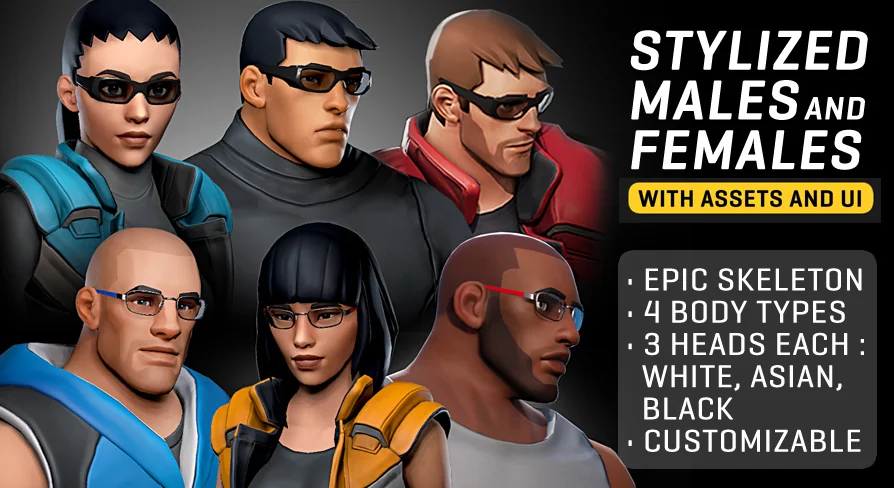
The core of the package is a modular character workflow. Bodies, ethnic heads, clothing pieces, hair styles, and accessories are all part of the set, and the items are split into clear body regions: head, upper, lower, hands, and feet. That structure makes the pack immediately relevant for projects that need visible character variation, especially when the goal is to let a player or developer swap parts instead of maintaining separate fully assembled characters for every combination.
Character customization in motion
The most practical part of this bundle is that it does not stop at loose character pieces. It includes a duplicate of the default thirdperson controller with improved animations, which places the modular characters into a familiar gameplay framework. Instead of only offering assets to assemble, the set also shows how those assembled results behave in an active controller setup.
A functional example of a character customization menu is included as well. That matters for implementation because the modular parts are not isolated examples; they are presented in a usable interface where the swaps can be seen in context. For teams prototyping a customization flow, this gives a direct reference point for how the heads, clothing, and other segmented pieces can be presented and changed inside a running character system.
The package also includes a simple swapper BP demo. Alongside the customization menu demo, this adds another practical layer to the bundle’s setup angle. One example focuses on the menu side of character changes, while the swapper blueprint demo points toward the moment-to-moment act of replacing parts. Together, those pieces make the asset easier to evaluate as a workflow resource instead of only a character art set.
Nine variants across UE4, UE5, Lyra, and Metahuman
The character lineup spans nine variants:
UE4 Male
UE4 Female
UE4 Tall Female
UE4 Buff Male
Tall Metahuman Male
Tall Metahuman Female
UE5 Lyra Male
UE5 Lyra Female
UE5 Lyra Buff Male
That range gives the bundle a broader implementation footprint inside Unreal character pipelines. It does not stay limited to one body type or one framework. Standard male and female variants are present, but the set also extends into taller and buff character forms, plus Metahuman and Lyra-based entries. For anyone comparing how a modular system might behave across different established Unreal character setups, this spread is one of the most concrete parts of the package.
The resource is built on the Epic skeleton for UE4 and UE5. This is one of the central compatibility details because it ties the modular character content directly to a known Unreal character rigging standard. The improved third-person controller duplicate and the listed UE4, UE5, Lyra, and Metahuman variants all fit into that broader picture of a bundle aimed at practical Unreal use rather than isolated stylized meshes.
Modular bodies, ethnic heads, clothing, hair, and accessories
On the content side, the bundle combines several categories of interchangeable elements. Modular bodies form the base of the character system. Ethnic heads are explicitly included in White, Black, and Asian variants, which expands visible character variety through head selection rather than relying on a single facial type. Clothing pieces, hair styles, and accessories then add further layers of assembly.
The split between head, upper, lower, hands, and feet is especially important for setup. It defines how the modularity is organized and suggests a clean part-based approach to assembly. A project can treat those regions as separate customization points instead of trying to replace a full character every time a visual change is needed. In practice, that means the bundle is framed around recombining sections and presenting those changes through the included UI and swapper examples.
The stylized look is another constant across the package. The tags connect it with contemporary and modern themes, while the character naming and included male and female variants keep the set grounded in recognizable person-based customization rather than fantasy creatures or hard-surface troops. Even so, the modular setup makes the resource less about one finished look and more about how a scene can present a range of character identities through a shared system.
What the included demos and tutorials support
The bundle includes more than one form of implementation help. There is documentation, a customization menu demo, a simple swapper BP demo, and a tutorial on how to use a custom character model with a character controller while assembling multiple parts. Those pieces support different stages of setup.
The documentation and tutorial speak to the assembly process itself: using a custom character model, connecting it with a character controller, and handling multiple parts as one playable result. That is a specific production concern in modular character work. A stylized character pack can contain many attractive pieces, but the practical challenge usually appears when those pieces need to function together inside a controller-driven character. This bundle addresses that area directly by including a tutorial focused on custom character model use and multi-part assembly.
The demos serve a slightly different role. The customization menu demo shows presentation and selection in context. The simple swapper BP demo points toward the logic of changing pieces. The duplicate thirdperson controller with improved animations helps close the loop by showing the character active in motion once those parts are assembled. Taken together, those inclusions make the pack read as a setup resource as much as an art resource.
PO-Art compatibility and where this bundle fits
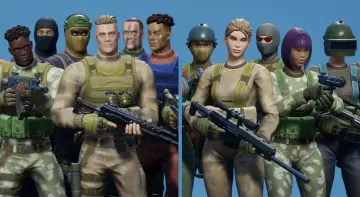
The resource is presented alongside other PO-Art compatible products: a Scifi Trooper set with heads, an Elf set with heads, a Fantasy Knight set, and a Female Mannequin. That compatibility note places this bundle inside a wider character ecosystem rather than isolating it as a one-off release.
For implementation planning, this is relevant because the stylized male and female set is not only a collection of modern characters with modular parts and UI examples. It also sits within a group of compatible character products that appear to share a broader approach. The immediate value here is not in any unstated cross-pack promise, but in the fact that compatibility is explicitly called out.
The strongest concrete takeaway is the bundle’s combination of modular character parts, nine Unreal-oriented variants, Epic skeleton support for UE4 and UE5, and included examples for customization, swapping, and controller-based assembly. Teams evaluating it are really evaluating a complete character setup workflow: parts divided into head, upper, lower, hands, and feet, shown through a working UI and backed by playable third-person context.
 Characters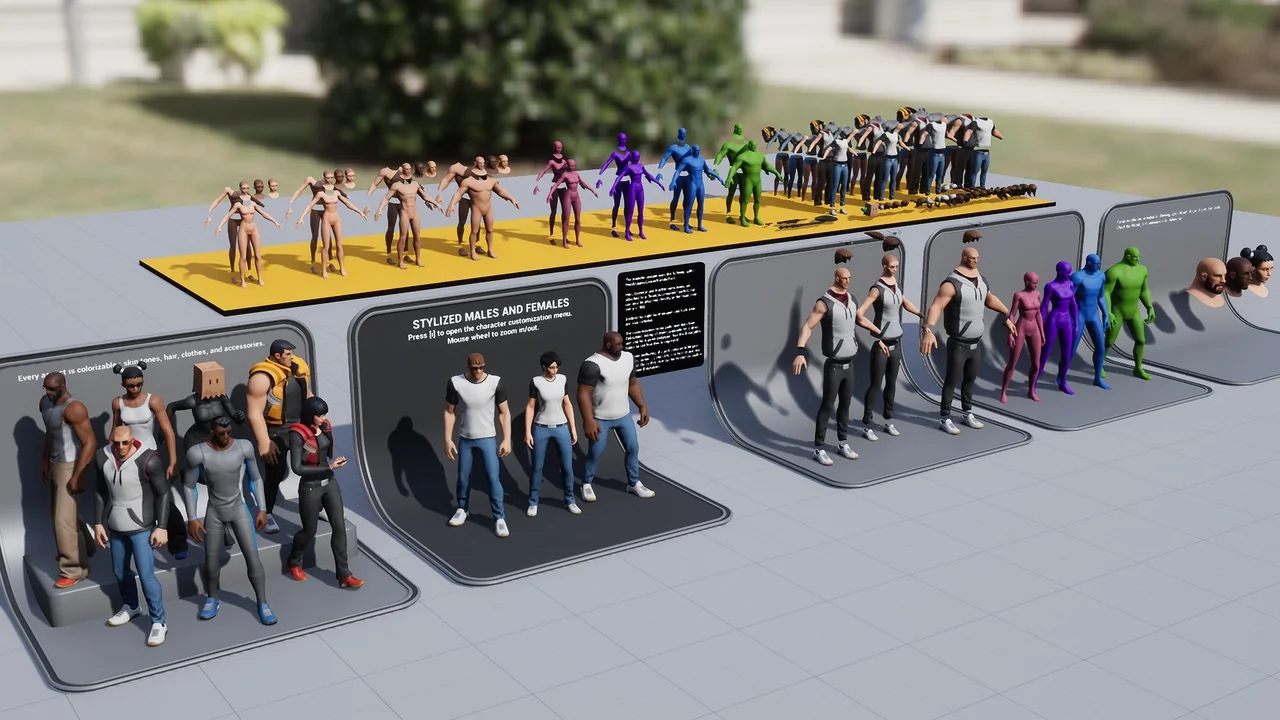
 Characters
 Characters
 Characters