"c68a05d5e51405b3"{"id":"1000687","slug":"stylized-china-town-stylized-stylised-chinese-china-china-city-lowpoly-asian","title":"Stylized China Town ( Stylized Stylised Chinese China China City Lowpoly Asian )","category":"Cyberpunk","engine":"5.0+","assetVersion":"","engineVersion":"Engine Version: 5.0+","tag":"Cyberpunk","accent":"blue","visual":"city","summary":"Cyberpunk slums environment pack with 125 unique stylized meshes, Lumen-enabled lighting, and optimized assets for Unreal Engine game-ready projects.","platform":"Unreal Engine","publishedAt":"2026-07-23T07:36:25.170Z","updatedAt":"2026-07-23T07:36:25.170Z","sourceNotes":[],"fileContents":[],"compatibility":["Unreal Engine","Engine Version: 5.0+"],"featuredImage":{"alt":"Stylized China Town ( Stylized Stylised Chinese China China City Lowpoly Asian )","src":"/wp-content/uploads/published/2026/07/01bcf6b21b08-eea68c86-bc87-4aae-9074-080b7e3eb8ca-54b73df586.webp"},"hasDownloadLink":true,"downloads":0,"terms":[{"taxonomy":"category","slug":"cyberpunk","name":"Cyberpunk"}],"galleryImages":[{"src":"/wp-content/uploads/published/2026/07/0769fd820701-ce6d8a56-5cf0-4330-8d6c-911526f0e30b-145e77861b.webp","alt":"Stylized China Town ( Stylized Stylised Chinese China China City Lowpoly Asian )"},{"src":"/wp-content/uploads/published/2026/07/e55b05a05b5a-9bf30a23-5c00-43a6-a934-2c81012820b7-62fc9ec33b.webp","alt":"Stylized China Town ( Stylized Stylised Chinese China China City Lowpoly Asian )"},{"src":"/wp-content/uploads/published/2026/07/7c3fd63c0e99-7c9da142-9666-4696-8e97-e3339f70153e-c6dca552a1.webp","alt":"Stylized China Town ( Stylized Stylised Chinese China China City Lowpoly Asian )"},{"src":"/wp-content/uploads/published/2026/07/524ada99346a-4bda3c1e-c072-4570-bf73-5ec9affd5aee-a0c90604a8.webp","alt":"Stylized China Town ( Stylized Stylised Chinese China China City Lowpoly Asian )"},{"src":"/wp-content/uploads/published/2026/07/cadd510e27a4-5b1668cd-b729-46c0-852b-900223ca7922-667cae05d0.webp","alt":"Stylized China Town ( Stylized Stylised Chinese China China City Lowpoly Asian )"},{"src":"/wp-content/uploads/published/2026/07/d19ba7d84f84-0a5fd600-61d8-428d-b3c1-8f10ee885bd1-f44d809971.webp","alt":"Stylized China Town ( Stylized Stylised Chinese China China City Lowpoly Asian )"},{"src":"/wp-content/uploads/published/2026/07/1cb65879add4-70d4dea8-e654-44af-b52b-a7842ff8c632-28be447d01.webp","alt":"Stylized China Town ( Stylized Stylised Chinese China China City Lowpoly Asian )"},{"src":"/wp-content/uploads/published/2026/07/353777e6e2f3-30768407-45bd-4985-bda8-0784f738c307-92f0bc5e0e.webp","alt":"Stylized China Town ( Stylized Stylised Chinese China China City Lowpoly Asian )"},{"src":"/wp-content/uploads/published/2026/07/5f6c2621bf12-6963f6c2-e426-423c-b6dd-824ffee3ecec-83cfe2ce30.webp","alt":"Stylized China Town ( Stylized Stylised Chinese China China City Lowpoly Asian )"},{"src":"/wp-content/uploads/published/2026/07/de008a127600-546703ab-980b-4e44-aa6a-b097cc457c5d-3cdd37ebd6.webp","alt":"Stylized China Town ( Stylized Stylised Chinese China China City Lowpoly Asian )"}],"accessPanel":{"kind":"resource","title":"Download this resource","eyebrow":"Free Download","message":"Log in or create a free account to start your download.","fileName":"Chinatown.7z","safetyNote":"Resources are manually reviewed before listing to improve quality and reduce obvious risks.","actionLabel":"Download Free","resourceType":"Resource archive"},"contentHtml":"\u003ch2\u003eDropping Stylized China Town into a Cyberpunk Slums Scene\u003c/h2\u003e\n\u003cp\u003eWhen a project calls for a cyberpunk-inflected Chinatown, the environment needs to read instantly as dense, lived-in, and layered with Asian architectural detail. Stylized China Town addresses this by delivering a cyberpunk slums setting shaped by 125 unique meshes. Every showcased asset in the pack ships with the download, so what appears in the showcase video translates directly into what teams place inside their levels.\u003c/p\u003e\n\u003cp\u003eThe asset set works as a modular Chinese city. That modularity means level designers can compose alleyways, rooftops, market stalls, and apartment exteriors from individual pieces rather than wrestling with monolithic prefabs. The low-poly stylized approach keeps the visual language consistent across everything from tea houses and pagoda architecture to cyberpunk skyscrapers and neon billboards.\u003c/p\u003e\n\n\u003ch2\u003eHow the 125 Unique Meshes Support Level Construction\u003c/h2\u003e\n\u003cp\u003eThe mesh count matters for practical scene assembly. With 125 unique meshes, the pack provides enough variety to avoid the repeated-asset look that undermines stylized environments. A designer building a Chinese district can pull from distinct architectural elements: traditional houses, wooden structures, bridges, and shops, which sit alongside cyberpunk elements like LED screens, neon signs, and high-tech street fixtures.\u003c/p\u003e\n\u003cp\u003eThe range covers both exterior and street-level detail. Food stalls, market stalls, and food courts let designers populate the ground level with activity. Rooftop scenes and rooftop restaurants extend the playable or cinematic space upward, which is critical for a cyberpunk setting where verticality defines the atmosphere. Hidden alleyways, secret passageways, and overgrown alleys provide the tight transitional spaces that make a stylized Chinatown feel navigable.\u003c/p\u003e\n\n\u003ch3\u003eArchitectural and Prop Variety Within the Mesh Set\u003c/h3\u003e\n\u003cp\u003eThe pack pulls from a broad architectural vocabulary. Chinese pagoda architecture, temple structures, and tea houses cover traditional building types. Chinese apartments, shopping districts, and docks expand into residential and commercial zones. Chinatown bridges and courtyards add connective tissue between districts. On the cyberpunk side, skyscrapers, tech markets, high-tech streets, and night clubs push the environment toward a futuristic Asian city aesthetic.\u003c/p\u003e\n\u003cp\u003eProp-level detail fills out the scene density. Dragon statues, sky lanterns, calligraphy signs, and graffiti walls add cultural specificity. Neon billboards and LED screens handle the cyberpunk lighting layer. Street vendors, food stalls, and gambling houses inject points of interest for exploration. The combination lets a single pack service both a fantasy Chinese marketplace and an open-world cyberpunk district without requiring supplementary asset purchases.\u003c/p\u003e\n\n\u003ch2\u003eLumen-Enabled Lighting and Optimization for Unreal Engine\u003c/h2\u003e\n\u003cp\u003eThe pack ships with Lumen enabled. For Unreal Engine projects, that means the stylized Chinatown can take advantage of real-time global illumination without additional lighting setup. Neon signs, LED screens, sky lanterns, and Chinatown night lights interact with surfaces through Lumen rather than requiring baked lightmaps or manual light placement for every emissive element. The documentation references Lumen documentation for technical guidance, which signals that the lighting setup is intended to work within Unreal Engine's current rendering pipeline rather than relying on legacy approaches.\u003c/p\u003e\n\u003cp\u003eOptimization is stated directly. The assets are described as well-optimized and game-ready, with a good level of detail. That positioning places the pack in the AAA game-ready environment category, where performance budgets matter alongside visual quality. For open-world Chinatown builds, the low-poly stylized aesthetic naturally supports draw-call management, and the modularity lets teams stream districts in and out as needed.\u003c/p\u003e\n\n\u003ch2\u003ePopulating Game Environments and Virtual Production Levels\u003c/h2\u003e\n\u003cp\u003eThe stated use cases cover two tracks. For game development, the pack supports FPS Chinatown scenes, open-world exploration, and Chinatown adventure layouts. The modular Chinese city approach means a team can block out a full district from the component meshes and then refine placement iteratively. Chinese cultural streets, night markets, and temple districts can all be assembled from the same asset pool.\u003c/p\u003e\n\u003cp\u003eFor virtual production, the same assets function as set pieces. The night ambience, street vibes, and festival streets translate to cinematic backdrops where the stylized look holds up under camera framing. Because Lumen handles the lighting response, virtual production setups running in Unreal Engine can adjust scene lighting on the fly without rebaking.\u003c/p\u003e\n\n\u003ch3\u003eScene Types the Asset Set Can Construct\u003c/h3\u003e\n\u003cp\u003eThe tag list attached to the pack reveals the specific scene configurations the creator anticipates. An open-world stylized Chinatown is the primary layout, but the tags also reference hidden Chinatown passages, abandoned streets, overgrown alleys, and secret temples. That range means the pack is not limited to a clean, bustling market. A team could build a degraded cyberpunk district with graffiti walls, abandoned gambling houses, and overgrown passages using the same mesh library.\u003c/p\u003e\n\u003cp\u003eThe tags also reference a Chinese temple district, Chinese docks, and a cultural center. These extend the pack beyond a single neighborhood block into a connected cityscape. Bridges, courtyards, and passageways serve as the connective geometry between these zones.\u003c/p\u003e\n\n\u003ch2\u003eCompatibility and Scale Considerations\u003c/h2\u003e\n\u003cp\u003eThe editor notes list compatibility with Stylized European Village. For teams already working with that pack, the Stylized China Town meshes can sit alongside European Village assets within a shared project, which is useful for builds that span multiple cultural districts within a single open world. The stylized rendering approach in both packs shares a low-poly aesthetic, so the visual transition between a European village and a Chinatown district stays consistent.\u003c/p\u003e\n\u003cp\u003eThe pack positions itself within the Unreal Engine ecosystem. Tags reference Unreal Engine stylized, Unreal Engine game-ready, and Unreal Engine modular Asian city workflows. The AAA designation in the tag list indicates the asset quality targets production-scale projects rather than hobbyist experiments. For teams evaluating the pack, the concrete takeaway is straightforward: 125 unique meshes, Lumen enabled out of the box, modularity for district-scale assembly, and cross-compatibility with the Stylized European Village for multi-region world builds.\u003c/p\u003e\n\n\u003ch2\u003eContinue Browsing Similar Packs\u003c/h2\u003e\n\u003cul\u003e\n\u003cli\u003e\u003ca href=\"https://3dcghub.com/cyberpunk-night-street-cyberpunk-town-cyberpunk-props-night-city/\" title=\"Cyberpunk Night Street ( Cyberpunk Town, Cyberpunk Props , Night City )\"\u003eCyberpunk Night Street ( Cyberpunk Town, Cyberpunk Props , Night City )\u003c/a\u003e\u003c/li\u003e\n\u003cli\u003e\u003ca href=\"https://3dcghub.com/cyber-night-city/\" title=\"Cyber Night City\"\u003eCyber Night City\u003c/a\u003e\u003c/li\u003e\n\u003cli\u003e\u003ca href=\"https://3dcghub.com/cyber-town-pack/\" title=\"Cyber-Town Pack\"\u003eCyber-Town Pack\u003c/a\u003e\u003c/li\u003e\n\u003cli\u003e\u003ca href=\"https://3dcghub.com/cyberpunk-high-city/\" title=\"Cyberpunk - High City\"\u003eCyberpunk - High City\u003c/a\u003e\u003c/li\u003e\n\u003cli\u003e\u003ca href=\"https://3dcghub.com/cyberpunk-port-city-environment-cyberpunk-port-city-cyber-cyperpunk-port-3d/\" title=\"Cyberpunk Port City Environment ( Cyberpunk Port City Cyber Cyperpunk Port 3D )\"\u003eCyberpunk Port City Environment ( Cyberpunk Port City Cyber Cyperpunk Port 3D )\u003c/a\u003e\u003c/li\u003e\n\u003c/ul\u003e","contentTextLength":6837,"navigation":{"current":1317,"total":3860,"previous":{"id":"1000688","slug":"stylized-egypt-textures-rpg-environment","title":"Stylized Egypt Textures - RPG Environment","category":"Nature \u0026 Terrain","platform":"Unreal Engine","updatedAt":"2026-07-23T07:51:12.332Z"},"next":{"id":"1000686","slug":"stylish-dual-gunner-pack-action-rpg-game","title":"Stylish Dual Gunner Pack Action RPG Game","category":"Combat","platform":"Unreal Engine","updatedAt":"2026-07-22T19:45:21.243Z"}},"relatedResources":[{"id":"7617","slug":"cyberpunk-night-street-cyberpunk-town-cyberpunk-props-night-city","title":"Cyberpunk Night Street ( Cyberpunk Town, Cyberpunk Props , Night City )","category":"Cyberpunk","engine":"5.1+","assetVersion":"Engine version: 5.1+","engineVersion":"5.1","tag":"Cyberpunk","accent":"blue","visual":"city","summary":"Transform your digital environments with a comprehensive collection of modular buildings, neon props, and gritty street assets designed for futuristic cityscapes.","platform":"Unreal Engine","publishedAt":"2026-02-21T17:05:44.000Z","updatedAt":"2026-07-13T11:55:33.583Z","sourceNotes":[],"fileContents":[],"compatibility":["Unreal Engine","Engine version: 5.1+"],"featuredImage":{"alt":"Cyberpunk Night Street ( Cyberpunk Town, Cyberpunk Props , Night City )","src":"https://3dcghub.com/wp-content/uploads/2026/02/98b1667a-a348-4361-aee6-0a3281b3f848.webp"},"hasDownloadLink":true,"downloads":1},{"id":"7521","slug":"cyber-night-city","title":"Cyber Night City","category":"Cyberpunk","engine":"5.1+","assetVersion":"Engine version: 5.1+","engineVersion":"5.1","tag":"Cyberpunk","accent":"blue","visual":"city","summary":"Transform your project with a vibrant urban aesthetic using this extensive collection of stylized 3D assets. Designed specifically for Unreal Engine 5, it offers everything needed to build a detailed neon-lit metropolis.","platform":"Unreal Engine","publishedAt":"2026-02-21T16:41:54.000Z","updatedAt":"2026-04-19T15:55:58.000Z","sourceNotes":[],"fileContents":[],"compatibility":["Unreal Engine","Engine version: 5.1+"],"featuredImage":{"alt":"Cyber Night City","src":"https://3dcghub.com/wp-content/uploads/2026/02/4d70fd2c-9e04-4860-b3cb-fc0110fc3c4d.webp"},"hasDownloadLink":true,"downloads":2},{"id":"1001086","slug":"fantasy-medieval-kingdom-stylized-castle-town-village-dungeon-kingdom","title":"Fantasy Medieval Kingdom (Stylized Castle, Town, Village, Dungeon, Kingdom)","category":"Fantasy","engine":"5.0+","assetVersion":"","engineVersion":"Engine Version: 5.0+","tag":"Fantasy","accent":"blue","visual":"mech","summary":"Fully playable 2x2 km stylized medieval open world with castle city, village, magic forest, dungeons, docks, underwater zones, modular buildings, and full inter","platform":"Unreal Engine","publishedAt":"2026-09-04T16:54:26.409Z","updatedAt":"2026-09-04T16:54:26.409Z","sourceNotes":[],"fileContents":[],"compatibility":["Unreal Engine","Engine Version: 5.0+"],"featuredImage":{"alt":"Fantasy Medieval Kingdom (Stylized Castle, Town, Village, Dungeon, Kingdom)","src":"/wp-content/uploads/published/2026/09/a67503d4b022-dd68fe93-0fdf-41df-bcd0-363d13ef92f5-d48693974f.webp"},"hasDownloadLink":true,"downloads":6}]}
Cyberpunk
Stylized China Town ( Stylized Stylised Chinese China China City Lowpoly Asian )
Cyberpunk slums environment pack with 125 unique stylized meshes, Lumen-enabled lighting, and optimized assets for Unreal Engine game-ready projects.
Dropping Stylized China Town into a Cyberpunk Slums Scene
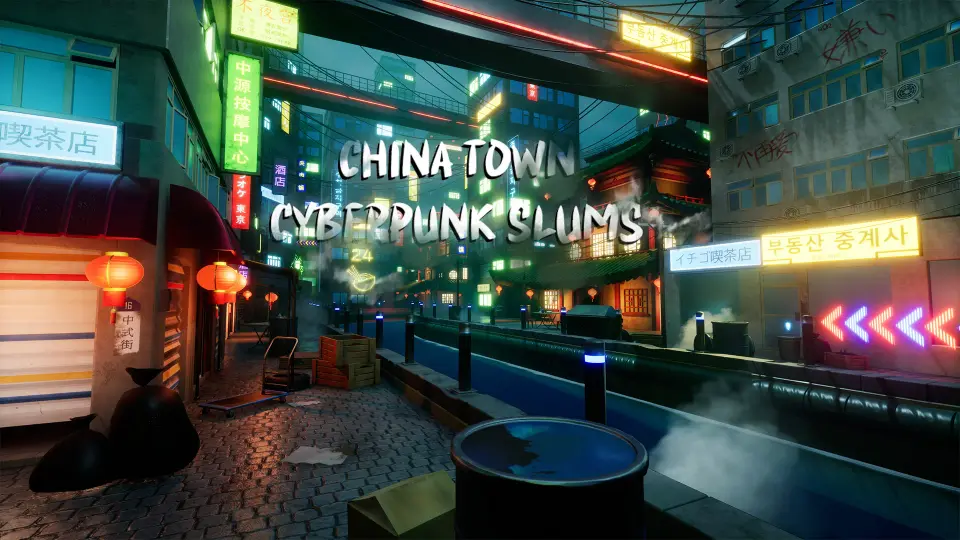
When a project calls for a cyberpunk-inflected Chinatown, the environment needs to read instantly as dense, lived-in, and layered with Asian architectural detail. Stylized China Town addresses this by delivering a cyberpunk slums setting shaped by 125 unique meshes. Every showcased asset in the pack ships with the download, so what appears in the showcase video translates directly into what teams place inside their levels.
The asset set works as a modular Chinese city. That modularity means level designers can compose alleyways, rooftops, market stalls, and apartment exteriors from individual pieces rather than wrestling with monolithic prefabs. The low-poly stylized approach keeps the visual language consistent across everything from tea houses and pagoda architecture to cyberpunk skyscrapers and neon billboards.
How the 125 Unique Meshes Support Level Construction
The mesh count matters for practical scene assembly. With 125 unique meshes, the pack provides enough variety to avoid the repeated-asset look that undermines stylized environments. A designer building a Chinese district can pull from distinct architectural elements: traditional houses, wooden structures, bridges, and shops, which sit alongside cyberpunk elements like LED screens, neon signs, and high-tech street fixtures.
The range covers both exterior and street-level detail. Food stalls, market stalls, and food courts let designers populate the ground level with activity. Rooftop scenes and rooftop restaurants extend the playable or cinematic space upward, which is critical for a cyberpunk setting where verticality defines the atmosphere. Hidden alleyways, secret passageways, and overgrown alleys provide the tight transitional spaces that make a stylized Chinatown feel navigable.
Architectural and Prop Variety Within the Mesh Set
The pack pulls from a broad architectural vocabulary. Chinese pagoda architecture, temple structures, and tea houses cover traditional building types. Chinese apartments, shopping districts, and docks expand into residential and commercial zones. Chinatown bridges and courtyards add connective tissue between districts. On the cyberpunk side, skyscrapers, tech markets, high-tech streets, and night clubs push the environment toward a futuristic Asian city aesthetic.
Prop-level detail fills out the scene density. Dragon statues, sky lanterns, calligraphy signs, and graffiti walls add cultural specificity. Neon billboards and LED screens handle the cyberpunk lighting layer. Street vendors, food stalls, and gambling houses inject points of interest for exploration. The combination lets a single pack service both a fantasy Chinese marketplace and an open-world cyberpunk district without requiring supplementary asset purchases.
Lumen-Enabled Lighting and Optimization for Unreal Engine
The pack ships with Lumen enabled. For Unreal Engine projects, that means the stylized Chinatown can take advantage of real-time global illumination without additional lighting setup. Neon signs, LED screens, sky lanterns, and Chinatown night lights interact with surfaces through Lumen rather than requiring baked lightmaps or manual light placement for every emissive element. The documentation references Lumen documentation for technical guidance, which signals that the lighting setup is intended to work within Unreal Engine's current rendering pipeline rather than relying on legacy approaches.
Optimization is stated directly. The assets are described as well-optimized and game-ready, with a good level of detail. That positioning places the pack in the AAA game-ready environment category, where performance budgets matter alongside visual quality. For open-world Chinatown builds, the low-poly stylized aesthetic naturally supports draw-call management, and the modularity lets teams stream districts in and out as needed.
Populating Game Environments and Virtual Production Levels
The stated use cases cover two tracks. For game development, the pack supports FPS Chinatown scenes, open-world exploration, and Chinatown adventure layouts. The modular Chinese city approach means a team can block out a full district from the component meshes and then refine placement iteratively. Chinese cultural streets, night markets, and temple districts can all be assembled from the same asset pool.
For virtual production, the same assets function as set pieces. The night ambience, street vibes, and festival streets translate to cinematic backdrops where the stylized look holds up under camera framing. Because Lumen handles the lighting response, virtual production setups running in Unreal Engine can adjust scene lighting on the fly without rebaking.
Scene Types the Asset Set Can Construct
The tag list attached to the pack reveals the specific scene configurations the creator anticipates. An open-world stylized Chinatown is the primary layout, but the tags also reference hidden Chinatown passages, abandoned streets, overgrown alleys, and secret temples. That range means the pack is not limited to a clean, bustling market. A team could build a degraded cyberpunk district with graffiti walls, abandoned gambling houses, and overgrown passages using the same mesh library.
The tags also reference a Chinese temple district, Chinese docks, and a cultural center. These extend the pack beyond a single neighborhood block into a connected cityscape. Bridges, courtyards, and passageways serve as the connective geometry between these zones.
Compatibility and Scale Considerations
The editor notes list compatibility with Stylized European Village. For teams already working with that pack, the Stylized China Town meshes can sit alongside European Village assets within a shared project, which is useful for builds that span multiple cultural districts within a single open world. The stylized rendering approach in both packs shares a low-poly aesthetic, so the visual transition between a European village and a Chinatown district stays consistent.
The pack positions itself within the Unreal Engine ecosystem. Tags reference Unreal Engine stylized, Unreal Engine game-ready, and Unreal Engine modular Asian city workflows. The AAA designation in the tag list indicates the asset quality targets production-scale projects rather than hobbyist experiments. For teams evaluating the pack, the concrete takeaway is straightforward: 125 unique meshes, Lumen enabled out of the box, modularity for district-scale assembly, and cross-compatibility with the Stylized European Village for multi-region world builds.
 Cyberpunk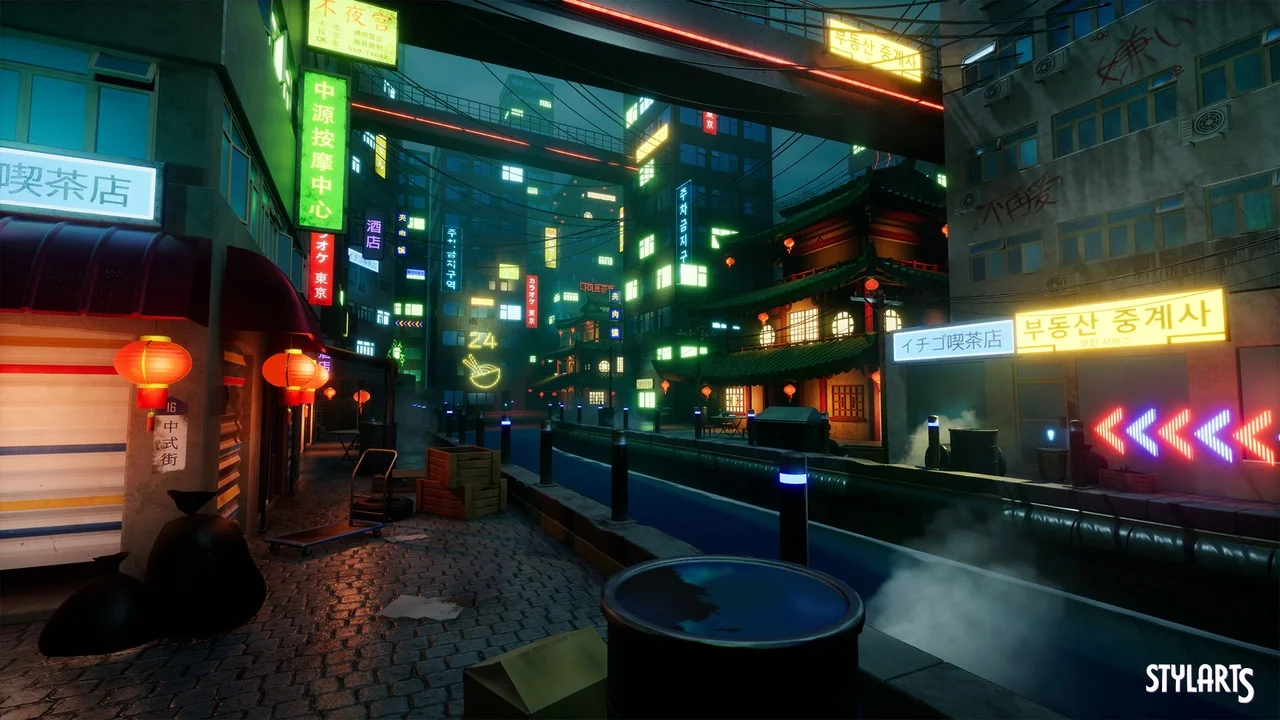
 Cyberpunk
 Cyberpunk
 Fantasy