"ad3a186885ec58a6"{"id":"1000502","slug":"cyber-town-pack","title":"Cyber-Town Pack","category":"Cyberpunk","engine":"5.0+","assetVersion":"","engineVersion":"Engine Version: 5.0+","tag":"Cyberpunk","accent":"blue","visual":"mech","summary":"Unreal Engine 5.4 asset pack for building cyberpunk cityscapes with procedural Building Generator, spline tools, customizable billboards, and collision-ready me","platform":"Unreal Engine","publishedAt":"2026-07-13T12:01:34.207Z","updatedAt":"2026-07-13T12:01:34.207Z","sourceNotes":[],"fileContents":[],"compatibility":["Unreal Engine","Engine Version: 5.0+"],"featuredImage":{"alt":"Cyber-Town Pack","src":"/wp-content/uploads/published/2026/07/f8d57dd3ab23-1c845ae9-51d2-461b-a4f1-aa7b2e9cfc92-b8d7dfb8c6.webp"},"hasDownloadLink":true,"downloads":0,"terms":[{"taxonomy":"category","slug":"cyberpunk","name":"Cyberpunk"}],"galleryImages":[{"src":"/wp-content/uploads/published/2026/07/37591556251f-471c5e04-f41e-4d0e-901c-d9ceaeaeab92-43add2bab4.webp","alt":"Cyber-Town Pack"},{"src":"/wp-content/uploads/published/2026/07/361c225907a2-f96a38e2-ed59-4b93-adb6-5f3e3974bb95-52652b39f6.webp","alt":"Cyber-Town Pack"},{"src":"/wp-content/uploads/published/2026/07/aa7805c53e81-b3be46c7-1ba0-4d11-9148-4c777b0e871a-3e6102435f.webp","alt":"Cyber-Town Pack"},{"src":"/wp-content/uploads/published/2026/07/3484c990b971-1e39a697-9d7f-4036-a17b-3a69096dcac1-e7de6704e3.webp","alt":"Cyber-Town Pack"},{"src":"/wp-content/uploads/published/2026/07/9ac376d74471-f35191ef-9dd9-4039-b307-98d56fac6686-3c0f360158.webp","alt":"Cyber-Town Pack"},{"src":"/wp-content/uploads/published/2026/07/0fa45d6e4be1-0f1177d8-338d-4b5c-8e36-4b60c27a697a-561ca1a678.webp","alt":"Cyber-Town Pack"},{"src":"/wp-content/uploads/published/2026/07/4f3eae5769ac-f9edcee2-7d7a-4204-983f-29c6472cf252-0fdde96b6d.webp","alt":"Cyber-Town Pack"},{"src":"/wp-content/uploads/published/2026/07/066a46673f12-6bc35a2b-2296-4323-91f9-2ed8de56d943-c4cc72e07d.webp","alt":"Cyber-Town Pack"},{"src":"/wp-content/uploads/published/2026/07/0a9166917931-e5eb1e24-0349-46ce-af28-a0e04a718a00-047e2129b0.webp","alt":"Cyber-Town Pack"},{"src":"/wp-content/uploads/published/2026/07/d2324e656c22-0e49a80c-684d-406d-aee7-8a7431a9706b-a1becd4a5a.webp","alt":"Cyber-Town Pack"}],"accessPanel":{"kind":"resource","title":"Download this resource","eyebrow":"Free Download","message":"Log in or create a free account to start your download.","fileName":"Content.7z","safetyNote":"Resources are manually reviewed before listing to improve quality and reduce obvious risks.","actionLabel":"Download Free","resourceType":"Resource archive"},"contentHtml":"\u003cp\u003eBuilding a dense cyberpunk cityscape in Unreal Engine usually means manually placing hundreds of meshes, aligning neon signs, and struggling to keep pipeline routes believable. The Cyber-Town Pack shifts that workflow by treating environment assembly as a procedural operation. Rather than delivering a static library of props, it combines high-quality assets with utility tools that handle structural generation, spline-based routing, and billboard customization.\u003c/p\u003e \u003cp\u003eThe pack functions as a construction framework where scenes grow through tool-driven inputs rather than drag-and-drop placement. Creators define building logic, route pipes along surfaces, and populate the skyline with illuminated signage—all through dedicated instrument panels built into the Unreal Engine plugin.\u003c/p\u003e \u003ch2\u003eUnreal Engine 5.4 and the Cyber-Town Building Generator\u003c/h2\u003e\n\u003cp\u003eCompatibility is confirmed for Unreal Engine 5.4, aligning the toolset with the current generation of the engine's rendering and blueprint architecture.\u003c/p\u003e \u003cp\u003eThe central utility is the Building Generator. Instead of authoring individual structures mesh by mesh, creators use the generator to produce building structures dynamically. The parameters feed directly into how a scene reads at a block level—determining massing, repetition, and density with far less manual placement.\u003c/p\u003e \u003cp\u003eThis generation extends to fire escape blueprints, integrating that dense, layered mechanical look characteristic of cyberpunk downtown environments. Rather than relying on separate static mesh libraries and careful alignment, the blueprints handle the structural logic automatically, embedding exterior features directly into the generated building logic.\u003c/p\u003e \u003ch3\u003eBaking Blueprints to Static Mesh Actors\u003c/h3\u003e\n\u003cp\u003ePurely procedural systems can sometimes carry a runtime cost, especially when complex blueprints populate a large scene. The pack includes baking functionality specifically for the Building Structure and Fire Escape blueprints. This allows creators to convert the generated procedural logic into standard static mesh actors.\u003c/p\u003e \u003cp\u003eThe operational benefit is a direct save in performance overhead. By resolving the dynamic calculations into baked geometry, the final scene retains the visual complexity of the generator's output while stripping away the continuous evaluation required by active blueprints during play.\u003c/p\u003e \u003ch2\u003eSpline Tools for Railings, Pipes, and Downtown Routing\u003c/h2\u003e\n\u003cp\u003eDetails make a cyberpunk alley feel populated. The pack includes dedicated spline tools for railings and pipes. These tools let creators draw paths through the environment along which the corresponding meshes are distributed automatically.\u003c/p\u003e \u003cp\u003eThis is a significant shift from manual vertex-snapping or static placement. A pipe running down the side of a generated building, or a safety railing tracing the edge of a walkway, acquires natural curvature and consistent spacing by following the assigned spline path. Environmental concourse elements like exterior wiring, structural bracing, and industrial plumbing can be routed quickly to match the visual complexity expected in a futuristic downtown scene.\u003c/p\u003e \u003ch2\u003eCustomizable Billboards, Neon Signs, and Cyberpunk Atmosphere\u003c/h2\u003e\n\u003cp\u003eA core visual identifier of the genre is pervasive illuminated signage. The pack addresses this with a Customizable Billboard Tool. This system allows creators to populate the environment with glowing advertisements and signs that define the vertical space of a cityscape.\u003c/p\u003e \u003cp\u003eThe thematic tags associated with the asset paint a clear picture of the intended aesthetic: Retro, Futuristic, Neon, Cybernetic, and Electric. Combined with structural elements like Hover, Car, and Alley, the visual targets extend toward vehicles and ground-level corridors. The intent is to provide the pieces needed to construct a cohesive, highly stylized urban sprawl—from the glow of a downtown sign to the industrial grime of a back alley structure.\u003c/p\u003e \u003ch2\u003eCollision Readiness and Iterative Stability Fixes\u003c/h2\u003e\n\u003cp\u003eFor any environment asset intended for interactive or playable contexts, reliable collision is mandatory. The assets are built to be collision-ready. This means the generated buildings, spline meshes, and individual props are equipped to interact physically with actors in the scene, preventing characters or vehicles from passing through solid geometry.\u003c/p\u003e \u003cp\u003eThe development cycle shows an active approach to resolving technical friction points. An early issue corrected in version 1.2 addressed file corruption that caused Building Structures to vanish in packaged builds and standalone sessions. That same update corrected a related visibility failure affecting spline tools in packaged builds. These were critical fixes, as tools that function perfectly in the editor but break upon packaging significantly hinder production pipelines.\u003c/p\u003e \u003ch3\u003eDoor Frame Collision Resolution\u003c/h3\u003e\n\u003cp\u003eA subsequent update, version 1.3, targeted a specific collision anomaly with Door Frame 01a. The presence of a detailed fix for an individual architectural component indicates refinement to the precision of the collision meshing. Fixing a collision issue on a specific door frame ensures reliable navigation through tight interior spaces or alleyway entrances where a character's hitbox must interact cleanly with the threshold.\u003c/p\u003e \u003ch2\u003ePlayable Demonstration and Showcase Limitations\u003c/h2\u003e\n\u003cp\u003eTo verify how these tools perform within an interactive context, a playable demo is available. The demo provides a ground-level sense of how the generated structures, spline tools, and billboards hold up under rendering strain in a real-time environment.\u003c/p\u003e \u003cp\u003eIt is noted that the character utilized in the showcase material—specifically Murdock from the Paragon Free Pack—is not included in the pack itself. This distinction is important for production scope. The pack delivers the environment framework, the building logic, and the visual atmosphere, but studios must supply their own third-person or first-person actors for traversal testing.\u003c/p\u003e \u003ch2\u003eEvaluation for Cyberpunk Level Construction\u003c/h2\u003e\n\u003cp\u003eThis resource is tailored for teams prioritizing environment construction speed without sacrificing the dense, cybernetic aesthetic required by the genre. The inclusion of a Building Generator and spline-based routing tools points toward creators who need to dress large areas efficiently. Larger studio pipelines can leverage the baking functionality to manage frame rates, while the procedural approach addresses the repeated tedium of dressing wide cityscapes.\u003c/p\u003e \u003cp\u003eThe pack provides a specific operational advantage: turning the tedious act of populating a futuristic city into an automated, tweakable process. For creators working on Unreal Engine 5.4 projects focused on cyberpunk, retro, or futuristic city themes, the procedural tools provided offer a distinct technical foundation for level design.\u003c/p\u003e\n\n\u003ch2\u003eMore From The Same Workflow\u003c/h2\u003e\n\u003cul\u003e\n\u003cli\u003e\u003ca href=\"https://3dcghub.com/cyberpunk-night-street-cyberpunk-town-cyberpunk-props-night-city/\" title=\"Cyberpunk Night Street ( Cyberpunk Town, Cyberpunk Props , Night City )\"\u003eCyberpunk Night Street ( Cyberpunk Town, Cyberpunk Props , Night City )\u003c/a\u003e\u003c/li\u003e\n\u003cli\u003e\u003ca href=\"https://3dcghub.com/cyberpunk-port-city-environment-cyberpunk-port-city-cyber-cyperpunk-port-3d/\" title=\"Cyberpunk Port City Environment ( Cyberpunk Port City Cyber Cyperpunk Port 3D )\"\u003eCyberpunk Port City Environment ( Cyberpunk Port City Cyber Cyperpunk Port 3D )\u003c/a\u003e\u003c/li\u003e\n\u003cli\u003e\u003ca href=\"https://3dcghub.com/cyber-night-city/\" title=\"Cyber Night City\"\u003eCyber Night City\u003c/a\u003e\u003c/li\u003e\n\u003cli\u003e\u003ca href=\"https://3dcghub.com/cyberpunk-sci-fi-bar-asset-pack-cyberpunk-sci-fii-bar-cyberpunk-bar-cyber/\" title=\"CyberPunk / Sci-Fi Bar Asset Pack ( CyberPunk Sci-Fii Bar Cyberpunk Bar Cyber )\"\u003eCyberPunk / Sci-Fi Bar Asset Pack ( CyberPunk Sci-Fii Bar Cyberpunk Bar Cyber )\u003c/a\u003e\u003c/li\u003e\n\u003cli\u003e\u003ca href=\"https://3dcghub.com/modular-stylized-cyberpunk-street-cyberpunk-cyber-street-cyberpunk-stylized/\" title=\"Modular Stylized Cyberpunk Street ( Cyberpunk Cyber Street Cyberpunk Stylized )\"\u003eModular Stylized Cyberpunk Street ( Cyberpunk Cyber Street Cyberpunk Stylized )\u003c/a\u003e\u003c/li\u003e\n\u003c/ul\u003e","contentTextLength":7109,"navigation":{"current":1257,"total":3619,"previous":{"id":"1000503","slug":"drivable-cars-supercar","title":"Drivable Cars: Supercar","category":"Cars \u0026 Trucks","platform":"Unreal Engine","updatedAt":"2026-07-13T12:08:55.990Z"},"next":{"id":"7617","slug":"cyberpunk-night-street-cyberpunk-town-cyberpunk-props-night-city","title":"Cyberpunk Night Street ( Cyberpunk Town, Cyberpunk Props , Night City )","category":"Cyberpunk","platform":"Unreal Engine","updatedAt":"2026-07-13T11:55:33.583Z"}},"relatedResources":[{"id":"1000687","slug":"stylized-china-town-stylized-stylised-chinese-china-china-city-lowpoly-asian","title":"Stylized China Town ( Stylized Stylised Chinese China China City Lowpoly Asian )","category":"Cyberpunk","engine":"5.0+","assetVersion":"","engineVersion":"Engine Version: 5.0+","tag":"Cyberpunk","accent":"blue","visual":"city","summary":"Cyberpunk slums environment pack with 125 unique stylized meshes, Lumen-enabled lighting, and optimized assets for Unreal Engine game-ready projects.","platform":"Unreal Engine","publishedAt":"2026-07-23T07:36:25.170Z","updatedAt":"2026-07-23T07:36:25.170Z","sourceNotes":[],"fileContents":[],"compatibility":["Unreal Engine","Engine Version: 5.0+"],"featuredImage":{"alt":"Stylized China Town ( Stylized Stylised Chinese China China City Lowpoly Asian )","src":"/wp-content/uploads/published/2026/07/01bcf6b21b08-eea68c86-bc87-4aae-9074-080b7e3eb8ca-54b73df586.webp"},"hasDownloadLink":true,"downloads":0},{"id":"7617","slug":"cyberpunk-night-street-cyberpunk-town-cyberpunk-props-night-city","title":"Cyberpunk Night Street ( Cyberpunk Town, Cyberpunk Props , Night City )","category":"Cyberpunk","engine":"5.1+","assetVersion":"Engine version: 5.1+","engineVersion":"5.1","tag":"Cyberpunk","accent":"blue","visual":"city","summary":"Transform your digital environments with a comprehensive collection of modular buildings, neon props, and gritty street assets designed for futuristic cityscapes.","platform":"Unreal Engine","publishedAt":"2026-02-21T17:05:44.000Z","updatedAt":"2026-07-13T11:55:33.583Z","sourceNotes":[],"fileContents":[],"compatibility":["Unreal Engine","Engine version: 5.1+"],"featuredImage":{"alt":"Cyberpunk Night Street ( Cyberpunk Town, Cyberpunk Props , Night City )","src":"https://3dcghub.com/wp-content/uploads/2026/02/98b1667a-a348-4361-aee6-0a3281b3f848.webp"},"hasDownloadLink":true,"downloads":0},{"id":"1000049","slug":"cyberpunk-port-city-environment-cyberpunk-port-city-cyber-cyperpunk-port-3d","title":"Cyberpunk Port City Environment ( Cyberpunk Port City Cyber Cyperpunk Port 3D )","category":"Cyberpunk","engine":"5.0+","assetVersion":"","engineVersion":"5.0+","tag":"Cyberpunk","accent":"blue","visual":"city","summary":"A cyberpunk port environment with 223 unique meshes, a preassembled scene, Unreal Engine 5 Lumen and Nanite support, and ULAT compatibility.","platform":"Unreal Engine","publishedAt":"2026-05-22T11:25:19.066Z","updatedAt":"2026-05-22T11:25:19.066Z","sourceNotes":[],"fileContents":[],"compatibility":["Unreal Engine","Engine version: 5.0+"],"featuredImage":{"alt":"Cyberpunk Port City Environment ( Cyberpunk Port City Cyber Cyperpunk Port 3D )","src":"/wp-content/uploads/published/2026/05/d393ecd1b05c-e8b7b059-5c0f-4346-a812-0e08c081591f-a9258e793e.webp"},"hasDownloadLink":true,"downloads":0}]}
Cyberpunk
Cyber-Town Pack
Unreal Engine 5.4 asset pack for building cyberpunk cityscapes with procedural Building Generator, spline tools, customizable billboards, and collision-ready me
Building a dense cyberpunk cityscape in Unreal Engine usually means manually placing hundreds of meshes, aligning neon signs, and struggling to keep pipeline routes believable. The Cyber-Town Pack shifts that workflow by treating environment assembly as a procedural operation. Rather than delivering a static library of props, it combines high-quality assets with utility tools that handle structural generation, spline-based routing, and billboard customization.
The pack functions as a construction framework where scenes grow through tool-driven inputs rather than drag-and-drop placement. Creators define building logic, route pipes along surfaces, and populate the skyline with illuminated signage—all through dedicated instrument panels built into the Unreal Engine plugin.
Unreal Engine 5.4 and the Cyber-Town Building Generator
Compatibility is confirmed for Unreal Engine 5.4, aligning the toolset with the current generation of the engine's rendering and blueprint architecture.
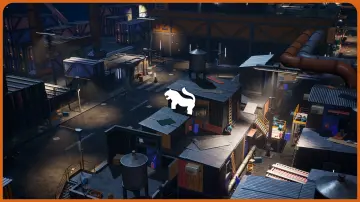
The central utility is the Building Generator. Instead of authoring individual structures mesh by mesh, creators use the generator to produce building structures dynamically. The parameters feed directly into how a scene reads at a block level—determining massing, repetition, and density with far less manual placement.
This generation extends to fire escape blueprints, integrating that dense, layered mechanical look characteristic of cyberpunk downtown environments. Rather than relying on separate static mesh libraries and careful alignment, the blueprints handle the structural logic automatically, embedding exterior features directly into the generated building logic.
Baking Blueprints to Static Mesh Actors
Purely procedural systems can sometimes carry a runtime cost, especially when complex blueprints populate a large scene. The pack includes baking functionality specifically for the Building Structure and Fire Escape blueprints. This allows creators to convert the generated procedural logic into standard static mesh actors.
The operational benefit is a direct save in performance overhead. By resolving the dynamic calculations into baked geometry, the final scene retains the visual complexity of the generator's output while stripping away the continuous evaluation required by active blueprints during play.
Spline Tools for Railings, Pipes, and Downtown Routing
Details make a cyberpunk alley feel populated. The pack includes dedicated spline tools for railings and pipes. These tools let creators draw paths through the environment along which the corresponding meshes are distributed automatically.
This is a significant shift from manual vertex-snapping or static placement. A pipe running down the side of a generated building, or a safety railing tracing the edge of a walkway, acquires natural curvature and consistent spacing by following the assigned spline path. Environmental concourse elements like exterior wiring, structural bracing, and industrial plumbing can be routed quickly to match the visual complexity expected in a futuristic downtown scene.
Customizable Billboards, Neon Signs, and Cyberpunk Atmosphere
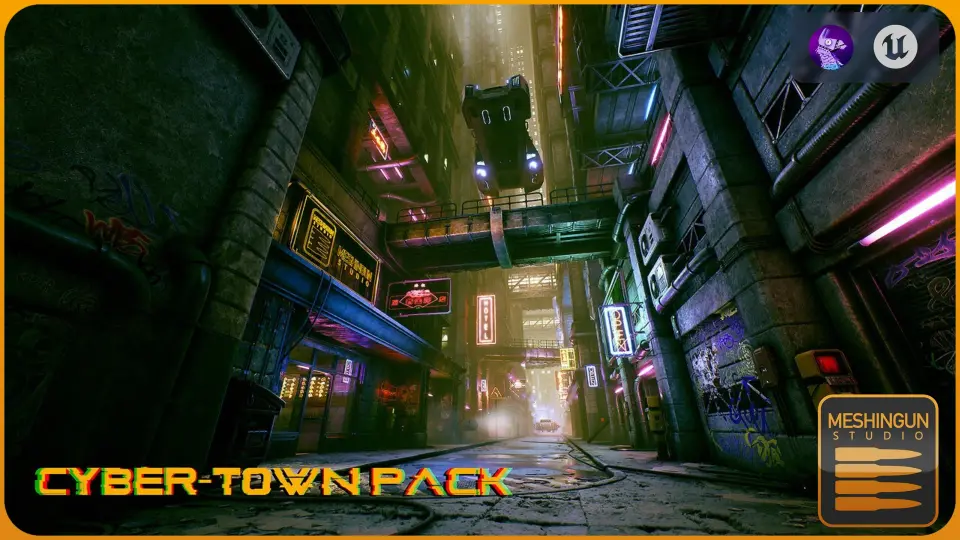
A core visual identifier of the genre is pervasive illuminated signage. The pack addresses this with a Customizable Billboard Tool. This system allows creators to populate the environment with glowing advertisements and signs that define the vertical space of a cityscape.
The thematic tags associated with the asset paint a clear picture of the intended aesthetic: Retro, Futuristic, Neon, Cybernetic, and Electric. Combined with structural elements like Hover, Car, and Alley, the visual targets extend toward vehicles and ground-level corridors. The intent is to provide the pieces needed to construct a cohesive, highly stylized urban sprawl—from the glow of a downtown sign to the industrial grime of a back alley structure.
Collision Readiness and Iterative Stability Fixes
For any environment asset intended for interactive or playable contexts, reliable collision is mandatory. The assets are built to be collision-ready. This means the generated buildings, spline meshes, and individual props are equipped to interact physically with actors in the scene, preventing characters or vehicles from passing through solid geometry.
The development cycle shows an active approach to resolving technical friction points. An early issue corrected in version 1.2 addressed file corruption that caused Building Structures to vanish in packaged builds and standalone sessions. That same update corrected a related visibility failure affecting spline tools in packaged builds. These were critical fixes, as tools that function perfectly in the editor but break upon packaging significantly hinder production pipelines.
Door Frame Collision Resolution
A subsequent update, version 1.3, targeted a specific collision anomaly with Door Frame 01a. The presence of a detailed fix for an individual architectural component indicates refinement to the precision of the collision meshing. Fixing a collision issue on a specific door frame ensures reliable navigation through tight interior spaces or alleyway entrances where a character's hitbox must interact cleanly with the threshold.
Playable Demonstration and Showcase Limitations
To verify how these tools perform within an interactive context, a playable demo is available. The demo provides a ground-level sense of how the generated structures, spline tools, and billboards hold up under rendering strain in a real-time environment.
It is noted that the character utilized in the showcase material—specifically Murdock from the Paragon Free Pack—is not included in the pack itself. This distinction is important for production scope. The pack delivers the environment framework, the building logic, and the visual atmosphere, but studios must supply their own third-person or first-person actors for traversal testing.
Evaluation for Cyberpunk Level Construction
This resource is tailored for teams prioritizing environment construction speed without sacrificing the dense, cybernetic aesthetic required by the genre. The inclusion of a Building Generator and spline-based routing tools points toward creators who need to dress large areas efficiently. Larger studio pipelines can leverage the baking functionality to manage frame rates, while the procedural approach addresses the repeated tedium of dressing wide cityscapes.
The pack provides a specific operational advantage: turning the tedious act of populating a futuristic city into an automated, tweakable process. For creators working on Unreal Engine 5.4 projects focused on cyberpunk, retro, or futuristic city themes, the procedural tools provided offer a distinct technical foundation for level design.
 Cyberpunk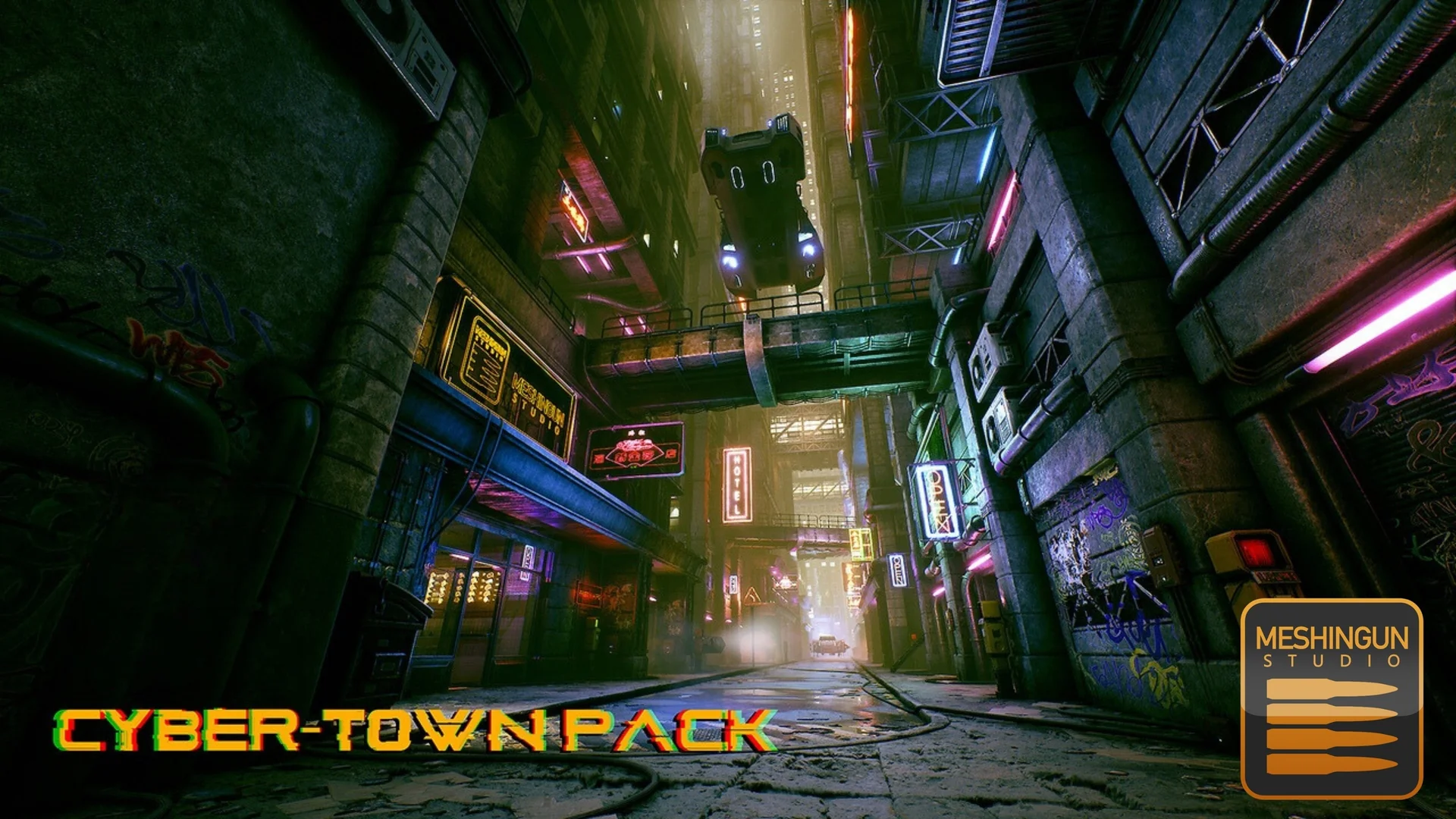
 Cyberpunk
 Cyberpunk
 Cyberpunk