"7066dd76da796369"{"id":"1000137","slug":"side-scroller-shooter-kit-v1-1","title":"Side Scroller Shooter Kit v1.1","category":"Shooter","engine":"4.26+,5.0+","assetVersion":"","engineVersion":"Engine Version: 4.26+,5.0+","tag":"Shooter","accent":"blue","visual":"mech","summary":"A 100% Blueprint single-player side scroller base for Unreal Engine, with cover, AI, aiming updates, input integration, and UE 5.5-5.7 support.","platform":"Unreal Engine","publishedAt":"2026-06-12T08:11:24.509Z","updatedAt":"2026-06-12T08:11:24.509Z","sourceNotes":[],"fileContents":[],"compatibility":["Unreal Engine","Engine Version: 4.26+,5.0+"],"featuredImage":{"alt":"Side Scroller Shooter Kit v1.1","src":"/wp-content/uploads/published/2026/06/0a51d74f8ceb-6369af1c-09d8-40ae-82e2-47626dd263a8-87602d033a.webp"},"hasDownloadLink":true,"downloads":5,"terms":[{"taxonomy":"category","slug":"shooter","name":"Shooter"}],"galleryImages":[{"src":"/wp-content/uploads/published/2026/06/eefd41b7bdf7-f8f5da0b-d75d-4e25-97a4-e0e8cfdf2b04-bb352f8bb8.webp","alt":"Side Scroller Shooter Kit v1.1"},{"src":"/wp-content/uploads/published/2026/06/998ba3cc2959-22f4f90f-6fd5-4a72-aacd-cba180818580-87f8c1afb7.webp","alt":"Side Scroller Shooter Kit v1.1"},{"src":"/wp-content/uploads/published/2026/06/6246380594a9-8ffc20dc-8f2d-4317-a3a3-fc810fd7e4b0-bd034f1b19.webp","alt":"Side Scroller Shooter Kit v1.1"},{"src":"/wp-content/uploads/published/2026/06/e3584ef468a6-c83114c6-0f6a-4da6-b099-af6075c73ef3-b62e2f46ad.webp","alt":"Side Scroller Shooter Kit v1.1"},{"src":"/wp-content/uploads/published/2026/06/de073f55f468-9e813918-c7fe-434a-95d8-310def836c40-04ed18e3a9.webp","alt":"Side Scroller Shooter Kit v1.1"},{"src":"/wp-content/uploads/published/2026/06/ad3fde38c7c8-221964a3-cc4b-4d8d-b06e-a5d86908d16e-a0da1cd698.webp","alt":"Side Scroller Shooter Kit v1.1"},{"src":"/wp-content/uploads/published/2026/06/286b3974aed5-d03ab808-8ba4-4962-ba7e-37e1487a5415-bf585e5286.webp","alt":"Side Scroller Shooter Kit v1.1"},{"src":"/wp-content/uploads/published/2026/06/4332cd8dd068-3a254e1e-a01a-49e0-845d-5897e4731af6-59e1ce3e8e.webp","alt":"Side Scroller Shooter Kit v1.1"},{"src":"/wp-content/uploads/published/2026/06/dbe7bdab8d0e-87ac24a7-4e0b-4585-a34c-c08df112496f-9a4082fde5.webp","alt":"Side Scroller Shooter Kit v1.1"}],"accessPanel":{"kind":"resource","title":"Download this resource","eyebrow":"Free Download","message":"Log in or create a free account to start your download.","fileName":"SideScrollerShooterKit_UE4.7z","safetyNote":"Resources are manually reviewed before listing to improve quality and reduce obvious risks.","actionLabel":"Download Free","resourceType":"Resource archive"},"contentHtml":"\u003cp\u003eGetting a side-scrolling shooter off the ground usually means solving several systems at once: aiming across a 2D plane, handling combat feedback, setting up enemies that react convincingly, and keeping traversal responsive enough for a fast-moving campaign structure. Side Scroller Shooter Kit v1.1 approaches that workload as a ready-made base for a side scroller game, delivered as a 100% Blueprint single-player project with documentation and notes inside the Blueprints.\u003c/p\u003e\n\u003cp\u003eThat setup matters because the project is not confined to simple run-and-gun basics. It reaches into advanced mechanics such as a cover system and robust AI while still covering the smaller pieces that shape actual play, from menus and checkpoints to weapon switching and environmental interaction. The package then offers a framework that can be implemented as a starting point for a fuller game rather than a narrow feature sample.\u003c/p\u003e \u003ch2\u003eStarting with Side Scroller Shooter Kit v1.1 in Blueprint\u003c/h2\u003e\n\u003cp\u003eThe strongest practical detail here is how the project is structured for direct use inside Unreal Engine. It is entirely Blueprint-based and built for single-player development, which places the implementation path in a visual scripting workflow from the beginning. Documentation and notes are included inside the Blueprints, so the project is set up not only as a playable foundation but also as something that can be studied and modified.\u003c/p\u003e\n\u003cp\u003eFor teams or solo developers working on a side-scrolling action game, that kind of internal documentation changes how quickly the kit can move from exploration to actual level work. It also fits the broader support material surrounding the project, including a character mesh changing tutorial, a zombie AI tutorial, a destructible system integration demo, and a tutorial for adding a new level. Those details suggest an asset meant to be extended rather than locked into a fixed sample scene.\u003c/p\u003e\n\u003cp\u003eThe included main menu supports level selection and persistent options, which gives the framework a more production-oriented shape than a prototype-only controller setup. A save game framework and pause menu continue that pattern. Instead of stopping at movement and weapons, the kit includes the surrounding systems that make iteration on a campaign or mission flow easier to manage.\u003c/p\u003e \u003ch2\u003eUpdate v1.1 changes the aiming and input layer\u003c/h2\u003e\n\u003cp\u003eVersion 1.1 focuses most clearly on the feel of control. The main update features include aiming improvements, with 2D screen space aiming added, alongside an improved unarmed state, animation asset updates, sound asset updates, enhanced input integration, and support for Unreal Engine 5.5 through 5.7.\u003c/p\u003e\n\u003cp\u003eThose additions sit directly on top of a control scheme that already includes several aiming and combat-facing elements. The project has character orientation based on mouse position, a 3D crosshair, and 2D aiming adjustable on mouse movement. Read together, these features point to a side-scroller shooting setup that gives aiming a central place in the experience rather than treating it as a simplified straight-line system.\u003c/p\u003e\n\u003cp\u003eEnhanced input integration also stands out because the broader feature set includes dynamic input change and gamepad support for gameplay. In practice, that means the control layer is not isolated to one device style. The kit acknowledges both mouse-based aiming behavior and controller play, which is useful for projects that want to preserve side-scroller responsiveness across different input methods.\u003c/p\u003e\n\u003cp\u003eThe improved unarmed state and the updates to animation and sound assets are smaller on paper than the aiming work, but they affect the consistency of the whole package. A shooter kit with melee, climbing, cover use, weapon switching, and stealth interactions depends heavily on animation clarity and readable state transitions. The update notes show maintenance in exactly those areas.\u003c/p\u003e \u003ch2\u003eCover system, human AI, and enemy reactions\u003c/h2\u003e\n\u003cp\u003eCombat implementation is one of the more developed parts of the kit. Major features include a cover system for both player and AI, human AI, melee attacks for player and AI, stealth kill functionality, depth aiming, quick time events, and a pathnode animation system for AI. These are not isolated checkboxes. They describe a combat framework where enemies and player characters use the environment, switch between ranged and close-range behavior, and occupy side-scroller spaces with more variety than simple forward aggression.\u003c/p\u003e\n\u003cp\u003eThe AI-related details expand that further. There is a pathnode animation system for human AI, destroyable cover points and vault behavior for AI, and enemies are able to alarm each other. Physical materials can make noise and alert enemies, and the project also includes a player noise system. That makes stealth and detection part of the same gameplay fabric rather than separate modes. Noise, cover, and alarm behavior all connect to the idea of a side-scrolling shooter where encounter flow can escalate dynamically.\u003c/p\u003e\n\u003cp\u003eEnemy variety also appears in the presence of a flying bot enemy, shields for enemies with autogenerated health, and surveillance cameras. Together with human AI, these elements give the framework a wider combat vocabulary. A level can move between grounded firefights, monitored spaces, flying threats, and defensive enemy types without stepping outside the listed systems.\u003c/p\u003e\n\u003cp\u003eThe kit also includes a turret and objects reacting to certain types of weapon. Those details matter for encounter construction because they add conditional interaction to the environment. Combat is not limited to aiming at characters; it can also involve reading what the level contains and how specific weapons affect it.\u003c/p\u003e \u003ch2\u003eMovement, climbing, and side-scroller combat flow\u003c/h2\u003e\n\u003cp\u003eTraversal is broad enough to support a more cinematic or mission-based side scroller instead of a flat lane shooter. Core movement features include crouching, sprinting, jumping, sliding, and standard movement. From there, the kit extends into vaulting for both player and AI, ladder climbing, and ledge climbing.\u003c/p\u003e\n\u003cp\u003eThese are the features that shape pacing between firefights. Sliding, vaulting, and climbing allow levels to break away from a purely horizontal rhythm. Elevators and launchpads reinforce that vertical or transitional movement, giving designers a way to vary traversal beats inside a side view framework. Since there is also a dynamic camera system, the project does not treat movement as a fixed single-angle problem. Camera behavior is part of how these spaces can be presented.\u003c/p\u003e\n\u003cp\u003eClose-range action is represented through side kick attacks and broader melee attacks for both player and AI, while stealth kill functionality provides another way to approach enemy placement. In a practical game-building sense, that means the kit supports several encounter tones: direct shooting, cover exchange, fast melee interruption, and quieter takedown setups.\u003c/p\u003e\n\u003cp\u003eQuick time events add another layer to that flow. They can be used to punctuate transitions or scripted moments within a campaign structure, especially when paired with traversal systems like ladders, ledges, elevators, and vault points. The framework is still driven by a shooter, but it clearly makes room for authored action sequences.\u003c/p\u003e \u003ch2\u003eWeapons, HUD, and level-facing gameplay pieces\u003c/h2\u003e\n\u003cp\u003eOn the moment-to-moment gameplay side, the kit includes shooting, weapon changing, laser sight functionality, and a weapon set consisting of an assault rifle, pistol, shotgun, and silenced pistol. The HUD covers health, ammo, and weapon type, which gives the player-facing interface the basic combat feedback expected from a shooter structure.\u003c/p\u003e\n\u003cp\u003eLevel interaction reaches beyond weapons. The project includes pickable items for health and ammo, loot objects, exploding barrels, a simple checkpoint system, spawn drop functionality, and button panels with IK targeting. These systems are practical because they can be placed directly into levels to support combat loops, progression, and short interaction beats without requiring entirely new mechanics.\u003c/p\u003e\n\u003cp\u003eA surveillance camera, launchpad, turret, and objects that respond to certain weapon types all point to scenario design rather than just character control. The framework supports levels where progression depends on reading hazards, using the right weapon, surviving checkpoints, and interacting with world elements that respond in specific ways.\u003c/p\u003e\n\u003cp\u003eUI and progression details help tie those pieces together. The main menu, persistent options, pause menu, and save game framework turn the kit into something closer to a playable game skeleton. It is not restricted to a combat sandbox; it includes the surrounding structure needed to support multiple levels and continued player progress.\u003c/p\u003e \u003ch2\u003eUE 5.5 - 5.7 support and a production-ready base\u003c/h2\u003e\n\u003cp\u003eSupport for Unreal Engine 5.5 through 5.7 is one of the clearest technical maintenance notes attached to version 1.1. Combined with enhanced input integration and the Blueprint-only structure, that gives the project a defined implementation range for current Unreal workflows.\u003c/p\u003e\n\u003cp\u003eThere is also an established support and usage ecosystem around the kit in the form of documentation, a forum thread, reviews and answered questions, gameplay videos, a demo build, a demo level gameplay video, a features level gameplay video, and an example campaign gameplay video. Even without relying on external materials, those details show that the kit has been presented not just as a collection of systems but as a broader playable framework with examples of how its mechanics come together.\u003c/p\u003e\n\u003cp\u003eAs a practical base, Side Scroller Shooter Kit v1.1 covers the parts that usually slow down early development: aiming logic, character orientation, enemy reactions, cover use, traversal, UI, checkpoints, saves, and menu structure. Its value as a workflow tool comes from that breadth. Rather than only offering a controller or weapon sample, it provides a side-scroller shooter foundation with enough combat, AI, and level interaction systems to support real implementation work and further customization.\u003c/p\u003e\n\n\u003ch2\u003eContinue Browsing Similar Packs\u003c/h2\u003e\n\u003cul\u003e\n\u003cli\u003e\u003ca href=\"https://3dcghub.com/multiplayer-bodycam/\" title=\"MULTIPLAYER BODYCAM\"\u003eMULTIPLAYER BODYCAM\u003c/a\u003e\u003c/li\u003e\n\u003cli\u003e\u003ca href=\"https://3dcghub.com/definitive-fps-kit/\" title=\"DEFINITIVE FPS KIT\"\u003eDEFINITIVE FPS KIT\u003c/a\u003e\u003c/li\u003e\n\u003cli\u003e\u003ca href=\"https://3dcghub.com/survival-game-kit-v2/\" title=\"Survival Game Kit V2\"\u003eSurvival Game Kit V2\u003c/a\u003e\u003c/li\u003e\n\u003cli\u003e\u003ca href=\"https://3dcghub.com/first-person-shooter-template-pack-fpstp-3-4-advanced-fps-kit-for-ue5/\" title=\"First Person Shooter Template Pack (FPSTP) 3.4 — Advanced FPS Kit for UE5\"\u003eFirst Person Shooter Template Pack (FPSTP) 3.4 — Advanced FPS Kit for UE5\u003c/a\u003e\u003c/li\u003e\n\u003cli\u003e\u003ca href=\"https://3dcghub.com/fps-game-starter-kit/\" title=\"FPS Game Starter Kit\"\u003eFPS Game Starter Kit\u003c/a\u003e\u003c/li\u003e\n\u003c/ul\u003e","contentTextLength":10207,"navigation":{"current":2030,"total":4016,"previous":{"id":"1000138","slug":"unreal-engine-5-product-animation-visualization","title":"Unreal Engine 5: Product Animation / Visualization","category":"Unreal Engine","platform":"Unreal Engine","updatedAt":"2026-06-12T16:14:45.512Z"},"next":{"id":"1000136","slug":"shadersource-tropical-ocean-tool","title":"SHADERSOURCE - Tropical Ocean Tool","category":"Ocean","platform":"Unreal Engine","updatedAt":"2026-06-12T07:50:40.444Z"}},"relatedResources":[{"id":"11974","slug":"definitive-fps-kit","title":"DEFINITIVE FPS KIT","category":"Shooter","engine":"5.5+","assetVersion":"Asset Version: 0.0.3","engineVersion":"Engine version: 5.5+","tag":"Shooter","accent":"blue","visual":"luts","summary":"The DEFINITIVE FPS KIT provides a solid foundation for creating professional first-person shooters. It features high-quality animations, customizable loadouts, and diverse game modes like round-based zombies and multiplayer.","platform":"Unreal Engine","publishedAt":"2026-03-06T16:27:47.000Z","updatedAt":"2026-10-16T06:54:06.998Z","sourceNotes":[],"fileContents":[],"compatibility":["Unreal Engine","Asset Version: 0.0.3","Engine version: 5.5+"],"featuredImage":{"alt":"DEFINITIVE FPS KIT","src":"https://3dcghub.com/wp-content/uploads/2026/03/6ad028e1-885c-4980-aa89-7ecea094d867.webp"},"hasDownloadLink":true,"downloads":24},{"id":"1001496","slug":"ultimate-multiplayer-fps-kit","title":"Ultimate Multiplayer FPS Kit","category":"Shooter","engine":"5.3+","assetVersion":"","engineVersion":"Engine Version: 5.3+","tag":"Shooter","accent":"blue","visual":"mech","summary":"Explore the Ultimate Multiplayer FPS Kit, featuring replicated mechanics, modular weapons, dynamic locomotion, and flexible objective frameworks.","platform":"Unreal Engine","publishedAt":"2026-10-09T05:55:05.138Z","updatedAt":"2026-10-09T05:55:05.138Z","sourceNotes":[],"fileContents":[],"compatibility":["Unreal Engine","Engine Version: 5.3+"],"featuredImage":{"alt":"Ultimate Multiplayer FPS Kit","src":"/wp-content/uploads/published/2026/10/391e1644e6fa-13c21395-24cd-4606-b1ed-a04edd06457c-0245a33139.webp"},"hasDownloadLink":true,"downloads":3},{"id":"1001097","slug":"zombie-shooter-kit-v2-12-unreal-engine-5-starter-pack","title":"Zombie Shooter Kit v2.12 - UNREAL ENGINE 5 Starter Pack","category":"Shooter","engine":"5.7+","assetVersion":"Asset Version: 2.11","engineVersion":"Engine Version: 5.7+","tag":"Shooter","accent":"blue","visual":"mech","summary":"Blueprint-based UE5 starter for survival shooters: replicated multiplayer, zombies and human AI, jigsaw inventory, crafting, vehicles, weather, and G.A.S.P. Loc","platform":"Unreal Engine","publishedAt":"2026-09-06T02:45:34.766Z","updatedAt":"2026-09-06T02:45:34.766Z","sourceNotes":[],"fileContents":[],"compatibility":["Unreal Engine","Asset Version: 2.11","Engine Version: 5.7+"],"featuredImage":{"alt":"Zombie Shooter Kit v2.12 - UNREAL ENGINE 5 Starter Pack","src":"/wp-content/uploads/published/2026/09/1d7d8e00baab-vqwonz-9f5e01b28f.webp"},"hasDownloadLink":true,"downloads":10}]}
Shooter
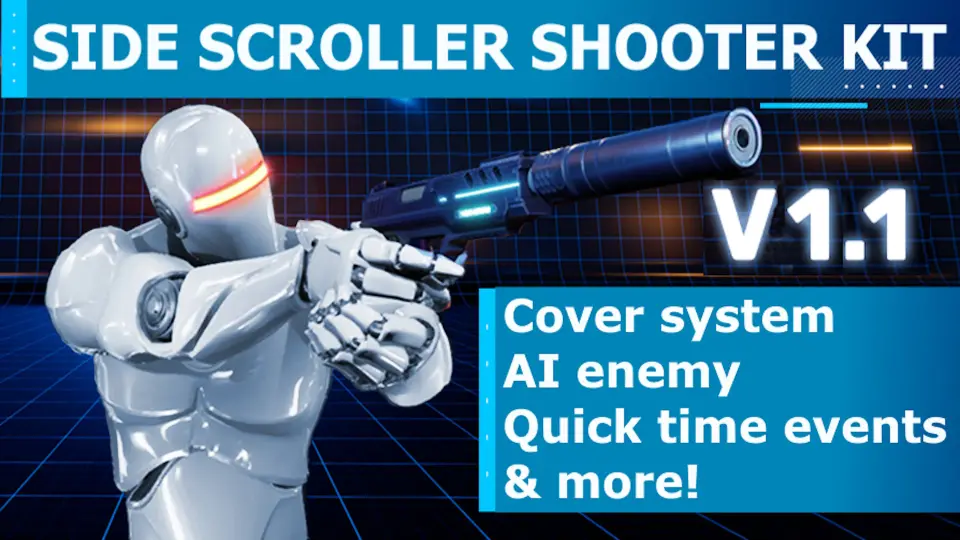
Side Scroller Shooter Kit v1.1
A 100% Blueprint single-player side scroller base for Unreal Engine, with cover, AI, aiming updates, input integration, and UE 5.5-5.7 support.
Category:Unreal Engine,ShooterPlatform: Unreal EngineEngine Version: 4.26+,5.0+Published: Jun 12, 2026
Shooter
Resource overview
Getting a side-scrolling shooter off the ground usually means solving several systems at once: aiming across a 2D plane, handling combat feedback, setting up enemies that react convincingly, and keeping traversal responsive enough for a fast-moving campaign structure. Side Scroller Shooter Kit v1.1 approaches that workload as a ready-made base for a side scroller game, delivered as a 100% Blueprint single-player project with documentation and notes inside the Blueprints.
That setup matters because the project is not confined to simple run-and-gun basics. It reaches into advanced mechanics such as a cover system and robust AI while still covering the smaller pieces that shape actual play, from menus and checkpoints to weapon switching and environmental interaction. The package then offers a framework that can be implemented as a starting point for a fuller game rather than a narrow feature sample.
Starting with Side Scroller Shooter Kit v1.1 in Blueprint
The strongest practical detail here is how the project is structured for direct use inside Unreal Engine. It is entirely Blueprint-based and built for single-player development, which places the implementation path in a visual scripting workflow from the beginning. Documentation and notes are included inside the Blueprints, so the project is set up not only as a playable foundation but also as something that can be studied and modified.
For teams or solo developers working on a side-scrolling action game, that kind of internal documentation changes how quickly the kit can move from exploration to actual level work. It also fits the broader support material surrounding the project, including a character mesh changing tutorial, a zombie AI tutorial, a destructible system integration demo, and a tutorial for adding a new level. Those details suggest an asset meant to be extended rather than locked into a fixed sample scene.
The included main menu supports level selection and persistent options, which gives the framework a more production-oriented shape than a prototype-only controller setup. A save game framework and pause menu continue that pattern. Instead of stopping at movement and weapons, the kit includes the surrounding systems that make iteration on a campaign or mission flow easier to manage.
Update v1.1 changes the aiming and input layer
Version 1.1 focuses most clearly on the feel of control. The main update features include aiming improvements, with 2D screen space aiming added, alongside an improved unarmed state, animation asset updates, sound asset updates, enhanced input integration, and support for Unreal Engine 5.5 through 5.7.
Those additions sit directly on top of a control scheme that already includes several aiming and combat-facing elements. The project has character orientation based on mouse position, a 3D crosshair, and 2D aiming adjustable on mouse movement. Read together, these features point to a side-scroller shooting setup that gives aiming a central place in the experience rather than treating it as a simplified straight-line system.
Enhanced input integration also stands out because the broader feature set includes dynamic input change and gamepad support for gameplay. In practice, that means the control layer is not isolated to one device style. The kit acknowledges both mouse-based aiming behavior and controller play, which is useful for projects that want to preserve side-scroller responsiveness across different input methods.
The improved unarmed state and the updates to animation and sound assets are smaller on paper than the aiming work, but they affect the consistency of the whole package. A shooter kit with melee, climbing, cover use, weapon switching, and stealth interactions depends heavily on animation clarity and readable state transitions. The update notes show maintenance in exactly those areas.
Cover system, human AI, and enemy reactions
Combat implementation is one of the more developed parts of the kit. Major features include a cover system for both player and AI, human AI, melee attacks for player and AI, stealth kill functionality, depth aiming, quick time events, and a pathnode animation system for AI. These are not isolated checkboxes. They describe a combat framework where enemies and player characters use the environment, switch between ranged and close-range behavior, and occupy side-scroller spaces with more variety than simple forward aggression.
The AI-related details expand that further. There is a pathnode animation system for human AI, destroyable cover points and vault behavior for AI, and enemies are able to alarm each other. Physical materials can make noise and alert enemies, and the project also includes a player noise system. That makes stealth and detection part of the same gameplay fabric rather than separate modes. Noise, cover, and alarm behavior all connect to the idea of a side-scrolling shooter where encounter flow can escalate dynamically.
Enemy variety also appears in the presence of a flying bot enemy, shields for enemies with autogenerated health, and surveillance cameras. Together with human AI, these elements give the framework a wider combat vocabulary. A level can move between grounded firefights, monitored spaces, flying threats, and defensive enemy types without stepping outside the listed systems.
The kit also includes a turret and objects reacting to certain types of weapon. Those details matter for encounter construction because they add conditional interaction to the environment. Combat is not limited to aiming at characters; it can also involve reading what the level contains and how specific weapons affect it.
Movement, climbing, and side-scroller combat flow
Traversal is broad enough to support a more cinematic or mission-based side scroller instead of a flat lane shooter. Core movement features include crouching, sprinting, jumping, sliding, and standard movement. From there, the kit extends into vaulting for both player and AI, ladder climbing, and ledge climbing.
These are the features that shape pacing between firefights. Sliding, vaulting, and climbing allow levels to break away from a purely horizontal rhythm. Elevators and launchpads reinforce that vertical or transitional movement, giving designers a way to vary traversal beats inside a side view framework. Since there is also a dynamic camera system, the project does not treat movement as a fixed single-angle problem. Camera behavior is part of how these spaces can be presented.
Close-range action is represented through side kick attacks and broader melee attacks for both player and AI, while stealth kill functionality provides another way to approach enemy placement. In a practical game-building sense, that means the kit supports several encounter tones: direct shooting, cover exchange, fast melee interruption, and quieter takedown setups.
Quick time events add another layer to that flow. They can be used to punctuate transitions or scripted moments within a campaign structure, especially when paired with traversal systems like ladders, ledges, elevators, and vault points. The framework is still driven by a shooter, but it clearly makes room for authored action sequences.
Weapons, HUD, and level-facing gameplay pieces
On the moment-to-moment gameplay side, the kit includes shooting, weapon changing, laser sight functionality, and a weapon set consisting of an assault rifle, pistol, shotgun, and silenced pistol. The HUD covers health, ammo, and weapon type, which gives the player-facing interface the basic combat feedback expected from a shooter structure.
Level interaction reaches beyond weapons. The project includes pickable items for health and ammo, loot objects, exploding barrels, a simple checkpoint system, spawn drop functionality, and button panels with IK targeting. These systems are practical because they can be placed directly into levels to support combat loops, progression, and short interaction beats without requiring entirely new mechanics.
A surveillance camera, launchpad, turret, and objects that respond to certain weapon types all point to scenario design rather than just character control. The framework supports levels where progression depends on reading hazards, using the right weapon, surviving checkpoints, and interacting with world elements that respond in specific ways.
UI and progression details help tie those pieces together. The main menu, persistent options, pause menu, and save game framework turn the kit into something closer to a playable game skeleton. It is not restricted to a combat sandbox; it includes the surrounding structure needed to support multiple levels and continued player progress.
UE 5.5 - 5.7 support and a production-ready base
Support for Unreal Engine 5.5 through 5.7 is one of the clearest technical maintenance notes attached to version 1.1. Combined with enhanced input integration and the Blueprint-only structure, that gives the project a defined implementation range for current Unreal workflows.
There is also an established support and usage ecosystem around the kit in the form of documentation, a forum thread, reviews and answered questions, gameplay videos, a demo build, a demo level gameplay video, a features level gameplay video, and an example campaign gameplay video. Even without relying on external materials, those details show that the kit has been presented not just as a collection of systems but as a broader playable framework with examples of how its mechanics come together.
As a practical base, Side Scroller Shooter Kit v1.1 covers the parts that usually slow down early development: aiming logic, character orientation, enemy reactions, cover use, traversal, UI, checkpoints, saves, and menu structure. Its value as a workflow tool comes from that breadth. Rather than only offering a controller or weapon sample, it provides a side-scroller shooter foundation with enough combat, AI, and level interaction systems to support real implementation work and further customization.
 Shooter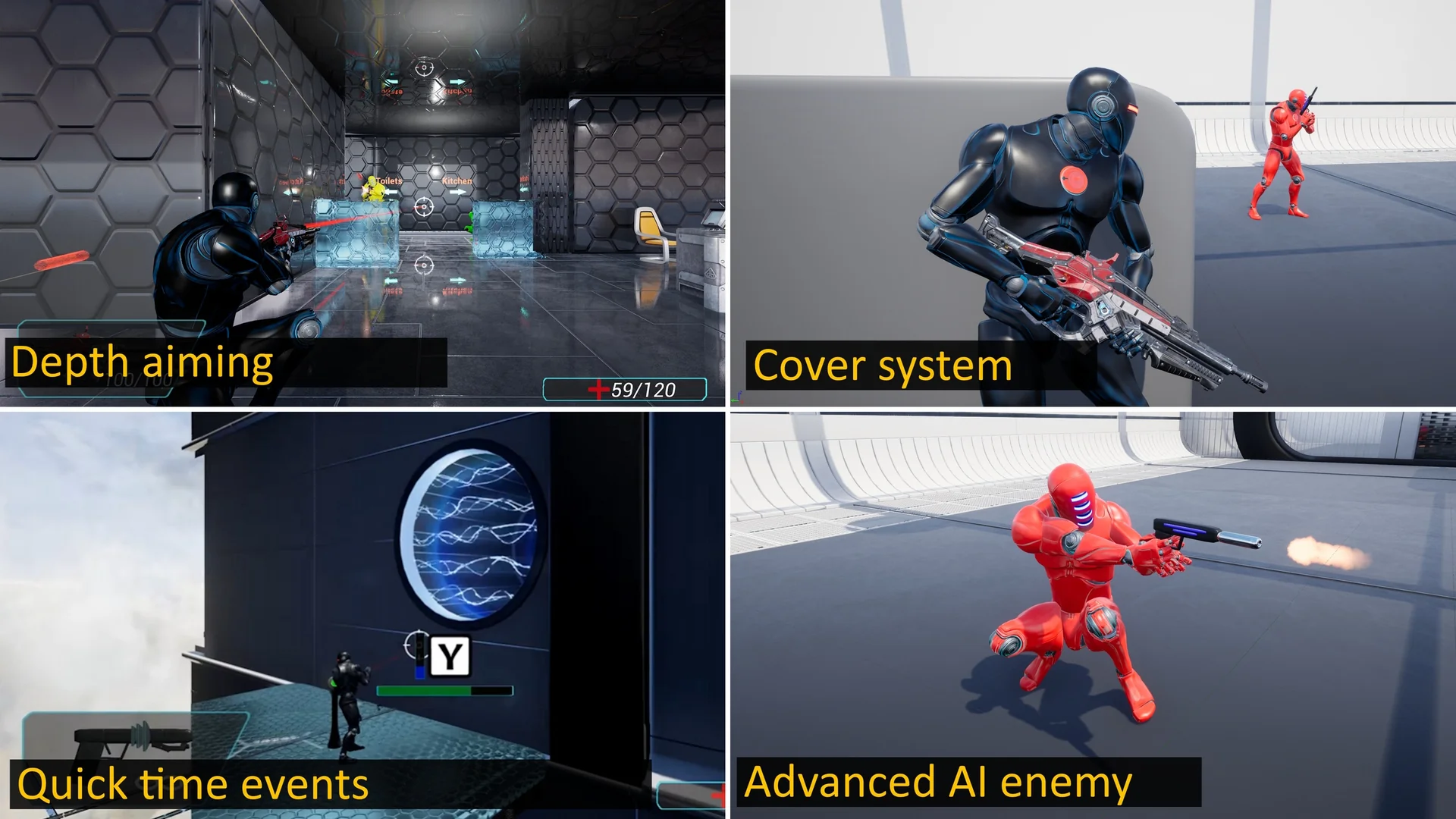
 Shooter
 Shooter
 Shooter