"7b46a695175d8694"{"id":"1001455","slug":"shields-vfx-pack","title":"Shields VFX Pack","category":"Spells \u0026 Combat","engine":"4.26+,5.0+","assetVersion":"","engineVersion":"Engine Version: 4.26+,5.0+","tag":"Spells \u0026 Combat","accent":"blue","visual":"mech","summary":"Shields VFX Pack provides 20 modular Blueprint shield effects featuring custom mesh materials, Niagara systems, hit reactions, and appear-dissolve controls.","platform":"Unreal Engine","publishedAt":"2026-10-08T00:58:02.008Z","updatedAt":"2026-10-08T00:58:02.008Z","sourceNotes":[],"fileContents":[],"compatibility":["Unreal Engine","Engine Version: 4.26+,5.0+"],"featuredImage":{"alt":"Shields VFX Pack","src":"/wp-content/uploads/published/2026/10/1409c9a08421-967c5e64-77e9-43c1-b32c-6bc881cf5ce4-d3ea0e1f69.webp"},"hasDownloadLink":true,"downloads":0,"terms":[{"taxonomy":"category","slug":"spells-and-combat","name":"Spells \u0026 Combat"}],"galleryImages":[{"src":"/wp-content/uploads/published/2026/10/bcb1c2f97f77-111ada33-60e4-48e0-9b61-4d3dbf65eba4-b17f957b62.webp","alt":"Shields VFX Pack"},{"src":"/wp-content/uploads/published/2026/10/b1db013977f2-80be7ffc-dc26-46f4-9245-fdeb8eac0488-984a2cc54d.webp","alt":"Shields VFX Pack"},{"src":"/wp-content/uploads/published/2026/10/4ff7b564e444-a4086673-11c4-4e1e-aa85-3c82997d326e-51909052a8.webp","alt":"Shields VFX Pack"},{"src":"/wp-content/uploads/published/2026/10/c6797e6b2dd3-7a3661a4-684b-432c-8770-693d83561dda-4dc911f41f.webp","alt":"Shields VFX Pack"},{"src":"/wp-content/uploads/published/2026/10/6dd0090e5aca-c91a99ea-b546-46bc-95ce-5ff35a0683d3-b62cc2532d.webp","alt":"Shields VFX Pack"},{"src":"/wp-content/uploads/published/2026/10/59d943c27f7e-7f23209c-87a7-4165-a343-4ed9bfa1af90-412c03268d.webp","alt":"Shields VFX Pack"},{"src":"/wp-content/uploads/published/2026/10/055bb9fb2fef-df7d0bbb-7f39-4b37-88e6-bc8a58e376ca-a44efe36ba.webp","alt":"Shields VFX Pack"},{"src":"/wp-content/uploads/published/2026/10/4bbc236ec48b-a0426704-0f1b-43d1-a2a6-8e7e2acda358-f86e5add7f.webp","alt":"Shields VFX Pack"},{"src":"/wp-content/uploads/published/2026/10/6ca9ac1ed7f5-4e4cca3a-f850-4296-8d63-1f07b0175545-2cca6bf82b.webp","alt":"Shields VFX Pack"}],"accessPanel":{"kind":"resource","title":"Download this resource","eyebrow":"Free Download","message":"Log in or create a free account to start your download.","fileName":"Content.7z","safetyNote":"Resources are manually reviewed before listing to improve quality and reduce obvious risks.","actionLabel":"Download Free","resourceType":"Resource archive"},"contentHtml":"\u003cp\u003eShaped by 20 complete Blueprint shield objects, Shields VFX Pack delivers a modular collection of defensive magic, stylized barrier effects, and combat armor visuals. Rather than relying exclusively on simple billboard sprites or flat particle emitters, each shield combines a distinct mesh-based object with custom materials and secondary Niagara systems. The resulting assets provide structured physical geometry paired with dynamic visual behavior, giving developers a practical foundation for defensive magic and reactive combat mechanics.\u003c/p\u003e \u003ch2\u003eBlueprint Structure and Mesh-Based Shield Architecture\u003c/h2\u003e\n\u003cp\u003eEach asset within the package is organized as a standalone Base Blueprint Shield object. At the foundation of every setup is a physical 3D mesh core rather than an unanchored volumetric effect. This mesh-first structure allows custom materials to project and flow across defined geometric contours, giving shields distinct boundaries, recognizable silhouettes, and a grounded sense of physical weight when placed in a game scene.\u003c/p\u003e \u003cp\u003eInside each Blueprint, the shield is composed of multiple discrete effect layers. Housing these elements within unified Blueprint objects keeps the component hierarchy cleanly contained and straightforward to navigate. Developers can inspect, tweak, or reconfigure individual sub-effects directly inside the Blueprint editor without needing to untangle monolithic emitter networks or manually reconnect material logic across separate actors. The Blueprints bridge the gap between static mesh geometry, dynamic material shaders, and supplemental Niagara particle systems, functioning as unified, ready-to-deploy actors.\u003c/p\u003e \u003ch2\u003eAppear, Dissolve, and Hit Reaction Mechanics\u003c/h2\u003e\n\u003cp\u003eProtective barriers in combat games rely on clear visual states to communicate their status to players. Every shield in the collection includes dedicated logic and material handling for activation, termination, and direct combat impact.\u003c/p\u003e \u003cp\u003eThe life cycle of each barrier is anchored by dedicated appear and dissolve effects. When a character raises a guard, triggers an enchanted item, or casts a defensive spell, the appear effect brings the shield into view across the mesh surface. Once the barrier duration lapses, the defense breaks, or the casting character lowers their guard, the dissolve effect engages to phase the visual barrier out smoothly. These transitions prevent visual popping, allowing magic barriers to materialize and dissipate naturally in real time.\u003c/p\u003e \u003cp\u003eAlongside activation and deactivation phases, each shield includes a dedicated hit reaction effect. When an attack connects with the surface of the protective ward, the hit reaction triggers across the shield to register the impact. This provides immediate visual feedback during gameplay exchanges, signaling to players that incoming damage has been deflected, absorbed, or contested by the barrier.\u003c/p\u003e \u003ch2\u003eMaterial Parameters, Niagara Systems, and Mesh Swapping\u003c/h2\u003e\n\u003cp\u003eCustomization across the package operates at both the material instance level and within the particle system parameters. The custom materials applied to the shield meshes expose color inputs alongside fine-tuning parameters, enabling developers to shift color schemes to match specific elemental affiliations, character classes, or faction palettes. Individual sub-effects can be dialed back or shut off completely to create restrained, understated energy fields, or pushed to higher intensities when an encounter demands bold, high-visibility magic.\u003c/p\u003e \u003cp\u003eWorking in tandem with the primary mesh shaders are secondary Niagara systems. These particle effects provide supplementary visual layers—such as orbiting sparks, ambient energy drift, or ground-level magical emanations—that wrap around the core barrier. Developers have full access to these particle system settings, allowing adjustments to particle rates, movement dynamics, and overall visual balance.\u003c/p\u003e \u003cp\u003eA central design feature of the package is the ability to swap the underlying base mesh. Because the visual logic resides within the custom materials, Blueprint components, and accompanying Niagara emitters, developers are not restricted to the default geometric silhouettes included in the pack. Swapping out the base mesh transforms the shape of the shield entirely—turning a standard crest or round buckler into a broad tower shield, a pointed crest, or an expansive full-body dome. The existing appear, dissolve, and hit reaction systems map to the newly assigned geometry, preserving functionality across custom models. Developers can also swap in their own textures, altering glyphs, surface patterns, and energy maps across the material framework.\u003c/p\u003e \u003ch2\u003eFantasy Spells, Stylized Armor, and Combat Integration\u003c/h2\u003e\n\u003cp\u003eCharacterized by tags spanning visual, modular, fantasy, spell, shield, stylized, armor, magic, and blueprint, the package is oriented toward stylized combat aesthetics and action-focused magic systems. The layered setup makes the shields adaptable across numerous gameplay scenarios, from paladin defense auras and arcane warding spheres to enchanted physical shields and boss-phase invulnerability bubbles.\u003c/p\u003e \u003cp\u003eBecause every shield lets developers toggle constituent sub-effects, the assets scale easily between standard gameplay applications and climactic moments. Minor encounters can use stripped-down, single-layer variants with subdued intensity, while major abilities can engage full mesh dissolves, bright hit responses, and active Niagara particle bursts. The package also aligns naturally with offensive animation and effect sets, maintaining direct compatibility with 280 Sword Slashes VFX Pack Vol. 1 to support cohesive offensive and defensive visual exchanges in stylized action projects.\u003c/p\u003e\n\n\u003ch2\u003eRelated Resources Worth Checking\u003c/h2\u003e\n\u003cul\u003e\n\u003cli\u003e\u003ca href=\"https://3dcghub.com/magic-aura-vfx/\" title=\"Magic Aura VFX\"\u003eMagic Aura VFX\u003c/a\u003e\u003c/li\u003e\n\u003cli\u003e\u003ca href=\"https://3dcghub.com/shield-fx-responsive/\" title=\"Shield FX Responsive\"\u003eShield FX Responsive\u003c/a\u003e\u003c/li\u003e\n\u003cli\u003e\u003ca href=\"https://3dcghub.com/magic-circles-and-shields-2/\" title=\"Magic Circles and Shields 2\"\u003eMagic Circles and Shields 2\u003c/a\u003e\u003c/li\u003e\n\u003cli\u003e\u003ca href=\"https://3dcghub.com/mega-magic-vfx-bundle/\" title=\"Mega Magic VFX Bundle\"\u003eMega Magic VFX Bundle\u003c/a\u003e\u003c/li\u003e\n\u003cli\u003e\u003ca href=\"https://3dcghub.com/niagara-sword-and-shield/\" title=\"Niagara Sword And Shield\"\u003eNiagara Sword And Shield\u003c/a\u003e\u003c/li\u003e\n\u003c/ul\u003e","contentTextLength":5829,"navigation":{"current":92,"total":3481,"previous":{"id":"1001456","slug":"showroom-level-kit-8","title":"Showroom Level Kit 8","category":"Sci-Fi","platform":"Unreal Engine","updatedAt":"2026-10-08T00:58:31.083Z"},"next":{"id":"1001454","slug":"school-of-magic-gothic-modular-environment","title":"School of Magic - Gothic Modular Environment","category":"Fantasy","platform":"Unreal Engine","updatedAt":"2026-10-08T00:57:08.109Z"}},"relatedResources":[{"id":"1000639","slug":"magic-aura-vfx","title":"Magic Aura VFX","category":"Spells \u0026 Combat","engine":"4.27,5.0+","assetVersion":"","engineVersion":"Engine Version: 4.27,5.0+","tag":"Spells \u0026 Combat","accent":"blue","visual":"mech","summary":"Ten customizable Unreal Engine Niagara effects covering magic trails, fantasy shields, and character auras with emissive lighting for games and cinematics.","platform":"Unreal Engine","publishedAt":"2026-07-21T17:15:13.459Z","updatedAt":"2026-07-21T17:15:13.459Z","sourceNotes":[],"fileContents":[],"compatibility":["Unreal Engine","Engine Version: 4.27,5.0+"],"featuredImage":{"alt":"Magic Aura VFX","src":"/wp-content/uploads/published/2026/07/205744193aab-fbdd8542-7a3c-4169-a254-ff27fa089dc5-2361e340a4.webp"},"hasDownloadLink":true,"downloads":1},{"id":"16666","slug":"shield-fx-responsive","title":"Shield FX Responsive","category":"Spells \u0026 Combat","engine":"4.26+,5.0+","assetVersion":"Engine version: 4.26+,5.0+","engineVersion":"5.2","tag":"Spells \u0026 Combat","accent":"blue","visual":"luts","summary":"Enhance your game’s visual feedback with Shield FX Responsive. This asset pack offers highly customizable, realistic shield effects specifically designed for main characters using Niagara and Blueprints.","platform":"Unreal Engine","publishedAt":"2026-03-12T17:45:37.000Z","updatedAt":"2026-04-19T15:43:43.000Z","sourceNotes":[],"fileContents":[],"compatibility":["Unreal Engine","Engine version: 4.26+,5.0+"],"featuredImage":{"alt":"Shield FX Responsive","src":"https://3dcghub.com/wp-content/uploads/2026/03/bbd7ae98-a01a-4834-a3d5-1095ea958d52.webp"},"hasDownloadLink":true,"downloads":2},{"id":"16419","slug":"magic-circles-and-shields-2","title":"Magic Circles and Shields 2","category":"Spells \u0026 Combat","engine":"4.26+,5.0+","assetVersion":"Engine version: 4.26+,5.0+","engineVersion":"4.24","tag":"Spells \u0026 Combat","accent":"blue","visual":"audio","summary":"Magic Circles and Shields 2 is a professional collection of 3D visual effects designed for fantasy games. It includes unique textures and customizable loops for diverse magical applications.","platform":"Unreal Engine","publishedAt":"2026-03-12T17:06:26.000Z","updatedAt":"2026-04-19T15:44:33.000Z","sourceNotes":[],"fileContents":[],"compatibility":["Unreal Engine","Engine version: 4.26+,5.0+"],"featuredImage":{"alt":"Magic Circles and Shields 2","src":"https://3dcghub.com/wp-content/uploads/2026/03/35f8e386-04e0-4c96-973e-de822e9f047a.webp"},"hasDownloadLink":true,"downloads":1}]}
Spells & Combat
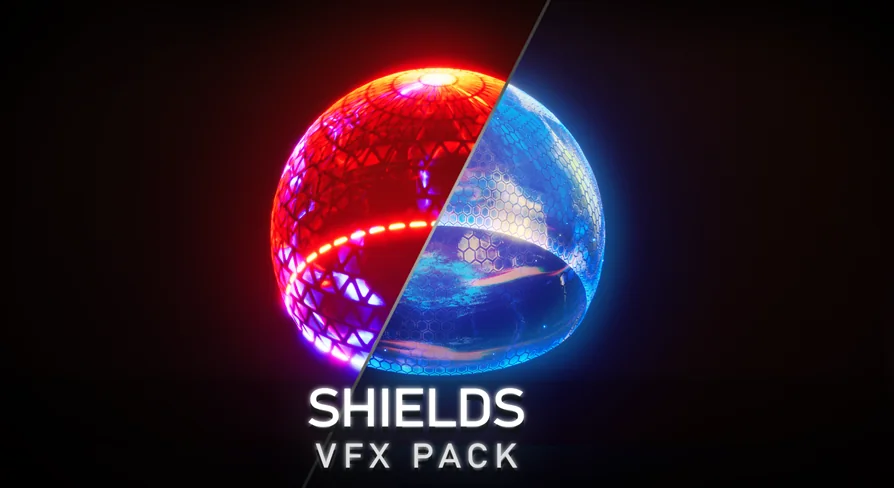
Shields VFX Pack
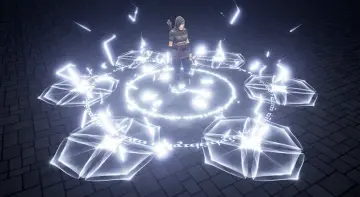
Shields VFX Pack provides 20 modular Blueprint shield effects featuring custom mesh materials, Niagara systems, hit reactions, and appear-dissolve controls.
Shaped by 20 complete Blueprint shield objects, Shields VFX Pack delivers a modular collection of defensive magic, stylized barrier effects, and combat armor visuals. Rather than relying exclusively on simple billboard sprites or flat particle emitters, each shield combines a distinct mesh-based object with custom materials and secondary Niagara systems. The resulting assets provide structured physical geometry paired with dynamic visual behavior, giving developers a practical foundation for defensive magic and reactive combat mechanics.
Blueprint Structure and Mesh-Based Shield Architecture
Each asset within the package is organized as a standalone Base Blueprint Shield object. At the foundation of every setup is a physical 3D mesh core rather than an unanchored volumetric effect. This mesh-first structure allows custom materials to project and flow across defined geometric contours, giving shields distinct boundaries, recognizable silhouettes, and a grounded sense of physical weight when placed in a game scene.
Inside each Blueprint, the shield is composed of multiple discrete effect layers. Housing these elements within unified Blueprint objects keeps the component hierarchy cleanly contained and straightforward to navigate. Developers can inspect, tweak, or reconfigure individual sub-effects directly inside the Blueprint editor without needing to untangle monolithic emitter networks or manually reconnect material logic across separate actors. The Blueprints bridge the gap between static mesh geometry, dynamic material shaders, and supplemental Niagara particle systems, functioning as unified, ready-to-deploy actors.
Appear, Dissolve, and Hit Reaction Mechanics
Protective barriers in combat games rely on clear visual states to communicate their status to players. Every shield in the collection includes dedicated logic and material handling for activation, termination, and direct combat impact.
The life cycle of each barrier is anchored by dedicated appear and dissolve effects. When a character raises a guard, triggers an enchanted item, or casts a defensive spell, the appear effect brings the shield into view across the mesh surface. Once the barrier duration lapses, the defense breaks, or the casting character lowers their guard, the dissolve effect engages to phase the visual barrier out smoothly. These transitions prevent visual popping, allowing magic barriers to materialize and dissipate naturally in real time.
Alongside activation and deactivation phases, each shield includes a dedicated hit reaction effect. When an attack connects with the surface of the protective ward, the hit reaction triggers across the shield to register the impact. This provides immediate visual feedback during gameplay exchanges, signaling to players that incoming damage has been deflected, absorbed, or contested by the barrier.
Material Parameters, Niagara Systems, and Mesh Swapping
Customization across the package operates at both the material instance level and within the particle system parameters. The custom materials applied to the shield meshes expose color inputs alongside fine-tuning parameters, enabling developers to shift color schemes to match specific elemental affiliations, character classes, or faction palettes. Individual sub-effects can be dialed back or shut off completely to create restrained, understated energy fields, or pushed to higher intensities when an encounter demands bold, high-visibility magic.
Working in tandem with the primary mesh shaders are secondary Niagara systems. These particle effects provide supplementary visual layers—such as orbiting sparks, ambient energy drift, or ground-level magical emanations—that wrap around the core barrier. Developers have full access to these particle system settings, allowing adjustments to particle rates, movement dynamics, and overall visual balance.
A central design feature of the package is the ability to swap the underlying base mesh. Because the visual logic resides within the custom materials, Blueprint components, and accompanying Niagara emitters, developers are not restricted to the default geometric silhouettes included in the pack. Swapping out the base mesh transforms the shape of the shield entirely—turning a standard crest or round buckler into a broad tower shield, a pointed crest, or an expansive full-body dome. The existing appear, dissolve, and hit reaction systems map to the newly assigned geometry, preserving functionality across custom models. Developers can also swap in their own textures, altering glyphs, surface patterns, and energy maps across the material framework.
Fantasy Spells, Stylized Armor, and Combat Integration
Characterized by tags spanning visual, modular, fantasy, spell, shield, stylized, armor, magic, and blueprint, the package is oriented toward stylized combat aesthetics and action-focused magic systems. The layered setup makes the shields adaptable across numerous gameplay scenarios, from paladin defense auras and arcane warding spheres to enchanted physical shields and boss-phase invulnerability bubbles.
Because every shield lets developers toggle constituent sub-effects, the assets scale easily between standard gameplay applications and climactic moments. Minor encounters can use stripped-down, single-layer variants with subdued intensity, while major abilities can engage full mesh dissolves, bright hit responses, and active Niagara particle bursts. The package also aligns naturally with offensive animation and effect sets, maintaining direct compatibility with 280 Sword Slashes VFX Pack Vol. 1 to support cohesive offensive and defensive visual exchanges in stylized action projects.
 Spells & Combat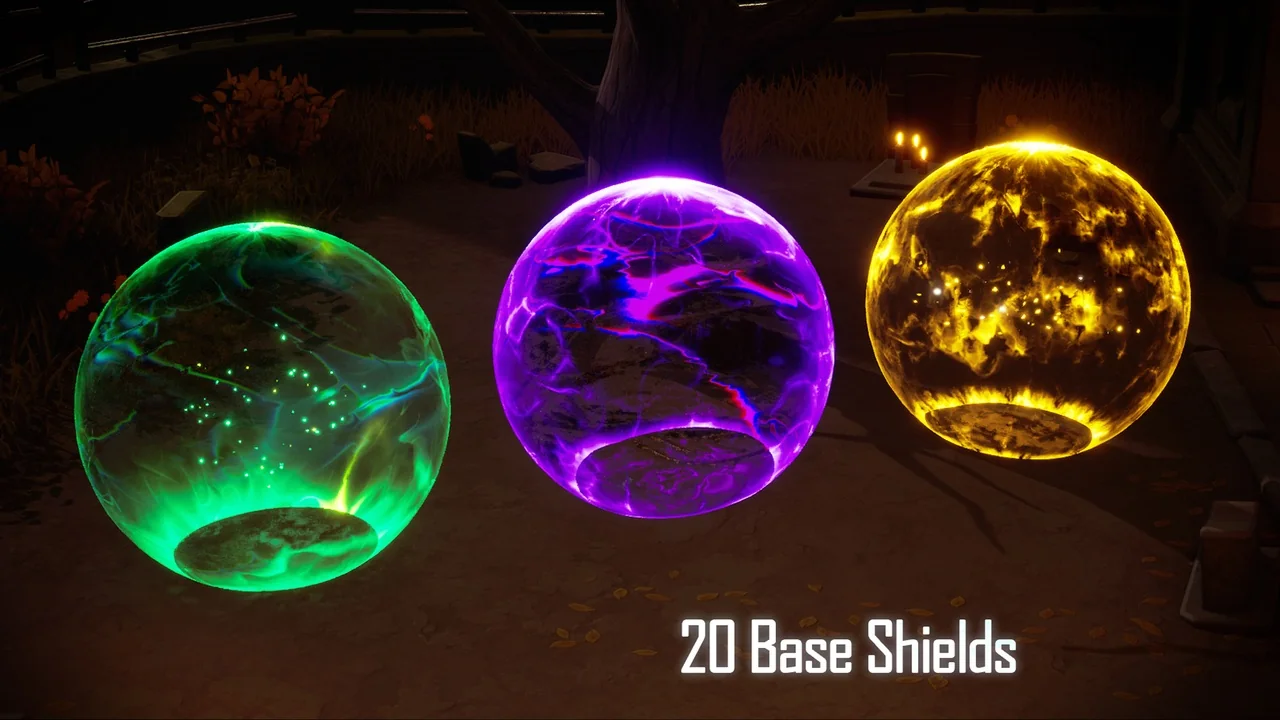
 Spells & Combat
 Spells & Combat
 Spells & Combat