"efaa631e936fd3ee"{"id":"1002198","slug":"server-room-kit","title":"Server Room Kit","category":"Electronics \u0026 Technology","engine":"4.26+,5.0+","assetVersion":"","engineVersion":"Engine Version: 4.26+,5.0+","tag":"Electronics","accent":"blue","visual":"mech","summary":"Explore the Server Room Kit featuring 10 modular low-poly assets, 2 LOD stages, atlas textures, and PBR channel-packed materials.","platform":"Unreal Engine","publishedAt":"2026-10-29T14:42:10.246Z","updatedAt":"2026-10-29T14:42:10.246Z","sourceNotes":[],"fileContents":[],"compatibility":["Unreal Engine","Engine Version: 4.26+,5.0+"],"featuredImage":{"alt":"Server Room Kit","src":"/wp-content/uploads/published/2026/10/f5d8ef0d3c6a-ae04ae2f-40cf-46f3-8f4b-b8d74e8a08ef-ed8400eaa0.webp"},"hasDownloadLink":true,"downloads":0,"terms":[{"taxonomy":"category","slug":"electronics-and-technology","name":"Electronics \u0026 Technology"}],"galleryImages":[{"src":"/wp-content/uploads/published/2026/10/93bc80f83cf2-f4b74818-01c6-4bb5-b37b-c58ebc3a7241-ec76d310d3.webp","alt":"Server Room Kit"},{"src":"/wp-content/uploads/published/2026/10/e908bfe86402-667793b5-5c6e-497f-861a-9bcc195c333f-b8a3810188.webp","alt":"Server Room Kit"},{"src":"/wp-content/uploads/published/2026/10/d364e419c535-0388944e-46f1-4769-ac25-288861e37f71-b8db3f2092.webp","alt":"Server Room Kit"},{"src":"/wp-content/uploads/published/2026/10/2ee2b2f90339-1d9a2bfc-ef69-40b7-be38-922aeea681db-f277fb4746.webp","alt":"Server Room Kit"},{"src":"/wp-content/uploads/published/2026/10/fb0ce5b7c795-c22fb9ea-2f7c-4c33-b07c-d31597a25991-f923d1e9ed.webp","alt":"Server Room Kit"}],"accessPanel":{"kind":"resource","title":"Download this resource","eyebrow":"Free Download","message":"Log in or create a free account to start your download.","fileName":"Content.7z","safetyNote":"Resources are manually reviewed before listing to improve quality and reduce obvious risks.","actionLabel":"Download Free","resourceType":"Resource archive"},"contentHtml":"\u003ch2\u003eModular Server Cases and Component Architecture\u003c/h2\u003e\n\u003cp\u003eTen low-poly modular pieces form the structural foundation of the Server Room Kit, giving level designers the building blocks needed to assemble computer storage facilities from scratch. The kit focuses on core infrastructure hardware, primarily server cases and connecting environmental structures that can be linked horizontally or stacked vertically. Rather than relying on static, single-piece room models, every section within the kit is built to interlock cleanly, allowing developers to shape long server aisles, compact network closets, or sprawling data centers.\u003c/p\u003e\n\u003cp\u003eModularity dictates how level geometry behaves during production. Because the assets share standardized spatial boundaries, developers can duplicate and snap racks along precise grid increments. A single server unit can stand alone against an office wall, or dozens can be mirrored to flank a long access corridor. The system supports varied interior silhouettes without requiring unique geometry for each equipment row, making it possible to construct custom layouts while keeping the underlying asset count compact and manageable.\u003c/p\u003e \u003ch2\u003eAtlas Material Setup and PBR Channel Packing\u003c/h2\u003e\n\u003cp\u003eTexture management in the kit relies on five unique materials, with a strong focus on resource conservation. All server cases share a single atlas material, combining the visual data for multiple hardware units onto a unified texture sheet. Grouping multiple server cases into one atlas significantly curbs draw calls across the scene. When a room contains dozens of repeated server racks, referencing a shared material prevents graphic processing units from repeatedly switching texture states, sustaining smooth frame rendering.\u003c/p\u003e\n\u003cp\u003eSurfaces are authored using the standard PBR metallic and roughness method, giving the metallic hardware and synthetic computer panels realistic light interaction. The texture pipeline relies on a specific map configuration:\u003c/p\u003e\n\u003cul\u003e\n\u003cli\u003e\u003cstrong\u003eDiffuse Map:\u003c/strong\u003e Supplies the base color and surface marking information across the hardware.\u003c/li\u003e\n\u003cli\u003e\u003cstrong\u003eNormal Map:\u003c/strong\u003e Encodes fine geometric recesses, ventilation grates, and bevels onto low-poly meshes.\u003c/li\u003e\n\u003cli\u003e\u003cstrong\u003eMetallic Map:\u003c/strong\u003e Dictates the electrical and conductive surface properties of the server enclosures.\u003c/li\u003e\n\u003cli\u003e\u003cstrong\u003eRoughness Map:\u003c/strong\u003e Packed directly into the alpha channel of the Metallic map to control microsurface scattering.\u003c/li\u003e\n\u003c/ul\u003e\n\u003cp\u003eEmbedding roughness into the alpha channel of the metallic map streamlines memory usage across graphics pipelines. Instead of requiring a standalone texture sampler for surface roughness, rendering engines sample the RGB channels for metalness and the alpha channel for roughness simultaneously. This channel-packing technique reduces texture memory footprints and cuts down active texture fetches during complex scene rendering.\u003c/p\u003e \u003ch2\u003eTwo LOD Stages, Collisions, and Lightmapped Geometry\u003c/h2\u003e\n\u003cp\u003eEvery asset across the collection includes two distinct LOD stages to regulate polygon throughput during runtime. The base meshes are already modeled with low-poly optimization in mind, ensuring that even close-up views of server racks remain lightweight. When camera distances increase, the secondary LOD stage steps down mesh density, stripping out non-essential edges and preventing dense server banks from oversaturating the polygon budget.\u003c/p\u003e\n\u003cp\u003eThe package ships with a fully assembled demo scene constructed entirely from the ten modular assets. This environment is prepared with collision meshes, pre-configured lightmap coordinates, and active LOD transitions. Having lightmaps set up out of the box guarantees that static lighting solutions calculate clean indirect bounces and shadow projections without manual unwrapping or lightmap seam corrections. Collision boundaries ensure players and physics objects react appropriately with hardware faces, floor boundaries, and structural frames immediately upon placement.\u003c/p\u003e \u003ch2\u003eAssembling Clean and Horror School Environments\u003c/h2\u003e\n\u003cp\u003eThe visual direction blends realistic computer equipment styling with adaptable utility, making the package compatible with settings such as clean modern facilities or dilapidated horror school environments. In a clean institutional context, the server racks assemble into organized campus IT facilities, high-school networking basements, or university administrative data hubs. The crisp metallic reflections and structured modular lines convey functional, well-maintained institutional technology.\u003c/p\u003e\n\u003cp\u003eThe same pieces translate effectively into suspense or survival horror themes. Because the demo scene proves that complex, claustrophobic layouts can be assembled solely from these ten components, designers can build maze-like underground server archives beneath an abandoned school building. In low-light horror setups, the normal maps pick up dynamic flashlight glints and flickering emergency fixtures across the server faces, while the modular units can be arranged to create narrow sightlines, blind corners, and enclosed hiding spaces behind humming technical hardware.\u003c/p\u003e \u003ch2\u003eRuntime Efficiency for Computer and Server Clusters\u003c/h2\u003e\n\u003cp\u003eCarefully managed asset metrics allow the kit to handle performance-sensitive scenarios where environmental geometry cannot afford heavy processing overhead. Because the entire demo scene is constructed purely from modular parts sharing five materials and an atlas pipeline, designers can scale up the density of computer racks without encountering the severe rendering bottlenecks common in high-poly prop packs.\u003c/p\u003e\n\u003cp\u003eThe combination of dual LOD stages, channel-packed PBR maps, and pre-built collision delivers a modular workflow that fits directly into real-time games. Whether configured as a minor technical closet or a sprawling underground server vault, the assets maintain consistent surface responses and stable runtime behavior across diverse lighting and architectural designs.\u003c/p\u003e\n\n\u003ch2\u003eExplore Similar Assets\u003c/h2\u003e\n\u003cul\u003e\n\u003cli\u003e\u003ca href=\"https://3dcghub.com/throne-room-environment-kit/\" title=\"Throne Room Environment Kit\"\u003eThrone Room Environment Kit\u003c/a\u003e\u003c/li\u003e\n\u003cli\u003e\u003ca href=\"https://3dcghub.com/qa-office-and-security-room/\" title=\"QA Office and Security Room\"\u003eQA Office and Security Room\u003c/a\u003e\u003c/li\u003e\n\u003cli\u003e\u003ca href=\"https://3dcghub.com/victorian-furniture-living-room/\" title=\"Victorian Furniture - Living Room\"\u003eVictorian Furniture - Living Room\u003c/a\u003e\u003c/li\u003e\n\u003cli\u003e\u003ca href=\"https://3dcghub.com/sci-fi-creatures-cryo-capsules-room-2/\" title=\"Sci-Fi Creatures Cryo Capsules Room 2\"\u003eSci-Fi Creatures Cryo Capsules Room 2\u003c/a\u003e\u003c/li\u003e\n\u003cli\u003e\u003ca href=\"https://3dcghub.com/classic-room/\" title=\"Classic Room\"\u003eClassic Room\u003c/a\u003e\u003c/li\u003e\n\u003c/ul\u003e","contentTextLength":5978,"navigation":{"current":87,"total":4209,"previous":{"id":"1002199","slug":"shooter-simplified-ai","title":"Shooter Simplified AI","category":"Weapons \u0026 Combat","platform":"Unreal Engine","updatedAt":"2026-10-29T14:42:40.371Z"},"next":{"id":"1002197","slug":"security-car","title":"Security Car","category":"Vehicles \u0026 Transportation","platform":"Unreal Engine","updatedAt":"2026-10-29T14:41:27.674Z"}},"relatedResources":[{"id":"1002260","slug":"vintage-scifi-pack-vol-9-server-computers","title":"Vintage SciFi Pack VOL 9 Server computers","category":"Electronics \u0026 Technology","engine":"4.26+,5.0+","assetVersion":"","engineVersion":"Engine Version: 4.26+,5.0+","tag":"Electronics","accent":"blue","visual":"mech","summary":"Explore Vintage SciFi Pack VOL 9 Server computers, featuring Substance Painter PBR textures and versatile assets built for Unreal Engine projects.","platform":"Unreal Engine","publishedAt":"2026-10-29T16:20:34.124Z","updatedAt":"2026-10-29T16:20:34.124Z","sourceNotes":[],"fileContents":[],"compatibility":["Unreal Engine","Engine Version: 4.26+,5.0+"],"featuredImage":{"alt":"Vintage SciFi Pack VOL 9 Server computers","src":"/wp-content/uploads/published/2026/10/7250aee024a2-8920dbfd-a740-431e-b1de-ea729b616173-7cbec4002e.webp"},"hasDownloadLink":true,"downloads":0},{"id":"8434","slug":"throne-room-environment-kit","title":"Throne Room Environment Kit","category":"Historical","engine":"5.1+","assetVersion":"Engine version: 5.1+","engineVersion":"5.1","tag":"Historical","accent":"blue","visual":"city","summary":"Transform your digital worlds with a comprehensive kit designed for high-end visuals. This resource features modular architecture, detailed props, and custom PBR materials suitable for a wide range of creative projects.","platform":"Unreal Engine","publishedAt":"2026-02-23T17:17:15.000Z","updatedAt":"2026-04-19T15:55:27.000Z","sourceNotes":[],"fileContents":[],"compatibility":["Unreal Engine","Engine version: 5.1+"],"featuredImage":{"alt":"Throne Room Environment Kit","src":"https://3dcghub.com/wp-content/uploads/2026/02/1d5fa2fc-26d1-4a5f-a571-7758fe1799d9.webp"},"hasDownloadLink":true,"downloads":1},{"id":"1001547","slug":"qa-office-and-security-room","title":"QA Office and Security Room","category":"Cities","engine":"4.16+,5.0+","assetVersion":"","engineVersion":"Engine Version: 4.16+,5.0+","tag":"Cities","accent":"blue","visual":"mech","summary":"Modular kit with over 450 objects for constructing multi-floor office building interiors, security rooms, reception halls, and parking exits.","platform":"Unreal Engine","publishedAt":"2026-10-10T03:10:24.551Z","updatedAt":"2026-10-10T03:10:24.551Z","sourceNotes":[],"fileContents":[],"compatibility":["Unreal Engine","Engine Version: 4.16+,5.0+"],"featuredImage":{"alt":"QA Office and Security Room","src":"/wp-content/uploads/published/2026/10/affba4cd2650-e7be77b3-7f30-49b6-80de-7e02e402e7a9-dc85e6def3.webp"},"hasDownloadLink":true,"downloads":0}]}
Electronics
Server Room Kit
Explore the Server Room Kit featuring 10 modular low-poly assets, 2 LOD stages, atlas textures, and PBR channel-packed materials.
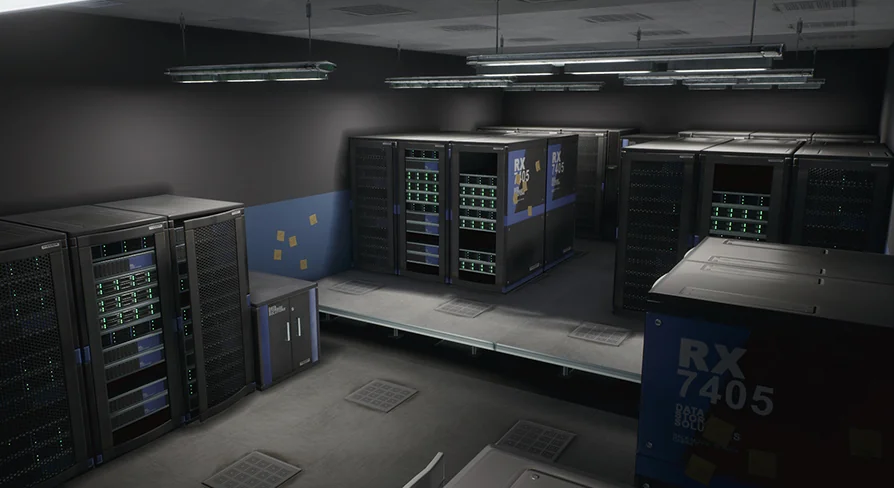
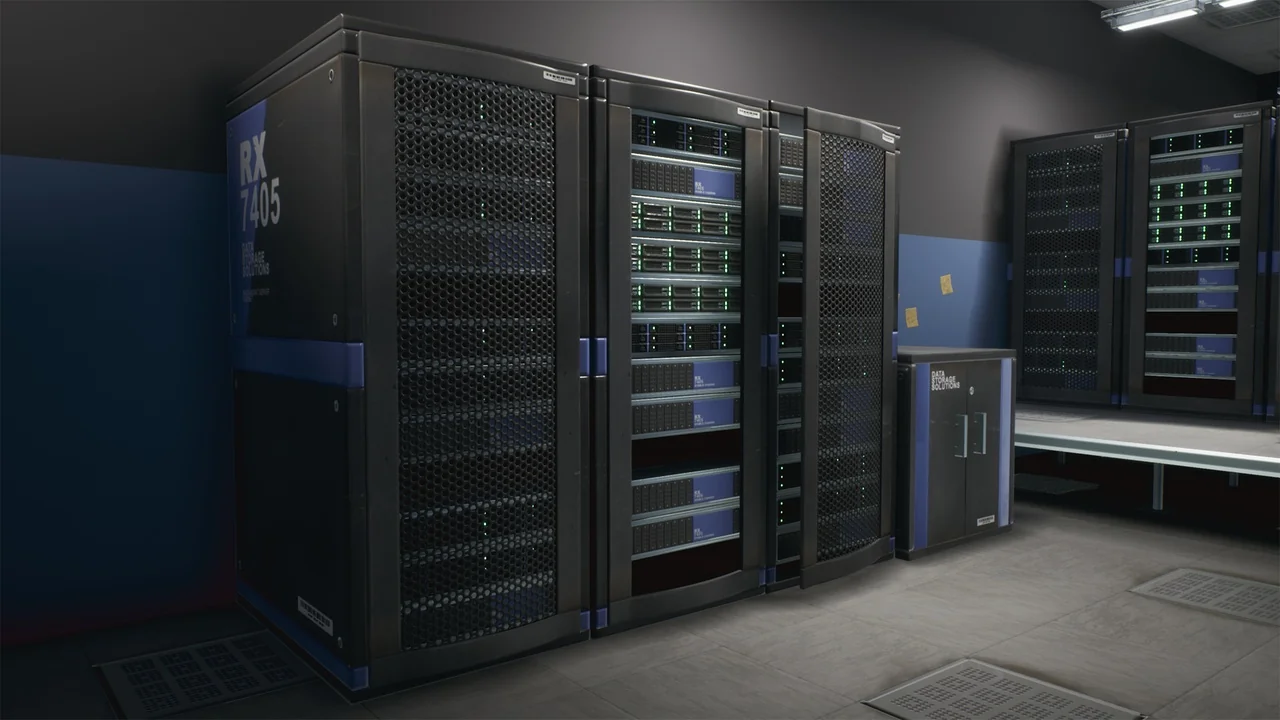
Ten low-poly modular pieces form the structural foundation of the Server Room Kit, giving level designers the building blocks needed to assemble computer storage facilities from scratch. The kit focuses on core infrastructure hardware, primarily server cases and connecting environmental structures that can be linked horizontally or stacked vertically. Rather than relying on static, single-piece room models, every section within the kit is built to interlock cleanly, allowing developers to shape long server aisles, compact network closets, or sprawling data centers.
Modularity dictates how level geometry behaves during production. Because the assets share standardized spatial boundaries, developers can duplicate and snap racks along precise grid increments. A single server unit can stand alone against an office wall, or dozens can be mirrored to flank a long access corridor. The system supports varied interior silhouettes without requiring unique geometry for each equipment row, making it possible to construct custom layouts while keeping the underlying asset count compact and manageable.
Atlas Material Setup and PBR Channel Packing
Texture management in the kit relies on five unique materials, with a strong focus on resource conservation. All server cases share a single atlas material, combining the visual data for multiple hardware units onto a unified texture sheet. Grouping multiple server cases into one atlas significantly curbs draw calls across the scene. When a room contains dozens of repeated server racks, referencing a shared material prevents graphic processing units from repeatedly switching texture states, sustaining smooth frame rendering.
Surfaces are authored using the standard PBR metallic and roughness method, giving the metallic hardware and synthetic computer panels realistic light interaction. The texture pipeline relies on a specific map configuration:
Diffuse Map: Supplies the base color and surface marking information across the hardware.
Normal Map: Encodes fine geometric recesses, ventilation grates, and bevels onto low-poly meshes.
Metallic Map: Dictates the electrical and conductive surface properties of the server enclosures.
Roughness Map: Packed directly into the alpha channel of the Metallic map to control microsurface scattering.
Embedding roughness into the alpha channel of the metallic map streamlines memory usage across graphics pipelines. Instead of requiring a standalone texture sampler for surface roughness, rendering engines sample the RGB channels for metalness and the alpha channel for roughness simultaneously. This channel-packing technique reduces texture memory footprints and cuts down active texture fetches during complex scene rendering.
Two LOD Stages, Collisions, and Lightmapped Geometry
Every asset across the collection includes two distinct LOD stages to regulate polygon throughput during runtime. The base meshes are already modeled with low-poly optimization in mind, ensuring that even close-up views of server racks remain lightweight. When camera distances increase, the secondary LOD stage steps down mesh density, stripping out non-essential edges and preventing dense server banks from oversaturating the polygon budget.
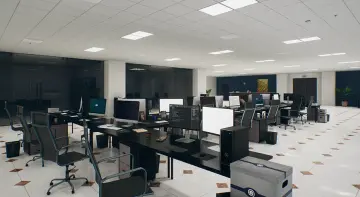
The package ships with a fully assembled demo scene constructed entirely from the ten modular assets. This environment is prepared with collision meshes, pre-configured lightmap coordinates, and active LOD transitions. Having lightmaps set up out of the box guarantees that static lighting solutions calculate clean indirect bounces and shadow projections without manual unwrapping or lightmap seam corrections. Collision boundaries ensure players and physics objects react appropriately with hardware faces, floor boundaries, and structural frames immediately upon placement.
Assembling Clean and Horror School Environments
The visual direction blends realistic computer equipment styling with adaptable utility, making the package compatible with settings such as clean modern facilities or dilapidated horror school environments. In a clean institutional context, the server racks assemble into organized campus IT facilities, high-school networking basements, or university administrative data hubs. The crisp metallic reflections and structured modular lines convey functional, well-maintained institutional technology.
The same pieces translate effectively into suspense or survival horror themes. Because the demo scene proves that complex, claustrophobic layouts can be assembled solely from these ten components, designers can build maze-like underground server archives beneath an abandoned school building. In low-light horror setups, the normal maps pick up dynamic flashlight glints and flickering emergency fixtures across the server faces, while the modular units can be arranged to create narrow sightlines, blind corners, and enclosed hiding spaces behind humming technical hardware.
Runtime Efficiency for Computer and Server Clusters
Carefully managed asset metrics allow the kit to handle performance-sensitive scenarios where environmental geometry cannot afford heavy processing overhead. Because the entire demo scene is constructed purely from modular parts sharing five materials and an atlas pipeline, designers can scale up the density of computer racks without encountering the severe rendering bottlenecks common in high-poly prop packs.
The combination of dual LOD stages, channel-packed PBR maps, and pre-built collision delivers a modular workflow that fits directly into real-time games. Whether configured as a minor technical closet or a sprawling underground server vault, the assets maintain consistent surface responses and stable runtime behavior across diverse lighting and architectural designs.
 Electronics
 Electronics
 Historical
 Cities