"9861c2075b9df49d"{"id":"1000465","slug":"sci-fi-drone-01","title":"Sci-fi Drone 01","category":"Mechanical \u0026 Robots","engine":"4.26+,5.0+","assetVersion":"","engineVersion":"Engine Version: 4.26+,5.0+","tag":"Mechanical","accent":"blue","visual":"mech","summary":"Game-ready Sci-fi Drone 01 3D model with 4K PBR textures, 26 unique animations, emissive customization, and 33,638 triangles for Unreal Engine workflows.","platform":"Unreal Engine","publishedAt":"2026-07-11T17:21:12.823Z","updatedAt":"2026-07-11T17:21:12.823Z","sourceNotes":[],"fileContents":[],"compatibility":["Unreal Engine","Engine Version: 4.26+,5.0+"],"featuredImage":{"alt":"Sci-fi Drone 01","src":"/wp-content/uploads/published/2026/07/9167065697e5-c19fa99c-2f88-4515-8a47-e4486a401685-a730db304d.webp"},"hasDownloadLink":true,"downloads":0,"terms":[{"taxonomy":"category","slug":"mechanical-and-robots","name":"Mechanical \u0026 Robots"}],"galleryImages":[{"src":"/wp-content/uploads/published/2026/07/540b56f2f5ca-14d01fc5-4cc6-44cc-8dfe-125f35a59d13-3713a506bb.webp","alt":"Sci-fi Drone 01"},{"src":"/wp-content/uploads/published/2026/07/78cd9827d645-af513606-1cb8-49b6-a6fe-49b5a0a9f20c-e4ed113f29.webp","alt":"Sci-fi Drone 01"},{"src":"/wp-content/uploads/published/2026/07/af1ff2ff73ee-f9e4ed69-0da9-4b4d-b30f-8006a6df09ea-ab22774f3b.webp","alt":"Sci-fi Drone 01"},{"src":"/wp-content/uploads/published/2026/07/e8a4eb7f1d04-4c19e4bb-cfb4-41c8-8c50-a7f8ba64fe36-87eec75ba1.webp","alt":"Sci-fi Drone 01"},{"src":"/wp-content/uploads/published/2026/07/a81f675549dd-1da4445e-e493-4b36-b911-70ee290b18ad-170b4eeaa1.webp","alt":"Sci-fi Drone 01"},{"src":"/wp-content/uploads/published/2026/07/be7e8b605510-01dd6b67-d642-42d6-93d1-5743aa53d3dd-663fd76351.webp","alt":"Sci-fi Drone 01"},{"src":"/wp-content/uploads/published/2026/07/a93e88571b44-d34b7933-1904-4253-822d-b775a3f670d1-18841883bc.webp","alt":"Sci-fi Drone 01"},{"src":"/wp-content/uploads/published/2026/07/6f214d86e59c-067e1139-7702-4cdf-bf30-a3e38c23daa2-20c0932410.webp","alt":"Sci-fi Drone 01"},{"src":"/wp-content/uploads/published/2026/07/6cbbdba5abac-b615034b-7e5f-4169-9f7a-02bbc55e8baa-502cd460b9.webp","alt":"Sci-fi Drone 01"},{"src":"/wp-content/uploads/published/2026/07/7610bcb188ba-bba06a96-5689-415f-815a-0975e0e1c9dc-8261b66c14.webp","alt":"Sci-fi Drone 01"}],"accessPanel":{"kind":"resource","title":"Download this resource","eyebrow":"Free Download","message":"Log in or create a free account to start your download.","fileName":"Content.7z","safetyNote":"Resources are manually reviewed before listing to improve quality and reduce obvious risks.","actionLabel":"Download Free","resourceType":"Resource archive"},"contentHtml":"\u003cp\u003eCyberpunk exteriors, futuristic industrial corridors, and mechanized patrol routes all demand flying units that feel mechanically grounded rather than decorative. Sci-fi Drone 01 takes aim at that need, landing as a game-ready 3D model built for real-time engines. It belongs in the category of animated robotic assets that can populate a scene as an active participant—patrolling, scanning, or engaging—instead of sitting idle as background dressing.\u003c/p\u003e \u003ch2\u003eWhat Sci-fi Drone 01 Actually Contains\u003c/h2\u003e \u003cp\u003eThe model carries a total of 33,638 triangles and 19,94 vertices, placing it in the mid-density range for a real-time mechanical unit. That polygon count carries enough geometric detail to hold up in close-quarters cinematics while remaining efficient enough for multiple instances in a populated scene. The topology supports the rigging required for movement, and the structure reads clearly as a purpose-built surveillance or combat drone.\u003c/p\u003e \u003cp\u003eSurface detail comes through a 4K PBR texture pipeline. The package includes three texture sets, meaning different material regions of the drone can carry their own albedo, normal, roughness, and metallic information. This multi-set approach allows distinct material reads across the body—separating treated metal panels from sensor housings or worn mechanical joints without relying on a single flat texture sheet.\u003c/p\u003e \u003cp\u003eThe texture work also supports simple emissive customization. Practically, this means the glowing elements on the drone can be adjusted without rebuilding the entire material structure. Light strips, sensor eyes, or warning indicators can shift in intensity or color, letting the same drone model serve different factions, alert states, or environmental moods without requiring separate assets for each variation.\u003c/p\u003e \u003ch2\u003eHow the 26 Unique Animations Shape In-Scene Behavior\u003c/h2\u003e \u003cp\u003eStatic models have limited utility in action-oriented projects. Sci-fi Drone 01 ships with 26 unique animations, giving it a full behavioral range that covers the movement vocabulary a sentient mechanical unit needs. The count suggests coverage beyond basic idle and fly states, extending into the kinds of specialized motions that define a drone's role in a scene.\u003c/p\u003e \u003cp\u003eFor a patrol sequence, the animation set likely includes the hovering, directional adjustments, and transition states needed to make the unit feel like it is actively scanning its environment rather than sliding along a spline. Combat or alert situations call for sharper evasive shifts, repositioning, and reaction poses. The presence of 26 distinct clips means the drone can cycle through several behavioral states within a single encounter without repeating the same motion too soon.\u003c/p\u003e \u003cp\u003eThe tagged term \u003cem\u003eAnimationblueprint\u003c/em\u003e Points toward integration within Unreal Engine's animation system. This indicates the animations are structured to work within Animation Blueprints, allowing state machines, blend spaces, and logic-driven transitions to control which clip plays and when. For developers, this means the drone is not just a collection of disconnected motion files. It is set up to plug into the engine's state-driven animation framework where logic can trigger hover, alert, or movement states based on gameplay conditions.\u003c/p\u003e \u003ch3\u003eUnreal Engine Compatibility Range\u003c/h3\u003e \u003cp\u003eThe asset supports Unreal Engine versions 4.20 through 4.27, covering the later releases of the previous generation of the engine. It also extends support into the current generation, working with versions 5.0 through 5.4. This dual-generation compatibility makes the drone viable for projects still maintained on Unreal Engine 4 while ensuring it remains relevant for teams that have migrated to Unreal Engine 5 or started fresh on the newer engine.\u003c/p\u003e \u003cp\u003eFor teams transitioning between engine versions, the supported range reduces friction. The drone can exist in a legacy Unreal Engine 4.27 project, move into an Unreal Engine 5.0 update, and continue functioning through to 5.4 without requiring a replacement asset or manual rework of the animation setup.\u003c/p\u003e \u003ch2\u003eWhere Sci-fi Drone 01 Fits in a Production Workflow\u003c/h2\u003e \u003cp\u003eThe tagged categories—Cyberpunk, Drone, Futuristic, Helicopter, Robot, Mech, Mecha, Armor, Cybernetic, Android—map directly to the visual language the asset speaks. In a cyberpunk setting, the drone operates as an automated security unit sweeping neon-lit rooftops or industrial no-fly zones. Futuristic military scenes can deploy it as a reconnaissance or combat support asset. The \u003cem\u003eHelicopter\u003c/em\u003e Tag suggests the flight behavior incorporates rotorcraft-like directional movement, giving it a distinct flight profile compared to a fixed-wing or hover-only unit.\u003c/p\u003e \u003cp\u003eThe \u003cem\u003eModular\u003c/em\u003e Tag carries practical implications for level design and scene composition. A modular drone asset can be placed in multiple contexts—solo patrol routes, squad formations, or as part of a larger monitoring system—without requiring custom variants for each placement. The emissive customization feeds directly into this modularity. The same base model can represent a friendly unit with blue indicators, a hostile one with red, or a neutral scanning probe with a steady neutral tone, all controlled through material parameters rather than duplicate mesh files.\u003c/p\u003e \u003cp\u003eThe \u003cem\u003eScript\u003c/em\u003e Tag hints at gameplay integration beyond pure visual use. Combined with the animation blueprint structure, this points toward the drone being set up for programmatic control. That means a developer can tie the animation states to AI behavior scripts, allowing the drone to react to player proximity, alarm triggers, or patrol schedules with corresponding visual feedback from the 26-animation set.\u003c/p\u003e \u003cp\u003eThe \u003cem\u003eStylized\u003c/em\u003e Tag indicates the visual direction avoids strict photorealism. The model sits in a space where mechanical detail is present and readable but leans into a deliberate art style. This matters for project matching. The drone will integrate cleanly into projects with a stylized cybernetic aesthetic, where hyper-realistic surface imperfections would clash with the surrounding environment. Team creating games with a defined visual tone rather than a filmic look will find the asset aligns more naturally with their established art direction.\u003c/p\u003e \u003ch2\u003ePractical Integration Notes for Dev Teams\u003c/h2\u003e \u003cp\u003eThe 33,638-triangle count places the drone well within real-time performance budgets. In a fast-paced shooter or action game, one or two of these units can appear on screen alongside characters and environments without becoming a bottleneck. In a slower-paced exploration game where the drone serves as a persistent companion or recurring enemy, the budget allows for that constant presence without forcing aggressive level-of-detail reduction.\u003c/p\u003e \u003cp\u003eThe three 4K texture sets mean the visual detail holds up in closer shots. A drone hovering a few meters from the camera, or one featured in a short cinematic sequence, will show distinct material separation across its body. The 4K resolution prevents the surface from breaking down into pixelation during these moments, while the three-set structure keeps the texture memory organized by material zone rather than wasting resolution on single combined sheets.\u003c/p\u003e \u003cp\u003eThe combination of detailed textures and moderate geometry gives the asset a balanced profile. It is not a lightweight prop meant for distant background placement. It carries the fidelity needed for mid-range and close interaction, and the 26 animations ensure it remains visually active whenever the camera or player gets near enough to study it.\u003c/p\u003e \u003ch2\u003eWho Benefits Most from This Asset\u003c/h2\u003e \u003cp\u003eSmall to mid-sized development teams working in Unreal Engine will find the most immediate value here. The drone fills a specific role—a stylized, animated robotic unit with customizable emissive detailing—without requiring the team to build a rig, animate flying states, or author custom materials from scratch. The dual-generation engine support means the asset slots into both ongoing Unreal Engine 4 projects and current Unreal Engine 5 work.\u003c/p\u003e \u003cp\u003eSolo developers and solo technical artists benefit from the animation blueprint readiness. The 26 clips and the implied state-driven control structure reduce the time needed to make the drone feel alive in a scene. Instead of building animation logic from zero, the developer can focus on tuning existing states and adjusting the emissive customization to fit the scene's faction colors or alert conditions.\u003c/p\u003e \u003cp\u003eThe stylized cybernetic direction also makes the asset a fit for projects outside strict sci-fi. Cyberpunk narratives, futuristic horror, or even surreal mechanical dreamscape scenes can deploy the drone as an active environmental element. The visual design is specific enough to read as a drone on first glance, but the stylization leaves room for creative placement beyond the most obvious genres.\u003c/p\u003e \u003cp\u003eFor any production that needs an active, animated flying unit with the visual presence to hold up in closer shots and the behavioral range to avoid feeling repetitive, Sci-fi Drone 01 covers that requirement in a single, engine-integrated package.\u003c/p\u003e\n\n\u003ch2\u003eRelated Resources Worth Checking\u003c/h2\u003e\n\u003cul\u003e\n\u003cli\u003e\u003ca href=\"https://3dcghub.com/sci-fi-cyber-robot-01/\" title=\"Sci-FI Cyber Robot 01\"\u003eSci-FI Cyber Robot 01\u003c/a\u003e\u003c/li\u003e\n\u003cli\u003e\u003ca href=\"https://3dcghub.com/robot-13/\" title=\"Robot 13\"\u003eRobot 13\u003c/a\u003e\u003c/li\u003e\n\u003cli\u003e\u003ca href=\"https://3dcghub.com/robot-14/\" title=\"Robot 14\"\u003eRobot 14\u003c/a\u003e\u003c/li\u003e\n\u003cli\u003e\u003ca href=\"https://3dcghub.com/sci-fi-aircraft/\" title=\"Sci Fi Aircraft\"\u003eSci Fi Aircraft\u003c/a\u003e\u003c/li\u003e\n\u003cli\u003e\u003ca href=\"https://3dcghub.com/fighter-drone/\" title=\"Fighter Drone\"\u003eFighter Drone\u003c/a\u003e\u003c/li\u003e\n\u003c/ul\u003e","contentTextLength":9077,"navigation":{"current":1366,"total":3687,"previous":{"id":"1000466","slug":"lgui-3d-ui-for-unrealengine","title":"LGUI - 3D UI for UnrealEngine","category":"Engine Tools","platform":"Unreal Engine","updatedAt":"2026-07-11T17:25:36.577Z"},"next":{"id":"1000464","slug":"sci-fi-assault-rifle","title":"Sci-Fi Assault Rifle","category":"Weapons \u0026 Combat","platform":"Unreal Engine","updatedAt":"2026-07-11T17:15:01.019Z"}},"relatedResources":[{"id":"1000399","slug":"robot-13","title":"Robot 13","category":"Mechanical \u0026 Robots","engine":"4.26+,5.0+","assetVersion":"","engineVersion":"Engine Version: 4.26+,5.0+","tag":"Mechanical","accent":"blue","visual":"mech","summary":"A low-poly, optimized sci-fi robot model featuring UE4 Epic Skeleton compatibility, custom PBR materials, and six alpha masks for deep surface customization.","platform":"Unreal Engine","publishedAt":"2026-07-07T15:42:38.985Z","updatedAt":"2026-07-07T15:42:38.985Z","sourceNotes":[],"fileContents":[],"compatibility":["Unreal Engine","Engine Version: 4.26+,5.0+"],"featuredImage":{"alt":"Robot 13","src":"/wp-content/uploads/published/2026/07/122d49234d35-1bb9b325-e1e6-42cb-b659-de44b242bf53-920d9c39d4.webp"},"hasDownloadLink":true,"downloads":0},{"id":"2998","slug":"sci-fi-cyber-robot-01","title":"Sci-FI Cyber Robot 01","category":"Mechanical \u0026 Robots","engine":"4.26+,5.0+","assetVersion":"Engine version: 4.26+,5.0+","engineVersion":"4.21","tag":"Mechanical","accent":"blue","visual":"character","summary":"Enhance your game with the Sci-Fi Cyber Robot 01. A low-poly, UE4/UE5 compatible character with advanced material customization for unique futuristic designs.","platform":"Unreal Engine","publishedAt":"2026-02-07T16:20:57.000Z","updatedAt":"2026-04-19T15:57:43.000Z","sourceNotes":[],"fileContents":[],"compatibility":["Unreal Engine","Engine version: 4.26+,5.0+"],"featuredImage":{"alt":"Sci-FI Cyber Robot 01","src":"https://3dcghub.com/wp-content/uploads/2026/02/df9493f3-803e-4630-b18c-aae34f08b429.webp"},"hasDownloadLink":true,"downloads":2},{"id":"2981","slug":"robot-14","title":"Robot 14","category":"Mechanical \u0026 Robots","engine":"5.0+","assetVersion":"Engine version: 5.0+","engineVersion":"4.26","tag":"Mechanical","accent":"blue","visual":"character","summary":"Boost your game performance with this optimized low poly robot model. Features Epic Skeleton compatibility, custom materials, and easy Blueprint controls.","platform":"Unreal Engine","publishedAt":"2026-02-07T16:17:08.000Z","updatedAt":"2026-04-19T15:57:43.000Z","sourceNotes":[],"fileContents":[],"compatibility":["Unreal Engine","Engine version: 5.0+"],"featuredImage":{"alt":"Robot 14","src":"https://3dcghub.com/wp-content/uploads/2026/02/282b0943-1a6c-4f43-bf75-9211d71c299e.webp"},"hasDownloadLink":true,"downloads":2}]}
Mechanical
Sci-fi Drone 01
Game-ready Sci-fi Drone 01 3D model with 4K PBR textures, 26 unique animations, emissive customization, and 33,638 triangles for Unreal Engine workflows.
Cyberpunk exteriors, futuristic industrial corridors, and mechanized patrol routes all demand flying units that feel mechanically grounded rather than decorative. Sci-fi Drone 01 takes aim at that need, landing as a game-ready 3D model built for real-time engines. It belongs in the category of animated robotic assets that can populate a scene as an active participant—patrolling, scanning, or engaging—instead of sitting idle as background dressing.
What Sci-fi Drone 01 Actually Contains
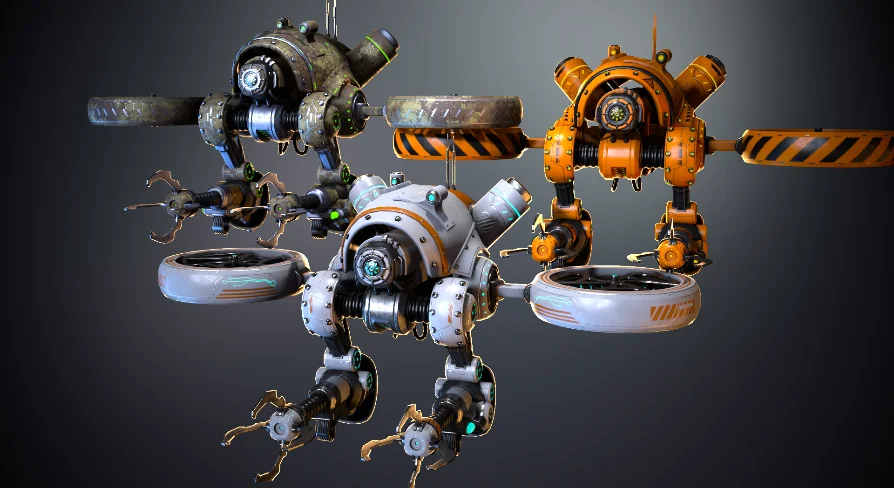
The model carries a total of 33,638 triangles and 19,94 vertices, placing it in the mid-density range for a real-time mechanical unit. That polygon count carries enough geometric detail to hold up in close-quarters cinematics while remaining efficient enough for multiple instances in a populated scene. The topology supports the rigging required for movement, and the structure reads clearly as a purpose-built surveillance or combat drone.
Surface detail comes through a 4K PBR texture pipeline. The package includes three texture sets, meaning different material regions of the drone can carry their own albedo, normal, roughness, and metallic information. This multi-set approach allows distinct material reads across the body—separating treated metal panels from sensor housings or worn mechanical joints without relying on a single flat texture sheet.
The texture work also supports simple emissive customization. Practically, this means the glowing elements on the drone can be adjusted without rebuilding the entire material structure. Light strips, sensor eyes, or warning indicators can shift in intensity or color, letting the same drone model serve different factions, alert states, or environmental moods without requiring separate assets for each variation.
How the 26 Unique Animations Shape In-Scene Behavior
Static models have limited utility in action-oriented projects. Sci-fi Drone 01 ships with 26 unique animations, giving it a full behavioral range that covers the movement vocabulary a sentient mechanical unit needs. The count suggests coverage beyond basic idle and fly states, extending into the kinds of specialized motions that define a drone's role in a scene.
For a patrol sequence, the animation set likely includes the hovering, directional adjustments, and transition states needed to make the unit feel like it is actively scanning its environment rather than sliding along a spline. Combat or alert situations call for sharper evasive shifts, repositioning, and reaction poses. The presence of 26 distinct clips means the drone can cycle through several behavioral states within a single encounter without repeating the same motion too soon.
The tagged term Animationblueprint Points toward integration within Unreal Engine's animation system. This indicates the animations are structured to work within Animation Blueprints, allowing state machines, blend spaces, and logic-driven transitions to control which clip plays and when. For developers, this means the drone is not just a collection of disconnected motion files. It is set up to plug into the engine's state-driven animation framework where logic can trigger hover, alert, or movement states based on gameplay conditions.
Unreal Engine Compatibility Range
The asset supports Unreal Engine versions 4.20 through 4.27, covering the later releases of the previous generation of the engine. It also extends support into the current generation, working with versions 5.0 through 5.4. This dual-generation compatibility makes the drone viable for projects still maintained on Unreal Engine 4 while ensuring it remains relevant for teams that have migrated to Unreal Engine 5 or started fresh on the newer engine.
For teams transitioning between engine versions, the supported range reduces friction. The drone can exist in a legacy Unreal Engine 4.27 project, move into an Unreal Engine 5.0 update, and continue functioning through to 5.4 without requiring a replacement asset or manual rework of the animation setup.
Where Sci-fi Drone 01 Fits in a Production Workflow
The tagged categories—Cyberpunk, Drone, Futuristic, Helicopter, Robot, Mech, Mecha, Armor, Cybernetic, Android—map directly to the visual language the asset speaks. In a cyberpunk setting, the drone operates as an automated security unit sweeping neon-lit rooftops or industrial no-fly zones. Futuristic military scenes can deploy it as a reconnaissance or combat support asset. The Helicopter Tag suggests the flight behavior incorporates rotorcraft-like directional movement, giving it a distinct flight profile compared to a fixed-wing or hover-only unit.
The Modular Tag carries practical implications for level design and scene composition. A modular drone asset can be placed in multiple contexts—solo patrol routes, squad formations, or as part of a larger monitoring system—without requiring custom variants for each placement. The emissive customization feeds directly into this modularity. The same base model can represent a friendly unit with blue indicators, a hostile one with red, or a neutral scanning probe with a steady neutral tone, all controlled through material parameters rather than duplicate mesh files.
The Script Tag hints at gameplay integration beyond pure visual use. Combined with the animation blueprint structure, this points toward the drone being set up for programmatic control. That means a developer can tie the animation states to AI behavior scripts, allowing the drone to react to player proximity, alarm triggers, or patrol schedules with corresponding visual feedback from the 26-animation set.
The Stylized Tag indicates the visual direction avoids strict photorealism. The model sits in a space where mechanical detail is present and readable but leans into a deliberate art style. This matters for project matching. The drone will integrate cleanly into projects with a stylized cybernetic aesthetic, where hyper-realistic surface imperfections would clash with the surrounding environment. Team creating games with a defined visual tone rather than a filmic look will find the asset aligns more naturally with their established art direction.
Practical Integration Notes for Dev Teams
The 33,638-triangle count places the drone well within real-time performance budgets. In a fast-paced shooter or action game, one or two of these units can appear on screen alongside characters and environments without becoming a bottleneck. In a slower-paced exploration game where the drone serves as a persistent companion or recurring enemy, the budget allows for that constant presence without forcing aggressive level-of-detail reduction.
The three 4K texture sets mean the visual detail holds up in closer shots. A drone hovering a few meters from the camera, or one featured in a short cinematic sequence, will show distinct material separation across its body. The 4K resolution prevents the surface from breaking down into pixelation during these moments, while the three-set structure keeps the texture memory organized by material zone rather than wasting resolution on single combined sheets.
The combination of detailed textures and moderate geometry gives the asset a balanced profile. It is not a lightweight prop meant for distant background placement. It carries the fidelity needed for mid-range and close interaction, and the 26 animations ensure it remains visually active whenever the camera or player gets near enough to study it.
Who Benefits Most from This Asset
Small to mid-sized development teams working in Unreal Engine will find the most immediate value here. The drone fills a specific role—a stylized, animated robotic unit with customizable emissive detailing—without requiring the team to build a rig, animate flying states, or author custom materials from scratch. The dual-generation engine support means the asset slots into both ongoing Unreal Engine 4 projects and current Unreal Engine 5 work.
Solo developers and solo technical artists benefit from the animation blueprint readiness. The 26 clips and the implied state-driven control structure reduce the time needed to make the drone feel alive in a scene. Instead of building animation logic from zero, the developer can focus on tuning existing states and adjusting the emissive customization to fit the scene's faction colors or alert conditions.
The stylized cybernetic direction also makes the asset a fit for projects outside strict sci-fi. Cyberpunk narratives, futuristic horror, or even surreal mechanical dreamscape scenes can deploy the drone as an active environmental element. The visual design is specific enough to read as a drone on first glance, but the stylization leaves room for creative placement beyond the most obvious genres.
For any production that needs an active, animated flying unit with the visual presence to hold up in closer shots and the behavioral range to avoid feeling repetitive, Sci-fi Drone 01 covers that requirement in a single, engine-integrated package.
 Mechanical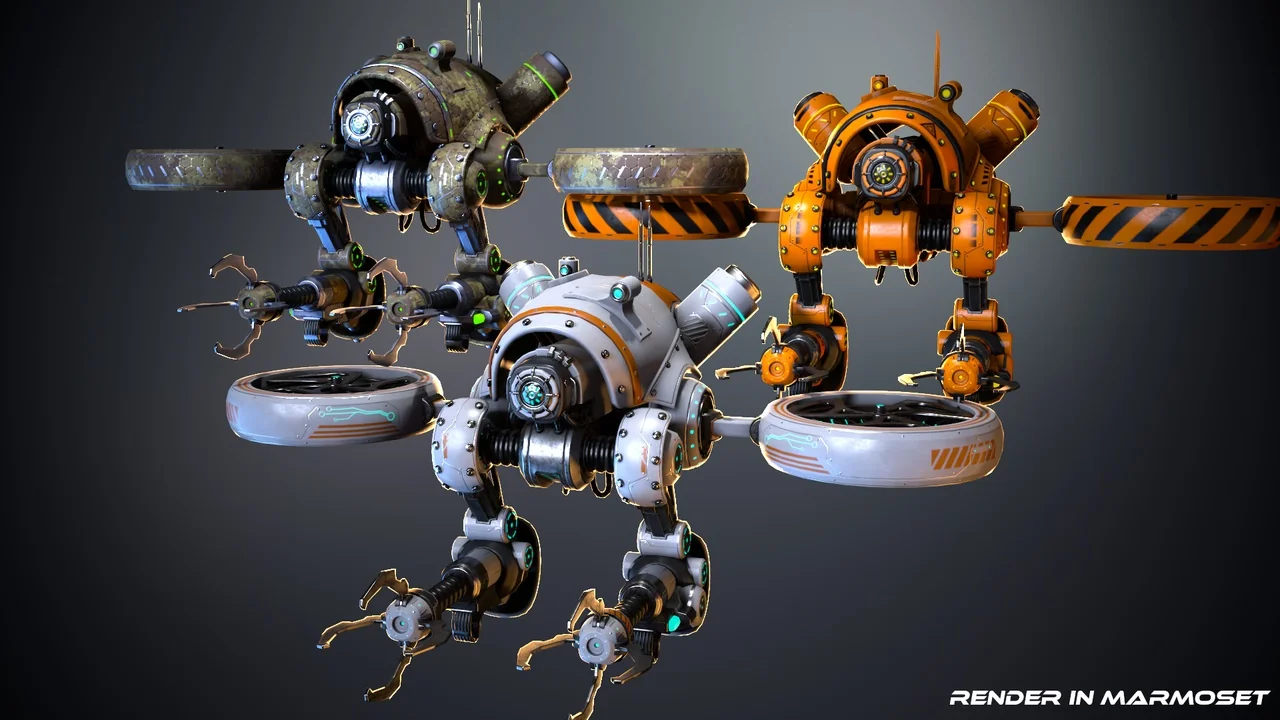
 Mechanical
 Mechanical
 Mechanical