"1f00f67f9253451b"{"id":"1000964","slug":"rome-fantasy-pack-i","title":"Rome Fantasy Pack I","category":"Fantasy","engine":"4.26+,5.0+","assetVersion":"","engineVersion":"Engine Version: 4.26+,5.0+","tag":"Fantasy","accent":"blue","visual":"mech","summary":"Modular ancient Roman streets with the blueprints, Substance-built textures, and props for middle- and lower-class life in Rome Fantasy Pack I.","platform":"Unreal Engine","publishedAt":"2026-08-15T11:18:20.925Z","updatedAt":"2026-08-15T11:18:20.925Z","sourceNotes":[],"fileContents":[],"compatibility":["Unreal Engine","Engine Version: 4.26+,5.0+"],"featuredImage":{"alt":"Rome Fantasy Pack I","src":"/wp-content/uploads/published/2026/08/47b205682961-e6db0a2f-5ed6-4af2-8e0c-68a8b8365c69-02fea6cfcf.webp"},"hasDownloadLink":true,"downloads":0,"terms":[{"taxonomy":"category","slug":"fantasy","name":"Fantasy"}],"galleryImages":[{"src":"/wp-content/uploads/published/2026/08/7d413226daa2-51237671-7037-4649-9886-18c242d435bc-498a17a7ac.webp","alt":"Rome Fantasy Pack I"},{"src":"/wp-content/uploads/published/2026/08/e2ca8148b158-f9d8196e-a436-4ee7-84c7-a11c9d719802-5f56699c6c.webp","alt":"Rome Fantasy Pack I"},{"src":"/wp-content/uploads/published/2026/08/0ab1eb90e9db-a9ed0d23-c77a-405c-935c-816f28ec7831-4586d079e2.webp","alt":"Rome Fantasy Pack I"},{"src":"/wp-content/uploads/published/2026/08/3f8fd726b782-af697b27-ec34-45c0-a857-4b378ae57b5a-6176e55def.webp","alt":"Rome Fantasy Pack I"},{"src":"/wp-content/uploads/published/2026/08/3772d740c348-e070bfa6-246e-447a-9535-6a99d2f6fc20-504b8ba797.webp","alt":"Rome Fantasy Pack I"},{"src":"/wp-content/uploads/published/2026/08/3a452edc60a0-d3a56816-80cd-4507-8445-fe12d59c6b14-6058f1ff9e.webp","alt":"Rome Fantasy Pack I"},{"src":"/wp-content/uploads/published/2026/08/44629346ce93-ad168a52-aae0-448a-973a-344520b69ef9-527f72c8bf.webp","alt":"Rome Fantasy Pack I"},{"src":"/wp-content/uploads/published/2026/08/709e866bbd15-b6173f52-4b9f-46a8-92d9-60e1517303f1-bb8b2ec4b1.webp","alt":"Rome Fantasy Pack I"},{"src":"/wp-content/uploads/published/2026/08/02ce5d40a4df-52a26588-d2bb-4083-b9f2-7ac16d88b303-0ecea56342.webp","alt":"Rome Fantasy Pack I"},{"src":"/wp-content/uploads/published/2026/08/b77c03ec9139-3bb1720f-704c-417a-b209-2d93b18302d9-5ad04ddff8.webp","alt":"Rome Fantasy Pack I"}],"accessPanel":{"kind":"resource","title":"Download this resource","eyebrow":"Free Download","message":"Log in or create a free account to start your download.","fileName":"Rome Fantasy Pack I.7z","safetyNote":"Resources are manually reviewed before listing to improve quality and reduce obvious risks.","actionLabel":"Download Free","resourceType":"Resource archive"},"contentHtml":"\u003cp\u003eFor anyone building a playable slice of ancient Rome, the more interesting streets are often the ones that don't make it onto postcards. Rome Fantasy Pack I focuses on the middle- and lower-class side of the city, where everyday life happens behind unadorned walls and around working doorways. This is the first pack in the developing Rome: Fantasy Pack series, and it brings a modular construction system, a broad set of Roman props, and a few texture tricks that help those spaces read as lived-in.\u003c/p\u003e\u003ch2\u003eMaterials that handle Rome's weather\u003c/h2\u003e\u003cp\u003eOne of the strongest draws of this pack is how the surfaces respond to the environment. The material setup uses vertex colors to paint wetness, stains, and decals directly onto geometry. That means the same wall or roof can shift from dry to damp, or pick up streaking grime, without swapping out texture sets. The decal materials are opaque mesh decals, so they can be placed as geometry rather than flat projected patches. The system also supports paintable opacity, letting you control how subtle or heavy a stain appears, and even includes a puddle depth channel for low spots in streets or floors. This kind of flexible weathering is useful for setting a specific time of day or atmosphere, especially if you want rain to feel recent without covering every surface in generic puddles.\u003c/p\u003e\u003cp\u003eGeometry benefits from area-weighted normals as well. These are modified vertex normals that produce smoother shading and more even lighting across the structure, so the architectural pieces and props avoid the visible faceting that can show up on curved surfaces.\u003c/p\u003e\u003ch2\u003eWalls, doors, roofs, and stairs: modular construction\u003c/h2\u003e\u003cp\u003eThe pack's architecture is designed around modularity. You can start with the prefabricated buildings if you want a complete structure quickly, or ignore them and assemble something custom piece by piece. The core pieces are walls, doors, roofs, and stairs, each of which can be used in combinations that fit your layout rather than being locked into a static building shell. Because the pack is aimed at middle- and lower-class settings, these pieces lean more toward practical buildings. They're the kind of walls and doorways you'd expect in narrow back streets, workshops, and modest housing.\u003c/p\u003e\u003ch2\u003eBlueprint placement for a faster workflow\u003c/h2\u003e\u003cp\u003eConstruction is handled through blueprints, and those blueprints come with intelligent options. The selling point here is that you don't need to open the content browser and dig through mesh folders every time you want to place an object. The blueprint interface gives you placement choices right in the viewport or through its option set, so the process is closer to snapping pieces into place than hunting for assets. That's a small quality-of-life boost, but it matters when you're arranging large numbers of architectural pieces across an entire village or level. It also makes the pack easier to teach or share with collaborators who don't live inside the asset folder.\u003c/p\u003e\u003ch2\u003eSubstance-built textures and sculpted detail\u003c/h2\u003e\u003cp\u003eThere are no photo-sourced textures in this pack. The entire Rome look is built using Substance Designer and Substance Painter workflows. That gives the materials a consistent, art-directed feel rather than a collection of clip-and-paste photographs stitched together. The props carry clean, custom normal maps generated from high-poly sculpts, so pottery, tools, and other small objects hold their shape in light instead of relying on flat albedo maps. For a realistic setting, good normal maps are what make a bowl or barrel feel solid rather than painted on.\u003c/p\u003e\u003cp\u003eThe prop library is a highlight on its own. It includes Roman pottery, bowls, barrels, blacksmith tools, and more. These aren't just background dressing. In the middle- and lower-class context, they're the objects that define daily life. A blacksmith's tools imply a forge, a stack of barrels suggests storage or trade, and scattered pottery gives a kitchen or market stall a sense of use. Combined with the opaque mesh decals and wetness controls, these props can be placed into the modular architecture to turn a skeleton of walls and roofs into a functioning Roman street.\u003c/p\u003e\u003ch2\u003eThe demo and final fit\u003c/h2\u003e\u003cp\u003eA demo is included with the pack, which gives you a reference for how the architecture, blueprints, and materials work together in a complete scene. The pack also comes with a YouTube preview and tutorials, so the setup process is available as a visual guide rather than just a manual. If your project needs a realistic Roman village, a medieval-fantasy settlement, or a level that sits somewhere between the two, Rome Fantasy Pack I is shaped by the kind of dense, lived-in spaces that usually take the longest to assemble by hand. The combination of smart blueprints and layered materials is meant to get you to that final look faster.\u003c/p\u003e\n\n\u003ch2\u003eMore From The Same Workflow\u003c/h2\u003e\n\u003cul\u003e\n\u003cli\u003e\u003ca href=\"https://3dcghub.com/dreamscape-stylized-environment-tower-stylized-nature-open-world-fantasy/\" title=\"Dreamscape: Stylized Environment Tower - Stylized Nature Open World Fantasy\"\u003eDreamscape: Stylized Environment Tower - Stylized Nature Open World Fantasy\u003c/a\u003e\u003c/li\u003e\n\u003cli\u003e\u003ca href=\"https://3dcghub.com/low-poly-fantasy-forest/\" title=\"LOW-POLY - Fantasy Forest\"\u003eLOW-POLY - Fantasy Forest\u003c/a\u003e\u003c/li\u003e\n\u003cli\u003e\u003ca href=\"https://3dcghub.com/deadly-forest-modular-asset-pack/\" title=\"Deadly Forest - Modular Asset Pack\"\u003eDeadly Forest - Modular Asset Pack\u003c/a\u003e\u003c/li\u003e\n\u003cli\u003e\u003ca href=\"https://3dcghub.com/stylized-village-modular-stylized-fantasy-village-environment/\" title=\"Stylized Village - Modular Stylized Fantasy Village Environment\"\u003eStylized Village - Modular Stylized Fantasy Village Environment\u003c/a\u003e\u003c/li\u003e\n\u003cli\u003e\u003ca href=\"https://3dcghub.com/fantasy-forest-environment/\" title=\"Fantasy Forest Environment\"\u003eFantasy Forest Environment\u003c/a\u003e\u003c/li\u003e\n\u003c/ul\u003e","contentTextLength":5060,"navigation":{"current":363,"total":3222,"previous":{"id":"1000965","slug":"sci-fi-door-set","title":"Sci-Fi Door Set","category":"Electronics \u0026 Technology","platform":"Unreal Engine","updatedAt":"2026-08-15T11:31:43.425Z"},"next":{"id":"1000963","slug":"realistic-starter-vfx-pack-vol-2","title":"Realistic Starter VFX Pack Vol 2","category":"Variety","platform":"Unreal Engine","updatedAt":"2026-08-15T11:13:19.886Z"}},"relatedResources":[{"id":"1001067","slug":"roman-palace-arena-and-dungeon-rome-fantasy-modular-kit","title":"Roman Palace, Arena \u0026 Dungeon - Rome Fantasy Modular Kit","category":"Fantasy","engine":"4.26+,5.0+","assetVersion":"","engineVersion":"Engine Version: 4.26+,5.0+","tag":"Fantasy","accent":"blue","visual":"mech","summary":"Rome Palace, Arena \u0026 Dungeon is a modular environment kit with structure modules, palace and dungeon scenes, dual lighting, and sublevel streaming.","platform":"Unreal Engine","publishedAt":"2026-09-03T16:36:54.367Z","updatedAt":"2026-09-03T16:36:54.367Z","sourceNotes":[],"fileContents":[],"compatibility":["Unreal Engine","Engine Version: 4.26+,5.0+"],"featuredImage":{"alt":"Roman Palace, Arena \u0026 Dungeon - Rome Fantasy Modular Kit","src":"/wp-content/uploads/published/2026/09/1a77e7e18a45-2e9d13ff-4d08-4bc3-aef6-7cd4a743f7be-a4bee2316d.webp"},"hasDownloadLink":true,"downloads":0},{"id":"7924","slug":"dreamscape-stylized-environment-tower-stylized-nature-open-world-fantasy","title":"Dreamscape: Stylized Environment Tower - Stylized Nature Open World Fantasy","category":"Fantasy","engine":"4.26+,5.0+","assetVersion":"Engine version: 4.26+,5.0+","engineVersion":"","tag":"Fantasy","accent":"blue","visual":"city","summary":"Build stunning stylized worlds with this massive collection of over 150 assets. It includes a modular tower, optimized foliage, and advanced landscape materials for next-gen performance.","platform":"Unreal Engine","publishedAt":"2026-02-22T15:54:58.000Z","updatedAt":"2026-04-19T15:55:52.000Z","sourceNotes":[],"fileContents":[],"compatibility":["Unreal Engine","Engine version: 4.26+,5.0+"],"featuredImage":{"alt":"Dreamscape: Stylized Environment Tower - Stylized Nature Open World Fantasy","src":"https://3dcghub.com/wp-content/uploads/2026/02/1ac90b59-2d5e-4d76-ae3a-f80afa26032b.webp"},"hasDownloadLink":true,"downloads":3},{"id":"7981","slug":"low-poly-fantasy-forest","title":"LOW-POLY - Fantasy Forest","category":"Fantasy","engine":"4.26+,5.0+","assetVersion":"Engine version: 4.26+,5.0+","engineVersion":"4.21","tag":"Fantasy","accent":"blue","visual":"city","summary":"Create stunning stylized worlds with this comprehensive collection of modular castle components and dynamic forest biomes. Featuring hand-painted textures and smart materials, it is perfect for any fantasy-themed project.","platform":"Unreal Engine","publishedAt":"2026-02-22T16:14:27.000Z","updatedAt":"2026-04-19T15:55:51.000Z","sourceNotes":[],"fileContents":[],"compatibility":["Unreal Engine","Engine version: 4.26+,5.0+"],"featuredImage":{"alt":"LOW-POLY - Fantasy Forest","src":"https://3dcghub.com/wp-content/uploads/2026/02/fd3adc34-9c67-44dd-84e4-b673261cc879.webp"},"hasDownloadLink":true,"downloads":0}]}
Fantasy
Rome Fantasy Pack I
Modular ancient Roman streets with the blueprints, Substance-built textures, and props for middle- and lower-class life in Rome Fantasy Pack I.
Category:Unreal Engine,FantasyPlatform: Unreal EngineEngine Version: 4.26+,5.0+Published: Aug 15, 2026
Fantasy
Resource overview
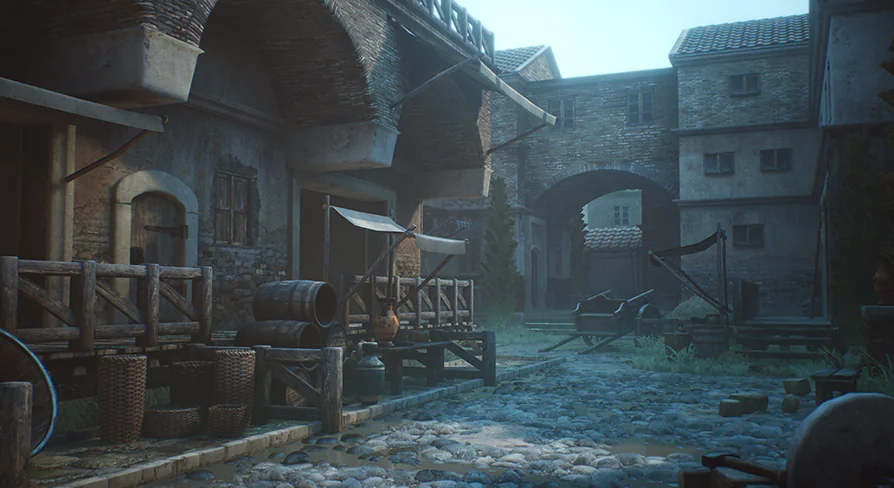
For anyone building a playable slice of ancient Rome, the more interesting streets are often the ones that don't make it onto postcards. Rome Fantasy Pack I focuses on the middle- and lower-class side of the city, where everyday life happens behind unadorned walls and around working doorways. This is the first pack in the developing Rome: Fantasy Pack series, and it brings a modular construction system, a broad set of Roman props, and a few texture tricks that help those spaces read as lived-in.
Materials that handle Rome's weather
One of the strongest draws of this pack is how the surfaces respond to the environment. The material setup uses vertex colors to paint wetness, stains, and decals directly onto geometry. That means the same wall or roof can shift from dry to damp, or pick up streaking grime, without swapping out texture sets. The decal materials are opaque mesh decals, so they can be placed as geometry rather than flat projected patches. The system also supports paintable opacity, letting you control how subtle or heavy a stain appears, and even includes a puddle depth channel for low spots in streets or floors. This kind of flexible weathering is useful for setting a specific time of day or atmosphere, especially if you want rain to feel recent without covering every surface in generic puddles.
Geometry benefits from area-weighted normals as well. These are modified vertex normals that produce smoother shading and more even lighting across the structure, so the architectural pieces and props avoid the visible faceting that can show up on curved surfaces.
Walls, doors, roofs, and stairs: modular construction
The pack's architecture is designed around modularity. You can start with the prefabricated buildings if you want a complete structure quickly, or ignore them and assemble something custom piece by piece. The core pieces are walls, doors, roofs, and stairs, each of which can be used in combinations that fit your layout rather than being locked into a static building shell. Because the pack is aimed at middle- and lower-class settings, these pieces lean more toward practical buildings. They're the kind of walls and doorways you'd expect in narrow back streets, workshops, and modest housing.
Blueprint placement for a faster workflow
Construction is handled through blueprints, and those blueprints come with intelligent options. The selling point here is that you don't need to open the content browser and dig through mesh folders every time you want to place an object. The blueprint interface gives you placement choices right in the viewport or through its option set, so the process is closer to snapping pieces into place than hunting for assets. That's a small quality-of-life boost, but it matters when you're arranging large numbers of architectural pieces across an entire village or level. It also makes the pack easier to teach or share with collaborators who don't live inside the asset folder.
Substance-built textures and sculpted detail
There are no photo-sourced textures in this pack. The entire Rome look is built using Substance Designer and Substance Painter workflows. That gives the materials a consistent, art-directed feel rather than a collection of clip-and-paste photographs stitched together. The props carry clean, custom normal maps generated from high-poly sculpts, so pottery, tools, and other small objects hold their shape in light instead of relying on flat albedo maps. For a realistic setting, good normal maps are what make a bowl or barrel feel solid rather than painted on.
The prop library is a highlight on its own. It includes Roman pottery, bowls, barrels, blacksmith tools, and more. These aren't just background dressing. In the middle- and lower-class context, they're the objects that define daily life. A blacksmith's tools imply a forge, a stack of barrels suggests storage or trade, and scattered pottery gives a kitchen or market stall a sense of use. Combined with the opaque mesh decals and wetness controls, these props can be placed into the modular architecture to turn a skeleton of walls and roofs into a functioning Roman street.
The demo and final fit
A demo is included with the pack, which gives you a reference for how the architecture, blueprints, and materials work together in a complete scene. The pack also comes with a YouTube preview and tutorials, so the setup process is available as a visual guide rather than just a manual. If your project needs a realistic Roman village, a medieval-fantasy settlement, or a level that sits somewhere between the two, Rome Fantasy Pack I is shaped by the kind of dense, lived-in spaces that usually take the longest to assemble by hand. The combination of smart blueprints and layered materials is meant to get you to that final look faster.
 Fantasy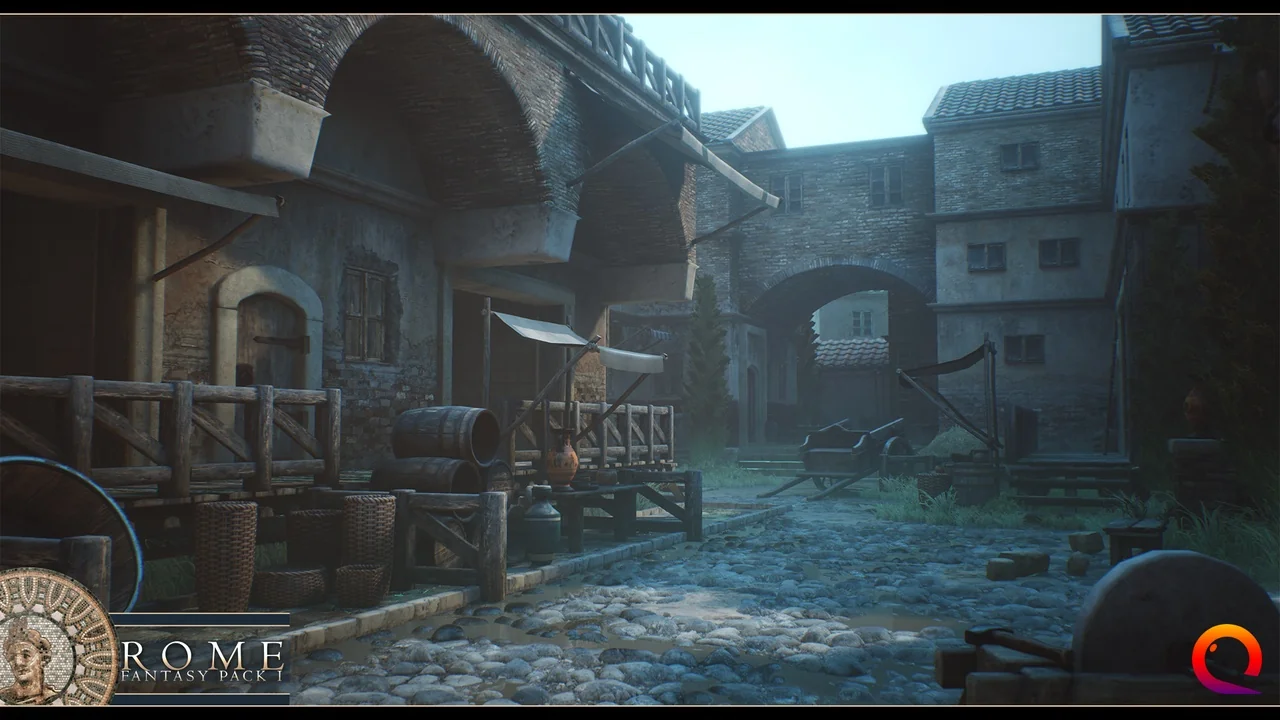
 Fantasy
 Fantasy
 Fantasy