"efaa631e936fd3ee"{"id":"1002174","slug":"robot-spider","title":"Robot Spider","category":"Characters \u0026 Creatures","engine":"4.19+,5.0+","assetVersion":"","engineVersion":"Engine Version: 4.19+,5.0+","tag":"Characters","accent":"blue","visual":"character","summary":"Examine the Robot Spider character model, featuring 4K PBR metallic-roughness textures, 13 animations, turret articulation, and an included damage variant.","platform":"Unreal Engine","publishedAt":"2026-10-29T10:54:47.040Z","updatedAt":"2026-10-29T10:54:47.040Z","sourceNotes":[],"fileContents":[],"compatibility":["Unreal Engine","Engine Version: 4.19+,5.0+"],"featuredImage":{"alt":"Robot Spider","src":"/wp-content/uploads/published/2026/10/c97535cddc0a-84eee4c7-f51c-4fc6-8d32-755f9175da17-3e3c630c50.webp"},"hasDownloadLink":true,"downloads":1,"terms":[{"taxonomy":"category","slug":"characters-and-creatures","name":"Characters \u0026 Creatures"}],"galleryImages":[{"src":"/wp-content/uploads/published/2026/10/2c9a35e922d6-b8bfacdd-06fe-4d2f-a6f4-17dd0fd341b3-99c5f97317.webp","alt":"Robot Spider"},{"src":"/wp-content/uploads/published/2026/10/cd1abcd18cb8-407739c9-bcc0-433f-acc7-796f319560c2-16b6e0ca39.webp","alt":"Robot Spider"},{"src":"/wp-content/uploads/published/2026/10/162b639436d5-9bd2ec59-ba18-4b7d-beab-57d97c0582fd-516f52bbce.webp","alt":"Robot Spider"},{"src":"/wp-content/uploads/published/2026/10/7cec9c9f4ce1-4614b34a-0ab6-432a-9c90-9eb1d31516db-87a1405bf7.webp","alt":"Robot Spider"},{"src":"/wp-content/uploads/published/2026/10/bdf3a097de4a-5ee696ad-0f81-4b1e-88de-c74d9060ebc6-0afc042c59.webp","alt":"Robot Spider"},{"src":"/wp-content/uploads/published/2026/10/a066080090df-03305080-95a1-4d32-a657-2d5f30fadcec-6269e67ad0.webp","alt":"Robot Spider"},{"src":"/wp-content/uploads/published/2026/10/6f1c8fd295f5-caf23533-7e43-4fe1-96a2-ba6ac5790756-245356e2da.webp","alt":"Robot Spider"},{"src":"/wp-content/uploads/published/2026/10/0b700b369d94-5c61f72e-7013-4057-9b03-4af1ece7d074-4b36e81337.webp","alt":"Robot Spider"},{"src":"/wp-content/uploads/published/2026/10/c57d82830af5-611e80e5-c7f6-43a7-8e8c-b9a823c2d95e-fe5bbbc2e9.webp","alt":"Robot Spider"}],"accessPanel":{"kind":"resource","title":"Download this resource","eyebrow":"Free Download","message":"Log in or create a free account to start your download.","fileName":"Content.7z","safetyNote":"Resources are manually reviewed before listing to improve quality and reduce obvious risks.","actionLabel":"Download Free","resourceType":"Resource archive"},"contentHtml":"\u003cp\u003eFuturistic military outposts, devastated urban warfronts, and alien industrial corridors frequently demand autonomous ground units capable of locking down choke points. The Robot Spider steps directly into these combat settings as a multi-legged combatant suited for first-person shooters, real-time strategy skirmishes, and role-playing encounters. Combining heavy ordnance housing with arachnid locomotion, the model serves as an aggressive front-line drone, a stationary defense turret, or a patrol unit guarding fortified perimeters.\u003c/p\u003e \u003ch2\u003eTurret Articulation and Robot Spider Geometry\u003c/h2\u003e\n\u003cp\u003eThe mesh structure is engineered around functional mechanical movement. Modeled with a polygon budget of 78,334 triangles across 69,920 vertices, the Robot Spider maintains crisp mechanical edges, joint articulation, and plated bulk while remaining optimized as a low-poly asset for interactive projects. Its multi-segmented chassis distributes weight across its legs, providing a stable visual platform for heavy weapon systems.\u003c/p\u003e \u003cp\u003eTargeting mechanics are defined by specific range allowances built into the chassis. The top-mounted turret tower is engineered with full 360-degree horizontal rotation, allowing the unit to track players or AI targets continuously without turning its base. Vertical travel spans from a 5-degree downward depression to a 25-degree upward elevation. This specific vertical range shapes how encounters can be structured, granting the Robot Spider effective line of sight when holding elevated platforms or shooting down at approaching ground squads, while maintaining balanced dead zones at steep vertical angles directly beneath its hull.\u003c/p\u003e \u003ch2\u003eMetallic-Roughness 4K Textures and the Damaged Variant\u003c/h2\u003e\n\u003cp\u003eSurfacing for the mechanical hull relies on a physically based rendering workflow structured through metallic-roughness conventions. Nine individual textures authored at 4K resolution map the physical wear, metal densities, and surface details across the armor panels and joint mechanisms. Rather than relying on flat sheeting, the high-resolution map allocations highlight panel seams, mechanical vents, joint sleeves, and barrel housings with clear visual fidelity under dynamic scene lighting.\u003c/p\u003e \u003cp\u003eThe material setup uses a single master material branched into two distinct material instances. This hierarchy directly feeds into visual storytelling through an included damage version of the character. When units sustain enemy fire, the alternative visual pass can be swapped into place to reflect structural degradation, wear, and combat exhaustion across the chassis. Having a dedicated damage variant directly aligned with the base geometry simplifies dynamic health-state switching during real-time encounters.\u003c/p\u003e \u003ch2\u003eLocomotion Library: In-Place and Root Motion Maneuvers\u003c/h2\u003e\n\u003cp\u003eCombat locomotion and behavioral cycles are driven by a collection of 13 animations partitioned across both in-place and root-motion configurations. Because different game types demand different locomotion architectures, having matching directional coverage for both setups ensures the asset adapts cleanly to either physics-driven movement or controller-driven directional velocity.\u003c/p\u003e \u003cp\u003eLocomotion covers full cardinal travel along with rotational adjustment:\u003c/p\u003e\n\u003cul\u003e \u003cli\u003e\u003cstrong\u003eWalk Forward\u003c/strong\u003e, \u003cstrong\u003eWalk Backward\u003c/strong\u003e, \u003cstrong\u003eWalk Left\u003c/strong\u003e, and \u003cstrong\u003eWalk Right\u003c/strong\u003e Provided in both in-place and root-motion tracks for directional traversal.\u003c/li\u003e \u003cli\u003e\u003cstrong\u003eTurn Left\u003c/strong\u003e And \u003cstrong\u003eTurn Right\u003c/strong\u003e Variants across both systems to handle orientation alignment when navigating around obstacles or tracking threats.\u003c/li\u003e\n\u003c/ul\u003e \u003cp\u003eOperational states complement the locomotion suite. The character includes dedicated WakeUp and Shutdown cycles, enabling scenarios where dormant spider drones activate from low-power storage modes when intruders breach defensive zones. In combat, an Idle loop keeps the mechanical posture active, while an explicit Death sequence resolves fatal structural collapse. Offensive capabilities are mapped to three independent firing states: Shoot_Left, Shoot_Right, and Shoot_All, accommodating alternating burst fire, single-side engagement, or full-barrage suppressive fire against incoming targets.\u003c/p\u003e \u003ch2\u003ePlatform Targeting and Technical Setup in Combat Pipelines\u003c/h2\u003e\n\u003cp\u003eThe Robot Spider package delivers a standalone single-character asset with broad operating compatibility, verified for both Windows and Mac development environments. Project setup is accompanied by content overview documentation to map out internal naming and resource organization. Video presentation scenes used in demonstration footage are not included in the package, leaving the focus entirely on the core functional character, its material network, and its animation sequences.\u003c/p\u003e \u003cp\u003eRigging implementation uses a bespoke skeletal system rather than standard Epic skeleton conventions, and it does not include inverse kinematics (IK) bones. Because the rig is tailored to the multi-legged articulation of an arachnid mech rather than a bipedal humanoid frame, animation targeting and state transitions rely directly on the asset's dedicated clip library and custom animation blueprint logic. Integrating the character into custom combat trees involves establishing transition logic between the wakeup routines, cardinal strafes, turret elevation angles, and designated fire animations to bring this mechanized threat to life in sci-fi combat encounters.\u003c/p\u003e\n\n\u003ch2\u003eMore From The Same Workflow\u003c/h2\u003e\n\u003cul\u003e\n\u003cli\u003e\u003ca href=\"https://3dcghub.com/spider-tank/\" title=\"Spider Tank\"\u003eSpider Tank\u003c/a\u003e\u003c/li\u003e\n\u003cli\u003e\u003ca href=\"https://3dcghub.com/robot-bee/\" title=\"Robot Bee\"\u003eRobot Bee\u003c/a\u003e\u003c/li\u003e\n\u003cli\u003e\u003ca href=\"https://3dcghub.com/robot-robbie-01/\" title=\"Robot Robbie 01\"\u003eRobot Robbie 01\u003c/a\u003e\u003c/li\u003e\n\u003cli\u003e\u003ca href=\"https://3dcghub.com/sci-fi-robot/\" title=\"Sci Fi Robot\"\u003eSci Fi Robot\u003c/a\u003e\u003c/li\u003e\n\u003cli\u003e\u003ca href=\"https://3dcghub.com/etasphera17/\" title=\"Etasphera17\"\u003eEtasphera17\u003c/a\u003e\u003c/li\u003e\n\u003c/ul\u003e","contentTextLength":5408,"navigation":{"current":111,"total":4209,"previous":{"id":"1002175","slug":"rapier-anim-set-2","title":"Rapier Anim Set","category":"Combat","platform":"Unreal Engine","updatedAt":"2026-10-29T12:03:40.588Z"},"next":{"id":"1002173","slug":"rapier-anim-set","title":"Rapier Anim Set","category":"Animations","platform":"Unity","updatedAt":"2026-10-29T10:44:49.154Z"}},"relatedResources":[{"id":"1000549","slug":"spider-tank","title":"Spider Tank","category":"Characters \u0026 Creatures","engine":"5.1+","assetVersion":"","engineVersion":"Engine Version: 5.1+","tag":"Characters","accent":"blue","visual":"character","summary":"Spider Tank is a fully customizable Unreal Engine robot asset with 4K textures, 4 LODs, 10 animations, SFX, AnimBPs, and single-slot master material.","platform":"Unreal Engine","publishedAt":"2026-07-15T06:05:04.002Z","updatedAt":"2026-07-15T06:05:04.002Z","sourceNotes":[],"fileContents":[],"compatibility":["Unreal Engine","Engine Version: 5.1+"],"featuredImage":{"alt":"Spider Tank","src":"/wp-content/uploads/published/2026/07/f2fc51502ac4-bb470fe7-e03b-491e-b261-e46d7177cba3-f1b3b70f9b.webp"},"hasDownloadLink":true,"downloads":1},{"id":"1002172","slug":"robot-bee","title":"Robot Bee","category":"Characters \u0026 Creatures","engine":"4.19+,5.0+","assetVersion":"","engineVersion":"Engine Version: 4.19+,5.0+","tag":"Characters","accent":"blue","visual":"character","summary":"Rigged and animated Robot Bee low-poly character model featuring 4K PBR metallic-roughness textures, full flight, walking, and weapon combat animations.","platform":"Unreal Engine","publishedAt":"2026-10-29T10:15:34.621Z","updatedAt":"2026-10-29T10:15:34.621Z","sourceNotes":[],"fileContents":[],"compatibility":["Unreal Engine","Engine Version: 4.19+,5.0+"],"featuredImage":{"alt":"Robot Bee","src":"/wp-content/uploads/published/2026/10/e2c941f553b6-24c810ad-37cb-43fa-8ee9-d1406a377a32-03d7e5bdb8.webp"},"hasDownloadLink":true,"downloads":0},{"id":"1001829","slug":"robot-robbie-01","title":"Robot Robbie 01","category":"Characters \u0026 Creatures","engine":"4.19+,5.0+","assetVersion":"","engineVersion":"Engine Version: 4.19+,5.0+","tag":"Characters","accent":"blue","visual":"character","summary":"Low-poly humanoid mecha Robot Robbie 01 features 4K PBR textures, Epic skeleton UE4 rigging, v1.1 eye morph targets, and a versatile animation suite.","platform":"Unreal Engine","publishedAt":"2026-10-21T08:21:32.204Z","updatedAt":"2026-10-21T08:21:32.204Z","sourceNotes":[],"fileContents":[],"compatibility":["Unreal Engine","Engine Version: 4.19+,5.0+"],"featuredImage":{"alt":"Robot Robbie 01","src":"/wp-content/uploads/published/2026/10/275ed59aa92f-b883a61c-8b35-4617-8f13-d93248ca4634-a2ab406c41.webp"},"hasDownloadLink":true,"downloads":0}]}
Characters
Robot Spider
Examine the Robot Spider character model, featuring 4K PBR metallic-roughness textures, 13 animations, turret articulation, and an included damage variant.
Futuristic military outposts, devastated urban warfronts, and alien industrial corridors frequently demand autonomous ground units capable of locking down choke points. The Robot Spider steps directly into these combat settings as a multi-legged combatant suited for first-person shooters, real-time strategy skirmishes, and role-playing encounters. Combining heavy ordnance housing with arachnid locomotion, the model serves as an aggressive front-line drone, a stationary defense turret, or a patrol unit guarding fortified perimeters.
Turret Articulation and Robot Spider Geometry
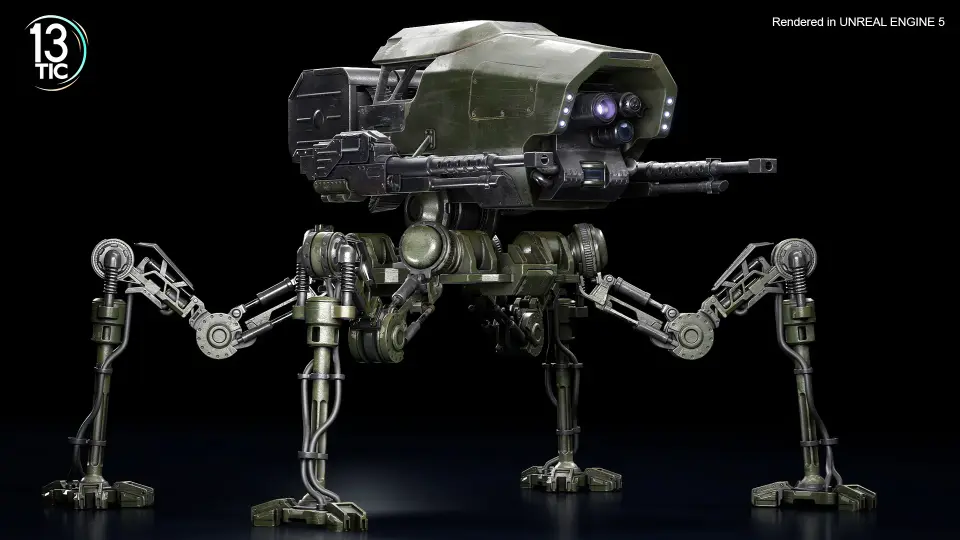
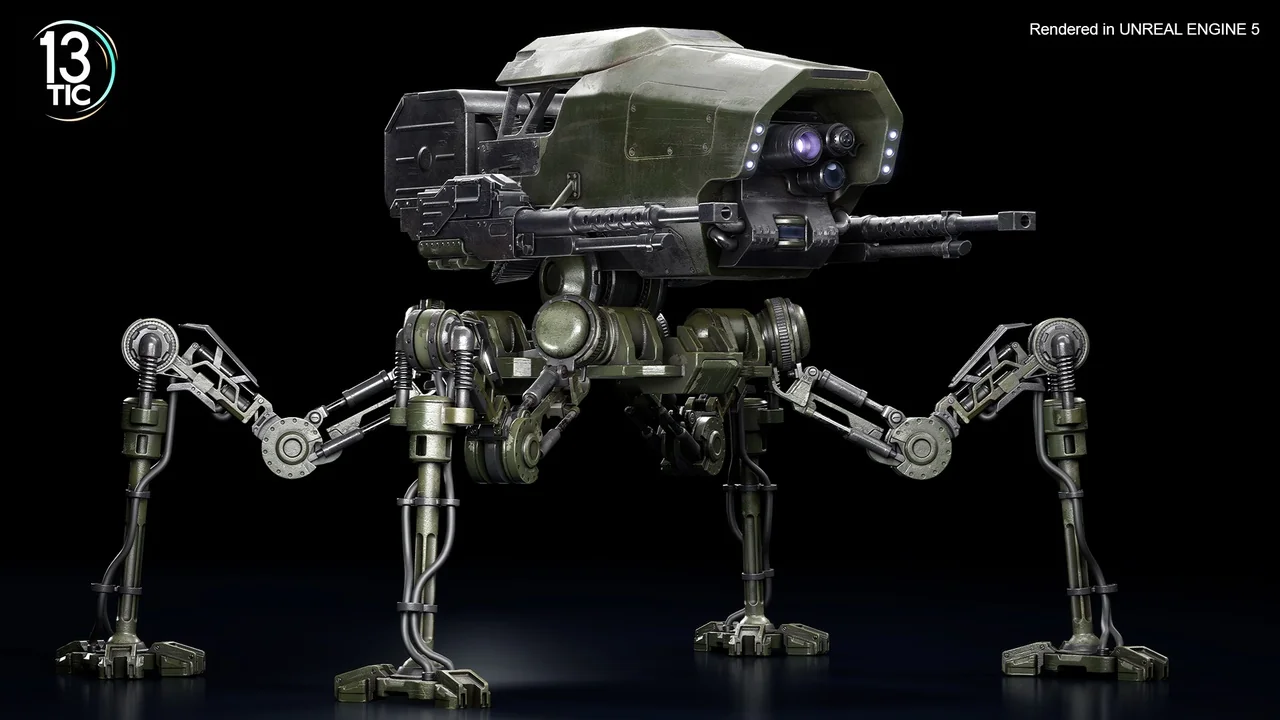
The mesh structure is engineered around functional mechanical movement. Modeled with a polygon budget of 78,334 triangles across 69,920 vertices, the Robot Spider maintains crisp mechanical edges, joint articulation, and plated bulk while remaining optimized as a low-poly asset for interactive projects. Its multi-segmented chassis distributes weight across its legs, providing a stable visual platform for heavy weapon systems.
Targeting mechanics are defined by specific range allowances built into the chassis. The top-mounted turret tower is engineered with full 360-degree horizontal rotation, allowing the unit to track players or AI targets continuously without turning its base. Vertical travel spans from a 5-degree downward depression to a 25-degree upward elevation. This specific vertical range shapes how encounters can be structured, granting the Robot Spider effective line of sight when holding elevated platforms or shooting down at approaching ground squads, while maintaining balanced dead zones at steep vertical angles directly beneath its hull.
Metallic-Roughness 4K Textures and the Damaged Variant
Surfacing for the mechanical hull relies on a physically based rendering workflow structured through metallic-roughness conventions. Nine individual textures authored at 4K resolution map the physical wear, metal densities, and surface details across the armor panels and joint mechanisms. Rather than relying on flat sheeting, the high-resolution map allocations highlight panel seams, mechanical vents, joint sleeves, and barrel housings with clear visual fidelity under dynamic scene lighting.
The material setup uses a single master material branched into two distinct material instances. This hierarchy directly feeds into visual storytelling through an included damage version of the character. When units sustain enemy fire, the alternative visual pass can be swapped into place to reflect structural degradation, wear, and combat exhaustion across the chassis. Having a dedicated damage variant directly aligned with the base geometry simplifies dynamic health-state switching during real-time encounters.
Locomotion Library: In-Place and Root Motion Maneuvers
Combat locomotion and behavioral cycles are driven by a collection of 13 animations partitioned across both in-place and root-motion configurations. Because different game types demand different locomotion architectures, having matching directional coverage for both setups ensures the asset adapts cleanly to either physics-driven movement or controller-driven directional velocity.
Locomotion covers full cardinal travel along with rotational adjustment:
Walk Forward, Walk Backward, Walk Left, and Walk Right Provided in both in-place and root-motion tracks for directional traversal.
Turn Left And Turn Right Variants across both systems to handle orientation alignment when navigating around obstacles or tracking threats.
Operational states complement the locomotion suite. The character includes dedicated WakeUp and Shutdown cycles, enabling scenarios where dormant spider drones activate from low-power storage modes when intruders breach defensive zones. In combat, an Idle loop keeps the mechanical posture active, while an explicit Death sequence resolves fatal structural collapse. Offensive capabilities are mapped to three independent firing states: Shoot_Left, Shoot_Right, and Shoot_All, accommodating alternating burst fire, single-side engagement, or full-barrage suppressive fire against incoming targets.
Platform Targeting and Technical Setup in Combat Pipelines
The Robot Spider package delivers a standalone single-character asset with broad operating compatibility, verified for both Windows and Mac development environments. Project setup is accompanied by content overview documentation to map out internal naming and resource organization. Video presentation scenes used in demonstration footage are not included in the package, leaving the focus entirely on the core functional character, its material network, and its animation sequences.
Rigging implementation uses a bespoke skeletal system rather than standard Epic skeleton conventions, and it does not include inverse kinematics (IK) bones. Because the rig is tailored to the multi-legged articulation of an arachnid mech rather than a bipedal humanoid frame, animation targeting and state transitions rely directly on the asset's dedicated clip library and custom animation blueprint logic. Integrating the character into custom combat trees involves establishing transition logic between the wakeup routines, cardinal strafes, turret elevation angles, and designated fire animations to bring this mechanized threat to life in sci-fi combat encounters.
 Characters
 Characters
 Characters
 Characters