"d44939561efbdce2"{"id":"1000126","slug":"nwh-dynamic-water-physics-2","title":"NWH Dynamic Water Physics 2","category":"Physics","engine":"4.27","assetVersion":"Asset Version:1.0","engineVersion":"Engine Version: 4.27","tag":"Physics","accent":"cyan","visual":"mech","summary":"A mesh-driven water-object interaction simulator for Unreal Engine featuring accurate buoyancy, hydrodynamics, and multi-threaded performance.","platform":"Unreal Engine","publishedAt":"2026-06-11T10:05:36.789Z","updatedAt":"2026-06-11T10:05:36.789Z","sourceNotes":[],"fileContents":[],"compatibility":["Unreal Engine","Asset Version:1.0","Engine Version: 4.27"],"featuredImage":{"alt":"NWH Dynamic Water Physics 2","src":"/wp-content/uploads/published/2026/06/0c4bc739a663-3a9c0c1e-64c3-40f4-b2dd-9e546051f444-a77f918910.webp"},"hasDownloadLink":true,"pageviews":4,"galleryImages":[{"src":"/wp-content/uploads/published/2026/06/cba785983941-0519adef-1dbf-4626-9842-3cf0d0b12b7d-c6dce21204.webp","alt":"NWH Dynamic Water Physics 2"},{"src":"/wp-content/uploads/published/2026/06/3fcf14e9fa0e-9cfff94b-740f-4f67-a1cd-465405fa40e5-00235f998a.webp","alt":"NWH Dynamic Water Physics 2"},{"src":"/wp-content/uploads/published/2026/06/332c654d40d9-c7be0759-6c5d-4980-9605-774addf2b614-fc3bae29fe.webp","alt":"NWH Dynamic Water Physics 2"},{"src":"/wp-content/uploads/published/2026/06/736b23003741-52b64569-36b8-49ab-8ed8-34268d0e7d04-ccbc745145.webp","alt":"NWH Dynamic Water Physics 2"},{"src":"/wp-content/uploads/published/2026/06/919fd5443b89-21622a6b-7fcb-4257-8f51-4335ea0b3af4-f4d34e14ad.webp","alt":"NWH Dynamic Water Physics 2"},{"src":"/wp-content/uploads/published/2026/06/5f7e85faab27-eb656c7f-30ac-49bc-84e3-1a6551ae569c-5841d6de37.webp","alt":"NWH Dynamic Water Physics 2"},{"src":"/wp-content/uploads/published/2026/06/12aa9197c1a1-f9a4a0aa-09f5-4b06-a72e-a0761672ae22-467f902a24.webp","alt":"NWH Dynamic Water Physics 2"}],"accessPanel":{"kind":"resource","title":"Access this resource","eyebrow":"Free protected download","message":"Sign in or create an account to continue to the protected download through the managed storage service.","fileName":"Plugins.7z","safetyNote":"Resources are manually reviewed before listing to improve quality and reduce obvious risks.","actionLabel":"Download Free","resourceType":"Resource archive","sourceShortcode":"cryptomus_member"},"contentHtml":"\u003cp\u003eBuilding interactive water environments requires physics systems that accurately reflect how objects float, sink, and move through fluid. Whether simulating a heavily loaded cargo ship navigating an ocean swell or scattered debris flowing down a river, the interaction between solid meshes and fluid surfaces demands precise calculation. NWH Dynamic Water Physics 2 addresses these mechanics by providing a water-object interaction simulator built entirely around mesh data. Instead of relying on simplified bounding boxes or basic collision spheres, the system evaluates the physical contours of an object to drive both buoyancy and fluid resistance.\u003c/p\u003e \u003cp\u003eBy processing the actual geometry of a \u003ccode\u003eUStaticMesh\u003c/code\u003e, the simulation ensures that stationary or moving objects of any shape or size interact with the water naturally. A long, narrow sailboat will displace water and resist rotational forces differently than a wide, flat raft. Because the physics behavior is inherently shape-aware, developers can drop highly irregular models into a body of water and expect them to settle, roll, and float according to their exact geometric volume. This removes the need for building complex custom collision proxies just to get an object to float correctly.\u003c/p\u003e \u003ch3\u003eHandling Buoyancy, Hydrodynamics, and Underwater Physics\u003c/h3\u003e \u003cp\u003eRealistically simulating a water-based object requires more than just pushing it upward to counteract gravity. The system calculates buoyancy to determine how an object floats on the surface, but it simultaneously computes hydrodynamics to simulate the drag and resistance encountered when the object moves. This dual calculation means that vehicles and props experience realistic friction and momentum loss as they accelerate through water, reacting to the fluid density just as they would in reality.\u003c/p\u003e \u003cp\u003eThese calculations are not limited to the surface level. The physics behavior remains fully functional underwater, allowing developers to simulate submerged objects, sinking debris, or functional underwater vehicles. Whether an object is entirely submerged, breaching the surface, or resting on top of a wave, the system maintains accurate physical responses based on the exposed and submerged portions of the mesh.\u003c/p\u003e \u003ch3\u003eCompatibility with Unreal Water and Oceanology\u003c/h3\u003e \u003cp\u003eIntegrating a physics simulator into a project often depends heavily on the specific water rendering system being used. NWH Dynamic Water Physics 2 is built to support several common environment setups right out of the box. Projects utilizing the native Unreal Water system, specifically version 4.26 and newer, can implement the physics interactions directly. Furthermore, the simulator supports Oceanology, a popular third-party water rendering system, allowing developers working with large-scale ocean environments to apply the physics natively to realistic ocean waves.\u003c/p\u003e \u003cp\u003eFor simpler projects or highly stylized environments, the system also fully supports standard flat water setups. If a development team uses a proprietary or highly customized water shader that falls outside of these native integrations, the package includes an easy-to-implement interface specifically made for adding custom water support. This ensures that the physics simulation is not strictly locked to a single rendering method and can be adapted to specific project requirements.\u003c/p\u003e \u003ch3\u003eMulti-Threaded C++ Architecture and Performance\u003c/h3\u003e \u003cp\u003eRunning complex hydrodynamic calculations on highly detailed meshes can quickly consume system resources if not properly optimized. To maintain high performance alongside modern Chaos physics, the core of this simulator is written entirely in C++. The architecture is well-optimized, fast, and multi-threaded, ensuring that the demanding physics calculations are distributed efficiently across the CPU. This multi-threaded approach prevents the water interaction math from bottlenecking the main game thread, keeping frame rates stable even when multiple floating objects are active in a single scene.\u003c/p\u003e \u003cp\u003eBecause of this optimization, the physics system scales effectively across different hardware platforms. It is suitable for both demanding desktop simulations and resource-constrained mobile applications. Developers targeting mobile platforms can implement realistic water interactions without sacrificing performance, while desktop projects can push the limits of complex scenes with numerous floating rigid bodies.\u003c/p\u003e \u003cp\u003eFor teams that need deep access to the core logic, the full C++ source code is included. Programmers can modify the base calculations, extend the multi-threading logic, or integrate the simulator deeper into their proprietary physics setups.\u003c/p\u003e \u003ch3\u003eBlueprint Workflow and the Ship Controller\u003c/h3\u003e \u003cp\u003eWhile the foundation is built on C++, the implementation workflow does not require extensive programming knowledge. Full Blueprint support is integrated directly into the system, meaning environment artists, technical designers, and gameplay developers can set up interactive water objects with no coding required. The setup process is fast and easy, allowing users to quickly assign the necessary components to a \u003ccode\u003eUStaticMesh\u003c/code\u003e And watch it react to the surrounding water.\u003c/p\u003e \u003cp\u003eA major advantage of this workflow is the inclusion of heavily customizable physics with runtime-adjustable settings. Instead of stopping the editor, tweaking variables, and recompiling, developers can adjust buoyancy strength, drag coefficients, and weight distribution while the simulation is actively running. This allows for rapid iteration and fine-tuning of vehicle handling or environmental prop behavior directly in the viewport.\u003c/p\u003e \u003cp\u003eTo further accelerate development, the package includes a pre-configured ship controller. Rather than building the input logic, steering mechanics, and propulsion systems from scratch, developers can use the included controller to establish a baseline for boats, sailboats, and motorized ships. This controller ties directly into the hydrodynamic system, translating player inputs into realistic physical movements through the simulated fluid.\u003c/p\u003e \u003cp\u003eDevelopment teams building realistic river currents, expansive ocean environments, or interactive mobile water scenes benefit heavily from mesh-driven hydrodynamics. By relying on the actual geometry of a \u003ccode\u003eUStaticMesh\u003c/code\u003e And distributing the calculations through optimized multi-threading, this system bridges the gap between accurate physics and manageable project performance. The inclusion of native Blueprint support and a ready-to-use ship controller ensures that artists and programmers alike can populate their water environments with dynamically reacting objects without engineering a custom fluid simulation from the ground up.\u003c/p\u003e\n\n\u003ch2\u003eExplore Similar Assets\u003c/h2\u003e\n\u003cul\u003e\n\u003cli\u003e\u003ca href=\"https://3dcghub.com/uiws-unified-interactive-water-system/\" title=\"UIWS - Unified Interactive Water System\"\u003eUIWS - Unified Interactive Water System\u003c/a\u003e\u003c/li\u003e\n\u003cli\u003e\u003ca href=\"https://3dcghub.com/dynamic-real-water/\" title=\"Dynamic Real Water\"\u003eDynamic Real Water\u003c/a\u003e\u003c/li\u003e\n\u003cli\u003e\u003ca href=\"https://3dcghub.com/water-interact-system/\" title=\"Water Interact System\"\u003eWater Interact System\u003c/a\u003e\u003c/li\u003e\n\u003cli\u003e\u003ca href=\"https://3dcghub.com/advanced-water-material/\" title=\"Advanced Water Material\"\u003eAdvanced Water Material\u003c/a\u003e\u003c/li\u003e\n\u003cli\u003e\u003ca href=\"https://3dcghub.com/collision-disabler/\" title=\"Collision Disabler\"\u003eCollision Disabler\u003c/a\u003e\u003c/li\u003e\n\u003c/ul\u003e","contentTextLength":6812,"navigation":{"current":628,"total":2683,"previous":{"id":"1000127","slug":"old-man-animset","title":"Old Man Animset","category":"Variety","platform":"Unreal Engine","updatedAt":"2026-06-11T10:12:14.396Z"},"next":{"id":"1000125","slug":"nv-spline-tools","title":"NV Spline Tools","category":"Gameplay Features","platform":"Unreal Engine","updatedAt":"2026-06-11T09:59:29.656Z"}},"relatedResources":[{"id":"14724","slug":"uiws-unified-interactive-water-system","title":"UIWS - Unified Interactive Water System","category":"Engine Tools","engine":"4.25 - 4.27,5.0 - 5.7","assetVersion":"Engine version: 4.25 - 4.27,5.0 - 5.7","engineVersion":"Asset Version:1.11 - 1.18","tag":"Engine Tools","accent":"amber","visual":"character","summary":"Enhance your Unreal Engine 4 projects with UIWS - Unified Interactive Water System. This powerful plugin offers real-time fluid interaction, caustic reflections, and easy setup for beautiful, dynamic water bodies.","platform":"Unreal Engine","publishedAt":"2026-03-11T19:07:27.000Z","updatedAt":"2026-04-19T15:45:41.000Z","sourceNotes":[],"fileContents":[],"compatibility":["Unreal Engine","Engine version: 4.25 - 4.27,5.0 - 5.7","Asset Version: 1.11 - 1.18"],"featuredImage":{"alt":"UIWS - Unified Interactive Water System","src":"https://3dcghub.com/wp-content/uploads/2026/03/89d02958-c237-4e09-b3ae-50ccff59c316.webp"},"hasDownloadLink":true,"pageviews":7},{"id":"13883","slug":"dynamic-real-water","title":"Dynamic Real Water","category":"Engine Tools","engine":"5.7","assetVersion":"Engine version: 5.7","engineVersion":"Asset Version:1.1","tag":"Engine Tools","accent":"violet","visual":"mech","summary":"Enhance your Unreal Engine 5 environments with Dynamic Real Water, a high-performance FFT simulation plugin. It offers realistic wave dynamics, advanced buoyancy physics, and seamless replication for multiplayer projects.","platform":"Unreal Engine","publishedAt":"2026-03-11T10:30:53.000Z","updatedAt":"2026-04-19T15:46:20.000Z","sourceNotes":[],"fileContents":[],"compatibility":["Unreal Engine","Engine version: 5.7","Asset Version: 1.1"],"featuredImage":{"alt":"Dynamic Real Water","src":"https://3dcghub.com/wp-content/uploads/2026/03/8532c421-bf8f-4903-bbfc-9e94a063892e.webp"},"hasDownloadLink":true,"pageviews":16},{"id":"11632","slug":"water-interact-system","title":"Water Interact System","category":"Procedural Systems","engine":"5.5+","assetVersion":"Engine version: 5.5+","engineVersion":"4.27","tag":"Procedural Systems","accent":"teal","visual":"luts","summary":"Enhance your game environments with the Water Interact System, featuring three unique lakes and dynamic interactions for characters, boats, and rain.","platform":"Unreal Engine","publishedAt":"2026-03-05T18:04:35.000Z","updatedAt":"2026-04-19T15:48:09.000Z","sourceNotes":[],"fileContents":[],"compatibility":["Unreal Engine","Engine version: 5.5+"],"featuredImage":{"alt":"Water Interact System","src":"https://3dcghub.com/wp-content/uploads/2026/03/d2961b0e-ba1f-47b9-9345-b2b0cf2e681e.webp"},"hasDownloadLink":true,"pageviews":10}]}
Physics
NWH Dynamic Water Physics 2
A mesh-driven water-object interaction simulator for Unreal Engine featuring accurate buoyancy, hydrodynamics, and multi-threaded performance.
Platform: Unreal EngineAsset Version: 1.0Engine Version: 4.27Published: Jun 11, 2026
Physics
Resource overview
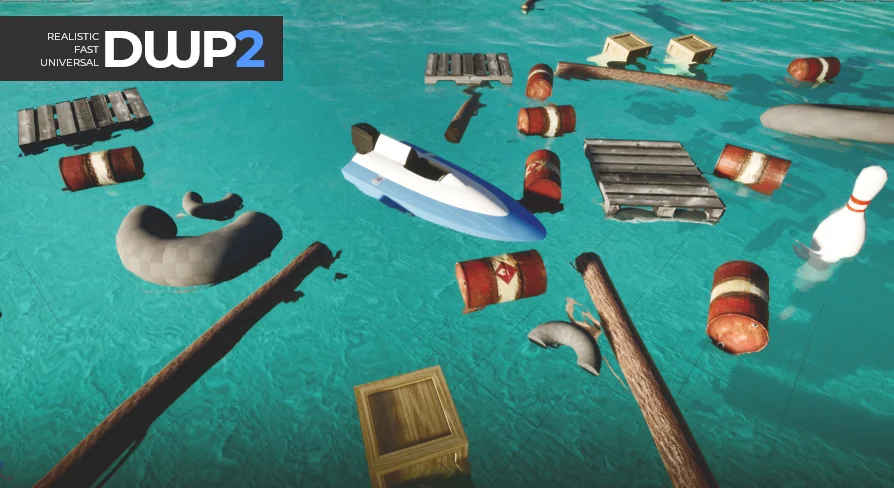
Building interactive water environments requires physics systems that accurately reflect how objects float, sink, and move through fluid. Whether simulating a heavily loaded cargo ship navigating an ocean swell or scattered debris flowing down a river, the interaction between solid meshes and fluid surfaces demands precise calculation. NWH Dynamic Water Physics 2 addresses these mechanics by providing a water-object interaction simulator built entirely around mesh data. Instead of relying on simplified bounding boxes or basic collision spheres, the system evaluates the physical contours of an object to drive both buoyancy and fluid resistance.
By processing the actual geometry of a UStaticMesh, the simulation ensures that stationary or moving objects of any shape or size interact with the water naturally. A long, narrow sailboat will displace water and resist rotational forces differently than a wide, flat raft. Because the physics behavior is inherently shape-aware, developers can drop highly irregular models into a body of water and expect them to settle, roll, and float according to their exact geometric volume. This removes the need for building complex custom collision proxies just to get an object to float correctly.
Handling Buoyancy, Hydrodynamics, and Underwater Physics
Realistically simulating a water-based object requires more than just pushing it upward to counteract gravity. The system calculates buoyancy to determine how an object floats on the surface, but it simultaneously computes hydrodynamics to simulate the drag and resistance encountered when the object moves. This dual calculation means that vehicles and props experience realistic friction and momentum loss as they accelerate through water, reacting to the fluid density just as they would in reality.
These calculations are not limited to the surface level. The physics behavior remains fully functional underwater, allowing developers to simulate submerged objects, sinking debris, or functional underwater vehicles. Whether an object is entirely submerged, breaching the surface, or resting on top of a wave, the system maintains accurate physical responses based on the exposed and submerged portions of the mesh.
Compatibility with Unreal Water and Oceanology
Integrating a physics simulator into a project often depends heavily on the specific water rendering system being used. NWH Dynamic Water Physics 2 is built to support several common environment setups right out of the box. Projects utilizing the native Unreal Water system, specifically version 4.26 and newer, can implement the physics interactions directly. Furthermore, the simulator supports Oceanology, a popular third-party water rendering system, allowing developers working with large-scale ocean environments to apply the physics natively to realistic ocean waves.
For simpler projects or highly stylized environments, the system also fully supports standard flat water setups. If a development team uses a proprietary or highly customized water shader that falls outside of these native integrations, the package includes an easy-to-implement interface specifically made for adding custom water support. This ensures that the physics simulation is not strictly locked to a single rendering method and can be adapted to specific project requirements.
Multi-Threaded C++ Architecture and Performance
Running complex hydrodynamic calculations on highly detailed meshes can quickly consume system resources if not properly optimized. To maintain high performance alongside modern Chaos physics, the core of this simulator is written entirely in C++. The architecture is well-optimized, fast, and multi-threaded, ensuring that the demanding physics calculations are distributed efficiently across the CPU. This multi-threaded approach prevents the water interaction math from bottlenecking the main game thread, keeping frame rates stable even when multiple floating objects are active in a single scene.
Because of this optimization, the physics system scales effectively across different hardware platforms. It is suitable for both demanding desktop simulations and resource-constrained mobile applications. Developers targeting mobile platforms can implement realistic water interactions without sacrificing performance, while desktop projects can push the limits of complex scenes with numerous floating rigid bodies.
For teams that need deep access to the core logic, the full C++ source code is included. Programmers can modify the base calculations, extend the multi-threading logic, or integrate the simulator deeper into their proprietary physics setups.
Blueprint Workflow and the Ship Controller
While the foundation is built on C++, the implementation workflow does not require extensive programming knowledge. Full Blueprint support is integrated directly into the system, meaning environment artists, technical designers, and gameplay developers can set up interactive water objects with no coding required. The setup process is fast and easy, allowing users to quickly assign the necessary components to a UStaticMesh And watch it react to the surrounding water.
A major advantage of this workflow is the inclusion of heavily customizable physics with runtime-adjustable settings. Instead of stopping the editor, tweaking variables, and recompiling, developers can adjust buoyancy strength, drag coefficients, and weight distribution while the simulation is actively running. This allows for rapid iteration and fine-tuning of vehicle handling or environmental prop behavior directly in the viewport.
To further accelerate development, the package includes a pre-configured ship controller. Rather than building the input logic, steering mechanics, and propulsion systems from scratch, developers can use the included controller to establish a baseline for boats, sailboats, and motorized ships. This controller ties directly into the hydrodynamic system, translating player inputs into realistic physical movements through the simulated fluid.
Development teams building realistic river currents, expansive ocean environments, or interactive mobile water scenes benefit heavily from mesh-driven hydrodynamics. By relying on the actual geometry of a UStaticMesh And distributing the calculations through optimized multi-threading, this system bridges the gap between accurate physics and manageable project performance. The inclusion of native Blueprint support and a ready-to-use ship controller ensures that artists and programmers alike can populate their water environments with dynamically reacting objects without engineering a custom fluid simulation from the ground up.
 Physics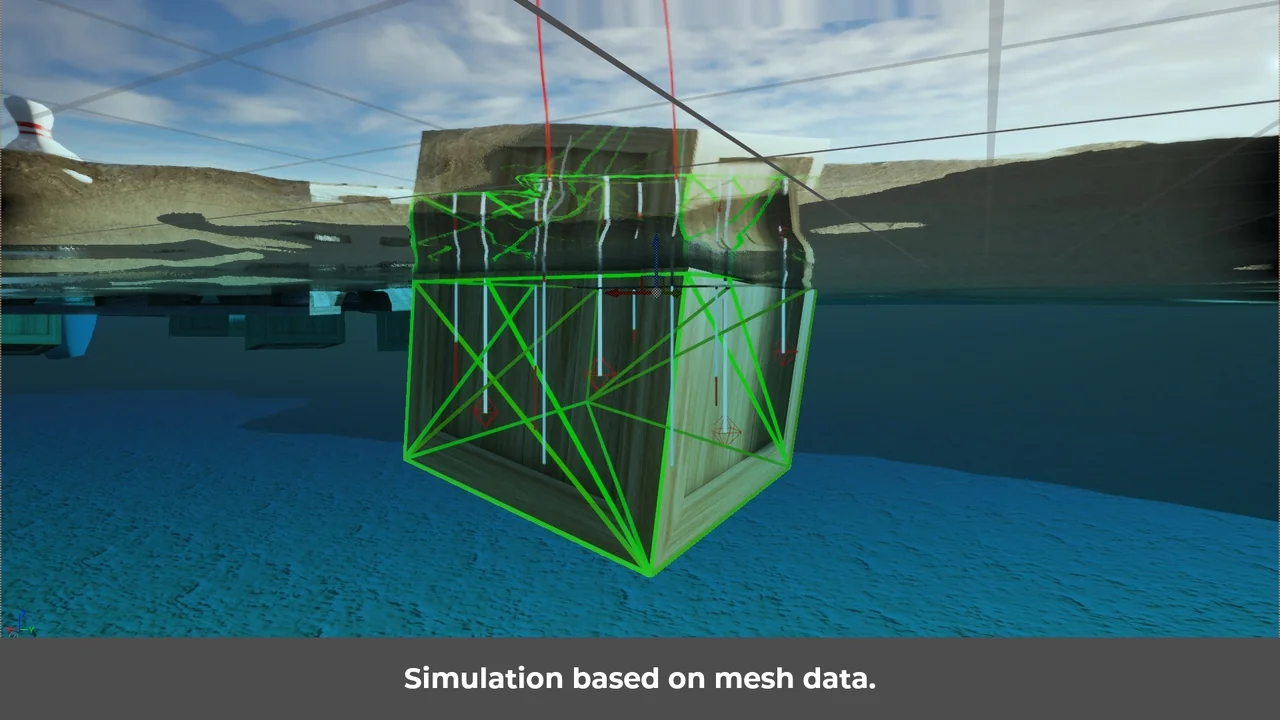
 Engine Tools
 Engine Tools
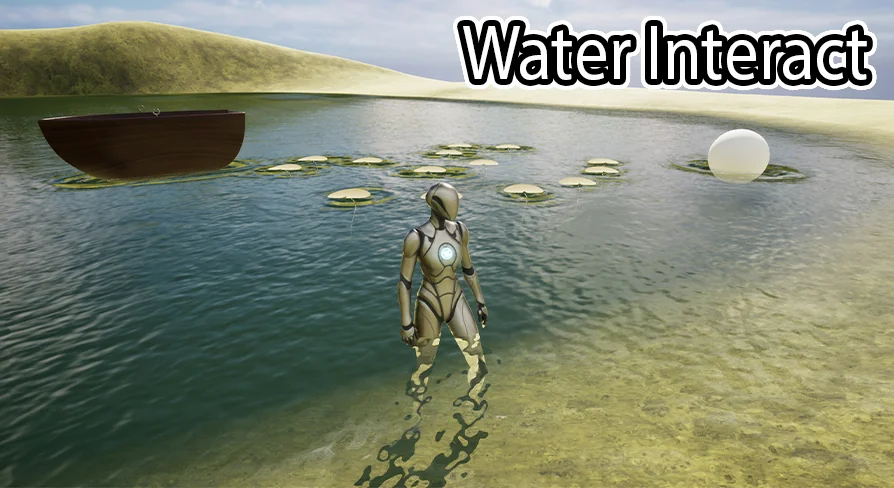 Procedural Systems