"c14ff6bd758dadb1"{"id":"1000533","slug":"nordic-harbour-modular-city-building-kit","title":"Nordic Harbour - Modular City Building Kit","category":"Cities","engine":"4.26+,5.0+","assetVersion":"","engineVersion":"Engine Version: 4.26+,5.0+","tag":"Cities","accent":"blue","visual":"city","summary":"Modular Nordic harbour building kit with 44 building modules, 15 prefab buildings, street furniture, foliage, traffic signs, parallax window interiors, and 4K m","platform":"Unreal Engine","publishedAt":"2026-07-14T17:52:33.396Z","updatedAt":"2026-07-14T17:52:33.396Z","sourceNotes":[],"fileContents":[],"compatibility":["Unreal Engine","Engine Version: 4.26+,5.0+"],"featuredImage":{"alt":"Nordic Harbour - Modular City Building Kit","src":"/wp-content/uploads/published/2026/07/04d7e8fae6d7-7912198b-61be-4f5a-8eba-99f9d0878dc1-c01f2c54b8.webp"},"hasDownloadLink":true,"downloads":1,"terms":[{"taxonomy":"category","slug":"cities","name":"Cities"}],"galleryImages":[{"src":"/wp-content/uploads/published/2026/07/8ed17ed98715-d80a84ef-951f-4c53-871e-4944e91353d5-3cc73a823c.webp","alt":"Nordic Harbour - Modular City Building Kit"},{"src":"/wp-content/uploads/published/2026/07/d1ecf1a72c40-09db29de-7e14-4fa4-964f-d13500e9ca18-304914aa05.webp","alt":"Nordic Harbour - Modular City Building Kit"},{"src":"/wp-content/uploads/published/2026/07/6f1a4a373d8e-0bb0d9cc-bd46-45c1-8e3c-23ba8ccbe8f5-110dc2197d.webp","alt":"Nordic Harbour - Modular City Building Kit"},{"src":"/wp-content/uploads/published/2026/07/199db07dfd0d-e24f2865-2280-493d-b607-7681a901a6a2-24e0e77e72.webp","alt":"Nordic Harbour - Modular City Building Kit"},{"src":"/wp-content/uploads/published/2026/07/7c57b5a7dc43-f9cb0278-30ab-4c56-9359-d95d1aee59fa-998d14c55c.webp","alt":"Nordic Harbour - Modular City Building Kit"},{"src":"/wp-content/uploads/published/2026/07/3c47f0ef0ed3-73ceb36e-e161-49cc-bd6c-775771d042f7-ac992c52ab.webp","alt":"Nordic Harbour - Modular City Building Kit"},{"src":"/wp-content/uploads/published/2026/07/19fe78b47fe1-8f007a42-51fc-4d56-8301-f708dee705e5-795ea40c5c.webp","alt":"Nordic Harbour - Modular City Building Kit"},{"src":"/wp-content/uploads/published/2026/07/59ca54bbddcb-51ed5f56-0d9f-4263-a7f9-33a6a90bff56-d9674284f7.webp","alt":"Nordic Harbour - Modular City Building Kit"},{"src":"/wp-content/uploads/published/2026/07/3f3fcb8bb9be-c7350631-be40-4e16-a63b-d6eb47352f21-c196506556.webp","alt":"Nordic Harbour - Modular City Building Kit"},{"src":"/wp-content/uploads/published/2026/07/eb6d3a73d0b4-a2b30b35-d90c-4cd5-b7d6-14599182a808-b0fc54827e.webp","alt":"Nordic Harbour - Modular City Building Kit"}],"accessPanel":{"kind":"resource","title":"Download this resource","eyebrow":"Free Download","message":"Log in or create a free account to start your download.","fileName":"Content.7z","safetyNote":"Resources are manually reviewed before listing to improve quality and reduce obvious risks.","actionLabel":"Download Free","resourceType":"Resource archive"},"contentHtml":"\u003ch2\u003eNordic Harbour - Modular City Building Kit\u003c/h2\u003e\n\u003cp\u003eProjects that call for a European canal-side setting often stall at the same bottleneck: the sheer volume of unique architecture needed to fill a waterfront. The Nordic Harbour — Modular City Building Kit addresses that gap directly, based on a modular facade system and a set of ready-made prefab structures. It is aimed at developers who need a populated harbour scene assembled quickly, without spending days modelling individual dwellings or detailing shop fronts.\u003c/p\u003e \u003cp\u003eThe kit sits squarely in the realistic Nordic and European visual category. Its modular pieces are designed so a harbour can be laid out in minutes, then refined through instance editing rather than bespoke authoring. Compatibility spans Unreal Engine versions 4.22 through 4.27 and 5.0 through 5.6, which means it has a genuinely safe floor for developers working on older editor branches and an up-to-date ceiling for those on the current release.\u003c/p\u003e \u003ch2\u003eBuilding Construction Workflows in Nordic Harbour\u003c/h2\u003e \u003cp\u003eAt the core of the package are 44 building modules. These include roofs, windows, walls, gutters, doors, gates, stairs, and chimneys. The breadth here is what allows a single kit to produce a large number of distinct structures. Rather than delivering finished shells, the developer treats buildings as assemblages of parts, which is precisely the approach needed when a scene calls for several blocks of varied but architecturally coherent houses.\u003c/p\u003e \u003cp\u003eOn top of those raw parts, 15 Blueprint prefab buildings are included. These are the practical shortcut for level designers who want a usable street wall fast. Each prefab can be dropped directly into a map. Once placed, every instance remains editable: wall textures, window choices, roofs, and other surface properties can be swapped on a per-instance basis. That approach matters because it turns one prefab into many visually distinct assets without duplication. A harbour front that needs fifteen buildings no longer requires fifteen separate authored models; it requires one prefab used fifteen times with different surface assignments.\u003c/p\u003e \u003cp\u003eThe practical implementation pattern looks like this: drop a chosen prefab onto the map, select the instance, modify its wall textures to match the desired colour palette, swap windows and roof options to differentiate it from neighbouring instances, and repeat across the waterfront. This gives a street of varied buildings produced with minimal per-building effort.\u003c/p\u003e \u003ch3\u003eWindow Interiors Without Geometry Overhead\u003c/h3\u003e \u003cp\u003eOne of the more technically deliberate features in the kit is the window treatment. All windows use texture cubemaps that simulate fake interiors. Rather than building internal geometry behind every pane of glass — an approach that would quickly bloat draw calls and memory — the kit provides up to five different interior variations that can be assigned to windows through texture selection.\u003c/p\u003e \u003cp\u003eThe effect relies on parallax texture movement. As the camera shifts position relative to a window, the parallax texture shifts accordingly, producing the illusion that a room sits behind the glass. In practice, the camera sees what looks like depth and spatial layout inside the building, but the interior is entirely a flat texture resource. This is a deliberate performance trade-off that keeps the harbour visually dense without the geometry cost that real interiors would demand.\u003c/p\u003e \u003cp\u003eFive interior variations mean that neighbouring buildings, or even different windows within the same building, can be assigned different-looking rooms. That variation is important in a harbour setting where long facades of similar windows would otherwise read as repetitive. The parallax movement keeps the illusion intact even when the camera moves laterally across a street or canal.\u003c/p\u003e \u003ch2\u003eFilling the Harbour: Streets, Pavements, and Docks\u003c/h2\u003e \u003cp\u003eThe kit extends well beyond buildings. Eighteen street modules cover roads, pavement, and dock sections. The dock pieces are worth noting specifically because a harbour scene falls apart quickly if the water edge feels improvised. Having purpose-built dock modules means the transition from street to waterfront can be handled with intended geometry rather than improvised scaling.\u003c/p\u003e \u003cp\u003eThe road and pavement modules give the ground plane the same modular logic as the buildings. This keeps the entire scene consistent in construction approach: nothing requires bespoke modelling, and every section can be iterated by swapping or repositioning instances.\u003c/p\u003e \u003ch3\u003eStreet-Level Detail Props and Traffic Infrastructure\u003c/h3\u003e \u003cp\u003eTwenty street furniture props are included. These cover benches, traffic cones, street lights, traffic lights, waste bins, and electricity boxes. The range is broad enough to dress both pedestrian quaysides and working harbour roads. Street lights and traffic lights are functional in the sense that they belong in a realistic scene and provide anchoring vertical elements at regular intervals.\u003c/p\u003e \u003cp\u003eSixteen distinct traffic signs extend the infrastructure layer. In a realistic European harbour context, traffic signage is one of the details that grounds a scene in place rather than letting it float as a generic streetscape. Having a dedicated set of signs allows the harbour to read as a regulated, lived-in environment rather than a dressed film set.\u003c/p\u003e \u003cp\u003eDecals are also included in the kit. These serve the secondary layer of surface storytelling: stains, weathering, painted markings, and ground-level grit that flat textures alone cannot deliver. They sit alongside the 4K materials that form the primary surface treatment for the buildings and ground.\u003c/p\u003e \u003ch2\u003eEnvironment Breakdown and Performance Profile\u003c/h2\u003e \u003cp\u003eThe kit is described as a highly optimised dynamic environment. The word dynamic is significant: rather than baked-only statics, the construction leans toward dynamic lighting and material response, which pairs with the instance-editing workflow. Because buildings are modified through per-instance texture and material swaps rather than through separate static meshes, the load stays manageable as the scene scales up.\u003c/p\u003e \u003cp\u003eFoliage assets round out the environment set. No exact species list is stated, but the presence of foliage in the kit means the harbour can have greenery along its quays and streets without sourcing external plant assets. The foliage works in tandem with the street furniture and signs to create the incident density that distinguishes an occupied harbour from an empty shell.\u003c/p\u003e \u003cp\u003eThe 4K material resolution is worth noting precisely because the parallax window trick and the surface variation system both depend on texture quality holding up at close range. If an instance has its wall texture swapped, the new surface needs to survive the camera getting near the facade without breaking down. 4K resolution provides headroom for that kind of proximity, which is essential in a harbour where waterfront paths often bring the player camera within arm's reach of building walls.\u003c/p\u003e \u003ch3\u003ePutting the Harbour Together\u003c/h3\u003e \u003cp\u003eAssembling a scene from the kit follows a consistent pattern. Start with the dock and road modules to establish the waterline and primary circulation. Drop in prefab buildings along the quay, using the instance-editing system to vary surface treatments and window assignments across the row. Use the 44 raw building modules wherever a custom structure is needed — a corner feature, a warehouse variant, or a building that does not match any prefab footprint. Dress the streets with the furniture prop set, place traffic signs at junctions and along quay edges, and apply decals as the final surface layer.\u003c/p\u003e \u003cp\u003eThroughout that process, the parallax windows keep the building stock visually occupied without any internal modelling. This gives a scene that reads as a populated Nordic harbour with canals, dock edges, varied architecture, and functional street infrastructure — all assembled from modular pieces and editable instances.\u003c/p\u003e \u003ch2\u003eWho Benefits Most From This Kit\u003c/h2\u003e \u003cp\u003eThis kit is most useful to level designers and environment artists working on European or Nordic harbour scenes in Unreal Engine. It solves two specific problems at once: the time cost of authoring many distinct buildings and the performance cost of giving those buildings visible interiors. The prefab-plus-instance approach scales visually without scaling authoring effort, and the parallax window system handles interior illusion at a fraction of the geometry cost of real rooms.\u003c/p\u003e \u003cp\u003eDevelopents that need a quick turnaround on a populated waterfront, and that want the flexibility to retexture and reconfigure buildings on the fly, will get the most out of the modular workflow. Any project with a narrow production window and a harbour brief should consider this kit a natural fit, especially since the compatible engine range extends from 4.22 up to 5.6.\u003c/p\u003e\n\n\u003ch2\u003eExplore Similar Assets\u003c/h2\u003e\n\u003cul\u003e\n\u003cli\u003e\u003ca href=\"https://3dcghub.com/modern-city-downtown-megapack-modern-city-downtown-building-usa-town-street/\" title=\"Modern City Downtown Megapack ( Modern City Downtown Building USA Town Street )\"\u003eModern City Downtown Megapack ( Modern City Downtown Building USA Town Street )\u003c/a\u003e\u003c/li\u003e\n\u003cli\u003e\u003ca href=\"https://3dcghub.com/poly-town-city-modular/\" title=\"POLY - Town City Modular\"\u003ePOLY - Town City Modular\u003c/a\u003e\u003c/li\u003e\n\u003cli\u003e\u003ca href=\"https://3dcghub.com/street-creator-set/\" title=\"Street Creator Set\"\u003eStreet Creator Set\u003c/a\u003e\u003c/li\u003e\n\u003cli\u003e\u003ca href=\"https://3dcghub.com/stylized-lowpoly-cyberpunk-city-stylized-stylised-cyber-cyberpunk-scifi-3d/\" title=\"Stylized Lowpoly Cyberpunk City ( Stylized Stylised Cyber Cyberpunk Scifi 3D )\"\u003eStylized Lowpoly Cyberpunk City ( Stylized Stylised Cyber Cyberpunk Scifi 3D )\u003c/a\u003e\u003c/li\u003e\n\u003cli\u003e\u003ca href=\"https://3dcghub.com/city-street-stylized-pack/\" title=\"City Street Stylized Pack\"\u003eCity Street Stylized Pack\u003c/a\u003e\u003c/li\u003e\n\u003c/ul\u003e","contentTextLength":9023,"navigation":{"current":1329,"total":3719,"previous":{"id":"1000534","slug":"uscans-workshop-01","title":"Uscans Workshop 01","category":"Apocalyptic / Post-apocalyptic","platform":"Unreal Engine","updatedAt":"2026-07-14T19:26:22.523Z"},"next":{"id":"1000532","slug":"modular-prison","title":"Modular Prison","category":"Cities","platform":"Unreal Engine","updatedAt":"2026-07-14T17:21:57.447Z"}},"relatedResources":[{"id":"1001413","slug":"postsoviet-city-pack","title":"PostSoviet City Pack","category":"Cities","engine":"4.26+,5.0+","assetVersion":"","engineVersion":"Engine Version: 4.26+,5.0+","tag":"Cities","accent":"blue","visual":"city","summary":"Construct authentic post-Soviet city environments using modular building segments, materials for fake interiors, roads, playgrounds, and utility mains.","platform":"Unreal Engine","publishedAt":"2026-10-05T06:21:00.890Z","updatedAt":"2026-10-05T06:21:00.890Z","sourceNotes":[],"fileContents":[],"compatibility":["Unreal Engine","Engine Version: 4.26+,5.0+"],"featuredImage":{"alt":"PostSoviet City Pack","src":"/wp-content/uploads/published/2026/10/638a9faee0c2-e2ee2726-9118-4949-9f85-7f90e6a51a7b-b1934f9667.webp"},"hasDownloadLink":true,"downloads":2},{"id":"1000103","slug":"stylized-lowpoly-cyberpunk-city-stylized-stylised-cyber-cyberpunk-scifi-3d","title":"Stylized Lowpoly Cyberpunk City ( Stylized Stylised Cyber Cyberpunk Scifi 3D )","category":"Cities","engine":"Engine Version: 4.27,5.0+","assetVersion":"Engine Version: 4.27,5.0+","engineVersion":"","tag":"Cities","accent":"blue","visual":"city","summary":"A low poly cyberpunk city environment with props, vehicles, characters, and buildings, optimized for game-ready projects and compatible with ULAT.","platform":"Unreal Engine","publishedAt":"2026-06-07T15:58:50.126Z","updatedAt":"2026-06-07T15:58:50.126Z","sourceNotes":[],"fileContents":[],"compatibility":["Unreal Engine","Engine Version: 4.27,5.0+"],"featuredImage":{"alt":"Stylized Lowpoly Cyberpunk City ( Stylized Stylised Cyber Cyberpunk Scifi 3D )","src":"/wp-content/uploads/published/2026/06/2332b6a7469b-3ed0854a-db36-4a8a-b80c-b053ee8e1197-67c66d6338.webp"},"hasDownloadLink":true,"downloads":0},{"id":"4375","slug":"street-creator-set","title":"Street Creator Set","category":"Cities","engine":"4.26+,5.0+","assetVersion":"Engine version: 4.26+,5.0+","engineVersion":"4.10","tag":"Cities","accent":"blue","visual":"audio","summary":"Create realistic low-poly urban environments with the Modular Street Creator Set. Features tileable roads, sidewalks, and various color options for 3D projects.","platform":"Unreal Engine","publishedAt":"2026-02-13T07:37:58.000Z","updatedAt":"2026-04-19T15:57:09.000Z","sourceNotes":[],"fileContents":[],"compatibility":["Unreal Engine","Engine version: 4.26+,5.0+"],"featuredImage":{"alt":"Street Creator Set","src":"https://3dcghub.com/wp-content/uploads/2026/02/1f09545f-41a9-4178-9b54-ca0c52c9871b.webp"},"hasDownloadLink":true,"downloads":1}]}
Cities
Nordic Harbour - Modular City Building Kit
Modular Nordic harbour building kit with 44 building modules, 15 prefab buildings, street furniture, foliage, traffic signs, parallax window interiors, and 4K m
Projects that call for a European canal-side setting often stall at the same bottleneck: the sheer volume of unique architecture needed to fill a waterfront. The Nordic Harbour — Modular City Building Kit addresses that gap directly, based on a modular facade system and a set of ready-made prefab structures. It is aimed at developers who need a populated harbour scene assembled quickly, without spending days modelling individual dwellings or detailing shop fronts.
The kit sits squarely in the realistic Nordic and European visual category. Its modular pieces are designed so a harbour can be laid out in minutes, then refined through instance editing rather than bespoke authoring. Compatibility spans Unreal Engine versions 4.22 through 4.27 and 5.0 through 5.6, which means it has a genuinely safe floor for developers working on older editor branches and an up-to-date ceiling for those on the current release.
Building Construction Workflows in Nordic Harbour
At the core of the package are 44 building modules. These include roofs, windows, walls, gutters, doors, gates, stairs, and chimneys. The breadth here is what allows a single kit to produce a large number of distinct structures. Rather than delivering finished shells, the developer treats buildings as assemblages of parts, which is precisely the approach needed when a scene calls for several blocks of varied but architecturally coherent houses.
On top of those raw parts, 15 Blueprint prefab buildings are included. These are the practical shortcut for level designers who want a usable street wall fast. Each prefab can be dropped directly into a map. Once placed, every instance remains editable: wall textures, window choices, roofs, and other surface properties can be swapped on a per-instance basis. That approach matters because it turns one prefab into many visually distinct assets without duplication. A harbour front that needs fifteen buildings no longer requires fifteen separate authored models; it requires one prefab used fifteen times with different surface assignments.
The practical implementation pattern looks like this: drop a chosen prefab onto the map, select the instance, modify its wall textures to match the desired colour palette, swap windows and roof options to differentiate it from neighbouring instances, and repeat across the waterfront. This gives a street of varied buildings produced with minimal per-building effort.
Window Interiors Without Geometry Overhead
One of the more technically deliberate features in the kit is the window treatment. All windows use texture cubemaps that simulate fake interiors. Rather than building internal geometry behind every pane of glass — an approach that would quickly bloat draw calls and memory — the kit provides up to five different interior variations that can be assigned to windows through texture selection.
The effect relies on parallax texture movement. As the camera shifts position relative to a window, the parallax texture shifts accordingly, producing the illusion that a room sits behind the glass. In practice, the camera sees what looks like depth and spatial layout inside the building, but the interior is entirely a flat texture resource. This is a deliberate performance trade-off that keeps the harbour visually dense without the geometry cost that real interiors would demand.
Five interior variations mean that neighbouring buildings, or even different windows within the same building, can be assigned different-looking rooms. That variation is important in a harbour setting where long facades of similar windows would otherwise read as repetitive. The parallax movement keeps the illusion intact even when the camera moves laterally across a street or canal.
Filling the Harbour: Streets, Pavements, and Docks
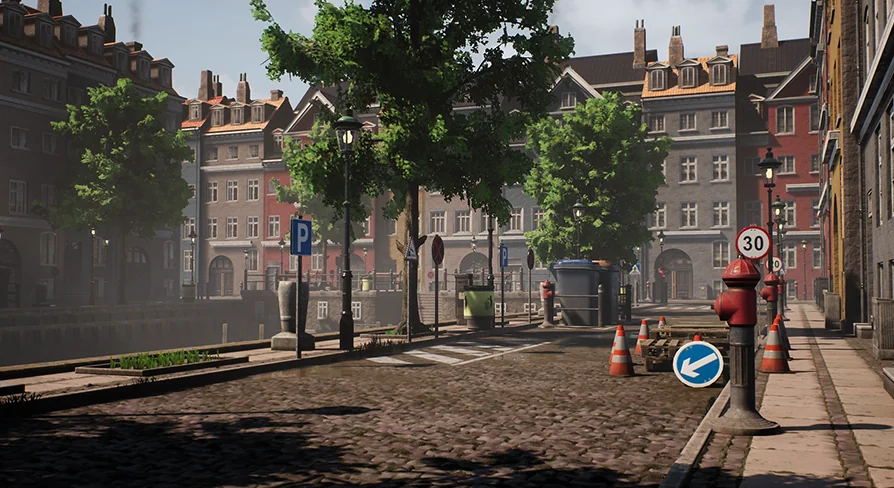
The kit extends well beyond buildings. Eighteen street modules cover roads, pavement, and dock sections. The dock pieces are worth noting specifically because a harbour scene falls apart quickly if the water edge feels improvised. Having purpose-built dock modules means the transition from street to waterfront can be handled with intended geometry rather than improvised scaling.
The road and pavement modules give the ground plane the same modular logic as the buildings. This keeps the entire scene consistent in construction approach: nothing requires bespoke modelling, and every section can be iterated by swapping or repositioning instances.
Street-Level Detail Props and Traffic Infrastructure
Twenty street furniture props are included. These cover benches, traffic cones, street lights, traffic lights, waste bins, and electricity boxes. The range is broad enough to dress both pedestrian quaysides and working harbour roads. Street lights and traffic lights are functional in the sense that they belong in a realistic scene and provide anchoring vertical elements at regular intervals.
Sixteen distinct traffic signs extend the infrastructure layer. In a realistic European harbour context, traffic signage is one of the details that grounds a scene in place rather than letting it float as a generic streetscape. Having a dedicated set of signs allows the harbour to read as a regulated, lived-in environment rather than a dressed film set.
Decals are also included in the kit. These serve the secondary layer of surface storytelling: stains, weathering, painted markings, and ground-level grit that flat textures alone cannot deliver. They sit alongside the 4K materials that form the primary surface treatment for the buildings and ground.
Environment Breakdown and Performance Profile
The kit is described as a highly optimised dynamic environment. The word dynamic is significant: rather than baked-only statics, the construction leans toward dynamic lighting and material response, which pairs with the instance-editing workflow. Because buildings are modified through per-instance texture and material swaps rather than through separate static meshes, the load stays manageable as the scene scales up.
Foliage assets round out the environment set. No exact species list is stated, but the presence of foliage in the kit means the harbour can have greenery along its quays and streets without sourcing external plant assets. The foliage works in tandem with the street furniture and signs to create the incident density that distinguishes an occupied harbour from an empty shell.
The 4K material resolution is worth noting precisely because the parallax window trick and the surface variation system both depend on texture quality holding up at close range. If an instance has its wall texture swapped, the new surface needs to survive the camera getting near the facade without breaking down. 4K resolution provides headroom for that kind of proximity, which is essential in a harbour where waterfront paths often bring the player camera within arm's reach of building walls.
Putting the Harbour Together
Assembling a scene from the kit follows a consistent pattern. Start with the dock and road modules to establish the waterline and primary circulation. Drop in prefab buildings along the quay, using the instance-editing system to vary surface treatments and window assignments across the row. Use the 44 raw building modules wherever a custom structure is needed — a corner feature, a warehouse variant, or a building that does not match any prefab footprint. Dress the streets with the furniture prop set, place traffic signs at junctions and along quay edges, and apply decals as the final surface layer.
Throughout that process, the parallax windows keep the building stock visually occupied without any internal modelling. This gives a scene that reads as a populated Nordic harbour with canals, dock edges, varied architecture, and functional street infrastructure — all assembled from modular pieces and editable instances.
Who Benefits Most From This Kit
This kit is most useful to level designers and environment artists working on European or Nordic harbour scenes in Unreal Engine. It solves two specific problems at once: the time cost of authoring many distinct buildings and the performance cost of giving those buildings visible interiors. The prefab-plus-instance approach scales visually without scaling authoring effort, and the parallax window system handles interior illusion at a fraction of the geometry cost of real rooms.
Developents that need a quick turnaround on a populated waterfront, and that want the flexibility to retexture and reconfigure buildings on the fly, will get the most out of the modular workflow. Any project with a narrow production window and a harbour brief should consider this kit a natural fit, especially since the compatible engine range extends from 4.22 up to 5.6.
 Cities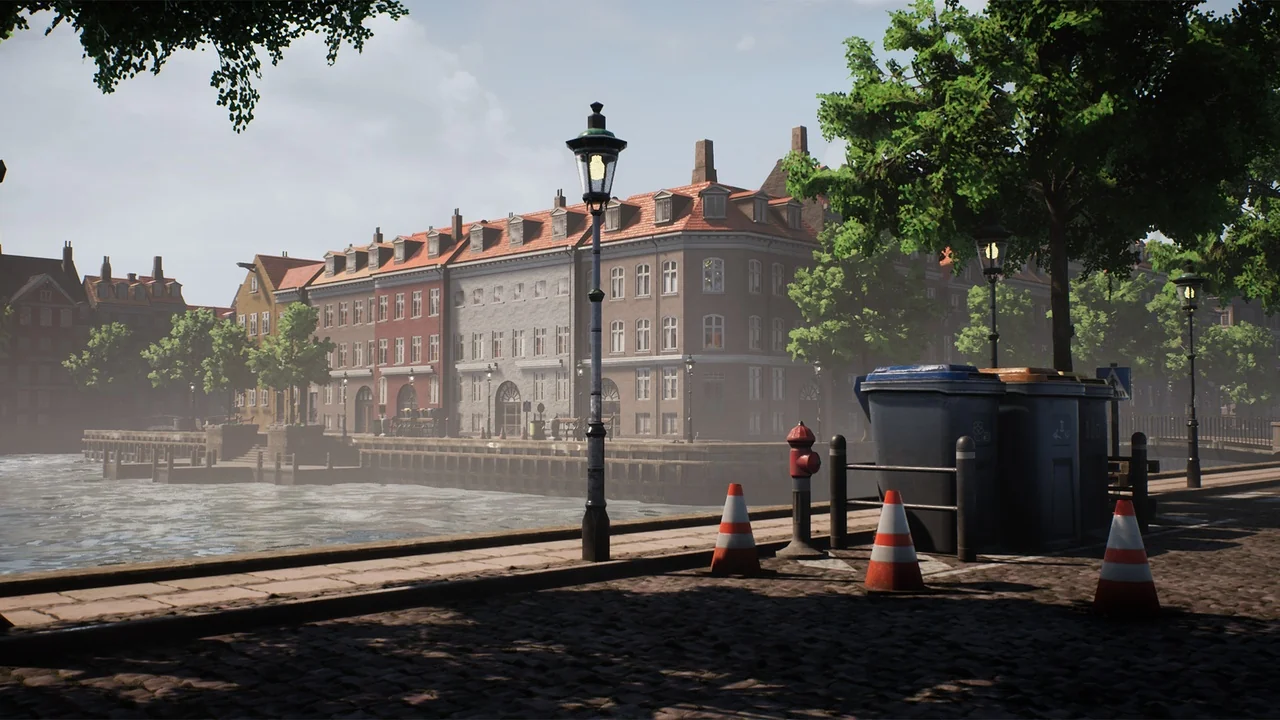
 Cities
 Cities
 Cities