"c14ff6bd758dadb1"{"id":"1000082","slug":"music-star-studio","title":"Music Star Studio","category":"Interior","engine":"Engine Version: 4.26+,5.0+","assetVersion":"Engine Version: 4.26+,5.0+","engineVersion":"","tag":"Interior","accent":"blue","visual":"audio","summary":"A modular music studio scene with 46 unique meshes, including stages, audience stands, studio props, and rotating disco elements.","platform":"Unreal Engine","publishedAt":"2026-06-05T15:54:44.401Z","updatedAt":"2026-06-05T15:54:44.401Z","sourceNotes":[],"fileContents":[],"compatibility":["Audio","Engine Version: 4.26+,5.0+"],"featuredImage":{"alt":"Music Star Studio","src":"/wp-content/uploads/published/2026/06/f156d38cd8a7-876dd27e-5982-4f73-a4b6-7e1348263b4a-e9a5fc2639.webp"},"hasDownloadLink":true,"downloads":1,"terms":[{"taxonomy":"category","slug":"interior","name":"Interior"}],"galleryImages":[{"src":"/wp-content/uploads/published/2026/06/006c1add51ba-967ff666-a7c9-4225-9e7c-15530a87f38f-3593d83ac4.webp","alt":"Music Star Studio"},{"src":"/wp-content/uploads/published/2026/06/5827dffd8560-fa0a7f25-0cac-4454-b784-b572ad490abe-bda5344199.webp","alt":"Music Star Studio"},{"src":"/wp-content/uploads/published/2026/06/9f67b9a3c468-744b1869-97fc-40a5-833a-4b2e3d80a463-1d243e34d2.webp","alt":"Music Star Studio"},{"src":"/wp-content/uploads/published/2026/06/f9733f3e6c4d-97b8caf4-d4ba-425d-8635-189ac8cc8f9a-cb0bf19faa.webp","alt":"Music Star Studio"},{"src":"/wp-content/uploads/published/2026/06/544ea35892ae-b92bf251-ebc2-4987-9a92-400a26aef45a-2d1c21c089.webp","alt":"Music Star Studio"},{"src":"/wp-content/uploads/published/2026/06/8ec8c7eb2095-6559401d-4973-4bb0-ab0c-6d3e3cc4240d-68adc067f5.webp","alt":"Music Star Studio"},{"src":"/wp-content/uploads/published/2026/06/0839d5ec1423-cc77f8f7-cbde-4477-b8c8-ed9cee1055c0-3e892d3348.webp","alt":"Music Star Studio"},{"src":"/wp-content/uploads/published/2026/06/92790d1e4169-0ff7aa3a-39ec-4285-be51-0d417e35772a-7970b463d3.webp","alt":"Music Star Studio"},{"src":"/wp-content/uploads/published/2026/06/976e55cff18b-925856fb-902f-4fe2-8915-cb4a5897d1a6-f51f31c4d2.webp","alt":"Music Star Studio"},{"src":"/wp-content/uploads/published/2026/06/6e2be5df16e9-f15900f0-cc90-4124-9e57-45b07dddf97e-0361438fbf.webp","alt":"Music Star Studio"}],"accessPanel":{"kind":"resource","title":"Access this resource","eyebrow":"Free Download","message":"Log in or create a free account to start your download.","fileName":"Content.7z","safetyNote":"Resources are manually reviewed before listing to improve quality and reduce obvious risks.","actionLabel":"Download Free","resourceType":"Resource archive"},"contentHtml":"\u003cp\u003eA performance scene changes quickly once the room already has a stage, a place for judges, and audience seating laid out in a coherent set. Music Star Studio focuses on that kind of ready-made interior: a modular music studio that combines show-stage structure with practical studio props, making it suitable for television-style music scenes, interior set work, and staged presentation environments.\u003c/p\u003e \u003cp\u003eThe pack contains 46 unique meshes and presents them as a modular studio instead of one locked environment. At the center is a main stage, supported by a separate stage for judges and fan stands for the audience. That arrangement gives the scene a clear broadcast-show identity. Instead of only supplying decorative pieces, it establishes the core spatial relationships that define a music competition or studio performance setup: performers in front, judges positioned for visibility, and audience areas built into the scene.\u003c/p\u003e \u003ch2\u003eMain stage, judges stage, and audience stands in Music Star Studio\u003c/h2\u003e\n\u003cp\u003eThe strongest part of the set is how clearly it maps out a show format. The main stage forms the focal point of the scene, while the judges' stage adds a second platform that supports panel-based or reaction-based staging. Fan stands for the audience complete the layout, turning the environment into more than a generic music room.\u003c/p\u003e \u003cp\u003eThat combination matters for projects that need an interior with an immediate sense of production structure. A stage on its own can fit many different scene types, but adding judges and audience areas narrows the visual language toward televised performance, talent-show presentation, or music-event staging. The included elements create a space where cameras, microphones, screens, and seating make practical sense together, rather than feeling like unrelated props dropped into one room.\u003c/p\u003e \u003cp\u003eThe included example level also helps frame how those parts can come together. The example scene shown in the preview materials is part of the pack, so the studio is not limited to a loose collection of meshes without context. There is a complete assembled level in addition to the modular parts, which gives teams a direct starting point for scene setup.\u003c/p\u003e \u003ch2\u003eModular construction with columns, wall blocks, stairs, and glass walls\u003c/h2\u003e\n\u003cp\u003eMusic Star Studio is not fixed to one arrangement. Its modular structure is one of the most concrete aspects of the pack. The studio can be further designed with constructive elements that include columns, floor blocks, wall blocks, stairs, fences, stages, glass walls, wall posters, and other pieces.\u003c/p\u003e \u003cp\u003eThis makes the pack useful in two distinct ways. First, it can function as a prepared studio environment through the included example level. Second, it can be treated as a construction kit for reshaping the studio into a different layout. Columns and wall blocks help define the shell of the room. Floor blocks and stairs allow changes in elevation and access. Fences and glass walls introduce boundaries and separation within the set, which is especially relevant in staged interiors where audience zones, judges' areas, and performer spaces need visual definition.\u003c/p\u003e \u003cp\u003eWall posters also contribute to the studio identity. They are part of the constructive and decorative mix rather than an afterthought, helping the set read as a branded entertainment space instead of a bare hall. That leaves a modular interior that can be adjusted by rearranging structural pieces and support props instead of rebuilding the scene from scratch.\u003c/p\u003e \u003ch2\u003e46 game-ready props and studio set dressing\u003c/h2\u003e\n\u003cp\u003eThe 46 included meshes cover more than the main architectural frame. The pack also includes game-ready props and a range of constructive elements, along with studio items such as chairs, cameras, microphones, tables, TV screens, stage pieces, and other supporting objects.\u003c/p\u003e \u003cp\u003eThese objects fill in the parts of a studio that need to feel occupied and functional. Chairs and tables support backstage, panel, or control-side arrangements. Cameras reinforce the television-studio angle. Microphones connect directly to performance use. TV screens help carry the language of a produced show set, where display surfaces are part of the environment rather than optional decoration.\u003c/p\u003e \u003cp\u003eBecause these props are included alongside the larger construction pieces, the pack can cover both room-building and scene-dressing tasks within the same visual theme. A project team working on a music-show interior would not just have platforms and walls; it would also have practical objects to place around stages and seating zones. That balance between structure and props is one of the pack's clearest strengths.\u003c/p\u003e \u003ch2\u003eDisco balls and rotating disco spot lights\u003c/h2\u003e\n\u003cp\u003eBeyond the static studio layout, Music Star Studio includes additional disco balls with rotating blueprints and disco spot lights with rotating blueprints. These elements push the scene further toward live-show presentation.\u003c/p\u003e \u003cp\u003eRotating disco elements change the atmosphere of a stage-focused environment because they imply movement and performance energy even before any characters or camera work are added. In a music studio context, that kind of lighting accessory helps the environment read less like a quiet set build and more like an active show space. Disco balls and spot lights are specific additions, not broad visual promises, and they fit the pack's focus on televised or staged music performance.\u003c/p\u003e \u003cp\u003eThey also complement the existing stage layout naturally. A main stage with judges and audience stands already suggests spectacle; rotating disco elements give that spectacle a more explicit visual toolset. For scenes that need a performance mood rather than a neutral studio interior, these additions stand out as one of the pack's more distinctive included extras.\u003c/p\u003e \u003ch2\u003eWhere this modular music studio fits best\u003c/h2\u003e\n\u003cp\u003eThe tag set around the pack points toward television, furniture, scene, modular set building, music, camera work, interior spaces, TV show environments, and room-scale studio layouts. Those themes align closely with what is included. This is most useful where a project needs an indoor performance environment with clearly separated functional zones and enough props to support the illusion of a produced event.\u003c/p\u003e \u003cp\u003eThat could mean a TV-show style set, a music presentation room, a staged interior for a game level, or a scene anchored in cameras and broadcast-style composition. The presence of audience stands and a judges' stage makes it especially suitable for show formats that are not just concerts, but judged or presented performances. The included cameras, microphones, screens, and seating continue to support that reading.\u003c/p\u003e \u003cp\u003eIt is also a practical fit for teams that want flexibility in how the room is assembled. The constructive elements make it possible to work from the example level or to reconfigure the studio with columns, walls, floors, fences, stairs, and glass sections. That dual approach gives the pack a clear place in projects that need either a fast starting set or a modular interior kit with a music-show identity already established.\u003c/p\u003e \u003ch2\u003eA strong fit for TV show and music performance scenes\u003c/h2\u003e\n\u003cp\u003eMusic Star Studio is most valuable for teams that need a modular interior set with a recognizable entertainment format already built in. The combination of 46 unique meshes, an included example level, show-specific stage layout, practical studio props, and rotating disco elements makes it best suited to projects that want a music or television performance scene without starting from an empty room.\u003c/p\u003e\n\n\u003ch2\u003eRelated Resources Worth Checking\u003c/h2\u003e\n\u003cul\u003e\n\u003cli\u003e\u003ca href=\"https://3dcghub.com/cgma-studio-offices/\" title=\"CGMA Studio Offices\"\u003eCGMA Studio Offices\u003c/a\u003e\u003c/li\u003e\n\u003cli\u003e\u003ca href=\"https://3dcghub.com/weather-tv-studio/\" title=\"Weather TV Studio\"\u003eWeather TV Studio\u003c/a\u003e\u003c/li\u003e\n\u003cli\u003e\u003ca href=\"https://3dcghub.com/artists-attic-studio-environment/\" title=\"Artist’s Attic Studio Environment\"\u003eArtist’s Attic Studio Environment\u003c/a\u003e\u003c/li\u003e\n\u003cli\u003e\u003ca href=\"https://3dcghub.com/news-studio-environment-for-vr-news-reports-or-backdrops/\" title=\"News Studio - Environment for VR, News Reports or Backdrops\"\u003eNews Studio - Environment for VR, News Reports or Backdrops\u003c/a\u003e\u003c/li\u003e\n\u003cli\u003e\u003ca href=\"https://3dcghub.com/mega-game-music-collection/\" title=\"Mega Game Music Collection\"\u003eMega Game Music Collection\u003c/a\u003e\u003c/li\u003e\n\u003c/ul\u003e","contentTextLength":7675,"navigation":{"current":1780,"total":3719,"previous":{"id":"1000083","slug":"npc-ai-queuing-system","title":"NPC AI Queuing System","category":"Gameplay Features","platform":"Unreal Engine","updatedAt":"2026-06-05T16:06:07.049Z"},"next":{"id":"1000081","slug":"multiplayer-horror-bodycam","title":"Multiplayer Horror Bodycam","category":"Network \u0026 Multiplayer","platform":"Unreal Engine","updatedAt":"2026-06-05T15:48:54.954Z"}},"relatedResources":[{"id":"1001530","slug":"laboratory-interior-studio-in-loft-style","title":"Laboratory Interior Studio in Loft Style","category":"Interior","engine":"4.23+,5.0+","assetVersion":"","engineVersion":"Engine Version: 4.23+,5.0+","tag":"Interior","accent":"blue","visual":"mech","summary":"Explore the Laboratory Interior Studio in Loft Style pack, featuring 370+ static meshes, 35 Blueprints, spline tools, decals, and master materials.","platform":"Unreal Engine","publishedAt":"2026-10-09T17:24:29.957Z","updatedAt":"2026-10-09T17:24:29.957Z","sourceNotes":[],"fileContents":[],"compatibility":["Unreal Engine","Engine Version: 4.23+,5.0+"],"featuredImage":{"alt":"Laboratory Interior Studio in Loft Style","src":"/wp-content/uploads/published/2026/10/4478225037e7-4bb5b192-bc18-4df5-a46a-9d191d846f42-e563108a1f.webp"},"hasDownloadLink":true,"downloads":0},{"id":"1000099","slug":"studio-news","title":"Studio News","category":"Interior","engine":"Engine Version: 4.26+,5.0+","assetVersion":"Engine Version: 4.26+,5.0+","engineVersion":"","tag":"Interior","accent":"blue","visual":"mech","summary":"Photorealistic Unreal Engine virtual studio sets for news, sports, elections, and live broadcasts, with video walls and customizable backgrounds.","platform":"Unreal Engine","publishedAt":"2026-06-07T13:09:12.722Z","updatedAt":"2026-06-07T13:09:12.722Z","sourceNotes":[],"fileContents":[],"compatibility":["Unreal Engine","Engine Version: 4.26+,5.0+"],"featuredImage":{"alt":"Studio News","src":"/wp-content/uploads/published/2026/06/e617d26a4e63-fc4f4dfc-3f6d-43e9-975e-7adfdb443b9a-b6b651c105.webp"},"hasDownloadLink":true,"downloads":1},{"id":"9046","slug":"weather-tv-studio","title":"Weather TV Studio","category":"Interior","engine":"4.26+,5.0+","assetVersion":"Engine version: 4.26+,5.0+","engineVersion":"4.26","tag":"Interior","accent":"blue","visual":"city","summary":"Build a professional broadcasting environment with the modular Weather TV Studio asset pack. This collection features 35 unique props and a fully customizable workflow for game developers.","platform":"Unreal Engine","publishedAt":"2026-02-25T17:38:45.000Z","updatedAt":"2026-04-19T15:55:20.000Z","sourceNotes":[],"fileContents":[],"compatibility":["Unreal Engine","Engine version: 4.26+,5.0+"],"featuredImage":{"alt":"Weather TV Studio","src":"https://3dcghub.com/wp-content/uploads/2026/02/ac5cec8e-1bb6-4df8-a4a3-3892628a4fce.webp"},"hasDownloadLink":true,"downloads":1}]}
Interior
Music Star Studio
A modular music studio scene with 46 unique meshes, including stages, audience stands, studio props, and rotating disco elements.
Category:Unreal Engine,InteriorPlatform: Unreal EngineEngine Version: 4.26+,5.0+Published: Jun 5, 2026
Interior
Resource overview
A performance scene changes quickly once the room already has a stage, a place for judges, and audience seating laid out in a coherent set. Music Star Studio focuses on that kind of ready-made interior: a modular music studio that combines show-stage structure with practical studio props, making it suitable for television-style music scenes, interior set work, and staged presentation environments.
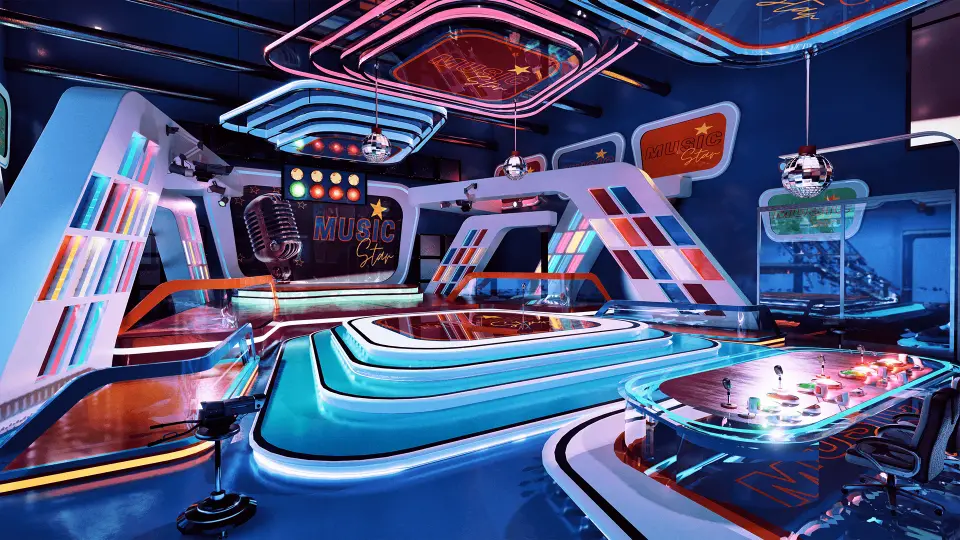
The pack contains 46 unique meshes and presents them as a modular studio instead of one locked environment. At the center is a main stage, supported by a separate stage for judges and fan stands for the audience. That arrangement gives the scene a clear broadcast-show identity. Instead of only supplying decorative pieces, it establishes the core spatial relationships that define a music competition or studio performance setup: performers in front, judges positioned for visibility, and audience areas built into the scene.
Main stage, judges stage, and audience stands in Music Star Studio
The strongest part of the set is how clearly it maps out a show format. The main stage forms the focal point of the scene, while the judges' stage adds a second platform that supports panel-based or reaction-based staging. Fan stands for the audience complete the layout, turning the environment into more than a generic music room.
That combination matters for projects that need an interior with an immediate sense of production structure. A stage on its own can fit many different scene types, but adding judges and audience areas narrows the visual language toward televised performance, talent-show presentation, or music-event staging. The included elements create a space where cameras, microphones, screens, and seating make practical sense together, rather than feeling like unrelated props dropped into one room.
The included example level also helps frame how those parts can come together. The example scene shown in the preview materials is part of the pack, so the studio is not limited to a loose collection of meshes without context. There is a complete assembled level in addition to the modular parts, which gives teams a direct starting point for scene setup.
Modular construction with columns, wall blocks, stairs, and glass walls
Music Star Studio is not fixed to one arrangement. Its modular structure is one of the most concrete aspects of the pack. The studio can be further designed with constructive elements that include columns, floor blocks, wall blocks, stairs, fences, stages, glass walls, wall posters, and other pieces.
This makes the pack useful in two distinct ways. First, it can function as a prepared studio environment through the included example level. Second, it can be treated as a construction kit for reshaping the studio into a different layout. Columns and wall blocks help define the shell of the room. Floor blocks and stairs allow changes in elevation and access. Fences and glass walls introduce boundaries and separation within the set, which is especially relevant in staged interiors where audience zones, judges' areas, and performer spaces need visual definition.
Wall posters also contribute to the studio identity. They are part of the constructive and decorative mix rather than an afterthought, helping the set read as a branded entertainment space instead of a bare hall. That leaves a modular interior that can be adjusted by rearranging structural pieces and support props instead of rebuilding the scene from scratch.
46 game-ready props and studio set dressing
The 46 included meshes cover more than the main architectural frame. The pack also includes game-ready props and a range of constructive elements, along with studio items such as chairs, cameras, microphones, tables, TV screens, stage pieces, and other supporting objects.
These objects fill in the parts of a studio that need to feel occupied and functional. Chairs and tables support backstage, panel, or control-side arrangements. Cameras reinforce the television-studio angle. Microphones connect directly to performance use. TV screens help carry the language of a produced show set, where display surfaces are part of the environment rather than optional decoration.
Because these props are included alongside the larger construction pieces, the pack can cover both room-building and scene-dressing tasks within the same visual theme. A project team working on a music-show interior would not just have platforms and walls; it would also have practical objects to place around stages and seating zones. That balance between structure and props is one of the pack's clearest strengths.
Disco balls and rotating disco spot lights
Beyond the static studio layout, Music Star Studio includes additional disco balls with rotating blueprints and disco spot lights with rotating blueprints. These elements push the scene further toward live-show presentation.
Rotating disco elements change the atmosphere of a stage-focused environment because they imply movement and performance energy even before any characters or camera work are added. In a music studio context, that kind of lighting accessory helps the environment read less like a quiet set build and more like an active show space. Disco balls and spot lights are specific additions, not broad visual promises, and they fit the pack's focus on televised or staged music performance.
They also complement the existing stage layout naturally. A main stage with judges and audience stands already suggests spectacle; rotating disco elements give that spectacle a more explicit visual toolset. For scenes that need a performance mood rather than a neutral studio interior, these additions stand out as one of the pack's more distinctive included extras.
Where this modular music studio fits best
The tag set around the pack points toward television, furniture, scene, modular set building, music, camera work, interior spaces, TV show environments, and room-scale studio layouts. Those themes align closely with what is included. This is most useful where a project needs an indoor performance environment with clearly separated functional zones and enough props to support the illusion of a produced event.
That could mean a TV-show style set, a music presentation room, a staged interior for a game level, or a scene anchored in cameras and broadcast-style composition. The presence of audience stands and a judges' stage makes it especially suitable for show formats that are not just concerts, but judged or presented performances. The included cameras, microphones, screens, and seating continue to support that reading.
It is also a practical fit for teams that want flexibility in how the room is assembled. The constructive elements make it possible to work from the example level or to reconfigure the studio with columns, walls, floors, fences, stairs, and glass sections. That dual approach gives the pack a clear place in projects that need either a fast starting set or a modular interior kit with a music-show identity already established.
A strong fit for TV show and music performance scenes
Music Star Studio is most valuable for teams that need a modular interior set with a recognizable entertainment format already built in. The combination of 46 unique meshes, an included example level, show-specific stage layout, practical studio props, and rotating disco elements makes it best suited to projects that want a music or television performance scene without starting from an empty room.
 Interior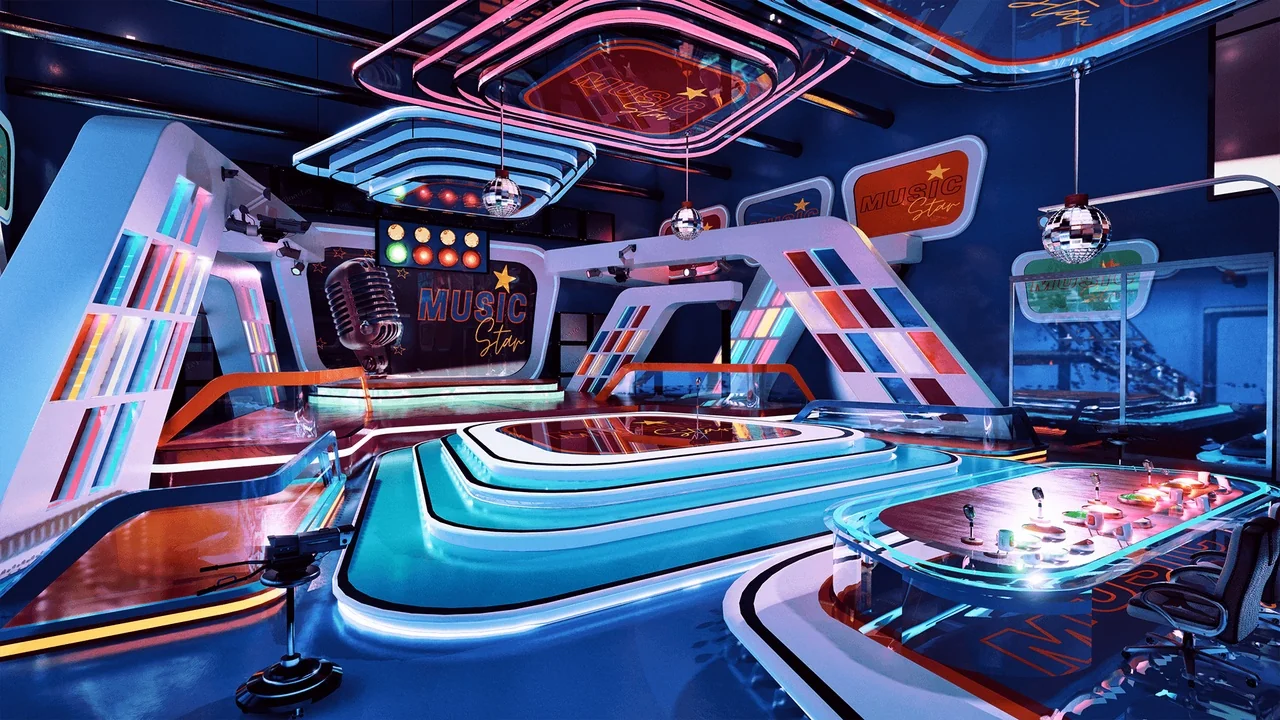
 Interior
 Interior
 Interior