"72afc5f8a809d018"{"id":"1002115","slug":"modular-scifi-hallways","title":"Modular SciFi Hallways","category":"Sci-Fi","engine":"4.26+,5.0+","assetVersion":"","engineVersion":"Engine Version: 4.26+,5.0+","tag":"Sci-Fi","accent":"blue","visual":"mech","summary":"Build diverse science fiction corridors with Modular SciFi Hallways, featuring 57 unique pieces, material instances, and six example environments.","platform":"Unreal Engine","publishedAt":"2026-10-29T08:57:52.632Z","updatedAt":"2026-10-29T08:57:52.632Z","sourceNotes":[],"fileContents":[],"compatibility":["Unreal Engine","Engine Version: 4.26+,5.0+"],"featuredImage":{"alt":"Modular SciFi Hallways","src":"/wp-content/uploads/published/2026/10/c419977f4d9b-2482eddb-072d-4f6e-a836-1747bb28079e-914fbc3146.webp"},"hasDownloadLink":true,"downloads":0,"terms":[{"taxonomy":"category","slug":"sci-fi","name":"Sci-Fi"}],"galleryImages":[{"src":"/wp-content/uploads/published/2026/10/a9e55dc92302-1ae1496a-b35a-4035-b821-399970d22d07-bf8639e26c.webp","alt":"Modular SciFi Hallways"},{"src":"/wp-content/uploads/published/2026/10/cadbc5e07809-f67839ec-dc5d-45a8-b5b7-a08e009648db-2ab3b0af1c.webp","alt":"Modular SciFi Hallways"},{"src":"/wp-content/uploads/published/2026/10/ef796536eea5-e13e01ad-9d85-40ad-b2e1-117bce8ab279-3583ff9735.webp","alt":"Modular SciFi Hallways"},{"src":"/wp-content/uploads/published/2026/10/1e76c6037e9d-5017e7bb-3561-492d-920f-7fd46478ba20-d758b44699.webp","alt":"Modular SciFi Hallways"},{"src":"/wp-content/uploads/published/2026/10/1b9c2da81012-e7756efe-4026-4efe-9268-eac6b5c43767-e477be2545.webp","alt":"Modular SciFi Hallways"},{"src":"/wp-content/uploads/published/2026/10/09075a856250-86ae5479-3046-4bbc-8914-900f2baa3cce-3832117537.webp","alt":"Modular SciFi Hallways"},{"src":"/wp-content/uploads/published/2026/10/9e619e7ae2a7-36f72435-9b3b-4502-8e82-f10e75845868-aa8985ee2c.webp","alt":"Modular SciFi Hallways"},{"src":"/wp-content/uploads/published/2026/10/4328c417bdd2-1e0d06dd-1858-4898-8543-5d730a206742-29e4b04089.webp","alt":"Modular SciFi Hallways"},{"src":"/wp-content/uploads/published/2026/10/60dc90098761-c95a4e9e-d62c-41ce-832a-42e06166ada0-bc18af9f93.webp","alt":"Modular SciFi Hallways"}],"accessPanel":{"kind":"resource","title":"Download this resource","eyebrow":"Free Download","message":"Log in or create a free account to start your download.","fileName":"Content.7z","safetyNote":"Resources are manually reviewed before listing to improve quality and reduce obvious risks.","actionLabel":"Download Free","resourceType":"Resource archive"},"contentHtml":"\u003ch2\u003eConstructing Layouts with 57 Unique Modular Pieces\u003c/h2\u003e\u003cp\u003eSci-fi level design often hinges on balancing rapid iteration with architectural variety. Modular SciFi Hallways addresses this balance by supplying a core set of 57 unique pieces built to construct contiguous interior corridor networks. Rather than locking an environment artist into a rigid corridor footprint, the modular breakdown lets creators plan, assemble, and snap together branching junctions, long straight passages, and segmented transit zones suited for space stations, planetary research bases, and industrial starship interiors.\u003c/p\u003e\u003cp\u003eUsing 57 distinct structural elements allows designers to tackle common level blocking hurdles. Having a broad selection of wall segments, structural frames, ceiling sections, and floor modules prevents corridor runs from looking overly repetitive. Instead of using a single monolithic hallway mesh, the pieces can be systematically combined into complex floor plans. Level designers can establish rhythm by mixing narrow access ways with wider circulation arteries, creating natural pacing across an indoor level layout.\u003c/p\u003e\u003ch2\u003eMaterial Instances, Detail Normals, and PBR Values\u003c/h2\u003e\u003cp\u003eVisual diversity in modular sets depends heavily on the shader pipeline. In Modular SciFi Hallways, surface appearance is controlled directly through customizable material instances. These instances allow artists to tint and define up to four separate colors across the meshes, making it possible to color-code different wings of an installation, establish faction identities, or adapt the same geometry for clean medical bays versus grimy engineering decks.\u003c/p\u003e\u003cp\u003eSurface material characteristics extend beyond simple diffuse color shifts. The included material instances expose adjustable PBR values, granting control over surface reflectivity, glossiness, and metallic responses across the meshes. By adjusting these PBR inputs alongside detail normals, artists can dial in micro-surface variation to keep surfaces readable up close. Modifying detail normals ensures that smooth panels take on appropriate high-frequency textural detail under varying lighting conditions, keeping structural geometry visually sharp across diverse viewing distances.\u003c/p\u003e\u003ch2\u003eExploring the Six Included Example Environments\u003c/h2\u003e\u003cp\u003eTo showcase how the modular components interact under finished lighting conditions, the set incorporates six distinct example environments. Five of these represent full scenes, presenting finished hallway layouts that demonstrate how various pieces snap together into complete corridor structures. These full environments act as ready-made structural references, illustrating clear transitions between walls, ceilings, corners, and floor panels in real architectural contexts.\u003c/p\u003e\u003cp\u003eThe sixth included environment serves a dedicated role focusing strictly on color customization. This setup isolates the material instance workflow, allowing developers to see immediate visual side-by-side results when adjusting the four color channels, tweaking PBR settings, and fine-tuning detail normal intensities. Having an explicit testbed helps creators understand how the material parameters translate from the material editor onto the physical 3D forms before committing changes across a wider project map.\u003c/p\u003e\u003ch2\u003eSci-Fi Base and Space Station Level Architecture\u003c/h2\u003e\u003cp\u003eSci-fi interior environments demand structural continuity. In space installations, planetary bases, and secure facilities, structural corridors must feel engineered and purposeful. The 57 parts within this kit emphasize structural cohesion, ensuring that floor lines, wall columns, and ceiling supports align naturally across long multi-room runs.\u003c/p\u003e\u003cp\u003eBecause the kit includes options for handling turns, intersections, and varied corridor lengths, level designers can craft intricate interior mazes or streamlined navigation routes without leaving visible architectural gaps. The geometric pieces provide the foundational framework required for interior base architecture, giving technical artists a dependable set of structural meshes to anchor lighting fixtures, props, and gameplay triggers.\u003c/p\u003e\u003ch2\u003ePipeline Integration and Visual Adaptability\u003c/h2\u003e\u003cp\u003eIntegrating modular assets into an ongoing production workflow requires flexibility in how surfaces read across different lighting setups. By combining 57 physical pieces with procedural color masks, adjustable PBR parameters, and surface detail normals, this package avoids the visual stiffness typical of static modular kits. Level artists can establish an initial blockout using the included geometry, verify movement routes within the sample scenes, and subsequently unify the visual palette through centralized material adjustments.\u003c/p\u003e\u003cp\u003eEnvironment artists and level designers building interior science fiction projects benefit most from this modular pipeline. The ability to pivot from the five ready-to-run layout scenes into custom corridor configurations—backed by immediate four-color and material instance tuning—delivers a practical foundation for building expansive space bases, research labs, and orbital corridor networks.\u003c/p\u003e\n\n\u003ch2\u003eRelated Resources Worth Checking\u003c/h2\u003e\n\u003cul\u003e\n\u003cli\u003e\u003ca href=\"https://3dcghub.com/scifi-corridor-environment/\" title=\"SciFi Corridor Environment\"\u003eSciFi Corridor Environment\u003c/a\u003e\u003c/li\u003e\n\u003cli\u003e\u003ca href=\"https://3dcghub.com/scifi-industrial-level-kit-2-0/\" title=\"SciFi/Industrial Level Kit 2.0\"\u003eSciFi/Industrial Level Kit 2.0\u003c/a\u003e\u003c/li\u003e\n\u003cli\u003e\u003ca href=\"https://3dcghub.com/modular-sci-fi-orion-mars-corridors/\" title=\"Modular Sci Fi Orion Mars Corridors\"\u003eModular Sci Fi Orion Mars Corridors\u003c/a\u003e\u003c/li\u003e\n\u003cli\u003e\u003ca href=\"https://3dcghub.com/modular-sci-fi-station/\" title=\"Modular Sci-Fi Station\"\u003eModular Sci-Fi Station\u003c/a\u003e\u003c/li\u003e\n\u003cli\u003e\u003ca href=\"https://3dcghub.com/concrete-hallway/\" title=\"Concrete Hallway\"\u003eConcrete Hallway\u003c/a\u003e\u003c/li\u003e\n\u003c/ul\u003e","contentTextLength":5242,"navigation":{"current":60,"total":4100,"previous":{"id":"1002116","slug":"modular-scifi-engineer-hallways","title":"Modular SciFi: Engineer Hallways","category":"Sci-Fi","platform":"Unreal Engine","updatedAt":"2026-10-29T08:58:36.225Z"},"next":{"id":"1002114","slug":"modular-russian-soldier","title":"modular russian soldier","category":"Characters \u0026 Creatures","platform":"Unreal Engine","updatedAt":"2026-10-29T08:57:07.985Z"}},"relatedResources":[{"id":"1002116","slug":"modular-scifi-engineer-hallways","title":"Modular SciFi: Engineer Hallways","category":"Sci-Fi","engine":"4.26+,5.0+","assetVersion":"","engineVersion":"Engine Version: 4.26+,5.0+","tag":"Sci-Fi","accent":"blue","visual":"mech","summary":"Construct detailed industrial corridors with Modular SciFi: Engineer Hallways, featuring 61 meshes, Blueprint animated doors, particles, and PBR controls.","platform":"Unreal Engine","publishedAt":"2026-10-29T08:58:36.225Z","updatedAt":"2026-10-29T08:58:36.225Z","sourceNotes":[],"fileContents":[],"compatibility":["Unreal Engine","Engine Version: 4.26+,5.0+"],"featuredImage":{"alt":"Modular SciFi: Engineer Hallways","src":"/wp-content/uploads/published/2026/10/530e57d394f5-5e51bc60-29b4-4686-8276-5f93a81ff46c-32df588476.webp"},"hasDownloadLink":true,"downloads":0},{"id":"1001665","slug":"scifi-corridor-environment","title":"SciFi Corridor Environment","category":"Sci-Fi","engine":"4.20+,5.0+","assetVersion":"","engineVersion":"Engine Version: 4.20+,5.0+","tag":"Sci-Fi","accent":"blue","visual":"city","summary":"Explore the SciFi Corridor Environment, a modular lowpoly level scene built for current gen games with customizable PBR materials and prop compatibility.","platform":"Unreal Engine","publishedAt":"2026-10-13T15:05:15.324Z","updatedAt":"2026-10-13T15:05:15.324Z","sourceNotes":[],"fileContents":[],"compatibility":["Unreal Engine","Engine Version: 4.20+,5.0+"],"featuredImage":{"alt":"SciFi Corridor Environment","src":"/wp-content/uploads/published/2026/10/522388a562b7-365997bb-848d-475f-be61-3d69c5e3307e-42292051e6.webp"},"hasDownloadLink":true,"downloads":1},{"id":"1001555","slug":"scifi-industrial-level-kit-2-0","title":"SciFi/Industrial Level Kit 2.0","category":"Sci-Fi","engine":"4.19+,5.0+","assetVersion":"","engineVersion":"Engine Version: 4.19+,5.0+","tag":"Sci-Fi","accent":"blue","visual":"mech","summary":"SciFi/Industrial Level Kit 2.0 delivers over 1500 modular meshes and Blueprints with PBR/IBL lighting and multi-resolution textures for sci-fi environments.","platform":"Unreal Engine","publishedAt":"2026-10-10T03:45:25.139Z","updatedAt":"2026-10-10T03:45:25.139Z","sourceNotes":[],"fileContents":[],"compatibility":["Unreal Engine","Engine Version: 4.19+,5.0+"],"featuredImage":{"alt":"SciFi/Industrial Level Kit 2.0","src":"/wp-content/uploads/published/2026/10/21759bf57f6e-da6da6ce-23c5-402b-8cc5-45bd1e8ecea9-a2e57d98d6.webp"},"hasDownloadLink":true,"downloads":1}]}
Sci-Fi
Modular SciFi Hallways
Build diverse science fiction corridors with Modular SciFi Hallways, featuring 57 unique pieces, material instances, and six example environments.
Category:Unreal Engine,Sci-FiPlatform: Unreal EngineEngine Version: 4.26+,5.0+Published: Oct 29, 2026
Sci-Fi
Resource overview
Constructing Layouts with 57 Unique Modular Pieces
Sci-fi level design often hinges on balancing rapid iteration with architectural variety. Modular SciFi Hallways addresses this balance by supplying a core set of 57 unique pieces built to construct contiguous interior corridor networks. Rather than locking an environment artist into a rigid corridor footprint, the modular breakdown lets creators plan, assemble, and snap together branching junctions, long straight passages, and segmented transit zones suited for space stations, planetary research bases, and industrial starship interiors.
Using 57 distinct structural elements allows designers to tackle common level blocking hurdles. Having a broad selection of wall segments, structural frames, ceiling sections, and floor modules prevents corridor runs from looking overly repetitive. Instead of using a single monolithic hallway mesh, the pieces can be systematically combined into complex floor plans. Level designers can establish rhythm by mixing narrow access ways with wider circulation arteries, creating natural pacing across an indoor level layout.
Material Instances, Detail Normals, and PBR Values
Visual diversity in modular sets depends heavily on the shader pipeline. In Modular SciFi Hallways, surface appearance is controlled directly through customizable material instances. These instances allow artists to tint and define up to four separate colors across the meshes, making it possible to color-code different wings of an installation, establish faction identities, or adapt the same geometry for clean medical bays versus grimy engineering decks.
Surface material characteristics extend beyond simple diffuse color shifts. The included material instances expose adjustable PBR values, granting control over surface reflectivity, glossiness, and metallic responses across the meshes. By adjusting these PBR inputs alongside detail normals, artists can dial in micro-surface variation to keep surfaces readable up close. Modifying detail normals ensures that smooth panels take on appropriate high-frequency textural detail under varying lighting conditions, keeping structural geometry visually sharp across diverse viewing distances.
Exploring the Six Included Example Environments
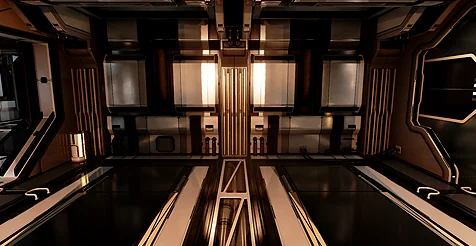
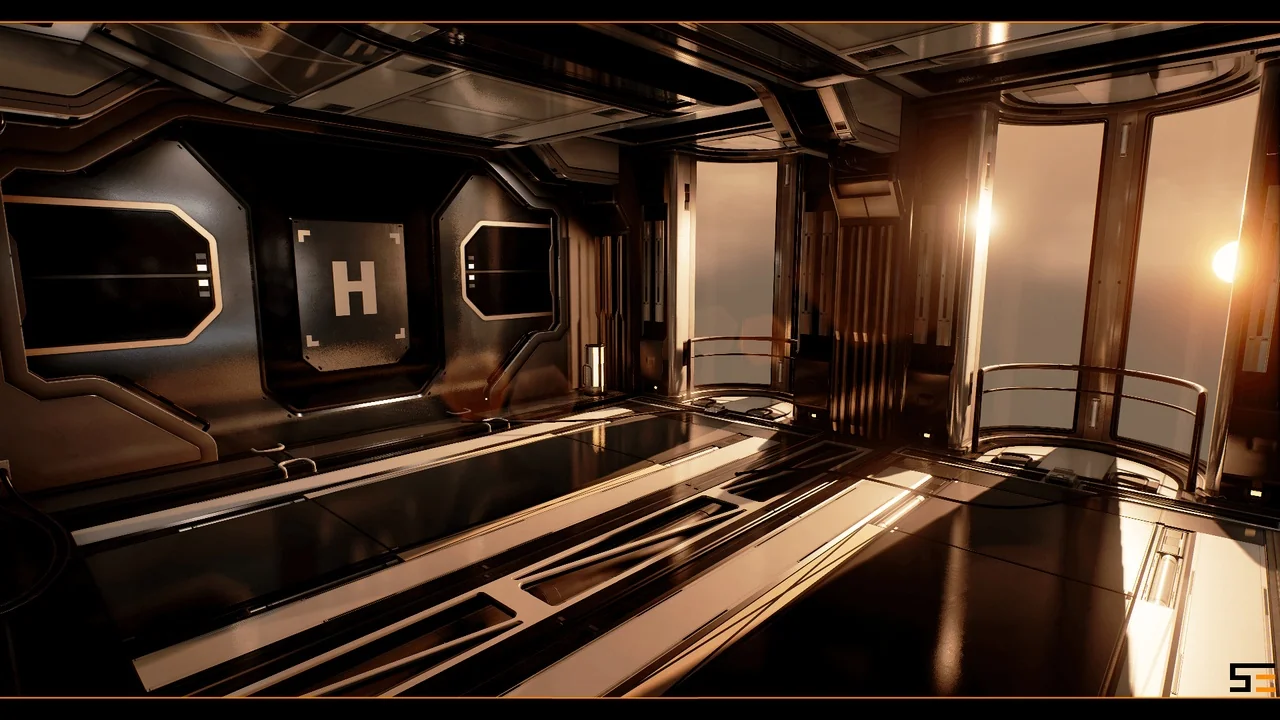
To showcase how the modular components interact under finished lighting conditions, the set incorporates six distinct example environments. Five of these represent full scenes, presenting finished hallway layouts that demonstrate how various pieces snap together into complete corridor structures. These full environments act as ready-made structural references, illustrating clear transitions between walls, ceilings, corners, and floor panels in real architectural contexts.
The sixth included environment serves a dedicated role focusing strictly on color customization. This setup isolates the material instance workflow, allowing developers to see immediate visual side-by-side results when adjusting the four color channels, tweaking PBR settings, and fine-tuning detail normal intensities. Having an explicit testbed helps creators understand how the material parameters translate from the material editor onto the physical 3D forms before committing changes across a wider project map.
Sci-Fi Base and Space Station Level Architecture
Sci-fi interior environments demand structural continuity. In space installations, planetary bases, and secure facilities, structural corridors must feel engineered and purposeful. The 57 parts within this kit emphasize structural cohesion, ensuring that floor lines, wall columns, and ceiling supports align naturally across long multi-room runs.
Because the kit includes options for handling turns, intersections, and varied corridor lengths, level designers can craft intricate interior mazes or streamlined navigation routes without leaving visible architectural gaps. The geometric pieces provide the foundational framework required for interior base architecture, giving technical artists a dependable set of structural meshes to anchor lighting fixtures, props, and gameplay triggers.
Pipeline Integration and Visual Adaptability
Integrating modular assets into an ongoing production workflow requires flexibility in how surfaces read across different lighting setups. By combining 57 physical pieces with procedural color masks, adjustable PBR parameters, and surface detail normals, this package avoids the visual stiffness typical of static modular kits. Level artists can establish an initial blockout using the included geometry, verify movement routes within the sample scenes, and subsequently unify the visual palette through centralized material adjustments.
Environment artists and level designers building interior science fiction projects benefit most from this modular pipeline. The ability to pivot from the five ready-to-run layout scenes into custom corridor configurations—backed by immediate four-color and material instance tuning—delivers a practical foundation for building expansive space bases, research labs, and orbital corridor networks.
 Sci-Fi
 Sci-Fi
 Sci-Fi
 Sci-Fi