"e919456b0935edbb"{"id":"1002113","slug":"modular-longbow-pack-game-ready","title":"Modular Longbow Pack - Game-Ready","category":"Weapons \u0026 Combat","engine":"4.20+,5.0+","assetVersion":"","engineVersion":"Engine Version: 4.20+,5.0+","tag":"Weapons \u0026 Combat","accent":"blue","visual":"mech","summary":"Explore the Modular Longbow Pack for Unreal Engine, featuring procedural Control Rig animation, texture atlas arrow variations, and cohesive quiver assets.","platform":"Unreal Engine","publishedAt":"2026-10-29T08:56:02.296Z","updatedAt":"2026-10-29T08:56:02.296Z","sourceNotes":[],"fileContents":[],"compatibility":["Unreal Engine","Engine Version: 4.20+,5.0+"],"featuredImage":{"alt":"Modular Longbow Pack - Game-Ready","src":"/wp-content/uploads/published/2026/10/9677d7480f4a-8f76f465-7fb1-427d-8c7d-4c3af4231f69-95963f3a76.webp"},"hasDownloadLink":true,"downloads":0,"terms":[{"taxonomy":"category","slug":"weapons-and-combat","name":"Weapons \u0026 Combat"}],"galleryImages":[{"src":"/wp-content/uploads/published/2026/10/575add8dff6d-ae836c20-b2f8-45b3-acfe-c042850a71ca-357593e3b5.webp","alt":"Modular Longbow Pack - Game-Ready"},{"src":"/wp-content/uploads/published/2026/10/5f4749b9a3f0-fc0831be-ba83-4b4f-9e2d-faff498a6eb7-defa32c227.webp","alt":"Modular Longbow Pack - Game-Ready"},{"src":"/wp-content/uploads/published/2026/10/2f43c425b0b0-2b107cb3-b9d1-4ab4-a667-f64cb27ea070-e842a9c6aa.webp","alt":"Modular Longbow Pack - Game-Ready"},{"src":"/wp-content/uploads/published/2026/10/1a650fb7d25a-77952529-2c38-4f87-a6af-82c384c0165f-922ce6e6c2.webp","alt":"Modular Longbow Pack - Game-Ready"},{"src":"/wp-content/uploads/published/2026/10/ce43d9bc7a65-3470e293-317c-465a-abe9-fde633623df2-847c51e3a9.webp","alt":"Modular Longbow Pack - Game-Ready"},{"src":"/wp-content/uploads/published/2026/10/28b56b940705-1c96e618-c0ee-4a71-8a00-ad807e72aba5-d1ff7d7098.webp","alt":"Modular Longbow Pack - Game-Ready"},{"src":"/wp-content/uploads/published/2026/10/85baa16f1866-7c4126f3-b70a-4d29-8eb1-fa69c3e1311b-f47e77b43f.webp","alt":"Modular Longbow Pack - Game-Ready"},{"src":"/wp-content/uploads/published/2026/10/d1dee9097100-7e72f422-5895-4afd-ae76-e4e30f8ca5fd-b2ccb2589b.webp","alt":"Modular Longbow Pack - Game-Ready"}],"accessPanel":{"kind":"resource","title":"Download this resource","eyebrow":"Free Download","message":"Log in or create a free account to start your download.","fileName":"Content.7z","safetyNote":"Resources are manually reviewed before listing to improve quality and reduce obvious risks.","actionLabel":"Download Free","resourceType":"Resource archive"},"contentHtml":"\u003ch2\u003eArchery Requirements in Real-Time Medieval and Fantasy Projects\u003c/h2\u003e\u003cp\u003eRanged combat in medieval games, fantasy role-playing titles, and wilderness survival settings demands weapon assets that respond directly to gameplay states. A bow cannot simply remain a static skeletal mesh when an avatar pulls the drawstring, aims from horseback, or notches different arrow types during an encounter. Modular Longbow Pack - Game-Ready addresses these real-time production requirements inside Unreal Engine by providing a structured collection of longbows, quivers, and arrows built for immediate technical integration.\u003c/p\u003e\u003cp\u003eInstead of treating bows and quivers as isolated art pieces, the package treats the entire archery ensemble as an interconnected system. The aesthetic remains grounded and cohesive, avoiding exaggerated proportions in favor of refined wooden finishes and believable craftsmanship. This uniformity ensures that whether a project requires cinematic cutscenes or dense third-person survival mechanics, the equipment matches visually across every piece in a character's loadout.\u003c/p\u003e\u003cp\u003eReal-time optimization sits alongside visual consistency as a primary production goal. Ranged weaponry frequently multiplies onscreen asset counts through loose arrows, back-mounted quivers, and wielded weapons across player characters and AI units. Structuring these components efficiently prevents technical bottlenecks when archery features heavily in combat encounters.\u003c/p\u003e\u003ch2\u003eProcedural Motion Through the Control Rig System\u003c/h2\u003e\u003cp\u003eTraditional character archery setups often rely on pre-baked skeletal animation clips for drawing, holding, and releasing bowstrings. This conventional approach quickly reveals limitations when a game requires variable draw lengths, distinct tension states, or dynamic aiming angles that must blend cleanly with full-body procedural movement. To solve this, the pack provides a Control Rig setup for procedural animation rather than static pre-rendered takes.\u003c/p\u003e\u003cp\u003eUsing Control Rig allows technical animators and gameplay programmers to manipulate the bow's physical response dynamically directly within the engine. Bow stave bending, string tension, and nocking points can be modulated via gameplay values, including draw stamina or charging time. This procedural foundation gives studios the flexibility to connect bow physics directly to custom character controllers, eliminating the need to author dozens of discrete keyframe animations for each slight timing adjustment or player state change.\u003c/p\u003e\u003cp\u003eThe system adapts cleanly across distinct gameplay scenarios. A quick-fire snapshot can use a shallower procedural bend, while an overdrawn power shot flexes the limbs further without breaking rig constraints. Because the procedural control happens in-engine, tweaking the weight and feel of combat pacing becomes an iterative, non-destructive process.\u003c/p\u003e\u003ch2\u003eDraw-Call Reduction with Single Mesh Arrows and Texture Atlases\u003c/h2\u003e\u003cp\u003eProjectiles pose an optimization challenge in real-time titles. When dozens of arrows pepper the ground, strike shields, or remain lodged in target meshes, rendering costs escalate rapidly if every arrow variant demands its own distinct geometry and dedicated material pass. The setup here resolves this through an atlas-driven workflow centered around a single base arrow mesh.\u003c/p\u003e\u003cp\u003eEvery visual variation of the arrow relies on that unified base mesh paired with a shared texture atlas. Material instances manage the aesthetic differences across shafts, fletchings, and tips. By routing visual divergence through material instances rather than separate 3D models and multi-material calls, the rendering pipeline combines draw calls, keeping frame render times stable during heavy projectile exchanges.\u003c/p\u003e\u003cp\u003eThis material-based variation workflow does not sacrifice diversity. Projects can implement distinct ammunition tiers—such as varying arrow designs for specific damage types, factions, or inventory progression levels—without bloating texture memory or draw calls. The asset keeps projectile rendering lean while retaining clean, detailed surface definition up close.\u003c/p\u003e\u003ch2\u003eCohesive Longbow and Quiver Design\u003c/h2\u003e\u003cp\u003eEquipment believability breaks down when a bow appears modern or polished while the accompanying quiver looks weathered, or when visual art directions mismatch across the set. All elements in this collection are shaped by a shared design language. Longbows feature refined, grounded textures that highlight realistic material properties suitable for PBR rendering pipelines, emphasizing subtle surface wear and natural timber tones.\u003c/p\u003e\u003cp\u003eQuivers are built to integrate seamlessly with both the longbows and the atlas-mapped arrows. Their scale, fastening points, and visual balance align directly with the weapon models. This allows developers to construct modular inventory and equipment swapping features where switching out a bow model never clashes with the worn quiver model resting against a character's back.\u003c/p\u003e\u003cp\u003eThe modular nature of the asset set also supports flexible equipment progression. Early-game survivalists, seasoned city guards, and high-tier fantasy rangers can draw from the same visual family while maintaining clear aesthetic relationships across their weapons, ammunition, and gear storage.\u003c/p\u003e\u003ch2\u003eGameplay Integration and Target Workflows\u003c/h2\u003e\u003cp\u003eIntegrating third-party combat assets into custom gameplay systems often creates friction if skeletal hierarchies, collision profiles, and rig controls require extensive restructuring. Because this collection focuses strictly on production-ready implementation, it drops smoothly into standard Unreal Engine combat architectures. Sockets, rigs, and material structures follow predictable game-ready standards, allowing technical artists to quickly wire the bows into native anim blueprints and item systems.\u003c/p\u003e\u003cp\u003eIndependent developers building action RPGs, historical combat prototypes, or survival simulators benefit heavily from the pack's unified technical framework. Studios avoid spending weeks rigging custom longbow flex parameters or troubleshooting fletching draw-call counts during optimization passes. By pairing an efficient single-mesh arrow setup with the adaptive flexibility of Control Rig, the package provides a solid, complete archery foundation that respects both rendering budgets and gameplay demands.\u003c/p\u003e\n\n\u003ch2\u003eExplore Similar Assets\u003c/h2\u003e\n\u003cul\u003e\n\u003cli\u003e\u003ca href=\"https://3dcghub.com/assortment-of-swords/\" title=\"Assortment of Swords\"\u003eAssortment of Swords\u003c/a\u003e\u003c/li\u003e\n\u003cli\u003e\u003ca href=\"https://3dcghub.com/axes-pack/\" title=\"Axes Pack\"\u003eAxes Pack\u003c/a\u003e\u003c/li\u003e\n\u003cli\u003e\u003ca href=\"https://3dcghub.com/medieval-viking-weapons-and-shields-set-medieval-viking-weapons-shield-old/\" title=\"Medieval / Viking Weapons and Shields Set ( Medieval Viking Weapons Shield Old )\"\u003eMedieval / Viking Weapons and Shields Set ( Medieval Viking Weapons Shield Old )\u003c/a\u003e\u003c/li\u003e\n\u003cli\u003e\u003ca href=\"https://3dcghub.com/c4-bomb-with-fps-animations/\" title=\"C4 Bomb With FPS Animations\"\u003eC4 Bomb With FPS Animations\u003c/a\u003e\u003c/li\u003e\n\u003cli\u003e\u003ca href=\"https://3dcghub.com/10-fantasy-stylish-weapon/\" title=\"10 Fantasy Stylish Weapon\"\u003e10 Fantasy Stylish Weapon\u003c/a\u003e\u003c/li\u003e\n\u003c/ul\u003e","contentTextLength":6471,"navigation":{"current":61,"total":4099,"previous":{"id":"1002114","slug":"modular-russian-soldier","title":"modular russian soldier","category":"Characters \u0026 Creatures","platform":"Unreal Engine","updatedAt":"2026-10-29T08:57:07.985Z"},"next":{"id":"1002112","slug":"modular-hut-pack","title":"Modular Hut Pack","category":"Tools, Objects \u0026 Decor","platform":"Unreal Engine","updatedAt":"2026-10-29T08:55:10.129Z"}},"relatedResources":[{"id":"1001955","slug":"assortment-of-swords","title":"Assortment of Swords","category":"Weapons \u0026 Combat","engine":"4.26+,5.0+","assetVersion":"","engineVersion":"Engine Version: 4.26+,5.0+","tag":"Weapons \u0026 Combat","accent":"blue","visual":"mech","summary":"A realistic collection of twelve swords spanning cultures and eras, featuring PBR ready materials and matching sheathes for applicable blades.","platform":"Unreal Engine","publishedAt":"2026-10-24T11:33:16.243Z","updatedAt":"2026-10-24T11:33:16.243Z","sourceNotes":[],"fileContents":[],"compatibility":["Unreal Engine","Engine Version: 4.26+,5.0+"],"featuredImage":{"alt":"Assortment of Swords","src":"/wp-content/uploads/published/2026/10/2704d3ae5c09-8a061ea6-16b0-426b-b664-a8ca4593d041-328758171b.webp"},"hasDownloadLink":true,"downloads":0},{"id":"1000725","slug":"axes-pack","title":"Axes Pack","category":"Weapons \u0026 Combat","engine":"4.26+,5.0+","assetVersion":"","engineVersion":"Engine Version: 4.26+,5.0+","tag":"Weapons \u0026 Combat","accent":"blue","visual":"mech","summary":"Axes Pack delivers five ready-for-battle melee axes with rigged versions, PBR materials, four texture resolutions, and 17 Blueprints for Unreal Engine workflows","platform":"Unreal Engine","publishedAt":"2026-07-26T15:29:31.703Z","updatedAt":"2026-07-26T15:55:51.664Z","sourceNotes":[],"fileContents":[],"compatibility":["Unreal Engine","Engine Version: 4.26+,5.0+"],"featuredImage":{"alt":"Axes Pack","src":"/wp-content/uploads/published/2026/07/6183996495d5-3e87e9af-7afa-4979-98e1-e5a25d473023-16fc163f21.webp"},"hasDownloadLink":true,"downloads":0},{"id":"5413","slug":"medieval-viking-weapons-and-shields-set-medieval-viking-weapons-shield-old","title":"Medieval / Viking Weapons and Shields Set ( Medieval Viking Weapons Shield Old )","category":"Weapons \u0026 Combat","engine":"4.26+,5.0+","assetVersion":"Engine version: 4.26+,5.0+","engineVersion":"4.19","tag":"Weapons \u0026 Combat","accent":"blue","visual":"luts","summary":"Enhance your game project with this optimized set of 18 Medieval and Viking weapons and shields. Features ZBrush sculpting and 2K textures for high detail.","platform":"Unreal Engine","publishedAt":"2026-02-15T15:00:55.000Z","updatedAt":"2026-04-19T15:56:57.000Z","sourceNotes":[],"fileContents":[],"compatibility":["Unreal Engine","Engine version: 4.26+,5.0+"],"featuredImage":{"alt":"Medieval / Viking Weapons and Shields Set ( Medieval Viking Weapons Shield Old )","src":"https://3dcghub.com/wp-content/uploads/2026/02/53285e9e-8a05-46f8-8475-cb377c2aba8b.webp"},"hasDownloadLink":true,"downloads":2}]}
Weapons & Combat
Modular Longbow Pack - Game-Ready
Explore the Modular Longbow Pack for Unreal Engine, featuring procedural Control Rig animation, texture atlas arrow variations, and cohesive quiver assets.
Archery Requirements in Real-Time Medieval and Fantasy Projects
Ranged combat in medieval games, fantasy role-playing titles, and wilderness survival settings demands weapon assets that respond directly to gameplay states. A bow cannot simply remain a static skeletal mesh when an avatar pulls the drawstring, aims from horseback, or notches different arrow types during an encounter. Modular Longbow Pack - Game-Ready addresses these real-time production requirements inside Unreal Engine by providing a structured collection of longbows, quivers, and arrows built for immediate technical integration.
Instead of treating bows and quivers as isolated art pieces, the package treats the entire archery ensemble as an interconnected system. The aesthetic remains grounded and cohesive, avoiding exaggerated proportions in favor of refined wooden finishes and believable craftsmanship. This uniformity ensures that whether a project requires cinematic cutscenes or dense third-person survival mechanics, the equipment matches visually across every piece in a character's loadout.
Real-time optimization sits alongside visual consistency as a primary production goal. Ranged weaponry frequently multiplies onscreen asset counts through loose arrows, back-mounted quivers, and wielded weapons across player characters and AI units. Structuring these components efficiently prevents technical bottlenecks when archery features heavily in combat encounters.
Procedural Motion Through the Control Rig System
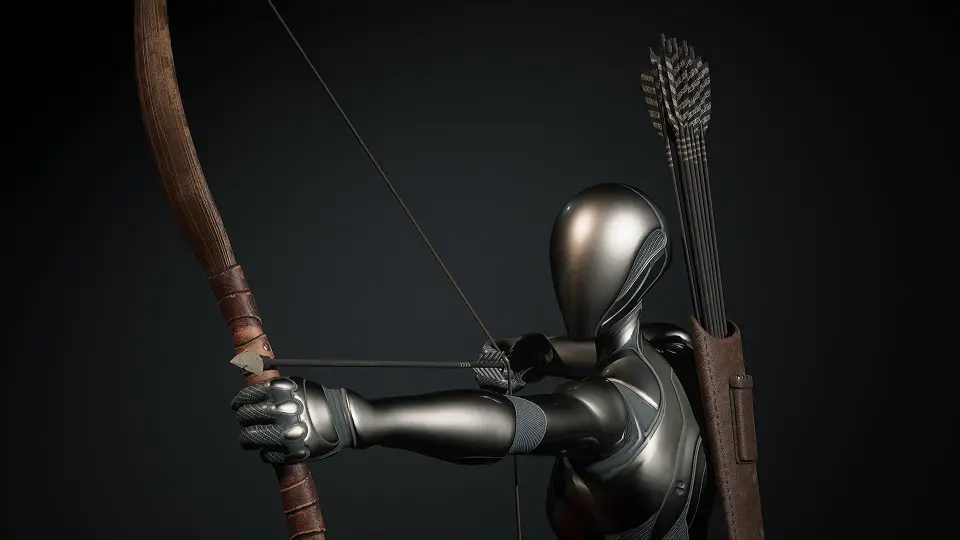
Traditional character archery setups often rely on pre-baked skeletal animation clips for drawing, holding, and releasing bowstrings. This conventional approach quickly reveals limitations when a game requires variable draw lengths, distinct tension states, or dynamic aiming angles that must blend cleanly with full-body procedural movement. To solve this, the pack provides a Control Rig setup for procedural animation rather than static pre-rendered takes.
Using Control Rig allows technical animators and gameplay programmers to manipulate the bow's physical response dynamically directly within the engine. Bow stave bending, string tension, and nocking points can be modulated via gameplay values, including draw stamina or charging time. This procedural foundation gives studios the flexibility to connect bow physics directly to custom character controllers, eliminating the need to author dozens of discrete keyframe animations for each slight timing adjustment or player state change.
The system adapts cleanly across distinct gameplay scenarios. A quick-fire snapshot can use a shallower procedural bend, while an overdrawn power shot flexes the limbs further without breaking rig constraints. Because the procedural control happens in-engine, tweaking the weight and feel of combat pacing becomes an iterative, non-destructive process.
Draw-Call Reduction with Single Mesh Arrows and Texture Atlases
Projectiles pose an optimization challenge in real-time titles. When dozens of arrows pepper the ground, strike shields, or remain lodged in target meshes, rendering costs escalate rapidly if every arrow variant demands its own distinct geometry and dedicated material pass. The setup here resolves this through an atlas-driven workflow centered around a single base arrow mesh.
Every visual variation of the arrow relies on that unified base mesh paired with a shared texture atlas. Material instances manage the aesthetic differences across shafts, fletchings, and tips. By routing visual divergence through material instances rather than separate 3D models and multi-material calls, the rendering pipeline combines draw calls, keeping frame render times stable during heavy projectile exchanges.
This material-based variation workflow does not sacrifice diversity. Projects can implement distinct ammunition tiers—such as varying arrow designs for specific damage types, factions, or inventory progression levels—without bloating texture memory or draw calls. The asset keeps projectile rendering lean while retaining clean, detailed surface definition up close.
Cohesive Longbow and Quiver Design
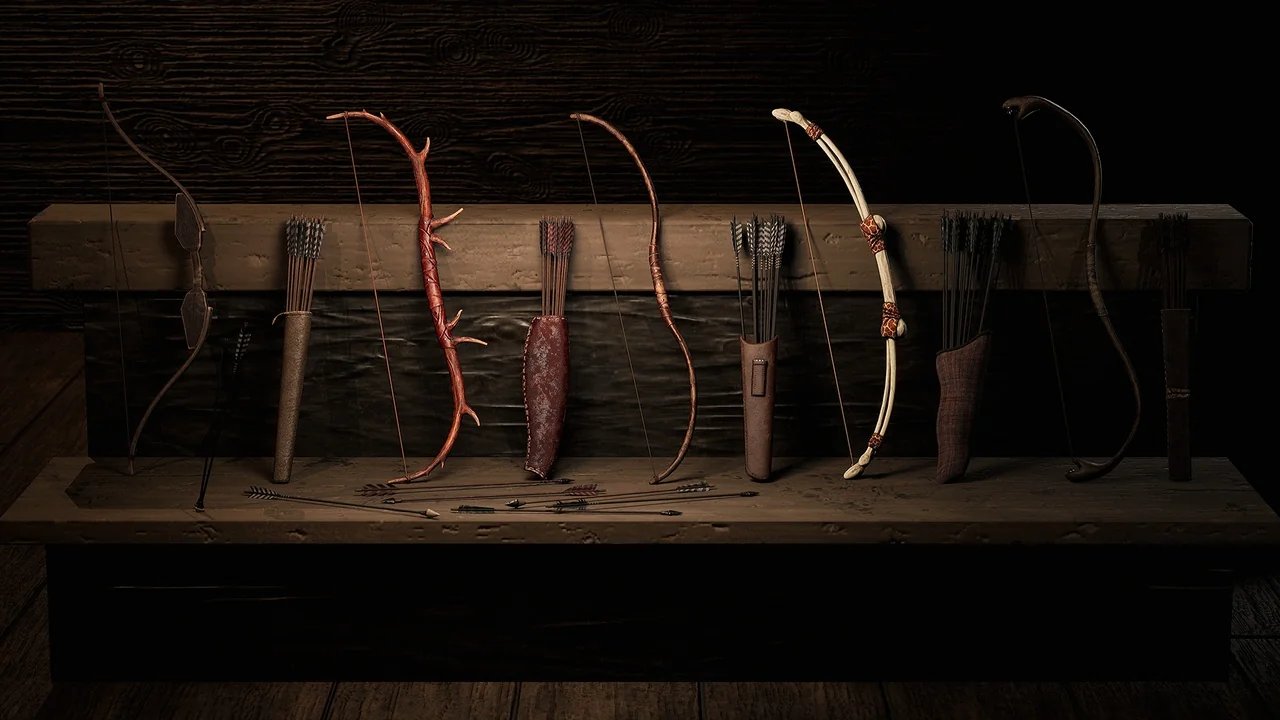
Equipment believability breaks down when a bow appears modern or polished while the accompanying quiver looks weathered, or when visual art directions mismatch across the set. All elements in this collection are shaped by a shared design language. Longbows feature refined, grounded textures that highlight realistic material properties suitable for PBR rendering pipelines, emphasizing subtle surface wear and natural timber tones.
Quivers are built to integrate seamlessly with both the longbows and the atlas-mapped arrows. Their scale, fastening points, and visual balance align directly with the weapon models. This allows developers to construct modular inventory and equipment swapping features where switching out a bow model never clashes with the worn quiver model resting against a character's back.
The modular nature of the asset set also supports flexible equipment progression. Early-game survivalists, seasoned city guards, and high-tier fantasy rangers can draw from the same visual family while maintaining clear aesthetic relationships across their weapons, ammunition, and gear storage.
Gameplay Integration and Target Workflows
Integrating third-party combat assets into custom gameplay systems often creates friction if skeletal hierarchies, collision profiles, and rig controls require extensive restructuring. Because this collection focuses strictly on production-ready implementation, it drops smoothly into standard Unreal Engine combat architectures. Sockets, rigs, and material structures follow predictable game-ready standards, allowing technical artists to quickly wire the bows into native anim blueprints and item systems.
Independent developers building action RPGs, historical combat prototypes, or survival simulators benefit heavily from the pack's unified technical framework. Studios avoid spending weeks rigging custom longbow flex parameters or troubleshooting fletching draw-call counts during optimization passes. By pairing an efficient single-mesh arrow setup with the adaptive flexibility of Control Rig, the package provides a solid, complete archery foundation that respects both rendering budgets and gameplay demands.
 Weapons & Combat
 Weapons & Combat
 Weapons & Combat
 Weapons & Combat