"7aa4acc705f0d80b"{"id":"1001955","slug":"assortment-of-swords","title":"Assortment of Swords","category":"Weapons \u0026 Combat","engine":"4.26+,5.0+","assetVersion":"","engineVersion":"Engine Version: 4.26+,5.0+","tag":"Weapons \u0026 Combat","accent":"blue","visual":"mech","summary":"A realistic collection of twelve swords spanning cultures and eras, featuring PBR ready materials and matching sheathes for applicable blades.","platform":"Unreal Engine","publishedAt":"2026-10-24T11:33:16.243Z","updatedAt":"2026-10-24T11:33:16.243Z","sourceNotes":[],"fileContents":[],"compatibility":["Unreal Engine","Engine Version: 4.26+,5.0+"],"featuredImage":{"alt":"Assortment of Swords","src":"/wp-content/uploads/published/2026/10/2704d3ae5c09-8a061ea6-16b0-426b-b664-a8ca4593d041-328758171b.webp"},"hasDownloadLink":true,"downloads":0,"terms":[{"taxonomy":"category","slug":"weapons-and-combat","name":"Weapons \u0026 Combat"}],"galleryImages":[{"src":"/wp-content/uploads/published/2026/10/46464438d8d6-6234589f-c3e0-4c01-9dab-25f2d47282dd-d31edd83ad.webp","alt":"Assortment of Swords"},{"src":"/wp-content/uploads/published/2026/10/4bd4abf6a28f-22f89d32-6041-434c-aeeb-08f17d1b2d51-7772218456.webp","alt":"Assortment of Swords"},{"src":"/wp-content/uploads/published/2026/10/80872340d8d1-02f9ca59-efdd-461b-bcc5-4dedda000537-84b57f10ae.webp","alt":"Assortment of Swords"},{"src":"/wp-content/uploads/published/2026/10/ea209c7b13f4-137fded9-cc8d-4620-a33f-0f2391d86acf-0e0e0f2569.webp","alt":"Assortment of Swords"},{"src":"/wp-content/uploads/published/2026/10/0a857f268cf0-6e789d6b-e8c8-45e0-b8a6-5d73504afb1e-244b294cb4.webp","alt":"Assortment of Swords"},{"src":"/wp-content/uploads/published/2026/10/500a7b752067-6fb895ca-d243-4025-9637-104e0b821b85-6190444225.webp","alt":"Assortment of Swords"}],"accessPanel":{"kind":"resource","title":"Download this resource","eyebrow":"Free Download","message":"Log in or create a free account to start your download.","fileName":"Content.7z","safetyNote":"Resources are manually reviewed before listing to improve quality and reduce obvious risks.","actionLabel":"Download Free","resourceType":"Resource archive"},"contentHtml":"\u003ch2\u003ePopulating Historical Armories and Martial Encounters\u003c/h2\u003e\n\u003cp\u003eStaging authentic melee combat or assembling period armories requires distinct silhouettes that instantly communicate time, place, and martial tradition. Assortment of Swords provides a focused arsenal of twelve individual bladed weapons drawn from distinct historical eras and cultures. Rather than confining characters to a single time period or geographic combat style, the selection spans antiquity, the European Middle Ages, the Renaissance, and Japanese swordcraft.\u003c/p\u003e\n\u003cp\u003eWhether dressing an armorer's workshop, outfitting rival factions in a multi-era arena, or providing signature sidearms for historical figures, having distinct blade profiles allows immediate visual distinction between combatants. A standard sidearm from classical antiquity presents vastly different combat postures and narrative implications than a sweeping Renaissance dueling blade or a two-handed battlefield greatsword.\u003c/p\u003e \u003ch2\u003eFrom Gladius to Zweihander: The Twelve Historical Swords\u003c/h2\u003e\n\u003cp\u003eThe core of the collection comprises twelve separate blade patterns, each representing specific functional requirements of foot soldiers, cavalrymen, duelists, and shock infantry across centuries of warfare:\u003c/p\u003e\n\u003cul\u003e \u003cli\u003e\u003cstrong\u003eGladius:\u003c/strong\u003e The short, stabbing sword synonymous with legionary close-quarters combat in classical antiquity.\u003c/li\u003e \u003cli\u003e\u003cstrong\u003eUlfberht:\u003c/strong\u003e The high-status Early Medieval blade of the Viking Age, recognizable by its broad fuller, distinct hilt construction, and crucible steel heritage.\u003c/li\u003e \u003cli\u003e\u003cstrong\u003eArming Sword:\u003c/strong\u003e The standard one-handed knightly sidearm of the High Middle Ages, built with a cruciform guard for balance alongside a shield.\u003c/li\u003e \u003cli\u003e\u003cstrong\u003eShortsword:\u003c/strong\u003e A nimble, general-purpose sidearm suited for confined fighting where longer steel becomes unwieldy.\u003c/li\u003e \u003cli\u003e\u003cstrong\u003eFalchion:\u003c/strong\u003e A single-edged, cleaver-like medieval weapon engineered for heavy cutting power through reinforced clothing and textile armor.\u003c/li\u003e \u003cli\u003e\u003cstrong\u003eLongsword:\u003c/strong\u003e The quintessential double-edged weapon of the late medieval fighting arts, balanced for versatile two-handed cutting, thrusting, and pommel strikes.\u003c/li\u003e \u003cli\u003e\u003cstrong\u003eClaymore:\u003c/strong\u003e The commanding Scottish two-handed sword known for its crossguard terminating in down-sloping spatulate ends, built for devastating battlefield sweeps.\u003c/li\u003e \u003cli\u003e\u003cstrong\u003eZweihander:\u003c/strong\u003e An immense two-handed blade utilized during the Renaissance by front-line shock troops to break pike formations and disrupt heavy infantry charges.\u003c/li\u003e \u003cli\u003e\u003cstrong\u003eKatana:\u003c/strong\u003e The curved, single-edged traditional Japanese sword celebrated for draw-cuts, precise edge alignment, and distinct grip wrapping.\u003c/li\u003e \u003cli\u003e\u003cstrong\u003eRapier:\u003c/strong\u003e A slender, thrust-centric civilian and dueling weapon of the Renaissance, characterized by an intricate basket hilt to protect the sword hand.\u003c/li\u003e \u003cli\u003e\u003cstrong\u003eSabre:\u003c/strong\u003e A curved, single-edged cavalry blade built for slicing from horseback and swift cut-and-thrust engagements in later eras.\u003c/li\u003e \u003cli\u003e\u003cstrong\u003eBroad Sword:\u003c/strong\u003e A basket-hilted military sword offering substantial hand defense alongside a robust, cutting blade suited for infantry and naval combat.\u003c/li\u003e\n\u003c/ul\u003e \u003ch2\u003eIntegrated Sheathes for Authentic Character Loadouts\u003c/h2\u003e\n\u003cp\u003eA weapon model rarely functions in isolation. When characters traverse game worlds, patrol encampments, or stand guard, their steel must be secured. Assortment of Swords addresses this requirement by including dedicated sheathes for applicable swords within the lineup.\u003c/p\u003e\n\u003cp\u003eHaving scabbards and sheathes designed specifically alongside the corresponding blades ensures clean alignment when models are slung at the waist, back, or across a saddle. Massive battlefield weapons such as the Zweihander or specific greatswords historically lacked full-body scabbards during marches, while sidearms like the Katana, Gladius, Rapier, and Arming Sword relied fundamentally on their matching scabbards for preservation and safe carriage. By incorporating sheathes where historically and practically appropriate, secondary states such as sheathed idle poses, holster animations, and weapon-draw mechanics remain seamless without requiring external prop modeling.\u003c/p\u003e \u003ch2\u003ePBR Ready Materials for Realistic Blade and Sheath Surfaces\u003c/h2\u003e\n\u003cp\u003ePhysical accuracy in weapons relies heavily on how steel, treated leather, wood cores, and cast crossguards react to varying ambient lighting. The assets in this collection are built with PBR ready materials, enabling realistic light interaction across both blade flats and hilt furnishings.\u003c/p\u003e\n\u003cp\u003eDifferent sword types demand diverse material responses. The polished fuller of a Longsword reflects sunlight differently than the scuffed surface of an iron guard, the stingray or cord-wrapped tsuka of a Katana, or the burnished fittings of a Rapier's swept hilt. PBR ready materials ensure that metallic highlights, roughness variations, and non-metallic scabbard elements respond naturally under modern deferred shading, ray tracing, and real-time reflection probes without artificial specular hotspots.\u003c/p\u003e \u003ch2\u003eCombat Roles and Project Implementation\u003c/h2\u003e\n\u003cp\u003eBecause the collection spans ancient combat through early modern martial history, it integrates smoothly into projects requiring wide equipment variety. Action-adventure titles featuring weapon progression can scale a hero's arsenal across distinct historical tiers, moving from simple shortswords and falchions to complex rapiers and two-handed claymores. Historical action games, strategy titles, and arena brawlers can assign specific weapons to distinct cultural factions, using the Gladius for classical infantry, the Ulfberht for northern raiders, and the Katana for eastern warriors.\u003c/p\u003e\n\u003cp\u003eBeyond period-specific historical projects, the set can also contrast directly against modern gear setups, such as the Assortment of Riot Gear asset line, providing the foundational blades needed for museum exhibits, armory displays, post-apocalyptic scavenged loadouts, or modern tactical operatives facing irregular threats.\u003c/p\u003e\n\n\u003ch2\u003eExplore Similar Assets\u003c/h2\u003e\n\u003cul\u003e\n\u003cli\u003e\u003ca href=\"https://3dcghub.com/assortment-of-riot-gear/\" title=\"Assortment of Riot Gear\"\u003eAssortment of Riot Gear\u003c/a\u003e\u003c/li\u003e\n\u003cli\u003e\u003ca href=\"https://3dcghub.com/tactical-grenades/\" title=\"Tactical Grenades\"\u003eTactical Grenades\u003c/a\u003e\u003c/li\u003e\n\u003cli\u003e\u003ca href=\"https://3dcghub.com/fps-world-war-pack/\" title=\"FPS World War Pack\"\u003eFPS World War Pack\u003c/a\u003e\u003c/li\u003e\n\u003cli\u003e\u003ca href=\"https://3dcghub.com/destruction-system/\" title=\"Destruction System\"\u003eDestruction System\u003c/a\u003e\u003c/li\u003e\n\u003cli\u003e\u003ca href=\"https://3dcghub.com/spaceship-colony-cruiser/\" title=\"Spaceship Colony Cruiser\"\u003eSpaceship Colony Cruiser\u003c/a\u003e\u003c/li\u003e\n\u003c/ul\u003e","contentTextLength":5867,"navigation":{"current":35,"total":3925,"previous":{"id":"1001956","slug":"automatic-landscape-deserts","title":"Automatic Landscape Deserts","category":"Fantasy","platform":"Unreal Engine","updatedAt":"2026-10-24T11:34:05.458Z"},"next":{"id":"1001954","slug":"assortment-of-riot-gear","title":"Assortment of Riot Gear","category":"Weapons \u0026 Combat","platform":"Unreal Engine","updatedAt":"2026-10-24T11:32:39.768Z"}},"relatedResources":[{"id":"1001954","slug":"assortment-of-riot-gear","title":"Assortment of Riot Gear","category":"Weapons \u0026 Combat","engine":"4.18+,5.0+","assetVersion":"","engineVersion":"Engine Version: 4.18+,5.0+","tag":"Weapons \u0026 Combat","accent":"blue","visual":"mech","summary":"Explore the Assortment of Riot Gear collection featuring PBR shields, batons, less-than-lethal grenades, and specialized dirty glass materials.","platform":"Unreal Engine","publishedAt":"2026-10-24T11:32:39.768Z","updatedAt":"2026-10-24T11:32:39.768Z","sourceNotes":[],"fileContents":[],"compatibility":["Unreal Engine","Engine Version: 4.18+,5.0+"],"featuredImage":{"alt":"Assortment of Riot Gear","src":"/wp-content/uploads/published/2026/10/4efaa488d732-b41fd931-c986-4bfd-aaf9-014cfdbff0dd-f40931a91b.webp"},"hasDownloadLink":true,"downloads":1},{"id":"1001709","slug":"tactical-grenades","title":"Tactical Grenades","category":"Weapons \u0026 Combat","engine":"4.26+,5.0+","assetVersion":"","engineVersion":"Engine Version: 4.26+,5.0+","tag":"Weapons \u0026 Combat","accent":"blue","visual":"mech","summary":"AAA tactical grenades featuring 4K PBR textures, custom animations, visual effects, and audio for PC, console, and VR combat projects.","platform":"Unreal Engine","publishedAt":"2026-10-14T17:14:02.022Z","updatedAt":"2026-10-14T17:14:02.022Z","sourceNotes":[],"fileContents":[],"compatibility":["Unreal Engine","Engine Version: 4.26+,5.0+"],"featuredImage":{"alt":"Tactical Grenades","src":"/wp-content/uploads/published/2026/10/3b1d353a273c-01b18f81-7f25-4166-92a9-31ee2818a19d-3e669dc0f6.webp"},"hasDownloadLink":true,"downloads":5},{"id":"1001516","slug":"fps-world-war-pack","title":"FPS World War Pack","category":"Weapons \u0026 Combat","engine":"4.16+,5.0+","assetVersion":"","engineVersion":"Engine Version: 4.16+,5.0+","tag":"Weapons \u0026 Combat","accent":"blue","visual":"mech","summary":"FPS World War Pack delivers realistic WW1 and WW2 firearms, 4K textures, animations, integrated FX, LODs, and rigged arms for first-person shooters.","platform":"Unreal Engine","publishedAt":"2026-10-09T13:17:18.880Z","updatedAt":"2026-10-09T13:17:18.880Z","sourceNotes":[],"fileContents":[],"compatibility":["Unreal Engine","Engine Version: 4.16+,5.0+"],"featuredImage":{"alt":"FPS World War Pack","src":"/wp-content/uploads/published/2026/10/62c84537fa94-8749cd98-e6b1-478b-9cfd-fb968a8ef547-9263acada7.webp"},"hasDownloadLink":true,"downloads":1}]}
Weapons & Combat
Assortment of Swords
A realistic collection of twelve swords spanning cultures and eras, featuring PBR ready materials and matching sheathes for applicable blades.
Populating Historical Armories and Martial Encounters
Staging authentic melee combat or assembling period armories requires distinct silhouettes that instantly communicate time, place, and martial tradition. Assortment of Swords provides a focused arsenal of twelve individual bladed weapons drawn from distinct historical eras and cultures. Rather than confining characters to a single time period or geographic combat style, the selection spans antiquity, the European Middle Ages, the Renaissance, and Japanese swordcraft.
Whether dressing an armorer's workshop, outfitting rival factions in a multi-era arena, or providing signature sidearms for historical figures, having distinct blade profiles allows immediate visual distinction between combatants. A standard sidearm from classical antiquity presents vastly different combat postures and narrative implications than a sweeping Renaissance dueling blade or a two-handed battlefield greatsword.
From Gladius to Zweihander: The Twelve Historical Swords
The core of the collection comprises twelve separate blade patterns, each representing specific functional requirements of foot soldiers, cavalrymen, duelists, and shock infantry across centuries of warfare:
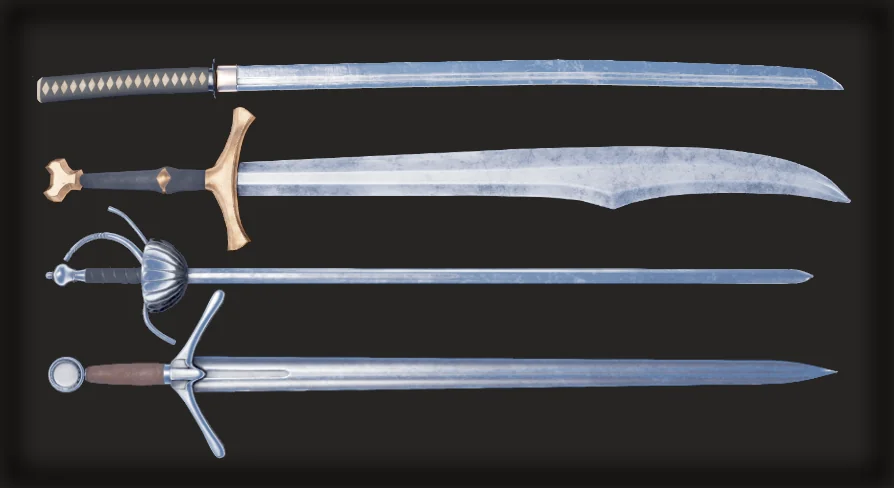
Gladius: The short, stabbing sword synonymous with legionary close-quarters combat in classical antiquity.
Ulfberht: The high-status Early Medieval blade of the Viking Age, recognizable by its broad fuller, distinct hilt construction, and crucible steel heritage.
Arming Sword: The standard one-handed knightly sidearm of the High Middle Ages, built with a cruciform guard for balance alongside a shield.
Shortsword: A nimble, general-purpose sidearm suited for confined fighting where longer steel becomes unwieldy.
Falchion: A single-edged, cleaver-like medieval weapon engineered for heavy cutting power through reinforced clothing and textile armor.
Longsword: The quintessential double-edged weapon of the late medieval fighting arts, balanced for versatile two-handed cutting, thrusting, and pommel strikes.
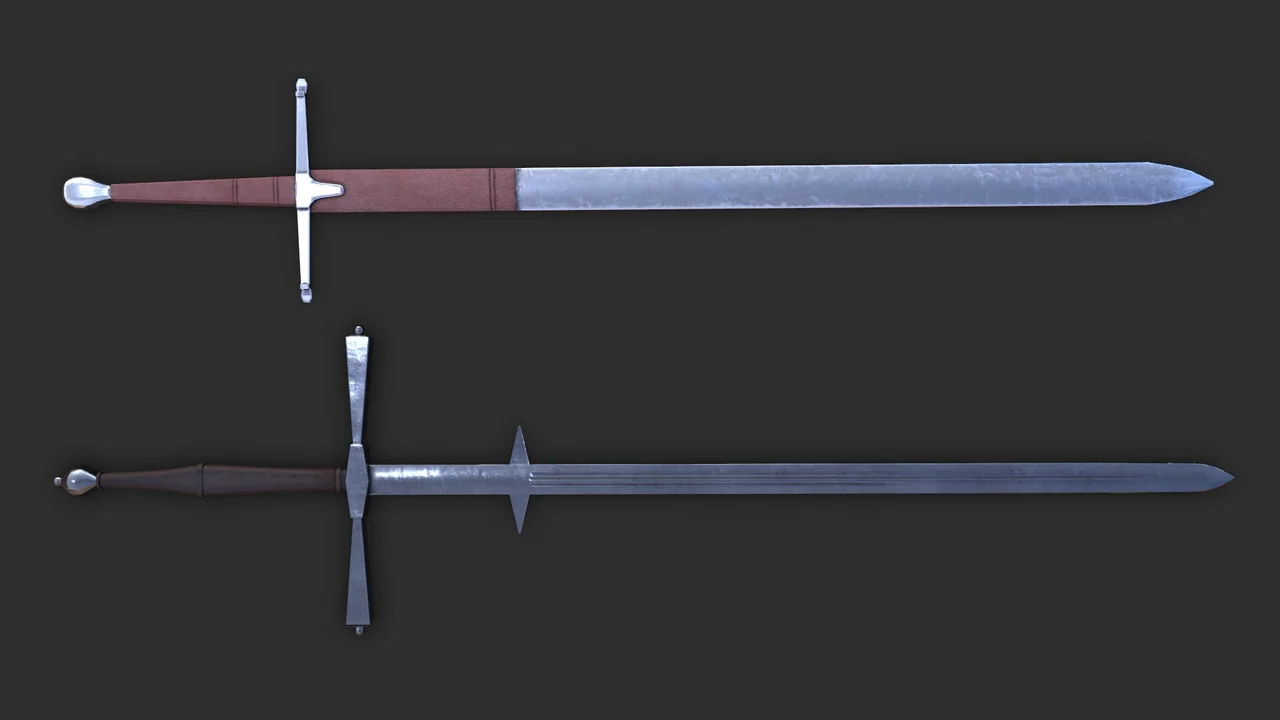
Claymore: The commanding Scottish two-handed sword known for its crossguard terminating in down-sloping spatulate ends, built for devastating battlefield sweeps.
Zweihander: An immense two-handed blade utilized during the Renaissance by front-line shock troops to break pike formations and disrupt heavy infantry charges.
Katana: The curved, single-edged traditional Japanese sword celebrated for draw-cuts, precise edge alignment, and distinct grip wrapping.
Rapier: A slender, thrust-centric civilian and dueling weapon of the Renaissance, characterized by an intricate basket hilt to protect the sword hand.
Sabre: A curved, single-edged cavalry blade built for slicing from horseback and swift cut-and-thrust engagements in later eras.
Broad Sword: A basket-hilted military sword offering substantial hand defense alongside a robust, cutting blade suited for infantry and naval combat.
Integrated Sheathes for Authentic Character Loadouts
A weapon model rarely functions in isolation. When characters traverse game worlds, patrol encampments, or stand guard, their steel must be secured. Assortment of Swords addresses this requirement by including dedicated sheathes for applicable swords within the lineup.
Having scabbards and sheathes designed specifically alongside the corresponding blades ensures clean alignment when models are slung at the waist, back, or across a saddle. Massive battlefield weapons such as the Zweihander or specific greatswords historically lacked full-body scabbards during marches, while sidearms like the Katana, Gladius, Rapier, and Arming Sword relied fundamentally on their matching scabbards for preservation and safe carriage. By incorporating sheathes where historically and practically appropriate, secondary states such as sheathed idle poses, holster animations, and weapon-draw mechanics remain seamless without requiring external prop modeling.
PBR Ready Materials for Realistic Blade and Sheath Surfaces
Physical accuracy in weapons relies heavily on how steel, treated leather, wood cores, and cast crossguards react to varying ambient lighting. The assets in this collection are built with PBR ready materials, enabling realistic light interaction across both blade flats and hilt furnishings.
Different sword types demand diverse material responses. The polished fuller of a Longsword reflects sunlight differently than the scuffed surface of an iron guard, the stingray or cord-wrapped tsuka of a Katana, or the burnished fittings of a Rapier's swept hilt. PBR ready materials ensure that metallic highlights, roughness variations, and non-metallic scabbard elements respond naturally under modern deferred shading, ray tracing, and real-time reflection probes without artificial specular hotspots.
Combat Roles and Project Implementation
Because the collection spans ancient combat through early modern martial history, it integrates smoothly into projects requiring wide equipment variety. Action-adventure titles featuring weapon progression can scale a hero's arsenal across distinct historical tiers, moving from simple shortswords and falchions to complex rapiers and two-handed claymores. Historical action games, strategy titles, and arena brawlers can assign specific weapons to distinct cultural factions, using the Gladius for classical infantry, the Ulfberht for northern raiders, and the Katana for eastern warriors.
Beyond period-specific historical projects, the set can also contrast directly against modern gear setups, such as the Assortment of Riot Gear asset line, providing the foundational blades needed for museum exhibits, armory displays, post-apocalyptic scavenged loadouts, or modern tactical operatives facing irregular threats.
 Weapons & Combat
 Weapons & Combat
 Weapons & Combat
 Weapons & Combat