"7aa4acc705f0d80b"{"id":"1001956","slug":"automatic-landscape-deserts","title":"Automatic Landscape Deserts","category":"Fantasy","engine":"4.26+,5.0+","assetVersion":"","engineVersion":"Engine Version: 4.26+,5.0+","tag":"Fantasy","accent":"blue","visual":"city","summary":"Explore the procedural workflow, 8192 desert landscape maps, and 4096 bitmap setup inside the Automatic Landscape Deserts material package.","platform":"Unreal Engine","publishedAt":"2026-10-24T11:34:05.458Z","updatedAt":"2026-10-24T11:34:05.458Z","sourceNotes":[],"fileContents":[],"compatibility":["Unreal Engine","Engine Version: 4.26+,5.0+"],"featuredImage":{"alt":"Automatic Landscape Deserts","src":"/wp-content/uploads/published/2026/10/2087a7a46c7f-8db0e01c-444d-46cd-a39e-51fe163ab7a2-feab6375d1.webp"},"hasDownloadLink":true,"downloads":0,"terms":[{"taxonomy":"category","slug":"fantasy","name":"Fantasy"}],"galleryImages":[{"src":"/wp-content/uploads/published/2026/10/45e79a619fe9-004720a1-797a-4567-8887-7df038c9d5a8-30b48146a9.webp","alt":"Automatic Landscape Deserts"},{"src":"/wp-content/uploads/published/2026/10/cdacadb604f3-88d7c17f-6023-43df-9fa4-144a620c2fe5-9cd3721dd9.webp","alt":"Automatic Landscape Deserts"},{"src":"/wp-content/uploads/published/2026/10/cce33a763d5f-22dc461d-7e2e-4205-a758-5aca10ab5802-5cccb71932.webp","alt":"Automatic Landscape Deserts"},{"src":"/wp-content/uploads/published/2026/10/4e624e5ab963-98c8fe18-cbfc-431d-9cd4-193cef2176d9-1c968af0d5.webp","alt":"Automatic Landscape Deserts"},{"src":"/wp-content/uploads/published/2026/10/5196179d3a9d-a459a89c-66b4-40b8-8dd9-dab0b1f9389c-d1c53010f8.webp","alt":"Automatic Landscape Deserts"},{"src":"/wp-content/uploads/published/2026/10/7cc4ad114cac-7d0484c4-644b-4c92-b2e6-b6d2ff363456-e29846e9a6.webp","alt":"Automatic Landscape Deserts"},{"src":"/wp-content/uploads/published/2026/10/ad86462600b8-08e401d6-a013-48d9-a886-3e9458dd02dd-962dc38122.webp","alt":"Automatic Landscape Deserts"}],"accessPanel":{"kind":"resource","title":"Download this resource","eyebrow":"Free Download","message":"Log in or create a free account to start your download.","fileName":"Automatic Landscape Deserts.7z","safetyNote":"Resources are manually reviewed before listing to improve quality and reduce obvious risks.","actionLabel":"Download Free","resourceType":"Resource archive"},"contentHtml":"\u003ch2\u003eAutomating Desert Texturing Without Manual Layer Painting\u003c/h2\u003e\n\u003cp\u003eProducing believable arid terrain across massive open environments typically presents a bottleneck: hand-painting material layers across hills, dunes, cliffs, and flat plains. Automatic Landscape Deserts approaches this challenge as an all-in-one procedural solution. Instead of requiring artists to manually apply rock, scree, sand, and soil masks by hand across square kilometers of geometry, the material automates layer placement directly during the sculpting phase.\u003c/p\u003e\n\u003cp\u003eWhenever terrain geometry is modified in the editor, the procedural system dynamically updates the visual surface. The texturing responds in direct accordance with the real landscape's physical structure, features, and contours. This eliminates the traditional two-step process of shaping a heightfield and then repainting it to match the newly formed slopes and ridges. The workflow acceleration is substantial, allowing level designers to iterate on natural topography while maintaining immediate visual cohesion across the entire landmass.\u003c/p\u003e\n\u003cp\u003eBecause the placement logic reflects genuine environmental forms, transitions look structurally grounded rather than arbitrarily placed. Steep precipices expose bare rock or packed earth, while low-lying basins and natural runoffs collect sediment as expected in realistic or fantasy desert environments.\u003c/p\u003e \u003ch2\u003eMaster Material Architecture and Instance-Level Adjustments\u003c/h2\u003e\n\u003cp\u003eAt the center of the system is a procedural dynamic master material accompanied by a collection of material instances intended for varied environmental scenarios. Rather than locking artists into a single desert climate or visual style, the package provides instances configured for distinct use cases and different times of year. This setup allows for visual variance between scorching summer badlands, dry winter expanses, and transitional seasonal lighting conditions without restructuring the underlying node network.\u003c/p\u003e\n\u003cp\u003eEvery parameter governing the visual character remains fully accessible on the material instance level. Artists can fine-tune several primary attributes:\u003c/p\u003e\n\u003cul\u003e \u003cli\u003e\u003cstrong\u003eColoring:\u003c/strong\u003e Modify surface hues, sand tinting, rock tone variation, and regional ground pigmentation to fit stylistic choices ranging from photorealistic deserts to stylized fantasy levels.\u003c/li\u003e \u003cli\u003e\u003cstrong\u003eShading:\u003c/strong\u003e Adjust roughness characteristics, micro-surface highlights, and shadow depth across distinct material components.\u003c/li\u003e \u003cli\u003e\u003cstrong\u003eDistribution:\u003c/strong\u003e Calibrate how materials spread across elevations, slope angles, and structural features, giving direct control over where bedrock ends and loose sand begins.\u003c/li\u003e\n\u003c/ul\u003e\n\u003cp\u003eExposing these properties within lightweight instances ensures that environment artists can craft unique geographic biomes while preserving the core logic of the parent material.\u003c/p\u003e \u003ch2\u003eResolution Benchmarks: 8192 Landscape Maps Across 10 by 10 Kilometers\u003c/h2\u003e\n\u003cp\u003eTo support vast wilderness scales, the package supplies 32 desert landscape-maps authored at a resolution of 8192. These heightmaps correspond to a physical footprint of 10 by 10 kilometers, providing 100 square kilometers of natural terrain out of the box. Having maps at this scale prevents the repetitive, unnatural terrain tiling that often degrades large-world production.\u003c/p\u003e\n\u003cp\u003eBeneath the broad macro layout of the 8192-pixel terrain data, all texture bitmaps used inside the Automatic Landscape material feature a resolution of 4096. This uniform 4K texture standard ensures that micro-surface detail holds up cleanly when viewed in close proximity, preventing blurriness, stretching, or loss of normal-map definition across expansive meshes.\u003c/p\u003e\n\u003cp\u003eThe combination of high-density height fields and 4096-pixel surface textures enables seamless coverage for large-scale outdoor projects, whether the target environment represents realistic desert terrain or expansive fantasy wastes with plant life and rocky canyons. The system also supports compatibility alongside assets such as Dungeon Lamps when building out transition zones between subterranean passages and desert surfaces.\u003c/p\u003e \u003ch2\u003eMaintaining Fidelity Across First-Person and Satellite Distances\u003c/h2\u003e\n\u003cp\u003eOne common failure point in landscape materials is distance degradation. Shaders configured for ground-level fidelity often turn into noisy, tiled visual patterns from a distance, while shaders tuned for high-altitude viewing lack the micro-texture needed when the player stands directly on the ground.\u003c/p\u003e\n\u003cp\u003eAutomatic Landscape Deserts accounts for both viewing extremes. From a close first-person shooter perspective, ground surfaces maintain tangible fidelity. Sand grains, rocky cracks, and soil roughness provide the necessary geometric cues for ground-level gameplay and immediate player interaction. Shading behavior responds realistically to direct and ambient light sources at shoe level.\u003c/p\u003e\n\u003cp\u003ePulling the camera back to high-altitude views or extreme satellite elevations demonstrates equal stability. The distribution logic prevents obvious grid repeating, blending slope materials and valley floors into broad, natural geographic patterns. This balance ensures the terrain remains visually believable whether viewed through a ground-combat camera, an aerial flythrough, or an orbital map view.\u003c/p\u003e \u003ch2\u003eWorkflow Suitability and Project Implementation\u003c/h2\u003e\n\u003cp\u003eThis automated desert system proves most beneficial for level designers, solo creators, and technical artists who need to prototype or ship expansive desert environments without dedicating hundreds of hours to terrain splat-map painting. The ability to manipulate mountain ranges, carve dune troughs, and adjust valleys in real time—while the material automatically calculates appropriate rock faces and sand accumulation—removes the friction between world layout and final environment art.\u003c/p\u003e\n\u003cp\u003eProjects requiring rapid worldbuilding across expansive 10 by 10 kilometer sectors benefit from the included 32 landscape maps, which provide immediate geographic foundations. Teams building realistic arid open worlds, barren fantasy expanses, or interconnected regional levels can use the material instances to adapt desert color palettes and seasonal variations across production cycles with minimal technical overhead.\u003c/p\u003e\n\n\u003ch2\u003eRelated Resources Worth Checking\u003c/h2\u003e\n\u003cul\u003e\n\u003cli\u003e\u003ca href=\"https://3dcghub.com/desert-mushroom-forest/\" title=\"Desert Mushroom Forest\"\u003eDesert Mushroom Forest\u003c/a\u003e\u003c/li\u003e\n\u003cli\u003e\u003ca href=\"https://3dcghub.com/crimson-desert-landscape/\" title=\"Crimson Desert Landscape\"\u003eCrimson Desert Landscape\u003c/a\u003e\u003c/li\u003e\n\u003cli\u003e\u003ca href=\"https://3dcghub.com/red-desert-pack/\" title=\"Red Desert Pack\"\u003eRed Desert Pack\u003c/a\u003e\u003c/li\u003e\n\u003cli\u003e\u003ca href=\"https://3dcghub.com/brushify-canyons-pack/\" title=\"Brushify - Canyons Pack\"\u003eBrushify - Canyons Pack\u003c/a\u003e\u003c/li\u003e\n\u003cli\u003e\u003ca href=\"https://3dcghub.com/space-colonies-other-planets/\" title=\"Space Colonies: Other Planets\"\u003eSpace Colonies: Other Planets\u003c/a\u003e\u003c/li\u003e\n\u003c/ul\u003e","contentTextLength":6293,"navigation":{"current":34,"total":3925,"previous":{"id":"1001957","slug":"automotive-extras","title":"Automotive Extras","category":"Building \u0026 Human-made","platform":"Unreal Engine","updatedAt":"2026-10-24T11:34:53.196Z"},"next":{"id":"1001955","slug":"assortment-of-swords","title":"Assortment of Swords","category":"Weapons \u0026 Combat","platform":"Unreal Engine","updatedAt":"2026-10-24T11:33:16.243Z"}},"relatedResources":[{"id":"1001628","slug":"desert-mushroom-forest","title":"Desert Mushroom Forest","category":"Fantasy","engine":"4.20+,5.0+","assetVersion":"","engineVersion":"Engine Version: 4.20+,5.0+","tag":"Fantasy","accent":"blue","visual":"mech","summary":"Explore the Desert Mushroom Forest setup, featuring stylized landscape materials, props, emissive foliage, and grass for fantasy level assembly.","platform":"Unreal Engine","publishedAt":"2026-10-13T02:05:01.901Z","updatedAt":"2026-10-13T02:05:01.901Z","sourceNotes":[],"fileContents":[],"compatibility":["Unreal Engine","Engine Version: 4.20+,5.0+"],"featuredImage":{"alt":"Desert Mushroom Forest","src":"/wp-content/uploads/published/2026/10/a40b9d768054-21032146-2f28-4e87-b7d6-33595c58d07b-8d27420f50.webp"},"hasDownloadLink":true,"downloads":0},{"id":"1000362","slug":"crimson-desert-landscape","title":"Crimson Desert Landscape","category":"Desert","engine":"4.26+,5.0+","assetVersion":"","engineVersion":"Engine Version: 4.26+,5.0+","tag":"Desert","accent":"blue","visual":"city","summary":"A fully stylized PBR environment package for Unreal Engine 4, featuring modular desert meshes, layered landscape materials, and high-resolution textures.","platform":"Unreal Engine","publishedAt":"2026-07-06T07:40:13.165Z","updatedAt":"2026-07-06T07:40:13.165Z","sourceNotes":[],"fileContents":[],"compatibility":["Unreal Engine","Engine Version: 4.26+,5.0+"],"featuredImage":{"alt":"Crimson Desert Landscape","src":"/wp-content/uploads/published/2026/07/beb10262ebcb-af97d694-2740-402a-8b01-55e38009ab79-a5923630c9.webp"},"hasDownloadLink":true,"downloads":0},{"id":"7825","slug":"red-desert-pack","title":"Red Desert Pack","category":"Desert","engine":"4.26+,5.0+","assetVersion":"Engine version: 4.26+,5.0+","engineVersion":"4.10","tag":"Desert","accent":"blue","visual":"city","summary":"Transform your digital worlds with the Red Desert Pack. This comprehensive collection features authentic North American vegetation, detailed geological assets, and advanced procedural shaders.","platform":"Unreal Engine","publishedAt":"2026-02-21T17:56:25.000Z","updatedAt":"2026-04-19T15:55:54.000Z","sourceNotes":[],"fileContents":[],"compatibility":["Unreal Engine","Engine version: 4.26+,5.0+"],"featuredImage":{"alt":"Red Desert Pack","src":"https://3dcghub.com/wp-content/uploads/2026/02/15d3ca2b-a345-481d-a3fb-e684e275b2a3.webp"},"hasDownloadLink":true,"downloads":0}]}
Fantasy
Automatic Landscape Deserts
Explore the procedural workflow, 8192 desert landscape maps, and 4096 bitmap setup inside the Automatic Landscape Deserts material package.
Category:Unreal Engine,FantasyPlatform: Unreal EngineEngine Version: 4.26+,5.0+Published: Oct 24, 2026
Fantasy
Resource overview
Automating Desert Texturing Without Manual Layer Painting
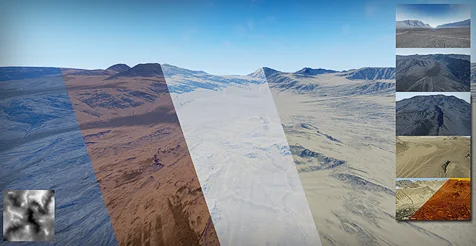
Producing believable arid terrain across massive open environments typically presents a bottleneck: hand-painting material layers across hills, dunes, cliffs, and flat plains. Automatic Landscape Deserts approaches this challenge as an all-in-one procedural solution. Instead of requiring artists to manually apply rock, scree, sand, and soil masks by hand across square kilometers of geometry, the material automates layer placement directly during the sculpting phase.
Whenever terrain geometry is modified in the editor, the procedural system dynamically updates the visual surface. The texturing responds in direct accordance with the real landscape's physical structure, features, and contours. This eliminates the traditional two-step process of shaping a heightfield and then repainting it to match the newly formed slopes and ridges. The workflow acceleration is substantial, allowing level designers to iterate on natural topography while maintaining immediate visual cohesion across the entire landmass.
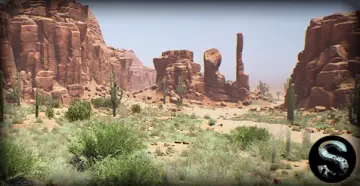
Because the placement logic reflects genuine environmental forms, transitions look structurally grounded rather than arbitrarily placed. Steep precipices expose bare rock or packed earth, while low-lying basins and natural runoffs collect sediment as expected in realistic or fantasy desert environments.
Master Material Architecture and Instance-Level Adjustments
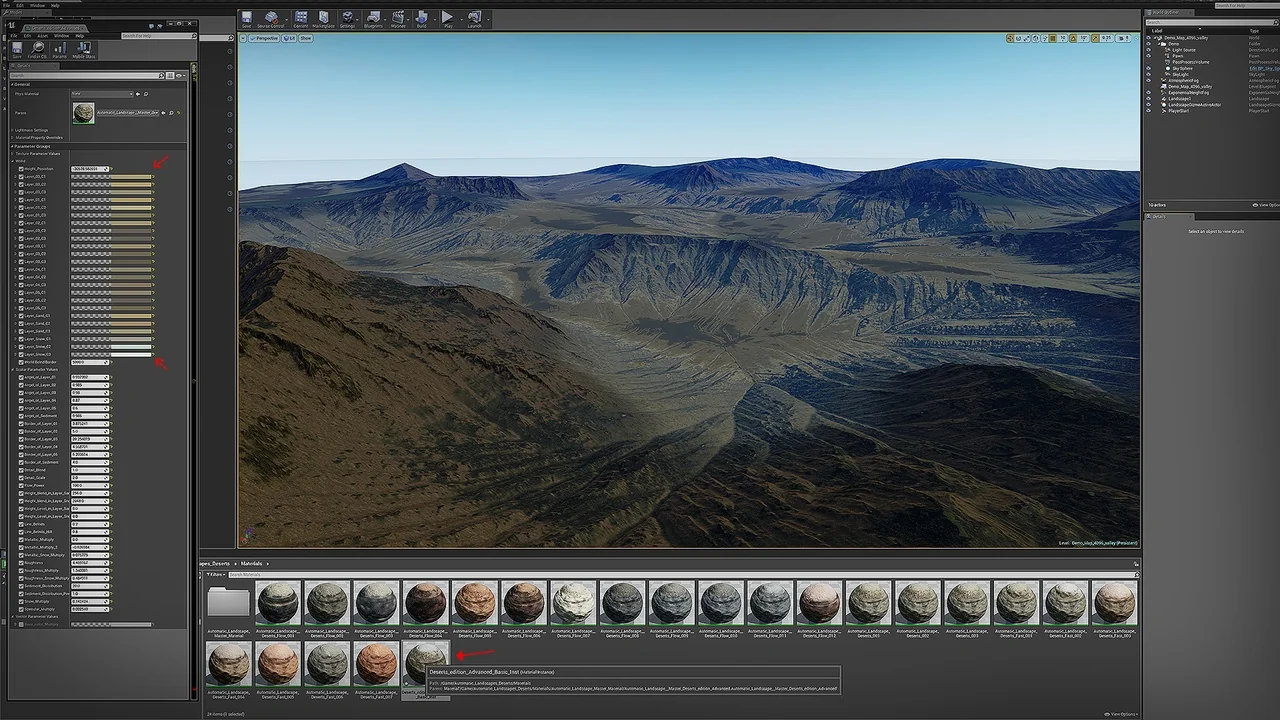
At the center of the system is a procedural dynamic master material accompanied by a collection of material instances intended for varied environmental scenarios. Rather than locking artists into a single desert climate or visual style, the package provides instances configured for distinct use cases and different times of year. This setup allows for visual variance between scorching summer badlands, dry winter expanses, and transitional seasonal lighting conditions without restructuring the underlying node network.
Every parameter governing the visual character remains fully accessible on the material instance level. Artists can fine-tune several primary attributes:
Coloring: Modify surface hues, sand tinting, rock tone variation, and regional ground pigmentation to fit stylistic choices ranging from photorealistic deserts to stylized fantasy levels.
Shading: Adjust roughness characteristics, micro-surface highlights, and shadow depth across distinct material components.
Distribution: Calibrate how materials spread across elevations, slope angles, and structural features, giving direct control over where bedrock ends and loose sand begins.
Exposing these properties within lightweight instances ensures that environment artists can craft unique geographic biomes while preserving the core logic of the parent material.
Resolution Benchmarks: 8192 Landscape Maps Across 10 by 10 Kilometers
To support vast wilderness scales, the package supplies 32 desert landscape-maps authored at a resolution of 8192. These heightmaps correspond to a physical footprint of 10 by 10 kilometers, providing 100 square kilometers of natural terrain out of the box. Having maps at this scale prevents the repetitive, unnatural terrain tiling that often degrades large-world production.
Beneath the broad macro layout of the 8192-pixel terrain data, all texture bitmaps used inside the Automatic Landscape material feature a resolution of 4096. This uniform 4K texture standard ensures that micro-surface detail holds up cleanly when viewed in close proximity, preventing blurriness, stretching, or loss of normal-map definition across expansive meshes.
The combination of high-density height fields and 4096-pixel surface textures enables seamless coverage for large-scale outdoor projects, whether the target environment represents realistic desert terrain or expansive fantasy wastes with plant life and rocky canyons. The system also supports compatibility alongside assets such as Dungeon Lamps when building out transition zones between subterranean passages and desert surfaces.
Maintaining Fidelity Across First-Person and Satellite Distances
One common failure point in landscape materials is distance degradation. Shaders configured for ground-level fidelity often turn into noisy, tiled visual patterns from a distance, while shaders tuned for high-altitude viewing lack the micro-texture needed when the player stands directly on the ground.
Automatic Landscape Deserts accounts for both viewing extremes. From a close first-person shooter perspective, ground surfaces maintain tangible fidelity. Sand grains, rocky cracks, and soil roughness provide the necessary geometric cues for ground-level gameplay and immediate player interaction. Shading behavior responds realistically to direct and ambient light sources at shoe level.
Pulling the camera back to high-altitude views or extreme satellite elevations demonstrates equal stability. The distribution logic prevents obvious grid repeating, blending slope materials and valley floors into broad, natural geographic patterns. This balance ensures the terrain remains visually believable whether viewed through a ground-combat camera, an aerial flythrough, or an orbital map view.
Workflow Suitability and Project Implementation
This automated desert system proves most beneficial for level designers, solo creators, and technical artists who need to prototype or ship expansive desert environments without dedicating hundreds of hours to terrain splat-map painting. The ability to manipulate mountain ranges, carve dune troughs, and adjust valleys in real time—while the material automatically calculates appropriate rock faces and sand accumulation—removes the friction between world layout and final environment art.
Projects requiring rapid worldbuilding across expansive 10 by 10 kilometer sectors benefit from the included 32 landscape maps, which provide immediate geographic foundations. Teams building realistic arid open worlds, barren fantasy expanses, or interconnected regional levels can use the material instances to adapt desert color palettes and seasonal variations across production cycles with minimal technical overhead.
 Fantasy
 Fantasy
 Desert
 Desert