"1a0e4ac4dc71d030"{"id":"1000193","slug":"moba-fight-multiplayer-project","title":"MOBA Fight MultiPlayer Project","category":"Weapons \u0026 Combat","engine":"Version details listed","assetVersion":"","engineVersion":"","tag":"Weapons \u0026 Combat","accent":"blue","visual":"mech","summary":"A multiplayer MOBA-style game project template with two-team setup, character selection, minimap movement, skills, items, creeps, respawn, and leveling.","platform":"Unreal Engine","publishedAt":"2026-06-22T17:24:49.917Z","updatedAt":"2026-06-22T17:24:49.917Z","sourceNotes":[],"fileContents":[],"compatibility":["Unreal Engine"],"featuredImage":{"alt":"MOBA Fight MultiPlayer Project","src":"/wp-content/uploads/published/2026/06/2759a9113ec2-fd707037-ad2c-4bf6-8925-e6b1b5b35aa9-0ab1d02d22.webp"},"hasDownloadLink":true,"downloads":0,"terms":[{"taxonomy":"category","slug":"weapons-and-combat","name":"Weapons \u0026 Combat"}],"galleryImages":[{"src":"/wp-content/uploads/published/2026/06/c18801559d6d-12bfcdf6-c5a0-44b3-8e81-4113812e3762-31e0044bbb.webp","alt":"MOBA Fight MultiPlayer Project"},{"src":"/wp-content/uploads/published/2026/06/850fac599271-25ccbbfd-67ae-4f12-a69c-3330aef87230-0a052dfdf3.webp","alt":"MOBA Fight MultiPlayer Project"},{"src":"/wp-content/uploads/published/2026/06/d9ddf81112fb-4c1d14d8-1382-4df3-aba7-d24a14073a54-6f7761bab9.webp","alt":"MOBA Fight MultiPlayer Project"},{"src":"/wp-content/uploads/published/2026/06/8ee3982f653d-64ad907a-5ae1-457c-8861-e85ccc87f99f-3b9d7ebf9f.webp","alt":"MOBA Fight MultiPlayer Project"},{"src":"/wp-content/uploads/published/2026/06/19d713554467-d63e67da-ba96-4b9e-8227-2d1df65069d8-bfb64552ea.webp","alt":"MOBA Fight MultiPlayer Project"},{"src":"/wp-content/uploads/published/2026/06/63c95a30a4e3-30aa0e53-7d9e-416f-a5db-f4312735c3ee-5a35deb459.webp","alt":"MOBA Fight MultiPlayer Project"},{"src":"/wp-content/uploads/published/2026/06/9ad094118553-fe236316-10d7-41b0-9d4f-41d69b328e22-72866b3e7b.webp","alt":"MOBA Fight MultiPlayer Project"},{"src":"/wp-content/uploads/published/2026/06/123ef3e660f2-d74aad8d-e3a4-4952-a7da-f38a863fb0cf-230c6b317e.webp","alt":"MOBA Fight MultiPlayer Project"},{"src":"/wp-content/uploads/published/2026/06/10de6ce54ee7-17aa5877-efb6-4e16-88f8-00d87adb898a-cdcf75b751.webp","alt":"MOBA Fight MultiPlayer Project"}],"accessPanel":{"kind":"resource","title":"Download this resource","eyebrow":"Free Download","message":"Log in or create a free account to start your download.","fileName":"MOBAFightMultiPlayerProje.7z","safetyNote":"Resources are manually reviewed before listing to improve quality and reduce obvious risks.","actionLabel":"Download Free","resourceType":"Resource archive"},"contentHtml":"\u003cp\u003eFor teams putting together a competitive fantasy battle prototype, MOBA Fight MultiPlayer Project sits in the part of production where core match flow matters more than isolated mechanics. It is a multiplayer game project template focused on versus play between two teams, with systems for server creation and joining, character selection, movement, skills, item interaction, creeps, respawn, and end-of-game scoring. The included direction is practical rather than abstract: it follows the structure of a playable match.\u003c/p\u003e \u003cp\u003eThat makes it useful when a project needs to move beyond single features and into how those features connect during play. Instead of treating camera, movement, items, combat, and unit spawning as separate experiments, the project ties them into a MOBA-style loop where players enter a match, choose a character, join a team, move through the map, trigger skills, manage items, and continue through death and respawn until the score condition ends the game.\u003c/p\u003e \u003ch2\u003eWhere MOBA Fight MultiPlayer Project fits in a playable match workflow\u003c/h2\u003e\n\u003cp\u003eThe strongest practical role for this project is early-to-mid gameplay assembly. Its concept gameplay outlines the sequence clearly. A match begins with creating a server and joining it, then setting a versus structure for two teams. After that, players select a character and use a team system, establishing the multiplayer setup before movement and combat even begin.\u003c/p\u003e \u003cp\u003eFrom there, the project covers two different movement interactions: drag mouse movement and click minimap movement. Those systems place it squarely in the lane of top-down competitive play where mouse-driven navigation is central to readability and pacing. Skill use also follows this interface-first structure, with skills triggered by clicking an icon. That detail matters because it connects input, UI behavior, and combat response into one flow instead of leaving skill activation as a disconnected combat test.\u003c/p\u003e \u003cp\u003eOnce a match is underway, the package continues through the broader MOBA loop. It includes a shop buy and sell item system, slot item operation, auto-spawn creep behavior, mouse-over object highlighting, and an algorithm for respawning units and ending the game through score. Those pieces are not decorative extras. They are the systems that turn a movement-and-attack prototype into something closer to an actual multiplayer battle format.\u003c/p\u003e \u003ch2\u003eTwo-team combat, character setup, and the rhythm of repeated matches\u003c/h2\u003e\n\u003cp\u003eProjects in this category often need repeatable match structure before they need content scale. MOBA Fight MultiPlayer Project addresses that structure directly with a server-and-join flow for versus play between two teams. This gives it a clear place in development for anyone testing multiplayer combat rules, team assignment logic, or repeated session-based gameplay.\u003c/p\u003e \u003cp\u003eThe character selection and team system push that further. Character selection is not presented as a detached menu idea; it is part of the active match pipeline. In practice, that means the project is positioned for developers who want to test how team identity and player choice work together from the beginning of a session. A game with multiple combat roles or hero-style choices needs that handoff from lobby state into active play. This project already frames its gameplay around that transition.\u003c/p\u003e \u003cp\u003eThe fantasy and stylized tags also help define where it belongs creatively. It is not described as a military or realistic combat project. Its place is closer to arena-style fantasy play where replicated multiplayer systems, combat interactions, and hero-like selection form the backbone of the experience. That gives it a distinct use inside prototyping or internal production: not just general online play, but online play shaped around a MOBA-like structure.\u003c/p\u003e \u003ch2\u003eMouse movement, minimap clicks, and camera updates in Update 4.00\u003c/h2\u003e\n\u003cp\u003eControl readability is one of the clearest practical themes here. The project includes drag mouse movement and click minimap movement, which together support the kind of navigation players expect from a top-down competitive format. Dragging for movement gives direct map interaction, while clicking the minimap supports quick repositioning and overview control. For developers, this is the point where movement starts to feel like part of a match interface rather than a placeholder locomotion system.\u003c/p\u003e \u003cp\u003eUpdate 4.00 adds several changes that reinforce that same focus. A custom camera follow player system was added, along with camera movement limits. Those updates suggest a stronger effort to control how players track their character and how far the camera can move while remaining readable during play. In a project with mouse-based navigation and minimap interaction, camera behavior is not a secondary detail. It affects targeting, map awareness, and how easily players can follow combat.\u003c/p\u003e \u003cp\u003eThe same update also adds a level-up system, updates enemy EXP parameters when enemies die, and updates player parameters and status when leveling up. Taken together, these changes push the project from a simple combat shell toward a match progression model. Combat no longer ends at dealing damage or defeating a unit; it now feeds into experience gain and character growth during the session. That matters in a MOBA-style structure because the feel of a match depends on how player power changes over time.\u003c/p\u003e \u003ch3\u003eWhat Update 4.00 changes in day-to-day testing\u003c/h3\u003e\n\u003cp\u003eWith level-up behavior in place, developers can test pacing between early and later moments in a match. Enemy defeats now relate to EXP, and leveling up affects player parameters and status. That creates a loop where player action, reward, and character growth feed into each other. The custom follow camera and camera limits support that loop by keeping the player view more controlled while those systems play out.\u003c/p\u003e \u003cp\u003eThere is also an update request tied to changing gold. No further detail is given beyond that note, so the practical takeaway is simply that currency-related behavior has been touched as part of the project’s ongoing update path.\u003c/p\u003e \u003ch2\u003eItems, creeps, highlights, and respawn logic keep the match from feeling empty\u003c/h2\u003e\n\u003cp\u003eA competitive project like this needs more than movement and attacks to sustain a full round of play. MOBA Fight MultiPlayer Project includes a shop system for buying and selling items, plus slot item operation. Those systems place item handling directly inside match progression rather than treating inventory as a separate utility screen. For a developer, that helps when testing the flow between combat pressure and player decision-making: move, fight, open the shop loop, manage item slots, and return to action.\u003c/p\u003e \u003cp\u003eThe auto-spawn creep system is another important part of where this project fits. Creeps are essential to a MOBA-like battlefield because they create repeated lane or field pressure, support experience gain, and keep the map active even when players are repositioning. Their presence means the project is not only about direct player-versus-player encounters; it also supports the surrounding battlefield behavior that gives those encounters context.\u003c/p\u003e \u003cp\u003eMouse-over highlight object behavior adds another layer of readability. This is a small but practical inclusion for games with dense interaction, where players need clear feedback on what they are targeting or inspecting. In a top-down multiplayer scene, readable object feedback can shape how comfortable the entire interface feels.\u003c/p\u003e \u003cp\u003eThe respawn algorithm and score-based game ending complete the round structure. Once units can die, return, and continue participating until a score condition finishes the match, the project supports repeated game-state cycles instead of one-off combat tests. That makes it better suited for developers trying to evaluate match duration, comeback flow, or the rhythm between defeat and re-entry.\u003c/p\u003e \u003ch2\u003eTutorial and Offline_Document support character customization and project use\u003c/h2\u003e\n\u003cp\u003eThe project includes a tutorial for customizing characters in the project, along with an Offline_Document. That combination places it in a practical production context rather than leaving teams to reverse-engineer everything through the project itself. Character customization is specifically called out, which is valuable for teams who need to adapt the included structure to their own roster ideas or presentation goals.\u003c/p\u003e \u003cp\u003eThere are also references to Update 3.00 and Update 2.00 with details available in the guide document. Even without listing those changes here, their presence shows that the project has an update trail supported by documentation. For a working team, that is useful because multiplayer templates tend to become more useful when there is some record of how systems have changed over time.\u003c/p\u003e \u003cp\u003eThe tags also help place the project in a development workflow. Replicated, template, multiplayer, component, script, combat, stylized, fantasy, and blueprint all point toward a project intended for practical assembly and iteration rather than static presentation. It is the kind of resource that fits when a team wants a starting point for online fantasy combat logic and connected gameplay systems, especially when those systems need to work together as part of an actual match structure.\u003c/p\u003e \u003cp\u003eFor developers who need a playable two-team framework more than a collection of isolated mechanics, MOBA Fight MultiPlayer Project is most useful where session flow, mouse-driven control, combat progression, and respawn-based match logic all need to exist in one place.\u003c/p\u003e\n\n\u003ch2\u003eMore From The Same Workflow\u003c/h2\u003e\n\u003cul\u003e\n\u003cli\u003e\u003ca href=\"https://3dcghub.com/grappling-hook-dual-maneuver-system/\" title=\"Grappling Hook - Dual Maneuver System\"\u003eGrappling Hook - Dual Maneuver System\u003c/a\u003e\u003c/li\u003e\n\u003cli\u003e\u003ca href=\"https://3dcghub.com/smart-ai/\" title=\"Smart AI\"\u003eSmart AI\u003c/a\u003e\u003c/li\u003e\n\u003cli\u003e\u003ca href=\"https://3dcghub.com/advanced-multiplayer-survival-templatev2/\" title=\"Advanced Multiplayer Survival TemplateV2\"\u003eAdvanced Multiplayer Survival TemplateV2\u003c/a\u003e\u003c/li\u003e\n\u003cli\u003e\u003ca href=\"https://3dcghub.com/multiplayer-zombie-survival-template/\" title=\"Multiplayer Zombie Survival Template\"\u003eMultiplayer Zombie Survival Template\u003c/a\u003e\u003c/li\u003e\n\u003cli\u003e\u003ca href=\"https://3dcghub.com/fps-first-person-shooter-framework-skg-shooter-framework-v2/\" title=\"FPS First Person Shooter Framework (SKG Shooter Framework V2)\"\u003eFPS First Person Shooter Framework (SKG Shooter Framework V2)\u003c/a\u003e\u003c/li\u003e\n\u003c/ul\u003e","contentTextLength":9684,"navigation":{"current":1109,"total":3200,"previous":{"id":"1000194","slug":"modern-home-house-interior-with-22-original-modern-paintings-painting","title":"Modern Home / House Interior with 22 Original Modern Paintings ( Painting )","category":"Interior","platform":"Unreal Engine","updatedAt":"2026-06-22T17:35:56.558Z"},"next":{"id":"1000192","slug":"hud-and-gui-medieval-art-bundle","title":"HUD and GUI Medieval Art Bundle","category":"Tools, Objects \u0026 Decor","platform":"Unreal Engine","updatedAt":"2026-06-22T17:21:47.836Z"}},"relatedResources":[{"id":"1001143","slug":"multiplayer-shooter-template-with-ai","title":"Multiplayer Shooter Template With AI","category":"Weapons \u0026 Combat","engine":"5.0+","assetVersion":"","engineVersion":"Engine Version: 5.0+","tag":"Weapons \u0026 Combat","accent":"blue","visual":"mech","summary":"Multiplayer Shooter Template With AI delivers full network replication, custom sensory AI, dynamic radar capture, and direct MetaHuman skeleton compatibility.","platform":"Unreal Engine","publishedAt":"2026-09-09T05:42:58.481Z","updatedAt":"2026-09-09T05:42:58.481Z","sourceNotes":[],"fileContents":[],"compatibility":["Unreal Engine","Engine Version: 5.0+"],"featuredImage":{"alt":"Multiplayer Shooter Template With AI","src":"/wp-content/uploads/published/2026/09/f9ce64bcb73f-d891bb99-f96d-4bc3-b423-edb9bcc0bf46-4cce92b723.webp"},"hasDownloadLink":true,"downloads":0},{"id":"5383","slug":"grappling-hook-dual-maneuver-system","title":"Grappling Hook - Dual Maneuver System","category":"Weapons \u0026 Combat","engine":"5.3+","assetVersion":"Engine version: 5.3+","engineVersion":"4.26","tag":"Weapons \u0026 Combat","accent":"blue","visual":"character","summary":"Enhance your game's movement with the Dual Maneuver Grappling Hook system. Features dual hooks, smart aiming, and multiplayer support for high-speed action.","platform":"Unreal Engine","publishedAt":"2026-02-15T14:52:31.000Z","updatedAt":"2026-04-19T15:56:57.000Z","sourceNotes":[],"fileContents":[],"compatibility":["Unreal Engine"],"featuredImage":{"alt":"Grappling Hook - Dual Maneuver System","src":"https://3dcghub.com/wp-content/uploads/2026/02/970d5c6e-60f0-44f9-9842-e93db6ce3075.webp"},"hasDownloadLink":true,"downloads":0},{"id":"1000619","slug":"multiplayer-in-unreal-with-gas-and-aws-dedicated-servers","title":"Multiplayer in Unreal with GAS and AWS Dedicated Servers","category":"Unreal Engine","engine":"File Content: video + English subtitles","assetVersion":"Video Language: English","engineVersion":"File Content: video + English subtitles","tag":"Unreal Engine","accent":"blue","visual":"mech","summary":"Build a MOBA in Unreal Engine using the Gameplay Ability System, AI behavior, inventory mechanics, and AWS-hosted dedicated servers across 62 hours of training.","platform":"Unreal Engine","publishedAt":"2026-07-21T02:25:55.632Z","updatedAt":"2026-07-21T02:25:55.632Z","sourceNotes":[],"fileContents":[],"compatibility":["Unreal Engine","Video Language: English","File Content: video + English subtitles"],"featuredImage":{"alt":"Multiplayer in Unreal with GAS and AWS Dedicated Servers","src":"/wp-content/uploads/published/2026/07/12409786a092-6659883-2e04-2-96e10435f1.webp"},"hasDownloadLink":true,"downloads":0}]}
Weapons & Combat
MOBA Fight MultiPlayer Project
A multiplayer MOBA-style game project template with two-team setup, character selection, minimap movement, skills, items, creeps, respawn, and leveling.
Category:Unreal Engine, Weapons & CombatPlatform: Unreal EngineEngine: Version details listedPublished: Jun 22, 2026
Weapons & Combat
Resource overview
For teams putting together a competitive fantasy battle prototype, MOBA Fight MultiPlayer Project sits in the part of production where core match flow matters more than isolated mechanics. It is a multiplayer game project template focused on versus play between two teams, with systems for server creation and joining, character selection, movement, skills, item interaction, creeps, respawn, and end-of-game scoring. The included direction is practical rather than abstract: it follows the structure of a playable match.
That makes it useful when a project needs to move beyond single features and into how those features connect during play. Instead of treating camera, movement, items, combat, and unit spawning as separate experiments, the project ties them into a MOBA-style loop where players enter a match, choose a character, join a team, move through the map, trigger skills, manage items, and continue through death and respawn until the score condition ends the game.
Where MOBA Fight MultiPlayer Project fits in a playable match workflow
The strongest practical role for this project is early-to-mid gameplay assembly. Its concept gameplay outlines the sequence clearly. A match begins with creating a server and joining it, then setting a versus structure for two teams. After that, players select a character and use a team system, establishing the multiplayer setup before movement and combat even begin.
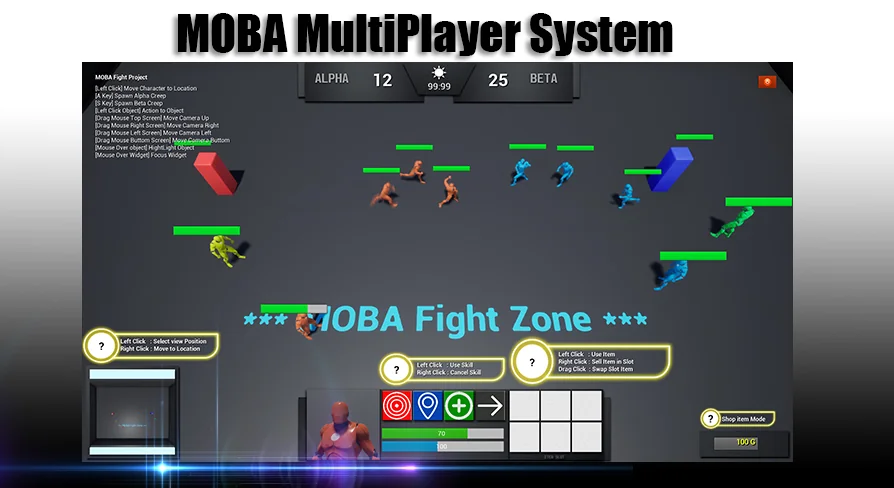
From there, the project covers two different movement interactions: drag mouse movement and click minimap movement. Those systems place it squarely in the lane of top-down competitive play where mouse-driven navigation is central to readability and pacing. Skill use also follows this interface-first structure, with skills triggered by clicking an icon. That detail matters because it connects input, UI behavior, and combat response into one flow instead of leaving skill activation as a disconnected combat test.
Once a match is underway, the package continues through the broader MOBA loop. It includes a shop buy and sell item system, slot item operation, auto-spawn creep behavior, mouse-over object highlighting, and an algorithm for respawning units and ending the game through score. Those pieces are not decorative extras. They are the systems that turn a movement-and-attack prototype into something closer to an actual multiplayer battle format.
Two-team combat, character setup, and the rhythm of repeated matches
Projects in this category often need repeatable match structure before they need content scale. MOBA Fight MultiPlayer Project addresses that structure directly with a server-and-join flow for versus play between two teams. This gives it a clear place in development for anyone testing multiplayer combat rules, team assignment logic, or repeated session-based gameplay.
The character selection and team system push that further. Character selection is not presented as a detached menu idea; it is part of the active match pipeline. In practice, that means the project is positioned for developers who want to test how team identity and player choice work together from the beginning of a session. A game with multiple combat roles or hero-style choices needs that handoff from lobby state into active play. This project already frames its gameplay around that transition.
The fantasy and stylized tags also help define where it belongs creatively. It is not described as a military or realistic combat project. Its place is closer to arena-style fantasy play where replicated multiplayer systems, combat interactions, and hero-like selection form the backbone of the experience. That gives it a distinct use inside prototyping or internal production: not just general online play, but online play shaped around a MOBA-like structure.
Mouse movement, minimap clicks, and camera updates in Update 4.00
Control readability is one of the clearest practical themes here. The project includes drag mouse movement and click minimap movement, which together support the kind of navigation players expect from a top-down competitive format. Dragging for movement gives direct map interaction, while clicking the minimap supports quick repositioning and overview control. For developers, this is the point where movement starts to feel like part of a match interface rather than a placeholder locomotion system.
Update 4.00 adds several changes that reinforce that same focus. A custom camera follow player system was added, along with camera movement limits. Those updates suggest a stronger effort to control how players track their character and how far the camera can move while remaining readable during play. In a project with mouse-based navigation and minimap interaction, camera behavior is not a secondary detail. It affects targeting, map awareness, and how easily players can follow combat.
The same update also adds a level-up system, updates enemy EXP parameters when enemies die, and updates player parameters and status when leveling up. Taken together, these changes push the project from a simple combat shell toward a match progression model. Combat no longer ends at dealing damage or defeating a unit; it now feeds into experience gain and character growth during the session. That matters in a MOBA-style structure because the feel of a match depends on how player power changes over time.
What Update 4.00 changes in day-to-day testing
With level-up behavior in place, developers can test pacing between early and later moments in a match. Enemy defeats now relate to EXP, and leveling up affects player parameters and status. That creates a loop where player action, reward, and character growth feed into each other. The custom follow camera and camera limits support that loop by keeping the player view more controlled while those systems play out.
There is also an update request tied to changing gold. No further detail is given beyond that note, so the practical takeaway is simply that currency-related behavior has been touched as part of the project’s ongoing update path.
Items, creeps, highlights, and respawn logic keep the match from feeling empty
A competitive project like this needs more than movement and attacks to sustain a full round of play. MOBA Fight MultiPlayer Project includes a shop system for buying and selling items, plus slot item operation. Those systems place item handling directly inside match progression rather than treating inventory as a separate utility screen. For a developer, that helps when testing the flow between combat pressure and player decision-making: move, fight, open the shop loop, manage item slots, and return to action.
The auto-spawn creep system is another important part of where this project fits. Creeps are essential to a MOBA-like battlefield because they create repeated lane or field pressure, support experience gain, and keep the map active even when players are repositioning. Their presence means the project is not only about direct player-versus-player encounters; it also supports the surrounding battlefield behavior that gives those encounters context.
Mouse-over highlight object behavior adds another layer of readability. This is a small but practical inclusion for games with dense interaction, where players need clear feedback on what they are targeting or inspecting. In a top-down multiplayer scene, readable object feedback can shape how comfortable the entire interface feels.
The respawn algorithm and score-based game ending complete the round structure. Once units can die, return, and continue participating until a score condition finishes the match, the project supports repeated game-state cycles instead of one-off combat tests. That makes it better suited for developers trying to evaluate match duration, comeback flow, or the rhythm between defeat and re-entry.
Tutorial and Offline_Document support character customization and project use
The project includes a tutorial for customizing characters in the project, along with an Offline_Document. That combination places it in a practical production context rather than leaving teams to reverse-engineer everything through the project itself. Character customization is specifically called out, which is valuable for teams who need to adapt the included structure to their own roster ideas or presentation goals.
There are also references to Update 3.00 and Update 2.00 with details available in the guide document. Even without listing those changes here, their presence shows that the project has an update trail supported by documentation. For a working team, that is useful because multiplayer templates tend to become more useful when there is some record of how systems have changed over time.
The tags also help place the project in a development workflow. Replicated, template, multiplayer, component, script, combat, stylized, fantasy, and blueprint all point toward a project intended for practical assembly and iteration rather than static presentation. It is the kind of resource that fits when a team wants a starting point for online fantasy combat logic and connected gameplay systems, especially when those systems need to work together as part of an actual match structure.
For developers who need a playable two-team framework more than a collection of isolated mechanics, MOBA Fight MultiPlayer Project is most useful where session flow, mouse-driven control, combat progression, and respawn-based match logic all need to exist in one place.
 Weapons & Combat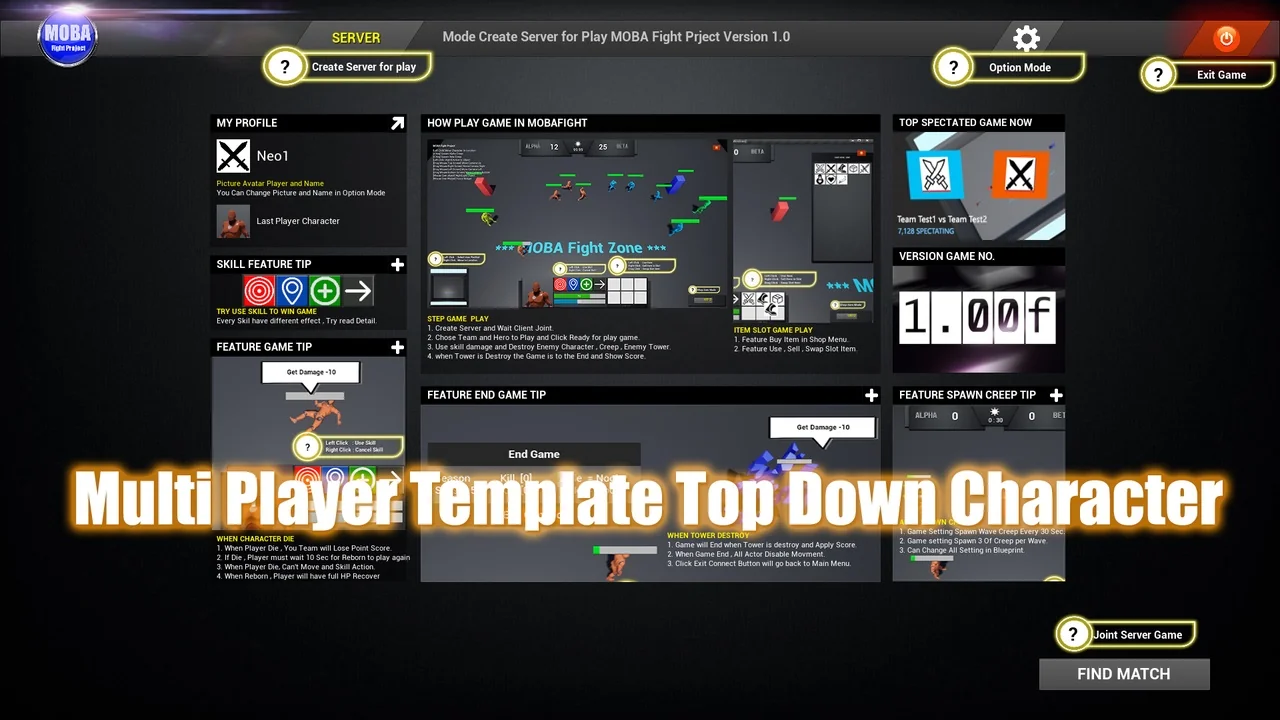
 Weapons & Combat
 Weapons & Combat
 Unreal Engine