"1a0e4ac4dc71d030"{"id":"1000159","slug":"multiplayer-zombie-survival-template","title":"Multiplayer Zombie Survival Template","category":"Shooter","engine":"5.0+","assetVersion":"Asset Version:1.7.0","engineVersion":"Engine Version: 5.0+","tag":"Shooter","accent":"blue","visual":"mech","summary":"A standalone multiplayer wave shooter template with 1st and 3rd person play, points, AI spawning, traps, lobbies, chat, and replicated systems.","platform":"Unreal Engine","publishedAt":"2026-06-18T22:34:44.428Z","updatedAt":"2026-06-18T22:34:44.428Z","sourceNotes":[],"fileContents":[],"compatibility":["Unreal Engine","Asset Version:1.7.0","Engine Version: 5.0+"],"featuredImage":{"alt":"Multiplayer Zombie Survival Template","src":"/wp-content/uploads/published/2026/06/40234d2a8548-72ef744c-3169-465e-8c47-9b75d7388d8c-173acd2dcb.webp"},"hasDownloadLink":true,"downloads":2,"terms":[{"taxonomy":"category","slug":"shooter","name":"Shooter"}],"galleryImages":[{"src":"/wp-content/uploads/published/2026/06/2e5e634723bf-048825b5-18b8-4055-a3bf-f7cf2e317791-fd4f2beba1.webp","alt":"Multiplayer Zombie Survival Template"},{"src":"/wp-content/uploads/published/2026/06/aa1f0358bf39-dc3a8adb-d3aa-4ff7-b3e4-3124156617a7-8e18ef1fa5.webp","alt":"Multiplayer Zombie Survival Template"},{"src":"/wp-content/uploads/published/2026/06/1906f48cc7c8-d9f72bc8-b19a-46be-9c1f-9cb45dae2403-03330400be.webp","alt":"Multiplayer Zombie Survival Template"},{"src":"/wp-content/uploads/published/2026/06/fc4b7f3e6575-d3a7da39-4757-467b-8322-d77202bdac0a-f3a421c3b1.webp","alt":"Multiplayer Zombie Survival Template"},{"src":"/wp-content/uploads/published/2026/06/0cf143adbf76-02102874-37c3-4545-a884-7cbbf47b61c0-4b0b5d1e8f.webp","alt":"Multiplayer Zombie Survival Template"},{"src":"/wp-content/uploads/published/2026/06/d9acf5484d3a-e5e55633-ba35-4870-ae1c-60c4e6e93b2a-ed6d48a692.webp","alt":"Multiplayer Zombie Survival Template"},{"src":"/wp-content/uploads/published/2026/06/8b5e820dc42d-5067b9d8-eb64-4db7-abf6-87a2ad96df2b-c904cfce97.webp","alt":"Multiplayer Zombie Survival Template"},{"src":"/wp-content/uploads/published/2026/06/e32136b12a39-841b1c34-4b53-40d4-924b-f5f05e943060-1c238cd181.webp","alt":"Multiplayer Zombie Survival Template"},{"src":"/wp-content/uploads/published/2026/06/01169a26eb78-b2e90337-7791-4fd7-b57b-5a1defd74890-85b40cff63.webp","alt":"Multiplayer Zombie Survival Template"},{"src":"/wp-content/uploads/published/2026/06/2e9194476fb0-a4cde662-f147-4b34-8cbe-fddef2c49b17-844d194e83.webp","alt":"Multiplayer Zombie Survival Template"}],"accessPanel":{"kind":"resource","title":"Download this resource","eyebrow":"Free Download","message":"Log in or create a free account to start your download.","fileName":"Multiplayer Zombie Survival Template v1.7.0.7z","safetyNote":"Resources are manually reviewed before listing to improve quality and reduce obvious risks.","actionLabel":"Download Free","resourceType":"Resource archive"},"contentHtml":"\u003cp\u003eProjects that need a playable co-op or competitive horde foundation usually rise or fall on their game loop. \u003cstrong\u003eMultiplayer Zombie Survival Template\u003c/strong\u003e Centers that loop on wave-based combat: players survive increasing rounds of enemies, push for a higher wave, earn points by shooting and killing, and then spend those points on practical choices such as weapons, traps, doors, or anything else a project wants to gate behind currency.\u003c/p\u003e\n\u003cp\u003eThat structure makes it useful for games that want a recognizable survival rhythm right away. The pressure climbs as waves progress because enemy difficulty increases over time, and the number of enemies scales with the number of players in the session. Instead of focusing on a single isolated mechanic, the template covers the base systems needed to turn that loop into a multiplayer game that can actually run from lobby to match and onward into spectating or respawn.\u003c/p\u003e \u003ch2\u003eWave-based survival with points, doors, traps, and random weapons\u003c/h2\u003e\n\u003cp\u003eAt its core, this is a first and/or third person wave shooter template. The immediate use case is a zombie survival project where players hold out against incoming enemies for as long as possible. The progression is straightforward: later waves become more difficult, more players bring more enemies into play, and successful combat feeds directly into the points system.\u003c/p\u003e\n\u003cp\u003eThe points system acts as the in-game currency and ties combat to decision-making. Points earned from shooting and killing enemies can be spent on opening doors, buying weapons, activating traps, or any other action that a developer wants to assign a cost to. That means the template supports both the moment-to-moment shooting and the between-fights choices that shape a survival match.\u003c/p\u003e\n\u003cp\u003eThere is also a random weapon box that grants a player a random weapon for a set amount of points. In practice, that adds another layer to the survival loop: players can either spend more predictably on fixed interactions like doors and traps or take a chance on a random weapon pull. Since the template already connects points spending with gameplay interactions, it gives projects a ready-made framework for familiar round-based survival rules without locking everything to one exact setup.\u003c/p\u003e\n\u003cp\u003eTraps are part of that same structure. They are player-activated and can wipe out large hordes of enemies, which makes them especially suited to intense waves where crowd control matters as much as raw weapon damage.\u003c/p\u003e \u003ch2\u003eMultiplayer Zombie Survival Template as a co-op starting point\u003c/h2\u003e\n\u003cp\u003eThis template is fully replicated for multiplayer and is positioned as a starting point for a game rather than a finished, locked-down experience. This helps because it already includes the networked base systems needed to get a multiplayer project operational while still leaving room for heavy customization.\u003c/p\u003e\n\u003cp\u003eFull online multiplayer support is included. By default it uses the Steam subsystem, and it has been tested to work with that setup, but it is not limited to it. The project can use whatever subsystem a developer wants. For teams building an online survival game, that gives them a network-ready foundation while keeping subsystem choice open.\u003c/p\u003e\n\u003cp\u003eThe online flow includes host and join sessions with a server browser, which covers the practical step of getting players into matches. Before the game starts, there is also a pre-game lobby with character and level select. That makes the template relevant not just for combat scenes but for the whole multiplayer session flow around them.\u003c/p\u003e\n\u003cp\u003eChat support is present as well, which is another concrete part of multiplayer usability rather than a cosmetic extra. Spectating and respawn systems round out the match lifecycle once a player goes down or needs to re-enter the game state. Taken together, these systems make the template suited to projects that need more than basic replicated shooting. It reaches into the connective tissue of multiplayer survival: browsing sessions, assembling players, selecting characters and levels, communicating, surviving, dying, and continuing.\u003c/p\u003e \u003ch2\u003e1st and 3rd Person play, plus room to swap your own content\u003c/h2\u003e\n\u003cp\u003eOne of the more practical aspects here is perspective support. The template features both 1st person and 3rd person play, and Enhanced Input is also available for UE5 versions of the template. For developers deciding between perspectives, or wanting to support different viewing styles in the same project, that opens up more flexibility from the start.\u003c/p\u003e\n\u003cp\u003eThe project is also set up to be easily edited and changed. Rather than treating the included content as untouchable, it allows developers to switch out player characters, animations, weapons, menus, sounds, and enemies with whatever they want to use. That makes it especially relevant for teams or solo creators who already have their own art direction or character setup but do not want to build the entire survival and multiplayer framework from scratch.\u003c/p\u003e\n\u003cp\u003eBecause it is a standalone project, it is not framed as a small isolated add-on. It is meant to provide the base operational layer for a multiplayer survival game. Inside a project, that makes it useful for prototypes, internal production foundations, or custom zombie-style projects where the priority is getting the core game loop, networking, and player flow in place first, then replacing content and tuning behavior afterward.\u003c/p\u003e \u003ch2\u003eWeapon System, Dynamic Crosshairs, and Replicated HUD\u003c/h2\u003e\n\u003cp\u003eThe combat side is broader than simple shooting. The weapon system supports both hitscan and projectile weapons. It also includes weapon recoil, spread, and enemy bullet penetration, with those settings handled in a weapons data table. That gives the shooting model enough structure for projects that want different weapon behaviors instead of one universal firing pattern.\u003c/p\u003e\n\u003cp\u003eDynamic crosshairs react to the spread of the weapon while moving and aiming, increasing and decreasing in size accordingly. This ties visual feedback to the handling model, which is useful in survival shooters where players need quick information about accuracy under pressure.\u003c/p\u003e\n\u003cp\u003eThe HUD is replicated and includes concrete multiplayer-facing information such as the scoreboard, points, kills, deaths, and player image. A settings menu is also included, and it saves and loads from file so settings remain saved. In a multiplayer template, that kind of support work matters because it reduces the amount of surrounding interface setup needed before a project feels coherent.\u003c/p\u003e\n\u003cp\u003eThe interaction system supports interaction with weapons, doors, traps, pickups, and other gameplay elements. That fits directly into the survival structure already established by the points economy and map progression. It also helps explain how the template supports more than isolated features: many of its systems are linked together through interaction, currency spending, and replicated player feedback.\u003c/p\u003e \u003ch2\u003eEnemy AI, spawn points, physical materials, and power-up drops\u003c/h2\u003e\n\u003cp\u003eThe enemy side includes AI with a spawn system and spawn points, covering both basic zombie and boss zombie behavior. For wave survival projects, that is one of the most important practical inclusions because the match structure depends on enemies arriving reliably, escalating over time, and giving players something distinct to react to beyond a single standard target.\u003c/p\u003e\n\u003cp\u003ePower-up drops add another survival-game layer by introducing pickups that can shift the momentum of a wave. Physical materials are also included for surface and impact response, with examples such as bullet holes, flesh, and metal. That kind of feedback is smaller in scope than networking or AI, but it contributes directly to how the shooting feels once players are in the middle of a round.\u003c/p\u003e\n\u003cp\u003eDocumentation is part of the package as well, with step-by-step tutorials and video tutorials available. There is also community support through Discord with an active group of more than 500 people. For developers using the template as a foundation rather than a finished endpoint, those supporting materials matter because this project contains many connected systems: online sessions, points, AI, weapons, lobbies, traps, HUD, and interaction.\u003c/p\u003e \u003ch2\u003eWhere this template fits best\u003c/h2\u003e\n\u003cp\u003eThis template suits developers who want a standalone starting point for a multiplayer zombie or horde shooter and need the groundwork already in place. It is most useful when a project needs wave progression, scalable enemy counts for multiple players, networked sessions, a lobby flow, point spending, weapon variety, and room to replace the included characters, enemies, sounds, menus, and other content with its own.\u003c/p\u003e\n\u003cp\u003eFor anyone building a first person or third person survival game and wanting the base systems operational without spending that time on the underlying multiplayer framework first, this is the clearest fit.\u003c/p\u003e\n\n\u003ch2\u003eMore From The Same Workflow\u003c/h2\u003e\n\u003cul\u003e\n\u003cli\u003e\u003ca href=\"https://3dcghub.com/definitive-fps-kit/\" title=\"DEFINITIVE FPS KIT\"\u003eDEFINITIVE FPS KIT\u003c/a\u003e\u003c/li\u003e\n\u003cli\u003e\u003ca href=\"https://3dcghub.com/infected-multiplayer-zombie-survival-third-person-shooter-template-by-kekdot/\" title=\"Infected - Multiplayer Zombie Survival Third Person Shooter Template - By Kekdot\"\u003eInfected - Multiplayer Zombie Survival Third Person Shooter Template - By Kekdot\u003c/a\u003e\u003c/li\u003e\n\u003cli\u003e\u003ca href=\"https://3dcghub.com/first-person-shooter-kit/\" title=\"First Person Shooter Kit\"\u003eFirst Person Shooter Kit\u003c/a\u003e\u003c/li\u003e\n\u003cli\u003e\u003ca href=\"https://3dcghub.com/advanced-multiplayer-survival-templatev2/\" title=\"Advanced Multiplayer Survival TemplateV2\"\u003eAdvanced Multiplayer Survival TemplateV2\u003c/a\u003e\u003c/li\u003e\n\u003cli\u003e\u003ca href=\"https://3dcghub.com/multiplayer-top-down-shooter-template/\" title=\"Multiplayer Top Down Shooter Template\"\u003eMultiplayer Top Down Shooter Template\u003c/a\u003e\u003c/li\u003e\n\u003c/ul\u003e","contentTextLength":9014,"navigation":{"current":1144,"total":3200,"previous":{"id":"1000160","slug":"military-battlefield-kit-and-middle-east-set","title":"Military Battlefield Kit and Middle East Set","category":"Cities","platform":"Unreal Engine","updatedAt":"2026-06-18T22:43:35.139Z"},"next":{"id":"1000158","slug":"sci-fi-city-hub-kit","title":"Sci-Fi City Hub Kit","category":"Industrial","platform":"Unity","updatedAt":"2026-06-18T22:29:43.919Z"}},"relatedResources":[{"id":"1001097","slug":"zombie-shooter-kit-v2-12-unreal-engine-5-starter-pack","title":"Zombie Shooter Kit v2.12 - UNREAL ENGINE 5 Starter Pack","category":"Shooter","engine":"5.7+","assetVersion":"Asset Version: 2.11","engineVersion":"Engine Version: 5.7+","tag":"Shooter","accent":"blue","visual":"mech","summary":"Blueprint-based UE5 starter for survival shooters: replicated multiplayer, zombies and human AI, jigsaw inventory, crafting, vehicles, weather, and G.A.S.P. Loc","platform":"Unreal Engine","publishedAt":"2026-09-06T02:45:34.766Z","updatedAt":"2026-09-06T02:45:34.766Z","sourceNotes":[],"fileContents":[],"compatibility":["Unreal Engine","Asset Version: 2.11","Engine Version: 5.7+"],"featuredImage":{"alt":"Zombie Shooter Kit v2.12 - UNREAL ENGINE 5 Starter Pack","src":"/wp-content/uploads/published/2026/09/1d7d8e00baab-vqwonz-9f5e01b28f.webp"},"hasDownloadLink":true,"downloads":7},{"id":"11974","slug":"definitive-fps-kit","title":"DEFINITIVE FPS KIT","category":"Shooter","engine":"5.5+","assetVersion":"Engine version: 5.5+","engineVersion":"5.5","tag":"Shooter","accent":"blue","visual":"luts","summary":"The DEFINITIVE FPS KIT provides a solid foundation for creating professional first-person shooters. It features high-quality animations, customizable loadouts, and diverse game modes like round-based zombies and multiplayer.","platform":"Unreal Engine","publishedAt":"2026-03-06T16:27:47.000Z","updatedAt":"2026-04-19T15:48:05.000Z","sourceNotes":[],"fileContents":[],"compatibility":["Unreal Engine","Engine version: 5.5+"],"featuredImage":{"alt":"DEFINITIVE FPS KIT","src":"https://3dcghub.com/wp-content/uploads/2026/03/6ad028e1-885c-4980-aa89-7ecea094d867.webp"},"hasDownloadLink":true,"downloads":15},{"id":"12066","slug":"infected-multiplayer-zombie-survival-third-person-shooter-template-by-kekdot","title":"Infected - Multiplayer Zombie Survival Third Person Shooter Template - By Kekdot","category":"Shooter","engine":"5.2+","assetVersion":"Engine version: 5.2+","engineVersion":"5.0","tag":"Shooter","accent":"blue","visual":"mech","summary":"Launch your game development journey with this comprehensive multiplayer zombie survival template. It features full match flow logic, shooter mechanics, and replicated gameplay actors for a seamless experience.","platform":"Unreal Engine","publishedAt":"2026-03-06T16:43:34.000Z","updatedAt":"2026-04-19T15:48:04.000Z","sourceNotes":[],"fileContents":[],"compatibility":["Unreal Engine","Engine version: 5.2+"],"featuredImage":{"alt":"Infected - Multiplayer Zombie Survival Third Person Shooter Template - By Kekdot","src":"https://3dcghub.com/wp-content/uploads/2026/03/bf7b5670-4dc2-4918-a33d-e50c42132107.webp"},"hasDownloadLink":true,"downloads":2}]}
Shooter
Multiplayer Zombie Survival Template
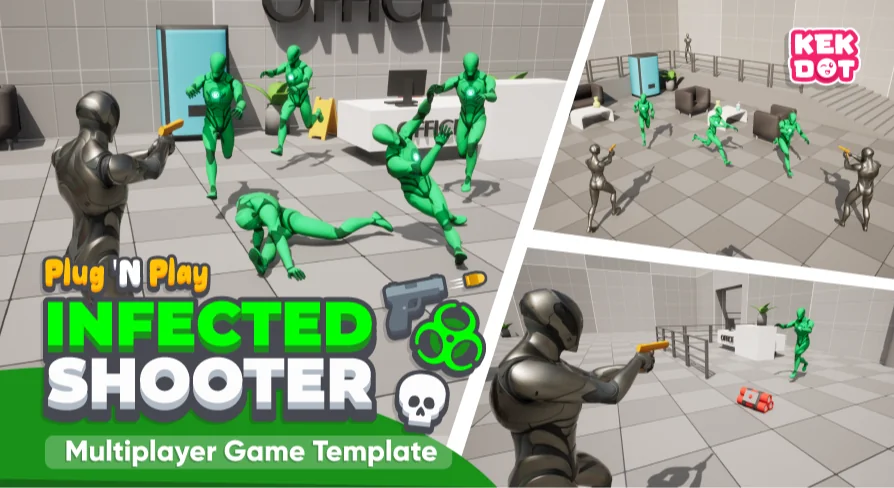
A standalone multiplayer wave shooter template with 1st and 3rd person play, points, AI spawning, traps, lobbies, chat, and replicated systems.
Projects that need a playable co-op or competitive horde foundation usually rise or fall on their game loop. Multiplayer Zombie Survival Template Centers that loop on wave-based combat: players survive increasing rounds of enemies, push for a higher wave, earn points by shooting and killing, and then spend those points on practical choices such as weapons, traps, doors, or anything else a project wants to gate behind currency.
That structure makes it useful for games that want a recognizable survival rhythm right away. The pressure climbs as waves progress because enemy difficulty increases over time, and the number of enemies scales with the number of players in the session. Instead of focusing on a single isolated mechanic, the template covers the base systems needed to turn that loop into a multiplayer game that can actually run from lobby to match and onward into spectating or respawn.
Wave-based survival with points, doors, traps, and random weapons
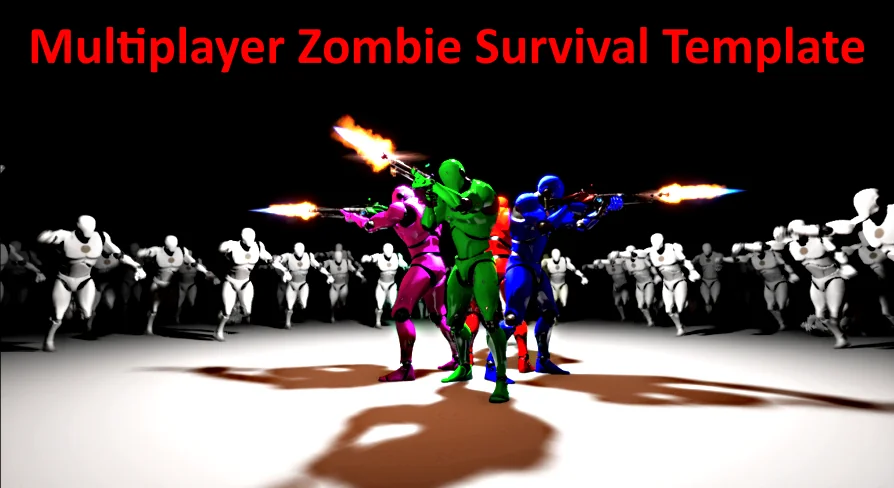
At its core, this is a first and/or third person wave shooter template. The immediate use case is a zombie survival project where players hold out against incoming enemies for as long as possible. The progression is straightforward: later waves become more difficult, more players bring more enemies into play, and successful combat feeds directly into the points system.
The points system acts as the in-game currency and ties combat to decision-making. Points earned from shooting and killing enemies can be spent on opening doors, buying weapons, activating traps, or any other action that a developer wants to assign a cost to. That means the template supports both the moment-to-moment shooting and the between-fights choices that shape a survival match.
There is also a random weapon box that grants a player a random weapon for a set amount of points. In practice, that adds another layer to the survival loop: players can either spend more predictably on fixed interactions like doors and traps or take a chance on a random weapon pull. Since the template already connects points spending with gameplay interactions, it gives projects a ready-made framework for familiar round-based survival rules without locking everything to one exact setup.
Traps are part of that same structure. They are player-activated and can wipe out large hordes of enemies, which makes them especially suited to intense waves where crowd control matters as much as raw weapon damage.
Multiplayer Zombie Survival Template as a co-op starting point
This template is fully replicated for multiplayer and is positioned as a starting point for a game rather than a finished, locked-down experience. This helps because it already includes the networked base systems needed to get a multiplayer project operational while still leaving room for heavy customization.
Full online multiplayer support is included. By default it uses the Steam subsystem, and it has been tested to work with that setup, but it is not limited to it. The project can use whatever subsystem a developer wants. For teams building an online survival game, that gives them a network-ready foundation while keeping subsystem choice open.
The online flow includes host and join sessions with a server browser, which covers the practical step of getting players into matches. Before the game starts, there is also a pre-game lobby with character and level select. That makes the template relevant not just for combat scenes but for the whole multiplayer session flow around them.
Chat support is present as well, which is another concrete part of multiplayer usability rather than a cosmetic extra. Spectating and respawn systems round out the match lifecycle once a player goes down or needs to re-enter the game state. Taken together, these systems make the template suited to projects that need more than basic replicated shooting. It reaches into the connective tissue of multiplayer survival: browsing sessions, assembling players, selecting characters and levels, communicating, surviving, dying, and continuing.
1st and 3rd Person play, plus room to swap your own content
One of the more practical aspects here is perspective support. The template features both 1st person and 3rd person play, and Enhanced Input is also available for UE5 versions of the template. For developers deciding between perspectives, or wanting to support different viewing styles in the same project, that opens up more flexibility from the start.
The project is also set up to be easily edited and changed. Rather than treating the included content as untouchable, it allows developers to switch out player characters, animations, weapons, menus, sounds, and enemies with whatever they want to use. That makes it especially relevant for teams or solo creators who already have their own art direction or character setup but do not want to build the entire survival and multiplayer framework from scratch.
Because it is a standalone project, it is not framed as a small isolated add-on. It is meant to provide the base operational layer for a multiplayer survival game. Inside a project, that makes it useful for prototypes, internal production foundations, or custom zombie-style projects where the priority is getting the core game loop, networking, and player flow in place first, then replacing content and tuning behavior afterward.
Weapon System, Dynamic Crosshairs, and Replicated HUD
The combat side is broader than simple shooting. The weapon system supports both hitscan and projectile weapons. It also includes weapon recoil, spread, and enemy bullet penetration, with those settings handled in a weapons data table. That gives the shooting model enough structure for projects that want different weapon behaviors instead of one universal firing pattern.
Dynamic crosshairs react to the spread of the weapon while moving and aiming, increasing and decreasing in size accordingly. This ties visual feedback to the handling model, which is useful in survival shooters where players need quick information about accuracy under pressure.
The HUD is replicated and includes concrete multiplayer-facing information such as the scoreboard, points, kills, deaths, and player image. A settings menu is also included, and it saves and loads from file so settings remain saved. In a multiplayer template, that kind of support work matters because it reduces the amount of surrounding interface setup needed before a project feels coherent.
The interaction system supports interaction with weapons, doors, traps, pickups, and other gameplay elements. That fits directly into the survival structure already established by the points economy and map progression. It also helps explain how the template supports more than isolated features: many of its systems are linked together through interaction, currency spending, and replicated player feedback.
Enemy AI, spawn points, physical materials, and power-up drops
The enemy side includes AI with a spawn system and spawn points, covering both basic zombie and boss zombie behavior. For wave survival projects, that is one of the most important practical inclusions because the match structure depends on enemies arriving reliably, escalating over time, and giving players something distinct to react to beyond a single standard target.
Power-up drops add another survival-game layer by introducing pickups that can shift the momentum of a wave. Physical materials are also included for surface and impact response, with examples such as bullet holes, flesh, and metal. That kind of feedback is smaller in scope than networking or AI, but it contributes directly to how the shooting feels once players are in the middle of a round.
Documentation is part of the package as well, with step-by-step tutorials and video tutorials available. There is also community support through Discord with an active group of more than 500 people. For developers using the template as a foundation rather than a finished endpoint, those supporting materials matter because this project contains many connected systems: online sessions, points, AI, weapons, lobbies, traps, HUD, and interaction.
Where this template fits best
This template suits developers who want a standalone starting point for a multiplayer zombie or horde shooter and need the groundwork already in place. It is most useful when a project needs wave progression, scalable enemy counts for multiple players, networked sessions, a lobby flow, point spending, weapon variety, and room to replace the included characters, enemies, sounds, menus, and other content with its own.
For anyone building a first person or third person survival game and wanting the base systems operational without spending that time on the underlying multiplayer framework first, this is the clearest fit.
 Shooter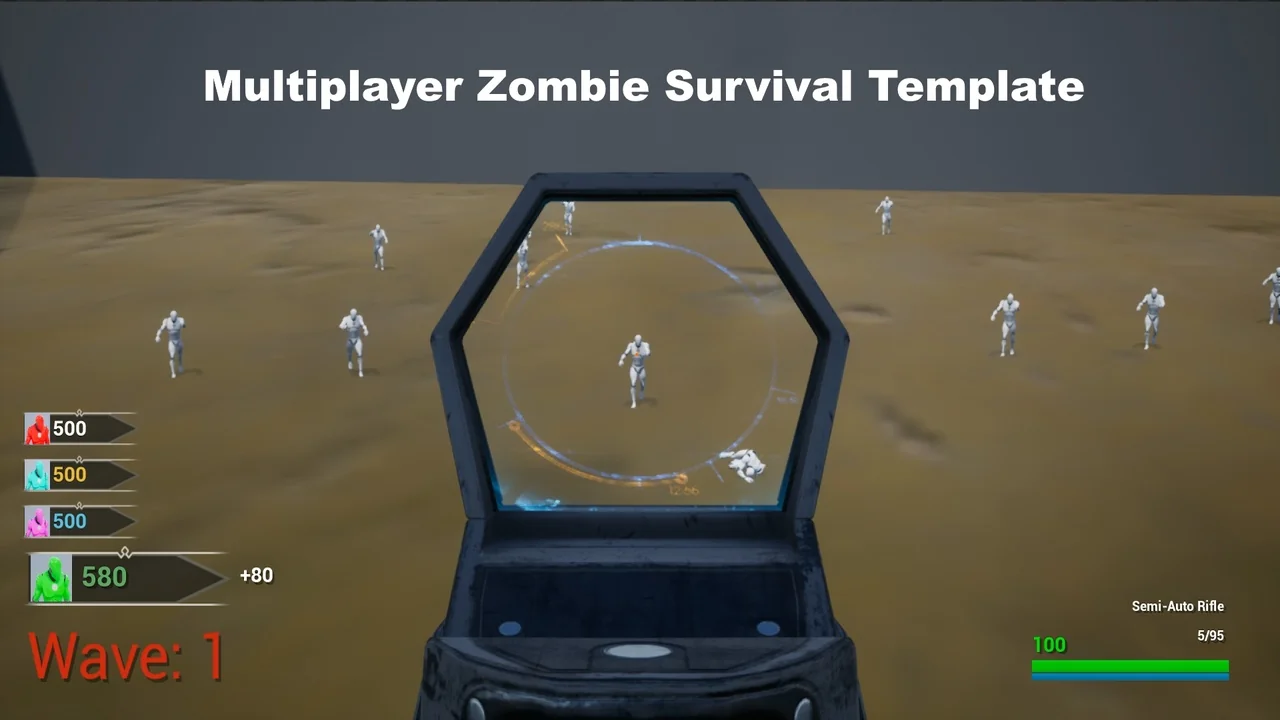
 Shooter
 Shooter
 Shooter