"a338a1d501976271"{"id":"1000312","slug":"military-drones","title":"Military Drones","category":"Weapons \u0026 Combat","engine":"4.26+,5.0+","assetVersion":"","engineVersion":"Engine Version: 4.26+,5.0+","tag":"Weapons \u0026 Combat","accent":"blue","visual":"mech","summary":"A tactical asset package featuring assault and kamikaze drones, a rigged first-person joystick controller, 4K PBR textures, and 30 flight and combat animations.","platform":"Unreal Engine","publishedAt":"2026-07-04T15:57:49.053Z","updatedAt":"2026-07-04T15:57:49.053Z","sourceNotes":[],"fileContents":[],"compatibility":["Unreal Engine","Engine Version: 4.26+,5.0+"],"featuredImage":{"alt":"Military Drones","src":"/wp-content/uploads/published/2026/07/154c055a0537-2ce36148-838c-4b6c-b579-db8cd9cbff30-aab5756714.webp"},"hasDownloadLink":true,"downloads":0,"terms":[{"taxonomy":"category","slug":"weapons-and-combat","name":"Weapons \u0026 Combat"}],"galleryImages":[{"src":"/wp-content/uploads/published/2026/07/240b88854fd4-0ada8546-52bc-4ca7-bed5-0a5568d6c083-97705d1e57.webp","alt":"Military Drones"},{"src":"/wp-content/uploads/published/2026/07/dce8cbedaa8d-78fa3c96-3e97-4693-8e79-5709c36d5db2-f427020c6a.webp","alt":"Military Drones"},{"src":"/wp-content/uploads/published/2026/07/42cc0b28ef6b-ffbdbccb-512e-4c56-b4a6-ad27ef683d29-62a8243826.webp","alt":"Military Drones"},{"src":"/wp-content/uploads/published/2026/07/adeef404a692-d1dd6665-4dc8-4843-b9d3-e39fe7c8ded2-6e5ce560b2.webp","alt":"Military Drones"},{"src":"/wp-content/uploads/published/2026/07/cdb1149a9fca-69a98abf-c77b-43ac-a543-1690bea5be0e-0415d90f5f.webp","alt":"Military Drones"},{"src":"/wp-content/uploads/published/2026/07/b98016d6569b-7c2eef4b-8322-4a77-a0fb-c09119a46ea9-6ae4fe44d2.webp","alt":"Military Drones"},{"src":"/wp-content/uploads/published/2026/07/b956c66c1f93-e48cf172-a51e-469e-9b04-dfa789237cc1-0216e78094.webp","alt":"Military Drones"},{"src":"/wp-content/uploads/published/2026/07/2d6f23ef79e7-f810665d-cb77-4cee-91bb-f32a13b4e31c-177ac18411.webp","alt":"Military Drones"},{"src":"/wp-content/uploads/published/2026/07/540afeeb26ce-dc447834-5891-4c55-8deb-68c7c45d47ea-77d917b6b7.webp","alt":"Military Drones"},{"src":"/wp-content/uploads/published/2026/07/9923aa0ef0cf-7a0f6397-34f2-4856-b9bf-91876d4545db-3257f1b131.webp","alt":"Military Drones"}],"accessPanel":{"kind":"resource","title":"Download this resource","eyebrow":"Free Download","message":"Log in or create a free account to start your download.","fileName":"Content.7z","safetyNote":"Resources are manually reviewed before listing to improve quality and reduce obvious risks.","actionLabel":"Download Free","resourceType":"Resource archive"},"contentHtml":"\u003cp\u003eThe Military Drones package equips developers with specialized unmanned aerial vehicles engineered for tactical combat scenarios. The core modules of this asset include an assault drone built to drop grenades on enemy positions, alongside a kamikaze drone that can be guided directly into vehicles and other targets. To anchor these models in a player's perspective, the pack provides a rigged set of animated hands and a dedicated control joystick. These hands function as an optional first-person element, allowing developers to visually demonstrate the operator actively piloting the drone or initiating a pre-flight sequence before the vehicle takes to the air.\u003c/p\u003e \u003ch2\u003eGeometric Density and 4K Surfacing\u003c/h2\u003e \u003cp\u003eThe structural assets include multiple drone meshes alongside the operator's equipment, offering a significant range of geometric complexity across the included models. The vertex counts are distinctly varied to handle different levels of on-screen detail. Drone 01 carries a vertex count of 15,226, providing a solid baseline for aerial units. Drone 02 scales up significantly to 68,948 vertices, and Drone 03 follows closely with 66,664 vertices, allowing for highly intricate mechanical detailing on the heavier variants. The operator's hands consist of 14,014 vertices to ensure smooth deformation during control animations, while the standalone control joystick adds another 5,725 vertices to the first-person view.\u003c/p\u003e \u003cp\u003eSurfacing for these models relies on a focused physically based rendering setup. The visual data is distributed across 11 materials and material instances, which draw from a centralized pool of 24 distinct textures. Every primary character map\u0026mdash;specifically Normals, Ambient Occlusion, Albedo, Metallic, and Emissive\u0026mdash;is authored at a maximum resolution of 4096 by 4096. This 4K texture setup ensures that the drones and the first-person control equipment maintain sharp, readable details. The specific inclusion of Metallic and Emissive maps allows for realistic rendering of the drones' chassis materials and any illuminated operational indicators, which is particularly critical when the camera is positioned tightly behind the joystick or tracking close to the drone during a kamikaze dive.\u003c/p\u003e \u003ch2\u003eDrone Flight Mechanics and Combat Behaviors\u003c/h2\u003e \u003cp\u003eMovement and combat behaviors are fully mapped out through a dedicated library of 30 total animations. The drones themselves are equipped with sequences covering the entirety of a standard flight cycle. Takeoff and landing animations handle the vertical transition between the ground and the air, while an idle state keeps the drone visually active while hovering in place.\u003c/p\u003e \u003cp\u003eFor directional travel, the package supplies forward, backward, left, and right flight animations. Notably, these four directional movements are provided in both Root Motion and In-place variations. This dual approach gives developers the flexibility to choose whether the animation data directly drives the actor's position in the world using Root Motion, or if the movement is handled strictly by the game engine's internal velocity logic via the In-place sequences. To manage in-air orientation, the drone features specific rotation animations authored at precise 45-degree and 90-degree increments for both left and right turns.\u003c/p\u003e \u003cp\u003eCombat actions are similarly detailed based on the drone variant. Because the assault drone is meant to deploy explosives from above, it utilizes three distinct grenade-dropping animations (Drone Dropping Grenade 01, 02, and 03). Providing three variations allows developers to cycle through different drop mechanics during aerial bombardments, preventing the visual repetition of a single repeating motion when engaging multiple targets.\u003c/p\u003e \u003ch2\u003eFirst-Person Operator Rig and Locomotion\u003c/h2\u003e \u003cp\u003eThe first-person hands are rigged directly to the Epic skeleton, specifically utilizing an Epic rig 4 setup. This ensures immediate compatibility with standard humanoid skeletons and established retargeting workflows. The operator's animation list focuses on interacting with the joystick and navigating the environment while actively piloting.\u003c/p\u003e \u003cp\u003eSequences like \"Arms Joystick Get\" and \"Arms Joystick Hide\" manage the equipping and stowing of the remote control unit, bringing the joystick in and out of the player's field of view. \"Arms Joystick Start Drone\" and \"Arms Joystick Stop Drone\" visually represent the ignition and shutdown commands. While the drone is in active flight, the \"Arms Joystick Drone Control\" and \"Arms Joystick Idle\" animations keep the player's hands engaged with the interface, reinforcing the connection between the operator and the vehicle.\u003c/p\u003e \u003cp\u003eThe operator remains fully capable of standard first-person locomotion while holding the controller. The walking and running animations are supported by a multi-part jump sequence that is broken down into \"Arms Joystick Jump Start,\" \"Arms Joystick Jump Loop,\" and \"Arms Joystick Jump End\" phases. This split-jump setup is standard practice for creating responsive, physics-driven in-air states within an animation blueprint, ensuring the hands react appropriately as the player leaves the ground and lands.\u003c/p\u003e \u003ch2\u003eDeployment in Tactical Shooters\u003c/h2\u003e \u003cp\u003eOut of the 30 total animations split between the drones and the operator hands, four utilize Root Motion, while the remaining 26 are authored In-place. The models, materials, and animation sequences are natively supported for development on both Windows and Mac platforms. By combining the high-resolution 4K materials, the distinct assault and kamikaze drone types, and the comprehensive Epic-rigged first-person control animations, the package provides the structural and behavioral components necessary to implement remote-controlled military strikes within modern tactical shooter environments.\u003c/p\u003e\n\n\u003ch2\u003eContinue Browsing Similar Packs\u003c/h2\u003e\n\u003cul\u003e\n\u003cli\u003e\u003ca href=\"https://3dcghub.com/sci-fi-survey-drones/\" title=\"Sci-fi Survey Drones\"\u003eSci-fi Survey Drones\u003c/a\u003e\u003c/li\u003e\n\u003cli\u003e\u003ca href=\"https://3dcghub.com/knife-dagger/\" title=\"Knife Dagger\"\u003eKnife Dagger\u003c/a\u003e\u003c/li\u003e\n\u003cli\u003e\u003ca href=\"https://3dcghub.com/ww2-germany-weapons/\" title=\"WW2 Germany Weapons\"\u003eWW2 Germany Weapons\u003c/a\u003e\u003c/li\u003e\n\u003cli\u003e\u003ca href=\"https://3dcghub.com/construction-site-vol-2-tools-parts-and-machine-props/\" title=\"Construction Site VOL. 2 - Tools, Parts, and Machine Props\"\u003eConstruction Site VOL. 2 - Tools, Parts, and Machine Props\u003c/a\u003e\u003c/li\u003e\n\u003cli\u003e\u003ca href=\"https://3dcghub.com/post-apocalyptic-melee-weapons-vol-2-post-apocalyptic-melee-weapons-weapon-old/\" title=\"Post Apocalyptic Melee Weapons VOL.2 (Post Apocalyptic Melee Weapons Weapon Old)\"\u003ePost Apocalyptic Melee Weapons VOL.2 (Post Apocalyptic Melee Weapons Weapon Old)\u003c/a\u003e\u003c/li\u003e\n\u003c/ul\u003e","contentTextLength":5989,"navigation":{"current":1164,"total":3338,"previous":{"id":"1000313","slug":"modular-orcs-and-troll-metahuman","title":"Modular Orcs \u0026 Troll - Metahuman","category":"Characters \u0026 Creatures","platform":"Unreal Engine","updatedAt":"2026-07-04T16:12:06.006Z"},"next":{"id":"1000309","slug":"lordenfel-castles-and-dungeons-rpg-pack","title":"Lordenfel: Castles \u0026 Dungeons RPG pack","category":"Medieval","platform":"Unreal Engine","updatedAt":"2026-07-04T10:19:55.493Z"}},"relatedResources":[{"id":"1000954","slug":"military-drone","title":"Military Drone","category":"Characters \u0026 Creatures","engine":"4.26+,5.0+","assetVersion":"","engineVersion":"Engine Version: 4.26+,5.0+","tag":"Characters","accent":"blue","visual":"character","summary":"A rigged military drone with 4096px PBR material and six basic animations for sci-fi and near-future scenes. Seen in Aliens: Dark Descent and more.","platform":"Unreal Engine","publishedAt":"2026-08-14T05:42:15.189Z","updatedAt":"2026-08-14T05:42:15.189Z","sourceNotes":[],"fileContents":[],"compatibility":["Unreal Engine","Engine Version: 4.26+,5.0+"],"featuredImage":{"alt":"Military Drone","src":"/wp-content/uploads/published/2026/08/977e0c2a89c8-f992d788-b6ce-4f82-bf59-1a8a840f75a9-1005abbefc.webp"},"hasDownloadLink":true,"downloads":0},{"id":"1000382","slug":"military-supplies-vol-5-war-machines","title":"Military Supplies - VOL.5 - War Machines","category":"Weapons \u0026 Combat","engine":"4.26+,5.0+","assetVersion":"","engineVersion":"Engine Version: 4.26+,5.0+","tag":"Weapons \u0026 Combat","accent":"blue","visual":"mech","summary":"Explore the technical setup of Military Supplies - VOL.5 - War Machines, featuring Unreal Engine master materials, channel-packed textures, and custom branding.","platform":"Unreal Engine","publishedAt":"2026-07-07T08:05:40.545Z","updatedAt":"2026-07-07T08:05:40.545Z","sourceNotes":[],"fileContents":[],"compatibility":["Unreal Engine","Engine Version: 4.26+,5.0+"],"featuredImage":{"alt":"Military Supplies - VOL.5 - War Machines","src":"/wp-content/uploads/published/2026/07/d2265e2418dc-548e47e9-3407-4b71-a98f-9698f89b1ef3-51452d68e5.webp"},"hasDownloadLink":true,"downloads":1},{"id":"1000465","slug":"sci-fi-drone-01","title":"Sci-fi Drone 01","category":"Mechanical \u0026 Robots","engine":"4.26+,5.0+","assetVersion":"","engineVersion":"Engine Version: 4.26+,5.0+","tag":"Mechanical","accent":"blue","visual":"mech","summary":"Game-ready Sci-fi Drone 01 3D model with 4K PBR textures, 26 unique animations, emissive customization, and 33,638 triangles for Unreal Engine workflows.","platform":"Unreal Engine","publishedAt":"2026-07-11T17:21:12.823Z","updatedAt":"2026-07-11T17:21:12.823Z","sourceNotes":[],"fileContents":[],"compatibility":["Unreal Engine","Engine Version: 4.26+,5.0+"],"featuredImage":{"alt":"Sci-fi Drone 01","src":"/wp-content/uploads/published/2026/07/9167065697e5-c19fa99c-2f88-4515-8a47-e4486a401685-a730db304d.webp"},"hasDownloadLink":true,"downloads":0}]}
Weapons & Combat
Military Drones
A tactical asset package featuring assault and kamikaze drones, a rigged first-person joystick controller, 4K PBR textures, and 30 flight and combat animations.
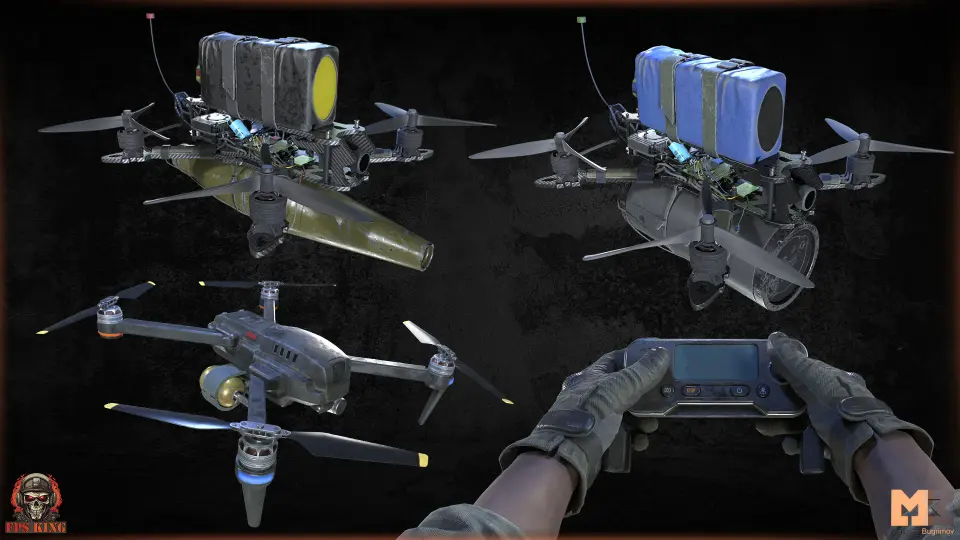
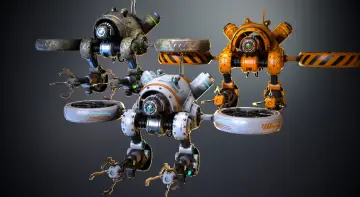
The Military Drones package equips developers with specialized unmanned aerial vehicles engineered for tactical combat scenarios. The core modules of this asset include an assault drone built to drop grenades on enemy positions, alongside a kamikaze drone that can be guided directly into vehicles and other targets. To anchor these models in a player's perspective, the pack provides a rigged set of animated hands and a dedicated control joystick. These hands function as an optional first-person element, allowing developers to visually demonstrate the operator actively piloting the drone or initiating a pre-flight sequence before the vehicle takes to the air.
Geometric Density and 4K Surfacing
The structural assets include multiple drone meshes alongside the operator's equipment, offering a significant range of geometric complexity across the included models. The vertex counts are distinctly varied to handle different levels of on-screen detail. Drone 01 carries a vertex count of 15,226, providing a solid baseline for aerial units. Drone 02 scales up significantly to 68,948 vertices, and Drone 03 follows closely with 66,664 vertices, allowing for highly intricate mechanical detailing on the heavier variants. The operator's hands consist of 14,014 vertices to ensure smooth deformation during control animations, while the standalone control joystick adds another 5,725 vertices to the first-person view.
Surfacing for these models relies on a focused physically based rendering setup. The visual data is distributed across 11 materials and material instances, which draw from a centralized pool of 24 distinct textures. Every primary character map—specifically Normals, Ambient Occlusion, Albedo, Metallic, and Emissive—is authored at a maximum resolution of 4096 by 4096. This 4K texture setup ensures that the drones and the first-person control equipment maintain sharp, readable details. The specific inclusion of Metallic and Emissive maps allows for realistic rendering of the drones' chassis materials and any illuminated operational indicators, which is particularly critical when the camera is positioned tightly behind the joystick or tracking close to the drone during a kamikaze dive.
Drone Flight Mechanics and Combat Behaviors
Movement and combat behaviors are fully mapped out through a dedicated library of 30 total animations. The drones themselves are equipped with sequences covering the entirety of a standard flight cycle. Takeoff and landing animations handle the vertical transition between the ground and the air, while an idle state keeps the drone visually active while hovering in place.
For directional travel, the package supplies forward, backward, left, and right flight animations. Notably, these four directional movements are provided in both Root Motion and In-place variations. This dual approach gives developers the flexibility to choose whether the animation data directly drives the actor's position in the world using Root Motion, or if the movement is handled strictly by the game engine's internal velocity logic via the In-place sequences. To manage in-air orientation, the drone features specific rotation animations authored at precise 45-degree and 90-degree increments for both left and right turns.
Combat actions are similarly detailed based on the drone variant. Because the assault drone is meant to deploy explosives from above, it utilizes three distinct grenade-dropping animations (Drone Dropping Grenade 01, 02, and 03). Providing three variations allows developers to cycle through different drop mechanics during aerial bombardments, preventing the visual repetition of a single repeating motion when engaging multiple targets.
First-Person Operator Rig and Locomotion
The first-person hands are rigged directly to the Epic skeleton, specifically utilizing an Epic rig 4 setup. This ensures immediate compatibility with standard humanoid skeletons and established retargeting workflows. The operator's animation list focuses on interacting with the joystick and navigating the environment while actively piloting.
Sequences like "Arms Joystick Get" and "Arms Joystick Hide" manage the equipping and stowing of the remote control unit, bringing the joystick in and out of the player's field of view. "Arms Joystick Start Drone" and "Arms Joystick Stop Drone" visually represent the ignition and shutdown commands. While the drone is in active flight, the "Arms Joystick Drone Control" and "Arms Joystick Idle" animations keep the player's hands engaged with the interface, reinforcing the connection between the operator and the vehicle.
The operator remains fully capable of standard first-person locomotion while holding the controller. The walking and running animations are supported by a multi-part jump sequence that is broken down into "Arms Joystick Jump Start," "Arms Joystick Jump Loop," and "Arms Joystick Jump End" phases. This split-jump setup is standard practice for creating responsive, physics-driven in-air states within an animation blueprint, ensuring the hands react appropriately as the player leaves the ground and lands.
Deployment in Tactical Shooters
Out of the 30 total animations split between the drones and the operator hands, four utilize Root Motion, while the remaining 26 are authored In-place. The models, materials, and animation sequences are natively supported for development on both Windows and Mac platforms. By combining the high-resolution 4K materials, the distinct assault and kamikaze drone types, and the comprehensive Epic-rigged first-person control animations, the package provides the structural and behavioral components necessary to implement remote-controlled military strikes within modern tactical shooter environments.
 Weapons & Combat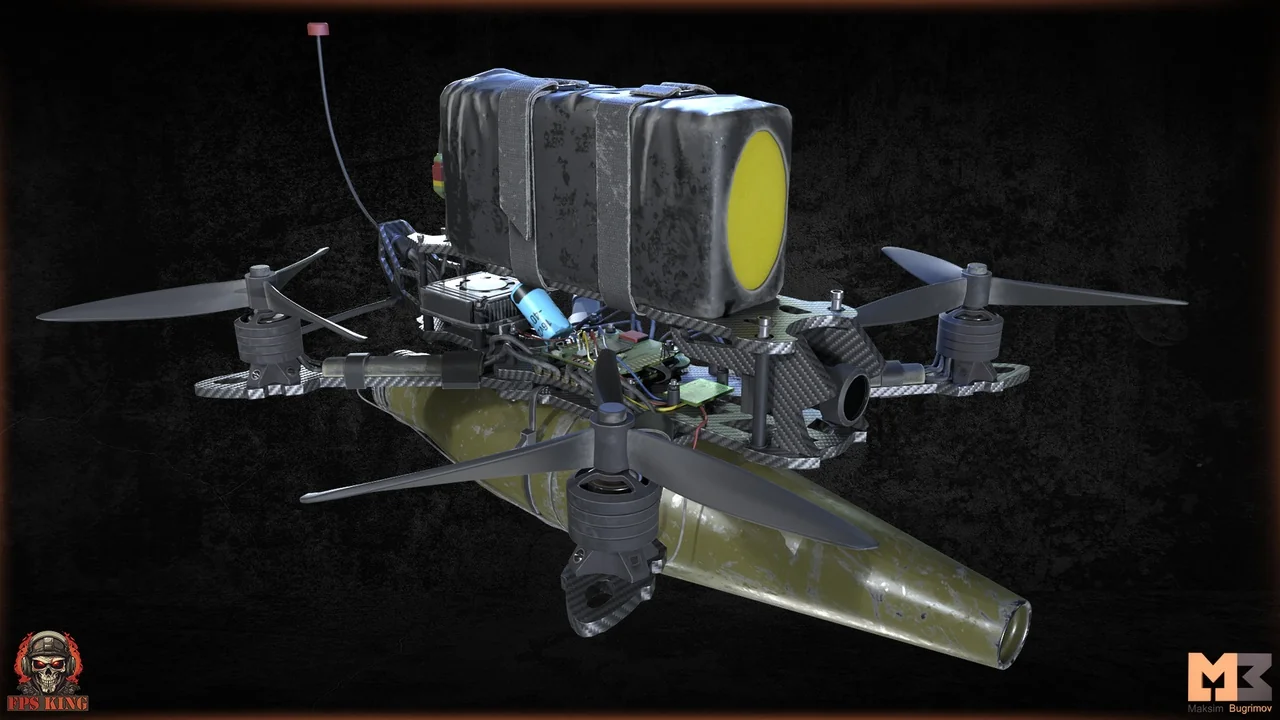
 Characters
 Weapons & Combat
 Mechanical