"c14ff6bd758dadb1"{"id":"1001057","slug":"medieval-tents-and-camping-props-pack","title":"Medieval Tents \u0026 Camping Props Pack","category":"Medieval","engine":"4.26+,5.0+","assetVersion":"","engineVersion":"Engine Version: 4.26+,5.0+","tag":"Medieval","accent":"blue","visual":"mech","summary":"Freshcan 3D's tent and camping props pack offers make-shift to carnival tent meshes, fabric texture options, and blueprint-based props for medieval scenes.","platform":"Unreal Engine","publishedAt":"2026-08-30T14:45:31.934Z","updatedAt":"2026-08-30T14:45:31.934Z","sourceNotes":[],"fileContents":[],"compatibility":["Unreal Engine","Engine Version: 4.26+,5.0+"],"featuredImage":{"alt":"Medieval Tents \u0026 Camping Props Pack","src":"/wp-content/uploads/published/2026/08/4f7dc1ba7621-e97a0383-1ee9-4eb0-86a7-642fa7cf6148-32928fb7b6.webp"},"hasDownloadLink":true,"downloads":1,"terms":[{"taxonomy":"category","slug":"medieval","name":"Medieval"}],"galleryImages":[{"src":"/wp-content/uploads/published/2026/08/89dc602ba842-74a4f8ac-c7fc-4738-a352-6b861225778e-7128cb74b6.webp","alt":"Medieval Tents \u0026 Camping Props Pack"},{"src":"/wp-content/uploads/published/2026/08/36fc85e5cb9a-c3df649a-bf28-472a-8b17-3da27094f353-c193ecc2ae.webp","alt":"Medieval Tents \u0026 Camping Props Pack"},{"src":"/wp-content/uploads/published/2026/08/c283e0e5e61c-063d708b-f676-4c09-a5e6-351a0019873e-a1d9979e84.webp","alt":"Medieval Tents \u0026 Camping Props Pack"},{"src":"/wp-content/uploads/published/2026/08/e0df860842bf-93fd145c-5805-43c8-9a26-f4698fc63a8b-8784357a56.webp","alt":"Medieval Tents \u0026 Camping Props Pack"},{"src":"/wp-content/uploads/published/2026/08/6aa7d72820dc-f44add0f-b222-4fa6-a0cd-974bb873d1b2-76e80930d8.webp","alt":"Medieval Tents \u0026 Camping Props Pack"},{"src":"/wp-content/uploads/published/2026/08/f78b4ae25fc3-1eca4d18-5276-4d77-9daf-2afa33ddb14e-b81296ed4b.webp","alt":"Medieval Tents \u0026 Camping Props Pack"},{"src":"/wp-content/uploads/published/2026/08/962054a9bbfd-b1e1fce6-fac1-4d58-b834-562248d26977-5a1a97233b.webp","alt":"Medieval Tents \u0026 Camping Props Pack"},{"src":"/wp-content/uploads/published/2026/08/862a9cc49efb-ee5cef5e-d1a3-4386-a920-c2e24e5e5d77-f7a5315f5d.webp","alt":"Medieval Tents \u0026 Camping Props Pack"},{"src":"/wp-content/uploads/published/2026/08/0c456342bf07-13f45900-9658-4795-8d3e-549ecafaac38-e15ba94bd7.webp","alt":"Medieval Tents \u0026 Camping Props Pack"},{"src":"/wp-content/uploads/published/2026/08/cd383f621f54-17f01f22-aa67-4caf-9b29-ed632eef5b50-7439b5570b.webp","alt":"Medieval Tents \u0026 Camping Props Pack"}],"accessPanel":{"kind":"resource","title":"Download this resource","eyebrow":"Free Download","message":"Log in or create a free account to start your download.","fileName":"Content.7z","safetyNote":"Resources are manually reviewed before listing to improve quality and reduce obvious risks.","actionLabel":"Download Free","resourceType":"Resource archive"},"contentHtml":"\u003cp\u003eMedieval Tents \u0026 Camping Props Pack is a deliberately focused asset set from Freshcan 3D. Instead of delivering a full landscape, it concentrates on the temporary structures and everyday items that turn a battlefield, forest, or village edge into a believable medieval camp. The pack contains a range of tent meshes in different styles, several fabric texture options, and carefully placed camping props, all tied together by pre-made blueprints.\u003c/p\u003e\u003ch2\u003eTent Meshes for Every Camp Setup\u003c/h2\u003e\u003cp\u003eThe core of the pack is its tent collection. The tents are described as distinct meshes with structures that range from make-shift shelters to carnival-style tents. That gives artists a way to populate a scene with more than identical canvas triangles. A military supply post might use the sturdier carnival-styled tents, while a band of fugitives or scouts could rely on make-shift coverings. Because each tent mesh is separate, designers can scatter them without obvious duplication.\u003c/p\u003e\u003cp\u003eFabric texture options add another layer of differentiation. The pack includes several texture choices specifically for the tents' cloth. This means a single tent mesh can be re-skinned to fit a faction's color scheme, a region's worn fabric, or a cleaner, more decorative look. The variety of structures and textures is meant to give medieval scenes a sense of improvisation and lived-in clutter, instead of one repeating tent model.\u003c/p\u003e\u003ch2\u003eCamping Props and Blueprint-Based Assembly\u003c/h2\u003e\u003cp\u003eBeyond the tents, the pack provides basic camping props. These are the small items that make a camp feel active: the source explicitly mentions them as tools for creating medieval campsites easily and effortlessly. The props are included in pre-made blueprint meshes, meaning the developer has already grouped them into reusable pieces. An artist can drop one of these blueprints into a level and immediately have a campfire or a cluster of supplies, without manually positioning every prop.\u003c/p\u003e\u003cp\u003eThe presence of blueprints is important for scene construction. They allow the pack to work as a kit of parts: individual meshes for custom layouts, or pre-assembled groups for quick placement. This duality speeds up both blockouts and final scene dressing. That the camping props are also included in these pre-made blueprints, so none of the small items are locked away—they are available for direct use as well.\u003c/p\u003e\u003ch2\u003eA Props-Only Pack: What to Expect\u003c/h2\u003e\u003cp\u003eOne detail is clearly stated in the product notice: the previews show a main scene with landscape and foliage, but that environment is not part of this pack. The Medieval Tents \u0026 Camping Props Pack is strictly the props. Anyone looking for the full natural environment seen in the promotional previews is directed to the Medieval Village Megapack Environment, which covers missing landscape and foliage.\u003c/p\u003e\u003cp\u003eThis does not make the pack incomplete. It simply defines its boundaries. For developers who already have terrain, vegetation, and building sets, this pack fills the gap where camps and temporary structures are needed. The tents and props are designed to sit on an existing landscape rather than to bring their own terrain. That separation keeps the package lightweight and makes it easier to insert into an ongoing project.\u003c/p\u003e\u003ch2\u003eCompatibility with Medieval Building Environments\u003c/h2\u003e\u003cp\u003eAlthough the pack stands on its own, the editorial notes point to a natural pairing: the Modular Medieval Environment, which includes medieval castles, houses, and a church. Those permanent structures contrast nicely with the temporary nature of tents and camping gear. A city or castle can have an encampment outside its walls, or an army can pitch tents in the courtyard while the main buildings serve as the backdrop.\u003c/p\u003e\u003cp\u003eBecause the props pack is modular in intent, it can be distributed across a scene in ways that match the layout of existing environment pieces. The tents are exterior assets, so they are suited for open fields, forest clearings, and fortress perimeters. The camping props reinforce the activity that would naturally cluster around such locations.\u003c/p\u003e\u003ch2\u003eStyle Profile and Game-Ready Use\u003c/h2\u003e\u003cp\u003eThe tags attached to the pack describe its visual and functional range: lowpoly, stylized, realistic, fantasy, war, medieval, and game-ready are all present. That means the pack is not pinned to a single aesthetic. The tent shapes and cloth options can lean toward the stylized side for an RPG, or toward the realistic side for a wargame, depending on how the assets are combined with the rest of a scene.\u003c/p\u003e\u003cp\u003eSeveral tags point to exterior and military uses—campfire, warfare, forest, tent, and military are all in the list. This makes the pack a natural fit for games or cinematics where armies halt for the night, caravans rest, or travelers stop in hostile territory. The blueprints are useful for level designers who need a quick version of a campsite, while the individual meshes give technical artists the freedom to build custom variations.\u003c/p\u003e\u003cp\u003eFor a team working in Unreal Engine, the pre-made blueprint meshes are the quickest entry point. They let the pack function as a set of ready-to-place assets rather than a pile of loose geometry. Combined with fabric texture options, the same tent can appear in multiple squads or factions without looking like a direct clone.\u003c/p\u003e\u003ch2\u003eSetting Up Campsites Without Set Dressing\u003c/h2\u003e\u003cp\u003eThe final strength of the Medieval Tents \u0026 Camping Props Pack is that it removes the manual work from camp creation. The developer does not need to model fabric, construct tent poles, or align campfire logs. The tents come with structure and texture options, the props come in blueprint form, and the whole set is built to populate a medieval scene with comparatively little effort. It is a focused addition to any environment that needs temporary living quarters, military outposts, or travelling merchants.\u003c/p\u003e\u003cp\u003eThe pack sets up the visual language of a camp, and the level designer can then decide how much to rearrange. Using the pre-made blueprints, a basic site can be established quickly; using the individual meshes, the same site can be rebuilt into a more organic layout. Either path stays within the same prop set, so the final scene remains consistent.\u003c/p\u003e\n\n\u003ch2\u003eRelated Resources Worth Checking\u003c/h2\u003e\n\u003cul\u003e\n\u003cli\u003e\u003ca href=\"https://3dcghub.com/medieval-village-pack-medieval-prop-medieval-market-medieval-house-medieval/\" title=\"Medieval Village Pack (Medieval Prop, Medieval Market, Medieval House, Medieval)\"\u003eMedieval Village Pack (Medieval Prop, Medieval Market, Medieval House, Medieval)\u003c/a\u003e\u003c/li\u003e\n\u003cli\u003e\u003ca href=\"https://3dcghub.com/medieval-armory/\" title=\"Medieval Armory\"\u003eMedieval Armory\u003c/a\u003e\u003c/li\u003e\n\u003cli\u003e\u003ca href=\"https://3dcghub.com/medieval-italian-village-environment/\" title=\"Medieval Italian Village Environment\"\u003eMedieval Italian Village Environment\u003c/a\u003e\u003c/li\u003e\n\u003cli\u003e\u003ca href=\"https://3dcghub.com/medieval-village-slavic-huts-environment/\" title=\"Medieval Village - Slavic Huts environment\"\u003eMedieval Village - Slavic Huts environment\u003c/a\u003e\u003c/li\u003e\n\u003cli\u003e\u003ca href=\"https://3dcghub.com/medieval-village-environment/\" title=\"Medieval Village Environment\"\u003eMedieval Village Environment\u003c/a\u003e\u003c/li\u003e\n\u003c/ul\u003e","contentTextLength":6377,"navigation":{"current":774,"total":3719,"previous":{"id":"1001058","slug":"mg-15-with-accessories-wwii-german-lmg","title":"MG-15 with Accessories (WWII German LMG)","category":"Weapons \u0026 Combat","platform":"Unreal Engine","updatedAt":"2026-08-30T14:54:50.549Z"},"next":{"id":"1001056","slug":"logic-driver-pro-blueprint-editor-for-dialogue-quest-combat-and-fsm-systems","title":"Logic Driver Pro - Blueprint Editor for Dialogue, Quest, Combat \u0026 FSM Systems","category":"Engine Tools","platform":"Unreal Engine","updatedAt":"2026-08-30T14:36:58.563Z"}},"relatedResources":[{"id":"1001133","slug":"castle-modular-pack","title":"Castle Modular Pack","category":"Medieval","engine":"4.26+,5.0+","assetVersion":"","engineVersion":"Engine Version: 4.26+,5.0+","tag":"Medieval","accent":"blue","visual":"mech","summary":"Modular medieval castle kit with walls, corners, beams, stairs, and props. Swap wall materials for a different look; compatible with Medieval Modular Town.","platform":"Unreal Engine","publishedAt":"2026-09-09T02:23:37.037Z","updatedAt":"2026-09-09T02:23:37.037Z","sourceNotes":[],"fileContents":[],"compatibility":["Unreal Engine","Engine Version: 4.26+,5.0+"],"featuredImage":{"alt":"Castle Modular Pack","src":"/wp-content/uploads/published/2026/09/86b9c474a2cd-c63533a0-2de8-4bdf-8835-c78614fb44c1-d3b2f4b807.webp"},"hasDownloadLink":true,"downloads":2},{"id":"1001627","slug":"deadly-ruins-modular-asset-pack","title":"Deadly Ruins - Modular asset pack","category":"Medieval","engine":"4.26+,5.0+","assetVersion":"","engineVersion":"Engine Version: 4.26+,5.0+","tag":"Medieval","accent":"blue","visual":"mech","summary":"Deadly Ruins offers over 150 modular meshes, 2K and 4K textures, advanced blending materials, and destroyed prop variants for dark fantasy environments.","platform":"Unreal Engine","publishedAt":"2026-10-13T02:04:16.811Z","updatedAt":"2026-10-13T02:04:16.811Z","sourceNotes":[],"fileContents":[],"compatibility":["Unreal Engine","Engine Version: 4.26+,5.0+"],"featuredImage":{"alt":"Deadly Ruins - Modular asset pack","src":"/wp-content/uploads/published/2026/10/f494e78f4a29-f27eb254-b7ef-473f-a1e3-f3cb3be46c1b-f8c22d6732.webp"},"hasDownloadLink":true,"downloads":0},{"id":"1000467","slug":"medieval-armory","title":"Medieval Armory","category":"Medieval","engine":"4.26+,5.0+","assetVersion":"","engineVersion":"Engine Version: 4.26+,5.0+","tag":"Medieval","accent":"blue","visual":"mech","summary":"Medieval Armory delivers roughly 80 interior props plus historically accurate weapons and shields for fantasy RPG scenes, with UE5 dynamic lighting and optimize","platform":"Unreal Engine","publishedAt":"2026-07-11T17:34:33.035Z","updatedAt":"2026-07-11T17:34:33.035Z","sourceNotes":[],"fileContents":[],"compatibility":["Unreal Engine","Engine Version: 4.26+,5.0+"],"featuredImage":{"alt":"Medieval Armory","src":"/wp-content/uploads/published/2026/07/d320a0afcc7c-541e99c9-4e4d-4f75-ab5e-c1dab28f46f2-067f6d53d0.webp"},"hasDownloadLink":true,"downloads":0}]}
Medieval
Medieval Tents & Camping Props Pack
Freshcan 3D's tent and camping props pack offers make-shift to carnival tent meshes, fabric texture options, and blueprint-based props for medieval scenes.
Category:Unreal Engine,MedievalPlatform: Unreal EngineEngine Version: 4.26+,5.0+Published: Aug 30, 2026
Medieval
Resource overview
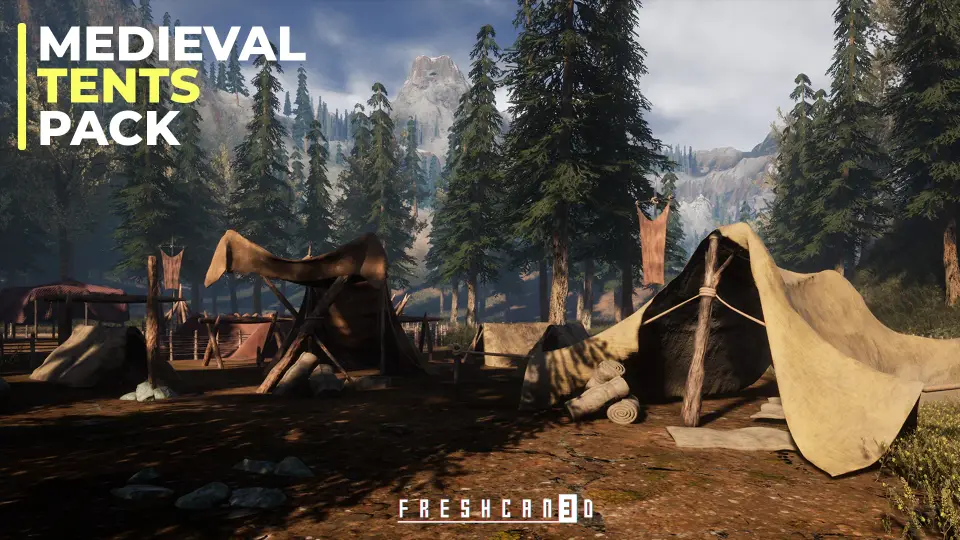
Medieval Tents & Camping Props Pack is a deliberately focused asset set from Freshcan 3D. Instead of delivering a full landscape, it concentrates on the temporary structures and everyday items that turn a battlefield, forest, or village edge into a believable medieval camp. The pack contains a range of tent meshes in different styles, several fabric texture options, and carefully placed camping props, all tied together by pre-made blueprints.
Tent Meshes for Every Camp Setup
The core of the pack is its tent collection. The tents are described as distinct meshes with structures that range from make-shift shelters to carnival-style tents. That gives artists a way to populate a scene with more than identical canvas triangles. A military supply post might use the sturdier carnival-styled tents, while a band of fugitives or scouts could rely on make-shift coverings. Because each tent mesh is separate, designers can scatter them without obvious duplication.
Fabric texture options add another layer of differentiation. The pack includes several texture choices specifically for the tents' cloth. This means a single tent mesh can be re-skinned to fit a faction's color scheme, a region's worn fabric, or a cleaner, more decorative look. The variety of structures and textures is meant to give medieval scenes a sense of improvisation and lived-in clutter, instead of one repeating tent model.
Camping Props and Blueprint-Based Assembly
Beyond the tents, the pack provides basic camping props. These are the small items that make a camp feel active: the source explicitly mentions them as tools for creating medieval campsites easily and effortlessly. The props are included in pre-made blueprint meshes, meaning the developer has already grouped them into reusable pieces. An artist can drop one of these blueprints into a level and immediately have a campfire or a cluster of supplies, without manually positioning every prop.
The presence of blueprints is important for scene construction. They allow the pack to work as a kit of parts: individual meshes for custom layouts, or pre-assembled groups for quick placement. This duality speeds up both blockouts and final scene dressing. That the camping props are also included in these pre-made blueprints, so none of the small items are locked away—they are available for direct use as well.
A Props-Only Pack: What to Expect
One detail is clearly stated in the product notice: the previews show a main scene with landscape and foliage, but that environment is not part of this pack. The Medieval Tents & Camping Props Pack is strictly the props. Anyone looking for the full natural environment seen in the promotional previews is directed to the Medieval Village Megapack Environment, which covers missing landscape and foliage.
This does not make the pack incomplete. It simply defines its boundaries. For developers who already have terrain, vegetation, and building sets, this pack fills the gap where camps and temporary structures are needed. The tents and props are designed to sit on an existing landscape rather than to bring their own terrain. That separation keeps the package lightweight and makes it easier to insert into an ongoing project.
Compatibility with Medieval Building Environments
Although the pack stands on its own, the editorial notes point to a natural pairing: the Modular Medieval Environment, which includes medieval castles, houses, and a church. Those permanent structures contrast nicely with the temporary nature of tents and camping gear. A city or castle can have an encampment outside its walls, or an army can pitch tents in the courtyard while the main buildings serve as the backdrop.
Because the props pack is modular in intent, it can be distributed across a scene in ways that match the layout of existing environment pieces. The tents are exterior assets, so they are suited for open fields, forest clearings, and fortress perimeters. The camping props reinforce the activity that would naturally cluster around such locations.
Style Profile and Game-Ready Use
The tags attached to the pack describe its visual and functional range: lowpoly, stylized, realistic, fantasy, war, medieval, and game-ready are all present. That means the pack is not pinned to a single aesthetic. The tent shapes and cloth options can lean toward the stylized side for an RPG, or toward the realistic side for a wargame, depending on how the assets are combined with the rest of a scene.
Several tags point to exterior and military uses—campfire, warfare, forest, tent, and military are all in the list. This makes the pack a natural fit for games or cinematics where armies halt for the night, caravans rest, or travelers stop in hostile territory. The blueprints are useful for level designers who need a quick version of a campsite, while the individual meshes give technical artists the freedom to build custom variations.
For a team working in Unreal Engine, the pre-made blueprint meshes are the quickest entry point. They let the pack function as a set of ready-to-place assets rather than a pile of loose geometry. Combined with fabric texture options, the same tent can appear in multiple squads or factions without looking like a direct clone.
Setting Up Campsites Without Set Dressing
The final strength of the Medieval Tents & Camping Props Pack is that it removes the manual work from camp creation. The developer does not need to model fabric, construct tent poles, or align campfire logs. The tents come with structure and texture options, the props come in blueprint form, and the whole set is built to populate a medieval scene with comparatively little effort. It is a focused addition to any environment that needs temporary living quarters, military outposts, or travelling merchants.
The pack sets up the visual language of a camp, and the level designer can then decide how much to rearrange. Using the pre-made blueprints, a basic site can be established quickly; using the individual meshes, the same site can be rebuilt into a more organic layout. Either path stays within the same prop set, so the final scene remains consistent.
 Medieval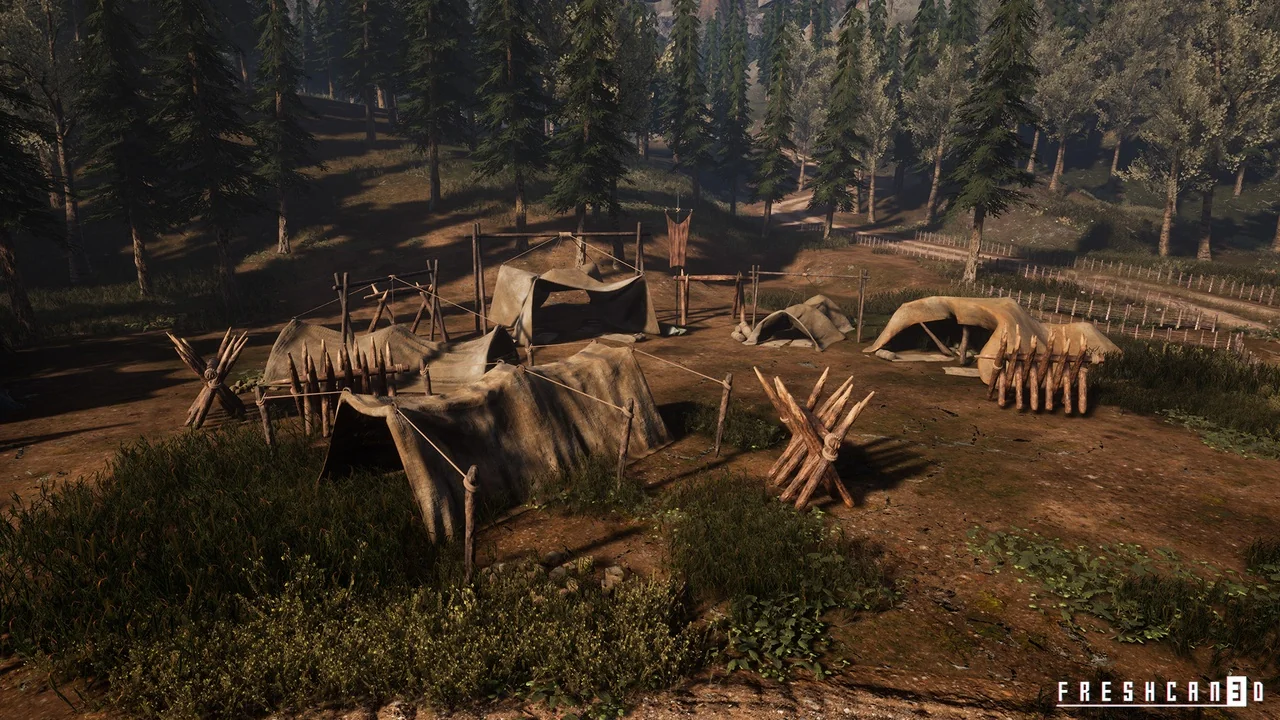
 Medieval
 Medieval
 Medieval