"7e6fc58c410f2894"{"id":"23332","slug":"magic-mirror-pro-recursive-edition","title":"Magic Mirror Pro - Recursive Edition","category":"Particles \u0026 Effects","engine":"Original Unity version: 2018.4.36","assetVersion":"Original Unity version: 2018.4.36","engineVersion":"Asset Version:1.0.5","tag":"Particles","accent":"cyan","visual":"character","summary":"Magic Mirror Pro - Recursive Edition brings recursive reflections into Unity with support for mirror surfaces, a fix for recursive water reflections, and shadow rendering across recursion layers. It also includes tuning options for performance and layer con...","platform":"Unity","publishedAt":"2026-04-09T16:42:15.000Z","updatedAt":"2026-04-19T15:35:30.000Z","sourceNotes":[],"fileContents":[],"compatibility":["Unity","Original Unity version: 2018.4.36","Asset Version: 1.0.5"],"featuredImage":{"alt":"Magic Mirror Pro - Recursive Edition","src":"https://3dcghub.com/wp-content/uploads/2026/04/b07d38d4e685_ad753928-db93-4c48-b292-3aef98ed77a4_1280x720_stretch.webp"},"hasDownloadLink":true,"downloads":1,"terms":[{"taxonomy":"category","slug":"particles-and-effects","name":"Particles \u0026 Effects"},{"taxonomy":"post_tag","slug":"materials","name":"Materials"},{"taxonomy":"post_tag","slug":"unity","name":"Unity"},{"taxonomy":"post_tag","slug":"vfx","name":"VFX"}],"galleryImages":[{"src":"https://3dcghub.com/wp-content/uploads/2026/04/4e11639a9ddf_5e2634ea-0644-4066-ad82-cd3c83570f5a_scaled.webp","alt":"Magic Mirror Pro - Recursive Edition"},{"src":"https://3dcghub.com/wp-content/uploads/2026/04/79cf1d97ed57_f4600337-6649-434f-a940-c6832ccc798e_scaled.webp","alt":"Magic Mirror Pro - Recursive Edition"}],"accessPanel":{"kind":"resource","title":"Access this resource","eyebrow":"Free Download","message":"Log in or create a free account to start your download.","fileName":"Magic Mirror Pro - Recursive Edition v1.0.5.7z","safetyNote":"All resources are 100% manually reviewed to eliminate all risks.","actionLabel":"Download Free","resourceType":"Resource archive"},"contentHtml":"\u003ch2\u003eSetting up recursive reflections in Unity\u003c/h2\u003e\u003cp\u003eMagic Mirror Pro - Recursive Edition places recursive reflections directly into a Unity project, giving artists and developers a way to work with mirrors that reflect mirrors again, instead of stopping at a single bounce. That makes it useful anywhere a scene needs layered reflective depth rather than a flat, one-step mirror response. The tool relies on a mix of clever math, shaders, and scripting, so the effect is not just visual decoration; it is an implemented reflection system that can be added to a project and adjusted from there.\u003c/p\u003e\u003cp\u003eThe workflow is anchored in practical scene use. Recursive reflections are the main feature, and a fix for recursive water reflections is included as well. That means the same approach can be used for surfaces that need repeated reflection behavior without losing the layered feel that makes the effect noticeable. The tool is presented as the first asset to provide proper recursive reflections, which places the emphasis squarely on implementing this kind of visual behavior rather than approximating it with a simpler mirror pass.\u003c/p\u003e\u003cp\u003eThere is also a playful extra included with the package: a creepy little voodoo thingy. It is not framed as a core system, but it is part of the package and can be used to add some character to a scene. For projects that want a reflective effect with a bit of personality, that addition gives the setup something beyond the technical mirror work alone.\u003c/p\u003e\u003ch2\u003eWhat can be tuned in the mirror\u003c/h2\u003e\u003cp\u003eThe mirror setup is not fixed. Performance can be tuned, and control over what layers are rendered in the mirror. That matters because recursive reflections can become expensive quickly, so being able to decide what appears in the reflected view gives more room to manage scene cost and visual focus. The same tuning idea applies to deep recursive reflection settings as well, which suggests that the tool expects different projects to need different levels of recursion.\u003c/p\u003e\u003cp\u003eShadows are rendered properly in all layers of recursion, which is an important detail for anyone trying to keep the effect believable. Recursive reflections can lose their impact if the shadowing breaks down as the reflection repeats, so proper shadow rendering across the recursion layers helps the final result stay consistent. The package is looking beautiful and performing well, but the available tuning options make it clear that the final result still depends on how the effect is configured.\u003c/p\u003e\u003cp\u003eLayer control is one of the most practical parts of the setup. If a scene has objects that should not appear in the mirror, the mirror layer settings provide a way to control that. This is useful for keeping reflections focused on the right objects and for reducing unnecessary work in more demanding scenes. The asset also notes that some tuning may be required for VR, mobile, and deep recursive reflection settings, so the same reflection system can be pushed in different directions depending on the projectâs needs.\u003c/p\u003e\u003ch2\u003eVR behavior and rendering limits\u003c/h2\u003e\u003cp\u003eVirtual reality support is present, but it comes with clear constraints. Single pass is supported on HTC Vive, while Oculus and Google may have single pass issues. A full render pass is required for each eye because of Unity limitations, which is an important production detail for anyone planning to use the asset in VR. The reflection effect can still be used in VR, but the setup has to work within those rendering requirements.\u003c/p\u003e\u003cp\u003eSome platform restrictions are spelled out plainly. Android VR is not supported, and multi-pass on Mac is broken. Scriptable render pipelines are also not supported, and the asset is not yet supported in Unity 2021 or newer. Those limits define where the tool fits best and where it should be avoided for now. If a project depends on a newer Unity version, a scriptable render pipeline, or Android VR, this is not the right match.\u003c/p\u003e\u003cul\u003e\u003cli\u003eOnly two mirrors are currently supported.\u003c/li\u003e\u003cli\u003eSingle pass is supported on HTC Vive.\u003c/li\u003e\u003cli\u003eOculus and Google may have single pass issues.\u003c/li\u003e\u003cli\u003eAndroid VR is not supported.\u003c/li\u003e\u003cli\u003eMulti-pass on Mac is broken.\u003c/li\u003e\u003cli\u003eScriptable render pipelines are not supported.\u003c/li\u003e\u003cli\u003eUnity 2021 and newer are not yet supported.\u003c/li\u003e\u003c/ul\u003e\u003cp\u003eThose limits do not change the core effect, but they do shape where the tool can be used safely. The important part is knowing the boundaries before putting recursive reflections into a scene, especially if the project includes VR or multiple mirror surfaces.\u003c/p\u003e\u003ch2\u003eVersion details and production fit\u003c/h2\u003e\u003cp\u003eThe package is listed with a latest version of 1.0.5 and a latest release date of Nov 05, 2021. It was first published on Apr 30, 2018, and its original Unity version is 2018.4.36. The file size is 2.1 MB, the asset count is 31, and the package type is unitypackage. It also carries SEAT license entitlement and sits in the Particles \u0026 Effects category under tools/particles-effects.\u003c/p\u003e\u003cp\u003eRelease notes mention a fix for another bad memory leak, especially in editor mode. That makes maintenance more visible than in many visual-only packages, since memory behavior can affect iteration in the editor as well as runtime use. The note also suggests the tool has been actively adjusted rather than left static, which matters for anyone evaluating it as part of a working production pipeline.\u003c/p\u003e\u003cp\u003eFor projects that need recursive mirror behavior, a water reflection fix, and a controlled set of rendering options, Magic Mirror Pro - Recursive Edition is aimed at the point where visuals, tuning, and engine limits meet. It is most useful when the reflection effect itself is central to the scene and when the project can stay within the supported Unity and rendering boundaries.\u003c/p\u003e\n\n\u003ch2\u003eContinue Browsing Similar Packs\u003c/h2\u003e\n\u003cul\u003e\n\u003cli\u003e\u003ca href=\"https://3dcghub.com/opencv-for-unity/\" title=\"OpenCV for Unity\"\u003eOpenCV for Unity\u003c/a\u003e\u003c/li\u003e\n\u003cli\u003e\u003ca href=\"https://3dcghub.com/exporter-for-unreal-to-for-unity-2026/\" title=\"Exporter for Unreal to/for Unity 2026\"\u003eExporter for Unreal to/for Unity 2026\u003c/a\u003e\u003c/li\u003e\n\u003cli\u003e\u003ca href=\"https://3dcghub.com/dialogue-system-for-unity/\" title=\"Dialogue System for Unity\"\u003eDialogue System for Unity\u003c/a\u003e\u003c/li\u003e\n\u003cli\u003e\u003ca href=\"https://3dcghub.com/ambient-sounds-interactive-soundscapes-for-unity-6/\" title=\"Ambient Sounds – Interactive Soundscapes for Unity 6\"\u003eAmbient Sounds – Interactive Soundscapes for Unity 6\u003c/a\u003e\u003c/li\u003e\n\u003cli\u003e\u003ca href=\"https://3dcghub.com/pegasus-flythroughs-for-unity-6/\" title=\"Pegasus – Flythroughs for Unity 6\"\u003ePegasus – Flythroughs for Unity 6\u003c/a\u003e\u003c/li\u003e\n\u003c/ul\u003e","contentTextLength":5868,"navigation":{"current":3519,"total":3618,"previous":{"id":"23289","slug":"impact-cfx-collision-effects-system","title":"Impact CFX - Collision Effects System","category":"Particles \u0026 Effects","platform":"Unity","updatedAt":"2026-04-19T15:35:31.000Z"},"next":{"id":"23327","slug":"lumina-gi-hdrp-real-time-voxel-global-illumination","title":"LUMINA GI HDRP: Real-Time Voxel Global Illumination","category":"Particles \u0026 Effects","platform":"Unity","updatedAt":"2026-04-19T15:35:30.000Z"}},"relatedResources":[{"id":"23263","slug":"expanse-volumetric-skies-clouds-and-atmospheres-in-hdrp","title":"Expanse - Volumetric Skies, Clouds, and Atmospheres in HDRP","category":"Particles \u0026 Effects","engine":"Original Unity version: 2020.1.17","assetVersion":"Original Unity version: 2020.1.17","engineVersion":"Asset Version:1.7.0b","tag":"Particles","accent":"cyan","visual":"luts","summary":"Expanse is a volumetric sky tool for HDRP that helps shape skies, clouds, and fog banks directly in the editor. It combines physically based rendering, realtime adjustment, and animated weather controls for scenes that need changing atmospheres.","platform":"Unity","publishedAt":"2026-04-09T16:08:06.000Z","updatedAt":"2026-04-19T15:36:47.000Z","sourceNotes":[],"fileContents":[],"compatibility":["Unity","Original Unity version: 2020.1.17","Asset Version: 1.7.0b"],"featuredImage":{"alt":"Expanse - Volumetric Skies, Clouds, and Atmospheres in HDRP","src":"https://3dcghub.com/wp-content/uploads/2026/04/af7ee660ab60_117677bb-0c45-4601-8791-43191c7fc291_1280x720_stretch.webp"},"hasDownloadLink":true,"downloads":0},{"id":"23237","slug":"crest-water-5-shallow-water","title":"Crest Water 5 - Shallow Water","category":"Particles \u0026 Effects","engine":"Original Unity version: 2022.3.62","assetVersion":"Original Unity version: 2022.3.62","engineVersion":"Asset Version:1.3.1","tag":"Particles","accent":"cyan","visual":"animation","summary":"Crest Water 5 - Shallow Water adds simulation-driven shallow water for shorelines and streams inside Crest 5. It gives artists a way to shape coastal edges, river channels, and other transition zones with static or camera-following shoreline behavior and an...","platform":"Unity","publishedAt":"2026-04-09T15:56:31.000Z","updatedAt":"2026-04-19T15:36:48.000Z","sourceNotes":[],"fileContents":[],"compatibility":["Unity","Original Unity version: 2022.3.62","Asset Version: 1.3.1"],"featuredImage":{"alt":"Crest Water 5 - Shallow Water","src":"https://3dcghub.com/wp-content/uploads/2026/04/d38076e02d44_6686ebed-098f-40ed-bea0-0be1704337bb_1280x720_stretch.webp"},"hasDownloadLink":true,"downloads":5},{"id":"23232","slug":"crest-water-4-urp-ocean-rivers-lakes","title":"Crest Water 4 URP (Ocean, Rivers \u0026 Lakes)","category":"Particles \u0026 Effects","engine":"Original Unity version: 2020.3.49","assetVersion":"Original Unity version: 2020.3.49","engineVersion":"Asset Version:4.21.2","tag":"Particles","accent":"cyan","visual":"character","summary":"Crest Water 4 URP starts with a compact setup path: water surface, underwater, and waves. From there, it expands into wave authoring, shoreline control, underwater treatment, and interaction systems that fit oceans, rivers, lakes, and large-world scenes.","platform":"Unity","publishedAt":"2026-04-09T15:56:19.000Z","updatedAt":"2026-04-19T15:36:48.000Z","sourceNotes":[],"fileContents":[],"compatibility":["Unity","Original Unity version: 2020.3.49","Asset Version: 4.21.2"],"featuredImage":{"alt":"Crest Water 4 URP (Ocean, Rivers \u0026 Lakes)","src":"https://3dcghub.com/wp-content/uploads/2026/04/0bbed9a77cb0_2b640420-1fed-4a76-a54e-e86b9693c2bb_1280x720_stretch.webp"},"hasDownloadLink":true,"downloads":3}]}
Particles
Magic Mirror Pro - Recursive Edition
Magic Mirror Pro - Recursive Edition brings recursive reflections into Unity with support for mirror surfaces, a fix for recursive water reflections, and shadow rendering across recursion layers. It also includes tuning options for performance and layer con...
Magic Mirror Pro - Recursive Edition places recursive reflections directly into a Unity project, giving artists and developers a way to work with mirrors that reflect mirrors again, instead of stopping at a single bounce. That makes it useful anywhere a scene needs layered reflective depth rather than a flat, one-step mirror response. The tool relies on a mix of clever math, shaders, and scripting, so the effect is not just visual decoration; it is an implemented reflection system that can be added to a project and adjusted from there.
The workflow is anchored in practical scene use. Recursive reflections are the main feature, and a fix for recursive water reflections is included as well. That means the same approach can be used for surfaces that need repeated reflection behavior without losing the layered feel that makes the effect noticeable. The tool is presented as the first asset to provide proper recursive reflections, which places the emphasis squarely on implementing this kind of visual behavior rather than approximating it with a simpler mirror pass.
There is also a playful extra included with the package: a creepy little voodoo thingy. It is not framed as a core system, but it is part of the package and can be used to add some character to a scene. For projects that want a reflective effect with a bit of personality, that addition gives the setup something beyond the technical mirror work alone.
What can be tuned in the mirror
The mirror setup is not fixed. Performance can be tuned, and control over what layers are rendered in the mirror. That matters because recursive reflections can become expensive quickly, so being able to decide what appears in the reflected view gives more room to manage scene cost and visual focus. The same tuning idea applies to deep recursive reflection settings as well, which suggests that the tool expects different projects to need different levels of recursion.
Shadows are rendered properly in all layers of recursion, which is an important detail for anyone trying to keep the effect believable. Recursive reflections can lose their impact if the shadowing breaks down as the reflection repeats, so proper shadow rendering across the recursion layers helps the final result stay consistent. The package is looking beautiful and performing well, but the available tuning options make it clear that the final result still depends on how the effect is configured.
Layer control is one of the most practical parts of the setup. If a scene has objects that should not appear in the mirror, the mirror layer settings provide a way to control that. This is useful for keeping reflections focused on the right objects and for reducing unnecessary work in more demanding scenes. The asset also notes that some tuning may be required for VR, mobile, and deep recursive reflection settings, so the same reflection system can be pushed in different directions depending on the projectâs needs.
VR behavior and rendering limits
Virtual reality support is present, but it comes with clear constraints. Single pass is supported on HTC Vive, while Oculus and Google may have single pass issues. A full render pass is required for each eye because of Unity limitations, which is an important production detail for anyone planning to use the asset in VR. The reflection effect can still be used in VR, but the setup has to work within those rendering requirements.
Some platform restrictions are spelled out plainly. Android VR is not supported, and multi-pass on Mac is broken. Scriptable render pipelines are also not supported, and the asset is not yet supported in Unity 2021 or newer. Those limits define where the tool fits best and where it should be avoided for now. If a project depends on a newer Unity version, a scriptable render pipeline, or Android VR, this is not the right match.
Only two mirrors are currently supported.
Single pass is supported on HTC Vive.
Oculus and Google may have single pass issues.
Android VR is not supported.
Multi-pass on Mac is broken.
Scriptable render pipelines are not supported.
Unity 2021 and newer are not yet supported.
Those limits do not change the core effect, but they do shape where the tool can be used safely. The important part is knowing the boundaries before putting recursive reflections into a scene, especially if the project includes VR or multiple mirror surfaces.
Version details and production fit
The package is listed with a latest version of 1.0.5 and a latest release date of Nov 05, 2021. It was first published on Apr 30, 2018, and its original Unity version is 2018.4.36. The file size is 2.1 MB, the asset count is 31, and the package type is unitypackage. It also carries SEAT license entitlement and sits in the Particles & Effects category under tools/particles-effects.
Release notes mention a fix for another bad memory leak, especially in editor mode. That makes maintenance more visible than in many visual-only packages, since memory behavior can affect iteration in the editor as well as runtime use. The note also suggests the tool has been actively adjusted rather than left static, which matters for anyone evaluating it as part of a working production pipeline.
For projects that need recursive mirror behavior, a water reflection fix, and a controlled set of rendering options, Magic Mirror Pro - Recursive Edition is aimed at the point where visuals, tuning, and engine limits meet. It is most useful when the reflection effect itself is central to the scene and when the project can stay within the supported Unity and rendering boundaries.
 Particles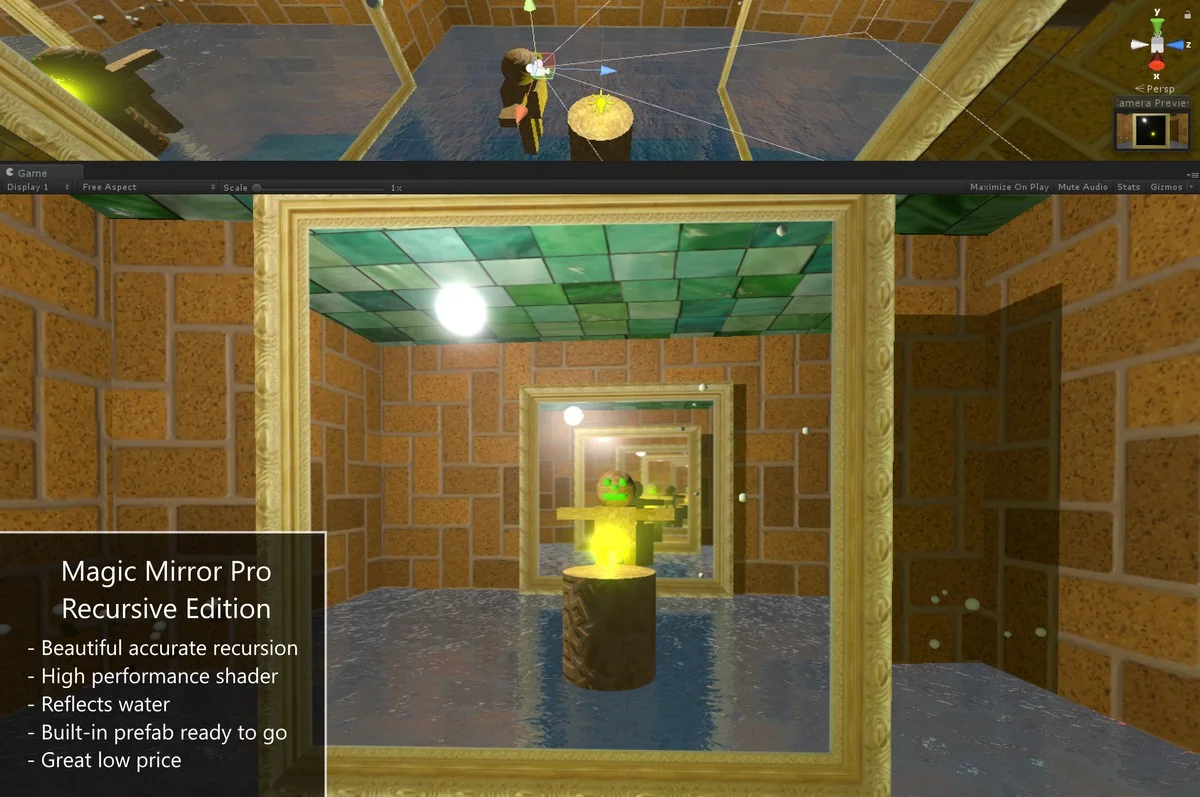
 Particles
 Particles
 Particles