"b00678cacce53329"{"id":"1002803","slug":"luos-s-pewpew-particle-pack","title":"Luos's PewPew Particle Pack","category":"Spells \u0026 Combat","engine":"4.16+,5.0+","assetVersion":"","engineVersion":"Engine Version: 4.16+,5.0+","tag":"Spells \u0026 Combat","accent":"blue","visual":"mech","summary":"Luos's PewPew Particle Pack provides 4 projectile types with 4 energy tiers, complete with charge, muzzle, and impact effects built in Cascade.","platform":"Unreal Engine","indexPolicy":"index","publishedAt":"2026-11-20T07:30:33.126Z","updatedAt":"2026-11-20T07:30:33.126Z","sourceNotes":[],"fileContents":[],"compatibility":["Unreal Engine","Engine Version: 4.16+,5.0+"],"featuredImage":{"alt":"Luos's PewPew Particle Pack","src":"/wp-content/uploads/published/2026/11/7451da800696-f997e86c-c561-4821-a055-09fbd7bb50a4-86a2f4c21f.webp"},"fileSizeBytes":182474562,"hasDownloadLink":true,"downloads":0,"terms":[{"taxonomy":"category","slug":"spells-and-combat","name":"Spells \u0026 Combat"}],"galleryImages":[{"src":"/wp-content/uploads/published/2026/11/c08cb048b414-3a7b002f-fbab-4a70-8db9-4e20b357c432-e4f257358e.webp","alt":"Luos's PewPew Particle Pack"},{"src":"/wp-content/uploads/published/2026/11/32ebd3a3de55-775e3e9c-6fac-4f0b-95ad-21f63162b1c2-2d0ff8ad05.webp","alt":"Luos's PewPew Particle Pack"},{"src":"/wp-content/uploads/published/2026/11/8ad0e09a8c33-5e115660-7239-46b6-b1b1-cca2b10f229b-4f8c3a1cbb.webp","alt":"Luos's PewPew Particle Pack"},{"src":"/wp-content/uploads/published/2026/11/baa12d8d5c54-75bc9bbb-cc6a-4214-9733-c5a10581a99d-8186248e70.webp","alt":"Luos's PewPew Particle Pack"},{"src":"/wp-content/uploads/published/2026/11/9e0edf1a8057-974ed5ac-c74e-4cfa-b833-5450aa036134-3a644ce2a3.webp","alt":"Luos's PewPew Particle Pack"},{"src":"/wp-content/uploads/published/2026/11/9263a1c9e6a7-60b47cb2-04d2-4338-a909-ea46ee61cc7d-c9828e674a.webp","alt":"Luos's PewPew Particle Pack"}],"accessPanel":{"kind":"resource","title":"Get this resource","safetyNote":"Resources are manually reviewed before listing to improve quality and reduce obvious risks.","fileName":"Content.7z","resourceType":"Resource archive","versions":[]},"contentHtml":"\u003cp\u003eA high-velocity energy round leaves a weapon barrel with a sharp crack, trails a concentrated line of luminescence through the air, and detonates against a surface with a synchronized splash of sparks and residual heat. In action game development, energy-based ballistics depend entirely on clear readability across three distinct spatial points: the origin point at the firearm, the trajectory line across the environment, and the strike point on the target. Luos's PewPew Particle Pack supplies that exact visual lineage across four distinct projectile types, equipping weapons like laserguns, energy cannons, and heavy sci-fi handcannons with fully articulated ballistic feedback.\u003c/p\u003e \u003ch2\u003eStaging Energy Weapon Combat with Luos's PewPew Systems\u003c/h2\u003e\n\u003cp\u003eCombat visual effects require visual continuity from the instant an attack input triggers until the shot resolves against a wall or character model. Rather than providing isolated projectile meshes or static bullet trails, Luos's PewPew Particle Pack organizes its content into structured operational sequences. The asset supplies four core projectile types, giving productions a variety of visual profiles suited for rapid-fire energy sidearms, piercing laser beams, concentrated pulse carbines, or heavy energy ordnance.\u003c/p\u003e\n\u003cp\u003eEach projectile archetype comes prepared with three additional levels of increased visual intensity, colloquially termed \"oomph.\" This structure yields four functional tiers per projectile family: a baseline discharge followed by three escalating stages of visual power. Game systems relying on escalating firepower, such as progressive weapon upgrades, combo meters, or variable fire modes, find direct visual equivalents in these graduated assets. Because each stage introduces denser particle volume, wider light dispersal, and more violent energetic turbulence, players receive immediate optical feedback regarding the kinetic power behind every trigger pull.\u003c/p\u003e \u003ch2\u003eCharge Phases and Dynamic Firing States\u003c/h2\u003e\n\u003cp\u003eRechargeable and power-staged weapons cannot simply manifest high-tier projectiles instantaneously without disjointing the combat rhythm. Mechanical anticipation matters as much as the projectile release itself. Luos's PewPew Particle Pack accounts for this by outfitting the three higher energy tiers of every projectile family with dedicated charge-up visual effects. When a player holds down an attack input to saturate a weapon's capacitor or spool up an energy cell, an accompanying charge particle system coalesces at the barrel, communicating the weapon's state during the spooling sequence.\u003c/p\u003e\n\u003cp\u003eBecause each of the three charged tiers features its own unique charge-up effect, developers can align visual buildup directly with mechanic charge gates. A quick half-second charge displays a restrained, gathering glow of energy; an intermediate hold introduces denser energetic tendrils; a maximum-duration charge visualizes a volatile, overcharged concentration of raw plasma. Once released, the transition from gathering energy to outbound discharge feels mechanically earned, giving rechargeable weaponry substantial physical weight inside the scene.\u003c/p\u003e \u003ch2\u003eMuzzle Bursts, Ballistic Flights, and Impact Detonations\u003c/h2\u003e\n\u003cp\u003eA frequent stumbling block in energy combat setups occurs when an overpowered projectile is launched from a generic, undersized muzzle flash, or when a heavy blast terminates in a tiny, underwhelming particle puff. Visual scale must remain consistent across the entire firing cycle. Luos's PewPew Particle Pack enforces this balance by providing dedicated muzzle flashes and tailored impact effects for every single level of all four projectile styles.\u003c/p\u003e\n\u003cp\u003eWhen firing a basic shot, the emitter produces a tight, localized muzzle pop paired with a clean, low-debris impact mark. Progressing into the higher tiers swaps both boundary points: the muzzle blast expands to reflect the increased wattage leaving the barrel, and the impact effect blooms into a larger visual detonation suited to heavy beam strikes or cannon hits. This 1-to-1 parity between charge, muzzle, trajectory, and impact ensures that a shot fired at tier three carries matching visual weight from the player's first-person weapon model all the way to the receiving geometry in the distance.\u003c/p\u003e \u003ch2\u003eCascade Architecture and Customizing Luos's PewPew Emitters\u003c/h2\u003e\n\u003cp\u003eUnder the hood, Luos's PewPew Particle Pack is constructed natively within Unreal Engine's Cascade particle system rather than the newer Niagara framework. Cascade remains fully operational inside Unreal Engine projects, operating with stable runtime performance and no indication of being removed from the engine anytime soon. Teams maintaining existing Cascade pipelines or working within production branches where Cascade remains the established standard can integrate the package directly without needing to configure Niagara translation layers.\u003c/p\u003e\n\u003cp\u003eFor technical artists and designers comfortable working within Cascade, the package functions as an extensive modular playground. Cascade's module-based hierarchy makes it straightforward to isolate specific sub-emitters, duplicate properties, and mix elements from different projectile profiles. A developer can take the charging corona from one projectile style, combine it with the core flight beam of a second, and terminate the blast using the violent impact splash of a third. This modularity allows the four foundational types to yield an expansive arsenal of hybrid sci-fi weapon visual effects with minimal setup time.\u003c/p\u003e \u003ch2\u003ePipeline Longevity and the Niagara Transition Pathway\u003c/h2\u003e\n\u003cp\u003eSelecting visual effects for active development requires evaluating both current efficiency and long-term asset maintenance. From a performance perspective, the Cascade effects in the pack run smoothly, allowing multiple active projectiles, charging states, and impact bursts to execute during dense firefights without unexpected frame drops or computational overhead. The lightweight nature of the optimized particle emitters preserves rendering budgets in fast-paced shooters where numerous combatants fire simultaneously.\u003c/p\u003e\n\u003cp\u003eLooking toward future project cycles, an update is planned to convert all effects within the package over to the Niagara framework. This planned path provides studios with a dual advantage: immediate deployment within established Cascade-reliant projects today, alongside a defined transition path to Niagara when upgrading production pipelines down the road. Whether implemented as a turnkey visual set for energy sidearms or disassembled within Cascade to construct bespoke beam weapons, the pack establishes a cohesive, scalable standard for sci-fi projectile combat.\u003c/p\u003e\n\n\u003ch2\u003eMore From The Same Workflow\u003c/h2\u003e\n\u003cul\u003e\n\u003cli\u003e\u003ca href=\"https://3dcghub.com/luos-s-lowpoly-particle-pack/\" rel=\"noopener noreferrer\"\u003eLuos\u0026#039;s LowPoly Particle Pack\u003c/a\u003e\u003c/li\u003e\n\u003cli\u003e\u003ca href=\"https://3dcghub.com/niagara-muzzle-flash-and-ejection-vfx-muzzle-flash-gun-vfx-bullet-vfx/\" rel=\"noopener noreferrer\"\u003eNiagara Muzzle Flash \u0026amp; Ejection VFX (Muzzle Flash, Gun VFX, Bullet VFX)\u003c/a\u003e\u003c/li\u003e\n\u003cli\u003e\u003ca href=\"https://3dcghub.com/fantasy-rpg-vfx-pack/\" rel=\"noopener noreferrer\"\u003eFantasy RPG VFX Pack\u003c/a\u003e\u003c/li\u003e\n\u003cli\u003e\u003ca href=\"https://3dcghub.com/bullet-vfx-pack/\" rel=\"noopener noreferrer\"\u003eBullet VFX Pack\u003c/a\u003e\u003c/li\u003e\n\u003cli\u003e\u003ca href=\"https://3dcghub.com/advancedmagicfx18/\" rel=\"noopener noreferrer\"\u003eAdvancedMagicFX18\u003c/a\u003e\u003c/li\u003e\n\u003c/ul\u003e","contentTextLength":6816,"navigation":{"current":77,"total":4797,"previous":{"id":"1002804","slug":"m5-vfx-rpg1-sword-trails-niagara","title":"M5 VFX RPG1. Sword Trails(Niagara)","category":"Spells \u0026 Combat","platform":"Unreal Engine","updatedAt":"2026-11-20T07:33:18.337Z"},"next":{"id":"1002802","slug":"luos-s-lowpoly-particle-pack","title":"Luos's LowPoly Particle Pack","category":"Spells \u0026 Combat","platform":"Unreal Engine","updatedAt":"2026-11-20T07:27:05.323Z"}},"relatedResources":[{"id":"1002802","slug":"luos-s-lowpoly-particle-pack","title":"Luos's LowPoly Particle Pack","category":"Spells \u0026 Combat","engine":"4.17+,5.0+","assetVersion":"","engineVersion":"Engine Version: 4.17+,5.0+","tag":"Spells \u0026 Combat","accent":"blue","visual":"mech","summary":"Explore the visual style, Cascade particle setup, material workflows, and multi-platform performance of Luos's LowPoly Particle Pack in Unreal Engine.","platform":"Unreal Engine","indexPolicy":"index","publishedAt":"2026-11-20T07:27:05.323Z","updatedAt":"2026-11-20T07:27:05.323Z","sourceNotes":[],"fileContents":[],"compatibility":["Unreal Engine","Engine Version: 4.17+,5.0+"],"featuredImage":{"alt":"Luos's LowPoly Particle Pack","src":"/wp-content/uploads/published/2026/11/257ab7fa782c-7cdccd51-19d2-4cb8-82f0-72875bad09e5-5c608292be.webp"},"fileSizeBytes":32343681,"hasDownloadLink":true,"downloads":0},{"id":"1002131","slug":"niagara-muzzle-flash-and-ejection-vfx-muzzle-flash-gun-vfx-bullet-vfx","title":"Niagara Muzzle Flash \u0026 Ejection VFX (Muzzle Flash, Gun VFX, Bullet VFX)","category":"Spells \u0026 Combat","engine":"4.25+,5.0+","assetVersion":"","engineVersion":"Engine Version: 4.25+,5.0+","tag":"Spells \u0026 Combat","accent":"blue","visual":"mech","summary":"Explore Niagara Muzzle Flash \u0026 Ejection VFX, featuring 17 particle systems across 5 weapon classes with realistic muzzle flashes and bullet shell ejections.","platform":"Unreal Engine","indexPolicy":"index","publishedAt":"2026-10-29T09:12:22.074Z","updatedAt":"2026-10-29T09:12:22.074Z","sourceNotes":[],"fileContents":[],"compatibility":["Unreal Engine","Engine Version: 4.25+,5.0+"],"featuredImage":{"alt":"Niagara Muzzle Flash \u0026 Ejection VFX (Muzzle Flash, Gun VFX, Bullet VFX)","src":"/wp-content/uploads/published/2026/10/31a727bcc5b7-e1a79014-146f-40db-a58b-c05ead407923-cec126815f.webp"},"fileSizeBytes":232616178,"hasDownloadLink":true,"downloads":3},{"id":"1002869","slug":"advanced-magic-fx-14","title":"Advanced Magic FX 14","category":"Spells \u0026 Combat","engine":"4.26+,5.0+","assetVersion":"","engineVersion":"Engine Version: 4.26+,5.0+","tag":"Spells \u0026 Combat","accent":"blue","visual":"mech","summary":"Explore Advanced Magic FX 14, featuring Niagara and Cascade magic spells, elemental fire vortexes, lasers, healing, lightning, and built-in particle LODs.","platform":"Unreal Engine","indexPolicy":"index","publishedAt":"2026-11-20T16:32:06.460Z","updatedAt":"2026-11-20T16:32:06.460Z","sourceNotes":[],"fileContents":[],"compatibility":["Unreal Engine","Engine Version: 4.26+,5.0+"],"featuredImage":{"alt":"Advanced Magic FX 14","src":"/wp-content/uploads/published/2026/11/33641332d289-27e981bf-72b2-4c5e-86dc-4b4d536e5221-8a43b3a7ca.webp"},"fileSizeBytes":112659794,"hasDownloadLink":true,"downloads":0}]}
Resource screenshots
1 / 6
Join our channel
Follow 3DCGHUB on Telegram for new resource drops, migration updates, and community notices.
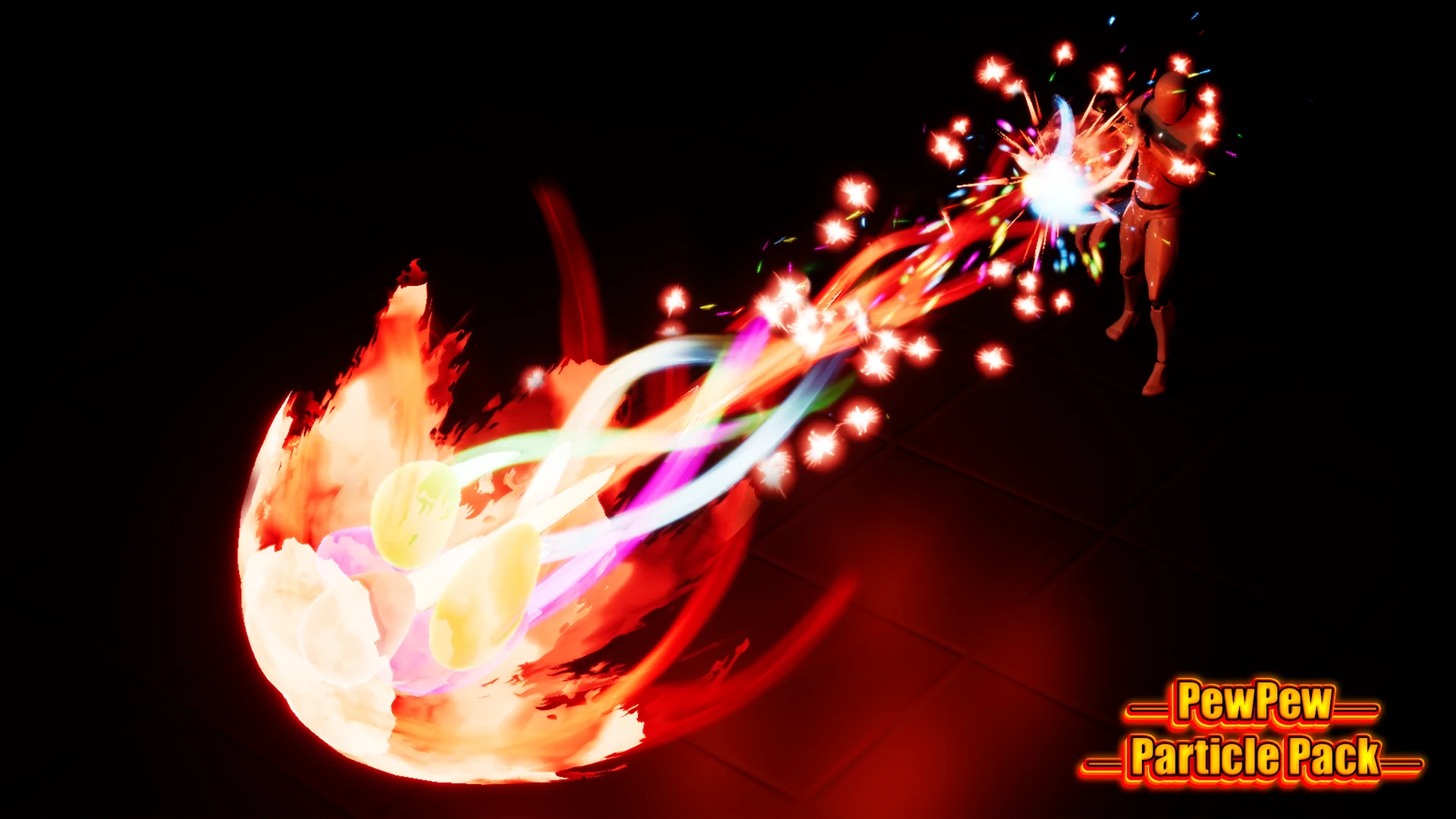
A high-velocity energy round leaves a weapon barrel with a sharp crack, trails a concentrated line of luminescence through the air, and detonates against a surface with a synchronized splash of sparks and residual heat. In action game development, energy-based ballistics depend entirely on clear readability across three distinct spatial points: the origin point at the firearm, the trajectory line across the environment, and the strike point on the target. Luos's PewPew Particle Pack supplies that exact visual lineage across four distinct projectile types, equipping weapons like laserguns, energy cannons, and heavy sci-fi handcannons with fully articulated ballistic feedback.
Staging Energy Weapon Combat with Luos's PewPew Systems
Combat visual effects require visual continuity from the instant an attack input triggers until the shot resolves against a wall or character model. Rather than providing isolated projectile meshes or static bullet trails, Luos's PewPew Particle Pack organizes its content into structured operational sequences. The asset supplies four core projectile types, giving productions a variety of visual profiles suited for rapid-fire energy sidearms, piercing laser beams, concentrated pulse carbines, or heavy energy ordnance.
Each projectile archetype comes prepared with three additional levels of increased visual intensity, colloquially termed "oomph." This structure yields four functional tiers per projectile family: a baseline discharge followed by three escalating stages of visual power. Game systems relying on escalating firepower, such as progressive weapon upgrades, combo meters, or variable fire modes, find direct visual equivalents in these graduated assets. Because each stage introduces denser particle volume, wider light dispersal, and more violent energetic turbulence, players receive immediate optical feedback regarding the kinetic power behind every trigger pull.
Charge Phases and Dynamic Firing States
Rechargeable and power-staged weapons cannot simply manifest high-tier projectiles instantaneously without disjointing the combat rhythm. Mechanical anticipation matters as much as the projectile release itself. Luos's PewPew Particle Pack accounts for this by outfitting the three higher energy tiers of every projectile family with dedicated charge-up visual effects. When a player holds down an attack input to saturate a weapon's capacitor or spool up an energy cell, an accompanying charge particle system coalesces at the barrel, communicating the weapon's state during the spooling sequence.
Because each of the three charged tiers features its own unique charge-up effect, developers can align visual buildup directly with mechanic charge gates. A quick half-second charge displays a restrained, gathering glow of energy; an intermediate hold introduces denser energetic tendrils; a maximum-duration charge visualizes a volatile, overcharged concentration of raw plasma. Once released, the transition from gathering energy to outbound discharge feels mechanically earned, giving rechargeable weaponry substantial physical weight inside the scene.
Muzzle Bursts, Ballistic Flights, and Impact Detonations
A frequent stumbling block in energy combat setups occurs when an overpowered projectile is launched from a generic, undersized muzzle flash, or when a heavy blast terminates in a tiny, underwhelming particle puff. Visual scale must remain consistent across the entire firing cycle. Luos's PewPew Particle Pack enforces this balance by providing dedicated muzzle flashes and tailored impact effects for every single level of all four projectile styles.
When firing a basic shot, the emitter produces a tight, localized muzzle pop paired with a clean, low-debris impact mark. Progressing into the higher tiers swaps both boundary points: the muzzle blast expands to reflect the increased wattage leaving the barrel, and the impact effect blooms into a larger visual detonation suited to heavy beam strikes or cannon hits. This 1-to-1 parity between charge, muzzle, trajectory, and impact ensures that a shot fired at tier three carries matching visual weight from the player's first-person weapon model all the way to the receiving geometry in the distance.
Cascade Architecture and Customizing Luos's PewPew Emitters
Under the hood, Luos's PewPew Particle Pack is constructed natively within Unreal Engine's Cascade particle system rather than the newer Niagara framework. Cascade remains fully operational inside Unreal Engine projects, operating with stable runtime performance and no indication of being removed from the engine anytime soon. Teams maintaining existing Cascade pipelines or working within production branches where Cascade remains the established standard can integrate the package directly without needing to configure Niagara translation layers.
For technical artists and designers comfortable working within Cascade, the package functions as an extensive modular playground. Cascade's module-based hierarchy makes it straightforward to isolate specific sub-emitters, duplicate properties, and mix elements from different projectile profiles. A developer can take the charging corona from one projectile style, combine it with the core flight beam of a second, and terminate the blast using the violent impact splash of a third. This modularity allows the four foundational types to yield an expansive arsenal of hybrid sci-fi weapon visual effects with minimal setup time.
Pipeline Longevity and the Niagara Transition Pathway
Selecting visual effects for active development requires evaluating both current efficiency and long-term asset maintenance. From a performance perspective, the Cascade effects in the pack run smoothly, allowing multiple active projectiles, charging states, and impact bursts to execute during dense firefights without unexpected frame drops or computational overhead. The lightweight nature of the optimized particle emitters preserves rendering budgets in fast-paced shooters where numerous combatants fire simultaneously.
Looking toward future project cycles, an update is planned to convert all effects within the package over to the Niagara framework. This planned path provides studios with a dual advantage: immediate deployment within established Cascade-reliant projects today, alongside a defined transition path to Niagara when upgrading production pipelines down the road. Whether implemented as a turnkey visual set for energy sidearms or disassembled within Cascade to construct bespoke beam weapons, the pack establishes a cohesive, scalable standard for sci-fi projectile combat.
 Spells & Combat
 Spells & Combat
 Spells & Combat