"b00678cacce53329"{"id":"1002776","slug":"bullet-vfx-pack","title":"Bullet VFX Pack","category":"Spells \u0026 Combat","engine":"4.12+,5.0+","assetVersion":"","engineVersion":"Engine Version: 4.12+,5.0+","tag":"Spells \u0026 Combat","accent":"blue","visual":"mech","summary":"Explore the Bullet VFX Pack for Unreal Engine 5, featuring Cascade and Niagara bullet impacts across 14 materials, lit particles, and weapon blueprints.","platform":"Unreal Engine","indexPolicy":"index","publishedAt":"2026-11-20T06:55:03.926Z","updatedAt":"2026-11-20T06:55:03.926Z","sourceNotes":[],"fileContents":[],"compatibility":["Unreal Engine","Engine Version: 4.12+,5.0+"],"featuredImage":{"alt":"Bullet VFX Pack","src":"/wp-content/uploads/published/2026/11/13334b07cbe4-ad1bca87-2865-46b0-b3f7-40cfbd09ef98-8da62a17d7.webp"},"fileSizeBytes":12448196,"hasDownloadLink":true,"downloads":0,"terms":[{"taxonomy":"category","slug":"spells-and-combat","name":"Spells \u0026 Combat"}],"galleryImages":[{"src":"/wp-content/uploads/published/2026/11/9e0a7db52ebf-acfab1f6-8be8-421d-abe2-fbce958df3d7-ae7b94aae4.webp","alt":"Bullet VFX Pack"},{"src":"/wp-content/uploads/published/2026/11/0c5c60759953-b5f03c16-e8d8-47ae-94bb-f7ee7137e28e-0f1678a7e9.webp","alt":"Bullet VFX Pack"},{"src":"/wp-content/uploads/published/2026/11/ad3f7ff9916a-fcc6ee9f-59c3-415e-b61b-88dd7a7715e4-614edf324c.webp","alt":"Bullet VFX Pack"},{"src":"/wp-content/uploads/published/2026/11/278513d65add-b477ef93-76a0-4d53-a152-9baada882776-6ca906d5ee.webp","alt":"Bullet VFX Pack"},{"src":"/wp-content/uploads/published/2026/11/fac45d64738f-9d1ac4f0-f2b8-4218-8657-935be6a91868-bb0e897dc8.webp","alt":"Bullet VFX Pack"},{"src":"/wp-content/uploads/published/2026/11/ca69c7858939-dad4021c-85a2-4fce-9dfc-f9d27dc893ba-d94bba42d6.webp","alt":"Bullet VFX Pack"},{"src":"/wp-content/uploads/published/2026/11/9a6391611a11-e64f748c-bf5b-449c-8638-c22696b5ce82-d2d3581ec1.webp","alt":"Bullet VFX Pack"},{"src":"/wp-content/uploads/published/2026/11/184eaa6bbfcd-4e362b25-9350-4e55-9106-055a3225b4d4-cca70fd73c.webp","alt":"Bullet VFX Pack"}],"accessPanel":{"kind":"resource","title":"Get this resource","safetyNote":"Resources are manually reviewed before listing to improve quality and reduce obvious risks.","fileName":"Content.7z","resourceType":"Resource archive","versions":[]},"contentHtml":"\u003ch2\u003eBullet Impact Systems Across Fourteen Surface Materials\u003c/h2\u003e\n\u003cp\u003eBallistic combat systems depend heavily on clear surface feedback to inform players where their rounds strike and what materials are taking damage. The Bullet VFX Pack establishes this visual response by supplying bespoke bullet impact effects across fourteen explicit physical material categories. Configured for both legacy Cascade and modern Niagara frameworks, the collection includes dedicated impact behaviors for Default, Blood, Concrete, Dirt, Electronics, Glass, Grass, Ice, Metal, Plastic, Sand, Snow, Water, and Wood.\u003c/p\u003e\n\u003cp\u003eEach material profile is crafted to reflect the physical attributes of the struck surface during a projectile collision. Solid structural elements such as concrete, metal, and wood exhibit sudden, high-energy displacement. Concrete impacts scatter dense dust clouds alongside chipped fragments, metal generates concentrated spark showers with ricocheting flakes, and wood releases directional splinters alongside coarse pulp debris. Brittle structural materials like glass and electronics feature sharp, high-contrast reactions; glass produces fractured slivers and reflective shatters, whereas electronics introduce sudden electrical discharges, burst sparks, and technical debris.\u003c/p\u003e\n\u003cp\u003eGranular and loose organic terrain types require a completely different kinetic signature. The package provides tailored behaviors for sand, dirt, and snow, where high-speed impacts displace loose earth into localized craters while lofting plumes of fine particulate into the surrounding air. In turf environments, the grass profile separates dirt ejection from sheared vegetation. Liquid and soft-body organic interactions are similarly addressed with custom profiles. The water impact drives upward fluid splashes accompanied by concentric ripple displacement, while the blood profile generates directional fluid bursts and localized splatter patterns upon projectile penetration. The default profile serves as a universal baseline, ensuring that untagged or unassigned colliders still trigger a consistent, readable kinetic impact rather than failing to fire a particle system.\u003c/p\u003e \u003ch2\u003eCascade and Niagara Implementation in the Bullet VFX Pack\u003c/h2\u003e\n\u003cp\u003eTo support ongoing development pipelines across multiple production generations, the collection maintains complete feature parity between Unreal Engine's legacy Cascade particle framework and the Niagara visual effects system. Updated for Unreal Engine 5, the collection provides dedicated assets constructed inside both environments, preventing the need to manually convert emitter logic, parameter bindings, or renderer modules when upgrading or maintaining existing codebases.\u003c/p\u003e\n\u003cp\u003eThe internal composition of each visual effect is configured using a strategic mixture of CPU, GPU, and mesh emitters tailored to the mechanical demands of each surface type:\u003c/p\u003e\n\u003cul\u003e \u003cli\u003e\u003cstrong\u003eGPU Emitters:\u003c/strong\u003e Utilized for high-density particle clouds, persistent atmospheric dust, dispersed mists, and wide-angle spark plumes where massive particle counts are needed without bogging down central processing threads.\u003c/li\u003e \u003cli\u003e\u003cstrong\u003eCPU Emitters:\u003c/strong\u003e Employed where precise particle coordination, exact lifespan boundaries, or direct interaction logic take priority over sheer particle volume.\u003c/li\u003e \u003cli\u003e\u003cstrong\u003eMesh Emitters:\u003c/strong\u003e Deployed for hard-surface impacts to instantiate three-dimensional debris fragments—such as chunks of concrete, splinters of timber, plastic shards, and shards of glass—that tumble away from the point of collision with physical volume.\u003c/li\u003e\n\u003c/ul\u003e\n\u003cp\u003eA major technical element across both the Cascade and Niagara configurations is the implementation of lit materials. Rather than using flat unlit sprites that glow unnaturally in dark spaces or look washed out under intense direct light, all smoke volumes and hard surface particles utilize lit materials. As a result, the smoke plumes emitted from dirt, sand, and wood, as well as the fragmented solid geometry thrown off by metal and concrete, receive scene illumination, cast dynamic shadows, and blend realistically into dynamic environments regardless of the time of day or light setup.\u003c/p\u003e \u003ch2\u003eMuzzle Flashes, Cartridge Meshes, and Lit Particle Materials\u003c/h2\u003e\n\u003cp\u003eVisual weapon discharge requires coordinated feedback at both the firearm muzzle and the projectile ejection port. The Bullet VFX Pack addresses the origin of gunfire by including six distinct muzzle flash effects built for both Cascade and Niagara. These six flashes are divided evenly between continuous and single-action fire modes, providing three looping variations and three non-looping variations.\u003c/p\u003e\n\u003cp\u003eThe three non-looping muzzle flashes are suited to semi-automatic, bolt-action, lever-action, and pump-action weapons. When triggered, each produces an isolated, immediate burst of combustion, smoke, and expanding flame that dissipates cleanly before the next round is cycled. The three looping muzzle flashes are engineered specifically for continuous automatic fire, including assault rifles, submachine guns, and mounted machine guns. These looping variations sustain continuous flame shape transitions and recurring gas plumes without hitching, visual popping, or premature emitter resets during sustained fire bursts.\u003c/p\u003e\n\u003cp\u003eComplementing the muzzle fire is an integrated bullet cartridge mesh setup. Delivered with both looping and non-looping ejection effects for Cascade and Niagara, this system casts physical cartridge models from the weapon receiver upon firing. The non-looping cartridge effect expels a single spent casing per trigger event for single-shot weapon profiles, while the looping variation provides a continuous ejection cadence tailored to high-rate-of-fire automatic weapons. Because these elements coordinate with the package's lit material pipeline, the expelled brass and surrounding muzzle smoke react directly to dynamic ambient illumination within the game world.\u003c/p\u003e \u003ch2\u003eWeapon Blueprints and the BulletContent Sample Level\u003c/h2\u003e\n\u003cp\u003eTo demonstrate how these visual components tie into operational gameplay systems, the package includes functional weapon logic built on Unreal Engine's First-Person Shooter template architecture. This implementation provides developers with a clear template for linking player input, weapon discharge, and impact spawning within Blueprint scripting.\u003c/p\u003e\n\u003cp\u003eThe package supplies dedicated Blueprint projectiles (BP projectiles) configured separately for both Cascade and Niagara pipelines. These Blueprints demonstrate how to execute line-trace collision checks, detect underlying physical material tags on static and dynamic geometry, and instantly instantiate the matching impact asset at the exact point of surface intersection. Developers can inspect these BP projectiles to observe how velocity, orientation vectors, and surface normals are passed directly into the Cascade and Niagara parameters to align debris direction and smoke expansion with the angle of incoming fire.\u003c/p\u003e\n\u003cp\u003eAll of these systems can be tested and verified inside an included sample level named BulletContent. Designed as a triggerable demonstration range, the BulletContent map allows creators to fire the sample First-Person Shooter weapon directly into various material targets. Within this environment, developers can examine the performance of all fourteen material impacts, test the responsive timing between single-shot and automatic muzzle flashes, observe spent cartridge ejections, and monitor how lit particles interact with level lighting in real time.\u003c/p\u003e \u003ch2\u003eIntegrating the Pack into Unreal Engine 5 Workflows\u003c/h2\u003e\n\u003cp\u003eDeploying the collection into an active production environment involves straightforward mapping of Unreal Engine Physical Materials to the corresponding Cascade or Niagara assets. Because the pack explicitly separates impacts into Default, Blood, Concrete, Dirt, Electronics, Glass, Grass, Ice, Metal, Plastic, Sand, Snow, Water, and Wood, developers can link their existing surface types directly to the corresponding emitter assets through Blueprint switch nodes, gameplay tags, or data tables.\u003c/p\u003e\n\u003cp\u003eWith its full update for Unreal Engine 5, developers can freely adopt Niagara for newly engineered combat systems while continuing to maintain legacy Cascade setups without asset fragmentation. The inclusion of CPU, GPU, and mesh emitters, lit materials for particulate and smoke, dedicated cartridge meshes, multiple muzzle flash behaviors, and functional Blueprint projectile assets ensures that the Bullet VFX Pack provides an end-to-end framework for interactive ballistic visual design.\u003c/p\u003e\n\n\u003ch2\u003eExplore Similar Assets\u003c/h2\u003e\n\u003cul\u003e\n\u003cli\u003e\u003ca href=\"https://3dcghub.com/niagara-muzzle-flash-and-ejection-vfx-muzzle-flash-gun-vfx-bullet-vfx/\" rel=\"noopener noreferrer\"\u003eNiagara Muzzle Flash \u0026amp; Ejection VFX (Muzzle Flash, Gun VFX, Bullet VFX)\u003c/a\u003e\u003c/li\u003e\n\u003cli\u003e\u003ca href=\"https://3dcghub.com/realistic-gun-vfx-muzzle-flash-bullet-impact-ejections-gun-vfx-vfx/\" rel=\"noopener noreferrer\"\u003eRealistic Gun VFX (Muzzle Flash, Bullet Impact, Ejections, Gun VFX, VFX)\u003c/a\u003e\u003c/li\u003e\n\u003cli\u003e\u003ca href=\"https://3dcghub.com/stylized-vfx-lightning/\" rel=\"noopener noreferrer\"\u003eStylized VFX - Lightning\u003c/a\u003e\u003c/li\u003e\n\u003cli\u003e\u003ca href=\"https://3dcghub.com/advancedmagicfx16/\" rel=\"noopener noreferrer\"\u003eAdvancedMagicFX16\u003c/a\u003e\u003c/li\u003e\n\u003cli\u003e\u003ca href=\"https://3dcghub.com/supernova-vfx/\" rel=\"noopener noreferrer\"\u003eSupernova VFX\u003c/a\u003e\u003c/li\u003e\n\u003c/ul\u003e","contentTextLength":8690,"navigation":{"current":104,"total":4797,"previous":{"id":"1002777","slug":"camera-based-post-process-effect","title":"Camera based Post Process Effect","category":"Variety","platform":"Unreal Engine","updatedAt":"2026-11-20T06:55:47.668Z"},"next":{"id":"1002775","slug":"background-vfx","title":"Background VFX","category":"Transition","platform":"Unreal Engine","updatedAt":"2026-11-20T06:54:03.591Z"}},"relatedResources":[{"id":"1002131","slug":"niagara-muzzle-flash-and-ejection-vfx-muzzle-flash-gun-vfx-bullet-vfx","title":"Niagara Muzzle Flash \u0026 Ejection VFX (Muzzle Flash, Gun VFX, Bullet VFX)","category":"Spells \u0026 Combat","engine":"4.25+,5.0+","assetVersion":"","engineVersion":"Engine Version: 4.25+,5.0+","tag":"Spells \u0026 Combat","accent":"blue","visual":"mech","summary":"Explore Niagara Muzzle Flash \u0026 Ejection VFX, featuring 17 particle systems across 5 weapon classes with realistic muzzle flashes and bullet shell ejections.","platform":"Unreal Engine","indexPolicy":"index","publishedAt":"2026-10-29T09:12:22.074Z","updatedAt":"2026-10-29T09:12:22.074Z","sourceNotes":[],"fileContents":[],"compatibility":["Unreal Engine","Engine Version: 4.25+,5.0+"],"featuredImage":{"alt":"Niagara Muzzle Flash \u0026 Ejection VFX (Muzzle Flash, Gun VFX, Bullet VFX)","src":"/wp-content/uploads/published/2026/10/31a727bcc5b7-e1a79014-146f-40db-a58b-c05ead407923-cec126815f.webp"},"fileSizeBytes":232616178,"hasDownloadLink":true,"downloads":3},{"id":"1000326","slug":"realistic-gun-vfx-muzzle-flash-bullet-impact-ejections-gun-vfx-vfx","title":"Realistic Gun VFX (Muzzle Flash, Bullet Impact, Ejections, Gun VFX, VFX)","category":"Spells \u0026 Combat","engine":"5.4+","assetVersion":"","engineVersion":"Engine Version: 5.4+","tag":"Spells \u0026 Combat","accent":"blue","visual":"mech","summary":"A high-fidelity gun weapon FX pack featuring plug-and-play Niagara systems for muzzle flashes, 31 surface impacts, and bullet ejections for PC and console.","platform":"Unreal Engine","indexPolicy":"index","publishedAt":"2026-07-05T06:37:35.328Z","updatedAt":"2026-07-05T06:37:35.328Z","sourceNotes":[],"fileContents":[],"compatibility":["Unreal Engine","Engine Version: 5.4+"],"featuredImage":{"alt":"Realistic Gun VFX (Muzzle Flash, Bullet Impact, Ejections, Gun VFX, VFX)","src":"/wp-content/uploads/published/2026/07/688ec596cc82-d9998270-7a81-402d-869b-83469c0a764b-984b07c132.webp"},"fileSizeBytes":469103366,"hasDownloadLink":true,"downloads":8},{"id":"1002282","slug":"stylized-vfx-lightning","title":"Stylized VFX - Lightning","category":"Spells \u0026 Combat","engine":"4.26+,5.0+","assetVersion":"","engineVersion":"Engine Version: 4.26+,5.0+","tag":"Spells \u0026 Combat","accent":"blue","visual":"mech","summary":"Explore 70 unique stylized lightning VFX built with optimized Sub UV materials for rapid drag-and-drop scene staging and electric combat gameplay.","platform":"Unreal Engine","indexPolicy":"index","publishedAt":"2026-10-29T16:58:48.449Z","updatedAt":"2026-10-29T16:58:48.449Z","sourceNotes":[],"fileContents":[],"compatibility":["Unreal Engine","Engine Version: 4.26+,5.0+"],"featuredImage":{"alt":"Stylized VFX - Lightning","src":"/wp-content/uploads/published/2026/10/619a1b1e94e4-6f0ab4a7-5e66-4219-a0bd-6f1369979f8d-60a39083c1.webp"},"fileSizeBytes":9856152,"hasDownloadLink":true,"downloads":3}]}
Resource screenshots
1 / 8
Join our channel
Follow 3DCGHUB on Telegram for new resource drops, migration updates, and community notices.
Resources are manually reviewed before listing to improve quality and reduce obvious risks.
No account required
Spells & Combat
Bullet VFX Pack
Explore the Bullet VFX Pack for Unreal Engine 5, featuring Cascade and Niagara bullet impacts across 14 materials, lit particles, and weapon blueprints.
Bullet Impact Systems Across Fourteen Surface Materials
Ballistic combat systems depend heavily on clear surface feedback to inform players where their rounds strike and what materials are taking damage. The Bullet VFX Pack establishes this visual response by supplying bespoke bullet impact effects across fourteen explicit physical material categories. Configured for both legacy Cascade and modern Niagara frameworks, the collection includes dedicated impact behaviors for Default, Blood, Concrete, Dirt, Electronics, Glass, Grass, Ice, Metal, Plastic, Sand, Snow, Water, and Wood.
Each material profile is crafted to reflect the physical attributes of the struck surface during a projectile collision. Solid structural elements such as concrete, metal, and wood exhibit sudden, high-energy displacement. Concrete impacts scatter dense dust clouds alongside chipped fragments, metal generates concentrated spark showers with ricocheting flakes, and wood releases directional splinters alongside coarse pulp debris. Brittle structural materials like glass and electronics feature sharp, high-contrast reactions; glass produces fractured slivers and reflective shatters, whereas electronics introduce sudden electrical discharges, burst sparks, and technical debris.
Granular and loose organic terrain types require a completely different kinetic signature. The package provides tailored behaviors for sand, dirt, and snow, where high-speed impacts displace loose earth into localized craters while lofting plumes of fine particulate into the surrounding air. In turf environments, the grass profile separates dirt ejection from sheared vegetation. Liquid and soft-body organic interactions are similarly addressed with custom profiles. The water impact drives upward fluid splashes accompanied by concentric ripple displacement, while the blood profile generates directional fluid bursts and localized splatter patterns upon projectile penetration. The default profile serves as a universal baseline, ensuring that untagged or unassigned colliders still trigger a consistent, readable kinetic impact rather than failing to fire a particle system.
Cascade and Niagara Implementation in the Bullet VFX Pack
To support ongoing development pipelines across multiple production generations, the collection maintains complete feature parity between Unreal Engine's legacy Cascade particle framework and the Niagara visual effects system. Updated for Unreal Engine 5, the collection provides dedicated assets constructed inside both environments, preventing the need to manually convert emitter logic, parameter bindings, or renderer modules when upgrading or maintaining existing codebases.
The internal composition of each visual effect is configured using a strategic mixture of CPU, GPU, and mesh emitters tailored to the mechanical demands of each surface type:
GPU Emitters: Utilized for high-density particle clouds, persistent atmospheric dust, dispersed mists, and wide-angle spark plumes where massive particle counts are needed without bogging down central processing threads.
CPU Emitters: Employed where precise particle coordination, exact lifespan boundaries, or direct interaction logic take priority over sheer particle volume.
Mesh Emitters: Deployed for hard-surface impacts to instantiate three-dimensional debris fragments—such as chunks of concrete, splinters of timber, plastic shards, and shards of glass—that tumble away from the point of collision with physical volume.
A major technical element across both the Cascade and Niagara configurations is the implementation of lit materials. Rather than using flat unlit sprites that glow unnaturally in dark spaces or look washed out under intense direct light, all smoke volumes and hard surface particles utilize lit materials. As a result, the smoke plumes emitted from dirt, sand, and wood, as well as the fragmented solid geometry thrown off by metal and concrete, receive scene illumination, cast dynamic shadows, and blend realistically into dynamic environments regardless of the time of day or light setup.
Muzzle Flashes, Cartridge Meshes, and Lit Particle Materials
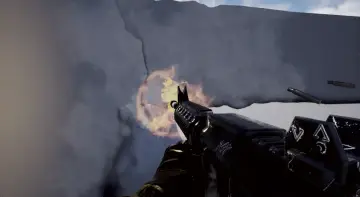
Visual weapon discharge requires coordinated feedback at both the firearm muzzle and the projectile ejection port. The Bullet VFX Pack addresses the origin of gunfire by including six distinct muzzle flash effects built for both Cascade and Niagara. These six flashes are divided evenly between continuous and single-action fire modes, providing three looping variations and three non-looping variations.
The three non-looping muzzle flashes are suited to semi-automatic, bolt-action, lever-action, and pump-action weapons. When triggered, each produces an isolated, immediate burst of combustion, smoke, and expanding flame that dissipates cleanly before the next round is cycled. The three looping muzzle flashes are engineered specifically for continuous automatic fire, including assault rifles, submachine guns, and mounted machine guns. These looping variations sustain continuous flame shape transitions and recurring gas plumes without hitching, visual popping, or premature emitter resets during sustained fire bursts.
Complementing the muzzle fire is an integrated bullet cartridge mesh setup. Delivered with both looping and non-looping ejection effects for Cascade and Niagara, this system casts physical cartridge models from the weapon receiver upon firing. The non-looping cartridge effect expels a single spent casing per trigger event for single-shot weapon profiles, while the looping variation provides a continuous ejection cadence tailored to high-rate-of-fire automatic weapons. Because these elements coordinate with the package's lit material pipeline, the expelled brass and surrounding muzzle smoke react directly to dynamic ambient illumination within the game world.
Weapon Blueprints and the BulletContent Sample Level
To demonstrate how these visual components tie into operational gameplay systems, the package includes functional weapon logic built on Unreal Engine's First-Person Shooter template architecture. This implementation provides developers with a clear template for linking player input, weapon discharge, and impact spawning within Blueprint scripting.
The package supplies dedicated Blueprint projectiles (BP projectiles) configured separately for both Cascade and Niagara pipelines. These Blueprints demonstrate how to execute line-trace collision checks, detect underlying physical material tags on static and dynamic geometry, and instantly instantiate the matching impact asset at the exact point of surface intersection. Developers can inspect these BP projectiles to observe how velocity, orientation vectors, and surface normals are passed directly into the Cascade and Niagara parameters to align debris direction and smoke expansion with the angle of incoming fire.
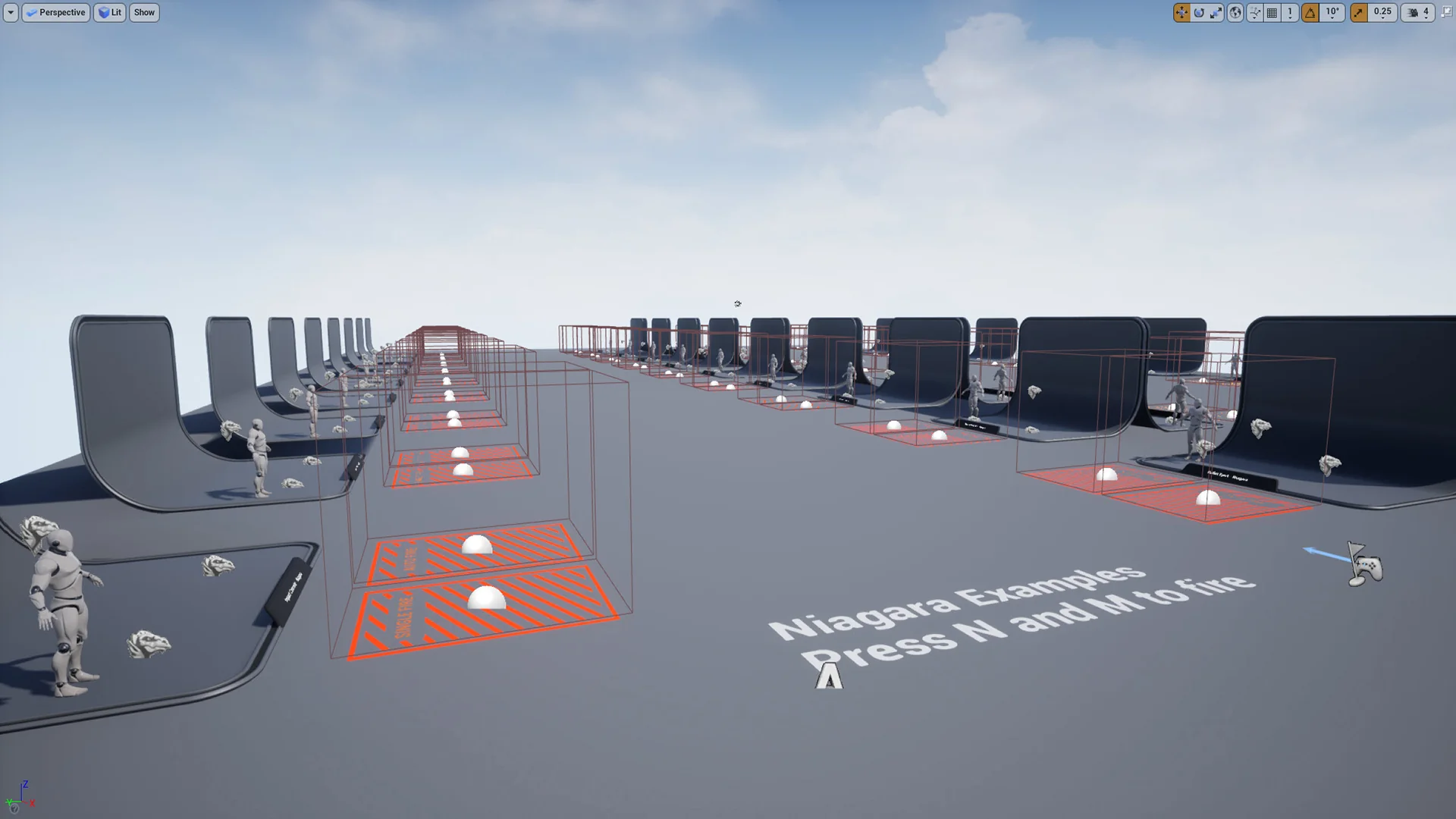
All of these systems can be tested and verified inside an included sample level named BulletContent. Designed as a triggerable demonstration range, the BulletContent map allows creators to fire the sample First-Person Shooter weapon directly into various material targets. Within this environment, developers can examine the performance of all fourteen material impacts, test the responsive timing between single-shot and automatic muzzle flashes, observe spent cartridge ejections, and monitor how lit particles interact with level lighting in real time.
Integrating the Pack into Unreal Engine 5 Workflows
Deploying the collection into an active production environment involves straightforward mapping of Unreal Engine Physical Materials to the corresponding Cascade or Niagara assets. Because the pack explicitly separates impacts into Default, Blood, Concrete, Dirt, Electronics, Glass, Grass, Ice, Metal, Plastic, Sand, Snow, Water, and Wood, developers can link their existing surface types directly to the corresponding emitter assets through Blueprint switch nodes, gameplay tags, or data tables.
With its full update for Unreal Engine 5, developers can freely adopt Niagara for newly engineered combat systems while continuing to maintain legacy Cascade setups without asset fragmentation. The inclusion of CPU, GPU, and mesh emitters, lit materials for particulate and smoke, dedicated cartridge meshes, multiple muzzle flash behaviors, and functional Blueprint projectile assets ensures that the Bullet VFX Pack provides an end-to-end framework for interactive ballistic visual design.
 Spells & Combat
 Spells & Combat
 Spells & Combat