"031373f479d9561a"{"id":"1000226","slug":"industrial-city","title":"Industrial City","category":"Cities","engine":"4.26+,5.0+","assetVersion":"","engineVersion":"Engine Version: 4.26+,5.0+","tag":"Cities","accent":"blue","visual":"city","summary":"A comprehensive 300-asset environment toolkit for building realistic, multi-level industrial cities with hyper-modular architecture and full grunge control.","platform":"Unreal Engine","publishedAt":"2026-06-27T15:07:23.916Z","updatedAt":"2026-06-27T15:07:23.916Z","sourceNotes":[],"fileContents":[],"compatibility":["Unreal Engine","Engine Version: 4.26+,5.0+"],"featuredImage":{"alt":"Industrial City","src":"/wp-content/uploads/published/2026/06/d672438a8da7-78c8a208-9417-4db9-acf5-32c4d90b5a13-c4726d249e.webp"},"hasDownloadLink":true,"downloads":0,"terms":[{"taxonomy":"category","slug":"cities","name":"Cities"}],"galleryImages":[{"src":"/wp-content/uploads/published/2026/06/ce6b7be05341-a674a787-0b34-496f-b36b-2016f02c836b-412965641f.webp","alt":"Industrial City"},{"src":"/wp-content/uploads/published/2026/06/e2c4d3a7ee31-24cdfa8a-3317-4a44-8bb5-c1c5d4e0b085-624c160370.webp","alt":"Industrial City"},{"src":"/wp-content/uploads/published/2026/06/34c33d768527-05b030ad-3951-43c6-a48a-4457acd23621-dd5f7c5f83.webp","alt":"Industrial City"},{"src":"/wp-content/uploads/published/2026/06/660a3bba18f0-75ad7aba-e775-4c2d-a8d5-8f2c62300b9b-14673591dd.webp","alt":"Industrial City"},{"src":"/wp-content/uploads/published/2026/06/2537b3599345-fd62965b-ca8d-429d-ac38-234ce4e0135c-41befa43ad.webp","alt":"Industrial City"},{"src":"/wp-content/uploads/published/2026/06/0c969ce14195-2de37ef4-8346-45b4-bfa6-a302ce5b8c67-c7a8c59fc8.webp","alt":"Industrial City"},{"src":"/wp-content/uploads/published/2026/06/93e8f8048125-f67c580e-b046-422f-8462-871984c53e81-056ab67632.webp","alt":"Industrial City"},{"src":"/wp-content/uploads/published/2026/06/9559abd208ac-3e749398-0198-49c7-8805-f0e1d9bb754a-7342baea50.webp","alt":"Industrial City"}],"accessPanel":{"kind":"resource","title":"Download this resource","eyebrow":"Free Download","message":"Log in or create a free account to start your download.","fileName":"IndustrialCity.7z","safetyNote":"Resources are manually reviewed before listing to improve quality and reduce obvious risks.","actionLabel":"Download Free","resourceType":"Resource archive"},"contentHtml":"\u003ch2\u003eConstructing Multi-Level Interiors and Exteriors\u003c/h2\u003e\n\u003cp\u003eBuilding a believable industrial environment requires more than just dropping large building facades into a scene. Developers need the flexibility to design custom, navigable floor plans while maintaining a cohesive, gritty aesthetic across an entire level. The Industrial City environment pack addresses this production bottleneck by supplying over 300 realistic assets designed specifically for urban construction.\u003c/p\u003e\n\u003cp\u003eInstead of relying on rigid, single-use structures, this toolkit focuses on a highly adaptable workflow. It allows level designers to shape custom multi-level interiors and exteriors from the ground up. Central to this system is the inclusion of full control of grunge. Having direct control over the grunge means that a single modular wall or pre-built floor can be reused multiple times across a level without looking identical. By adjusting the dirt and wear on a per-instance basis, developers can break up the repetition that often plagues modular cityscapes and dial in the exact amount of decay required for a realistic industrial atmosphere.\u003c/p\u003e \u003ch2\u003eMixing Modular and Hyper-Modular Building Assets\u003c/h2\u003e\n\u003cp\u003eThe core of the architectural workflow relies on a dual-layered modular system that accommodates different stages of level design. The package provides over 100 hyper-modular pieces alongside more than 60 pre-built roof, main, and mid-floor components. This combination gives developers the choice between rapid scene block-outs and meticulous, piece-by-piece construction.\u003c/p\u003e\n\u003cp\u003eThe pre-built sections facilitate the quick assembly of multi-level floors, allowing designers to establish the silhouette and primary massing of a city block in a short amount of time. When more custom layouts are necessary, the hyper-modular pieces can be introduced into the pipeline. The distinction between modular and hyper-modular is critical for teams looking to optimize their environment art pipeline. While pre-built sections save time, the hyper-modular assets offer the granular control needed to create unique focal points or complex architectural intersections.\u003c/p\u003e\n\u003cp\u003eBy mixing and matching these smaller elements with the larger pre-built main and mid-floor sections, developers can generate an endless variety of buildings. Because the system is specifically engineered to support multi-level floors with interiors, the resulting structures are not simply empty exterior shells. Designers can construct continuous, realistic environments where players can navigate from the street level directly into the multi-level interiors of the industrial facilities.\u003c/p\u003e \u003ch2\u003ePopulating Back Alleys with Industrial Props\u003c/h2\u003e\n\u003cp\u003eA realistic urban landscape relies heavily on the structural dressing that surrounds the primary architecture. To bridge the gap between the building foundations and the street, the pack includes modular building assets like ventilation systems and fire escapes. These specific industrial props attach directly to the exterior walls, breaking up flat surfaces and adding believable infrastructure to the multi-level buildings. Integrating these elements helps to visually anchor the towering structures to the ground level, ensuring that the transition between the roof pieces and the streets feels authentic.\u003c/p\u003e\n\u003cp\u003eTo fully populate the city streets and industrial zones, the environment pack is supplied with a comprehensive set of over 150 industrial props. This huge variety of props is essential for filling out the scene and disguising the seams that naturally occur in modular level design. On the ground level, the inclusion of garbage and back alley debris provides the necessary clutter to ground the environment.\u003c/p\u003e\n\u003cp\u003eScattering garbage and back alley debris is not just about visual noise; it is a fundamental environmental storytelling tool. By carefully placing these industrial props around key navigational paths or beneath fire escapes, level designers can subtly guide player movement and highlight areas of interest within the dense urban grid. Distributing these specific elements throughout the alleys and pathways reinforces the lived-in, realistic tone of the industrial city.\u003c/p\u003e \u003ch2\u003eGround Variation and Tileable Terrain Textures\u003c/h2\u003e\n\u003cp\u003eEstablishing the foundation of an industrial zone requires specific attention to the ground surfaces beneath the props and buildings. The package supplies 12 tileable terrain textures designed to handle the varied surfaces of an urban level.\u003c/p\u003e\n\u003cp\u003eThese tileable materials are built to paint walkways, outline dirt paths, and help break up the ground plane with natural variation. When combined with the overarching grunge control system, these terrain textures allow developers to transition smoothly from heavily trafficked dirt paths to paved industrial walkways, ensuring the street level perfectly matches the gritty aesthetic of the surrounding buildings.\u003c/p\u003e \u003ch2\u003eIntegrating Vegetation and Managing Level of Detail\u003c/h2\u003e\n\u003cp\u003eEven the most heavily industrialized environments contain pockets of nature that break up the concrete and metal. To help add some greenery to the scene, the pack includes about 20 vegetation props. This targeted selection of trees, bushes, and grass allows artists to introduce organic shapes that contrast with the rigid lines of the hyper-modular pieces. Placing bushes and grass along the dirt paths or positioning trees near back alley debris adds a layer of neglect and overgrowth that is characteristic of realistic, aging industrial zones.\u003c/p\u003e\n\u003cp\u003ePopulating a dense urban level with hundreds of architectural pieces, structural props, and foliage can easily strain rendering budgets in a real-time environment. To maintain a streamlined game, technical optimization is integrated directly into the heavier assets. LOD (level of detail) states are included specifically for the trees and props throughout the package.\u003c/p\u003e\n\u003cp\u003eAs a camera navigates through the multi-level interiors or looks down sprawling industrial alleys, these LOD states ensure that the complex meshes scale down appropriately at a distance. This setup provides the performance headroom necessary to utilize the full extent of the 150 industrial props and vegetation without compromising the realistic visual standard of the project. By combining extensive modular flexibility with comprehensive optimization, the toolset fits directly into workflows that demand realistic, highly detailed urban environments.\u003c/p\u003e\n\n\u003ch2\u003eContinue Browsing Similar Packs\u003c/h2\u003e\n\u003cul\u003e\n\u003cli\u003e\u003ca href=\"https://3dcghub.com/post-industrial-environment/\" title=\"Post-Industrial Environment\"\u003ePost-Industrial Environment\u003c/a\u003e\u003c/li\u003e\n\u003cli\u003e\u003ca href=\"https://3dcghub.com/american-city-packs-bundle/\" title=\"American City Packs (Bundle)\"\u003eAmerican City Packs (Bundle)\u003c/a\u003e\u003c/li\u003e\n\u003cli\u003e\u003ca href=\"https://3dcghub.com/modern-city-downtown-megapack-modern-city-downtown-building-usa-town-street/\" title=\"Modern City Downtown Megapack ( Modern City Downtown Building USA Town Street )\"\u003eModern City Downtown Megapack ( Modern City Downtown Building USA Town Street )\u003c/a\u003e\u003c/li\u003e\n\u003cli\u003e\u003ca href=\"https://3dcghub.com/vista-buildings/\" title=\"Vista Buildings\"\u003eVista Buildings\u003c/a\u003e\u003c/li\u003e\n\u003cli\u003e\u003ca href=\"https://3dcghub.com/modular-urban-city-asset-megapack/\" title=\"Modular Urban City Asset Megapack\"\u003eModular Urban City Asset Megapack\u003c/a\u003e\u003c/li\u003e\n\u003c/ul\u003e","contentTextLength":6587,"navigation":{"current":1123,"total":3223,"previous":{"id":"1000227","slug":"interior-toolkit","title":"Interior Toolkit","category":"Historical","platform":"Unreal Engine","updatedAt":"2026-06-27T18:29:02.492Z"},"next":{"id":"1000225","slug":"how-to-create-an-online-base-claim-system-with-ue5","title":"How to create an Online Base Claim System with UE5","category":"Unreal Engine","platform":"Unreal Engine","updatedAt":"2026-06-27T14:32:52.012Z"}},"relatedResources":[{"id":"7327","slug":"post-industrial-environment","title":"Post-Industrial Environment","category":"Cities","engine":"4.26+,5.0+","assetVersion":"Engine version: 4.26+,5.0+","engineVersion":"4.25","tag":"Cities","accent":"blue","visual":"city","summary":"Build high-fidelity game worlds with the Post-Industrial Environment kit. This modular resource combines photogrammetry and custom Blueprints to streamline your level design workflow in Unreal Engine 5.","platform":"Unreal Engine","publishedAt":"2026-02-21T12:35:12.000Z","updatedAt":"2026-04-19T15:56:01.000Z","sourceNotes":[],"fileContents":[],"compatibility":["Unreal Engine","Engine version: 4.26+,5.0+"],"featuredImage":{"alt":"Post-Industrial Environment","src":"https://3dcghub.com/wp-content/uploads/2026/02/ee2e2601-4d73-4c96-8d34-fe37aad70d13.webp"},"hasDownloadLink":true,"downloads":0},{"id":"27322","slug":"american-city-packs-bundle","title":"American City Packs (Bundle)","category":"Cities","engine":"5.0+","assetVersion":"Engine version: 5.0+","engineVersion":"","tag":"Cities","accent":"blue","visual":"city","summary":"American City Packs (Bundle) brings downtown, suburbs, and industrial content together in a single city-building workflow. It focuses on editor-based generation, modular control, and the kind of assets that let large urban scenes come together quickly.","platform":"Unreal Engine","publishedAt":"2026-04-24T05:51:42.000Z","updatedAt":"2026-04-24T05:51:43.000Z","sourceNotes":[],"fileContents":[],"compatibility":["Unreal Engine","Engine version: 5.0+"],"featuredImage":{"alt":"American City Packs (Bundle)","src":"https://3dcghub.com/wp-content/uploads/2026/04/e249548065ab_189ac72c-3333-403f-a2e2-9bd95e2a751d.webp"},"hasDownloadLink":true,"downloads":1},{"id":"1000541","slug":"nyc-new-york-city","title":"NYC | New York City","category":"Cities","engine":"4.26+,5.0+","assetVersion":"","engineVersion":"Engine Version: 4.26+,5.0+","tag":"Cities","accent":"blue","visual":"city","summary":"Universal urban environment pack featuring modular NYC buildings with ground-floor interiors, LODs, collisions, and a detailed demonstration level. Compatible w","platform":"Unreal Engine","publishedAt":"2026-07-15T03:33:12.505Z","updatedAt":"2026-07-15T03:33:12.505Z","sourceNotes":[],"fileContents":[],"compatibility":["Unreal Engine","Engine Version: 4.26+,5.0+"],"featuredImage":{"alt":"NYC | New York City","src":"/wp-content/uploads/published/2026/07/059c88207afc-27867b9e-4bc6-4530-a5e6-718353f9b45b-5a434e9b65.webp"},"hasDownloadLink":true,"downloads":2}]}
Cities
Industrial City
A comprehensive 300-asset environment toolkit for building realistic, multi-level industrial cities with hyper-modular architecture and full grunge control.
Category:Unreal Engine,CitiesPlatform: Unreal EngineEngine Version: 4.26+,5.0+Published: Jun 27, 2026
Cities
Resource overview
Constructing Multi-Level Interiors and Exteriors
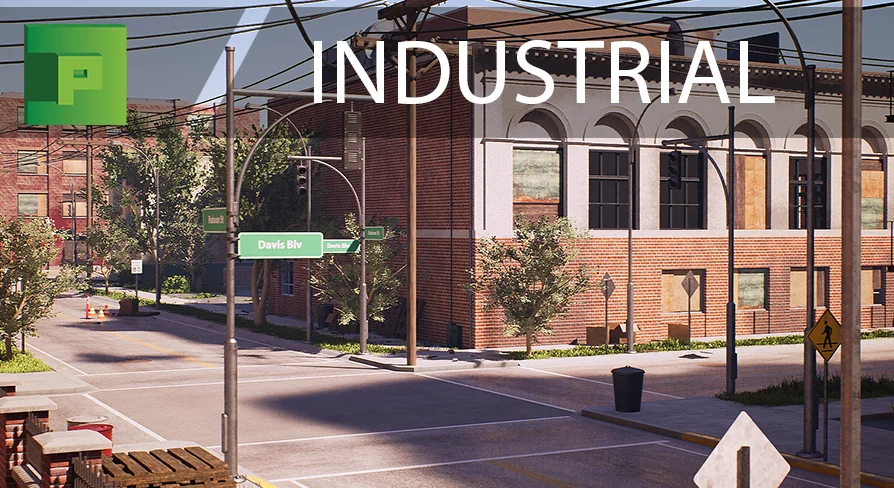
Building a believable industrial environment requires more than just dropping large building facades into a scene. Developers need the flexibility to design custom, navigable floor plans while maintaining a cohesive, gritty aesthetic across an entire level. The Industrial City environment pack addresses this production bottleneck by supplying over 300 realistic assets designed specifically for urban construction.
Instead of relying on rigid, single-use structures, this toolkit focuses on a highly adaptable workflow. It allows level designers to shape custom multi-level interiors and exteriors from the ground up. Central to this system is the inclusion of full control of grunge. Having direct control over the grunge means that a single modular wall or pre-built floor can be reused multiple times across a level without looking identical. By adjusting the dirt and wear on a per-instance basis, developers can break up the repetition that often plagues modular cityscapes and dial in the exact amount of decay required for a realistic industrial atmosphere.
Mixing Modular and Hyper-Modular Building Assets
The core of the architectural workflow relies on a dual-layered modular system that accommodates different stages of level design. The package provides over 100 hyper-modular pieces alongside more than 60 pre-built roof, main, and mid-floor components. This combination gives developers the choice between rapid scene block-outs and meticulous, piece-by-piece construction.
The pre-built sections facilitate the quick assembly of multi-level floors, allowing designers to establish the silhouette and primary massing of a city block in a short amount of time. When more custom layouts are necessary, the hyper-modular pieces can be introduced into the pipeline. The distinction between modular and hyper-modular is critical for teams looking to optimize their environment art pipeline. While pre-built sections save time, the hyper-modular assets offer the granular control needed to create unique focal points or complex architectural intersections.
By mixing and matching these smaller elements with the larger pre-built main and mid-floor sections, developers can generate an endless variety of buildings. Because the system is specifically engineered to support multi-level floors with interiors, the resulting structures are not simply empty exterior shells. Designers can construct continuous, realistic environments where players can navigate from the street level directly into the multi-level interiors of the industrial facilities.
Populating Back Alleys with Industrial Props
A realistic urban landscape relies heavily on the structural dressing that surrounds the primary architecture. To bridge the gap between the building foundations and the street, the pack includes modular building assets like ventilation systems and fire escapes. These specific industrial props attach directly to the exterior walls, breaking up flat surfaces and adding believable infrastructure to the multi-level buildings. Integrating these elements helps to visually anchor the towering structures to the ground level, ensuring that the transition between the roof pieces and the streets feels authentic.
To fully populate the city streets and industrial zones, the environment pack is supplied with a comprehensive set of over 150 industrial props. This huge variety of props is essential for filling out the scene and disguising the seams that naturally occur in modular level design. On the ground level, the inclusion of garbage and back alley debris provides the necessary clutter to ground the environment.
Scattering garbage and back alley debris is not just about visual noise; it is a fundamental environmental storytelling tool. By carefully placing these industrial props around key navigational paths or beneath fire escapes, level designers can subtly guide player movement and highlight areas of interest within the dense urban grid. Distributing these specific elements throughout the alleys and pathways reinforces the lived-in, realistic tone of the industrial city.
Ground Variation and Tileable Terrain Textures
Establishing the foundation of an industrial zone requires specific attention to the ground surfaces beneath the props and buildings. The package supplies 12 tileable terrain textures designed to handle the varied surfaces of an urban level.
These tileable materials are built to paint walkways, outline dirt paths, and help break up the ground plane with natural variation. When combined with the overarching grunge control system, these terrain textures allow developers to transition smoothly from heavily trafficked dirt paths to paved industrial walkways, ensuring the street level perfectly matches the gritty aesthetic of the surrounding buildings.
Integrating Vegetation and Managing Level of Detail
Even the most heavily industrialized environments contain pockets of nature that break up the concrete and metal. To help add some greenery to the scene, the pack includes about 20 vegetation props. This targeted selection of trees, bushes, and grass allows artists to introduce organic shapes that contrast with the rigid lines of the hyper-modular pieces. Placing bushes and grass along the dirt paths or positioning trees near back alley debris adds a layer of neglect and overgrowth that is characteristic of realistic, aging industrial zones.
Populating a dense urban level with hundreds of architectural pieces, structural props, and foliage can easily strain rendering budgets in a real-time environment. To maintain a streamlined game, technical optimization is integrated directly into the heavier assets. LOD (level of detail) states are included specifically for the trees and props throughout the package.
As a camera navigates through the multi-level interiors or looks down sprawling industrial alleys, these LOD states ensure that the complex meshes scale down appropriately at a distance. This setup provides the performance headroom necessary to utilize the full extent of the 150 industrial props and vegetation without compromising the realistic visual standard of the project. By combining extensive modular flexibility with comprehensive optimization, the toolset fits directly into workflows that demand realistic, highly detailed urban environments.
 Cities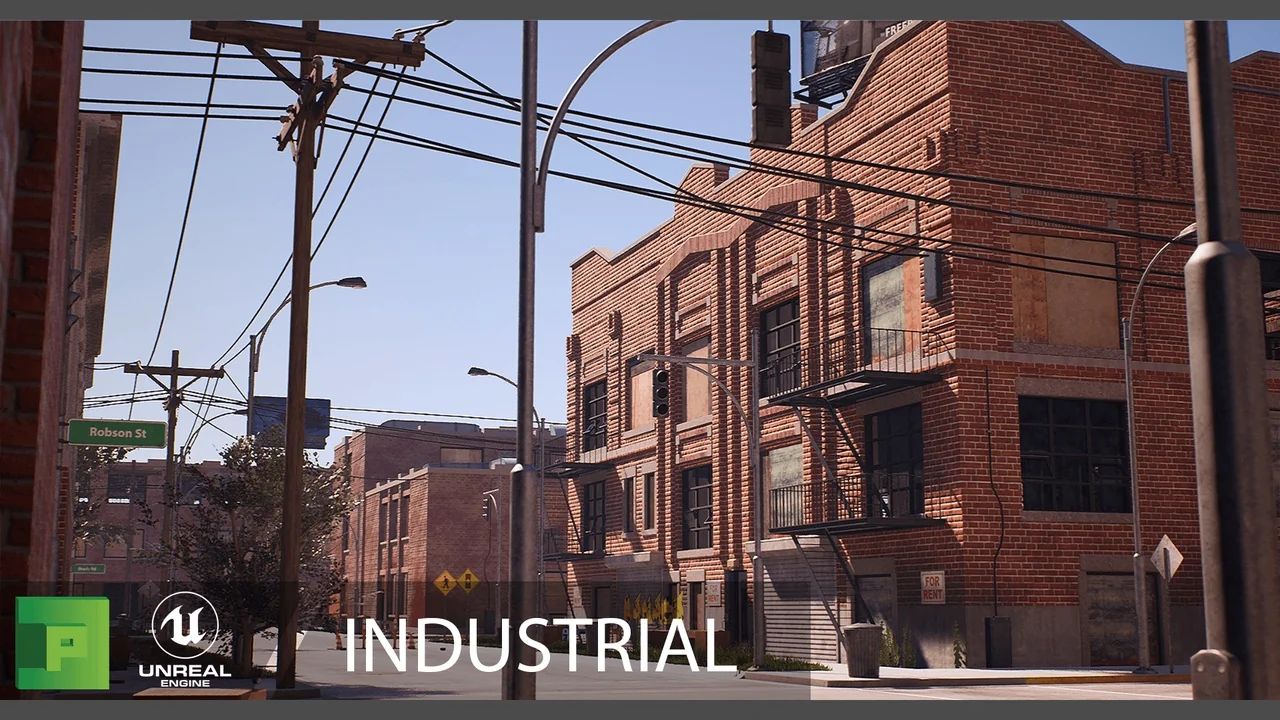
 Cities
 Cities
 Cities