"a19e0535960bd083"{"id":"1002057","slug":"hq-retro-school-bus","title":"HQ Retro School Bus","category":"Vehicles \u0026 Transportation","engine":"4.26+,5.0+","assetVersion":"","engineVersion":"Engine Version: 4.26+,5.0+","tag":"Vehicles","accent":"blue","visual":"mech","summary":"Detailed look at the HQ Retro School Bus featuring clean and abandoned rusty variants, animated doors, aligned pivots, and UE4 drivable vehicle mechanics.","platform":"Unreal Engine","publishedAt":"2026-10-26T15:14:11.469Z","updatedAt":"2026-10-26T15:14:11.469Z","sourceNotes":[],"fileContents":[],"compatibility":["Unreal Engine","Engine Version: 4.26+,5.0+"],"featuredImage":{"alt":"HQ Retro School Bus","src":"/wp-content/uploads/published/2026/10/a70e0d37f377-5083ade9-d21a-4355-8998-da775f79fda3-289ea2cc8e.webp"},"hasDownloadLink":true,"downloads":0,"terms":[{"taxonomy":"category","slug":"vehicles-and-transportation","name":"Vehicles \u0026 Transportation"}],"galleryImages":[{"src":"/wp-content/uploads/published/2026/10/f01188de4599-f43f226a-92ce-49eb-abc2-9e6076a3acef-be78b6907b.webp","alt":"HQ Retro School Bus"},{"src":"/wp-content/uploads/published/2026/10/1da4db0fac0e-828f51f9-c610-46b5-9785-69d71c4f8ddf-63baf98315.webp","alt":"HQ Retro School Bus"},{"src":"/wp-content/uploads/published/2026/10/52166b50d660-c32c957b-c850-4c0a-aa58-407735935435-7e791000d0.webp","alt":"HQ Retro School Bus"},{"src":"/wp-content/uploads/published/2026/10/ef960694bea8-48ed290f-0b06-4d31-a8e0-c3286c9cf15b-19482ebe6e.webp","alt":"HQ Retro School Bus"},{"src":"/wp-content/uploads/published/2026/10/cfda6079cfdb-053c7733-d8a0-45ac-8474-d7866431311d-83d69cd5d5.webp","alt":"HQ Retro School Bus"},{"src":"/wp-content/uploads/published/2026/10/114dd99c0374-bbb9be17-82c7-4246-a5d8-ab8f58bd8a74-6c11f36308.webp","alt":"HQ Retro School Bus"},{"src":"/wp-content/uploads/published/2026/10/eaa275eef741-5e3b92a6-44d5-4327-9359-137d5866d419-e679f59c9e.webp","alt":"HQ Retro School Bus"},{"src":"/wp-content/uploads/published/2026/10/dd379434242d-64f0c80d-0bfc-4657-b3e8-857b73691183-41803dd708.webp","alt":"HQ Retro School Bus"},{"src":"/wp-content/uploads/published/2026/10/19ba235d0eb0-0a771974-ddc1-4e85-9b44-6c20f2d31905-61e7e54486.webp","alt":"HQ Retro School Bus"},{"src":"/wp-content/uploads/published/2026/10/b2c44dbe18a0-09921aa3-d5ef-438d-9f3c-578c5ad54a77-617ee72e15.webp","alt":"HQ Retro School Bus"}],"accessPanel":{"kind":"resource","title":"Download this resource","eyebrow":"Free Download","message":"Log in or create a free account to start your download.","fileName":"Content.7z","safetyNote":"Resources are manually reviewed before listing to improve quality and reduce obvious risks.","actionLabel":"Download Free","resourceType":"Resource archive"},"contentHtml":"\u003ch2\u003eDeploying the 1970s School Bus Across Period and Ruined Environments\u003c/h2\u003e\n\u003cp\u003eStaging a believable roadside sequence often requires heavy vehicles that immediately anchor a scene's timeline and mood. The HQ Retro School Bus addresses distinct production requirements by capturing the signature silhouette of a 1970s passenger transport. Whether an environment demands an operational vehicle traversing a suburban route or an oxidized carcass blocking a rural highway, this model fits into period pieces, modern abandoned zones, and disaster landscapes alike.\u003c/p\u003e\n\u003cp\u003eRural backdrops serve as natural settings for this type of vehicle. Placed near the modular structures of the HQ Retro Farmhouse, the bus acts as a bridge between structural architecture and the open road. In survival, horror, and post-apocalyptic projects, a yellow transport vehicle left rotting in a field instantly establishes a feeling of sudden evacuation or long-term neglect. Because the asset avoids modern aerodynamic curves in favor of the flat paneling, heavy grilles, and utilitarian styling of the 1970s and 1980s, it functions cleanly in historic period projects without feeling misplaced.\u003c/p\u003e \u003ch2\u003eClean and Abandoned Rusty Surface Presentations\u003c/h2\u003e\n\u003cp\u003eTwo distinct visual treatments define how this vehicle can be deployed: clean and abandoned rusty. The clean configuration represents an active, working bus. Its painted panels, untarnished glass, and preserved trim make it immediately usable for living worlds, functional transit depots, school drop-off points, and active roadway traffic in period productions. The surfaces reflect proper vehicle maintenance, allowing creators to drop the vehicle into historical simulations or mid-century municipal environments without needing to hide cosmetic damage.\u003c/p\u003e\n\u003cp\u003eThe abandoned rusty version takes the opposite route, transforming the transport into weathered salvage. This variant features accumulated dirt, heavy oxidization, peeling coloration, and widespread surface decay across the bodywork. It communicates years of environmental exposure, making it well-suited for quarantine zones, overgrown highways, military blockades, and decaying desert junkyards. Rather than merely applying a uniform dirt texture across the exterior, the distressed version accounts for how rust naturally crawls along seams, panel joints, wheel wells, and window seals on heavy machinery.\u003c/p\u003e \u003ch2\u003eExterior and Interior Detail with Animated Components\u003c/h2\u003e\n\u003cp\u003eBoth the clean and abandoned versions feature full development across their exterior and interior spaces. Many vehicle assets treat passenger compartments as low-priority backdrops, but this asset provides an interior that supports close inspections, third-person walkthroughs, and first-person exploration. Players or cameras can move down the center aisle, inspect the seating rows, and position themselves right in the driver's seat.\u003c/p\u003e\n\u003cp\u003eFunctional moving elements are built directly into the geometry:\u003c/p\u003e\n\u003cul\u003e \u003cli\u003e\u003cstrong\u003eAnimated arm-door:\u003c/strong\u003e The folding entry door mechanism operates via an authentic articulated arm, capturing the mechanical folding motion unique to commercial passenger buses.\u003c/li\u003e \u003cli\u003e\u003cstrong\u003eSeparated wheels:\u003c/strong\u003e Each wheel is detached from the chassis mesh, allowing for independent rotation, suspension physics, and custom collision setup.\u003c/li\u003e \u003cli\u003e\u003cstrong\u003eCorrectly aligned steering wheel:\u003c/strong\u003e The steering wheel mesh features its pivot point aligned to its central steering column axis, facilitating clean rotation inputs without wobbling or off-center drift.\u003c/li\u003e\n\u003c/ul\u003e\n\u003cp\u003eHaving properly aligned pivots removes tedious manual correction work during technical setup. When an animator or technical artist needs the steering wheel to respond to player inputs or cinematic keyframes, the asset turns naturally around the intended mechanical angle.\u003c/p\u003e \u003ch2\u003eDriving the Rigged Bus in Unreal Engine 4\u003c/h2\u003e\n\u003cp\u003eBeyond functioning as a static set dressing piece, the package contains an interactive, rigged drivable version of the vehicle. This operational setup allows developers to drive the school bus directly inside game levels, enabling vehicular gameplay, playable escape sequences, or dynamic background traffic without rigging the base mesh from scratch.\u003c/p\u003e\n\u003cp\u003eThe drivable configuration is built specifically for Unreal Engine 4. Within UE4, the rigging coordinates with the engine's native vehicle mechanics, tying together wheel movement, steering input, and chassis motion. Teams targeting UE4 can place the vehicle into a map, configure input bindings, and immediately test driving dynamics across terrain or road systems. When working in later engine generations, the asset continues to serve as a detailed static prop or cinematic asset, but the interactive drivable rigging remains tailored strictly to Unreal Engine 4 environments.\u003c/p\u003e \u003ch2\u003ePractical Workflows for Level Designers and World Builders\u003c/h2\u003e\n\u003cp\u003eIntegrating a vehicle of this scale benefits level designers looking to control player line-of-sight and navigation paths. A 1970s school bus occupies significant physical volume. Parked sideways, it creates an impenetrable barrier for roadside encounters, funnels infantry through narrow choke points, or provides cover during combat scenarios. The fully realized interior also means designers can leave the doors open, turning the interior aisle into an explorable interior tunnel or loot location rather than an impassable prop.\u003c/p\u003e\n\u003cp\u003eThe pairing with rural architectural sets, such as the HQ Retro Farmhouse, simplifies the task of building cohesive mid-century American environments. By sharing design sensibilities rooted in vintage utility, the vehicle blends seamlessly alongside older wood-paneled barns, residential farmhouses, and dirt driveways.\u003c/p\u003e \u003ch2\u003eProduction Utility and Audience Focus\u003c/h2\u003e\n\u003cp\u003eLevel designers building narrative horror games, historical dramas, and survival titles will find the strongest utility in this package. Having both pristine and ruined variants in a single resource eliminates the need to source mismatched models when depicting locations before and after an apocalyptic event. Technical artists developing gameplay on Unreal Engine 4 gain an immediate drivable chassis, while environment artists benefit from aligned mechanical pivots, articulated folding doors, and comprehensive interior modeling that withstand close camera scrutiny.\u003c/p\u003e\n\n\u003ch2\u003eMore From The Same Workflow\u003c/h2\u003e\n\u003cul\u003e\n\u003cli\u003e\u003ca href=\"https://3dcghub.com/vehicles-vol-4-retro-cars-low-poly/\" title=\"Vehicles VOL.4 - Retro Cars (Low Poly)\"\u003eVehicles VOL.4 - Retro Cars (Low Poly)\u003c/a\u003e\u003c/li\u003e\n\u003cli\u003e\u003ca href=\"https://3dcghub.com/vehicles-vol-3-retro-cars-low-poly/\" title=\"Vehicles VOL.3 - Retro Cars (Low Poly)\"\u003eVehicles VOL.3 - Retro Cars (Low Poly)\u003c/a\u003e\u003c/li\u003e\n\u003cli\u003e\u003ca href=\"https://3dcghub.com/vehicles-vol-2-retro-cars-low-poly/\" title=\"Vehicles VOL.2 - Retro Cars (Low Poly)\"\u003eVehicles VOL.2 - Retro Cars (Low Poly)\u003c/a\u003e\u003c/li\u003e\n\u003cli\u003e\u003ca href=\"https://3dcghub.com/drivable-retro-car-farton/\" title=\"Drivable retro car \u0026quot;Farton\u0026quot;\"\u003eDrivable retro car \u0026quot;Farton\u0026quot;\u003c/a\u003e\u003c/li\u003e\n\u003cli\u003e\u003ca href=\"https://3dcghub.com/driveable-steampunk-car-vehicle-steampunk-car-retro-futuristic-victorian/\" title=\"Driveable SteamPunk Car / Vehicle ( SteamPunk Car Retro Futuristic Victorian)\"\u003eDriveable SteamPunk Car / Vehicle ( SteamPunk Car Retro Futuristic Victorian)\u003c/a\u003e\u003c/li\u003e\n\u003c/ul\u003e","contentTextLength":6472,"navigation":{"current":34,"total":4026,"previous":{"id":"1002058","slug":"html-menus-and-pdf-viewer-browser-plugin","title":"HTML Menus and PDF viewer Browser Plugin","category":"Engine Tools","platform":"Unreal Engine","updatedAt":"2026-10-26T15:15:33.420Z"},"next":{"id":"1002056","slug":"hover-controller","title":"Hover Controller","category":"Vehicles \u0026 Transportation","platform":"Unreal Engine","updatedAt":"2026-10-26T15:13:04.821Z"}},"relatedResources":[{"id":"1000707","slug":"vehicles-vol-4-retro-cars-low-poly","title":"Vehicles VOL.4 - Retro Cars (Low Poly)","category":"Vehicles \u0026 Transportation","engine":"5.1+","assetVersion":"","engineVersion":"Engine Version: 5.1+","tag":"Vehicles","accent":"blue","visual":"mech","summary":"Five retro low-poly vehicles with split meshes, 4k textures, tintable paint, channel-packed masks, and Lumen support for Unreal Engine 5.0+.","platform":"Unreal Engine","publishedAt":"2026-07-24T01:51:03.278Z","updatedAt":"2026-07-24T01:51:03.278Z","sourceNotes":[],"fileContents":[],"compatibility":["Unreal Engine","Engine Version: 5.1+"],"featuredImage":{"alt":"Vehicles VOL.4 - Retro Cars (Low Poly)","src":"/wp-content/uploads/published/2026/07/e0d046dad155-ef4a759a-30af-4e29-9985-9418dfe7ed11-02e1c9682c.webp"},"hasDownloadLink":true,"downloads":0},{"id":"1000494","slug":"vehicles-vol-3-retro-cars-low-poly","title":"Vehicles VOL.3 - Retro Cars (Low Poly)","category":"Vehicles \u0026 Transportation","engine":"5.1+","assetVersion":"","engineVersion":"Engine Version: 5.1+","tag":"Vehicles","accent":"blue","visual":"mech","summary":"Five retro low-poly cars with Police and Taxi variants, 4K textures, master material controls, Lumen support for Unreal Engine 5.0+, and custom branding.","platform":"Unreal Engine","publishedAt":"2026-07-13T03:37:05.947Z","updatedAt":"2026-07-13T03:37:05.947Z","sourceNotes":[],"fileContents":[],"compatibility":["Unreal Engine","Engine Version: 5.1+"],"featuredImage":{"alt":"Vehicles VOL.3 - Retro Cars (Low Poly)","src":"/wp-content/uploads/published/2026/07/cc034263a868-564937b7-8588-42e1-a8f1-e2490a8b9177-a0640cadd4.webp"},"hasDownloadLink":true,"downloads":0},{"id":"1000493","slug":"vehicles-vol-2-retro-cars-low-poly","title":"Vehicles VOL.2 - Retro Cars (Low Poly)","category":"Vehicles \u0026 Transportation","engine":"5.1+","assetVersion":"","engineVersion":"Engine Version: 5.1+","tag":"Vehicles","accent":"blue","visual":"mech","summary":"Unreal Engine retro low poly car pack with 5 vehicles plus a police variant, 4k textures, channel-packed maps, tintable paint, Lumen support, and custom brandin","platform":"Unreal Engine","publishedAt":"2026-07-13T03:29:26.435Z","updatedAt":"2026-07-13T03:29:26.435Z","sourceNotes":[],"fileContents":[],"compatibility":["Unreal Engine","Engine Version: 5.1+"],"featuredImage":{"alt":"Vehicles VOL.2 - Retro Cars (Low Poly)","src":"/wp-content/uploads/published/2026/07/f275bb8c8319-9f01aaab-c8f7-4797-b97a-53a94f84b3e1-987760189e.webp"},"hasDownloadLink":true,"downloads":0}]}
Vehicles
HQ Retro School Bus
Detailed look at the HQ Retro School Bus featuring clean and abandoned rusty variants, animated doors, aligned pivots, and UE4 drivable vehicle mechanics.
Deploying the 1970s School Bus Across Period and Ruined Environments
Staging a believable roadside sequence often requires heavy vehicles that immediately anchor a scene's timeline and mood. The HQ Retro School Bus addresses distinct production requirements by capturing the signature silhouette of a 1970s passenger transport. Whether an environment demands an operational vehicle traversing a suburban route or an oxidized carcass blocking a rural highway, this model fits into period pieces, modern abandoned zones, and disaster landscapes alike.
Rural backdrops serve as natural settings for this type of vehicle. Placed near the modular structures of the HQ Retro Farmhouse, the bus acts as a bridge between structural architecture and the open road. In survival, horror, and post-apocalyptic projects, a yellow transport vehicle left rotting in a field instantly establishes a feeling of sudden evacuation or long-term neglect. Because the asset avoids modern aerodynamic curves in favor of the flat paneling, heavy grilles, and utilitarian styling of the 1970s and 1980s, it functions cleanly in historic period projects without feeling misplaced.
Clean and Abandoned Rusty Surface Presentations
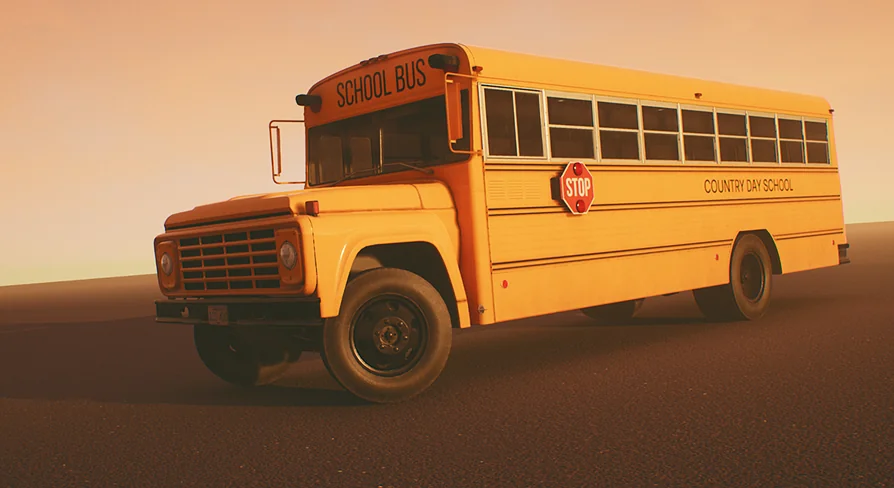
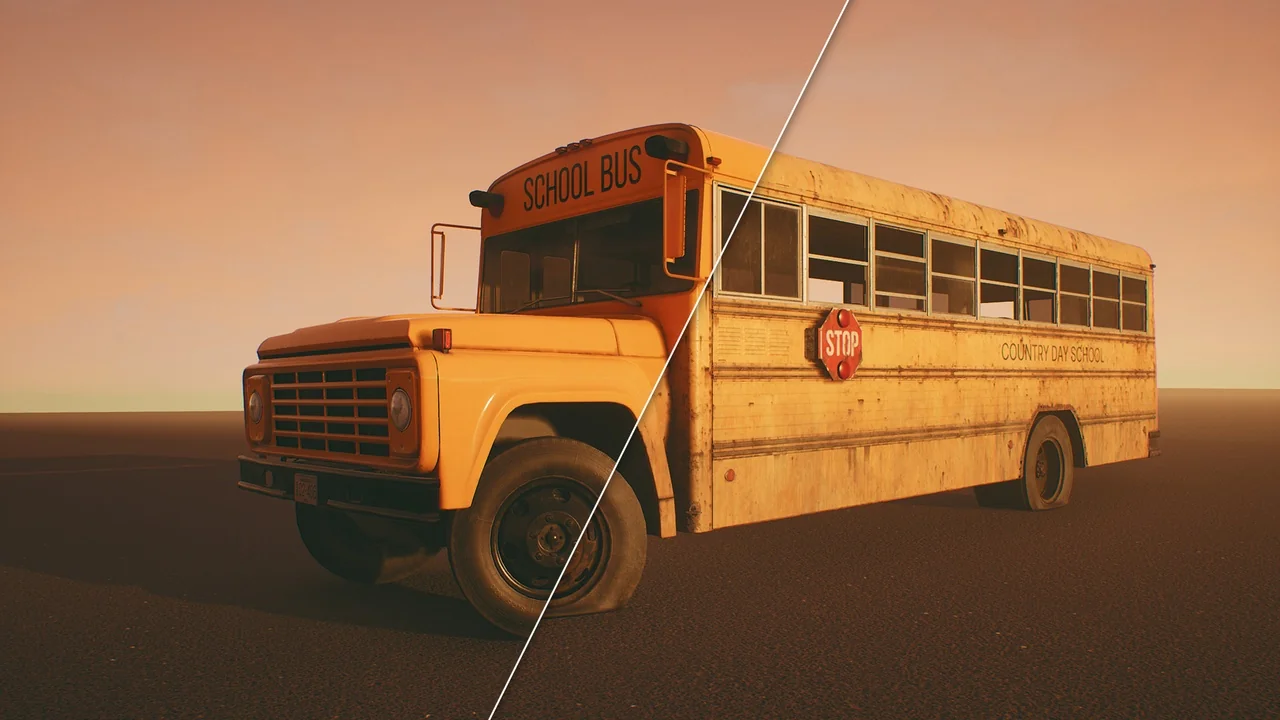
Two distinct visual treatments define how this vehicle can be deployed: clean and abandoned rusty. The clean configuration represents an active, working bus. Its painted panels, untarnished glass, and preserved trim make it immediately usable for living worlds, functional transit depots, school drop-off points, and active roadway traffic in period productions. The surfaces reflect proper vehicle maintenance, allowing creators to drop the vehicle into historical simulations or mid-century municipal environments without needing to hide cosmetic damage.
The abandoned rusty version takes the opposite route, transforming the transport into weathered salvage. This variant features accumulated dirt, heavy oxidization, peeling coloration, and widespread surface decay across the bodywork. It communicates years of environmental exposure, making it well-suited for quarantine zones, overgrown highways, military blockades, and decaying desert junkyards. Rather than merely applying a uniform dirt texture across the exterior, the distressed version accounts for how rust naturally crawls along seams, panel joints, wheel wells, and window seals on heavy machinery.
Exterior and Interior Detail with Animated Components
Both the clean and abandoned versions feature full development across their exterior and interior spaces. Many vehicle assets treat passenger compartments as low-priority backdrops, but this asset provides an interior that supports close inspections, third-person walkthroughs, and first-person exploration. Players or cameras can move down the center aisle, inspect the seating rows, and position themselves right in the driver's seat.
Functional moving elements are built directly into the geometry:
Animated arm-door: The folding entry door mechanism operates via an authentic articulated arm, capturing the mechanical folding motion unique to commercial passenger buses.
Separated wheels: Each wheel is detached from the chassis mesh, allowing for independent rotation, suspension physics, and custom collision setup.
Correctly aligned steering wheel: The steering wheel mesh features its pivot point aligned to its central steering column axis, facilitating clean rotation inputs without wobbling or off-center drift.
Having properly aligned pivots removes tedious manual correction work during technical setup. When an animator or technical artist needs the steering wheel to respond to player inputs or cinematic keyframes, the asset turns naturally around the intended mechanical angle.
Driving the Rigged Bus in Unreal Engine 4
Beyond functioning as a static set dressing piece, the package contains an interactive, rigged drivable version of the vehicle. This operational setup allows developers to drive the school bus directly inside game levels, enabling vehicular gameplay, playable escape sequences, or dynamic background traffic without rigging the base mesh from scratch.
The drivable configuration is built specifically for Unreal Engine 4. Within UE4, the rigging coordinates with the engine's native vehicle mechanics, tying together wheel movement, steering input, and chassis motion. Teams targeting UE4 can place the vehicle into a map, configure input bindings, and immediately test driving dynamics across terrain or road systems. When working in later engine generations, the asset continues to serve as a detailed static prop or cinematic asset, but the interactive drivable rigging remains tailored strictly to Unreal Engine 4 environments.
Practical Workflows for Level Designers and World Builders
Integrating a vehicle of this scale benefits level designers looking to control player line-of-sight and navigation paths. A 1970s school bus occupies significant physical volume. Parked sideways, it creates an impenetrable barrier for roadside encounters, funnels infantry through narrow choke points, or provides cover during combat scenarios. The fully realized interior also means designers can leave the doors open, turning the interior aisle into an explorable interior tunnel or loot location rather than an impassable prop.
The pairing with rural architectural sets, such as the HQ Retro Farmhouse, simplifies the task of building cohesive mid-century American environments. By sharing design sensibilities rooted in vintage utility, the vehicle blends seamlessly alongside older wood-paneled barns, residential farmhouses, and dirt driveways.
Production Utility and Audience Focus
Level designers building narrative horror games, historical dramas, and survival titles will find the strongest utility in this package. Having both pristine and ruined variants in a single resource eliminates the need to source mismatched models when depicting locations before and after an apocalyptic event. Technical artists developing gameplay on Unreal Engine 4 gain an immediate drivable chassis, while environment artists benefit from aligned mechanical pivots, articulated folding doors, and comprehensive interior modeling that withstand close camera scrutiny.
 Vehicles
 Vehicles
 Vehicles
 Vehicles