Framework Integration and Pipeline Compatibility
GIBLION 2024 is designed as a specialized anime scene generation framework tailored for the Unity3D Universal Render Pipeline (URP). The system is built to function within specific long-term support (LTS) environments, notably Unity 2022.3 LTS and the more recent Unity 6 LTS. For developers working within Unity 6, the framework specifically operates using RenderGraph mode, reflecting a transition toward modern rendering architectures. It is important to note that the legacy compatibility mode in Unity 6 is not supported, making the adoption of RenderGraph a requirement for implementation in that version.
The development foundation of the asset rests on Unity 2022.3.18f1 LTS. While the system is designed to accommodate later versions, the developer indicates that technical updates and patches are applied as new Unity versions are released to address potential pipeline breakages. For projects still utilizing Unity 2021.3, the workflow requires the use of the original legacy GIBLION asset rather than the 2024 edition.
Shading Techniques and Non-Photorealistic Rendering
The framework approaches anime aesthetics through a combination of shader-based techniques and post-processing image effects. This dual approach allows for a high degree of control over Non-Photorealistic Rendering (NPR) styles. The system includes multiple toon and anime shading models, which are supplemented by dedicated outlining tools to define character and object edges in a way that mimics hand-drawn animation.
By integrating both standard shaders and image-based FX, the framework enables the layering of stylized visuals. This includes specialized toon water rendering and a dedicated system for river shading. The latter is paired with a spline-based river generator, allowing the stylized water to follow complex paths through a scene while maintaining consistent anime-style light behavior and surface characteristics.
Environmental Systems and Foliage Generation
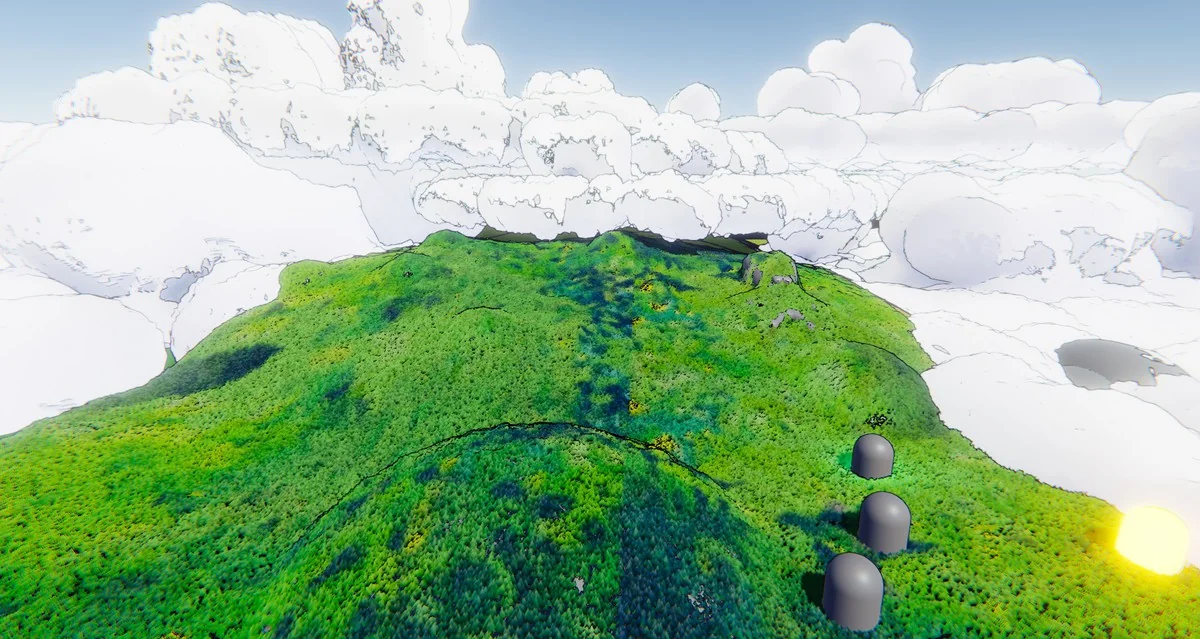
A significant portion of the GIBLION 2024 toolkit focuses on the procedural and particle-based generation of environmental elements. Rather than relying solely on static meshes, the system utilizes a blob-based creation method for both cloud formations and tree structures. This approach allows users to define the volume and silhouette of environmental assets, which are then rendered with anime-specific shaders to create a cohesive visual style across the sky and terrain.
For ground-level detail, the framework implements a dynamic grass system inspired by the “Wind Walker” aesthetic. This system is designed for movement and responsiveness, simulating wind patterns through the vegetation. Foliage generation is further handled through a particle-based system, which provides a different workflow compared to traditional manual placement or mesh-painting methods. This is designed to work in tandem with the terrain systems to populate scenes with dense, stylized greenery.
Dynamic Dynamics and Specialized Tools
Beyond static environment assets, the framework includes tools for dynamic scene elements. A dynamic wires system is included to handle hanging cables or power lines, adding structural detail to urban or industrial anime settings. These elements interact with the broader scene logic to maintain the stylized look of the environment.
Atmospheric elements are also addressed through the inclusion of sky tools. By combining the blob-based cloud system with the framework’s NPR shaders, developers can create complex skyboxes that match the lighting and color palettes of the terrain and water. The interplay between these systems—sky, water, terrain, and foliage—is intended to provide a unified framework where the different components of the scene react predictably to the anime-style rendering rules.
Technical Limitations and Platform Support
When implementing GIBLION 2024, there are several technical constraints regarding hardware and platforms. The system is primarily developed and tested for desktop environments. As of the current version, the system has not been tested for use with VR, mobile devices, consoles, WebGL, OpenGL, or Linux environments.
Specific hardware limitations exist for Mac users. Certain rendering modes within the framework are built upon a Geometry Shader base, which is incompatible with the Mac platform. Consequently, these specific modes will not function on macOS, though other aspects of the system may remain accessible depending on the specific rendering techniques chosen. Developers should consider these platform-specific limitations during the initial setup and implementation phase of their projects.
The system remains in active development, with future updates planned to align with the ongoing evolution of Unity 6 and user requirements. This initial version of the 2024 framework serves as a foundation for NPR scene creation, focusing on the core pillars of stylized shading, procedural environment generation, and dynamic vegetation.
Preview Images
Protected download
Access this resource
All resources are 100% manually reviewed to eliminate all risks.