"0341a2901a4ae9aa"{"id":"27702","slug":"fruit-tree-collection","title":"Fruit Tree Collection","category":"Trees","engine":"5.3+","assetVersion":"Engine version: 5.3+","engineVersion":"","tag":"Trees","accent":"blue","visual":"mech","summary":"Fruit Tree Collection brings together 42 highly detailed tree models with a broad spread of fruit-bearing varieties. With nanite foliage support for Unreal Engine 5.2 and above, it gives environment artists a ready mix of orchard staples and specialty trees...","platform":"Unreal Engine","publishedAt":"2026-04-28T15:14:09.000Z","updatedAt":"2026-04-28T15:14:10.000Z","sourceNotes":[],"fileContents":[],"compatibility":["Unreal Engine","Engine version: 5.3+"],"featuredImage":{"alt":"Fruit Tree Collection","src":"https://3dcghub.com/wp-content/uploads/2026/04/c8cfe33bec26_86d45ea7-6d4a-46bf-b3d5-0ab0289fff24.webp"},"hasDownloadLink":true,"downloads":1,"terms":[{"taxonomy":"category","slug":"trees","name":"Trees"},{"taxonomy":"post_tag","slug":"environment","name":"Environment"},{"taxonomy":"post_tag","slug":"unreal-engine-5","name":"Unreal Engine 5"}],"galleryImages":[{"src":"https://3dcghub.com/wp-content/uploads/2026/04/7e9dfbc0e839_00ea232f-bd1d-4a70-a885-22e39ec012bf.webp","alt":"Fruit Tree Collection"},{"src":"https://3dcghub.com/wp-content/uploads/2026/04/9a00dd0cc2a6_75236410-3c88-4f1f-8573-d2da5a7d2a78.webp","alt":"Fruit Tree Collection"},{"src":"https://3dcghub.com/wp-content/uploads/2026/04/31a0131d1d48_4a629327-ebb1-4aec-9890-0d14ea5f0491.webp","alt":"Fruit Tree Collection"},{"src":"https://3dcghub.com/wp-content/uploads/2026/04/5375a00c9503_886bd13a-41a7-4c88-ba18-d339bd782018.webp","alt":"Fruit Tree Collection"},{"src":"https://3dcghub.com/wp-content/uploads/2026/04/82554c1694b5_f80cd96d-25c2-4a17-9199-8739bebcaf20.webp","alt":"Fruit Tree Collection"},{"src":"https://3dcghub.com/wp-content/uploads/2026/04/2681708116b2_879cdd4e-76ea-4455-9ab9-2321cd19f005.webp","alt":"Fruit Tree Collection"},{"src":"https://3dcghub.com/wp-content/uploads/2026/04/ea64715db282_4e16fa20-e088-4914-b6fb-25e07d022a79.webp","alt":"Fruit Tree Collection"},{"src":"https://3dcghub.com/wp-content/uploads/2026/04/468c143cba2a_7cef8f1f-579d-45f9-92f5-d5d92404a5a8.webp","alt":"Fruit Tree Collection"},{"src":"https://3dcghub.com/wp-content/uploads/2026/04/2a1ba21ab657_ec5d91a8-5d46-4f2e-9823-caa4da06acad.webp","alt":"Fruit Tree Collection"}],"accessPanel":{"kind":"resource","title":"Access this resource","eyebrow":"Free Download","message":"Log in or create a free account to start your download.","fileName":"Content.7z","safetyNote":"All resources are 100% manually reviewed to eliminate all risks.","actionLabel":"Download Free","resourceType":"Resource archive"},"contentHtml":"\u003cp\u003eDense orchard rows, mixed groves, and standalone hero trees all read differently once the species start to vary. Fruit Tree Collection leans into that visual range with 42 highly detailed tree models, giving artists a set that can shift a scene from uniform planting to something richer and more location-specific.\u003c/p\u003e\u003cp\u003eThe collection was created in partnership with the 3D modelling team at Pandora Land, and its focus stays clear: detailed fruit trees that can hold up as foliage in Unreal Engine scenes. Instead of revolving around one species repeated over and over, the pack spreads its attention across common orchard trees as well as a smaller number of less frequently seen varieties.\u003c/p\u003e\u003ch2\u003eFruit Tree Collection changes the look of an orchard quickly\u003c/h2\u003e\u003cp\u003eThe largest share of the set goes to apple trees, with 12 included. Lemon trees follow with 8, while orange trees and peach trees each appear 4 times. That alone gives enough variation to shape sizable fruit-growing areas without relying on a single tree silhouette.\u003c/p\u003e\u003cp\u003eThe rest of the lineup adds smaller but useful clusters: 2 cherry trees, 2 tangerine trees, 2 pear trees, 2 persimmon trees, 2 mango trees, and 2 stone pine trees. The collection rounds out with 1 pomegranate tree and 1 plum tree.\u003c/p\u003e\u003cp\u003eThose numbers matter in practice because they create a natural balance between repetition and contrast. The higher counts on apples and lemons suit broader orchard coverage, while the lower-count species can break up the rhythm of a planted environment or act as more distinctive accents within a larger foliage pass.\u003c/p\u003e\u003ch2\u003eApple Trees, Lemon Trees, and mixed species for scene variety\u003c/h2\u003e\u003cp\u003eThe species mix gives the collection a flexible identity. Apple, lemon, orange, and peach trees support scenes that need recognizable fruit agriculture at a glance. Cherry, pear, persimmon, mango, pomegranate, and plum widen the visual language without pushing the set away from a fruit-focused theme.\u003c/p\u003e\u003cp\u003eStone pine trees stand out in that lineup. Their inclusion means the collection is not limited to only fruit-bearing shapes, which can help when building more layered planting layouts around orchard edges or transitional outdoor spaces. Even within a fruit-driven environment, that kind of variation can stop the scene from feeling too neat or too repetitive.\u003c/p\u003e\u003cp\u003eFor developers, the spread of tree types can also affect gameplay readability in simple but meaningful ways. Different species can mark distinct zones, routes, or points of interest purely through visual change. For artists, the same spread makes it easier to compose frames that feel cultivated rather than cloned.\u003c/p\u003e\u003ch2\u003eNanite foliage in UE 5.2+\u003c/h2\u003e\u003cp\u003eFruit Tree Collection takes advantage of the nanite foliage feature available in Unreal Engine versions 5.2 and above. That puts the collection squarely in a modern Unreal workflow where high-detail foliage can play a central role in the final scene rather than being treated as background dressing only.\u003c/p\u003e\u003cp\u003eThe technical note here is brief but important. This is not presented as a general-purpose tree set with unspecified engine support; it specifically targets Unreal Engine 5.2+ through nanite foliage. For teams already building environments in that range of Unreal versions, that makes the collection easier to evaluate as part of a foliage-heavy scene pipeline.\u003c/p\u003e\u003cp\u003eBecause the trees are described as highly detailed, the nanite foliage support is also part of the collection's core identity rather than an incidental extra. The visual ambition and the engine feature are presented together.\u003c/p\u003e\u003ch2\u003eVersion updates add fruit detail and nanite assembly assets\u003c/h2\u003e\u003cp\u003eThe update history shows steady refinement across multiple releases. Version 1.1, released on 25/11/23, focused on bug fixes. Version 1.2, released on 18/01/24, improved fruit detail for most of the collection.\u003c/p\u003e\u003cp\u003eThat second update is especially relevant for close and mid-range presentation, since fruit detail is one of the defining visual traits of this set. When a collection is centered on recognizable produce trees rather than generic broadleaf foliage, the fruit itself becomes part of the silhouette and part of the read.\u003c/p\u003e\u003cp\u003eVersion 1.3, released on 01/02/26, added 3 nanite assembly assets. That continues the Unreal-focused direction of the pack and gives the later version a more specific nanite-related expansion instead of limiting updates to fixes alone.\u003c/p\u003e\u003ch3\u003eWhere Fruit Tree Collection fits best\u003c/h3\u003e\u003cp\u003eThis collection is strongest when a project needs more than one type of orchard tree and wants that variety to be visible immediately. The 42-model count, the emphasis on detailed fruit trees, and the spread from apples and lemons through mango, persimmon, pomegranate, and plum make it a practical choice for scenes that benefit from species contrast instead of a single repeated foliage asset.\u003c/p\u003e\u003cp\u003eThe clearest takeaway is simple: for Unreal Engine 5.2+ projects using nanite foliage, Fruit Tree Collection offers a broad orchard-ready mix with enough variety to make planted outdoor spaces feel more deliberate and less uniform.\u003c/p\u003e","contentTextLength":5048,"navigation":{"current":2240,"total":4017,"previous":{"id":"27714","slug":"gasp-basic-template-for-fps-with-spatial-inventory","title":"GASP: Basic Template for FPS with Spatial Inventory","category":"Gameplay Features","platform":"Unreal Engine","updatedAt":"2026-04-28T15:48:40.000Z"},"next":{"id":"27690","slug":"forest-essentials-forest-environment-procedural-mountain-forest-forest","title":"Forest Essentials ( Forest Environment , Procedural Mountain Forest, Forest )","category":"Forest \u0026 Jungle","platform":"Unreal Engine","updatedAt":"2026-04-28T13:59:45.000Z"}},"relatedResources":[{"id":"4255","slug":"realistic-trees-2","title":"Realistic Trees 2","category":"Trees","engine":"4.26+,5.0+","assetVersion":"Engine version: 4.26+,5.0+","engineVersion":"4.19","tag":"Trees","accent":"blue","visual":"audio","summary":"Enhance your projects with 45 realistic tree meshes. Features include 4 LODs, customizable wind systems, and seasonal variations for high-quality game worlds.","platform":"Unreal Engine","publishedAt":"2026-02-10T11:47:41.000Z","updatedAt":"2026-04-19T15:57:11.000Z","sourceNotes":[],"fileContents":[],"compatibility":["Unreal Engine","Engine version: 4.26+,5.0+"],"featuredImage":{"alt":"Realistic Trees 2","src":"https://3dcghub.com/wp-content/uploads/2026/02/8eacf7cb-8eea-490b-a096-197a3017e018.webp"},"hasDownloadLink":true,"downloads":1},{"id":"1000006","slug":"foliage-vol-24-farming-plants-low-poly","title":"Foliage VOL.24 - Farming Plants (Low Poly)","category":"Trees","engine":"5.1+","assetVersion":"","engineVersion":"5.1+","tag":"Trees","accent":"blue","visual":"mech","summary":"A collection of 54 optimized farming plant meshes featuring 4K textures, Nanite geometry, Lumen support, and a master material setup for Unreal Engine 5.0+.","platform":"Unreal Engine","publishedAt":"2026-05-19T16:47:59.873Z","updatedAt":"2026-05-19T16:47:59.873Z","sourceNotes":[],"fileContents":[],"compatibility":["Unreal Engine","Engine version: 5.1+"],"featuredImage":{"alt":"Foliage VOL.24 - Farming Plants (Low Poly)","src":"/wp-content/uploads/published/2026/05/3b7fd447288f-8c01c0ae-718e-494f-9a1e-7a7d7b92b157-c5d9fedc75.webp"},"hasDownloadLink":true,"downloads":1},{"id":"25171","slug":"vegetation-pack-vegetation-pack-vegetations-trees-bushes-grass-plants-3d","title":"Vegetation Pack ( Vegetation Pack Vegetations Trees Bushes Grass Plants 3D )","category":"Trees","engine":"5.1+","assetVersion":"Engine version: 5.1+","engineVersion":"","tag":"Trees","accent":"blue","visual":"city","summary":"This vegetation pack gives environment artists a ready set of trees, bushes, grass, plants, and ivy for real-time scenes. It focuses on 45 unique meshes, high-quality detail, and Unreal Engine 5.0+ support for Nanite and Lumen.","platform":"Unreal Engine","publishedAt":"2026-04-19T12:04:15.000Z","updatedAt":"2026-04-20T06:12:31.000Z","sourceNotes":[],"fileContents":[],"compatibility":["Unreal Engine","Engine version: 5.1+"],"featuredImage":{"alt":"Vegetation Pack ( Vegetation Pack Vegetations Trees Bushes Grass Plants 3D )","src":"https://3dcghub.com/wp-content/uploads/2026/04/1097b3f2c0ce_ef3a8667-121d-4e2d-bc04-61b161a6a408.webp"},"hasDownloadLink":true,"downloads":0}]}
Trees
Fruit Tree Collection
Fruit Tree Collection brings together 42 highly detailed tree models with a broad spread of fruit-bearing varieties. With nanite foliage support for Unreal Engine 5.2 and above, it gives environment artists a ready mix of orchard staples and specialty trees...
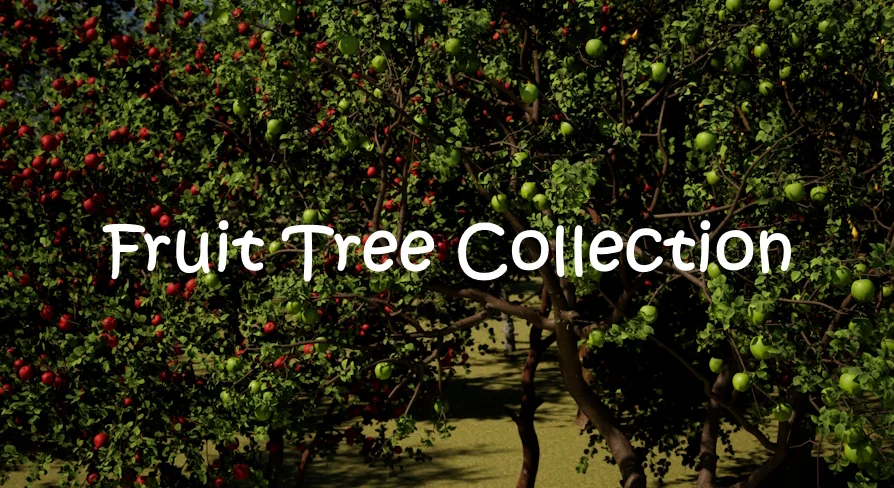
Dense orchard rows, mixed groves, and standalone hero trees all read differently once the species start to vary. Fruit Tree Collection leans into that visual range with 42 highly detailed tree models, giving artists a set that can shift a scene from uniform planting to something richer and more location-specific.
The collection was created in partnership with the 3D modelling team at Pandora Land, and its focus stays clear: detailed fruit trees that can hold up as foliage in Unreal Engine scenes. Instead of revolving around one species repeated over and over, the pack spreads its attention across common orchard trees as well as a smaller number of less frequently seen varieties.
Fruit Tree Collection changes the look of an orchard quickly
The largest share of the set goes to apple trees, with 12 included. Lemon trees follow with 8, while orange trees and peach trees each appear 4 times. That alone gives enough variation to shape sizable fruit-growing areas without relying on a single tree silhouette.
The rest of the lineup adds smaller but useful clusters: 2 cherry trees, 2 tangerine trees, 2 pear trees, 2 persimmon trees, 2 mango trees, and 2 stone pine trees. The collection rounds out with 1 pomegranate tree and 1 plum tree.
Those numbers matter in practice because they create a natural balance between repetition and contrast. The higher counts on apples and lemons suit broader orchard coverage, while the lower-count species can break up the rhythm of a planted environment or act as more distinctive accents within a larger foliage pass.
Apple Trees, Lemon Trees, and mixed species for scene variety
The species mix gives the collection a flexible identity. Apple, lemon, orange, and peach trees support scenes that need recognizable fruit agriculture at a glance. Cherry, pear, persimmon, mango, pomegranate, and plum widen the visual language without pushing the set away from a fruit-focused theme.
Stone pine trees stand out in that lineup. Their inclusion means the collection is not limited to only fruit-bearing shapes, which can help when building more layered planting layouts around orchard edges or transitional outdoor spaces. Even within a fruit-driven environment, that kind of variation can stop the scene from feeling too neat or too repetitive.
For developers, the spread of tree types can also affect gameplay readability in simple but meaningful ways. Different species can mark distinct zones, routes, or points of interest purely through visual change. For artists, the same spread makes it easier to compose frames that feel cultivated rather than cloned.
Nanite foliage in UE 5.2+
Fruit Tree Collection takes advantage of the nanite foliage feature available in Unreal Engine versions 5.2 and above. That puts the collection squarely in a modern Unreal workflow where high-detail foliage can play a central role in the final scene rather than being treated as background dressing only.
The technical note here is brief but important. This is not presented as a general-purpose tree set with unspecified engine support; it specifically targets Unreal Engine 5.2+ through nanite foliage. For teams already building environments in that range of Unreal versions, that makes the collection easier to evaluate as part of a foliage-heavy scene pipeline.
Because the trees are described as highly detailed, the nanite foliage support is also part of the collection's core identity rather than an incidental extra. The visual ambition and the engine feature are presented together.
Version updates add fruit detail and nanite assembly assets
The update history shows steady refinement across multiple releases. Version 1.1, released on 25/11/23, focused on bug fixes. Version 1.2, released on 18/01/24, improved fruit detail for most of the collection.
That second update is especially relevant for close and mid-range presentation, since fruit detail is one of the defining visual traits of this set. When a collection is centered on recognizable produce trees rather than generic broadleaf foliage, the fruit itself becomes part of the silhouette and part of the read.
Version 1.3, released on 01/02/26, added 3 nanite assembly assets. That continues the Unreal-focused direction of the pack and gives the later version a more specific nanite-related expansion instead of limiting updates to fixes alone.
Where Fruit Tree Collection fits best
This collection is strongest when a project needs more than one type of orchard tree and wants that variety to be visible immediately. The 42-model count, the emphasis on detailed fruit trees, and the spread from apples and lemons through mango, persimmon, pomegranate, and plum make it a practical choice for scenes that benefit from species contrast instead of a single repeated foliage asset.
The clearest takeaway is simple: for Unreal Engine 5.2+ projects using nanite foliage, Fruit Tree Collection offers a broad orchard-ready mix with enough variety to make planted outdoor spaces feel more deliberate and less uniform.
Preview Gallery
Resource screenshots
9 curated preview images
1 / 9
Free Download
Download this resource
Log in or create a free account to start your download.
All resources are 100% manually reviewed to eliminate all risks.
 Trees
Trees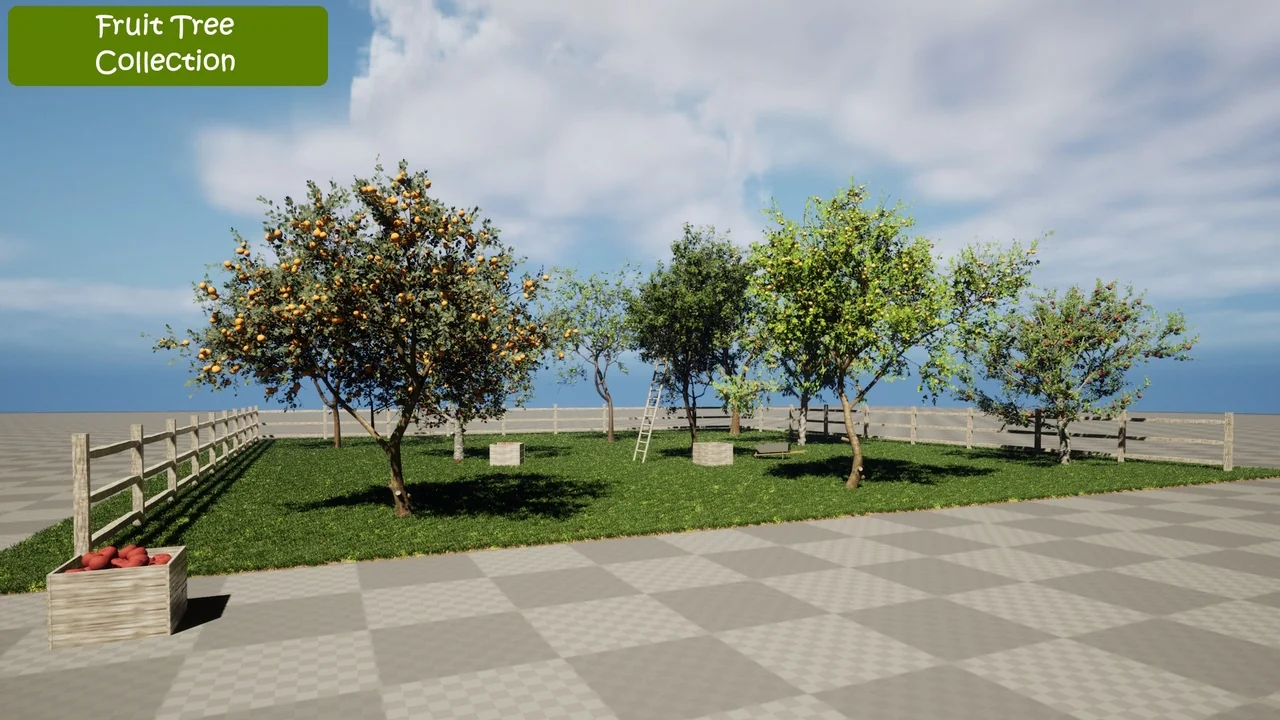
 Trees
Trees Trees
Trees Trees
Trees