"d037b61901c110d2"{"id":"1002667","slug":"forest-of-spikes","title":"Forest Of Spikes","category":"Fantasy","engine":"5.6+","assetVersion":"","engineVersion":"Engine Version: 5.6+","tag":"Fantasy","accent":"blue","visual":"mech","summary":"Technical breakdown of Forest Of Spikes in Unreal Engine 5.6, covering Nanite meshes, wind pivot textures, lighting blueprints, and demo levels.","platform":"Unreal Engine","indexPolicy":"index","publishedAt":"2026-11-16T22:16:40.385Z","updatedAt":"2026-11-16T22:16:40.385Z","sourceNotes":[],"fileContents":[],"compatibility":["Unreal Engine","Engine Version: 5.6+"],"featuredImage":{"alt":"Forest Of Spikes","src":"/wp-content/uploads/published/2026/11/416f4147ae3c-2fd0c997-e8d6-4905-bb78-50c323fd4f10-a5032f24c3.webp"},"fileSizeBytes":438692011,"hasDownloadLink":true,"downloads":0,"terms":[{"taxonomy":"category","slug":"fantasy","name":"Fantasy"}],"galleryImages":[{"src":"/wp-content/uploads/published/2026/11/0b29dbca3f29-f05532a3-35c9-4e43-87c3-4ae37f368cb1-27d398e66d.webp","alt":"Forest Of Spikes"},{"src":"/wp-content/uploads/published/2026/11/9ada9588c6ce-2dec44a6-6ccc-4aa4-ac7e-f3532a64feb8-49f2392365.webp","alt":"Forest Of Spikes"},{"src":"/wp-content/uploads/published/2026/11/49640161d0fa-440bf21d-8567-4e7b-a39e-33fd03fd5506-b721d2326b.webp","alt":"Forest Of Spikes"},{"src":"/wp-content/uploads/published/2026/11/fa462e486913-fc6d1c62-8a62-4424-b43a-603289e55db2-598232f3fd.webp","alt":"Forest Of Spikes"},{"src":"/wp-content/uploads/published/2026/11/4fa19eb70f6f-a5569955-18ca-4f82-8391-af0b13244c25-2fc9472af3.webp","alt":"Forest Of Spikes"},{"src":"/wp-content/uploads/published/2026/11/597672cb1ef8-3d7c7218-b454-497a-b364-1ca9ec189289-09d73b7002.webp","alt":"Forest Of Spikes"},{"src":"/wp-content/uploads/published/2026/11/45e7a70f9f1e-b70e6656-a026-49a6-b7ca-35b5f65540db-daba7190db.webp","alt":"Forest Of Spikes"},{"src":"/wp-content/uploads/published/2026/11/d08a6ff83cfd-b84c07d8-1957-456e-8dbc-f7886ad02b9f-ecbd154258.webp","alt":"Forest Of Spikes"},{"src":"/wp-content/uploads/published/2026/11/a687b9cf741e-ddf5a36a-9a2c-473a-85e4-34dc74b583dc-678ffac698.webp","alt":"Forest Of Spikes"},{"src":"/wp-content/uploads/published/2026/11/325bd0ba30b6-18004cc6-ca1c-40c0-98f3-8ce3f6044136-fcd3c2f4a5.webp","alt":"Forest Of Spikes"}],"accessPanel":{"kind":"resource","title":"Get this resource","eyebrow":"Free resource","message":"Download this resource in your browser.","fileName":"Content.7z","safetyNote":"Resources are manually reviewed before listing to improve quality and reduce obvious risks.","actionLabel":"Get this resource","resourceType":"Resource archive","versions":[]},"contentHtml":"\u003ch2\u003eImporting and Geometry Pipeline in Forest Of Spikes\u003c/h2\u003e\u003cp\u003eIntegrating Forest Of Spikes into an active project starts inside Unreal Engine 5.6 or later builds. The package bypasses traditional discrete Level of Detail chains by running directly on the Nanite virtualized geometry framework. This rendering path handles the high-density vertex distribution across 18 unique static meshes, eliminating manual screen-percentage transitions and popping artifacts during camera movements.\u003c/p\u003e\u003cp\u003eThe mesh collection focuses on dead, twisted, and thorned botanical silhouettes suitable for dark fantasy, survival horror, and cursed swamp biomes. The geometry incorporates thorns, exposed roots, dry limbs, and sharp architectural vegetation. Because Nanite governs geometric density at runtime, performance scaling depends on virtualized cluster management rather than generated LOD cascades. Every piece in the 18-mesh set ships with custom collision already mapped to the surfaces, preventing players from clipping through complex clusters of spikes or getting trapped inside hollowed, twisted branch roots.\u003c/p\u003e\u003ch2\u003eMaterial Setup and Wind Pivot Architecture in the Spikes Environment\u003c/h2\u003e\u003cp\u003eSurfacing across the asset kit relies on a lean base of 6 master materials extended through 26 specialized material instances. This hierarchy gives technical artists direct control over surface parameters without compiling redundant shader code across every dead trunk, vine cluster, or spike formation.\u003c/p\u003e\u003cp\u003eTexture distribution across the library covers 44 distinct graphic files structured into functional resolution brackets:\u003c/p\u003e\u003cul\u003e\u003cli\u003e13 textures rendered at 4K resolution (4096\u0026times;4096) for primary bark surfaces, root trunks, and foreground silhouettes.\u003c/li\u003e\u003cli\u003e1 texture mapped at 2K resolution (2048\u0026times;2048) for secondary structural accents.\u003c/li\u003e\u003cli\u003e7 textures sized at 1K resolution (1024\u0026times;1024) for fine detail patterns and utility masks.\u003c/li\u003e\u003cli\u003e23 textures authored at arbitrary sizes expressly engineered to supply hierarchical wind pivots.\u003c/li\u003e\u003c/ul\u003e\u003cp\u003eThe hierarchical wind pivot textures carry specialized spatial offset data directly into the material shaders. Rather than applying a single uniform wave displacement across an entire static trunk, the vertex shader reads coordinate pivots from these dedicated maps. The package then offers segmented motion where thicker core trunks retain rigid anchoring while slender branches, dangling vines, and thorned shoots oscillate based on nested wind weights. Surface materials also link into an included custom water material designed to pool beneath stagnant roots, mist-covered bogs, and murky swamp beds.\u003c/p\u003e\u003ch2\u003eAtmospheric FX, Water, and Interactive Blueprints\u003c/h2\u003e\u003cp\u003eSetting up scene ambiance involves several utility assets packaged alongside the static geometry. The asset set provides discrete visual effect emitters for fire and smoke. These particle systems can be dropped directly onto broken timber, defensive barricades, or camp clearances to simulate smoldering deadwood within cursed forest margins.\u003c/p\u003e\u003cp\u003eDynamic lighting and camera behaviors are handled through two pre-configured blueprint actors:\u003c/p\u003e\u003cul\u003e\u003cli\u003e\u003cstrong\u003eFlickering Light Blueprint:\u003c/strong\u003e Controls randomized, non-linear light decay curves to simulate failing lanterns, guttering torches, or erratic supernatural illumination against dense thorn clusters.\u003c/li\u003e\u003cli\u003e\u003cstrong\u003eCamera Shaker Blueprint:\u003c/strong\u003e Applies programmable procedural oscillation to the player viewport, useful for environmental tremors, sudden impacts, or disorienting psychological status effects common in horror gameplay loops.\u003c/li\u003e\u003c/ul\u003e\u003cp\u003eThese blueprints link directly with the included water shader to establish cohesive micro-encounters. Placing a flickering light actor directly above an inlet shaded with the water material produces realistic specular breakup across surface ripples, framing the jagged silhouettes of the spiked flora against dark reflections.\u003c/p\u003e\u003ch2\u003eLighting Configurations Across the Forest Demonstration Maps\u003c/h2\u003e\u003cp\u003eEvaluating the assets under different lighting conditions is streamlined through four pre-built demonstration maps included in the package directory:\u003c/p\u003e\u003cp\u003e\u003cstrong\u003eOverview Level:\u003c/strong\u003e Houses all 18 unique meshes alongside their respective material instances on a flat staging plane. This map serves as an asset inspection bay, allowing level designers to audit collision bounds, material response, and pivot alignment before placing pieces into live production maps.\u003c/p\u003e\u003cp\u003e\u003cstrong\u003eDemo Day:\u003c/strong\u003e Presents an expansive wilderness layout under direct, neutral daylight. High-angle sun exposure makes it straightforward to verify ambient occlusion, normal map fidelity, and shadow contact lines across the 4K and 2K bark textures without the masking effect of darkness.\u003c/p\u003e\u003cp\u003e\u003cstrong\u003eDemo Day Hi:\u003c/strong\u003e An updated version of the daylight map configured to incorporate expanded mesh variations and dense foliage layouts introduced during an update pass. This environment tests cluster density and scene rendering when packing multiple twisted tree structures into overlapping volumes.\u003c/p\u003e\u003cp\u003e\u003cstrong\u003eDemo Night:\u003c/strong\u003e Establishes a stylized dark fantasy presentation emphasizing fog, mist, and deep shadows. In this environment, the included smoke emitters, flickering light blueprints, and water materials work in tandem to demonstrate survival horror scenarios, framing player pathways with sinister, thorned barriers and heavy gothic atmosphere.\u003c/p\u003e\u003ch2\u003ePlatform Target Considerations and Collision Data\u003c/h2\u003e\u003cp\u003eDeployment across target platforms requires zero restructuring of the underlying static assets. The meshes and material graphs run natively on both Windows and macOS systems supporting Unreal Engine 5.6 forward rendering pipelines.\u003c/p\u003e\u003cp\u003eCustom collision primitives embedded within the 18 unique meshes safeguard navigation fidelity across uneven swamp terrain. Irregular tree roots and thorned spikes present complex geometric profiles that frequently break default capsule sweep collision if left to automatic convex hulls. The integrated custom collision matches player traversal bounds to the visible trunks and spike walls, ensuring project teams avoid collision pass-through bugs when constructing barricades, narrow maze routes, or defensive survival encampments.\u003c/p\u003e\n\n\u003ch2\u003eExplore Similar Assets\u003c/h2\u003e\n\u003cul\u003e\n\u003cli\u003e\u003ca href=\"https://3dcghub.com/forest-pack-easy-landscape-with-plants-and-flowers/\" rel=\"noopener noreferrer\"\u003eForest pack. Easy landscape with plants and flowers\u003c/a\u003e\u003c/li\u003e\n\u003cli\u003e\u003ca href=\"https://3dcghub.com/raided-forest-camp/\" rel=\"noopener noreferrer\"\u003eRaided Forest Camp\u003c/a\u003e\u003c/li\u003e\n\u003cli\u003e\u003ca href=\"https://3dcghub.com/desert-mushroom-forest/\" rel=\"noopener noreferrer\"\u003eDesert Mushroom Forest\u003c/a\u003e\u003c/li\u003e\n\u003cli\u003e\u003ca href=\"https://3dcghub.com/deadly-forest-modular-asset-pack/\" rel=\"noopener noreferrer\"\u003eDeadly Forest - Modular Asset Pack\u003c/a\u003e\u003c/li\u003e\n\u003cli\u003e\u003ca href=\"https://3dcghub.com/low-poly-fantasy-forest/\" rel=\"noopener noreferrer\"\u003eLOW-POLY - Fantasy Forest\u003c/a\u003e\u003c/li\u003e\n\u003c/ul\u003e","contentTextLength":6243,"navigation":{"current":22,"total":4611,"previous":{"id":"1002668","slug":"gaea","title":"Gaea","category":"Forest \u0026 Jungle","platform":"Unreal Engine","updatedAt":"2026-11-16T22:17:58.625Z"},"next":{"id":"1002666","slug":"flying-fantasy-town","title":"Flying Fantasy Town","category":"Fantasy","platform":"Unreal Engine","updatedAt":"2026-11-16T22:15:10.780Z"}},"relatedResources":[{"id":"1002032","slug":"forest-pack-easy-landscape-with-plants-and-flowers","title":"Forest pack. Easy landscape with plants and flowers","category":"Fantasy","engine":"4.26+,5.0+","assetVersion":"","engineVersion":"Engine Version: 4.26+,5.0+","tag":"Fantasy","accent":"blue","visual":"city","summary":"Build nature environments using Forest pack. Easy landscape with plants and flowers, featuring wind support, terrain textures, rocks, and trees.","platform":"Unreal Engine","indexPolicy":"index","publishedAt":"2026-10-26T13:36:51.883Z","updatedAt":"2026-10-26T13:36:51.883Z","sourceNotes":[],"fileContents":[],"compatibility":["Unreal Engine","Engine Version: 4.26+,5.0+"],"featuredImage":{"alt":"Forest pack. Easy landscape with plants and flowers","src":"/wp-content/uploads/published/2026/10/58747824d4db-bad7ae2e-69e8-4f22-9b78-a728e4c3793b-4985cb1c90.webp"},"fileSizeBytes":359385831,"hasDownloadLink":true,"downloads":0},{"id":"1001652","slug":"raided-forest-camp","title":"Raided Forest Camp","category":"Fantasy","engine":"4.26+,5.0+","assetVersion":"","engineVersion":"Engine Version: 4.26+,5.0+","tag":"Fantasy","accent":"blue","visual":"mech","summary":"Build dark fantasy and medieval encampment aftermaths with Raided Forest Camp, featuring 47 meshes, decals, spline water, and rock materials.","platform":"Unreal Engine","indexPolicy":"index","publishedAt":"2026-10-13T08:28:08.172Z","updatedAt":"2026-10-13T08:28:08.172Z","sourceNotes":[],"fileContents":[],"compatibility":["Unreal Engine","Engine Version: 4.26+,5.0+"],"featuredImage":{"alt":"Raided Forest Camp","src":"/wp-content/uploads/published/2026/10/031f5e071975-c176d058-aac5-4c77-ac17-7147cb21f98c-f13d511cc3.webp"},"fileSizeBytes":986008037,"hasDownloadLink":true,"downloads":0},{"id":"1001628","slug":"desert-mushroom-forest","title":"Desert Mushroom Forest","category":"Fantasy","engine":"4.20+,5.0+","assetVersion":"","engineVersion":"Engine Version: 4.20+,5.0+","tag":"Fantasy","accent":"blue","visual":"mech","summary":"Explore the Desert Mushroom Forest setup, featuring stylized landscape materials, props, emissive foliage, and grass for fantasy level assembly.","platform":"Unreal Engine","indexPolicy":"index","publishedAt":"2026-10-13T02:05:01.901Z","updatedAt":"2026-10-13T02:05:01.901Z","sourceNotes":[],"fileContents":[],"compatibility":["Unreal Engine","Engine Version: 4.20+,5.0+"],"featuredImage":{"alt":"Desert Mushroom Forest","src":"/wp-content/uploads/published/2026/10/a40b9d768054-21032146-2f28-4e87-b7d6-33595c58d07b-8d27420f50.webp"},"fileSizeBytes":437180650,"hasDownloadLink":true,"downloads":0}]}
Resource screenshots
1 / 10
Fantasy
Forest Of Spikes
Technical breakdown of Forest Of Spikes in Unreal Engine 5.6, covering Nanite meshes, wind pivot textures, lighting blueprints, and demo levels.
Importing and Geometry Pipeline in Forest Of Spikes
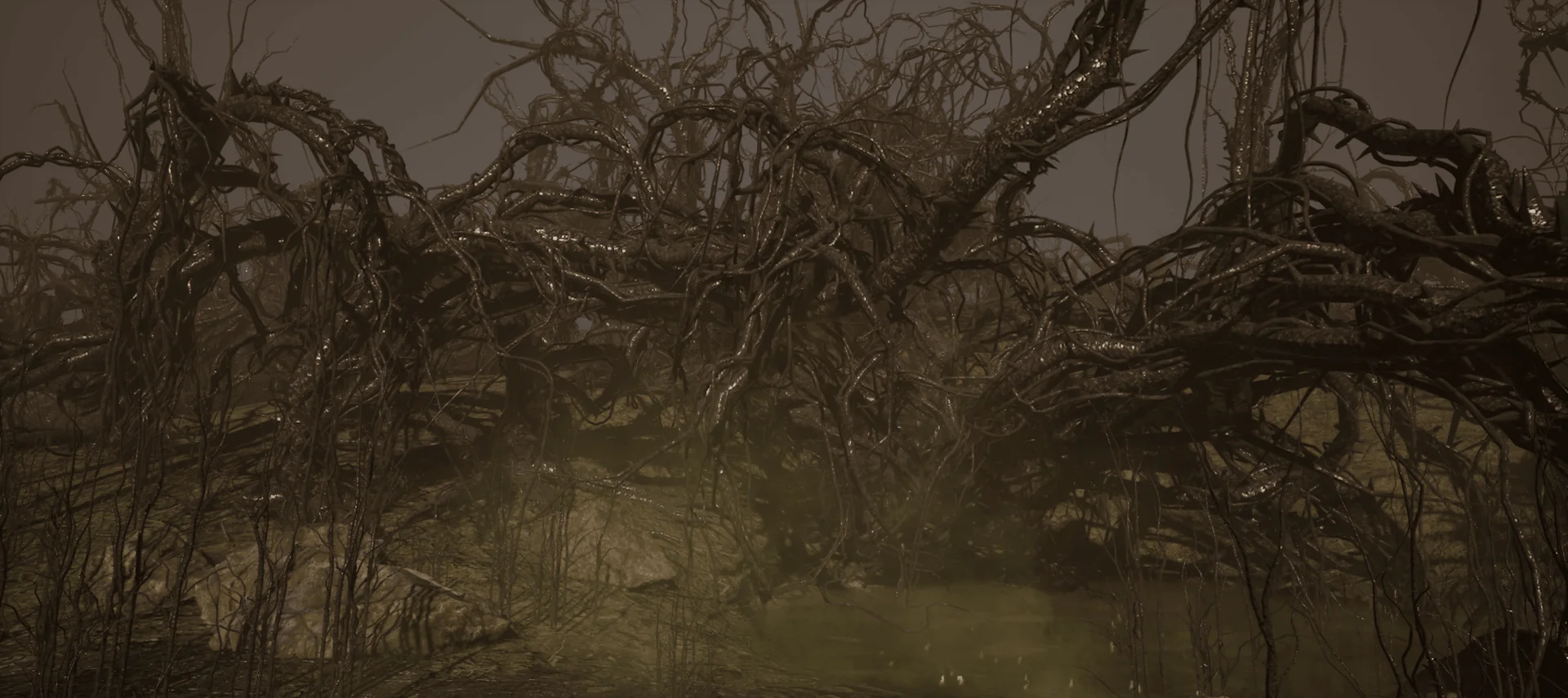
Integrating Forest Of Spikes into an active project starts inside Unreal Engine 5.6 or later builds. The package bypasses traditional discrete Level of Detail chains by running directly on the Nanite virtualized geometry framework. This rendering path handles the high-density vertex distribution across 18 unique static meshes, eliminating manual screen-percentage transitions and popping artifacts during camera movements.
The mesh collection focuses on dead, twisted, and thorned botanical silhouettes suitable for dark fantasy, survival horror, and cursed swamp biomes. The geometry incorporates thorns, exposed roots, dry limbs, and sharp architectural vegetation. Because Nanite governs geometric density at runtime, performance scaling depends on virtualized cluster management rather than generated LOD cascades. Every piece in the 18-mesh set ships with custom collision already mapped to the surfaces, preventing players from clipping through complex clusters of spikes or getting trapped inside hollowed, twisted branch roots.
Material Setup and Wind Pivot Architecture in the Spikes Environment
Surfacing across the asset kit relies on a lean base of 6 master materials extended through 26 specialized material instances. This hierarchy gives technical artists direct control over surface parameters without compiling redundant shader code across every dead trunk, vine cluster, or spike formation.
Texture distribution across the library covers 44 distinct graphic files structured into functional resolution brackets:
13 textures rendered at 4K resolution (4096×4096) for primary bark surfaces, root trunks, and foreground silhouettes.
1 texture mapped at 2K resolution (2048×2048) for secondary structural accents.
7 textures sized at 1K resolution (1024×1024) for fine detail patterns and utility masks.
23 textures authored at arbitrary sizes expressly engineered to supply hierarchical wind pivots.
The hierarchical wind pivot textures carry specialized spatial offset data directly into the material shaders. Rather than applying a single uniform wave displacement across an entire static trunk, the vertex shader reads coordinate pivots from these dedicated maps. The package then offers segmented motion where thicker core trunks retain rigid anchoring while slender branches, dangling vines, and thorned shoots oscillate based on nested wind weights. Surface materials also link into an included custom water material designed to pool beneath stagnant roots, mist-covered bogs, and murky swamp beds.
Atmospheric FX, Water, and Interactive Blueprints
Setting up scene ambiance involves several utility assets packaged alongside the static geometry. The asset set provides discrete visual effect emitters for fire and smoke. These particle systems can be dropped directly onto broken timber, defensive barricades, or camp clearances to simulate smoldering deadwood within cursed forest margins.
Dynamic lighting and camera behaviors are handled through two pre-configured blueprint actors:
Flickering Light Blueprint: Controls randomized, non-linear light decay curves to simulate failing lanterns, guttering torches, or erratic supernatural illumination against dense thorn clusters.
Camera Shaker Blueprint: Applies programmable procedural oscillation to the player viewport, useful for environmental tremors, sudden impacts, or disorienting psychological status effects common in horror gameplay loops.
These blueprints link directly with the included water shader to establish cohesive micro-encounters. Placing a flickering light actor directly above an inlet shaded with the water material produces realistic specular breakup across surface ripples, framing the jagged silhouettes of the spiked flora against dark reflections.
Lighting Configurations Across the Forest Demonstration Maps
Evaluating the assets under different lighting conditions is streamlined through four pre-built demonstration maps included in the package directory:
Overview Level: Houses all 18 unique meshes alongside their respective material instances on a flat staging plane. This map serves as an asset inspection bay, allowing level designers to audit collision bounds, material response, and pivot alignment before placing pieces into live production maps.
Demo Day: Presents an expansive wilderness layout under direct, neutral daylight. High-angle sun exposure makes it straightforward to verify ambient occlusion, normal map fidelity, and shadow contact lines across the 4K and 2K bark textures without the masking effect of darkness.
Demo Day Hi: An updated version of the daylight map configured to incorporate expanded mesh variations and dense foliage layouts introduced during an update pass. This environment tests cluster density and scene rendering when packing multiple twisted tree structures into overlapping volumes.
Demo Night: Establishes a stylized dark fantasy presentation emphasizing fog, mist, and deep shadows. In this environment, the included smoke emitters, flickering light blueprints, and water materials work in tandem to demonstrate survival horror scenarios, framing player pathways with sinister, thorned barriers and heavy gothic atmosphere.
Platform Target Considerations and Collision Data
Deployment across target platforms requires zero restructuring of the underlying static assets. The meshes and material graphs run natively on both Windows and macOS systems supporting Unreal Engine 5.6 forward rendering pipelines.
Custom collision primitives embedded within the 18 unique meshes safeguard navigation fidelity across uneven swamp terrain. Irregular tree roots and thorned spikes present complex geometric profiles that frequently break default capsule sweep collision if left to automatic convex hulls. The integrated custom collision matches player traversal bounds to the visible trunks and spike walls, ensuring project teams avoid collision pass-through bugs when constructing barricades, narrow maze routes, or defensive survival encampments.
 Fantasy
 Fantasy
 Fantasy